My first gun was a Webley Mk III .38S&W (or .380/200 in British parlance) made in 1897. I bought it because it was a piece of history, more than as a self-defense piece, although I did carry it for several years. This particular weapon has an relatively rare grip, and the Webley folks confirmed it was originally a Singaporean constabulatory weapon. More on this later…
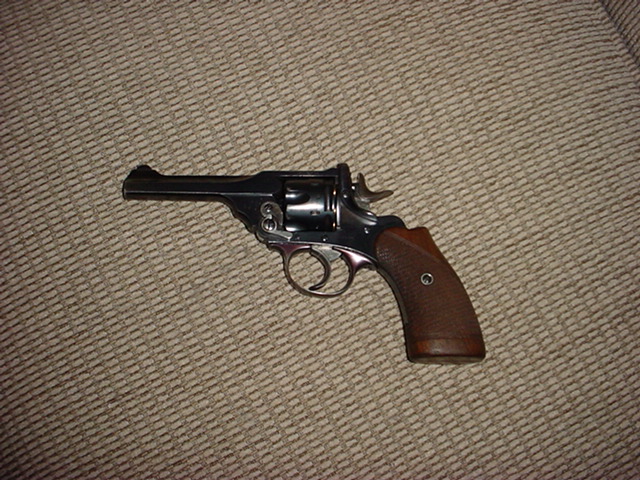
Shortly afterward, I bought a Mk VI in .455 Webley. This is the weapon that was the British military issue gun from 1889 until about 1963, when the Browning High-Power officially replaced it. Heavy and large, this is not a concealed carry weapon. It is, however, a superb field gun: very robust, reliable, accurate, and a fairly good manstopper.

This weapon was made in 1918 and has the “wartime” finish. Apparently, Webley couldn’t take the time to make the bluing mate well on the guns, and they suffer from wear on the barrels. Despite this, the pitting is minimal and there is no rust on the pistol. The design is pure Victorian — heavy (almost 3.5 lbs loaded), with handsome lines along the octagonal barrel, and a lovely curved underbarrel, where the hinge for the weapon is. The weapons have a heavy breech lock above the backface of the receiver that locks the weapon closed for operation. It is stout! and opening it can take a bit of thumb strength. It can easily handle the pressures of .45ACP +P.
Webley double pressure proofed they guns and they can take a hell of a pounding. I regularly hot-loaded the .455 cartridge and one of my Mark VIs is converted to .45ACP. It coughs out +P rounds like they were nothing. These are some of the most robust, well-made handguns in history. In my opinion, the Webley is one of the best overall designs for a revolver, period.
Function of the Webley is no-nonsense and very reliable. I have, in several thousand rounds in three different Webleys, never had a malfunction or any kind of damage to the gun through use. The double action trigger pull is long and stiff, running 10-12 pounds, with the double action a crisp 5ish pounds (and my Mark III has a dangerously light 2 lb. trigger.) Cocking the hammer with the off hand I have been able to achieve a rate of fire comparable to that of a 1911 .45, with a high order of accuracy.
Speaking of accuracy, the Webley is on par with any full-size 1911 frame handgun, and I have reliably hit targets at 50 yards. An officer was expected to fire with his troops during volley fire during the 1880s, and the Webley was capable of hits out to 100 yards. At usual handgun engagement ranges of 25 yards or less, the Webley will print 3″ groups in single action with little effort. At 10 yards, double action will at least score you hits in the center mass area. Rapid fire, thumbing the hammer to single action, I have managed to do 6 round groups of 2″ at 10 yards on a regular basis.
Stopping power is one of the few places were “experts” will question the .455 cartridge. It is a short-box cartridge that speeds a 265 grain soft conical bullet (this is the Fiocchi load — pretty much all you’ll find commercially, although Hornady is doing a Webley round, now, as well) to 650-660fps. The muzzle energy is lower than a .45ACP by a bit and is on par with a 9mm round; recoil is mild, aiding in follow-up shots. Despite the lower energies, this is a big, heavy bullet and was plenty effective in combat. For a while, the British military was obsessed with “knockdown”, and the .455 was considered highly reliable in stopping a target. It did well in the 1904 trials for the US military, leading up to the adoption of the .45 ACP. I would have no trouble counting on it for self-defense…other than the $40/box cost. If you are a handloader, however, the Webley is a nice challenge. You can get .455 dies, and it will accept most .451 caliber slugs. I have also fired .450 Corto and Short Colt through the weapon without incident. .476 Enfield should also work, but I’ve not tested that.
As mentioned, I also have a Mark VI that has been modified for .45ACP. The cylinder is shaved down to allow moon clips, and once again, has never provided any trouble in its operation. It has fired everything from soft lead to hollow points to +P ammunition with nary a hiccup. These “cut” cylinders also allow the use of .45 Auto Rim, a bit more expensive, but some of the loads range up to 255 gr. with an 800fps velocity. Not whimpy.
A quick note on the .380/200 Webley Mark III from the beginning of the piece. This weapon is also a sturdy and reliable sidearm, and small enough for concealed carry. The .38 S&W round is anemic by most standards, but is on par with .380 for stopping power. Recoil is non-existent out of the 4″ barrel Webley, and a friend used to reload the used cartridges to 9mm Luger specs without incident (I split a few cases, though…) Accuracy was steady to 25 yards.
The Webley is not exactly a common gun, but out west in the US, you will find them with some regularity. The .455s are usually cheap in the local gun store — $300 is the highest I’ve seen, while the .45 conversions will run you up to $500, depending on condition. Most of the .380/200s I’ve seen have been Enfield Mark IIs (same gun, essentially) and they usually run the gambit from $250-400 depending on the condition of the gun. (You’ll pay higher on Gunbroker for all of these.)
For the cost, they are worth every penny.
 The Black Campbell
12 December, 2010 at 17:27
Where have you seen a webley .455 for $300? I am in Utah and have been seeing them for almost $1000!
12 December, 2010 at 17:35
That was about the cost the last time I bought one, say 5 years ago. I’m sure they’ve gone up by now.
13 March, 2011 at 19:49
While the mk VI is undoubtedly a sturdy revolver, firing 45 ACP in it is asking for trouble: a lot of mk VI have been blown up this way.
The 455 works at about 13000 psi, while the 45 ACP goes over 18000.
Basically, each round of 45 ACP you put through your mk VI is like a proof charge.
Firing +P ammo is putting your gun and your luck to a shockingly severe test.
Not all guns were equal, due to production methods. Some had broader cylinder throats and barrel bores, which may help somewhat with the overpressures, but others had narrower bores. Heat treatment varied as well, especially if one considers how long the gun has been in production.
So, I’ll repeat it: while the webley is a very sturdy revolver which, fed the proper loads, may last generations, perhaps centuries, one should NOT fire 45 ACP ammo in it, least of all +P ammo.
It is safe to fire webleys converted to accept 45 ACP ammo as long as.one reloads it to 455 webley pressure specs.
With a brief search on google you may find many vintage british firearms forums with a lot of warnings on this subject.
You have been lucky. Don’t push it. And, please, don’t induce others to repeat what you did: they may be less lucky than you.
14 June, 2011 at 13:39
For my converted Webley, I hand load my .45 ACP’s down to pressures slightly lower than that of the original Mark II .455 Webley rounds- about 6500CUP. This is a safe diet for the centenarian revolver, and will still cycle a 1911 with a standard weight recoil spring- although it won’t throw the cases very far!
It is important to inspect any converted Webley VERY closely prior to shooting- as the conversions were mostly performed in the 1950’s and 1960’s, one generally has no idea if the weapon in question was abused with a long diet of high-pressure (i.e., factory-loaded .45 ACP) cartridges. (Look for hairline cracks or stretching on the top strap, barrel latch, and cylinder.) If the Webley passes close examination, there is no reason why it cannot be safely fired with the previously mentioned low pressure handloads – but check it closely at every cleaning.
-AvM
4 February, 2012 at 04:39
My uncle has come across a chrome Webley mark v, excellent condition, isn’t computer savvy, but asking $600 for his revolver, is that a good price for this pistol?
4 February, 2012 at 05:04
I suspect the chrome plating might detract from the value somewhat. The big thing seems to be if it’s .455 or cut to .45ACP: if the former, it’s more valuable for collectors; if the latter, it’s more valuable to shooters. You might check Gunbroker and see what the Webleys are running for.
8 March, 2012 at 13:13
I have a Webley Vl .455 and recently loaded with the correct ammo attempted to fire but the hammers firing pin did not make enough contact with the primer to fire. Are there any adjustments to the throw of the Hammer to provide more pin for contact to the primer?
8 March, 2012 at 14:07
Well, I’m not a gunsmith, but the first thing i would try is a good cleaning of the hammer well. I know my Webley gets filthy there; old oil can gum up the works and slow the hammer fall enough to set off the round. Option two is you might need a new spring for the hammer. Should be able to find parts on gunbroker.com.
23 March, 2012 at 14:50
After cleaning no change so with the cut down cylinder i manufactured a reverse Moon clip that sits on the cylinder sets primer closer to firing pin and allows the extractor to operate. fires the .455 rimmed cartridges allows the cylinder to rotate as well.
23 March, 2012 at 16:51
Nice!
31 October, 2016 at 19:33
its been cut to take .45 auto rim or .45 A.C.P. in moonclips, you can still chamber the original .455 cartridge but the headspace is a toss up whether the firing pin will reach the case hard enough to fire it, some will, some wont so check the serial number around the rear rim of the cylinder, it has a serial number around the rim, if you cannot see the bottoms of the numbers its been shaved to use the American cases.
1 November, 2016 at 23:01
Who in the world would RUIN a Webley Mark VI by milling the rear of the cylinder to accept moon clips and .45 ACP ?? Surely not a collector ! I looked for almost a year before I found an original for my military COLLECTION. If you want to shoot .45ACP run ’em through a 1911 !!
On Mon, Oct 31, 2016 at 9:36 PM, The Black Campbell wrote:
> rory gibbons commented: “its been cut to take .45 auto rim or .45 A.C.P. > in moonclips, you can still chamber the original .455 cartridge but the > headspace is a toss up whether the firing pin will reach the case hard > enough to fire it, some will, some wont so check the serial numb” >
2 November, 2016 at 06:36
Apparently, many folks didn’t feel the same way. Different strokes…
19 July, 2012 at 21:27
Where in the world can you find a Webley VI in .455 for $300, even $750. I missed one at $1400 because I was too late in getting my bid in. Would GLADLY buy one for $1400 – Who would take a $1400 gun and make a $500 gun out of it by milling down the cylinder. If you want to SHOOT .45 get a Urberti SAA, or a 1911 – Some of us are COLLECTORS !!
19 July, 2012 at 22:44
Bought it in 1994. $150 because it wasn’t a normal caliber. I find internet deals on .455 ammo all the time and with prices where they are, I’ve started shooting the Mk VI over my .45ACP autoloader.
20 July, 2012 at 10:41
Thanks for your reply. As I am primarily a collector I see the Mark VI as a one hundred year old piece of WW1 history. Therefore .455 is THE caliber I look for. The guns are very scarce. I missed one by hours on GunsAmerica for $1400 – would gladly pay over $1000 in original condition. . Other characteristice I look for on the Mark 6 : ALL three s/n must match. Not refinished and no import marks. I have a rather nice collection of military guns from the Mexican War (1846-8) through WW1 and quite a bit of WW2. I collect only original condition military. I do have my “shooters” almost all of them are modern guns – some CC guns. Nice visiting with you.
2 November, 2016 at 15:16
I would support “different strokes ” However, there are collectors who would agree with “original” – we want original military in our collections. For instance there are a lot of Nagant WW1 revolvers out there with the Czarist markings ground off. I found mine, nearly mint, with original Czarist markings. ORIGINAL, UN-SPORTERIZED. The reference to an original .445 Webley Mrk VI for $300 is “unicorns and rainbows.” I paid almost $1000 for mine – MINT – and happy to get it.
10 March, 2013 at 20:11
go north young man. Webley mk6’s in original condition are the norm here in Canada. bought one with dies, 200rnds loaded, space brass, bullets and holster for $550. I do notice that gun dealers up here are selling them around the 750 to $1000 range. much better deals to be found on the gun boards.
30 January, 2014 at 01:05
I’ve acquired a Webley Mark VI and would love to put a few rounds through it, and maybe carry it as a “ranch” gun, but it’s modified and I keep reading conflicting info. The fear mongering seems to all stem back from ONE article with pics where someone used unknown ammo unknown times and it bulged / “blew up” (to no harm of the firer.) since then I read regurgitations of that one incident and then accompanying “you’re an idiot if you use OTC ammo with this gun!” rhetoric. I’d like to hear more stories like this one of people who have been using .45 ammo successfully for years, because there are so many modified Webley’s out there I’d imagine there has to be more people doing it successfully than those experiencing catastrophic malfunctions.
I certainly don’t want to lose a hand over being hard-headed, but not all of us can reload or have easy access to reloading, and the sites that sell reloads seem to all be out of stock. I just want a few “I used this shelf ammo and it works fine” stories without some doom-and-gloomer coming along telling me it’s a suicide mission because this one time 4 years ago something bad happened.
30 January, 2014 at 07:22
I’ve had .455 and .45 conversion Webleys since the early ’90s and I’ve shot everything from old surplus .45 to modern .455 and .45acp ammo. No issues, so long as the pistol is in good condition.
This is, of course, a “shooter beware” sort of situation, as I don’t know the condition of the pistol in question, but of the half dozen weapons or so I’ve had, I’ve no issues. I’d steer clear of +P and very hot handloads, and stick to Fiocchi for .455 or plain jane .45ACP, if thats what you’ve got. If handloading, use your discretion…
26 October, 2015 at 23:11
IT IS NOT SAFE TO SHOOT .45 ACP STANDARD LOADS IN A WEBLEY CONVERTED TO CHAMBER IT!!!!!!!!!!!!!!!!!!!!!!PLEASE READ AN IMPORTANT SAFETY NOTICE FOR WEBLEY REVOLVER OWNERS CUT FOR .45 ACP/.45 AUTO-RIM…..
Here is a warning put together that I think is critical to have pinned to this page….****Warning for Webley Mark V and Mark VI Owners for guns with shaved cylinders****This caution is directed at owners of .455 Webley revolvers – or any other revolver originally chambered in .455 for that matter – that have been converted in some manner to chamber and fire .45 ACP cartridges in moon clips (or .45 Auto Rim cartridges without moon clips)
You will likely have been told (or have read) that it is fine to shoot “factory” or “GI Spec” .45 ACP (or .45 Auto Rim) cartridges in your altered .455 revolver, and you may well already have put many such rounds through your revolver without mishap.
Please be aware that in the view of many who are familiar with these revolvers IT IS NOT SAFE TO FIRE SUCH ROUNDS.
Please consider these facts –
1. The operating pressure for the Mark VI Webley revolver (the last, and strongest, of the .455 Webley service revolvers) was a maximum of 13200PSI (i.e. six ‘long tons’ of 2200 lbs).
2. The standard operating pressure generated by milspec and full factory loads of .45 ACP ball ammunition is 19,000PSI.
3. The pressure of .45 ACP milspec and standard factory loads exceeds the proof load for the Mark VI Webley revolver.
4. The dimensions of the chamber throats on Webley service revolvers are a bit variable, but generally are smaller than bore diameter for some reason – but this system worked well with the original hollowbase bullet design, which was quite soft (20/1 lead/tin) and non-jacketed. These soft bullets swage down passing through the chamber throat (…. my own view is that this was intentional, to get the most out of the relatively small powder charge, and thus maximize the velocity produced ….) but then the base expands nicely to engage the rifling in the bore. However, the general consensus is that jacketed bullets (such as those loaded in most GI-spec .45ACP ammo) can work to dramatically increase the already excessive chamber pressure generated by such rounds.
5. Furthermore, the earlier models of .455 Webley service revolver were not as strong as the Mark VI. Indeed, the Mark I, Mark II and Mark III revolvers were in fact designed for black powder loads.
Although it cannot be denied that many .455 Webley revolvers have survived being subjected for a long time to standard .45 ACP ammunition, that is equivalent to having been fed a steady diet of proof loads. Simply put, it is a testament to the sturdiness of Webley service revolvers, but can hardly be considered either safe or advisable! It is best to handload these shaved Webleys with lead bullets in the .452-455″ size range ad 230-270 grains in weight in either .45 ACP or .45 Auto-Rim cases downloaded to 620-710 fps. This is the only way to safely enjoy shooting a shaved Webley.
Here is what can happen if you do use .45 ACP GI ball in a shaved or cut Webley. Handloading is the only safe way to shoot these guns with lead bullets, softer is better and so is hollow base, in either .45 ACP or .45 Auto-Rim cases downloaded to .455 pressures, with velocity around 620-710 fps. Lead bullets in the 250-270 grain range do best for the Webley’s sight regulation, but some have had great success with cast bullets in the 200-230 grain range. Be safe and go easy on these “Empire Building” old warhorses…
27 October, 2015 at 07:51
John makes some good points here. Caution when using any older firearm is always warranted, especially once you get past the century mark, as metal can degrade over time. In the case of using ammunition that creates higher pressures than recommended — or using handloads, for that matter, proceed with care.
13 August, 2017 at 10:15
You can have cartridges had loaded to almost any level. I used .45 Auto Rim loaded to a lower level as I don’t like moon clips. If you like you can even have them loaded with black powder.
13 August, 2017 at 10:17
“hand loaded” not “had loader” typo.
22 December, 2023 at 02:09
For what is worth, I have a Webley Fosberry. It’s the nicest revolver I have ever shot and they are extremely accurate.
7 January, 2024 at 17:56
The Fosbury was an interesting experiment.