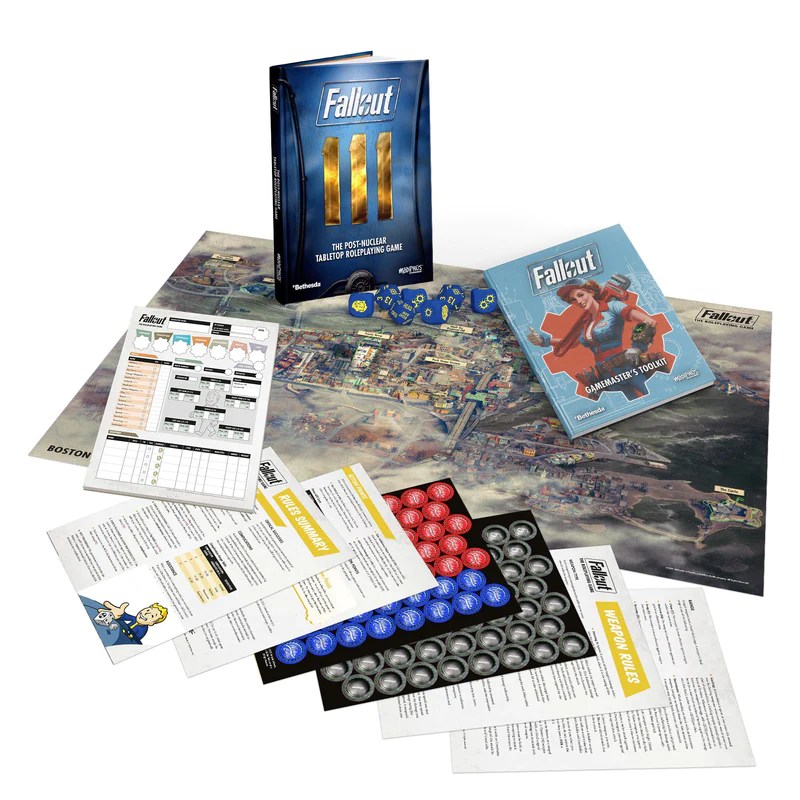
Recently, I’ve been given an exceedingly rare reprieve from running the game(s) when one of the players wanted to kick the tires on Fallout, the 2d20-driven RPG by Modiphius. He had done either the pre-order or Kickstarter on the game and got the GECK box set, with includes all of the GM bundle, some cool Nuka-Cola bottle caps to use for AP (more on that in a minute), maps, etc., etc…
I will admit to being less than enthusiastic about trying the game. I haven’t played any of the video games, although they look quite interesting. The rest of the players all have experience with them. Our group, years ago, had been on the playtesting for the 2d20 John Carter game and had been thoroughly put off by the overly complicated rules — made worse by terrible writing of the same. (Therein lies one of the great issues of RPG writing. You need creative writers to make the settings and other elements interesting, but you need the technical writer to do the actual rules descriptions. They’re seriously different skill sets.) We essentially could not figure out what the hell we were doing — and that was six people, two of them game writers. Because of that, I’ve avoided 2d20 like the plague. Back to present: We ran the basic adventure presented in the box set, and said player-now-GM put together a few more episodes, so I’m reviewing after a good month or two of playing the game.
The basic mechanics are simple: roll 2d20 and try to get under the combination of attribute (here called S.P.E.C.I.A.Ls — a call back to the video game. So shooting a gun would be Small Gun (for hand weapons)+Agility to give you the number to roll under. If you get under the skill, it’s two successes. If that skill is also “tagged”, you get an extra success. For many tests, your difficulty is measured from a zero on up. Zeros are an automatic success, but rolling to get extra successes is a good idea. If a difficulty is two, you need two successes to pull it off, and so on. In opposed tests, whoever gets the highest number of successes wins. Any extra successes generate Action Points — represented in the GECK edition by the Nuka-Cola bottlecaps. (It’s fun flicking these things back and forth with the GM.) If you role a 20, some complication occurs.
Now that wasn’t so hard, was it?
Action Points allow you extra d20s to roll on a test, allow you to reduce the time of an action, take additional actions, or add extra damage. These are communal and meant to be spent. You make them back pretty quickly, so hoarding them is actually pretty useless. The GM also gets AP equal to the number of players involved in the game and can use them for similar effects. Still pretty simple.
But…there is also an attribute called Luck, and this generates Luck Points that are used for re-rolling damage or a d20, changing your position in the turn order, or adding an aspect to the scene. You regain these by looking at some trinket of importance to you, finishing a mission/quest, or a milestone (if using milestones instead of experience points for advancement.) The use of a second game currency is — in my opinion confusing and redundant. It would have been better to keep one or the other. Since Luck is an attribute in the video games, as well; combining them into Luck might have made it just a bit less cumbersome.
Combat feels very old school. There’s a die for hit location. There’s armor for physical, energy, and radiation for each body section. (I’m assuming this parallels combat in the video games…) Radiation exposure can rob you of Hit Points until you get access to the right treatment (Radaway, rightaway!) Actions are broken into major and minor actions and you get one each unless spending AP. When you hit, you roll d6s that have blank faces (zero damage), a bullet hole (1 or 2 damage depending on the number of holes, and the smiling Vault Boy character, which gives you damage and activates any special feature of the weapon used. It felt a bit mechanical to me, but also the guy running hasn’t GM’d in a long time, so that might be an artifact of him learning the rules and sticking to them.
A lot of the book is dedicated to the environment and how to move around, scavenge, map, and otherwise survive in the Wasteland near Boston, as well as setting up shelter or a town. Again, I’m assuming this parallels a lot of the elements of the latter Fallout games — and the other players have confirmed this. There’s a lot of resource management here. You take effects from hunger, thirst, and other conditions, so finding safe food is important.
The book is packed with material from Fallout 4‘a Boston setting, and the artwork is gorgeous. The print books included are well done — handsome, good paper, and well bound (the core book), or stapled in magazine form. The dice are well crafted, as are the bottle caps (at least in this edition) and the PDFs that came with the bundle have all the materials in file sizes that won’t blow up your printer.
Having played for a few weeks, I now have a good handle on the 2d20 rules. They’re not bad. Not my favorite, to be sure, but fully serviceable. In fact, I even went ahead and bought the core bundle for Star Trek Adventures based off of the experience — but that’s another review for another day.
So is it worth it? If you are a fan of the Fallout series and a gamer — yes. If you have someone to run it that knows the universe and the tone the game is looking for — yes. Otherwise, I’d pass on this one. Modiphius tends to be a bit on the spendy side for RPGs.
 The Black Campbell
29 June, 2023 at 07:00
[…] I covered this in the posting on Fallout, the RPG, it bears repeating that my initial experience with the 2d20 system was pretty bad. Our […]
3 August, 2023 at 00:01
[…] forward to this year. One of the other players has been running Fallout for us (review here) and the 2d20 system that had been so damned awful in playtesting years ago, was much better laid […]