While I covered this in the posting on Fallout, the RPG, it bears repeating that my initial experience with the 2d20 system was pretty bad. Our group at the time had been on the playtesting for John Carter, but the initial rules information sent to us was pretty badly written to the point that we really had no bloody clue what was going on. After playing Fallout, however, and having read the (much better written) rules, i felt comfortable with taking 2d20 off of my “no way in hell” list.
I had run a Star Trek campaign back in the summer/fall of 2019 following the excellent second season of Discovery. I had initially been on the fence with the series — I liked some of what they did, and eventually came around to the gothy version of the Klingons they had introduced — or at least the aesthetic of the ships — but it was when they brought in Anson Mount’s terrific Captain Pike that they had me. I grabbed up the old Decipher Trek books and got the group into a game set during that season.
I did use the Disco version of the Klingons mixed with the movie period, kept their ships, and off we went with ten adventures set aboard USS Fearless, a Walker-class ship once commanded by Captain Garth (before the going nuts.) The Decipher rules are relatively simple, although they are obviously an attempt to mesh the superior rules set of Last Unicorn’s Trek with the dictats from Decipher. Starship combat is pretty clunky and wargame-y. That’s good for some but it can be a hard transition from roleplaying to board gaming.
So now, after dropping a bit of dosh on the Modiphius storefront, I have the Corebook bundle (w/pretty much all of the PDFs), the GM screen, the Disco sourcebook, and the Utopia Planitia Guide…plus the geeky dice. Needs the geeky dice, we do.
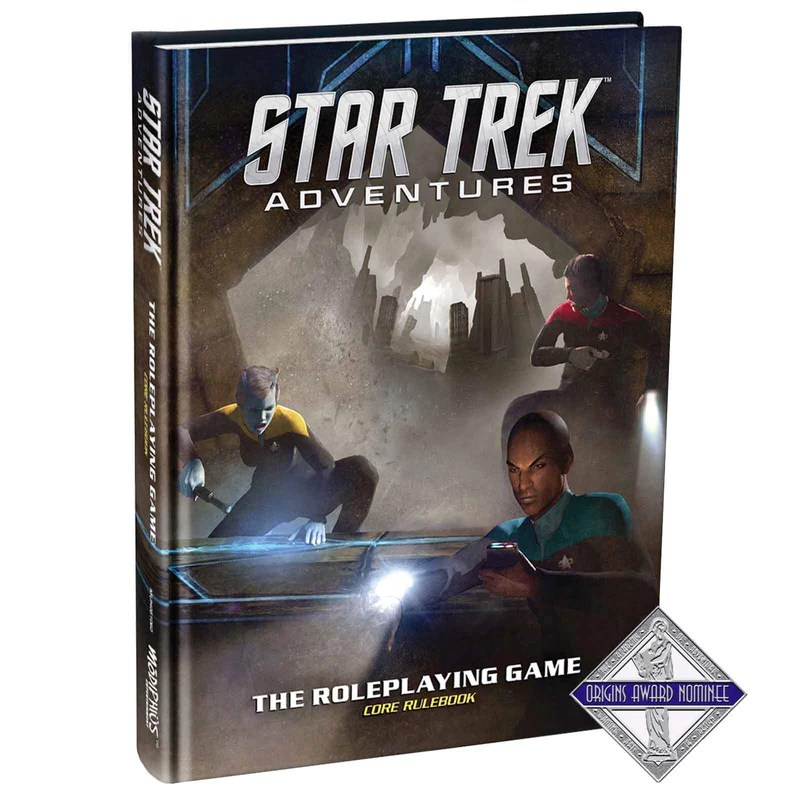
The basics: roll 2d20 and get under the combo of your attribute+discipline (skill); if you get under the skill, you get an extra success. The attributes are Control, Daring, Fitness, Insight, Presence, and Reason. There’s a bit of overlap between dexterity and willpower in control, but the rest are pretty straightforward. The disciplines are where the feel of the shows is well recreated: Command, Conn (basically anything tech operation related), Engineering, Security, Science, and Medicine. You have six focuses — specialities acquired in character creation, four values — short blurbs that aid with roleplaying and get some game currency (more in a minute). There’s also traits, but those are usually lumped up in your species.
Like other 2d20 games, there is a game currency for tweaking things — momentum — which you can spend to get extra d20s to roll on a test, allow you to reduce the time of an action, take additional actions, or add extra damage. These are communal and meant to be spent. Where the writers messed up, in my opinion, was naming momentum “threat” when the GM gets…momentum. It’s an unnecessary difference that can be confusing to the new gamer. Or even those that know what they’re looking at. Much like Luck in Fallout, Star Trek Adventures isn’t done with the in-game currency; there’s also “determination”, which you get from playing your character correctly. You can gain them by allowing the GM to use a value against you, and spending them allows you to reroll dice or gain another d20, or take an advantage on something. All this could have been done with momentum. A second game currency seems a bit fiddly.
Starship combat is better pot together than previous Star Trek games. There’s an attempt to keep the roleplaying going during ship-to-ship engagements, with each officer’s actions playing off of each other. Here, the engineer and operations officers are very important because to pull off maneuvers requires power — as in the shows — and these characters’ main job is to replenish and manage power when they aren’t fixing stuff that’s been shot up. It’s the first Trek game that’s really given ops guys and engineers something more to do than jury rig things in the fight.
Another inspired bit is the “supporter characters” option. Is your character not present in a scene? Maybe one of his subordinates was. There’s a thumbnail character you create and control if they’re part of your team, department, whatever.
The material for STA is pretty expansive, already, and they have overcome the dreaded “Klingon supplement” problem. (Ever damned Trek RPG seemed to fold as soon as a Klingon guide was announced or published.) There’s quadrant guides, there’s series guides for Discovery and Lower Decks, there’s guides to the departments, adventure modules, and of course…the Klingon core book and campaign. I figure we’re going to get a Picard guide pretty soon. There’s miniatures, there’s department-colored d20s with d6s for damage with the Starfleet arrowhead as a 6.
So is it worth it? Modiphius tends to be a bit pricey compared to some of the game companies, but at $50ish depending on where you look, the main book is reasonably priced, and the GM screen and kit is actually really good — almost essential. I think the Utopia Planitia guide is also a good buy for the wealth of ships it provides at $30ish. If you’re a Trek fan and gamer, and you want to take a spin in the best known sci-fi franchise, it’s worth it. I’d see if you could get the corebook and PDF bundle I got, which was most of the damned products for about $110. If you’re piece-mealing it, it’s going to get more expensive.
 The Black Campbell
3 August, 2023 at 00:01
[…] year and the end of 2020, so the RPG bought this year was Mödiphiüs’ Star Trek Adventures, reviewed here. I had run a Star Trek game a few years ago, but I used the old Decipher system that had powered […]