The game group finally came to grips with the 2d20 system when one of the players relieved me as GM to run Fallout back at the start of the summer. The system was manageable and with some knowledge of how it worked, I looked over the Star Trek Adventures core book I had a PDF of and decided “what the hell” and picked up the hardcover core book, the Utopia Planitia guide, and the Discovery guide, as well as a GM screen and the dice sets.
Quick backstory: back in the midsts of time, our group was one of the playtest groups for John Carter of Mars when Modiphius was rolling it out. We had found the rules almost indecipherable — not so much that the core mechanic is difficult (but it is a bit overly complicated), but that the writing was disorganized and, well, bad. We wound up dropping out of the playtest because we couldn’t get through an evening without throwing our hands up and making it up as we went. I didn’t touch 2d20 again, and avoided the games tied to it like the plague. Fallout seemed a bit better written and not running it meant I could learn the system without the annoyance of running the game, as well.
Back to Trek: I had run a “season” of Star Trek using the old Decipher rules, set in the second season of Discovery thanks to the excellent addition of Anson Mount’s Captain Pike. The writing was tighter and better than the uneven first season, and since the drop of Strange New Worlds, I’m a Trek fan for the first time since Enterprise screwed the pooch back in the early aughties. We had a good time with a system that was still mostly familiar, although it has some stumbling blocks.
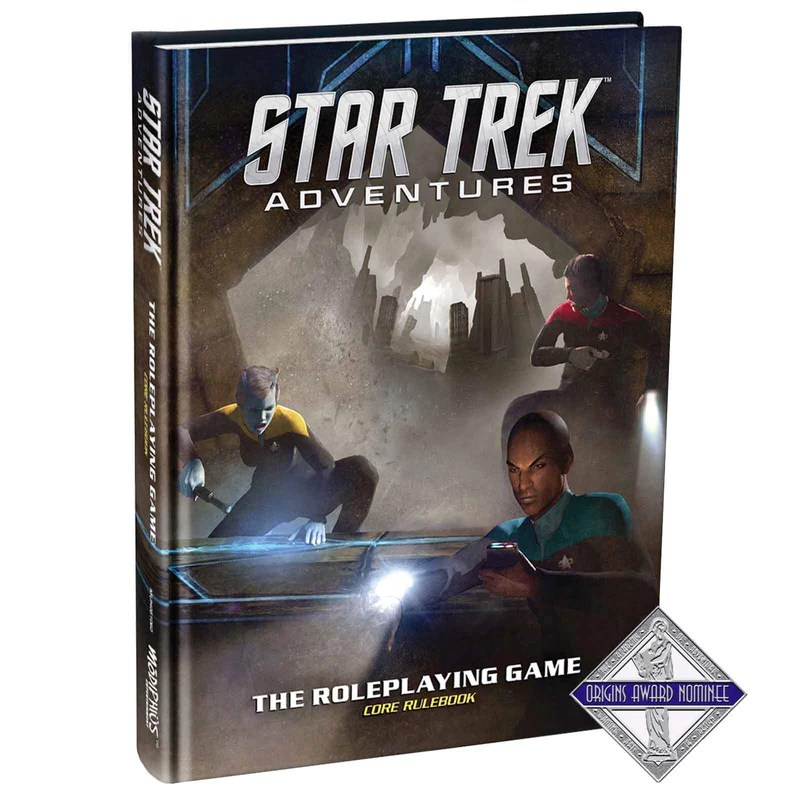
For “season 2”, I swapped us to 2d20. The characters ported over very easily and were pretty close to what they were in Decipher. The combat monster Andorian was a bit more combat monstery, and the hot shot pilot was even better, but most of the characters were spot on. We built them up out of the book, then I double checked what I was doing with an excellent STA website. Our ship — USS Fearless, one of the last of the Walker-class, came together nicely, as well. The characters are defined by six attributes and six skills called departments (science, command, etc.) and it works nicely — though there can be some confusion as to which attributes handles what, and with a good argument, I let players use alternate departments. There are focuses which give extra successes, and values that can generate advancement milestones and determination points — one of the game currencies, in addition to momentum (called threat when the GM gets momentum, because two names for the same thing isn’t going to confuse some folks…)
I banged up a few “short treks” to ease the players back into their characters and system (a shore leave, then a save another ship from a strange anomaly adventure) before diving into our first action episode. I quickly started ignoring the Determination points rules; like Fallout there’s two different meta-game currencies…one too many. Another problem was that the determination rules’ index location was not where the actual rules for their use was.
The characters escorted a convoy of humanitarian aid ships to Coridan — a major producer of dilithium that was hit hard by the Klingon War, only to find out the Orion Syndicate had been “aiding” the world…by repairing then running their dilithium mines for the Coridanites. There was a street fight after making contact with a Starfleet Intelligence agent (and Orion female — their abilities are sharply curtailed in STA). The fight went great until — where are the stun rules for the phasers? A quick flip through the book to phasers…then to combat… turned into a long flip through the book. While another player tried to find the rules, I hit up the interwebz…nothing. Some players have loads of stress points, but the average seems to be in the range of 16. You’re not getting that kind of stress in a phaser rifle hit, so you can’t emulate the show where most humanoids go for nappy-time when you stun them. In the end, I house ruled that the character or NPC hit had to do a Fitness+Command or Security vs. the number of stress they took, or be stunned and unable to do anything for a number of rounds equal to the stress hit (or however long the plot needed them out for.)
The rules for extended tests work pretty well — we have a hacking scene where the characters had a gated activity: get onto the roof of a building (they beamed in overhead and paraglided in), patch physically into the building antenna and make it look like the hack was local and not from the starship, get past the security, and download the material. I set the Work rating as 10 successes and a Magnitude 1 (they would need to successes to succeed). Worked well, no issues. There was another fight using our stun rules, though it went lethal quickly.
After their missions to the surface, the Orions overreacted to the Federation agents getting data that showed the Orions were trading Coridan’s dilithium for Klingon surplus ships (I was using the Eaglemoss ships from Discovery for their cool gothic aesthetic…I have to admit, I hated the Disco Klingons, at first, but warmed to them when you could actually see what the ships looked like) and this led to a four on one fight between Fearless and a Bird of Prey, and three Orion Interceptors. This was our chance to try out the starship combat for STA, and I figured this was going to be as muddled as finding a straight answer to how quickly to healed stress and injuries. (Again…half the stuff you need was not where the index said it was.)
To our pleasant surprise, starship combat really worked well. We had a station card from the GM screen for everyone — pilot, ops and engineering, tactical, and the players used the inspired “minor character” rules where they could quick generate a bit player they could play to assist them in their actions. (It’s also excellent for when a character isn’t present — now you’re playing Ensign Snuffy in the redshirt… now find out how the monster works!) Initiative usually starts with the PCs and each station gets an action that can aid the others or can do their particular schtick. The bad guys get an action between the PCs, and the players can choose who goes when on the PC turns. We found this worked very well and allowed the players to strategize their actions and feel like they were actually more than just there to roll for a hit on another ship. Ops and Engineering don’t just fix damage here; there’s a lot of planning — fix some damage or manage the power track? Like the shows, the ships blow power on their maneuvers and firing, etc., and that has to be replaced by the operations manager or engineer, or you’ll find yourself unable to do much. By doing this, they were able to evade fire, set up advantages for a firing solution, manage the shield damage, and badly wreck the Orions while taking minimal damage themselves. Of all the sections of the game mechanics, this was probably where Star Trek Adventures shines the most.
The rules aren’t bad. For most basic tests, it works just fine. Combat is a hot mess once you aren’t punching or using melee weapons. Like many RPGs that tried to tackle the ST universe, they often run afoul of the damages the weapons do: phasers just vaporized people in the show. That could make for a short run for a character in combat. You would also think, for a show where the phrase “phasers on stun” is uttered a lot, having stun rules would be a good idea. Starship combat? Excellent.
Advancement is based on “milestones” — did you use or buck your values? Did you stick to the regulations, screw up, lose people under your command, etc.? These stack up and give you the ability to swap ratings on things, or with the arc milestones increase scores, add foci or values. One excellent bit — you can spend your milestones on minor characters that regularly aid you or the ship. The milestones also gives you dice to roll against your Reputation — another aspect of the game that the index doesn’t send you to “how to bloody use it” but rather a bland — you have reputation blurb. It can be spent for medals and commendation, or promotions. It looks like it was also supposed to be able to be used for social tests, but that’s not in the core book — it’s in the Klingon sourcebook. Helpful. There’s almost no real direction given on reputation and I’ve been house ruling on it.
But now for the real problem with Star Trek Adventures…it’s badly written. The rules should be easy to parse out, but there’s so much side chatter about momentum and determination that you can miss the main rule mechanic — roll two or more d20, get below the combo of attribute and department. If you get below the department — that’s an extra success (or two if it’s a focus.) Momentum can be used to buy extra dice, or a number of other things; determination does much less. you could easily combine the two into one currency. The problem with STA and other 2d20 products is that the rules are haphazardly scattered about the book — sometimes in places that defy reason. Worse, the index page is utterly f$%king useless. Half the things you would look for aren’t there, are under a different name, or send you to a page that the thing is mentioned but the use of which is not provided at that spot. Like determination. Or reputation. It feels like the book was churned out fast, an editor was employed sporadically, and they chucked it out the door. It’s been a few years since STA debuted…by now they should have fixed some of this with a second edition. (And the Klingon campaign book does, to an extent.)
So…is it worth it? This one’s a bit tough. The system is perfectly serviceable for most situations. It’s (I think) supposed to be on the rule light side, but isn’t. Personal combat needs serious reworking and starship combat is excellent. Advancement — both the milestones and reputation mechanics are half-baked. Character creation is quick and easy, and creature creation similarly easy. NPCs can be presented as novices or experienced, etc. with stock ratings like Attribute 9 and department 2. The ability to create a background character on the fly and let a player run it so they are in the scene is inspired. There’s a lot of good, but just as much that’s just…not finished for a major licensed product that’s been out for a while. Lastly, it’s a hot, damned mess from a writing, editing, and indexing standpoint, and that’s just not acceptable for a $60 book. So — if you want to run a Star Trek game and don’t want to do the heaviy lifting to write up material for a system you like, yeah, it’s sometimes a pain in the ass but worth it. If you are looking for the system that really captures the flavor of the series-eses, it’s not quite there. If you want a seamless play experience — nope. We’re at least six weeks of play into the season and I’m still looking rules up while trying to run the game.
But, as always, your mileage may vary.
 The Black Campbell
10 September, 2023 at 19:50
When I run it, I allow multiple injuries to be applied in one attack for phasers and disrupters. This allows shots to stun or kill in one shot for most PC shooters and taxes their resources when taking fire. It seems to match the show in play with that adjustment.