Back to the ol’ American Heritage Dictionary for tact /tăkt/, a noun describing the 1. Acute sensitivity to what is proper and appropriate in dealing with others, including the ability to speak or act without offending; 2. The sense of touch; feeling (as in tactile); 3. The stroke in beating time. (I did not know this one… BC)
Or a better definition by the great Winston Churchill: “Tact is the ability to tell someone to go to hell in such a way that they look forward to the trip.”
There are a few ways that tact turns up in roleplaying games — usually as some form of skill like etiquette, control, diplomacy (or even poise, our day 3 prompt.) and while it can have ties to charisma, this is really about the ability to choose your words to get an outcome in a social encounter that create the least friction with the person you are attempting to convince regarding something. It’s a very useful skill in an RPG, particularly ones where social conflict is a major theme, rather than just hack & slash.
A good example of the utility of tact is in the game Dune: Adventures in the Imperium by Mödiphiüs. The world of Frank Herbert’s Dune really finds its strength in the period before the events of the novel. While the focus is on Arakkis and the machinations between the Emperor, the Harkonnen, and the Atreides (with some side players here and there), the book sets up a fascinating 16-17th Century looking social structure dominated by competing royal houses. The effect is a late medieval/renaissance period political structure with the imperial house bolted on top. Trade groups like the Spacing Guild and the imperium-wide trade consortium CHOAM make sure that all houses have some kind of skin in the game regarding the economic health of the Imperium. Absolutists monarchies with fancy titles (weirdly divorced of their hierarchical status) rule the various worlds and court etiquette and a dueling culture brought about by shielding technology that limits the use of their directed energy weapons, gives the world the same war of words, wit, and steel that one might expect playing in a game revolving around the Three Musketeers.
Etiquette, here, is just as important as diplomacy — and both overlap, and in many cases, it’s tact — the ability to ingratiate yourself into a group or with a person central to your goal that greases the wheels for diplomacy. Any game set in the Renaissance into Victorian period is prime territory for the courtier — the person that brings the fun to the party, but knows how to mind their place while mining their betters for position and wealth. Do you know how to dance, how to dress well, how to eat at the table properly, how to address people with titles? “Hey, Duke…” doesn’t cut it, but “Good evening, Your Grace” will get your farther.
Tact isn’t just a way of speaking; it is understanding the rules of the group you are in. 1920s New York? You might want to know the ins-and-outs of the speakeasy, how to properly approach a member of the “machine” running city hall, how to talk to your Italian or Irish mob boss in a way that they take counsel and not offense. There are rules — whether you’re a schmuck looking to get into illicit services in the 1980s, the hanger-on to a 1990s rap star, or a foreigner at an Meiji-period Japanese court. Tact is the skill that makes that happen.
To create a good example of this sort of character, I present John McCray — built for Outgunned Adventure.
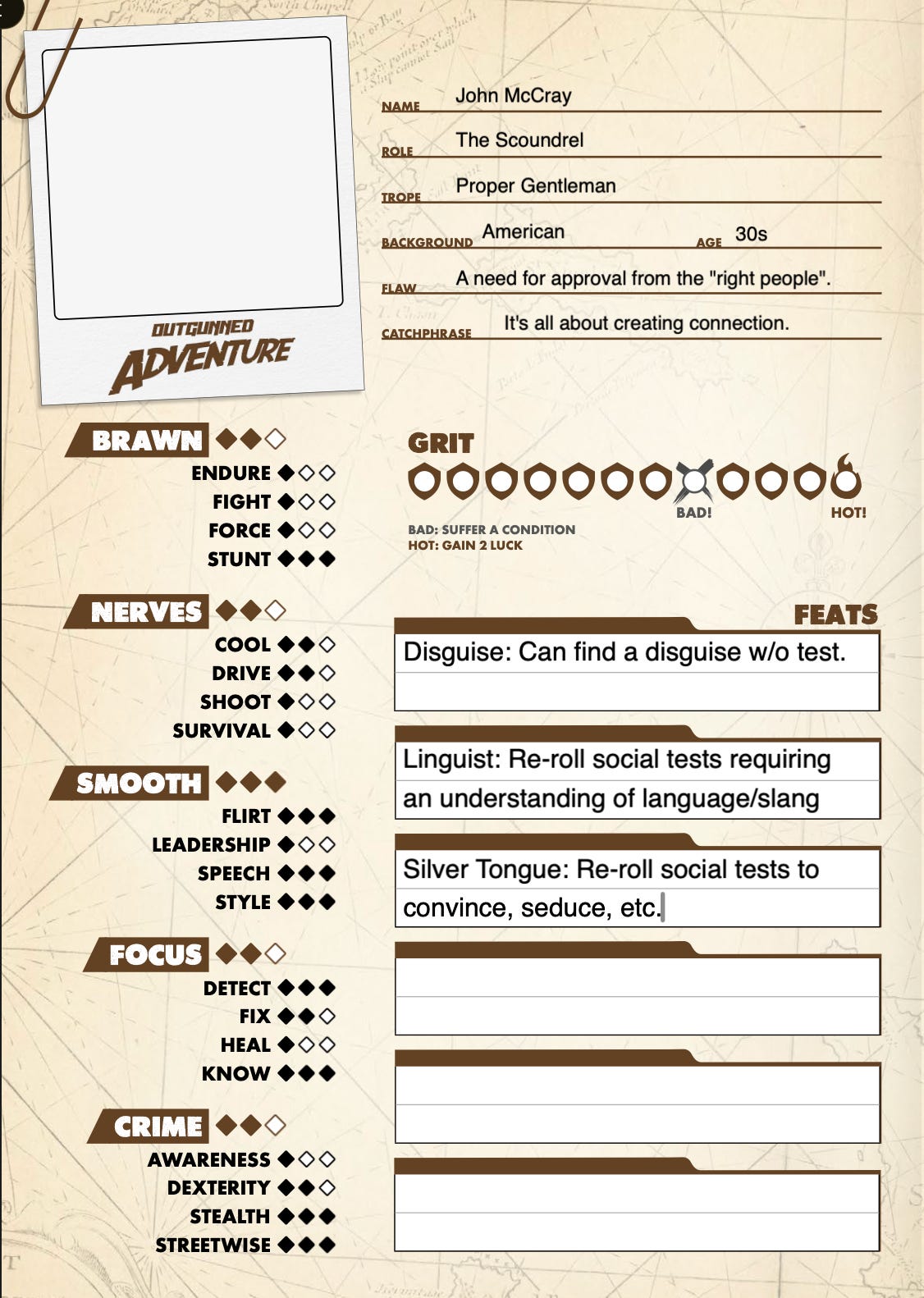
McCray is from California and started off as a petty con man, before realizing that being a “proper gentleman” could get you much further than a two-bit huckster — you’ve got to be able to get where the money is, to get the money. And in the Roaring ‘20s, he’s the perfect gentleman scoundrel. He dresses well, can pick up accents with a few days exposure, and is particularly good at reading the unwritten rules in a particular group. He reads heavily, eavesdrops quietly, and learnsbefore putting himself into the circle where his mark is. He’s not always looking for a quick score, often he wan’t to create a rapport that can be exploited to both his and the mark’s unwitting advantage.
The skill set above speaks for itself — his style, mode of speech, and bearing get him by in any environment from the slummiest street to the sparkling-est court. Under the feats, I see “Disguise” as less the dress-up kind, and more the immediate character creation we saw from Axel Foley in Beverley Hills Cop — dropping into a character that is either wholly appropriate (or the opposite, in the case of “Ramon — the man he met at the club…”) He inhabits a role quickly and completely.
Whether its to get financial gain, or a fancy seat on a hunting expedition in Africa, or a good table at that swanky Chicago speakeasy, or a meet with the Shanghai gang leader — it’s all the same to McCray.


Leave a Reply