Firearms


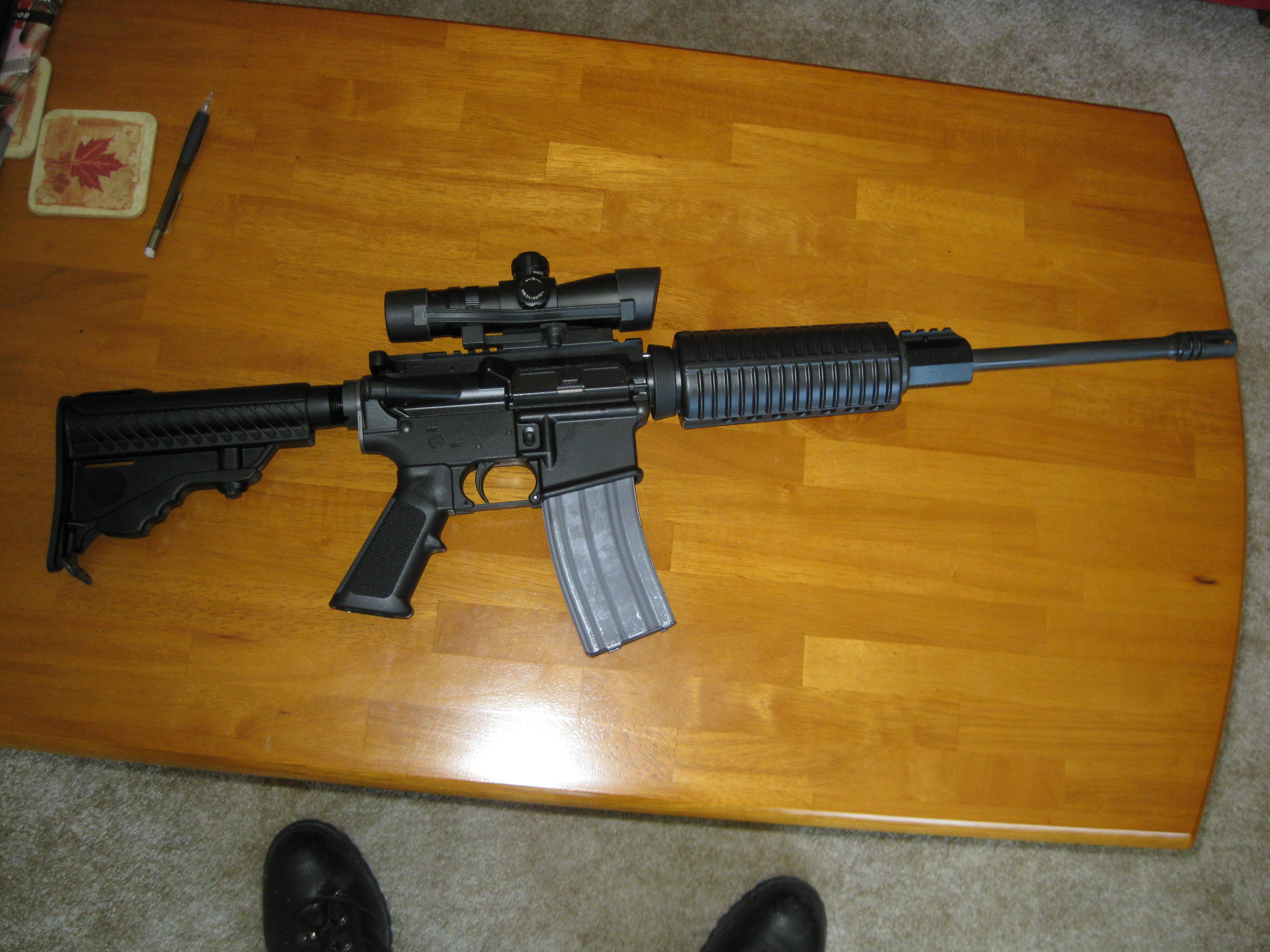
DPMS A-15 (M4A3-style) 5.56mm, 16″ barrel w/ 1-9 twist. Added a 1.5-4x scope with standard and illuminated reticle (red or green…)

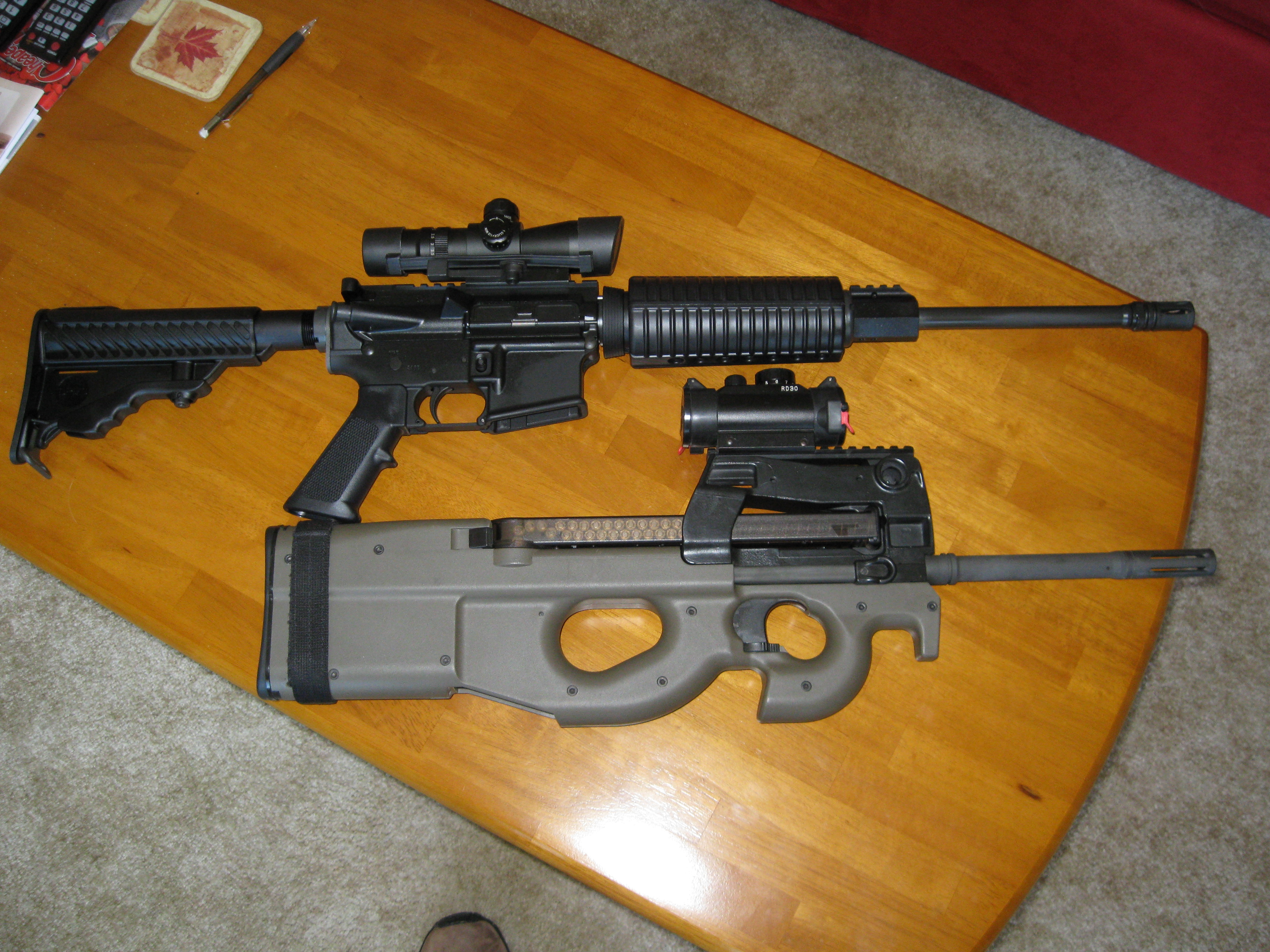
Here’s a size comparison of the PS90 and the A-15:

While the A-15’s got range and muzzle energy on the PS90, the FN’s much better for urban terrain and house-to-house operations for the compact size (the P90’s even better with a 10″ barrel.)

UPDATE: I got a chance to take the DPMS out for a run Saturday, scoping her in for 250 yrds. It only took 9 rounds to get her zeroed, although the old scope seems to have given up the elevation adjustment ghost. Out to 25 yards, I have to give it about a 3″ bump up, but it’s bang on at 100-200 yards. A new scope may be in the offing.

No issues in 100 rounds of shooting, the recoil is the usual M4 quantity — perfectly manageable. (I had a M4 gas piston gun that, while manageable, did hit harder…) And, as expected, only a few magazines and the thing is pretty dirty. Function and accuracy were top-notch. Worth the $25 I paid, would be worth the MSRP of $800-850 I’ve seen.

There’s another review of the FN FiveSeven on the site here, that covers the version of the pistol with the standard adjustable sights.  I had one of those guns for about six years and carried it daily.  I sold it to help cover expenses for my trip to Scotland last summer, having shot over 20,000 rounds through it with only a few malfunctions from a bad ammo lot early in it’s ownership, and two due to a failing magazine catch (I wore it out from use!)  The new owner, a friend of mine, is still shooting it regularly and without issue.

I was looking for the version with the C-More fixed sites — I prefer fixed over adjustable for a reason I can’t really qualify, but suspect it’s because the rear site groove tends to be more spacious in fixed sites, allowing for faster target acquisition.  For whatever reason, I shoot better with fixed, low-profile sites.  (I prefer the old, no-dot, barely-there ones on the 1911A1…so there!)

Delivery of my FiveSeven was yesterday, and I took her out to the range 250 rounds to break her in.  The new pistol has the fixed sites and they are much better for a pisto you intend to conceal — they are low-profile — especially the front site, which you could dig trenches with on the older model.  Mine is also, apparently, a limited-edition Davidsons-distributor only version with the controls — usually a dove gray against the matte black pistol — in black.

The all-black look looses the toy-like quality I’ve heard some people describe for the FiveSeven.  It’s still very light, has 20 rounds in the magazine (unless you live someplace crappy like California or New Jersey), has almost no recoil and is very accurate.

As you can see, the front sight is less blade-like, and low enough to lessen chances of catching on clothing while drawing.  Blackhawk makes the excellent Serpa holster for the FiveSeven; I usually got with the paddle Serpa so that I can get the holster on and off fast, without having to take off my belt.  The push-button retention allows for very fast release of the gun.

This is the site pattern of the new pistol:

The rear channel is wide ad allows fast taret acquisition.  I found the FiveSeven shoots about an inch low out to 7 yards, and about 3 inches low at 10-15 yards with the SS197 blue-tipped hunting rounds.  The SS195s should hit on target out to 7 yards, and drop an inch or so in the 10-15 yard range.

To be fair, I’ve shot an FN a lot over the last half decade, so my muscle memory for the handgun is pretty tight, but I found that I could more quickly bring the sites online with my target than I could with the old version of the FiveSeven.  My first round of the day, at 7 yards, snap-shooting was dead center of the bullseye over the heart of my silhouette target I was firing on.  A magazine of 20, fired without a rest and with deliberation gave me a 1.5″ group at 10 yards, with two flyers.  No malfunctions for the entire outing, and none were expected.  The reliability of the FiveSeven is equal to anything I’ve shot.

The gun run about $1200 in a store in the Southwest, and the prices vary by $200 depending on where you are.  I picked up the new in box FN for $930 on Gunbroker.  It’s worth every penny, and is an excellent self-defense gun — light (so you’ll take with you!), accurate and powerful enough to drop an assailant.  I don’t know that I’d use it for anything above varmint hunting, and it doesn’t take the place of my 10mm Tanfoglio as my “bike gun” (where you need to stop an inanimate object; something the 5.7x28mm round isn’t suitable for.)


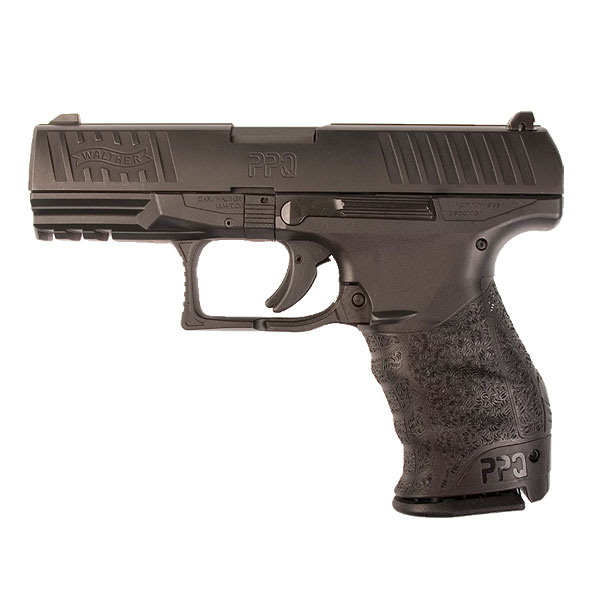
After talking to a friend at the local gunstore, I did a bit of digging and found this picture of what could be the new Walther service pistol.  It’s obviously a refinement of the P99 — a grip that is cribbed from the Heckler & Koch P30 (but with out the replaceable side panels), an extended slide release lever (if it were ambidextrous, that would be excellent), and a retooled slide with forward serrations for press checks and the like.  The addition of the Glock-like trigger: awful — better to stay with the P99’s “anti-stress” trigger.  Takedown looks like it’s stayed the same as the P99.

Early reports are that it’s going to have the same ammo capacity as the P99s in 9mm and .40S&W.

Homebuilt…

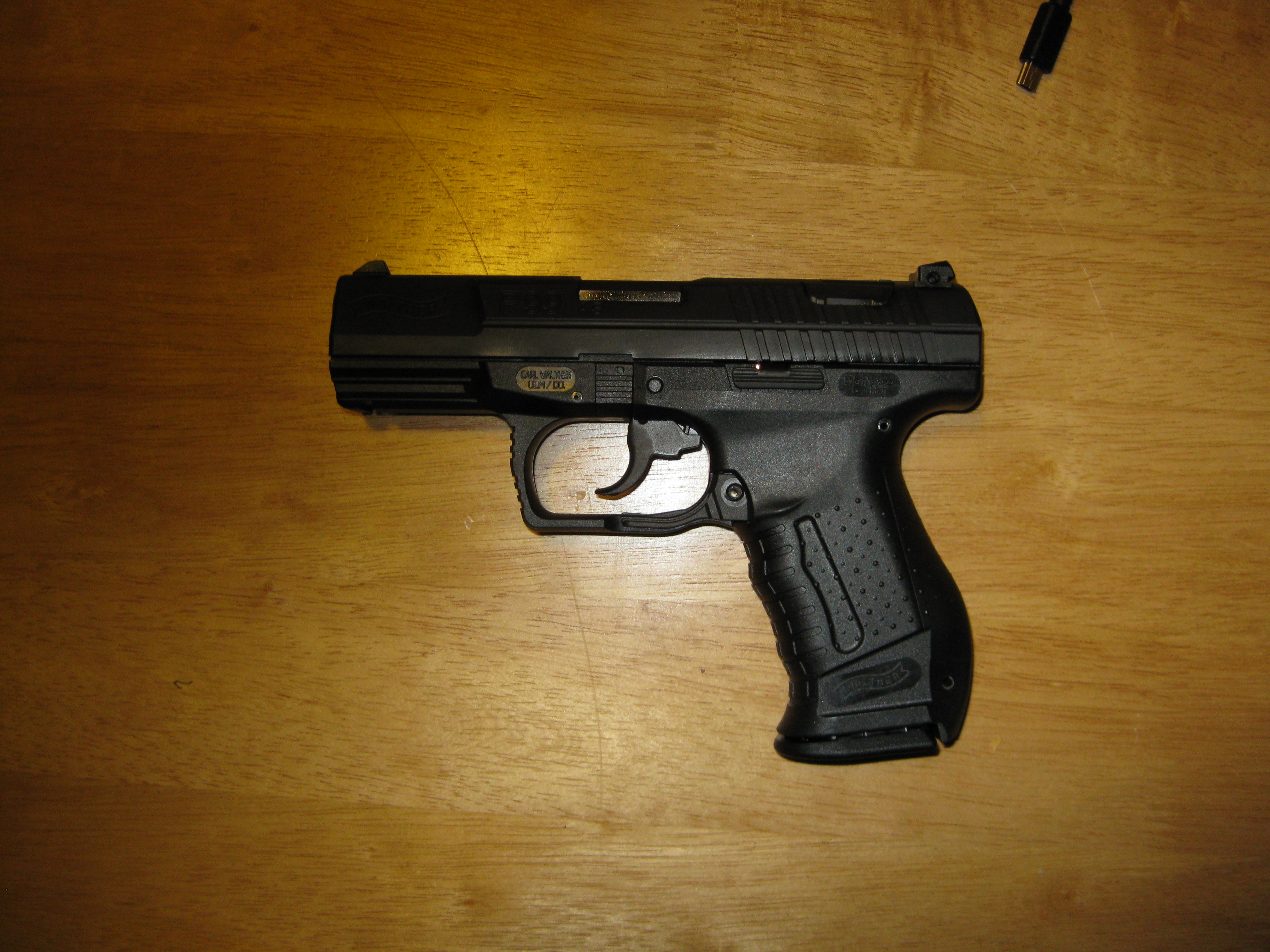
Back in 1999, I bought one of the original Walther P99 9mm handguns.  I had a few different pistols, including the Heckler & Koch USP .45 Compact, and was tending to carry the latter at the time.  The P99 had one of the best grips on the market at the time — ergonomically designed to give the user an incredible hold on the weapon, three different backstraps to resize the weapon for the hand, and adjustable rear sights with different front sight heights to make the weapon customizable for the user.  These are all common on polymer guns now, but most forget how revolutionary this was in 1999.  It had the downside of being during the Clinton gun ban when you could only have 10 rounds, instead of 15…so it really didn’t offer much over the 8-shot USP.

It shot incredibly accurately, with mild recoil, but had a break in period that I found made me question the weapon’s reliability.  (After about 200 rounds, the P99 started running flawlessly.)  I know a lot of handgunners hear this “break it in” crap, but to me that means the factory didn’t bother to finish their product.  If I need the gun that night after I’ve bought it, “break in” just isn’t going to cut it, should it malfunction.  I didn’t have to break in my H&Ks, or my CZ-85 (flawless out of the box), nor my FN57.

I wound up needing money for a move from Austin to Albuquerque in 2000 and sold the weapon.  I regretted it almost immediately, and bought a P99 in .40S&W.  Unlike the 9mm, I found the .40 version functioned very well, but found the accuracy spotty past 10 yards.  I got rid of it and was on the look out for a 9mm P99 with the original trigger set up (now called “anti stress”).  At that ever turned up was the idiotic double action version.

Today, I found a P99AS in 9mm in near pristine shape but with enough rounds through it to be “broken in.”

So — the P99AS.  The benefit of the anti-stress trigger is that it is a stepped trigger:  with the striker cocked, the trigger has a step that allows the user to not accidentally pop a round off, and shortens the trigger pull.  A decocking button on the left side of the slide drops the striker for a long, heavy pull on the first shot, then drops to the AS trigger for the rest of the magazine.  The P99s now come with a 15-round magazine, making them an excellent, light, and super-accurate (to about 25 yards) self-defense weapon.  It is light enough I might occasionally take it on walks, instead of the CZ-85 (but the CZ configuration remains my favorite, to date.)

If you can find one of these gems used, a good price is between $450-600.  They’re one of the better handguns on the market — as good as the S&W built PPKs are bad.

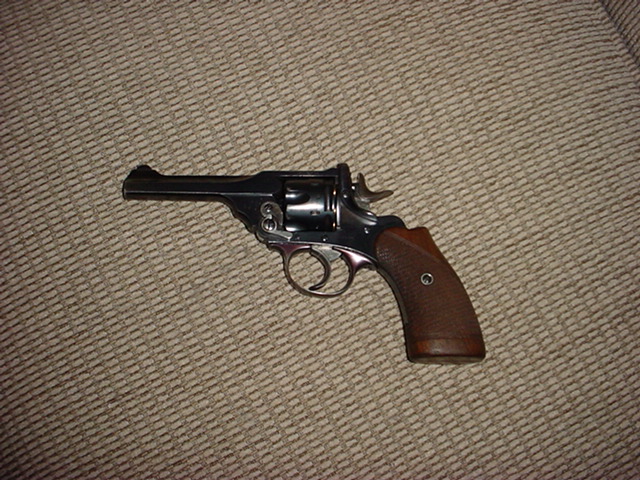
My first gun was a Webley Mk III .38S&W (or .380/200 in British parlance) made in 1897.  I bought it because it was a piece of history, more than as a self-defense piece, although I did carry it for several years.  This particular weapon has an relatively rare grip, and the Webley folks confirmed it was originally a Singaporean constabulatory weapon.  More on this later…
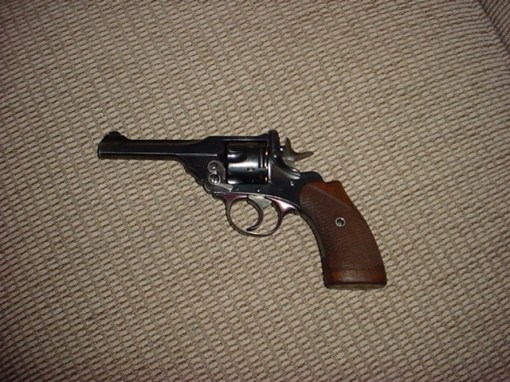
Shortly afterward, I bought a Mk VI in .455 Webley.  This is the weapon that was the British military issue gun from 1889 until about 1963, when the Browning High-Power officially replaced it.  Heavy and large, this is not a concealed carry weapon.  It is, however, a superb field gun:  very robust, reliable, accurate, and a fairly good manstopper.

This weapon was made in 1918 and has the “wartime” finish.  Apparently, Webley couldn’t take the time to make the bluing mate well on the guns, and they suffer from wear on the barrels.  Despite this, the pitting is minimal and there is no rust on the pistol.  The design is pure Victorian — heavy (almost 3.5 lbs loaded), with handsome lines along the octagonal barrel, and a lovely curved underbarrel, where the hinge for the weapon is.  The weapons have a heavy breech lock above the backface of the receiver that locks the weapon closed for operation.  It is stout! and opening it can take a bit of thumb strength.  It can easily handle the pressures of .45ACP +P.

Webley double pressure proofed they guns and they can take a hell of a pounding.  I regularly hot-loaded the .455 cartridge and one of my Mark VIs is converted to .45ACP.  It coughs out +P rounds like they were nothing.  These are some of the most robust, well-made handguns in history.  In my opinion, the Webley is one of the best overall designs for a revolver, period.

Function of the Webley is no-nonsense and very reliable.  I have, in several thousand rounds in three different Webleys, never had a malfunction or any kind of damage to the gun through use.  The double action trigger pull is long and stiff, running 10-12 pounds, with the double action a crisp 5ish pounds (and my Mark III has a dangerously light 2 lb. trigger.)  Cocking the hammer with the off hand I have been able to achieve a rate of fire comparable to that of a 1911 .45, with a high order of accuracy.

Speaking of accuracy, the Webley is on par with any full-size 1911 frame handgun, and I have reliably hit targets at 50 yards.  An officer was expected to fire with his troops during volley fire during the 1880s, and the Webley was capable of hits out to 100 yards.  At usual handgun engagement ranges of 25 yards or less, the Webley will print 3″ groups in single action with little effort.  At 10 yards, double action will at least score you hits in the center mass area.  Rapid fire, thumbing the hammer to single action, I have managed to do 6 round groups of 2″ at 10 yards on a regular basis.

Stopping power is one of the few places were “experts” will question the .455 cartridge.  It is a short-box cartridge that speeds a 265 grain soft conical bullet (this is the Fiocchi load — pretty much all you’ll find commercially, although Hornady is doing a Webley round, now, as well) to 650-660fps.  The muzzle energy is lower than a .45ACP by a bit  and is on par with a 9mm round; recoil is mild, aiding in follow-up shots.  Despite the lower energies, this is a big, heavy bullet and was plenty effective in combat.  For a while, the British military was obsessed with “knockdown”, and the .455 was considered highly reliable in stopping a target.  It did well in the 1904 trials for the US military, leading up to the adoption of the .45 ACP.  I would have no trouble counting on it for self-defense…other than the $40/box cost.  If you are a handloader, however, the Webley is a nice challenge.  You can get .455 dies, and it will accept most .451 caliber slugs.  I have also fired .450 Corto and Short Colt through the weapon without incident.  .476 Enfield should also work, but I’ve not tested that.

As mentioned, I also have a Mark VI that has been modified for .45ACP.  The cylinder is shaved down to allow moon clips, and once again, has never provided any trouble in its operation.  It has fired everything from soft lead to hollow points to +P ammunition with nary a hiccup.  These “cut” cylinders also allow the use of .45 Auto Rim, a bit more expensive, but some of the loads range up to 255 gr. with an 800fps velocity.  Not whimpy.

A quick note on the .380/200 Webley Mark III from the beginning of the piece.  This weapon is also a sturdy and reliable sidearm, and small enough for concealed carry.  The .38 S&W round is anemic by most standards, but is on par with .380 for stopping power.  Recoil is non-existent out of the 4″ barrel Webley, and a friend used to reload the used cartridges to 9mm Luger specs without incident (I split a few cases, though…)  Accuracy was steady to 25 yards.

The Webley is not exactly a common gun, but out west in the US, you will find them with some regularity.  The .455s are usually cheap in the local gun store — $300 is the highest I’ve seen, while the .45 conversions will run you up to $500, depending on condition.  Most of the .380/200s I’ve seen have been Enfield Mark IIs (same gun, essentially) and they usually run the gambit from $250-400 depending on the condition of the gun.  (You’ll pay higher on Gunbroker for all of these.)

For the cost, they are worth every penny.
I got my 10mm conversion kit ($245 straight from EAAcorp.com) for my Witness .45 in on Wednesday and finally had a chance to take it out to shoot.  There was some concern, originally, since the slide to frame fit was tight! and the action would not run through smoothly.  Mostly I think this was due to the black permacoat of the slide being rough and sticky from the packing lubricant.  After cleaning the slide several times with MPro7 cleaner, and leaving it well oiled along the slide rails for the night (MPro7 gun oil), I took the barrel and spring assembly out and ran the thing by hand for about an hour until it loosened up.

The factory spring for the Witness is 14lbs.  Way too light for the 10mm or .45 rounds.  I use a 16 lb. in the .45 configuration and went with the 20 lb. from Wolff for the 10mm.  It was more than adequate to suck up a bunch of the recoil.  I should be getting a conefit guide rod from Henning Walgren in Colorado in the next few days.  The design increases the amount of surface contact between the frame and guide rod, to lessen the battering the frame takes.

Here’s a quick clip of me changing the .45 slide/barrel for the 10mm…

I shot a box of the Blazer 200gr. 10mm, which moves at about 1050fps.  Essentially, it’s a .40 S&W cartridge.  After that, I traded up to the 180gr. Double Tap hollow-points, which move at 1400fps.  Not much more kick, and delivers 717ft-lbs. at the muzzle.  Lastly, the Double Tap 200gr. with a velocity of 1250-1300fps, depending on where you’re reading the specs; 680ish ft-lbs. at the muzzle.  The last two cartridges are easily in .357 magnum to .41 magnum ranges.  A bit more jump at the muzzle on the 200gr., but nothing serious.  I can’t believe the FBI complained about the recoil on this cartridge in the 1980s.

Here’s what it looked like…

Here’s a pic of the Witness in his 10mm configuration:

Accuracy was on par with the .45acp at ranges up to 15 yards (I was more interested in function for this outing) — groups at 7 and 10 yards were in the 2-2.5″ range.  At 15 yards, a 10-round group was about 4″ without taking my time between shots.

I’m a fan of the Tanfoglios in .45, and now I’m delighted to finally have a new 10mm that works well.  The conversion kit system of the Witness is a nice idea for people looking to have multiple calibers on the same, ergonomical platform.

Five years ago, I decided to pick up the PS90 carbine from Fabrique Nationale Herstal, along with the FiveSeven handgun.  I had been wanting to get a carbine/handgun combo in the same ammunition in case of political unrest, robot or zombie apocalypse…or just to have.

I had fired the full-auto version of the P90 a few years back and was impressed with the weapon’s reliability and accuracy.  Stopping power was a questionable issue to a lot of the US shooting commnunity, but the record of the P90 in the field was solid, despite the whinging of the “if it don’t start with a 4 and end in a 5, it ain’t good enough” crowd.

I got my PS90 for $1100 in 2004 and the FiveSeven for $800.  (Can’t do that now!)  Since I’ve had it, I have put 5000-6000 rounds through the carbine with only a few jams (FTF), mostly due to a bad ammo lot.  It likes the 40-grain SS197 blue-tips, especially, whereas the pistol (mine, at least) prefers the 28-grain SS195 rounds.

The weapon is ambidextrous, with charging handles on either side of the weapon and a rotary safety under the trigger.  The magazine sits on the top of the weapon, inside the frame for the optics, and civilian mags hold 30 rounds (10 if you’re unlucky enough to still live in California.)  the guts can be swapped for the standard military 50-round magazine, or you can buy them straight out.  FN mags run about $70, but there are other companies making the magazines, now that there are AR uppers for the 5.7x28mm.  They run about $40.  Spent casings eject out of the bottom.  The weapon is small, even with the 16″ barrel, and the original 10″ makes this the perfect urban house gun.  (you don’t even have to dip the muzzle going through a door; they’re lovely!)

Accuracy is superb in the FN, both in the 10 and 16″ barrel.  Stock PS90s have a black reticle sight that, frankly, sucks.  They also have iron sights on either side of the sight that are solid out to 25 yards.  I was able to group sub-2″ groups out to 25 yards with a bit of deliberation, and could rapid fire a 4″ group at 15 yards without a problem.  Since the stock sight is awful, I installed an equipment rail (simple unscrew the sight, drop in a rail [they can be had from gunbroker or CMMGinc.com] and throw on a sight) and a cheap $40 BSA red dot scope, no magnification, and have managed to hit a wine bottle at 300 yards.  That’s a bit outside of the intended operational range of a personal defense weapon (50-100 yards.)  At the intended self-defense range of 25-100 yards, the weapon will group sub 2″ groups with ease.  Iron sights are good out to about 50 yards, but require the shooter to really hunker over the gun.

Operation is a simple blowback bolt on dual rails with lightweight springs.  The gun, like the FiveSeven, runs incredibly clean and a trip to the range with 200 rounds through it looked like it hadn’t been used at all.  Takedown is accomplished with a push of a button, then pulling off the barrel assembly.  Slide out the bolt and take off the buttplate.  Then remove the trigger pack.  Done.  the gun runs so clean, I rarely clean the trigger pack.  One pass with a boresnake and a few Q-tips, and the weapon is clean in under two minutes.

The 5.7x28mm round is a cut down 5.56mm.  Factory ammo velocities are in the 2300fps range for the PS90.  The round has little recoil and is designed on impact to yaw and cavitate; the effects are disproportionate to the muzzle energy and size of the round (.224 diameter.) SS195s in ballistic gel open a larger temporary wound track than a .45.  Penetration is comparable to a 9mm hollow-point:  about 11-12 inches.  The SS195 yaw and cavitate as designed, where as the SS197s fragment.  Muzzle energy on the SS197s is on par with the 9mm 115 grain round, but I’ve got anecdotal evidence the SS195 are more effective in dropping a two-legged target.  (Thanks to my Little Rock forensics hookup!)

The rounds are easily stopped by hard cover beyond 25 yards, but they do a number on soft tissue out to 100 yards.  They’ll drop a nutria (it’s a souped up groundhog) with a shot, where a 9mm will just piss them off; I’ve heard of guys taking down small deer with the PS90.

Reliability of this weapon is top-notch, as is accuracy.  Recoil is negligible, making it an excellent starter rifle for kids or casual shooters, and an excellent self-defense weapon.  The round is effective on small game and for defense purposes.  Maintenance is incredibly easy.  FN’s customer service is great, as well; I managed to break a magazine and they replaced it, no questions asked.  (The magazines were a problem for a while, but their plastic quality as improved dramatically.)

It’s worth the money up to about $1500.  After that, look for a used one.

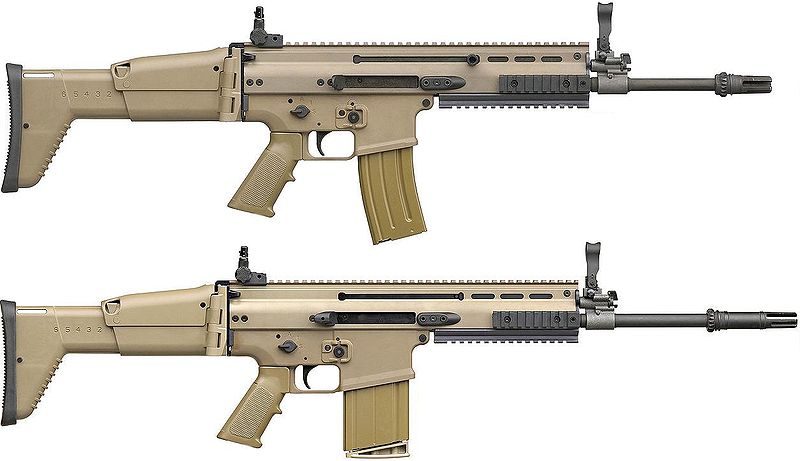
I hit the firing range today to keep the ol’ skills up and was greeted by one of the guys there with an invite to lay my furry paws on the Fabrique Nationale SCAR-L in 5.56mm.  The SCAR is FN’s answer to the military requests for a new battle rifle for US special forces.

First impression — the gun is incredibly light, which is not what I expected with all the plastic on it.  The company’s F2000 is a bullpup version of this gun, but feels like it weighs about twice what the SCAR does.  The stock folds to the right and does not interfere with the shooter’s grip, nor with operation of the ejection port.

It uses standard AR mags, and the seat easily and drop free when the release is hit.  Manipulation of the charging handle (on the left side of the gun) is easy and could be used to chamber a round as easy as the bolt release.  Trigger is smooth and felt to be about 5ish pounds.  Fold down sights are standard, and there is a Piccatinny rail for optics.

Take down looked to be very easy, and there were a minimum of moving parts.  (I only counted four…)  The weapon has about the same recoil as my old CMMG piston-driven AR, despite being lighter.  This weapon also uses a piston to drive the bolt carrier, and this makes the gun function much cleaner and more reliably.  (My CMMG was a delight to clean, compared to my service-issed M16 and M4.)  Accuracy for a rifle is hard to assess on a 25 yard range, but the SCAR drilled a single ragged hole in the head of a silhouette target with 10 rounds…so just as good as any AR or P90 at similar distances.

This would be an excellent shooter for the field, without a doubt.  However, the $2500 price tag was a bit steep for my blood.  (Which would have undoubtedly been spilled by “she who must be obeyed”, had I bought the thing.)  There is a .308 version on route sometime later this year.

Tanfoglio is an Italian manufacturer of handguns based in the “Valley of the Gun” outside of Brescia (there are several manufactures located there, including Beretta.)  One of their primary products is a copy of the CZ-75, called alternately the Combat or the Witness.  It is imported into the US by European American Armory and is usually called the EAA Witness.  It is available in .22LR, 9mm, .40S&W, 10mm, and .45ACP.

I have not fired the other calibers of this pistol, so we will focus solely on the .45 Witness.  Simply put:  this is one of the best .45s you can buy for sub-$500 (although prices have climbed some with the recent nonsense.)

The CZ is one of my favorite configurations for a handgun, and the clones of the weapon are highly-controllable, accurate, and reliable.  I originally bought my first Tanfoglio in 1997 because it was the closest thing I could get to the old Bren Ten — a fantastic weapon.  It was, at the time, a $250 gun and worth every penny.  Since then, I have purchased two more of the weapons.  None have been a let down.

Quality of build and finish is good.  The Witness usually comes in a stainless steel frame and slide, what they call their Wonder Finish.  It is low-reflection steel with almost a brushed look to it.  The fit of the slide to frame is tight and the slide sits inside the frame, unlike most semiautos.  This makes for a more solid feeling weapon, in my opinion. The only issue with the .45 and 10mm versions of the handgun are light recoil springs — the Witnesses ship with 14 pound recoil springs.  Make sure you order a Wolff spring in 16 or 18 pounds for the .45, and at least a 20lb for the 10mm.  This not only helps with recoil management, but dramatically lowers the beating the frame takes from hotter +P .45s or the high-velocity 10mms.

Speaking of recoil…the Witness .45 has a stout recoil that, like the 1911 series, comes straight back into your hand with a minimum of muzzle flip.  Operation of the weapon is single/double action.  It can be carried with the hammer down, half-cock, or cocked and locked.  Unlike the CZs, the Tanfoglio can be safed in any hammer position, a feature I very much like and wish CZ would adopt.  The trigger pull is long in single action and about 8ish pounds, in single action it’s more like 4-5 lbs. and has a bit of play before engaging.  Some shooters don’t like this, but I don’t mind a bit of slack, personally.

Sights are fairly basic, adjustable with an Allen wench in most new models, and the weapon is extremely accurate.  (Attributed to the minimized play in the slide due to the way it mates to the frame.)  The ergonomics are comfortable for most shooters, and even my wife’s small hands, and a friend’s arthritic ones found it comfortable.  The wife did have trouble reaching the trigger in SA, but if a person with small mits was carrying, they could do it Condition One and have little problem.  The handle is bigger than the 1911, but gives the shooter 10 rounds in the magazine.

On every Witness I’ve owned, I’ve been able to print 2.5″ groups, free-standing with some speed, out to 25 yards.  Ordinarily, I like to try and practice moving and single handed shooting at cans or something appropriately small.  The Tanfoglio is a solid can-popper out to 10-15 yards, on the move and point shooting.  On an indoor range, the Witness regularly outshoots my friend’s Kimber Pro-Carry (but not another friend’s Yost-bonitz modified Springfield 1911.)

I’ve never had a malfunction in 2000 rounds with my current Tanfoglio, only had a handful of FTF (usually double feeds) on one that was magnaported.  (It was a bad magazine.)

They are a handsome, solid (and heavy) weapon with strong accuracy and reliability.  It might be a bit hefty for some to carry everyday, but for hiking or duty, the Tanfoglio would be a superb weapon.

« Previous PageNext Page »