Roleplaying Games


For a guy who was utterly disappointed by the playtesting of Modiphius’ John Carter of Mars RPG way back when, I’ve been playing a lot of 2d20 — a system I thought I’d never warm to. I’ll have a bit up on Star Trek Adventures — their 2d20 Star Trek game which I’ve been running now (on and off) for about a year with a surprising bit of success. In the wake of the second installment of Dune, which the wife loved, I thought I’d buy the RPG on the off chance I might run it for her and daughter. This review will encompass the core rules, The Great Game: House of the Landsraad, the Power and Pawns: The Emperor’s Court books, as well as the GM screen.

Dune is a much improved version of the 2d20 system (and if I’ve heard right, is used for their Chuthulu series of games), and from first glance at the quickstart, the version 2.0 of Star Trek Adventures. Really, I can’t impress on the reader how much improved the system is over the old one…but not just that, the things that made 2d20 so painful to engage with are improved: the writing is clear and concise, the indexing works — the stuff you look for in the index is where they say it is (unlike the execrable job that was done for STA), the color balance and use of typeface makes it readable where STA was an eyesore. (Fallout is equally well laid out and designed, written, and indexed.) This continues through the two supplements I quick picked up, as well, since while I saw the movies and read the Herbert novels way back last century — and boy, does that hurt to say — I’m not a real fan of the Dune setting after the first two books. However, while were on the usability and design of the materials, lets give a real round of accolades to the GM screen. There’s a way range of utility in GM screens — from the truly useless D&D screens and the practically unreadable screen for Aegean, to the serviceable like Hollow Earth Expedition and Star Trek Adventures screens (although in fairness, the ship combat cards that come with the latter are very useful), to the superb — Lex Arcana and Broken Compass/Outgunned screens where you can almost run the whole game off of the screens without referencing the core rules. Dune is in the last category: the screen features the combat sequence, the use of zones for different types of combat, difficulties, the use of momentum and determination, and the best of all , has the pg. the rules are located on in little bubbles on each chart so you know where to go if you do need a bit more. This wound up being useful on our first play test a few weeks ago.

The first 84 pages are dedicated to bringing you up to speed on the universe of Dune, a setting that is richly presented in the original novels and expanded n a bunch of books I haven’t read. There was a lot hinted at, and the size and scope of the Imperium is such that you could play in the setting without ever having to engage with any of the major players of the novels. Character creation is pretty straight forward and mostly moves linearly through chapters three and four. You create your house — be it a minor or major player, create a rival or rivals, then pick roles you will fill in the house from ruler or heir, to consort, to advisors and swordmasters and the like. You have two main sets of stats to run off of — there’s your Skills, like Battle or Move or Communicate; there’s Drives — motivations for the character to do something. Pick the most appropriate of the two and roll 2d20 (or more depending on other things) and get under the combined number for a success. you get two successes under the skill value, and if you have an applicable focus like “long blade” or “espionage” you get another. Beat the difficult of the task — a 1 if it’s a mundane task, or a 5 if it’s virtually impossible. Anything over the required amount generates momentum which can be used later to add up to 3d20, add aspects on a scene, gain a asset, etc. You have a drive statement that can, if you are playing to it, gain a determination (the really powerful game currency, which can erase an injury or give an auto 1 on a die….) The GM can invoke that statement, as well, to make you use that drive in a test (often to your disadvantage), and you can refuse but this gives the GM “threat” — momentum, but for the GM.

The use of two terms for momentum is a sticking point for me — it overly complicates the game currency, just as determination does.

Where Dune excels is losing the use of “challenge dice” — d6s that were specially marked for the respective games to give a character stress, or key a special aspect of the weapon, etc. They added more chance into play that could undo a particularly good test. (“Hey, I rolled six successes on a two success difficulty…but rolled two stress on my six dice of damage…”) That’s gone. You weapons, shields, vehicles, extra guys, whatever, are assets that add a die or more (up to 5d20 total) and extra success generate not just momentum, but do the damage. You have an asset of “sword 2” and rolled two successes over the necessary to hit? That’s 5 points to the other major NPCs “Battle” skill. Once you’ve got the skill to zero, you’ve won. You don’t have to kill the guy. You could injure, capture, whatever. Your choice; you won. For minor NPCs, you just drop them with whatever outcome you were looking for.

The use of zones gets a novel reworking. For duels, this involves trying to get through the guard of a character to the body. You can make this happen with a subtle attack, moving into the zone for your strike, or boldly — aggressively launching an attack to force the guard away and get to the person. For skirmishes, this works like 2d20 normally does, moving your character from one zone is an action, or you can boldly or subtly move and if successful, launch your attack after moving; you can also move the other person out of a zone — say, moving into a fight to push the attackers off an ally. This scales to large land battles, moving your forces from one objective to another and trying to push off the enemy, or launching an attack on them directly. Where it gets innovative is doing this for intrigue (social battles where you are trying to learn information or get close to a particular person) where you are trying to influence, gain information, or whatever from a person in a social setting. This recreates the medieval court intrigue that is central to the Imperium. It is also used for Espionage — similar theme, moving from one group or lead to another to get the information or contacts you need.

I liked this enough I ported it into the current side quest for the Star Trek Adventures game where the crew are trying to cut into the Orion Syndicate to find out who is dealing in Federation and Klingon war surplus after the war. (The game is set in the 1st season of Strange New Worlds.)

There’s a chapter on assets and how they work, another on the characters from the movies/books, and an adventure I haven’t used.

Layout, artwork, typefacing, paper and binding quality are all top notch, and this continues into the other material from the line I purchased. Power and Pawns digs into Imperial court life and gives a few more character options for the player. It also providess more insight into the other powers in the Imperium — the misterious Ix, who build machines that skirt right along the edge of the prohibition against “machines made in the image of Man’s mind”, the Tlelaxeu — the genetic engineers who are seriously creepy and played a major partin the play test I ran for the family; the Swordmasters of Ginaz, and CHOAM — the interstellar consortium of businesses that not-so-secretly run the whole show. I haven’t dug into this one quite as much, as we started with a minor house on a far-flung world. However, The Great Game is very useful, giving several chapters to expanding how the characters’ House works, how to run it, grow it, and interact with other Houses. There’s more on CHOAM, the Spacing Guild, and includes options for the players’ characters. Lastly, there’s a catalogue of the great houses of the empire.

Playtesting Dune over two nights, I ran an adventure where the characters stumbled onto smuggled Tlexlaxu artificial organs…but being smuggled off their world. The investigation took them through the spaceport to a smaller port town in their lands where a criminal gang was fronting the goods (not knowing what they were moving), to a small island and a distillery where a rogue Face Dancer — a Tlelaxu agent? — had set up a rogue lab using kidnapped girls to grow his organs. The distillery people, concerned for the safety of their families, and scared by the new “boss” and his ability to show up anywhere unannounced, had little idea what was going on, but knew it was bad. We ran the skirmish and dueling rule, as well as the espionage rules and they ran quickly and cleanly. The adventure was not hampered by the rules, and in a few places the use of assets and aspects on scenes (similar to how they work in Fate) lent flavor and options for the characters to use in their adventure.

So is it worth it? If you like the setting, absolutely. If you want a rules set you could cannibalize for another similar setting, probably yes. If you want rules that will port into 2d20 settings fairly easily, again, yes. The books are pretty, well written and laid out, and the setting is — when you really think about the genetic engineering end of things — potentially bonkers, as if seen in the later Herbert novels. I found The Great Game equally useful, and the GM screen is well worth it. As for the specialty dice? Not needed, and if you have any of the other 2d20 dice, they’ll work just fine.

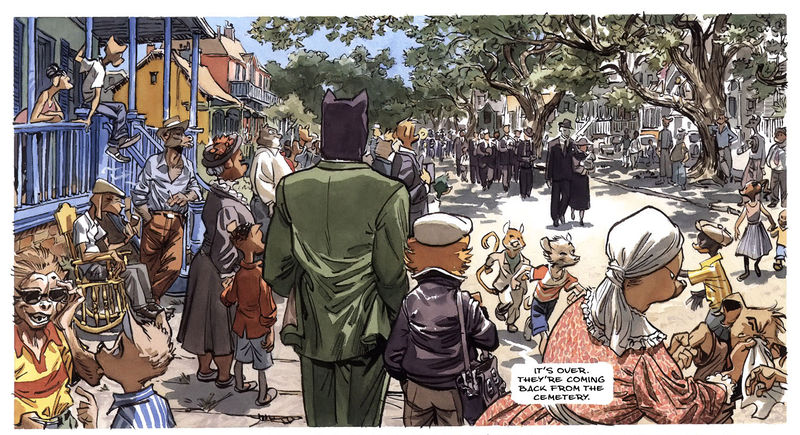
Funnily, I saw the Kickstarter for the Blacksad roleplaying game before I’d ever known about the comic books. The comics are written by a Spanish duo — author Juan Díaz Canales and artist Juanjo Guarnido. The six or so graphic novels follow the adventures of a private detective named John Blacksad and is set in 1950s America…kind of. In the book, however, all the characters are anthropomorphic animals — this is more to help define their personality traits. The comics are well worth reading, although I’ve only been able to find a few of the volumes in English, hardcopy; you can get the Kindle versions, however.

The art in the comics, which is used liberally in the RPG corebook and the GM screen is stunningly good. The background art, from city street scenes to the clutter of Blacksad’s apartment/office is highly detailed. Cars, buildings, clothes — everything is perfect. It’s also not a kid’s series — these are classic noir stories with femme fatales, people getting killed, drug use, etc. and the roleplaying game leans into the noir storytelling with rules that allow you to use and lose conscience points as the drag of evil pulls you in. The rule book is available in Spanish and English, and the translation to English was superb.

The Kickstarter campaign, like most that started in the midst of COVID, ran long on getting the physical materials out, but the PDF has been in my iPad since last year. This past month, the boys of Nerd Night™️ finally got a chance to kick the tires on the system. Our experience was, surprisingly, very good. One of the players has a soft spot for the anthropomorphic animal thing, and I will admit I was into Albedo and Fusion back in the 1980s. The others were more reticent about that, but two of the players are hard-core noir fans, so they were in. The story revolved around a group of ex-army buddies who fought in Europe together and have come home to varying degrees of success — a motorcycle gang member who does petty crime (a coyote); another that does “odd jobs”, Equalizer style (mountain lion); another who was a demolitions guy and now works construction (Kodiak bear); and their former captain, a banker (owl). Their friend, a member of a rival biker gang that the coyote, is killed — shot under mysterious circumstances, and they are hired by his brother to find out what happened. Over the next few weeks of play, complete with well-timed cliffhangers, they found out he had been involved in buying H from the local Chinese gang, apparently in an attempt to bolster their gangs position for a proposed merger with the Pissed Off Bastards (creating, eventually, the Hells’ Angels). They figure out his girlfriend, a Chinese white tiger, might have set him up, but it also appears their buddy’s MC president might have done the deed. Gang fights, gun fights, motorcycle chases, and a showdown between the coyote, the tiger, and the other gang leader ended with both gang boys being shot by the tiger — who skips town.

The story gave us the chance to work a lot of the rules. There are four basic characteristics: Fortitude, Reflexes, Willpower, and Intelligence. You can have from 1-5 in the characteristics and this allows a number of “action dice” to be rolled equal to it. You then top off your “hand” of dice with “complementary dice” of a different color. (Black for action, white for complementary is the norm.) There are also “tension dice” (red) that can be added instead of the complementary when the character is doing something agains their principles or giving in to their worst impulses. The action dice have a success on a 4-6; complementary a success on a 6, but a failure that negates a success on a 1; and the tension die give a success on 4 and 5, two successes on a 6, and a failure that negates a success on a 1.

Characteristics also give you the number equal to the dice in Traits. A Kodiak bear, with a fortitude might have Big & Tough +2 and a Hits Hard +2 and a +1 to their protection against damage as Traits for that Characteristic. You get these for each characteristic. This allows even a klutz with a Reflexes 2 to have a +2 in Steady Hands or something similar so that even though they aren’t the fastest on their feet or quickest to respond to things, they’re good with their hands. The traits can be added to any one of the dice rolled in the dice pool. That includes flipping a failure (say adding the +2 Steady Hands to a failure on setting a bomb). It allows for more nuances characters. We found that the die mechanic and the characteristics/traits really made it feel like the characters got to act like they should — with failures mitigated where they should be, and successes being — if not assured — certainly not as reliant on sheer luck of the roll.

Milestones give two elements of the characters past — like Grew Up in the Wilderness or WWII Sapper — and two that tie to the character’s nature, like Easygoing or Defender. These traits are there to help the player direct their actions. There’s also the Complications — the weakness of the characters — and these can led the GM to push Conscience checks on some things. There are rules for resisting temptation and corruption by doing things that are morally damaging. We saw these in use for characters taking actions that were a bit outside of being the “good guy” — like shooting an attacker when they couldn’t see the character and were unable to defend themselves; or when the coyote character was duped by the white tiger girlfriend of his dead buddy.

The mechanic is simple — beat a number of successes needed for a task. An average task might be a two difficulty, negating the first two successes a character might roll. Anything more and you pulled it off. In combat, it works the same way. Most characters start with a 2 Defense, requiring three successes to really do damage. (It’s pretty easy to pull this off.) Get more than one success through, you multiply the damage by the number of successes. If you shoot a guy in a darkened alley who can’t see you, the dark and his lack of seeing the danger he’s in might cancel themselves out — he’s got a 2 Defense. The character blasts away with four successes…his Walther PPK .32 does 6 points times 2 [the number of successes that got through] = 12. The target’s in some trouble. There’s some derived combat scores like Endurance — typically about a 4. In the case above, the guy would have also suffered a serious injury (a concussion or a broken bone) from the attack being three times his endurance.

The rules only take up 50 pages of the 160 total run deal with running the genre well, NPC portraits based on the set piece for a scene — like a pool hall or the like. I would have liked a bit more fleshing out of the chase rules, but outside of that, the game is rules light and simple. It was fun to run and easy for the players to pick up how things worked.

So, is it worth the $40ish bucks? Overall, I’d say yes. We really enjoyed our trip back to 1948 San Francisco (where I set the adventure) and I could see us playing this regularly on our game rotation. You could conceivably just run a straight noir game with the ruleset and just ditch the anthropomorphic characters, if that’s not your bag (baby!) You can find Blacksad at Nosolorol’s website.

Space Cowboys are cool. Since the release of Cowboy Bebop, and followed up with spiritual cousins Firefly, Serenity, The Mandalorian, and The Expanse (at least the TV series) — people getting by with existential issues in space has given us some of the best sci-fi TV ever.

So I was pretty excited a year or two ago when the Cowboy Bebop roleplaying game rolled up on Kickstarter from a little company out of Italy (and if it’s not Sweden, most of the really good stuff is coming out of Italy, right now). I got the PDF in a few months back and perused it and was…underwhelmed. I held off of any kind of review, though, until I had the physical product. I’ve noticed, of late, that when I read the PDF of a game, I don’t always get what I’m looking at. Something about the screen (usually an iPad) and my periodic astigmatism makes it a pain to read for long periods of time; and the inability to quickly index back and forth means I don’t always get a clear picture of mechanics if they are quirky (as is the case here) or badly written (pretty much trying to find rules in any Modiphius product. Seriously — editors and a good index, guys.)

Well, I’ve go the book and GM screen in and it’s time to give a first impression. I’m not going to call this a review until I’ve run the game. I get the impression a lot of my issue with the game comes down to verbiage and not how the game would actually run. More on that in a minute.

The physical book is very well done. The paper and binding quality is easily on par with most stuff on the market. It’s chock full of official artwork and screencaps. The layout is double column and in a very readable typeface. It was written in Italian and translated to English, and the translation is top notch, with only a few spots when a better word choice might have been appropriate. It’s edited well — I caught no typos or layout issues. The book runs 272 pages — about normal for an RPG corebook. The GM screen is on solid cardstock with a wraparound on the front of the crew of Bebop, and the basics for running the game on the back. And I do mean the basics. As screens go, I found this one lacking a lot.

Allora, onto the meat. The system is a d6 die pool based on the approach you want to take to solving a problem, what “tab” you are in, and whether or not your approach is narratively appropriate to the story. To explain: the session is essentially split into what most of us would understand as “acts”, like in a play or show; they call them tabs. I should have a look through the Italian version to see if they use act there. You get a die for the first act, 2 for the second, and 3 for the third; the difficulty of tasks also increases. Roll the dice and beat the target number. Simple there.

How you approach the task is important. The approaches are essentially “attributes” — rock is trying to act under pressure; dance is more related to a combo of dexterity and stamina; blues deals with spirituality or self-awareness…wisdom, if you will; tango is a charisma-based approach; jazz is smarts, skill, improvisation. The music-based nomenclature is appropriate to the source material, but could be confusing as hell to those who might be looking for a more traditional set of attributes for their character. I will admit I really liked the idea on first read, changed my mind on the second reading and thought it overly subjective, but now I’m leaning a bit back to my initial impression. I can see, however, this will be a point of failure for the game group at first.

Another aspect of the system is the use of “clocks”. This is the number of successes needed to pull off a objective. There are multiple ways to bust up these clocks — 4, 6, 8, etc. Hell, you could do a 1 or 2, I suppose. There can be a few of these running coterminously; you could have an investigation clock looking for your bounty, and have a threat clock pop up due to a fight scene. You need to succeed at one or more of these for the act you are in. The GM or Big Shot — in keeping with the in-show TV program alerting bounty hunters to marks — can also have clocks running for the opposition. If they get the clock cleared first, that’s a failure.

There are hits and shocks as “damage”. Hits are the successes of the players; shocks are the GM’s game currency and can be spent to increase difficulties later. Shocks are gained when the players roll a 1 or based on the something in the act. You absorb these by taking a wound on your approach. Two wounds and you can’t use the approach for the rest of the session. You can also clear a shock by marking a “bullet” — this is a clock of sorts where you get six bullets before something in your past comes up to haunt you. There are examples of play in the book that help with all of this, but on first read it was confusing as hell. I think if the GM can come to grips with how this works (or just ditch it for a number of successes must be accrued by a certain number of tests) the game will run smoothly. But there will be a learning curve for the GM. The players will have an easier time of it once they get past the approaches idea.

Each of the approaches also gets a trait that, if the player can weave it into their description of what they’re doing, aids in the die pool. This can be things like a personal description, a piece gear, clothing, etc. You have a key memory and a “groove” — a basic schtick you can use in play.

The group gets to choose a “mothership” — their base of operations — and a personal vehicle, either a small spacecraft like Spike Spiegel’s Swordfish, or the like.

The rest of the book is a guide to the Bebop universe — the criminal factions, corporations, and other players in the solar system. There’s source material on the gate system that allows the characters to get around space, the various worlds and asteroids, and an episode guide that is, I think, too long. I would have liked a bit more background material, but they stayed very faithful to the anime. (I may be in the minority, but I rather liked how the live action series buffed out some of the universe.)

So…is it worth it? I honestly don’t want to say, yet, but would prefer to kick the tires on it and see how it plays. That said, if you are a Cowboy Bebop fan and want to support officially licensed material for it, or you are a completist that wants to have all the hot steamy jazz you can get…go for it.

Contrasting Cowboy Bebop is Orbital Blues — a “…game of sad space cowboys, your crew of desperate and downtrodden outlaws do what they can to make ends meet. They travel across a music-infused space-western universe filled with retro-future technology, plagued by heartbreak and the haunting shadow of the blues.” This rolled up as a Kickstarter a few months back for Afterburner, a new expansion to the original book. Since the original was included in one of the bundles for a reasonably price, I jumped on it, as I was still as bit on the fence about Cowboy Bebop. Soul Muppet Publishing is out of Nottingham and publishes a number of rules-lite games.

Right now, I only have the PDF for Orbital Blues, but the layout allows for easy reading. It’s filled with retro artwork, a clean layout that looks like the print book is probably on the size of the 5×7″ Fate books. The typeface is clean — Helvetica Neue, I’m guessing — and sized well. We’ll see how the physical book looks when I get it.

Orbital Blues is a rules-lite system trying to do a lot of the same things that Cowboy Bebop is doing, but without a lot of the chaff, which you can see in its 108 pages. The characters have three stats: Muscle, Grit, and Savvy — easy enough to intuit what they do: physical stuff, willpower stuff, and smarts/skills stuff. Stats run from -1 to +2 and get added to a 2d6 roll when something happens that requires an ability check. If you have some form of advantage (“The Upper Hand”), you get an extra die and drop the lowest; when disadvantaged (“Against All Odds”) roll three dice and drop the highest. Beat the target number…which is always an 8. If it’s harder than usual, it’s “against all odds”, and when easier “the upper hand”. Gear can also provide bonuses. Dead simple.

A note on mechanics: if this sounds a lot like Traveler, I agree, except the main mechanic is also used for combat, so that isn’t more complicated than a normal task — something that does crop up in other rules-lite systems. A target of 8+ on two dice is about 41.6% to succeed. That seems pretty low. Admittedly, the 3d6 of “the Upper Hand” should mitigate that with about a 68ish%. (Keep in mind, I’m really not a mathematician — so be kind, numbers people!)

You have health for physical injuries, and Blues for a rating of psychic impact of things happening to you or what you have done. Get enough blues, you will accrue a “trouble” — something karmic this way comes. You start with a trouble and a gambit — a schtick you can use. For every two troubles, you get a new gambit.

Like Cowboy Bebop, you choose your ship and gear and get rolling. Ships and vehicles have three stats, as well, and take damage directly to the stat. Once they’re at zero, the ship is either dead, dead in the water, or blind.

The rest of the book is given to 40 pages of example NPCs, bad guy groups, and vehicles. The last 50 pages or so outline one particular star system, Sutler, is great detail with locations, groups, NPCs, etc. The Orbital Blues setting is interstellar, not interplanetary like Bebop, and is an excellent jumping off point for crafting one’s own setting.

At $20 or so, is it worth it? I’m willing to jump on this one untested and say yes, if you are looking for a space RPG that’s lightweight, has room for expansion, and you’re on a budget.

So…which one is better for Cowboy Bebop? I honestly, at this point, don’t have an opinion, but if I had to guess, most folks will be more happy with the simplicity of Orbital Blues. We’ll see how some testplay on CB goes, then I’ll revisit this.

The game group finally came to grips with the 2d20 system when one of the players relieved me as GM to run Fallout back at the start of the summer. The system was manageable and with some knowledge of how it worked, I looked over the Star Trek Adventures core book I had a PDF of and decided “what the hell” and picked up the hardcover core book, the Utopia Planitia guide, and the Discovery guide, as well as a GM screen and the dice sets.

Quick backstory: back in the midsts of time, our group was one of the playtest groups for John Carter of Mars when Modiphius was rolling it out. We had found the rules almost indecipherable — not so much that the core mechanic is difficult (but it is a bit overly complicated), but that the writing was disorganized and, well, bad. We wound up dropping out of the playtest because we couldn’t get through an evening without throwing our hands up and making it up as we went. I didn’t touch 2d20 again, and avoided the games tied to it like the plague. Fallout seemed a bit better written and not running it meant I could learn the system without the annoyance of running the game, as well.

Back to Trek: I had run a “season” of Star Trek using the old Decipher rules, set in the second season of Discovery thanks to the excellent addition of Anson Mount’s Captain Pike. The writing was tighter and better than the uneven first season, and since the drop of Strange New Worlds, I’m a Trek fan for the first time since Enterprise screwed the pooch back in the early aughties. We had a good time with a system that was still mostly familiar, although it has some stumbling blocks.

For “season 2”, I swapped us to 2d20. The characters ported over very easily and were pretty close to what they were in Decipher. The combat monster Andorian was a bit more combat monstery, and the hot shot pilot was even better, but most of the characters were spot on. We built them up out of the book, then I double checked what I was doing with an excellent STA website. Our ship — USS Fearless, one of the last of the Walker-class, came together nicely, as well. The characters are defined by six attributes and six skills called departments (science, command, etc.) and it works nicely — though there can be some confusion as to which attributes handles what, and with a good argument, I let players use alternate departments. There are focuses which give extra successes, and values that can generate advancement milestones and determination points — one of the game currencies, in addition to momentum (called threat when the GM gets momentum, because two names for the same thing isn’t going to confuse some folks…)

I banged up a few “short treks” to ease the players back into their characters and system (a shore leave, then a save another ship from a strange anomaly adventure) before diving into our first action episode. I quickly started ignoring the Determination points rules; like Fallout there’s two different meta-game currencies…one too many. Another problem was that the determination rules’ index location was not where the actual rules for their use was.

The characters escorted a convoy of humanitarian aid ships to Coridan — a major producer of dilithium that was hit hard by the Klingon War, only to find out the Orion Syndicate had been “aiding” the world…by repairing then running their dilithium mines for the Coridanites. There was a street fight after making contact with a Starfleet Intelligence agent (and Orion female — their abilities are sharply curtailed in STA). The fight went great until — where are the stun rules for the phasers? A quick flip through the book to phasers…then to combat… turned into a long flip through the book. While another player tried to find the rules, I hit up the interwebz…nothing. Some players have loads of stress points, but the average seems to be in the range of 16. You’re not getting that kind of stress in a phaser rifle hit, so you can’t emulate the show where most humanoids go for nappy-time when you stun them. In the end, I house ruled that the character or NPC hit had to do a Fitness+Command or Security vs. the number of stress they took, or be stunned and unable to do anything for a number of rounds equal to the stress hit (or however long the plot needed them out for.)

The rules for extended tests work pretty well — we have a hacking scene where the characters had a gated activity: get onto the roof of a building (they beamed in overhead and paraglided in), patch physically into the building antenna and make it look like the hack was local and not from the starship, get past the security, and download the material. I set the Work rating as 10 successes and a Magnitude 1 (they would need to successes to succeed). Worked well, no issues. There was another fight using our stun rules, though it went lethal quickly.

After their missions to the surface, the Orions overreacted to the Federation agents getting data that showed the Orions were trading Coridan’s dilithium for Klingon surplus ships (I was using the Eaglemoss ships from Discovery for their cool gothic aesthetic…I have to admit, I hated the Disco Klingons, at first, but warmed to them when you could actually see what the ships looked like) and this led to a four on one fight between Fearless and a Bird of Prey, and three Orion Interceptors. This was our chance to try out the starship combat for STA, and I figured this was going to be as muddled as finding a straight answer to how quickly to healed stress and injuries. (Again…half the stuff you need was not where the index said it was.)

To our pleasant surprise, starship combat really worked well. We had a station card from the GM screen for everyone — pilot, ops and engineering, tactical, and the players used the inspired “minor character” rules where they could quick generate a bit player they could play to assist them in their actions. (It’s also excellent for when a character isn’t present — now you’re playing Ensign Snuffy in the redshirt… now find out how the monster works!) Initiative usually starts with the PCs and each station gets an action that can aid the others or can do their particular schtick. The bad guys get an action between the PCs, and the players can choose who goes when on the PC turns. We found this worked very well and allowed the players to strategize their actions and feel like they were actually more than just there to roll for a hit on another ship. Ops and Engineering don’t just fix damage here; there’s a lot of planning — fix some damage or manage the power track? Like the shows, the ships blow power on their maneuvers and firing, etc., and that has to be replaced by the operations manager or engineer, or you’ll find yourself unable to do much. By doing this, they were able to evade fire, set up advantages for a firing solution, manage the shield damage, and badly wreck the Orions while taking minimal damage themselves. Of all the sections of the game mechanics, this was probably where Star Trek Adventures shines the most.

The rules aren’t bad. For most basic tests, it works just fine. Combat is a hot mess once you aren’t punching or using melee weapons. Like many RPGs that tried to tackle the ST universe, they often run afoul of the damages the weapons do: phasers just vaporized people in the show. That could make for a short run for a character in combat. You would also think, for a show where the phrase “phasers on stun” is uttered a lot, having stun rules would be a good idea. Starship combat? Excellent.

Advancement is based on “milestones” — did you use or buck your values? Did you stick to the regulations, screw up, lose people under your command, etc.? These stack up and give you the ability to swap ratings on things, or with the arc milestones increase scores, add foci or values. One excellent bit — you can spend your milestones on minor characters that regularly aid you or the ship. The milestones also gives you dice to roll against your Reputation — another aspect of the game that the index doesn’t send you to “how to bloody use it” but rather a bland — you have reputation blurb. It can be spent for medals and commendation, or promotions. It looks like it was also supposed to be able to be used for social tests, but that’s not in the core book — it’s in the Klingon sourcebook. Helpful. There’s almost no real direction given on reputation and I’ve been house ruling on it.

But now for the real problem with Star Trek Adventures…it’s badly written. The rules should be easy to parse out, but there’s so much side chatter about momentum and determination that you can miss the main rule mechanic — roll two or more d20, get below the combo of attribute and department. If you get below the department — that’s an extra success (or two if it’s a focus.) Momentum can be used to buy extra dice, or a number of other things; determination does much less. you could easily combine the two into one currency. The problem with STA and other 2d20 products is that the rules are haphazardly scattered about the book — sometimes in places that defy reason. Worse, the index page is utterly f$%king useless. Half the things you would look for aren’t there, are under a different name, or send you to a page that the thing is mentioned but the use of which is not provided at that spot. Like determination. Or reputation. It feels like the book was churned out fast, an editor was employed sporadically, and they chucked it out the door. It’s been a few years since STA debuted…by now they should have fixed some of this with a second edition. (And the Klingon campaign book does, to an extent.)

So…is it worth it? This one’s a bit tough. The system is perfectly serviceable for most situations. It’s (I think) supposed to be on the rule light side, but isn’t. Personal combat needs serious reworking and starship combat is excellent. Advancement — both the milestones and reputation mechanics are half-baked. Character creation is quick and easy, and creature creation similarly easy. NPCs can be presented as novices or experienced, etc. with stock ratings like Attribute 9 and department 2. The ability to create a background character on the fly and let a player run it so they are in the scene is inspired. There’s a lot of good, but just as much that’s just…not finished for a major licensed product that’s been out for a while. Lastly, it’s a hot, damned mess from a writing, editing, and indexing standpoint, and that’s just not acceptable for a $60 book. So — if you want to run a Star Trek game and don’t want to do the heaviy lifting to write up material for a system you like, yeah, it’s sometimes a pain in the ass but worth it. If you are looking for the system that really captures the flavor of the series-eses, it’s not quite there. If you want a seamless play experience — nope. We’re at least six weeks of play into the season and I’m still looking rules up while trying to run the game.

But, as always, your mileage may vary.

Simple. James Bond:007 RPG by Victory Games. It dropped in 1983 — some about the time of Octopussy. (A terrible entry, especially considering the excellent George MacDonald Fraser wrote it, but after the much superior For Your Eyes Only — bleh!) It was published for about four years and was an a real break from the d20 TSR offering, Top Secret, which hove too tightly to the “class” idea (assassin, spy, whatever), and which still used a random damage system.

JB:007 allowed you to build your character for points, so you could get close to what you envisioned. It had a rudimentary weakness system that could have been buffed up a bit, but it was a start. The system was mostly straightforward — attribute and skill gave a base number, then that was modified by the difficulty. (This required some rudimentary math, so that was not popular, but they had a chart on your character sheet to help. Combat was not radically different from other tasks and the quality of your success dictated the damage you did, not a die roll, which a lot of new system still use and is still, I submit, stupid. Even Cortex used your success as the base damage, plus a weapon damage rating.

The guns, the knives, the cars and boats, the gadgets — all had specific ratings from the speed it could fire to damage, to range and accuracy, as well as how likely to malfunction. This was way cool in the ’80s, and later for someone who tried a lot of cars and shot a lot of different guns. The product placement idea wasn’t overt, but it was there.

They had a series of modules based on the movies and which they altered the plots or the action pieces to be a surprise. There was a combat simulator game that I ignored, and a few setting and equipment guides (which inspired the Q2 Manual here on Black Campbell).

I ran spy games, police procedurals, even a cyberpunk campaign and a Stargate game using this rules set from 1983 until about 2010, when for some inexplicable reason — I just didn’t want to deal with the spy genre anymore. The reasons were really inexplicable, but there were a host of them that converged at the same time to make it “not fun” anymore.

Lately, I’ve been eyeing the rules and thinking about how to run a spy game that decouples the characters from governments and their obvious run toward authoritarianism. simpler stuff like mercenary work ala Extraction or Kingsman.

Over forty years of gaming (man, I’m old), there’s too many to count, so I’ll go with the most recent one that sticks in the mind. This was the first Dungeons & Dragons campaign I’d run since the 1980s, back in 2016-17. The setting was an alternate Roman Empire with low magic, monsters being either rare or stand ins for the various tribes (hobgoblins for Vandals, for instance). The characters had been traveling for a while and had come across a village that had been wrecked by a troll, and who was still sorting through the loot when they came upon him.

The characters leapt into action and proceeded to start getting their butts kicked by the creature, who was incensed that they were coming to steal his things, and that “stealing was wrong”. The monk character, suddenly inspired by the troll’s focus on the injustice of them coming to steal from him and attack him when he hadn’t hurt them, he started to try and preach to the troll. He apologized for their actions and in the end converted the troll to what would later be a half-assed, barely understood collection of folk ideas, bits of Bible, etc.

They escaped with their lives.

In a later, follow-up campaign set in Arthurian, end of Roman Britain, the new characters ran across the troll — twenty years later, running a parish in the Cotswolds and shaking down travelers using the bridge next to his church for alms while protecting/terrifying the life out of the locals as their priest. It was a last minute, unexpected callback that the group loved. His understanding of the Scriptures hadn’t improved at all.

Ooo — good one! Easy one for me: I’d like a second edition of the Alien RPG using the Blade Runner/Twilight:2000 die mechanics. The die pool of d6s for Alien, while simple, seems to weirdly, not lead to the number of successes it statistically should. We had a mathematician playing in the game for a while and even he noted the frequency with which we didn’t get successes, but should have. The BR version of the game uses different dice for attributes and skills — d6 through d12, as you get better and get a 6 on at least one to get a success. Every 6+ is a success, and over 10 is an extra success. We’re finding it works better, and there’s something tactile to rolling different types of dice that gamers just seem to like.

We’ve all got ’em. That game you bought that looked cool, or was a licensed franchise you like on TV or whatever, or you used to play and just don’t anymore, or everyone just wants to play D&D… The orphan taking up room on your shelf that you’re not going to play, but keep because — just maybe — one day it’ll happen.

I’ve got a bunch of these. Sometimes I buy them to steal ideas, or the art s pretty to look at, or I liked other products with the same mechanics –either way, there’s a host of these things sitting waiting to entertain my gaming group (or not…they might suck.)

Some are new and we just haven’t gotten to it. The obvious one here is The One Ring — the new Free League version. I bought it because the wife is a Tolkein nut but we just haven’t gotten to it. There’s settings for D&D: Odyssey of the Dragonlords, or Age of Antiquity — a Rome-based campaign that, had it published on time, would have been useful when I was running a Rome-based D&D game. There’s Forbidden Lands, another Free League game. I bought it to possibly play a more realistic and brutal version of D&D. Blacksad is still waiting for its test run. I never got a chance to run Firefly, and honestly, I bought it to have material for the original MWP Serenity game; I do not like the Fate-ified version of Cortex that has been their go-to since the Leverage game came out. There’s the perennial outcast — Jovian Chronicles, a rich and interesting anime-inspired hard sci-fi setting. The mechanics are awful. Similarly, I was really pumped for Altered Carbon. I liked the show (haven’t read the books) and the initial art, etc. looked promising. It’s a hot mess — mostly due to it’s use of symbols for everything that makes the rule book all but unreadable. There’s Capers — a superheroes meets Prohibition America. Look interesting; haven’t gotten to it yet. Another old one — Aces & Eights, a Western RPG that has some weird mechanics to it. There’s a host of interesting material that I’ve stolen for other Victorian-period games, but the game itself looks like a hot mess. But again — fantastic background material.

So what have you got on the shelf you haven’t played and why?

I have increasingly liked rule lite systems. I used to like not so much complexity, but a more simulationist approach to combat and equipment and the like — an artifact of playing the excellent James Bond:007 game for too long. But as early as Star Wars by West End Games, I liked seeing simple mechanics that could aid in character development and roleplaying over roll-playing.

The endpoint of the “easy to play and run” search was Broken Compass by the game company called (at the time) Two Little Mice. The characters have six attributes like Action or Wild or Knowledge with three skills under them. Depending on the number of pips in the two, that’s the number of six-sided dice you roll. It doesn’t matter if they’re typically or have funny symbols — the BC dice had N, W, E, S, a compass, and another symbol — so long as they all match. The goal, like Yahtzee, get as many matches as you can. Difficulty steps required you to get more matches: a pair for a basic success, three of a kind for a critical, and so on. Aid from others, environmental effects, equipment provided a die of advantage or took away a die for disadvantage. Simple. It’s the engine, I believe for their Household game and a modified version looks to power Outgunned! which just finished its Kickstarter at the time of this writing. You can find it here.

On the complex side — that’s easy. Anything 2d20 by Mödiphiüs. We’ve been playing Fallout, with another of the game group running, and I’m planning on running Star Trek Adventures, now that I’ve got a handle on the mechanics. The basic mechanic is simple, but still more complicated that it needs to be: roll 2d20, get under the number that your attribute and skill combined gives you, and get an extra success when under your skill. However, there are disadvantages and advantages to gain and lose dice, there’s two different game currencies — momentum (also called threat when the GM has it…ust to be confusing) and determination. Spend these game currencies to get extra dice on one hand, or extra damage dice on the other, among things you can do with them. I find the two game currencies — the equivalent of “luck/story/plot/whatever points” in other games, to be overly fiddly and confusing, but for the most part it’s a serviceable system. They do manage to do space combat without needing a completely different set of mechanics like some space games, and its set up in such a way that it emulates the “we need more power” schtick of the show, while giving everybody on the bridge something to do.

Honorable mention for complex mechanics goes to Lex Arcana, an excellent game that feels very old school. The character creation gets a bit fiddly, and the die mechanic is a simple roll dice and get over a target number…except you take the number of whatever you’re using — say, de Bello [war] to fight. If you have a de Bello of 15, you can break that number into up to three dice — say 3d5, or a d10 and d5, or a single die if the number were appropriate. It has a steeper learning curve for that reason, although some of the gaming group figured their best spreads and just jotted those down on their character sheets. It’s weird, but once you’re used to it, it works alright. Mathematically, using three dice is more likely to ensure a success, but it’s an exploding die system; get the maximum on all the dice and you roll again and add — that allows a player to roll one die, if they can, and that raises the chance of an exploding die.

This is a tough one. Between multi-million dollar Kickstarters, good desktop publishing software, and real money behind some of the bigger production companies (Wizards of the Coast, of course, has Hasbro in their corner, there’s Mödiphiüs, Free League…) the production values of RPG books and extras has really improved. There are some staggeringly beautiful books put out by all the big names. Most of 5th edition D&D books are well-laid out, well bound on good quality paper, and the artwork is top notch. Free League really hit their stride with Alien and Blade Runner, although the art style has been getting a bit stale for me. Kickstarters like Blacksad — based on the anthropomorphic noir comic books (trust me, they’re good!) has stellar artwork, a well designed GM screen (a rarity in the past) and had cute dice with the character face on them. Modiphius does specialty dice for bloody everything — ’cause up yours! buy our stuff! Magpie Games knocked it out of the park with their Avatar Legends Kickstarter. The paper quality, binding, artwork, card design (and the card box! superb card stock), a cloth map from the show, a little Pi Sho tile, die with the element symbols on them and the dice bag… Magpie deserves a huge bunch of kudos for their work on this game and everything connected to it. The Altered Carbon RPG was similarly beautiful to look at, but not so much to read thanks to the impenetrable use of weird symbols for f#$@ing everything. Everything Lex Arcana is beautiful.

So if i had to go with the coolest RPG related thing (for me) lately, I’d go with the dice and dice bag combo from the Avatar Legends game. They look cool with the color appropriate die with the symbols for the elements on the highest number face. They have a nice feel, too; I really noticed the quality of the dice when handling them. It’s a shame the GM doesn’t really get to roll in the game.

I think my honorable mention would go the the excellent Herbalist’s Primer by Exalted Funeral, “a system-agnostic illustrated guide to real-world magical plants. Inspired by the 19th-century herbalists and the millennia of folklore, myths, and legends, it brings a wealth of easily-accessible, organized information straight to your gaming table.” The artwork on the plants, the real-world use of the same, plus the fantasy game uses — it’s an excellent addition for the druid/cleric/whatever in your party to work from. It did well enough there’s a Geologist’s Primer Kickstarter that finished up last month and might still be available for pre-order.

« Previous PageNext Page »