Roleplaying Games


If there’s one trope that always works well in fiction, whether it’s on the screen or on the page, it’s having your heroes double crossed by one of their erstwhile allies. Particularly in espionage settings, but also in the realm of pulp — be it private eyes duped by their comely clients or archeologists who choose the wrong friends — or even in superhero comics, finding out that guy or gal you’ve been depending on has been selling you out to the enemy always works for great drama, and great drama makes enjoyable stories.

Working in that double cross with background NPCs is easy enough, but what if the traitor is a player character? There’s a few ways to make this work, but they all need player buy-in, if you’re to make it work without honking off the character’s player.

The player knows from the jump, the group does not: Here the GM can work with the player early on to set up the parameters of what the turncoat is doing, how much they want to reveal to the players, etc. You could have a general idea — my character is a SHIELD agent working for HYDRA undercover; my character is a Cylon in the fleet, working to erode the stability of the Colonial fleet; my MI6 operative is secretly a member of SPECTRE/the Russians/enter bad guy group…

With this option, the people who need to know, know, and they can try to work together to make life difficult for the others in the group. The player is the accomplice of the GM in making things move. They can conspire out of game, or by notes/texts in game — did he just report the team to the bad guys, ensuring their capture?, and the point of this approach is to keep the others in the dark. You might give them the occasional hint — Agent Smith sure seems to disappear a lot at night. That hot blonde chick in the berth next to me was seen talking with someone in the corridor right before that bomb went off and disabled the FTL!  the key here is to make it innocuous — something that should be easily explainable. You might give them the occasional perception check to see something out of place. Or you could just wait until the cinematically appropriate time, and drop the world on them, complete with the traitor helping out. “Suddenly, HYDRA soldiers swarm the room, before anyone can act, Typhoon strikes!”

For players — this can be a real blast to do. You get to influence the story in a way that is not obvious to all. You are, in essence, acting as a deputy GM — your actions and ideas can turn the storyline in a way that might advantage you over the other players…try not to take a competitive stance as the player, even if your character feels that way. You are working with the GM to make this a better experience for all.

The GM wants to make a character a turncoat at some point appropriate in the campaign: I had this happen in my ongoing Battlestar Galactica game, and it went well. The key was that I chose the character that made sense for this — he was the equivalent of an FBI agent, a conspiracy nut that believed aliens, or something, was infiltrating Colonial society. The more he and the others dug up Cylon conspiracies, the faster they seemed to cover it up. In the end, I used a background bit that had been established early on — the character had been in a car accident and was “modified” by the Cylons to broadcast his experiences, and occasionally fugued out for his handlers to make him do things without his knowledge. The player loved it and it was a great reveal and made for great drama.

Another time, I tried this without player knowledge, and they were less than enthusiastic about the idea. I let it drop. Similarly, a PC whose player moved away I turned into a traitor at an appropriate moment. It worked so well because the character had seemed to earnest and steadfast. They never saw it coming. The player, while agreeing it was a great plot twist, was not overly happy with it being his former character.

Players form attachments to characters, and these are an expression of the player’s agency in the game world (and sometimes, it’s the only damned control they have over things in their real life, too…) — get the player’s buy-in before you turn their alter ego into something despicable. Trust me on this one.

Players — if your GM comes to you with this idea, here’s a few things to consider before turning them down or buying in: 1) Does it seem like a logical twist? In other words, have your character’s actions or beliefs hinted that they might be susceptible to the influence of the bad guys? And can you see how they might have gotten your cooperation? 2) Do you think this could give the game more or less dramatic appeal? Will this be something you could play up for a while, or do you think the others will just magic missile your ass to your game world’s version of Hell? 3) Might it be appropriate for the character’s story to end that way? 4) Do you want to keep playing the character, or were you getting bored? Maybe this might give the character a new lease on life. Maybe it’s a good way to end the character and move to something more interesting. Maybe you are moving away and your character is a bit too integral to just conveniently disappear…

The whole group knows: This only works when you have players adult or good enough to not use their meta-knowledge to try an improve their character’s actions in the game. Here, you might allow the player to openly show how he’s screwing the others over, or still use the secret note route…but people know he’s built to be a double agent. You might use codas and little cut scenes to let the players know that Agent Smith is dropping a dime on them to the enemy. The point is — they know and don’t do anything beyond what their character might know because they enjoy watching the story unfold, even if it disadvantages them, because they know that adversity is part of the fun of having an adventure.

I say this works best with players who are “adult”, and that can be a loaded word but it is truth — some folks (see above) put a lot of emotional investment into their characters, are competitive, or want to feel in control…these sorts of personalities do not work and play well with this sort of approach to conspiracies. You’d be better off with the first choice, here. However, as gaming has moved away from the antagonistic relationship between GM and players, and the more narrative/storytelling idea of role playing has become more popular, I’ve found people are usually willing to separate their knowledge from the character’s.

Players — the advice here is simple: help the story and the fun along. Yes, it’s great to win all the time, but it’s often more interesting when things go pear shaped. You get to do heroic stuff.

Example: I had one player in my Hollow Earth Expedition China campaign that was not the brightest fellow. He was trusting, a sucker for women, and a jump first, try to fly next, think once he hit the ground type. The player knew that something he was about to do was going to get the character munched, possibly killed…but it made sense that he would leap before he looked, so he did it anyway. He frequently had to take a moment to “do what Jack would do”, rather than what he knew was the smart thing.

Be that player — make the character and the game sing, even if it means things don’t go so smooth. GMs — in game systems with plot/hero/fate points, this kind of play can be aided by — well — bribing the player (or “compelling” them in Fate). Give ’em points for going along with the script. You all win.

(Aside: Way back in the ’90s, I used to keep a couple of 3×5″ cards that had a few words written on them just to have a nice shorthand for players that were about to let their natural desire to shred everything, including the plot. One had HINT on one side, CLUE on the other for when they missed the obvious. The other said IT’S IN THE SCRIPT, which I used for one particular player…)
 

I always found the Reavers of the Firefly universe intriguing until the movie ruined it. Oh, look, space zombies… Or maybe “space Crazies” would be more appropriate. I understand the movie was an attempt to wrap as many plotlines from the far-too-early-axed television series, but making the Reavers simple a science experiment gone bad was…lazy.

Worse, it too away the agency of a group that had been built up to be a terrifying, almost existential, terror for space travelers in the ‘Verse, the equivalent of trolls under the bridge.

One of the things that made them so interesting was shown in the episode Bushwhacked. Here, the reavers had killed the crew of a transport, yet left one of the crew alive…why? The man is suffering from traumatic bonding, and starts to see himself as one of those that had tortured and killed his crew. But what if it were more than that..? What if, periodically, they leave people alive to see if they will come find them? What if they recruit..?

What if this was a culture, instead of simply space zombies?

These are people who can pilot ships, navigate, operate tactically, who lay traps…not the behavior of animalistic nutballs. Instead of drug-addled space crazies, what if you have a culture of people that have taken body modification, anarchic tendencies, and counterculture ghettoization to a point where they simple don’t quite fit as “human” anymore? We are talking about a period, post war, where there would be a lot of disaffected and damaged folks looking for…something. What about those kids that want to rebel, or are damaged from their childhood — the sort that fled to the likes of Charles Manson and every other low-rent messiah? They don’t just torture their victims; they do it to themselves! They recruit from their victims, like the character in Bushwhacked, but they also have people out there collecting the vulnerable, the young and stupid, the disaffected war veterans, or the power-mad that cannot succeed in the political systems in place.

They prey on ships, but where do they get that flight data to intercept? Space is big; you’d miss your prey without intelligence. What if some of these folks look and act “normal” (’til they ask you, Hannibal Lector-like, to dinner) and work jobs that allow them to find prey or to recruit. you could be friends with one and never know that the erudite fellow you have drinks with after work would torture, rape, and eat you, were you on a spaceship in the black.

Maybe, like other subcultures, it is fragmented and tribal — they fight each other, as much as “the man.” What if you got that one charismatic leader that pulled the disparate crews together?

This version of the reavers could be more than a campfire ghost story, but a much more dangerous and driven group that doesn’t just seek to terrorize for terror’s sake, but might look to eat its prey — in this case civilization — from the inside, as well as out.


Almost two years after their successful Kickstarter, Exile Games has finally rolled out their PDF for Revelations of Mars — their planetary romance supplement for Hollow Earth Expedition. The e-book is stil in proofreading (it’s being done by the people that crowdfunded the book) and it should be up for general consumption soon. The physical book should be available at GenCon, or so Jeff Combos — the head developer at Exile — claims.

The book has a similar layout and look to the other Hollow Earth Expedition products — a nice full-color cover and map of the RoM Mars in the endpapers, and color character example pages, but grayscale drawings throughout the rest of the work. It’s got a nice clear font, and the slightly gray pages are easy to read on my iPad in low light conditions without causing eye fatigue. I suspect the physical book will be hardcover, but I could be wrong about this one, and will have solid production values. Most of the HEX line has been very high quality.

The book has an opening fiction to set the flavor of the game, and does its job well enough, then after a short introduction to give the reader an idea of the goal of the setting, they jump into character creation. There are specific motivations, skills, traits and flaws to fit the creatures on Mars, as well as a selection of examples using artwork from when this book was first supposed to be coming out (five years or so, if I remember correctly.)  There’s a new skill: armed combat, that has a big blurb about various styles of fencing, etc. One of the things this brought to mind is that Ubiquity — the system Hollow Earth Expedition uses — feels like an older generation game, something from the dice pool era of the 1990s. This is not a bad thing — I’ve not been overly complementary of the new hotness of very rules lite games and shared narrative responsibility. Ubiquity feels lighter than many rules sets, but compared to Fate Accelerated, is a bit beefy. Or maybe “crunchy” is a better term. There’s a chapter of new psychic powers to fit with some of the new Martian races.

The equipment chapter give the players a nice anachronistic flavor — melee weapons galore and “blasters” — quasi-energy weapons that shoot energized slugs — and other rayguns. The skyships of Mars use sails to get around, but mysterious ancient Martian tech to fly. The how isn’t really addressed, or how new lifter systems might be manufactured (or perhaps I glossed over that bit) — something that should have be addressed, if even to hand-wave it off. This is followed by a chapter on vehicle combat that expands on the material in Secrets of the Surface World, and primarily deals with skyships, as one might expect.

The next chapter deals with the natives of Mars, and the flavor of this chapter, together with the equipment and vehicle chapters, evokes the Barsoom of Edgar Rice Burroughs mixed heavily with the more glitzy (and underrated) John Carter movie. There are the Chitik, beatle-like bugmen; Dheva, the four armed green-skinned human-looking Martians; the Elosi, more traditional “gray aliens” that are tied to the Atlantians — the ancient race that one ruled the planet and who tie this setting to the Hollow Earth of the other sourcebooks; the Grodh, four armed apemen of Mars, Praelor, four-eyed purple “smart” Martians; and Sauren, dinomen of Mars; Vrii, giant crystal humanoids that guard and feed “the Great Machine” that is breaking down, but used to keep Mars alive; and lastly the red-skinned Zhul-ya, the “demi-god” children of the Atlantian “God-Kings” that are alleged to be “sleeping” after an Age of War.

After this is a guide to Mars, including several important cities, the Great Machine in Olympus Mons, and descriptions of the wastelands of the planet. Also, they talk about how to get to the Red Planet — by rocketship, abduction by the Elosi’s disk-shaped spacecraft, an astral projection machine that lets people transport their consciousness to Mars while their body slumbers (John Carter-like), or Atlantian portals. This is followed with Atlantian History on Mars and defines the various God-Kings and their differences. There’s a chapter of NPCs for the GM to use and a bestiary.

The book ends with a Revelations of Mars adventure campaign that I haven’t read through yet; I tend to ignore these as they tend to interfere with the vision of running the setting I tend to get while reading the material.

So is it worth it? Yes — it has a nice Burroughs-esque flavor while cutting its own path in creating a planetary romance setting for the Hollow Earth Expedition game world. Comparing it to Space: 1889 (especially the Ubiquity version recently released), it has some very strong points — much more alien creatures, for instance. The look of the book is up to Exile’s standards, but it’s also obvious they had to go with another set of artists for their interior work, where the other books were very consistent in their look. The writing is solid, the system mechanics well thought out, if a bit heavier than is popular these days.

I haven’t gotten pricing for the ebook or physical product at this time, but my Kickstarter contribution entitled me to a physical book, some dice, a Martian Princess figure, and a map of Mars for $75. So yeah, it’s worth it. I assume the book will run about $50 for the physical book.

It’s a buy.

The final night of our Atomic Robo game went off quite well. We jumped straight in from a cliffhanger where one of the PCs — a WAVE with a penchant for machines — and her team had been captured by the Japanese soldier/scientists of the notorious Unit 723’s “Division X” who were working on creating a TeslaTech machine that would be able to shield their military units from sight. Unfortunately for the Japanese, the other half of the team, led by a PC “PT Boat Commander” with an Omega aspect of “Heroics First, Politics After” is able to slip in under cover of a scene aspect DARK AND STORMY NIGHT…

They slip into the massive underground base in a cavern created by a lava bubble, rescue the WAVE, before setting off grenades to cover their escape and put the kybosh on the Jap’s program for good. Problem: a crappy roll led to a succeed but situation: one of the scientists killed by grenades turns on the machine, which is hyper-powered by the lightning storm striking their collection antennae! The machine starts “hiding” sections of the cave and mountain as it had in Philadelphia. The characters know that there is some kind of temporal effect, as well, and start hoofing it for the furthest section of the island they can, as portions of the island disappear into the effect, letting seawater spill into the now exposed lava of the seamount below. Steam, scalding cinders, earthquakes, and panicked Japanese soldiers complicated their mad dash to a small fishing boat with a convenient outboard motor (thanks to Fate Point use) and barely escaped the destruction.

They were able to link up with their Catalina and fly back to Wake Island mostly unmolested, and that was where the characters in modern day closed the report on the Incident at Koro Jima in 1943.

The modern day characters choppered into Koro Jima — now back and having “merged” with the existing island just under the surface — with the assistance of the US Navy and a scientist from Big Science! Corporation of Japan. They find the island is unstable — with the volcano now active, earthquakes, and felled trees and burned sections of foliage from the event during WWII. They also find starving Japanese soldiers and their two American prisoners that had not escaped the effect. After a bit of contentious attempts to convince the Japanese the war is over, they manage to get the last 25 people or so off the island by SH-60s right before the island suddenly flashes out of existence again, causing another massive volcanic eruption.

After some wrap up on character bits, we closed out our first Atomic Robo volume successfully.

Overall, the response from the players was good. We liked the modified version of Fate and thought it played remarkably quickly. One place it fell down — more due to the limited number of players — was the Brainstorming rules, which are tres cool, but require more bodies to get that arguing scientists in the midst of a crisis feel from the comics.  The other was having players throw aspects or complications on scenes; my group isn’t used to that sort of input, I suspect, and I usually handle these bits of narration on the fly in our other game. It’s not an issue of game design, but more of we’re used to running/playing differently. I suspect this would become a bit more natural over time.


Here’s a site with flooplans for an assortment of pre-WWI apartment buildings in New York City that should be useful for pulp games set in the 1920-1940s.

Game 4 of the new Atomic Robo campaign went off well last Thursday, with the characters picking up from their San Francisco adventure on Wake island, where the United States had only a week or two ago defeated the Japanese. The characters have been on the move since the “Philadelphia Experiment” in night two, where they had to try and stop a Japanese agent and her Philly mooks from stealing the plans to some TeslaTech the Navy and the Strategic Science Division of the US Army Corps of Engineers were testing to hide ships from sight and radar. Apparently, the device did more than that — possibly displacing the vehicle from our time and space for five minutes. (One of the characters is convinced they’ve accidentally invented a “time machine.”)

The officers — a PC from the navy, his Army Air Corps pilot friend, and the SSD Captain Nolan (was supposed to have been a PC, but now an NPC) — meet with Admiral Nimitz and General Holland “Howlin’ Mad” Smith, USMC (the “father of amphibious assault”) and brief them on the Japanese agents that managed to escape by submarine with the plans. They figure themselves only a day or two ahead of the Japanese, having flown in legs from San Fran to Hawaii, then to wake in a PBY Catalina. They have the coordinates of the sub thanks to some good interrogation work in San Fran…but it’s 1500 miles behind the lines on one of the Bonin Islands, Koro Jima. It’s a small island with a small fishing village on it, and they have no current intelligence. Getting there in force is not an option: they can go by submarine or plane, but either way, it’ll be a small force of eight or ten.

The other PC, a WAVE aviation mechanic’s mate, modifies their Catalina, Shanghai Doll, for an asset of LONG RANGE, which should allow them to get to and from Koro Jima, and they put together the gear they’ll need to slip in and destroy the Japanese project (they hope…) There was some nice scene setting — palm trees and warm but not hot central Pacific weather.

The team flies west and is intercepted by a few A6M Zeros launched from a nearby ship. There was some hard flying and aspect throwing as the characters tried to gun down the Zeros (successfully), but not before the Catalina was hit for a moderate complication (engines down!) While the plane was fitfully heading for the drink, the WAVE, tied to a rope, crawls out onto the wing to fix the fuel lines, stepping back the damage enough to escape the combat scene and later fix the plane.

They get to the Japanese island a few hours ahead of an incoming storm, land the Catalina on beach near the island’s volcano (of course it has one!) and camouflage the craft. After some late night stealth, they find the sub is already here, and that the Japanese have set up a small landing field and some kind of bunker against the side of the volcano. The rim of the caldera is lined with the same kin of antennae that the Americans were using to pull power from the Earth’s magnetic field.

While doing recon, the navy officer was able to avoid capture, unlike the WAVE and the portion of the team that she was with. Taken into the bunker, which leads through a dead lava tube to an underground chamber, she sees the Japanese are well along in their project, but she also sees that they are still working with the Tesla plans to try and fix their equipment. While she is roughly interrogated, the navy PC links up with the other half of the team that has been disabling the antennas to stage a daring rescue…

This week should wrap the WWII period portion of the adventure and bounce us back to modern day, where the agents of the Office of Scientific Intelligence are approaching the island that suddenly appeared out of nowhere after 72 years!

So, I hit the theaters Monday morning to see Mad Max: Fury Road. I was 14 when I saw The Road Warrior in the theater, and I had been entranced. Like many of the kids of this period that would go on to be artists, writers, gamers, I was inevitably influenced in my view of the future by The Road Warrior (much more, I would suggest, than Mad Max) and Blade Runner. Dystopian futures were industrial and rainy, with a noir flavor; the apocalypse were car in the desert.

Recently, I had already been looking at doing a more tradition post-apocalyptic game, I think partly due to my reading Greg Rucka’s Lazarus comic series. Technically, I’m already doing one, with the Battlestar Galactica game, but that campaign is increasingly wrapped into exploratory science fiction and grand mythology. No battered, modded cars in the desert. No guys in leather and PVC, with mohawks.

I could start something new, or I could simply add a side campaign to BSG that followed the survivors on the Twelve Colonies. Surely on 12 nuclear war-devastated worlds there’s some analogue of Australia’s Outback (or Namibia, where they shot a lot of Fury Road….), why not do cars in the desert and tie it to the current campaign. Doable, especially as we are going to be exploring what happened to Pegasus in our campaign. (The ship and Cain are still around, but with the Cylon civil war, it was deemed a good strategy for Pegasus to take the fight to the toasters, and they are returning to the Colonies…)

If I don’t do that, what other choices are there? The classic nuclear war/war for oil/water wars of the mad Max universe are a good start. You can have the survivors struggling to survive or rebuild in whatever setting on the world you want. It’s easy enough to pick a system to use, as well, as it is a modern setting…just pick the level of crunch you want. Do you want the players to have to keep track of every bullet, so they can see their supplies dripping away? Do you want to use fatigue and hunger rules? Or do you want to keep it narrative, as in Fate, and slap scene aspects on them and hand wave a bit?

I’ve been leaning toward a Lazarus-like dystopia where, for most people, it’s the apocalypse. Governments got more and more hollowed-out by their populations’ expectations and finally collapsed. The world is ruled by big families that run multinational corporations…who they sell to, that might be a good thing for Rucka to explore. They, in turn, employ a serf class — those with the skills these families need to keep order in their enclaves, surrounded by the dystopian/apocalyptic setting for the last class — the Waste. People who are not worth the families’ time, and who scrounge and survive in the interstices between the families’ control. I can still get my cars in the desert, then deal with dystopian industrial city-scapes, or pop up to Elysium-like high tech cloisters where the uber-rich live.

Either way, the apocal-itch has hit and must be scratched…

So how to run it? I tend to narrative, character-heavy games, and am increasingly fond of lighter-weight systems. The scrounging for survival quality of the setting, however, almost requires a close resource management by the characters…how many clips for that Beretta do you have? Do you have enough water? Food? How bout gas for that Ford Falcon XB..? And the timing on that V8 is sounding pretty dicey of late…

If I go with the extension of Battlestar Galactica, Cortex is the obvious choice; just stick with the same system and setting we’ve been developing. But Cortex is a nice, character and story-supportive rules set that can be heavy on the crunch, if we wanted. Fate, less so, but the use of scene aspects like “There’s nothing out here!”, or throwing a consequence on one’s car of “Running low on juice” can get around the bean counting while still keeping the flavor of the setting.

Strangely, the handle the crunchy cars in desert trope, James Bond is a good choice of mechanics, as well. Weapons have specific mods, ammo capacities and ranges; cars the same, and can be modified — blow a structure for a Rousch supercharger on that old Mustang you’re cruising the wasteland in.

Got the apocal-itch..? How are you thinking of addressing it? What rules system, what setting?

Over the years, my group has tried to do the distance gaming thing. We had a bunch of our gamers move away to Texas, or their schedules were such that getting to Albuquerque to play was inconvenient. We tried having people Skype, Google Hangouts, or Facetime in so that we could have the gamer on the iPad or computer, the group on the other side. This led to issues of sound quality, trying to arrange the play space so that the missing player could see everyone, and connection quality. In short, it never quite worked out. One option that popped up was Roll20, an online gaming tabletop.

A few nights ago, I was talking with a friend from my high school/college gaming days, who was lamenting his being out of the hobby for almost two decades. He just hadn’t been able to find a group, and finally gave up on it. We were discussing Roll20, and I finally had a good look at it. Previously, it wasn’t really an option. I’m on a Mac, and my old 2010 Air wouldn’t have handled the Flash-based video conferencing without the fan sounding like a jumbo jet taking off; the new 2015 Air, however, handles the site with no issues…so I decided it was time to revisit.

The website requires you to set up an account, and you can set yourself up as GM or player. As GM, you invite your players to a game-specific web address, then you can video conference. I suspect the best way to do this will be with gaming headsets for sound quality. It has a table “space” that you can draw or import maps, player icon/tokens, and annotate. You roll die in the space, as well, and the results are tallied on a running chat panel to the right of the play space. Dice types, combination rolls, Fate dice — they’re all possible. Players can also upload characters sheets (there are already many of these set up on the site), to make things easy.

I’ve only played around a bit with it and haven’t yet tried the conferencing feature, but I suspect this might be a good option for folks looking to play with friends around the world. It looks best set up to handle two-five players, each calling in  individually. I’m going to have a go with it at some point in the near future, and will report back once I have.

The third installment of our Atomic Robo game went off last night, and all of us seem much more comfortable with the rules set.

This “issue” was “Face of the Enemy” and saw our heroes chase a half-Japanese, half-English femme fatale from Philadelphia, where she had contracted some mobsters to steal the plans for a device the navy was testing that would render a ship invisible (yes, The Philadelphia Experiment.) The device was TeslaTech, recovered by the FBI after the inventor’s shop was destroyed in a fire, and the characters brainstormed that drew power from the Earth’s magnetic field and created an electromagnetic bubble that warped light…it also appeared to slow time. After losing the mobsters in a chase, save one they questioned, they managed to figure out the identity of the agent from her boarding room and ascertained she had hoped a TWA transcontinental flight for San Francisco.

I did a quick bit of research and, of course, they could have had the FBI or someone stop her at one of the points on the way to San Fran…but that wouldn’t make for a good story, now, would it? The characters manage to requisition an aircraft from Mustin Field to Crissy Field on the Presidio. The DC3, even with stops, was looking like a 15 hour flight, while the B-25 they hopped a ride in would get there, with a refuel stop in Kansas City, in 11 or so… With her head start, they arrive in San Fran roughly the same time she does.

There was a quick bit of exposition and scene setting: General DeWitt, the commander of the Western Military District is introduced as the paranoid, racist old man he was…but in this case, he’s right: there are Japanese spies up to no good! The FBI has a man on the case, but they could only spare one man between the clean up associated with Japanese internment and men lost to the war effort. The SFPD is in worse shape, operating mostly with retirees and 4Fs. So it’s no surprise when they get to the airport, that the enemy — Betsy Brant — has managed to escape by using some kind of knockout spray on one of the codgers that tried to arrest her. Fortunately, Agent Clive was able to get the license plate of the ’40 Oldsmobile 60 she hopped into and it is quickly located by a patrolman in the Tenderloin District.

Despite a war on, and a curfew in effect, the Tenderloin is lit up, active, and full of sailors and soldiers, civilian blacks and women. It was a place of swanky hotels and restaurants, surrounded by jazz clubs, strip joints, gambling halls, and they search the place and find Brant, now dressed to the nines, gambling in a hotel casino where she is winning heavily…the casino owner is paying her off, or facilitating her pay.

We had out first action sequence here and I really tried to use aspects on scenes well for this evening’s play. The casino was FILLED WITH HIGH ROLLERS that one PC used his Rhode Island Royalty aspect to help him fit in an not be noticed; while the Working Class Dame of the other PC I compelled against her. They find Brant, there’s a scuffle and foot chase in which Brant nearly escapes, but they capture her.

During her interrogation, the PCs used the COLD INTERROGATION ROOM aspect to their advantage, hit Brant with a WILLING TO COOPERATE aspect. While they were doing that, another PC cracked the code on her notebook, figuring out where the Japanese cell was operating…in the now abandoned Japantown off of Geary. They grab some MPs and hit the place one of a series of rowhomes (that no long exist…)

The house was broken into several “zones” — the living room, kitchen/dining area, hallway and stairs, and the upper bedrooms, each with aspects like DARKENED ROOM, CROWDED WITH FURNITURE, DARK STAIRWELL, etc… A fight sequence against a pair of Japanese agents with the aspects NINJA! and I Would Die For My Emperor ensued and saw all sorts of chop socky goodness: shuriken, katanas, fraternal fire (oops!), through which the characters persevered.

They find a photography lab with the Tesla plans, and figure out the spies made copies. Brant helps them decode the notebooks after their use of the US Army Intelligence Corps faction rolled spectacularly badly and had no Japanese speakers available to help them. They figure out the spies transferred the plans to a submarine, most likely, and that the destination is an island in the Bonin chain — Koro Jima — 1500 miles behind enemy lines!

DeWitt sends them out to the front lines…maybe, somehow, they can get ahead of this. They catch a military-chartered Boeing Clipper out to Hawaii, then from there fly with an old school chum of one of the PCs who is now piloting PBY Catalinas. At one point, the WAVE PC tunes up the Catalina with a new benie — LONG RANGE that allows the craft to have enough range for whatever the story requires. They island hop from Hawaii to Wake, where the Marines are still mopping up from their invasion.

And there ended the third installment.

Having played the game a few nights now, I feel we are starting to get the hang of the system, although we have a tendency to not use aspects and fate points as much as we should. This is most likely due to the nature of plot points in Cortex — the system we’ve been playing for so long. Plot points can be used to mitigate damage in combat and it’s natural that the players tend to hoard their fate points because of this. Also, fate points don’t get doled out as often for playing to your aspects, but also I might be concentrating on using other elements of the rules and could be giving the players short shrift on the fate points.

The game still seems to run fast, even with the longer fight sequence we had this night (A great, very cinematic one it was, too!) and I’m finding I need to slow it down a bit from time to time to allow for more player/character interaction and to fill time. Ordinarily, a game night for us is about three to 3.5 hours; we’re still running about 2.5 using Fate. It also could be I’ve been trying to break the action up more effectively into “issues” as the comic the game emulated does.

After talking with the players, we seem to be unanimous in thinking the mechanics of Fate are working very well for the pulp-style of the game, and also facilitate the multi-decade nature of the campaign I had envisioned. The five aspects, rather than 10, of normal Fate, and the more extensive use of Stunts and Mega-Stunts lends itself very well to multiple genres, we thought, and I suspect the Atomic Robo version of Fate will see more service for our gaming than we initially expected.

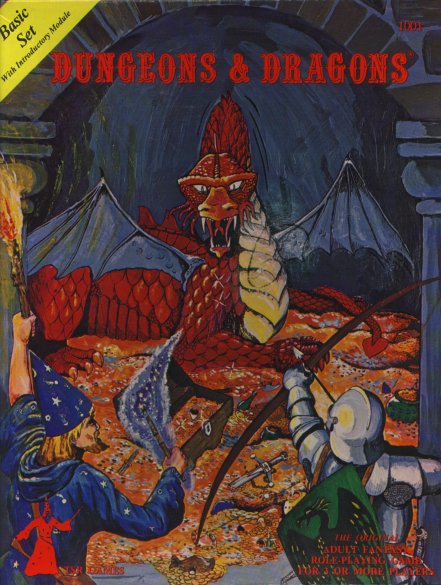
I had been discussing my history with roleplaying games with an acquaintance today, and out of curiosity, I looked up what edition of Dungeons & Dragons I had first purchased as boy, and found it was the 5th edition of the “Basic Set” published in late 1978/early 1979 (I’m pretty certain it was purchased with a Christmas gift card to Hess’ department store.)

basic5th

That means that I have been gaming — with a few breaks thanks to life events — 36 years now… It also got me thinking about all the games I’d played over the years. With plenty better to do with my time (like work on prepping a couple of up-coming 400-level classes and working on the new novel), I sat down, busted open Numbers on the MacBook Air, and started filling a spreadsheet with the games that had been played over the years and when. I didn’t get too granular — there were a few years where I might not have gamed for half the year, looking for players, or overtaken by events — but I did keep it to games I had played at least twice, or had some level of a campaign run.

I noticed trends in gaming that wouldn’t have occurred to me — when major life changes are in the offing, I tend to drop down to one particular game, after which there is an explosion of trying new games, before settling (generally) into two to three campaigns running coterminously. In the last few years, the multiple campaigns are more like two, mostly due to only playing one night a week, but for most of my adult life, I’ve been able to sustain two to three regular (weekly) game nights.

Another thing I noticed was what things were interesting me at the time — maybe it was subject matter, maybe it was some new system. My high school years saw the widest array of games played, mostly TSR products, of course, but rapidly dropping Star Frontiers for TravellerGangbusters and Top Secret got overrun by the much better James Bond: 007, and after high school, I never again played Dungeons & Dragons.

College (the first go ’round) saw a contraction to James Bond (me running), and Champions (run by another student in the group.) After college, I tried a few things — FASA Star Trek (The Next Generation would have just hit the air), Marvel Superheroes (FASERIP) as I had discovered comics during that glorious boom of excellent storytelling in the format. Bond remained the mainstay, however, until I moved to Philadelphia, where DC Heroes became the other campaign to hold through that two year period. Toward the end of 1989, however, GDW — whose Twilight: 2000 I had found so disappointing, brought us Space: 1889 — and more than anything launched the “steampunk” subgenre. I tried running it for a few months with some success, then hd a spectacular collapse of my life, requiring me to slink back to live with my mother for about a year.

I went back to college and excelled. I found new friends, and I started gaming. From 1990 until 2008, with a break during my military days, some manner of Victorian science fiction was on the docket, and so was James Bond. There was a period where Star Wars (d6) was our other big campaign, replaced by The Babylon Project…the d20 Babylon 5 campaign in the aughties did not engender that much interest. For the Space: 1889 game, we played with different systems — Castle Falkenstein, Fudge (later Fate), and other small homebrews banging around the not-yet-come-of-age internet.

When I moved back to Albuquerque in 2000, Star Trek (Last Unicorn, then Decipher) joined James Bond and our Space:1889 using Castle Falkenstein rules as our big game, with multiple successful and interlocking campaigns finished by 2005 or so. Grad school and GM fatigue trimmed Trek out of the rotation for Serenity. Then Battlestar Galactica and Hollow Earth Expedition hit. For the first time in almost 18 years, no Victorian game. James Bond as a rules set was still being played, but we were running an alternate Stargate game. Then BSG dropped and since 2008, I’ve had a campaign running — two in all with the first dying along with my marriage and a rather tight-knit gaming group that had been together since 2003.

The aftermath of that event saw about half the group stick together, and new campaigns were booted up — the current, and I think very successful, Battlestar Galactica game, and the excellent Shanghai Hollow Earth Expedition game which did not survive most of the other players having to bow out about a year or so later… BSG, for several years, has been the only real game we’ve played, outside of an abortive Supernatural and Marvel Heroic game. (Partly because it’s been a damned good game, partly due to the responsibilities of new parenthood for two of us…)

Recently, I’d noticed I’m branching out again and trying new things. BSG is on hiatus until we finish this first “volume” of Atomic Robo. We have another GM running Wild Talents for us. I’m starting to look at doing either a dystopian future or post-apocalyptic game…probably using Bond or Cortex as the engine. I’d like to bring back the Victorian sic-fi. It would seem that the ground is stable enough to branch out again.

Looking over the spreadsheet, I’m surprised by the longevity of some of these games, not so much by others. James Bond, by the time Victory Games lost the license in 1987, had been the most popular espionage RPG with about 100,000 copies sold…that’s huge for most roleplaying games. The rules set was innovative, and until Fate and Cortex, was about the best you could find for modern or near future games. I might not have used it for spy games, but I did use it to replace Cyberpunk, to run a game based loosely on John Varley’s Titan series, to run Stargate. The Victorian sci-fi thing was a direct influence on me going into history as a field of study, and it was slightly coincidence that during my doctorate, due partly to the collapse of our European department, partly due to my sudden interest in 1930s America that I switched focus from Victorian-period imperialism to modern American as my focus.

When I was talking to the wife about this piece, I had mentioned it was a bit pathetic that this hobby had taken up so much of my life, and her response was superb: It wasn’t pathetic; it was the thing that helped me evolve while have some sense of firmament. Gaming didn’t just reflect my interests, it helped shape them. My desire for verisimilitude led to my reading widely across fields. It was also the activity that brought me the friends that have lasted the longest, helped me move from being a painful shy youth, to a skilled public speaker, and taught me to think “out of the box” in ways that many do not.

With any luck, I can introduce my daughter to the hobby, and maybe she will be able to use it to help her grow and make friends in the future.

« Previous PageNext Page »