Roleplaying Games


In keeping with the game tonight — more adventures of Artemis Campbell, this time it’s 1948 Yugoslavia — here’s a pair of rifles for early Cold War jaunts:

Springfield Armory M1C Garand .30-06

The M1 was one of the issue rifles for the American forces during WWII and Korea, and could be had in 7.62 NATO or .30-06 (the C is a sniper weapon and was usually in the latter; ballistically, they don’t differ enough to have different stats.)  The rifle is a semi-automatic with a “clip” of eight rounds.  On the last round, the clip is also ejected.  The weapon has to be fed through the breach and the charging lever actuated to load the weapon.

PM: +1   S/R: 2   AMMO: 8   DC: J   CLOS: 0-50   LONG: 120-200   CON: n/a   JAM: 96+   DR: -3   RL: 2

GM Information:  The M1C and D had a sniper scope and has a LONG of 240-400.

And for the Yugos…

Samozaryadniy Karabin sistemi Simonova (SKS) 7.62x39mm

This is the carbine that much of the Eastern Bloc is using throughout the 1940s and 1950s.  It was introduced during the final year of WWII, and the Yugoslavians cranked out tons of them.  They are very robust and reliable, and this semiautomatic was the predecessor of the AK-47, which borrowed heavily from this design.  The 7.62mm was less powerful than it’s 7.62x51mm NATO competition, but accurate and deadly enough at the ranges for which it was designed (out to about 500 yards.)  They are fed either by a box magazine or by a stripper clip system similar to that of the Mauser M1897 broomhandle.  They are still popular in civilian markets.

PM: 0   S/R: 2   AMMO: 10   DC: I   CLOS: 0-20   LONG: 50-90   CON: n/a   JAM: 98+   DR: -3   RL: 2

GM Information:  The bayonet on an SKS gives a PM: +1   DC: +2.

A note on the ballistics and damages of the .30(ish) calibers….the Q Manual gives the .303 British cartridge a damage of I.  The .303 British round was  much more powerful than the 7.62x39mm round — on par with the .30-06 and in the same area as the .308/7.62x51mm NATO round.  Most of the .308 weapons are given a K damage, so a 7.62mm M1 should have a DC: K.  The .303 I place at DC: J, like the .30-06, more for the spotty quality of ammunition; when properly loaded, it’s just as lethal as .308.

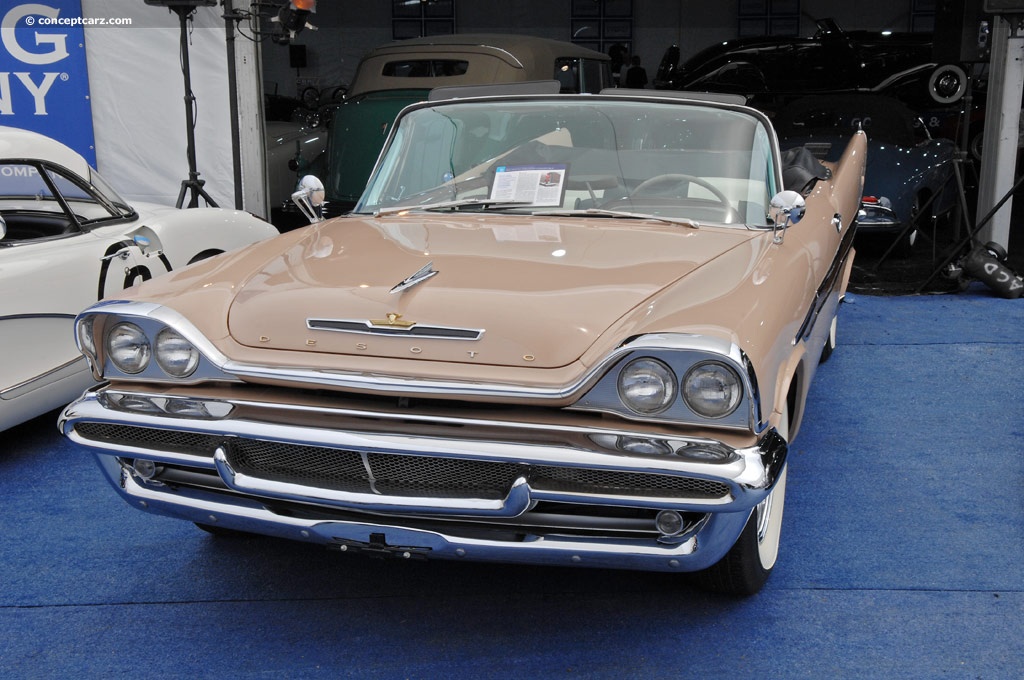
One of the hooks for the Engineer in our upcoming Dr. Who RPG was that her TARDIS always chooses vehicles when it can, and sometimes anachronistic versions of the same.  One of her/its favorite forms — the 1958 DeSoto Firesweep.  You get into the actual ship through the bonnet or the engine compartment.  It’s “a girl” and I’m hoping for a sense of humor in her operation that gives you the impression that she tolerates being a vessel for other people.

A friend of my mother’s had one of these when I was a kid in a turquoise with sea green trim.  It was big, beautiful, and I loved it.

And just because I can’t resist…the specs for the Firesweep for James Bond:

PM: 0   RED: 5   CRUS: 70   MAX: 120   RNG: 200   FCE: 3   STR: 7

GM Information:  the ’58 Firesweep is a beastly thing in turns:  -1EF to Quick Turn or Double Back, but a +1 to Force maneuvers.

I’ve been toying with the idea of a Ghost in the Shell-style campaign using Cortex.  Scattered throughout the core book and the Serenity material is much of what you might need to develop a setting similar to Shirow’s world.

First thing that is necessary is to have some kind of idea regarding cybernetics.  For systems like Cyberpunk and others in the cyberpunk genre, there is a tendency to get very detailed with the type of equipment that you’ve bolted onto yourself.  This isn’t really necessary:  most of the cybernetic enhancement can be covered by a few Traits, well described.  In essence, you have two things cybernetics would do, systems mechanics-wise:  increase your attributes, provide an existing trait, or provide skill emulation.

CYBERNETIC ENHANCEMENT (d2-d4):  You’ve have work done to improve your body’s natural characteristics — maybe it’s a kinesthetic monitoring system that enhances your inner ear, or sensory buffer that pushes data to the brain at a faster rate giving you a better Agility or Alertness; maybe it’s artificial eyes or ears that give better vision and hearing, adding to your Alertness; maybe its an adrenal boost that aids in your natural Strength; maybe it’s a drug shunt that adds to your Vitality or Willpower tests.  Whatever the system, it hacks the meat to push it to its limit.  You can take this multiple times, to give the boost across abilities.  Gives another die for tests involving that particular attribute.

METACORTEX (d2-d6):  This is a cybernetic uplink that conencts the user’s mind to the internet, or whatever you’re calling it in the campaign.  It doesn’t boost the intelligence of the user, per se, but instead gives a die bonus when doing an Intelligence based skill like Knowledge, Scientific Expertise, etc.  It allows you to find the data on the wb/net/cyberspace, and use it.  It doesn’t make you a surgeon, or an astronomer, or make you an expert in the paintings of Matisse, but you might be able to fake it.  It could also give the Enhanced Communications Trait at d6 (Because of the nature of the cyberpunk genre, I’d say just have this cost the equivalent of a d4 trait as an add-on.

Another Cybernetic Enhancement might give a Trait, instead — bionic legs might give a Fast on your Feet, but don’t offer much else in the way of enhancement; a Vehicle Interface would give you the Born Behind the Wheel Trait that is good for any vehicle; Eyes and Ears might provide Enhanced Senses; nanobots designed to strip toxins and disease from the body might provide a combination of Hearty Constitution and Fast Healing — or possibly Immune, depending on the nature of the cybernetics.

Cut down to the most basic levels, these are really the only Traits you need for the basic cybernetics.  To tailor them, you can take Complications specific to the technology.

Maybe your iBrain only works on the AT&T network, and as a result, you can’t always get a signal or fast throughput, you could take OUT OF NETWORK (d2-d6):  Depending on where you are, the GM might have you incur a die penalty, added to the difficulty of whatever Metacortex-based test you are rolling.  (“Dammit!  I’m only getting one bar — I’ll never get the recipe I need for this casserole in time!)

Maybe your strength benefit from cybernetics is specific to a single limb (“My right arm is the best prosthetics money can buy!”), and can only really be used for crushing or punching, but you can’t benchpress a ton if only your right arm from shoulder to hand is artificial.  Take the cost of the enhancement dow a die step, but note that it’s only go for such-and-such.

The real issue would be full body prosthesis — essentially, you would have to build the character as usual, but with the CONSTRUCTED Trait and NONHEALING Flaw — you require repairs after damage.  You might go so far as to have something like ROUTINE MAINTENANCE (d2-6):  If the character doesn’t receive routine service, their body is prone to breakdown or malfunction.  At d2, thy require service every six months, d4 monthly, d6weekly.  If they aren’t maintained, they must roll an EASY RESISTANCE for the first time period (for a d4, the first month), then +4/per period (AVERAGE for two months on a d4, HARD at three, etc…)  If the roll have failed, they have their die rating added to tasks as their system break down.  On a botch, they completely fail and cannot operate until repaired.

I think the tricker elements are the full body prostheses of GITS, where there’s enough of their biological bits and bobs left that they have to eat, but have to have mainenance, where they are resistance to disease, but the meat bits can still get sick.

Still ruminating on this…

So, one of my group members is going to start trading the GM reigns with me (first time I’ll get to play in about 8 years) and he decided to run the new Dr. Who game by Cubicle 7.

We were playing with who might play the Doctor, and I spitballed an idea for a new Time Lord: the Engineer.  Originally, I was seeing a Robbie Coltraine-esque figure for this character, with a penchant for steampunk and streamline moderne, but started to play with the idea over a few days.  I’m not a huge Whovian (or whatever they call themselves) and don’t know much about the universe:  I loved Eccelston’s season, I liked Tennant most of the time, the Matt Smith guy seems quite good in the two eps I’ve seen.  I’m not a fan of the old stuff which was just too campy for my tastes when I was a kid.

THE ENGINEER

ATTRIBUTES:  Awareness 4, Coordination 3, Ingenuity 7, Presence 3, Resolve 3, Strength 2

SKILLS:  Athletics 1, Convince 1, Craft (Building) 3, Fighting 0, Knowledge (Alien Cultures) 3, Marksman 1, Medicine 0, Science (Quantum Physics) 5, Subterfuge 1, Survival 1, Technology (Gadgetry, Repair) 5[+2], Transport (TARDIS) 3

TRAITS:  Attractive, Boffin, Psychic (Mildly so), Resourceful Pockets, Technically Adept, Time Lord, Experienced

FLAWS:  Adversary, Code of Conduct (Will attempt to help others), Dark Secret (Coward?), Eccentric (Thrillseeker), Impulsive, Last of Her Kind

Technology Levels: 4, 6, 10

The Engineer is one of the last Time Lords, who survived the Time War in an undisclosed manner — but one that involved being trapped outside of space and time (or turned into another race to escape the timelock, using a fob watch — leaving this up to the GM.)  He had opposed the Council’s final plan for victory, and for that was hunted by his own people, the form of the Horde of Travesties (I picked that because it sounded cool…)  He was either imprisoned or hid in his pocket universe, and to escape the refuge or prison, he had to die.  Regenerated, he was surprised to find himself not 6’8″ and 300 lbs, but 5’9″, slim…and female with a Scottish accent.

Guilty over her cowardice or inability to stop the destruction of Gallifrey, she has begun to do “good works” to attone.  This isn’t to do good; it’s to bolster her own image of self.  She is traveling in her Type 52 TARDIS — one of two left in the universe.  She tends to disguise it as a vehicle of the period she is in, or something whimsically similar — a train engine, a plane, a car…

Berin (the GM) decided she was the inventor of the fob watches that were in the Tennant tenure — where the mind and physiology of the Time Lord can be stored — and I am positing that they were created specifically to avoid detection by other Time Lords.

She is fascinated with technology — from simple devices to mechanical lifeforms, and has very peculiar tastes in aesthetics (“All cultures have two shared art periods — a kind of art deco/streamline moderne, and postmodernism.  One celebrates speed, enthusiasm, and adventure…the other sucks.”)

UPDATE: Onto my impressions of the Dr. Who character creation:  I’ve done up a character myself (above) and one of the other players — a human thief who will be introduced trying to steal the TARDIS in its 1959 DeSoto Fireflite convertible “disguise”.

Character creation is dead stupid simple:  24 point to spread across the attributes and traits (negative traits add back), and left overs can go to skills.  Skill points, you get 18 unless you have certain traits like Experienced of Time Lord, to put in the skills above (that’s it, folks!) and if you have a 33 or higher, you get a specialization.  You can also buy a specialization for a point and it gives you +2.  You have 12 Story Points (like plot points, hero points, etc.) that you use to manipulate the story, die rolls, etc.  It’s your maximum number of points you can have, but it can be reduced at character creation with traits like…Experienced, Time Lord, etc.

It took me ten minutes to build the Time Lord above, my first go.  The human thief, two or three…

(A public apology — I have been informed my name does appear on a few of the products that I have worked on for Cubicle 7, so to all and sundry…I’m a dick and I’m sorry for any heartburn I might have caused.  If you’re in Edinburgh from Aug 3-6, or the Galsgow area from Aug 7-15 (excluding the 8th — that’s birthday with the family — I will gladly buy you a pint as a “sorry”!)

For Battlestar Galactica and Serenity (and the other Cortex campaigns I might run), I’ve been using a stripped down “defense” system to speed play.  For players defending against multiple attacks, I have them roll once — either their Agility+Athletic (Dodge) [in hand-to-hand or melee they can use Agility+combat skill to block, parry, etc.] or the Agility straight if they don’t have the skill.  This test, if higher than the base difficulty to hit (say, Average for a bunch of mooks in a karate fight scene) — it’s the skill or attribute check they have to beat; if lower, it’s the 7 for an Average.  To emulate multiple attackers, I giver them a die step on their skill for each mook.

Example:  Martin “th Black Monk” Zhuong is fighting three guys from the Brotherhood of the White Chrysanthemum.  He has a Agility of d10 and a Unarmed combat (Karate) of d10.  The mooks are Agility d6+UC/Karate d6.  The three of them are wailing away at him in a circle and he has to do the Jet Li mutli-block schtick against them  it’s d6+d10 (+2 steps for the extra two guys) vs. Zhuong’s 2d10.  The GM rolls a 6 (they would have missed him even if he didn’t actively defend — most likely, their punches and kicks are getting in each other’s way — and Zhuong rolls a 19.  He easily beats them out, well enough that were this an actual test in a game I would let him have one attack roll at his normal stats, even if he had done multiple rolls.

It works for viper combat in BSG — Skidmark is being harried by three raiders that have her bracketed and locked up.  She is trying to fly them into her wingman’s line of fire, but has to dodge their shots.  Skidmakr is a solid pilot at d8 Agility and d10 Pilot/Viper.  The raiders are combat experienced Cylons with an Agility of d12, and due to experience, a Pilot of d4.  They roll a d12+d8 (for the extra two) vs. Skidmark’s d8+d10…Cylons roll 8, Skidmark 7: one of the raiders tags her viper for 1S+d8 for the cannon damage — a 6 — 1S, 6W.  Skidmark’s Mk VII takes 2W, after the armor.  they’ve stitched her ship, but “it’s nothing she can’t handle…”

Our Hollow Earth Expedition campaign, titled Gorilla Ace! for the eponymous character has been chugging along nicely since we first started joking with the idea of a lead character who was a gorilla and a pilot. We are now nine “issues” into the campaign and it shows no signs of stopping…

Here’s a brief list of the adventures, which one might turn into seeds for your own pulp-style campaign:

1: “Gorilla Ace and the Island of Terror!”  It’s June 1936, and WWI fly ace Rowland Cabot and his wife Jackie Jin Dr. Robert Stanford, a wealthy and connected doctor track down his missing medical school mentor. What they find on Ferrnando Po is a ppantation of slaves beg used by the evil Dr. Wasserman of the SS Medical corps as human guinea pigs — blending man and animal. During their escape, Cabot is accidentally dosed with formula that turns him into a giant gorilla man!

2: “Gorilla Ace and the Sky Pirates!”   On their way to England from Fernando Po, the team encounters a strange air vessel (think the SHIELD helicarriers and you’re close) committing piracy in the Straits of Gibraltar. They aid the Royal Navy in tracking the vessel to it’s secret base in Morocco, where they attempt to board and destroy the ship. (They wound up capturing it and bringing it into port.)

3: “Gorilla Ace and Perils of Celebrity”.   Now world famous, the team travels to London, only to have attempt by Nazi agents to kidnap him for study right off their ocean liner while at a stop in Bordeaux. On arrival in London, they are the toast of the town, but have to watch for British Union of Fascist agents tracking their every move.

4: “Gorilla Ace and the Attack of the Radio Men!”   Large robots spouting socialist rhetoric attack a gathering of the London aristocrats — including King Edward VIII — requiring the team and the Special Branch to thwart the robotic monstrosities. They track the fantastical contraptions’ heat Ray eye to a Swiss optician and learn of the figure behind the Radio Men…the infamous former NKVD agent “the Phantom”, hunted by his Stalinist enemies, and MI5 alike. Ended with a cliffhanger attack using a bomb in a special television set communicator…

5: “Gorilla Ace and the Lair of the Phantom!”  Gorilla Ace and his team discover the radio frequency controlling the Radio Men and track it to a warehouse in the East India Dockyards. Mayhem ensues when they run into more robotic giants and mooks on “hoop cycles”, leading to a chase on the vehicles through the London Underground. Jackie discovers the lair and learns of the Phantom’s plans to attack the British aristocracy at the heart during a speech in Parliament by the king to commemorate the upcoming 1936 Summer Olympics. James Bond style raid by Gorilla Ace and the Special Branch and the Phantom escapes.

6: “Gorilla Ace and the Hampstead Horror!”  The team are approached by a famed physicist and occultist looking for the secret of the radium engines the Radio Men used and that Dex Vincetti — the team’s mechanic has cracked. Dex and his notes are snagged up by zombies, leading to a meeting with MI6 occultist and agent Aleister Crowley (the crazy music thing is mostly an act to cover his espionage activities.). In a raid on the physicist’s home, they have to rescue Dex and stop a group of rich, idiotic occultists using a small radium-powered engine to heighten their mystic powers and open a gate to another dimension! Strange Chthulu-like critters are stopped from entering our world when they — of course — reverse the polarity.

7: “Gorilla Ace and Murder on the R100!” The team is traveling home on the airship R100 when a member of the crew is found murdered and stuffed in a Canadian official’s car. The investigation turns up a missing bag of money from the cargo hold safe with $1 million Canadian missing. They have to stop the murderer (a ship radio operator) and the thief from escaping via parachute over Newfoundland coastline.  Ends with a chase through the interior of the ship and on the top of the hull.

8:  “Gorilla Ace at the National Air Races!”  September 1936 and the Gorilla Ace Flying Circus has entered into several of the contests.  Jackie Cabot flies the Women’s Air Derby from Los Angeles (Grand Central Airport in Glendale) to Cincinati (pot was $4000.)  There’s the 10 mile, 10 lap Thompson Cup speed races ($9000 that year.) and lastly, the Bendix Cup, a grueling 2300 mile endurance course with a $7000 pot at the end.)

9:  “Gorilla Ace and the Simian Menace!”  Gorilla Ace and company are attacked by real dogfighters while shooting the dogfighting stunts of the new Gorilla Ace! movie serials.  Their attackers chase them over the streets of Burbank and the 300 yard long, 100 yard wide fake African jungle for the aerial shots (while being filmed!), using their wits to outsmart their opponents.  (Wound up with all three bad guy planes down and GA!’s SEV3 destroyed.)   Later, after a wrap party at the Trocadero with other RKO stars like Fred Astair, Errol Flynn, and guys like Howard Hughes, they find their home ransacked, and at their hangar Dex and his notebooks are missing.  They find Dr. Stanford has been held hostage while thugs and LAPD detectives search his Laurel Canyon home for his notes on Gorilla Ace and his transformation.  They later have to get Dex and his notes back in a fight on top of a Los Angeles monument.  (Haven’t finished this one, yet, so don’t want to release spoilers…players read the blog.)

Still to come!

10:  “Gorilla Ace and the Thing from Inside the Earth!”  An earthquake unleashes an ancient horror on Los Angeles and only the Gorilla Ace Flying Circus can save the day!  The GAFC joins up with an elite group of scientists and inventors fighting weird dangers to the world.  (Will include Nikola Tesla, possibly an “Atomic Robo”-like character, Howard Hughes, Dr. Henry Jones Jr., and others…  Going for a 1930s Dr. Savage meets Buckaroo Banzai flavor.)

11:  “Gorilla Ace and the Werewolf of Manhattan!”…that’s all I have for it, so far.

12.  “Gorilla Ace over China!”  A mission to supply the American volunteers in China goes awry.  Possilby introducing a Jake Cutter-esque character.

Here’s a piece from Michael Paukner.  There’s some beautiful stuff at his site.

A friend of mine is gearing up to run a Dr. Who campaign, using the new rules set from Cubicle 9. One of the rules bits he liked was their set up for Time Lord regeneration, where the appearance and abilities are randomly selected. It’s a good idea, in keeping with the show.

I had another idea that dovetails with this: randomly select a member of the gaming group to take over the role of the Doctor (or whatever Time Lord) and have them be the new “actor” for the series.

Recently, I ran the 1936 National Air Races for our Gorilla Ace! pulp campaign.  HEX has some fairly crunchy rules for chase sequences in Secrets of the Surface World, pg. 145 (sidebar), which is essentially what a race is.  The problem I found with the SOSW rules are that they cut into the flow of a cinematic/comic book action sequence — you have to take the base combat speed, add the base speed in feet of the vehicle times the number of successes.  It’s not complex, but it requires a sudden jump into math, and that can throw the players out of the moment.

I decided to run the races differently.  One of the races was the Thompson Cup — a 10 mile course through pylons at different altitudes (but usually quite low to the ground) with 10 laps total…I had the characters roll for each lap — their PILOT sill plus the Handling of the aircraft.  They were competing against some of the best pilots in the world, so I used the average assuming the pilots they were racing had a Dexterity 4, Pilot 4, and a +2 Handling:  they had to beat a 5 per lap to lead the race.

Any successes were added to their next lap test — so if one pilot got a +2 success (a 7), they added that +2 dice to their next test.  If they missed the test by two, then had a -2 dice to their test.  There was also a lower success point that, if missed, meant they lost control of the vehicle (a PILOT 2 in this case and totally arbitrary…)  Another thing I added was a reliability test for the vehicles at the beginning — race planes are testy beasts and the characters’ mechanic had to run a test at the beginning of the race.  A failure would mean some kind of mechanic issue that would put the character out of the race.

This systems moved fast and kept the excitement of a fast moving race.

For the Bendix Cup — a transcontinental race — the length of the contest was such that running all 15 hours or so would also not work.  For an endurance/ navigation based race, I set up legs for the trip — in this case, New York to Cincinati, Cincinati to St. Louis, St. Louis to Midland Texas, Texas to Los Angeles.  Each leg requires a MECHANICS test v. 2 — a failure results in an incident where the pilot would have to put the plane down safely and would be out of the race; the other test was a navigation test that the pilot (and if they had a navigator a joint test) vs. 2 during the day, 3 at night.

Modifiers for the distance test are different:  Handling isn’t an issue, speed is.  So in this case, I took the average speed of a racing plane (about 250mph) and gave a +1 die bonus for each 25 mph over the average, -1 die for each 25mph under the average.  The number of successes adds to the next leg’s test and the success is cumulative.  During a leg where they had to stop for fuel (usually about ever 900 miles) they would lose -2 die due to the time on the ground.

I think these guidelines can work to aid in a fast paced chase sequence, as well.  The chased car escapes once the die benefits are either higher that the pursuit car’s driver skill rating (for instance, a mook chasing you with a faster car [assume a +1 die bonus], a +2 handling, and skill rating of 6 for a total of 9 [average 4+] is lost when the die benefit from your successes is higher than 4+).  Another option would be to give the bonus from successes to a DRIVE test to do some maneuver that would hide the vehicle from the pursuer — park behind a building, make an unexpected turn into an alley, take it off-road and park behind a convenient copse of trees — with a contested DRIVE (pursued) vs. PERCEPTION (pursuer) test.  If they don’t see you, you lost them.

A lot of the games I like are set in the Victorian period and the 1930s.  As a historian, I have a tendency to get really wrapped up in the actual history of the eras we’re playing in — there’s so much actual neat stuff that I want to stick more closely to history than I probably should for a role playing game.  Still, often the players are jammed into a historical event that happened in an ancillary role or I change history.  I always throw in tons of real folks from the period, and occasionally will do a League of Extraordinary Gentlemen-style addition of cool fictional characters (I’m considering adding Indiana Jones and Jake Cutter to my Hollow Earth Expedition campaign as background characters.)

So, should you change history in your RPG?  Depends on the nature of the game.  If you’re not doing alternate history, you could have your players do lower-level stuff:  detective work in Los Angeles in the 1930s, fighting side battles in WWII…but it’s much more fun to throw them into a major event and let them either take the reins or in some way have an effect.

Tonight, the Gorilla Ace! crew flew in the 1936 National Air Races.  One character won the Thompson Cup instead of Michel Detroyant, and also won the Women’s Air Derby.  But through engine misfortune, they didn’t change the outcome of the Bendix Cup — won by Louise Thaden (the first woman to do so.)  I would have let them win, if they had rolled well enough.  They met Alexander de-Seversky (head of Seversky, later Republic Aircraft) and Gorilla Ace was hired to fly the SEV-3 in the Nationals.  Howard Hughes and Vince Bendix had minor roles, as did aviatrices Jackie Cochran, Louis Thaden, Laura Ingalls; avition greats Roscoe Turner (and his lion mascot, Gilmore), Ben and Maxine Howard — to name a few.

No matter if you’re doing “real” history or pulp adventure, use the people and events of the time to set the stage and give your campaign a little verisimilitude.  Yes, you might have aether flyers in the 1890s, but that doesn’t mean that you wouldn’t have the colonial campaigns that happened not occur; you still have the same prime minister in the UK, and president in the US as in real life…but maybe there’s something different about them.  I have airships in my pulp campaign being used for commercial and military use when in actuality the British airship scheme folded in 1931, and the US Navy program had pretty much ended with the decommissioning of Los Angeles — history is different, but there’s enough that’s the same to make it comfortable for the players.  There are giant robot men in London in the pulp campaign running on radium-powered engines, but it’s not common technology.

Play with history.  Your games will be better for it.

« Previous PageNext Page »