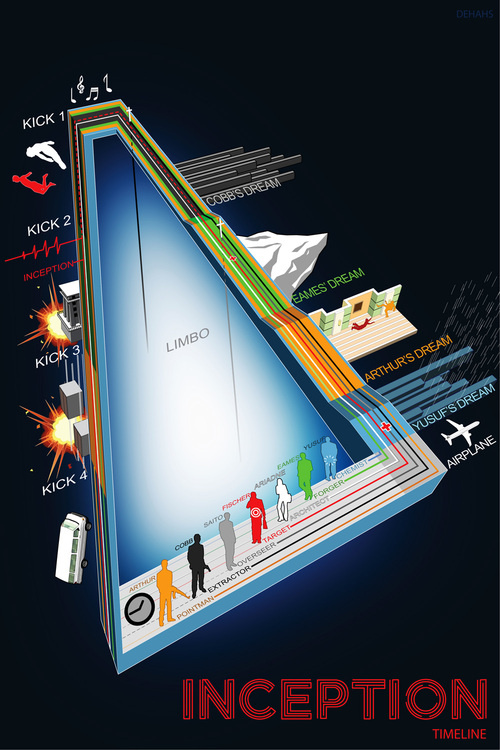
Dehah’s fantastic infographic of the Inception plotline, just in case you forgot who’s dream was whose….
31 July, 2010
Dehah’s fantastic infographic of the Inception plotline, just in case you forgot who’s dream was whose….
31 July, 2010
In keeping with the game tonight — more adventures of Artemis Campbell, this time it’s 1948 Yugoslavia — here’s a pair of rifles for early Cold War jaunts:
Springfield Armory M1C Garand .30-06

The M1 was one of the issue rifles for the American forces during WWII and Korea, and could be had in 7.62 NATO or .30-06 (the C is a sniper weapon and was usually in the latter; ballistically, they don’t differ enough to have different stats.) The rifle is a semi-automatic with a “clip” of eight rounds. On the last round, the clip is also ejected. The weapon has to be fed through the breach and the charging lever actuated to load the weapon.
PM: +1 S/R: 2 AMMO: 8 DC: J CLOS: 0-50 LONG: 120-200 CON: n/a JAM: 96+ DR: -3 RL: 2
GM Information: The M1C and D had a sniper scope and has a LONG of 240-400.
And for the Yugos…
Samozaryadniy Karabin sistemi Simonova (SKS) 7.62x39mm

This is the carbine that much of the Eastern Bloc is using throughout the 1940s and 1950s. It was introduced during the final year of WWII, and the Yugoslavians cranked out tons of them. They are very robust and reliable, and this semiautomatic was the predecessor of the AK-47, which borrowed heavily from this design. The 7.62mm was less powerful than it’s 7.62x51mm NATO competition, but accurate and deadly enough at the ranges for which it was designed (out to about 500 yards.) They are fed either by a box magazine or by a stripper clip system similar to that of the Mauser M1897 broomhandle. They are still popular in civilian markets.
PM: 0 S/R: 2 AMMO: 10 DC: I CLOS: 0-20 LONG: 50-90 CON: n/a JAM: 98+ DR: -3 RL: 2
GM Information: The bayonet on an SKS gives a PM: +1 DC: +2.
A note on the ballistics and damages of the .30(ish) calibers….the Q Manual gives the .303 British cartridge a damage of I. The .303 British round was much more powerful than the 7.62x39mm round — on par with the .30-06 and in the same area as the .308/7.62x51mm NATO round. Most of the .308 weapons are given a K damage, so a 7.62mm M1 should have a DC: K. The .303 I place at DC: J, like the .30-06, more for the spotty quality of ammunition; when properly loaded, it’s just as lethal as .308.
26 July, 2010
One of the hooks for the Engineer in our upcoming Dr. Who RPG was that her TARDIS always chooses vehicles when it can, and sometimes anachronistic versions of the same. One of her/its favorite forms — the 1958 DeSoto Firesweep. You get into the actual ship through the bonnet or the engine compartment. It’s “a girl” and I’m hoping for a sense of humor in her operation that gives you the impression that she tolerates being a vessel for other people.

A friend of my mother’s had one of these when I was a kid in a turquoise with sea green trim. It was big, beautiful, and I loved it.
And just because I can’t resist…the specs for the Firesweep for James Bond:
PM: 0 RED: 5 CRUS: 70 MAX: 120 RNG: 200 FCE: 3 STR: 7
GM Information: the ’58 Firesweep is a beastly thing in turns: -1EF to Quick Turn or Double Back, but a +1 to Force maneuvers.
23 July, 2010
Okay — went to see Inception today since it looked like the kind of flick that works best on the big screen. So the review: it’s good. Really bloody good.
The world it paints is ambiguous enough to disguise that it’s cyberpunk-style science-fiction, a heist movie wrapped in near future sci-fi where the protagonists are able to jacking into other people’s subconsciousnesses while they are sleeping. The movie’s internal logic holds and they don’t play with the technology outside the basic premise — you can ride along in someone’s dreams, you can manipulate what they are doing to get to information they are trying to hide or to explore/alter their dream state.
The lead character, Cobb, is a troubled fellow (we find out why later — essentially he got trapped in a dream state where the perceived timespan was decades; it — and another important plot element — have left him a bit loopy, and on the run from the United States, where his children are) but he is a top “extractor” — a man who pulls information from people’s minds. He gets hired by a Japanese corporate type with a faint smell of yakuza (although this is never mentioned…maybe I’m just projecting a bit of the ol’ WG onto the flick) to break into the mind of an heir to a major energy corporation to get him to do the unthinkable: break up his father’s near monopolistic hold on energy.
To plant an idea in a person’s mind is extremely difficult, as they can always track the source of the meme; they call it “inception”. Cobb is promised by the Saito — Ken Watanabe being awesome — that he will fix it so the charges keeping Cobb out of the US are dropped. Cobb jumps at the chance and puts together a crack team to intercept Fischer (Cilian Murphy…good as always!) and break into his mind to plant this idea of breaking up his inheritance.
After this point, the action ramps up and the movie starts throwing fantastic effects sequences, interspersed with actual stunts (real stunt work always punches up CGI, I think; without a grounding in the real world — in sets, stunts, etc. — CGI starts working against the verisimilitude the more it is abused), and damned good action sequences that really take advantage of the “mental landscapes” the characters are in. There a slight Philip K Dick suggestion at the end that is no surprise in coming, but it’s almost necessary to put the button on the movie.
The acting is quite good — from Leo DeCaprio’s Cobb and Cillian Murphy’s Fischer, to Marion Coutillard as Cobb’s ex. The show, for me, was stolen — and this seems to be the case whenever I see him in things — by Tom Hardy (loved him in Rock n Rolla). Ellen Page I tend to find one-note in her performances, but she’s workable in this. Joseph Gordon-Levitt is well cast and does a good job as Cobb’s number two.
The visuals are stunning, and the wire work and combination of set design for actual stunt work really makes the movie pop. The CGI looks great, but that’s because they use it to enhance, not to do the heavy lifting in the scenes. It’s well written, and at about two and a half hours only about 5-10 minutes too long. Not enough to not enjoy, just enough to notice it’s time to wrap it up.
The sound mixing is the usual overly loud music and sound effects, but I could understand what the actors were saying…so plus there.
Style: 5 out of 5 with a bullet. Substance: 5 out of 5. It’s a damn good movie. Worth the full price, not just matinée.
21 July, 2010
Just a heads-up for those that care: I will be on vacation for the first half of August, so posting will be rare or nonexistent until after the 16th. I most likely will still be answering comments or emails, depending on my Internet coverage. (Probably going to splurge on Vodaphone’s 3G card for the iPad.)
Hopefully, I’ll have time to post some pictures.
20 July, 2010
So, one of my group members is going to start trading the GM reigns with me (first time I’ll get to play in about 8 years) and he decided to run the new Dr. Who game by Cubicle 7.
We were playing with who might play the Doctor, and I spitballed an idea for a new Time Lord: the Engineer. Originally, I was seeing a Robbie Coltraine-esque figure for this character, with a penchant for steampunk and streamline moderne, but started to play with the idea over a few days. I’m not a huge Whovian (or whatever they call themselves) and don’t know much about the universe: I loved Eccelston’s season, I liked Tennant most of the time, the Matt Smith guy seems quite good in the two eps I’ve seen. I’m not a fan of the old stuff which was just too campy for my tastes when I was a kid.
THE ENGINEER
ATTRIBUTES: Awareness 4, Coordination 3, Ingenuity 7, Presence 3, Resolve 3, Strength 2
SKILLS: Athletics 1, Convince 1, Craft (Building) 3, Fighting 0, Knowledge (Alien Cultures) 3, Marksman 1, Medicine 0, Science (Quantum Physics) 5, Subterfuge 1, Survival 1, Technology (Gadgetry, Repair) 5[+2], Transport (TARDIS) 3
TRAITS: Attractive, Boffin, Psychic (Mildly so), Resourceful Pockets, Technically Adept, Time Lord, Experienced
FLAWS: Adversary, Code of Conduct (Will attempt to help others), Dark Secret (Coward?), Eccentric (Thrillseeker), Impulsive, Last of Her Kind
Technology Levels: 4, 6, 10
The Engineer is one of the last Time Lords, who survived the Time War in an undisclosed manner — but one that involved being trapped outside of space and time (or turned into another race to escape the timelock, using a fob watch — leaving this up to the GM.) He had opposed the Council’s final plan for victory, and for that was hunted by his own people, the form of the Horde of Travesties (I picked that because it sounded cool…) He was either imprisoned or hid in his pocket universe, and to escape the refuge or prison, he had to die. Regenerated, he was surprised to find himself not 6’8″ and 300 lbs, but 5’9″, slim…and female with a Scottish accent.
Guilty over her cowardice or inability to stop the destruction of Gallifrey, she has begun to do “good works” to attone. This isn’t to do good; it’s to bolster her own image of self. She is traveling in her Type 52 TARDIS — one of two left in the universe. She tends to disguise it as a vehicle of the period she is in, or something whimsically similar — a train engine, a plane, a car…
Berin (the GM) decided she was the inventor of the fob watches that were in the Tennant tenure — where the mind and physiology of the Time Lord can be stored — and I am positing that they were created specifically to avoid detection by other Time Lords.
She is fascinated with technology — from simple devices to mechanical lifeforms, and has very peculiar tastes in aesthetics (“All cultures have two shared art periods — a kind of art deco/streamline moderne, and postmodernism. One celebrates speed, enthusiasm, and adventure…the other sucks.”)
UPDATE: Onto my impressions of the Dr. Who character creation: I’ve done up a character myself (above) and one of the other players — a human thief who will be introduced trying to steal the TARDIS in its 1959 DeSoto Fireflite convertible “disguise”.
Character creation is dead stupid simple: 24 point to spread across the attributes and traits (negative traits add back), and left overs can go to skills. Skill points, you get 18 unless you have certain traits like Experienced of Time Lord, to put in the skills above (that’s it, folks!) and if you have a 33 or higher, you get a specialization. You can also buy a specialization for a point and it gives you +2. You have 12 Story Points (like plot points, hero points, etc.) that you use to manipulate the story, die rolls, etc. It’s your maximum number of points you can have, but it can be reduced at character creation with traits like…Experienced, Time Lord, etc.
It took me ten minutes to build the Time Lord above, my first go. The human thief, two or three…
(A public apology — I have been informed my name does appear on a few of the products that I have worked on for Cubicle 7, so to all and sundry…I’m a dick and I’m sorry for any heartburn I might have caused. If you’re in Edinburgh from Aug 3-6, or the Galsgow area from Aug 7-15 (excluding the 8th — that’s birthday with the family — I will gladly buy you a pint as a “sorry”!)
19 July, 2010
The New York Times had an editorial a few months ago on an idea floating through the hall of Comgress, and splattered out there by the “Paper of Record”: “search neutrality“… If this doesn’t sound scary to you, you need to think some more on it, or remember this — eventually, you’re people will be out of power and someone else will have access to those organs of government you set up.
Here’s the gist: Google,which is a massive Democratic Party supporter, managed to get a bunch of halfwitted Progressives into office. They were one of the major forces behind “net neutrality”, a staggeringly bad idea couched in terms of “freedom” and “fairness” (mostly the latter, since it would limit the former), and designed to benefit smaller bandwidth sites Vis-a-vis larger ones. In other words, it’s a subsidy for smaller sites (political ones, if you hadn’t gotten the inference) that can’t compete. This support wouldn’t go to me, for instance…I’ll still have to pay my ISP and put up with service transfer limits, high as they are. If I want to take my blog here big time, I have to pay for a swankier site, a domain name.
No, this is for the political websites — the DNC supported sites, the small opinion maker sites, and other groups that want a free ride competing in the marketplace of ideas. And guess who gets to decide what’s fair in this marketplace? It’s the electronic Fairness Doctrine, and the pushers of Net Neutrality hope to strengthen their hold on the political and historical narrative with it.
Now comes along “search neutrality”, which is touted as aiding smaller sites to be seen on Google’s search engine. Right now, you can pay to have your site be a banner result, or the engine occasionally throws up a few likely websites you’re looking for based on your previous search history. But that doesn’t get government funded or subsidized companies in the top slots of the search returns, and it doesn’t let less innovative or motivated companies do the same (think the small oil companies that couldn’t compete with Standard Oil…answer: have your Comgressman attack Standard Oil.) It also doesn’t get you to politically approved sites for the information you are looking for. There’s to much chance you might wind up on a blog or site that do not have the correct political persuasion and might cause you to question the wisdom of certain policies or politicians.
Search Neutrality is a cudgel to quash free speech and competition, as is net neutrality, wrapped in the promise of “fairness”. It also ignores the fact that Google has competition in the search engine market. Bing has become a popular engine for those looking to escape the data mining and sales activities of Google. There’s Start Page, Dogpile (which used to be fantastic and was my go-to for years.). Why does Google have such a good market share on searching? They do it better than their competition!
Google was none too fond of China curtailing their activities; it should be a lesson for the company: government regulation always comes at a cost. Think about that, the next time you’re pushing some “neutrality plot”, boys.
 The Black Campbell