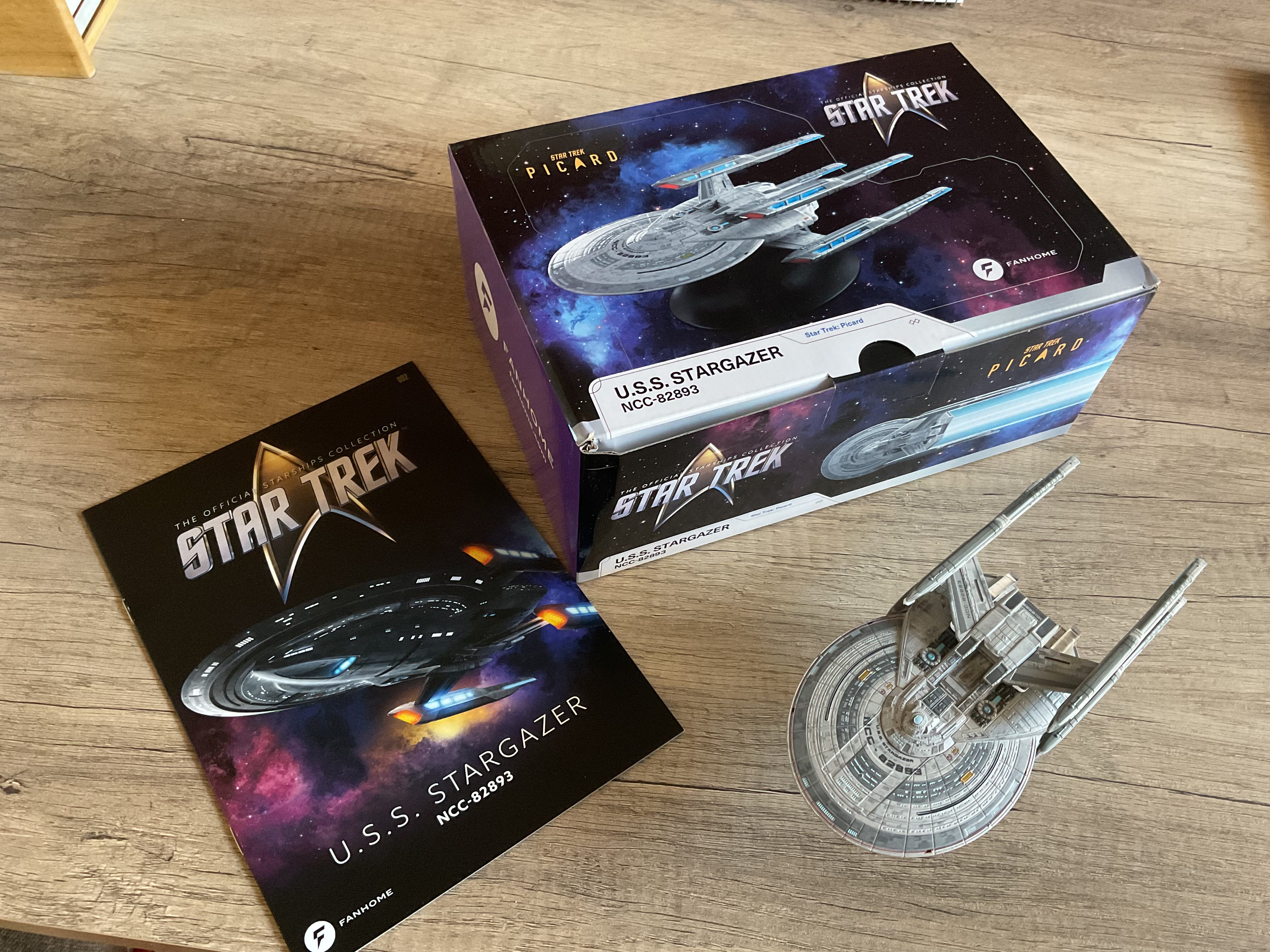
The latest drop from FanHome did not disappoint. Even though I’m not much on the look of a lot of the 25th Century ships but Stargazer (Sagan-class) is well executed. It arrived about a week late thanks to the holiday season (and to much online bitching), but again — the packaging is much better than the bland blue of Eaglemoss, similar packing, the usual booklet on the design, history, and appearance of the ship with good quality gloss paper.
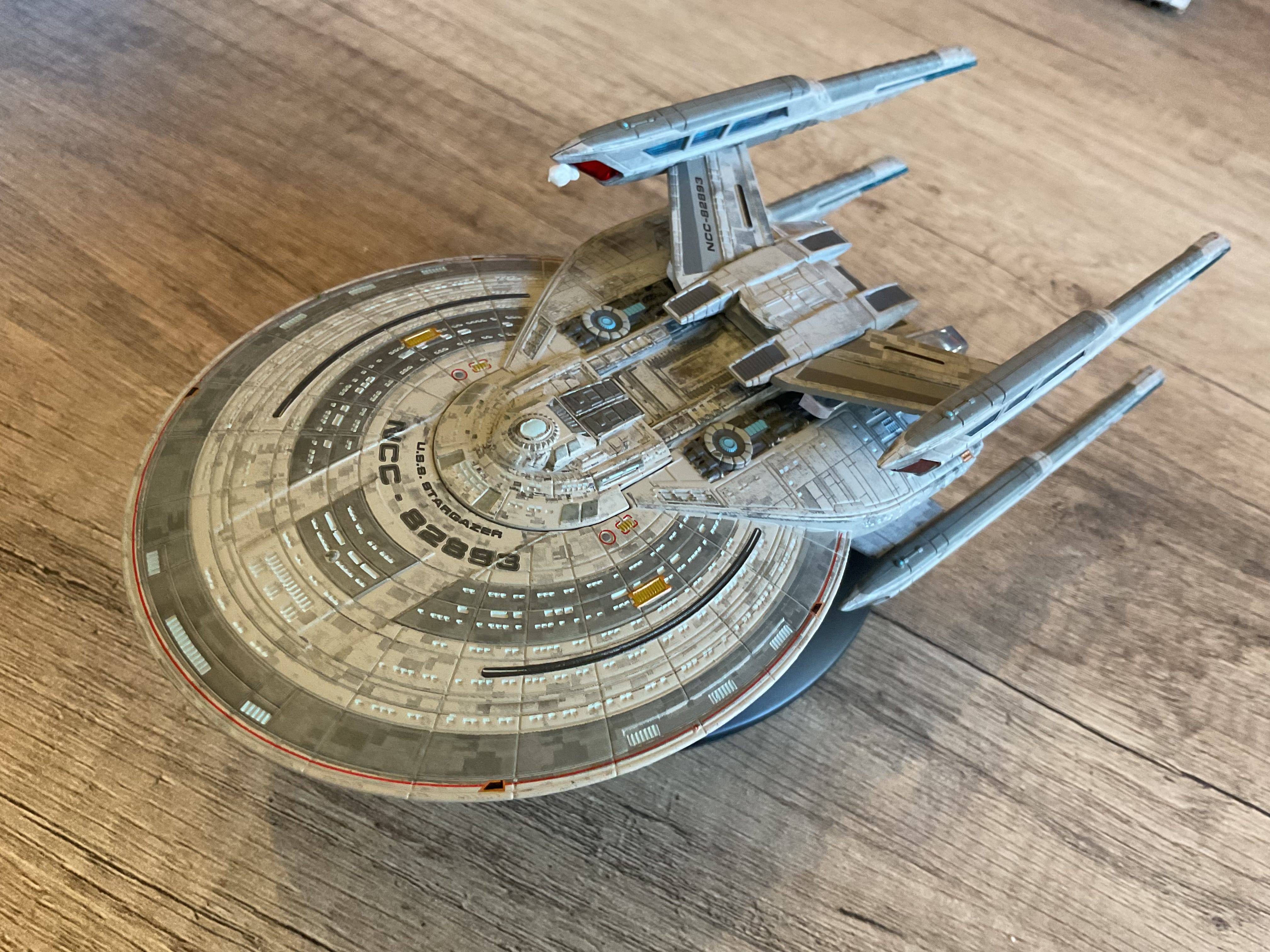
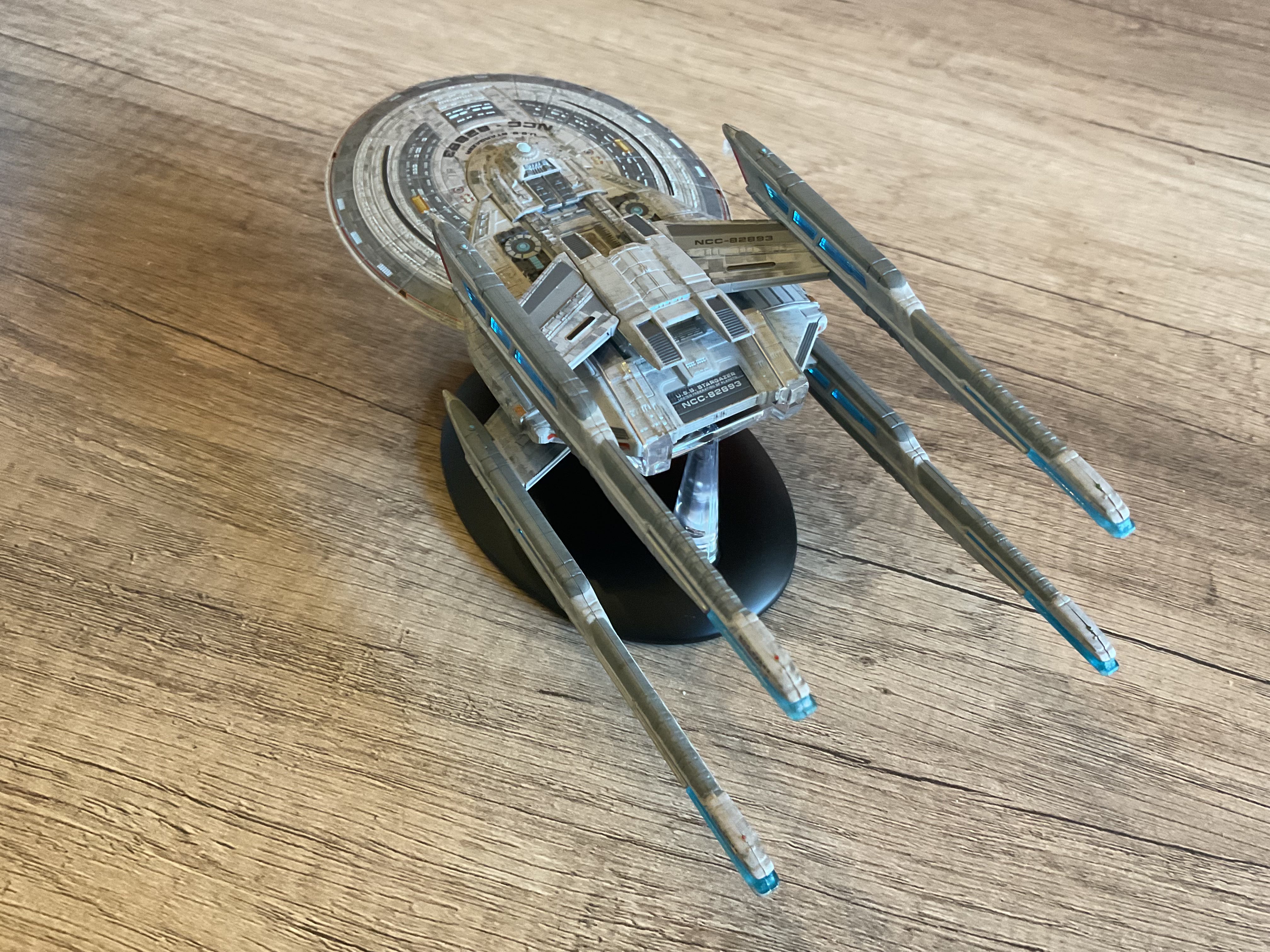
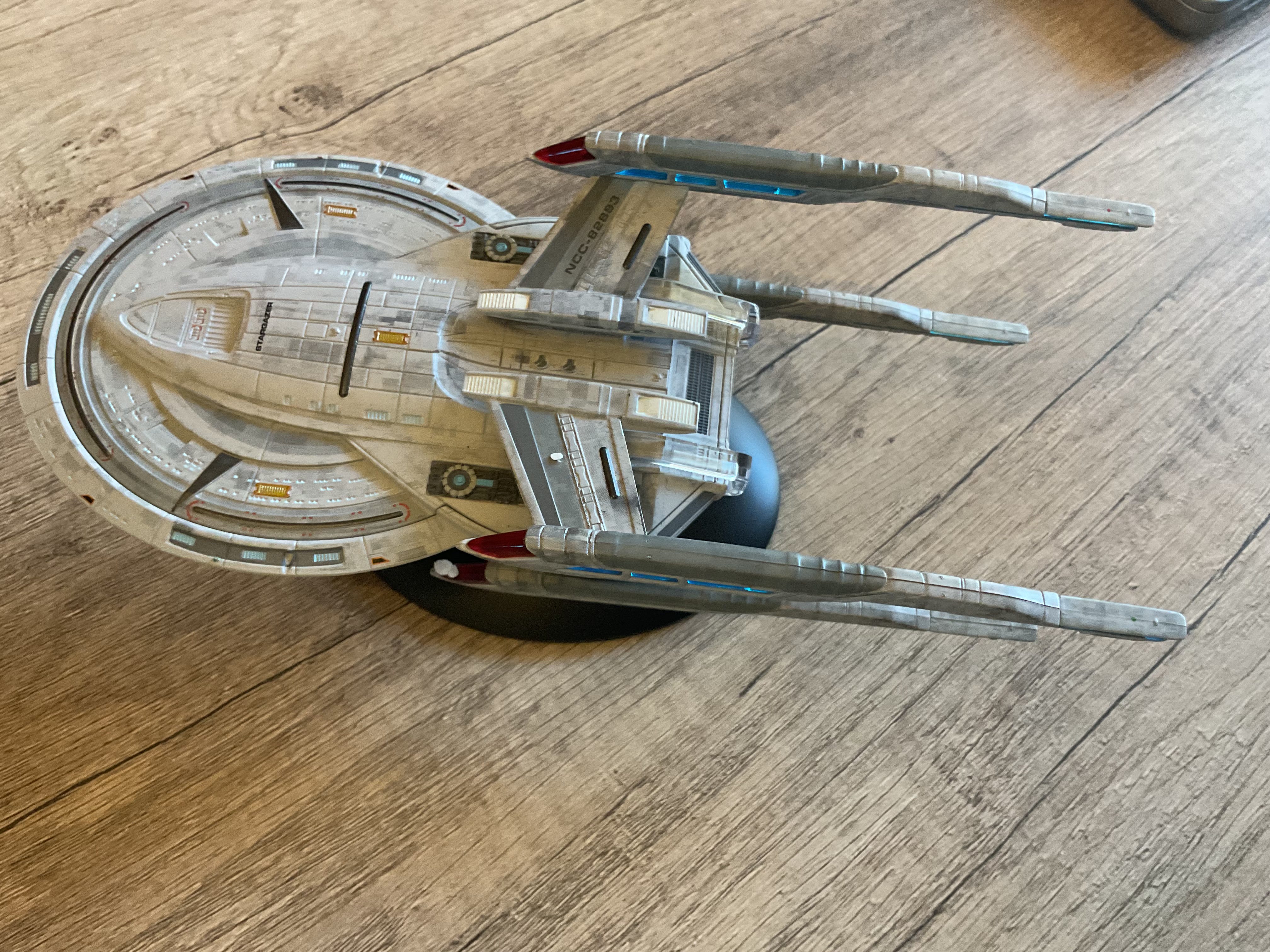
The model itself is well detailed, but in the mold and the paint job. The portholes really pop on this thing, for some reason (I think because they’re a light blue rather than white.)
There’s a bit more detail on the undersides of this and Titan from last month than Eaglemoss often would do on the Discovery period ships, so that’s a plus.
Overall, I’ve been pretty impressed with the model quality and presentation so fan. Can’t wait to see a Strange New Worlds ship to compare with the previous Pike Enterprise: next month: Farragut.
Is it worth it? If you’ve been collecting Trek ships from the previous manufacturer and are a completist, absolutely. If this was a ship that really sang to you, yes. Price should be $65 w/ shipping. The subscription knocks off $10 and shipping. Allegedly, you can cancel the ones you don’t want, but I’ve yet to test that with FanHome (although Eaglemoss did it for my Galactica subscription, no questions.)
Spotlight Characters: Security and Science officers
SYNOPSIS
The ship is doing a routine patrol along the Romulan Neutral Zone when they receive a distress signal from Nimbus III.
OPENING LOG ENTRY
Captain’s Log, Stardate 56844.1: We are on a routine patrol along the Romulan Neutral Zone, close to the Nimbus system — the “Planet of Galactic Peace” — whose purpose is to allow the major powers of the Quadrant to meet and hash out their differences peaceably. In reality it is a sort of civilian Starbase 80 — a dumping ground for failed and disgraced diplomats. It is located in the Neutral Zone, and is the only point where Federation, Romulan, and Klingon ships may enter the zone.
MAJOR BEATS
1) Distress Call
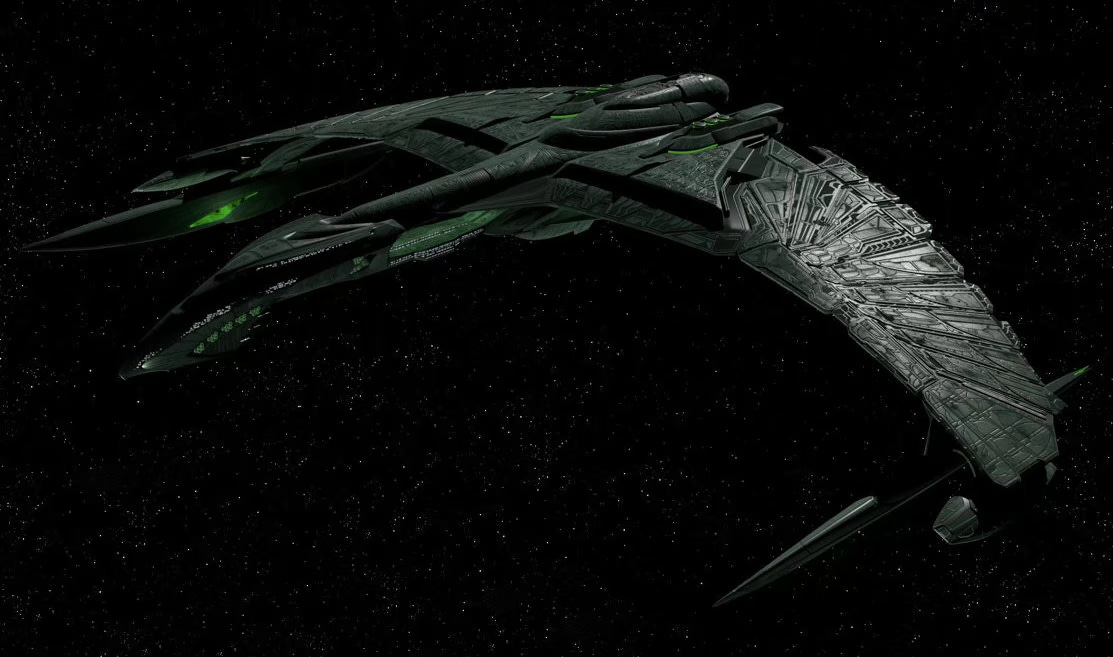
The ship will monitor some kind of high energy discharges only a few light hours away in the Romulan Neutral Zone. A successful scan of the area will reveal two Romulan warbirds duking it out. Both are in violation of treaty, but what are they doing fighting each other? As they watch, the Valdore-class warbird is destroyed by the older, larger D’Deridex, which quickly cloaks and disappears. A successful scan, difficulty 4 will reveal that just before the destruction of the warbird, there was a vessel launched and which quickly cloaked (for 2MP, they can determine it was a small scout ship, their equivalent of a runabout.)
They will pick up a faint signal a little while later. It’s the scout vessel, currently in the Nimbus system. “…need assistance… attacked by warbird {static] and ship destroyed… Have to get word to the high command… coup d’etat… Trying to make Nimbus III but losing control…” They will lose the signal, but not before the ship is spotted near Nimbus III, entering the atmosphere much too quickly.
Fortunately, they are authorized to enter the zone in a tight corridor of space to get to Nimbus III. A difficulty 2 navigation test should get them there in an hour or so.
2) Planet of Galactic Peace
A review of their records will show the Romulan ambassador is Shir’el — a diplomat that had worked to bring the Romulans into the Dominion War after the assassination of Senator Vreenak. The UFP Vincent Lorentz — a human from Centauri who had some personal issues that made him unsuitable for higher office. The Klingon ambassador is a former captain, Balek, who lost his attack wing during the war and has been parked on Nimbus III in disgrace. the world itself is mostly desert, although the settlers conned into coming to Nimbus with the promise of opportunity have managed to wrestle portions of it into (barely) arable land. The capital is Paradise City, and they will hear from any officials they contact that the scout ship never made it.
If they contacted the Romulan ambassador, he will relate that the scout ship must have gone down somewhere on the planet and that they will find it. Their assistance is not required. The Federation diplomat, however, will encourage them to find the ship and rescue the crew.
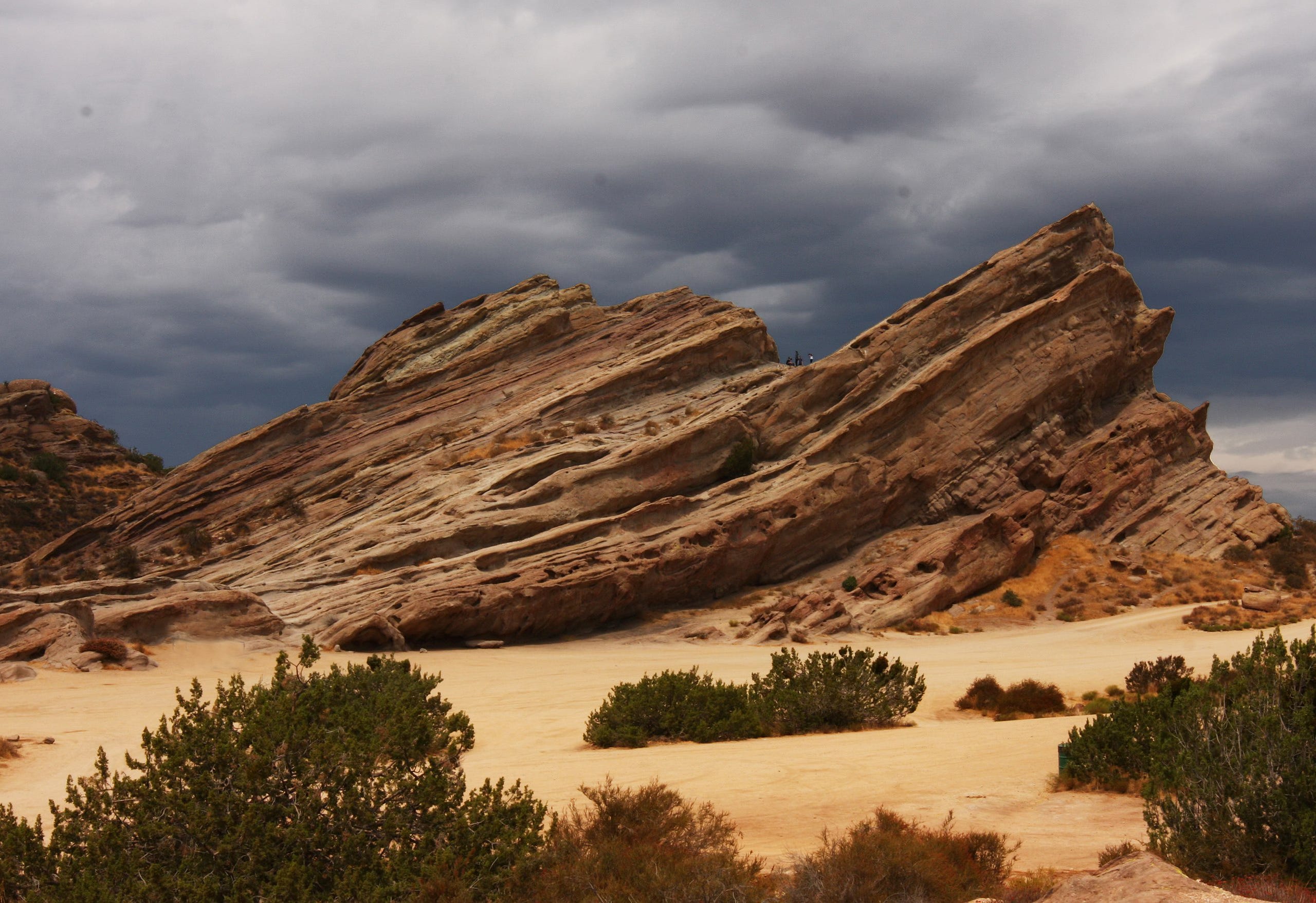
On arrival, they can start scanning for the ship. The helmsman can assist with a successful difficulty 1 test to set up a Polar Orbit scene trait that will aid in a more quick and efficient scan. This can be run as an extended test. Once they have found it, the wreck is near a small town of farms near an outcropping of rocky hills (that are absolutely not the Vasquez Rocks). The wreck is mostly intact, but there’s no life signs.
The mission directives are thus: 1) find and rescue the crew, 2) gather any intelligence regarding their claim of a coup d’etat — a coup against whom?
3) The Wreck
The scout ship is badly damaged — it looks like when their mothership blew up, the scout was hit with debris that eventually caused a lost of power and control systems. The computer core has been destroyed with a disruptor. Why? Before they can ask, a ground vehicle with a team of Romulans will arrive — and they are not friendly disposed. The leader Senek is looking for the crew, as well, and is highly suspicious of their presence.
Searching the area for life signs — there’s some small critters and plant life tenaciously digging into the dead soil of the planet. A difficulty 3 will find the Romulans from the scout ship, two life signs, hiding (of course) in a cave in the rocks. Work together with the Romulans or try to beat them to the crew?
4) Friend or Foe?
The crew are Tal Shi’ar officers who are hiding out from their people. Subcommander Valera and Lieutenant Tala had tried to reach the Federation ambassador, but their ship was barely under their control. Why not go to their ambassador? The reason is simple: they don’t know who to trust; they were attacked by Commander Suran of the warbird Triere. He’s one of the main commanders in the region.
If the characters had worked with the Romulans to find the crew, this is where the double cross happens and the Romulans attack!
They had uncovered one of the Tal Shi’ar’s research centers was experimenting with a danger weapon: a small thalaron radiation projector. Thalaron radiation can disrupt biological functions quickly and disastrously. These projectors had been built for some of their people who were concerned about the thawing relations with the Federation following the Dominion War, and are looking to murder the Praetor Hiren!
If the characters worked alone and beat the Romulans to the cave and the scout ship’s crew, they’ll arrive just in time for a fight.
5) Calling in the Cavalry
Once back on their ship, they can attempt to contact a Romulan commander that Valera trusts: Commander Donatra of the warbird Valdore. They will receive word that she is on her way, but at that moment Commander Suran’s D’Deridexuncloaks! He will demand the return of the scout’s crew or he will destroy their ship.
If a fight ensues, let it run until one side or the other is in real trouble. At that point, Valdore will arrive and Donatra will warn Suran off. She will take the Tal Shi’ar officers into her protection. They’ve done a real service; they made have just stopped a Romulan civil war.
CONCLUSION
The crew, several days later, will receive the news that a coup d’etat has occurred on Romulus and that a new Praetor, Shinzon, has ascended to rule. the rumor is some kind of biogenic weapon was used to kill much of the Romulan Senate! He has already offered to open talks with the Federation, and USS Enterprise under Captain Picard is on route to Romulus.
The copyright for 2d20 system is Modiphius, 2019. STAR TREK and related marks and logos are trademarks of CBS Studios inc. All Rights Reserved and no infringement is intended.
So…you can use your Promotion Points in the Blade Runner RPG, but what exactly are those awards and medals? Here’s a list of real (and a few imagined for the Blade Runnersetting) for your characters to spend PP on.
Los Angeles Police Department Awards and Decorations
The awards and medals are not presented in their order of precedence when displaced on an officer’s uniform.
Awards for Bravery
Medal of Valor: Given for individual acts of bravery above and beyond the call of duty, this medal is awarded by the Board of Police Commissioners and the Chief of Police, and is the highest award in the department. It was first presented in 1925 and is awarded at a yearly banquet for the medal’s recipients.
Preservation of Life Medal: This medal may be awarded to an officer who has distinguished himself or herself by employing exceptional tactics and exercising sound judgment, beyond the normal demands of duty, to preserve the life of another during a volatile or dangerous encounter while protecting the safety and security of the public or fellow officers.
Police Medal: Awarded for individual acts of bravery in the line of duty (though not above and beyond the call).
Purple Heart: Awarded to officers who sustain traumatic injury due to suspect action in the line of duty. May also be awarded posthumously when officer dies due to suspect’s actions.
Police Star: An award for bravery performed with exceptional judgment and/or utilization of tactics to defuse dangerous situations.
Police Lifesaving Medal: Given for bravery in the act of rescuing or attempting to rescue a fellow officer or other person in imminent danger.
Awards for Service
Police Distinguished Service Medal: The Distinguished Service Medal is the department’s highest award for service and may be awarded to officers or other employees who distinguish themselves by performing exceptional service in a duty of great responsibility or of critical importance to law enforcement.
Police Meritorious Service Medal: This medal is awarded to employees who distinguish themselves by performing exception service in a position of of great responsibility or critical importance to law enforcement, but to a lesser degree than required for the Distinguished Service Medal.
Police Meritorious Achievement Medal: Primarily a civilian award, given for either sustained, long-term, noteworthy achievement or a single significant, noteworthy achievement in the administrative, clerical, or craft duties.
Police Commission Distinguished Service Medal: This medal is given for exceptional performance in service to the LAPD in stressful or emergency situations with good judgment or bravery.
Police Commission Integrity Medal: Awarded for actions of exemplary integrity, requiring personal character, fortitude or moral courage.
Community Policing Medal: This medal is given to personnel who have solved a significant community problem, included the community in the problem solving process, and/or showing a commitment to the department’s community policing philosophy.
Human Relations Medal: Awarded to officers who have shown compassion and gone above and beyond the call of duty in their response to their fellow human beings.
Unit Citations
(These are typically authorized for uniform wear while serving with the unit.)
Police Commission Unit Citation: The highest unit award, this citation is given to an organization unit of the department for bravery or outstanding service by its members functioning as a team.
Police Meritorious Unit Citation: Awarded to an organizational unit of the department for bravery or outstanding service by its members, but to a lesser degree than the Commission Unit Citation.
Commendations
Commendation Ribbon: The ribbon is authorized for wear after the employee has received 40 minor or major commendations or citizen letters. After 80 such commendations, a bronze oak leaf is worn on the ribbon. After 120 commendations, the bronze oak leaf is replaced with a silver star. after 160 commendations, the silver star is replaced by a gold star.
Patrol Service Ribbon: The ribbon is authorized for wear after 5 years of patrol services as an officer, sergeant, or lieutenant. After 10 years, a bronze oak leaf is worn on the ribbon. After 15 years, the leaf is replaced by a silver star, and after 20 years, with a gold star.
Detective Service Ribbon: This ribbon is authorized after 5 years with investigative units as a detective or lieutenant. As with the Patrol Service Ribbon, the bronze oak leaf device is worn on the ribbon after 10 years, a silver star after 15, and gold star after 20 years.
Replicant Detection Ribbon: The ribbon is authorized for wear 5 years with investigative units as a detective or lieutenant and is noted for its metal knife device on detective’s ribbon (hence the nickname “blade runner”). The bronze knife device is replace with a silver blade on the ribbon after 10 years, a gold blade after 15, and gold star after 20 years.
Reserve Service Ribbon: Awarded for 4000 hours of service as a reserve officer.
Event Awards
1984 Summer Olympics Ribbon: Given to any officer who saw service during the period of the Olympic Games in 1984.
1987 Papal Visit Ribbon: Given to any officer who saw service during the period of the Papal visit in 1987.
1992 Civil Disturbance Ribbon: Given to any officer who saw service during the period of the riots of 1992.
1994 Earthquake Ribbon: Given to any officer who saw service during the period of Jan 17-18, 1994.
2000 Democratic National Convention Ribbon: Given to any officer who saw service during the period of the 2000 Democratic National Convention.
2010 Replicant Rebellion Ribbon: Given to officers who saw service during the events of the 2010 Nexus 5 rebellion.
2022 Blackout Ribbon: Given to any officer who saw service during the period of the Blackout in 2022.
Qualification Ribbons
Urban Police Rifle Cadre Ribbon: Given to any officer who is qualified to use a police urban rifle.
Shotgun Slug Ammunition Cadre Ribbon: Given to any officer who is qualified to use a shotgun with slug ammunition.
Voight-Kampf Testing Ribbon: Officers must have qualified with use of the Voight-Kampf Detection Device.
Aerial Vehicle Ribbon: Officer must have passed classroom and solo flight testing for use of dpartmental aerial vehicles.
Distinguished Expert Marksman Badge: Officers must score 2310 out of 2400in a consecutive six-month period in voluntary bonus qualification shoots held each month. (Characters must have a B or higher in both Agility and Firearms, gives 1 chiyen per session.)
Expert Marksman Badge: Offices must score 380 out of a possible 400 in voluntary qualification shoots held each month. (Characters must have a B in either Agility and Firearms, gives 1 chiyen per session. does not stack with DEM Badge.)
Sharpshooter Marksman Badge: Offices must score 340 out of a possible 400 in voluntary qualification shoots held each month. (Characters must have a C or higher in both Agility and Firearms.)
Marksmanship Badge: Offices must score 300 out of a possible 400 in voluntary qualification shoots held each month. (Characters must have a C in either Agility and Firearms.)
I kept hearing about this project and saw some of the initial cryptic videos coming out of OTOY, a group connected to the Roddenberry estate, it seems, that have been doing archival work on Star Trek. Here we get to the heart of why the original show worked so well — characters. Friendship.
9. STAR TREK and related marks and logos are trademarks of CBS Studios inc. All Rights Reserved and no infringement is intended.
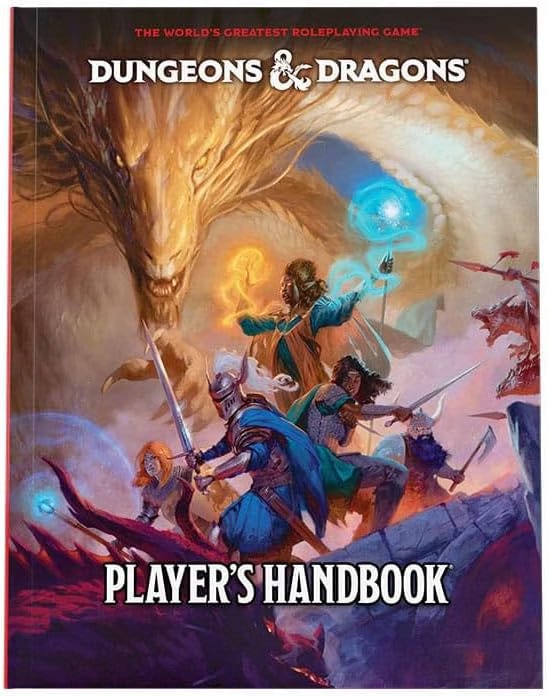
Right up front: I’ve not been a fan of the d20 system for decades. I played Dungeons & Dragons up through the AD&D days, but from version 3 on, I mostly ignored it and played other things. About eight years ago, our new gaming group coalesced around 5e. I inherited books from a Pathfinder fan who didn’t want them and started running the game for the group, as well as another campaign for my wife and daughter. A few of the group were excited for the drop of the new Player’s Handbook at GenCon and after having a look through it, I’m glad I didn’t waste money on it.
So what’s wrong with it? There’s a few things but let’s start with the obvious: D&D is an utter disaster, rules-wise. The basic die mechanic is fine. Very simple. Roll a die and get above the DC (difficulty class). The flat probability (each face on the d20 is essentially 5%) is simple, although there are so many systems that allow for the probability curve to shift by using different dice or multiple dice, rather than a flat modifier based off of the ability. In fact, the ability score itself — strength, dexterity, what have you — is generally not used.
And then you get to combat. There’s 13 different types of damage, some that carry on over the course of a few turns or until a save throw is made. It’s overly fiddly, and an artifact from the wargaming origins of the game. Yes, there’s some reason for it. Maybe you’re resistant to a type of damage — fire, cold, necrotic, etc. — and the rule is there to allow specificity so that a player or gamemaster can ensure fairness.
There’s been some complaining over time about the use of ye olde 10’ (or 5’) grids for combat, but again…this started as a wargame and for a lot of the older players, that’s what they’re looking for. Yes, I prefer the idea of zones (see everything Free League, and other publishers…) better, but it’s certainly not a deal breaker. The issue with the grid can come quickly when the GM or the player starts busting out their trigonometry skill to figure out if their target’s elevation puts it outside the range of a weapon or spell.
Spellcasting is probably the most egregious point of failure in the game. The spell section is enormous — and no, that’s not a good thing. The original 5e Player’s Handbook has 82 pages of word count-filling blather. There are spells no one is going to use…ever. There are the ones that will be commonly used. Is it a cone? Is it a sphere? Area effect? Range? There’s a lot of moving parts to just using a spell, and this is an artifact of the game’s original wargaming heritage. Only certain spells can be used by certain spellcasters. Good to try and have players focus on their character and their type of magic, instead of everyone just grabbing fireball.
Character creation is overly involved and fiddly — especially once you start adding the burgeoning feats (74, now…about double what they had in the original 5e), ideals, bonds, flaws, or even alignment. I’ve always hated alignment, although I understand why it’s there. More on this in a moment. There’s more weapons mastery properties (proficiencies, essentially). More is not better; more is just more. The race/class/level mechanic is central to a lot of the roleplaying element of D&D and becomes a primary driver of the game: gaining levels to gain more spells, special maneuvers, and other perks. The list of these is huge — 54 pages of material on character class for 12 classes. Add in the special abilities of different races, and it’s overwhelming for newbies.
Just to simplify it to the point of making running an adventure manageable, I used the excellent Game Master 5 and Fight Club 5 apps, which take a lot of the work out of running the game.
None of this has been fundamentally changed by the 2024 edition. Yes, there’s the move from “race” to “species” because some folks have to be offended by…everything. Does it change the idea of race? Nope. Classes have more perks per level. Why? More, stupid! There’s more subclasses in each class. Why? More.
There is also, of course, the whinging about “woke”, and yes, the social justice types have infiltrated WotC in force. The move from race to species, the addition of the BDSM derived “safety tools” that are showing up in almost every new TTRPG are there. (The worst offended I’ve seen is Evil Hat, to the point I haven’t even considered their products since Atomic Robo.) I’m not surprised by this development. We’ve gotten allow the spoiled, wealthy, and whiny to politicize everything at the expense of fun, and games are not immune. I’m also not doing that stuff at my table. Should you be alert to things that might be making folks uncomfortable? Yes. Should one overly sensitive tit shut down everything so you can all pay attention to and change everything for them? No.
Yes, there’s the professed attempt to “decolonize” D&D and push white guys out of the hobby so the rainbow warriors can have it all to themselves. The anti-white woke was particularly highlighted by the online rants of brand leader Kyle Brink — since let go from Wizards. Ain’t going to happen. We’ll see what we’ve always seen: like-minded folks will play together. Cool. So, yes, D&D got woke and that might hurt the brand, but it’s the least of the problems.
The big error is their move toward trying to milk the players for every dime they can. The “One D&D” push reminds me of BMW and Mercedes trying to charge drivers a subscription to use their heated seats. The push to move to digital books and tools and away from pen & paper is 1) cheaper for WotC, especially with the cost of paper, printing, and shipping; 2) allows them to bilk their customers with a subscription model for access to Beyond D&D and other “exclusive products”. If anything, this is the reason that Dungeons & Dragons is most likely going to bleed customers to Pathfinderand better games like Forbidden Realms, The One Ring, and the retroclones of old D&D.
So, is it worth it? At $50-60 to get new art and feel like you’re saving Orcs from racism? Nope. Find the 5e stuff on sale and buy that.
Our Dune: Adventures in the Imperium game has been humming along much of this year. I’m running it for my daughter (who loved the movies) and wife (who loved both the Villaneuve and Linch movies). Neither have read the books, so the Imperium is mostly a mystery to them. To lean into this and have allow them to discover the world of Dunewithout a massive info dump, I started them on a backwater world run by a small House Major (Fujimori) that hadn’t really managed to hit their stride in the millennium of running the world. They have been playing as one of the House Minor — the Cailean — that served the Fujimori loyally…even though this was their homeworld for thousands of years before their masters were foisted on them.
Throughout the plot of the game sessions, the new generation of Cailean are more amibtious and get several openings to advance their masters and themselves. One of these adventures was the uncovering of a major pirate base only 11 light years from their homeworld. (We’re using House Reyder, lightly described in The Great Game: Housed of the Imperium sourcebook as the baddies.) They discovered that the Reyder use “slow FTL” — faster than light travel buth not the instantaneous foldspace of Dune. Without the use of high-order machine intelligence, slow FTL is dangerous — with a 10-20% loss rate for ships using it. It is also highly illegal, as the Spacing Guild has the monopoly on safe interstellar travel. Gaining the aid of the Guild, the Cailean maneuvered the Fujimori into an invasion of the world.
PURANA (Gamma Tucanae ): a star system in the older portions of Imperial space, it is a F4V main sequence star with a mass of 1.5 sols, diameter of 2.2 sols, and a luminosity of 11.3. Bright, hot, and with a quick rotational period. The heat and brightness mean a high local radiation level and of the eleven planets, the third sat in the prime zone.
BHUMI (Gamma Tucanae 3): A Class V habitable world, Bhumi saw limited colonial efforts during the early expansion before the Butlerian Jihad, and for reasons only speculated at, was overlooked in the rush for exploring further into space. One possibility is the native flora often was toxic, the fauna was highly aggressive, and even with a strong magnetic field, the planet saw higher than average rates of solar irradiation. With two Class I moons, the planet has a stable axial tilt of 19.6˚ and a strong magnetic field powered by active tectonics.
Nevertheless, recent surveys conducted by House Fujimori and the Spacing Guild have revealed a populated world of approximately 500 million people. Technological development is stunted, with only a few of the larger cities possessing modern amenities. Much of the world is governed by petty potentates with limited area of influence. The most developed of the cities, Dari, is the site of the lone spaceport on the world. The city has been dependent on House Reyder, a minor house that has operated the spaceport out of the sight of the Empire and the Guild, and which had been illegally using slow FTL equipped ships to move to other nearby worlds to operate clandestinely.
Gravity on the world is 1.1g (In game terms, a scene trait of “heavy gravity”) and an atmospheric pressure at surface of 16.2psi. The planet possesses no ice caps and 71% is covered in ocean. The climate is warm to hot and tropical.
The population of the world is listed as “independent” with no ruling family, at present. The low population is spread in dense clusters and much of the planet is untamed. The primary languages are an older form of Galach, Dravid, and Hindi. There is no organized planetary forces, and the few fighting forces present tend to be local, the equivalent of “militia” under rulers than could be considered “nascent houses.”
The primary resources for exploitation would be agricultural and mineral — the planet and system is a treasure trove of heavy metals and radioactives. The human capital is mostly uneducated, the political systems rife with corruption and inefficiencies.
In game terms, taking a planet is an expensive endeavor. Note the near panic of the Atreides on arriving at Arrakis and finding much of the spice mining equipment in poor shape. Not only do they have quotas to meet, but the expense of moving the house from Caladan would have been prohibitively expensive. The invasion the Harkonnen plan nearly bankrupts them. This is why most “wars” in Dune as hit and run affairs, more to make a point or gain a very specific goal, than invasion.
Using the House Management rules from chapter four of the Great Game, gaining the title to Bhumi would require a boon ventures of Gain Territory (wealth 50, Communicate, Diff 5) to gain the sirdar to the world. This alone could be a series of adventures set at the court in Kaitain as the characters’ house attempts to gain the Emperor’s favor for taking the world under their rule. Moving their forces will require a wealth 10 to have the Guild move their people to Bhumi. Once they have succeeded, at the very least they will need to Claim Domain, Secondary (12 resources/per domain and an Understand, Diff 5) to organize production to the point the house to provide material to the Imperial markets. Once they have secondary domains, the next House management cycle would allow them to attempt to grow a domain to a primary. Fortifications, building military forces, all would need to be done fairly quickly. Since most houses won’t have this kind of money or resources, there is the option to take a loan from the Guild Bank. For simplicity sake, assume the loans would have a certain period with a fixed interest rate — say 10% for 20 years. If the house finances all of this, you’re looking at a principal of, say, 75 wealth, for a yearly expense of 11 wealth on top of the other usual expenses to maintain the house. (Debt is the most subtle slavery of all.)
I was late to the game on the Eaglemoss collections. I knew about their plethora of small models, which always seemed pricey to me. When they started up their Battlestar Galactica line, I jumped and started subscribing to their ship of the month. Oi then branched out to the Alien line. These were all their “XL line” — larger than the wee hand-sized Star Trek stuff. With the Discovery XL line (and the superb break with the old school look of ships) I jumped on collecting many of those ships, as well.
Then Eaglemoss went bust a few years ago. There were rumors that the collection had been picked up by another vendor. Master Replicas was selling out the remainders of the old Eaglemoss stuff, and Fanhome was alleged to be picking it up this summer.
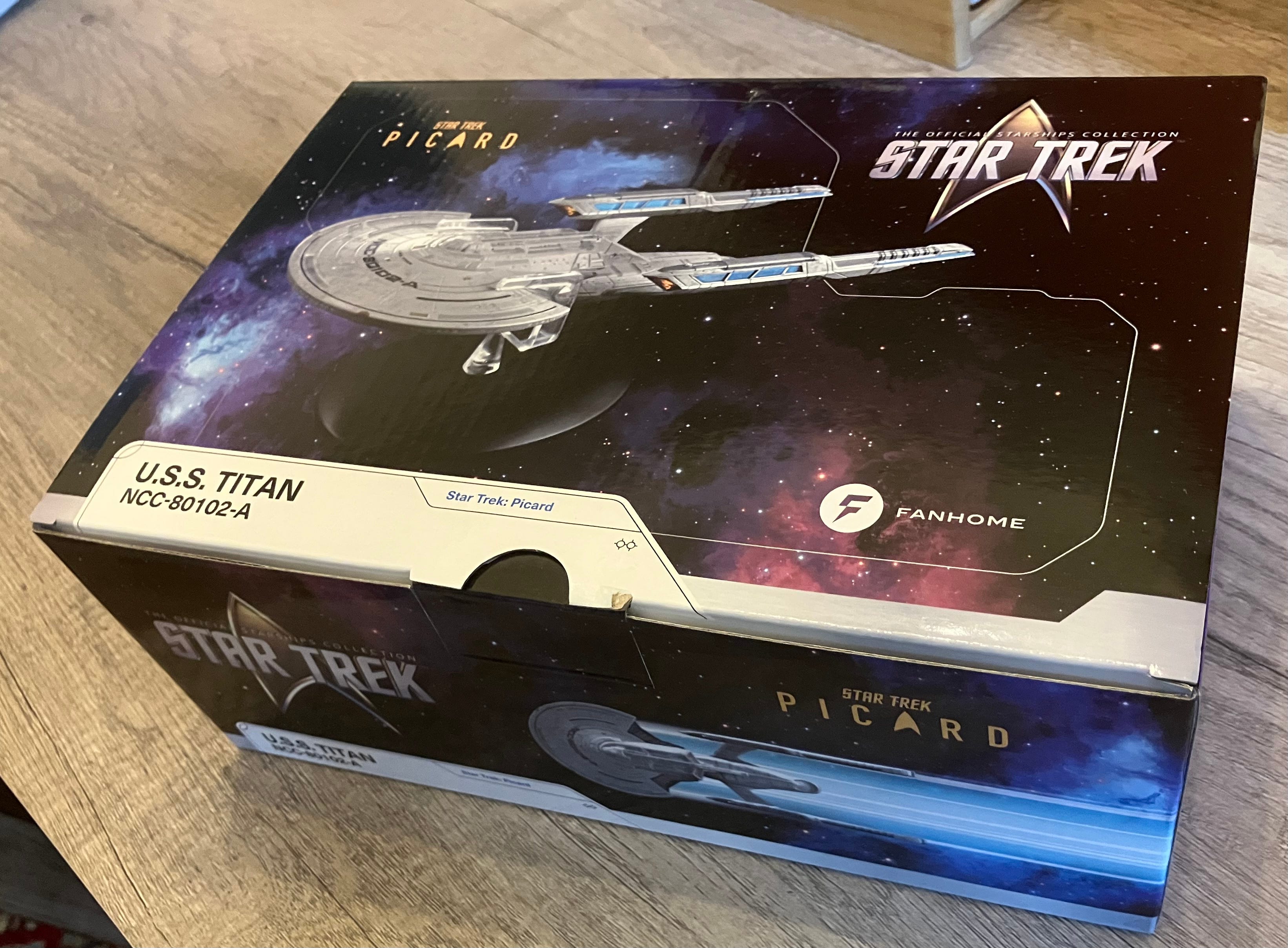
They delivered. My first Fanhome starship, the XL(ish) Constitution III-class U.S.S. Titan-A. So how do they compare to the old Eaglemoss stuff? Packaging is nice — good quality cardboard with styrofoam insert to protect the model. Art design is more colorful and attractive than the fairly bland blue with model picture of the Eaglemoss days.
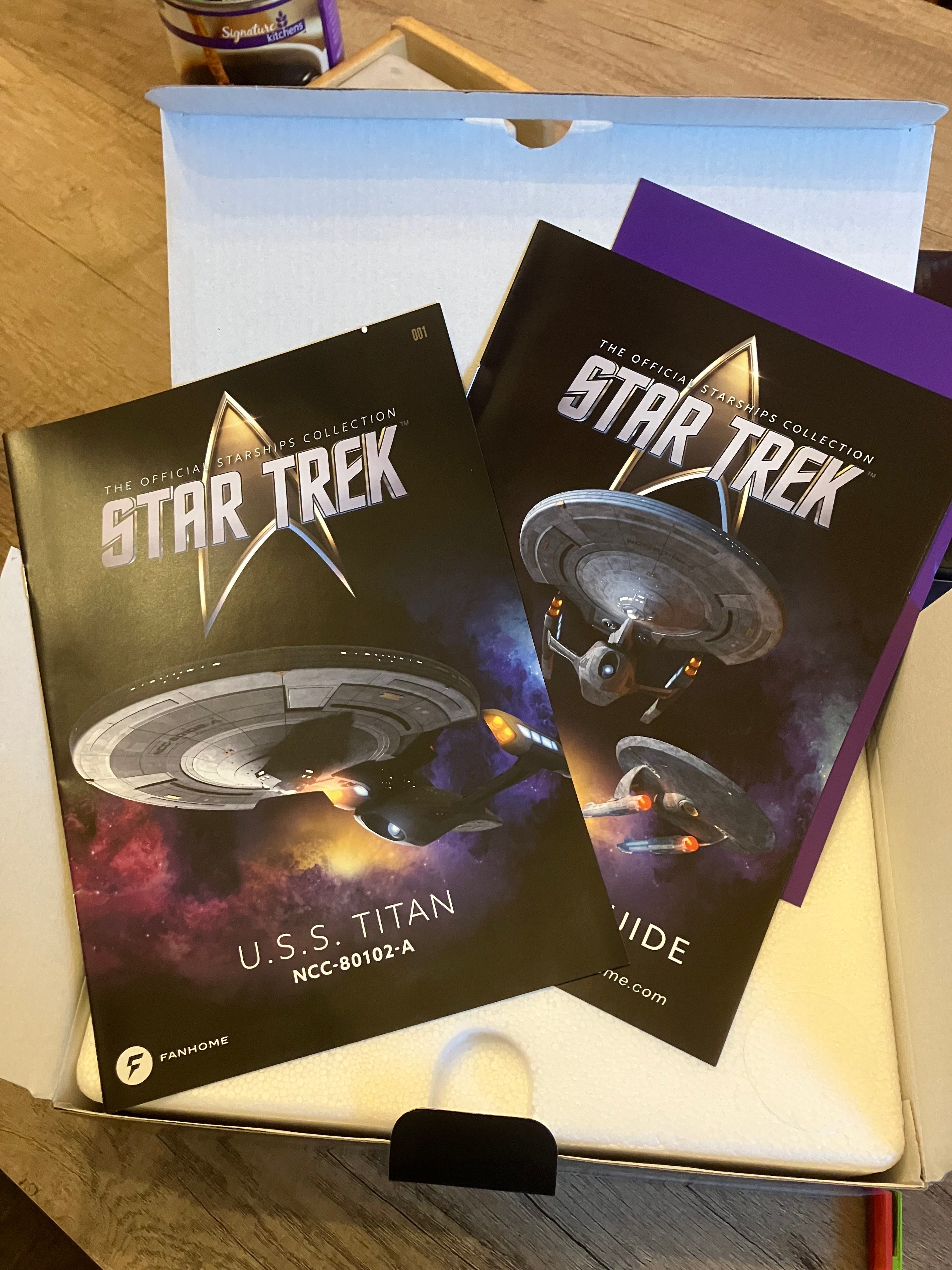
Inside, you get a small booklet with information on the ship, the process and reasonings behind its design, and place in the show. As this is issue #1, there’s also an advert pamphlet on the ships to come, and a welcome to the club sheet. The usual black stand with clear acrylic stand post to hold the model — just as you would expect from Eaglemoss — is there.
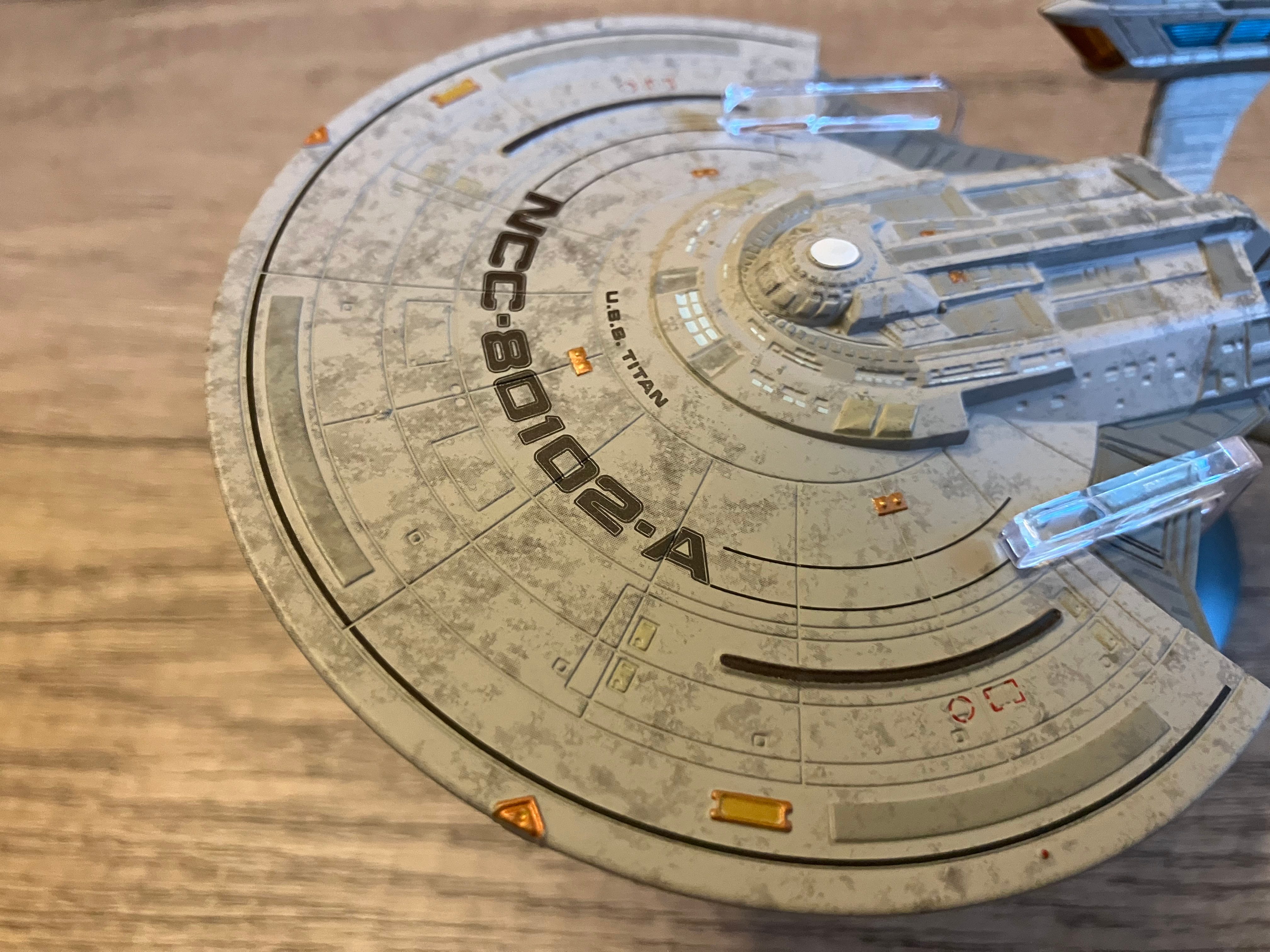
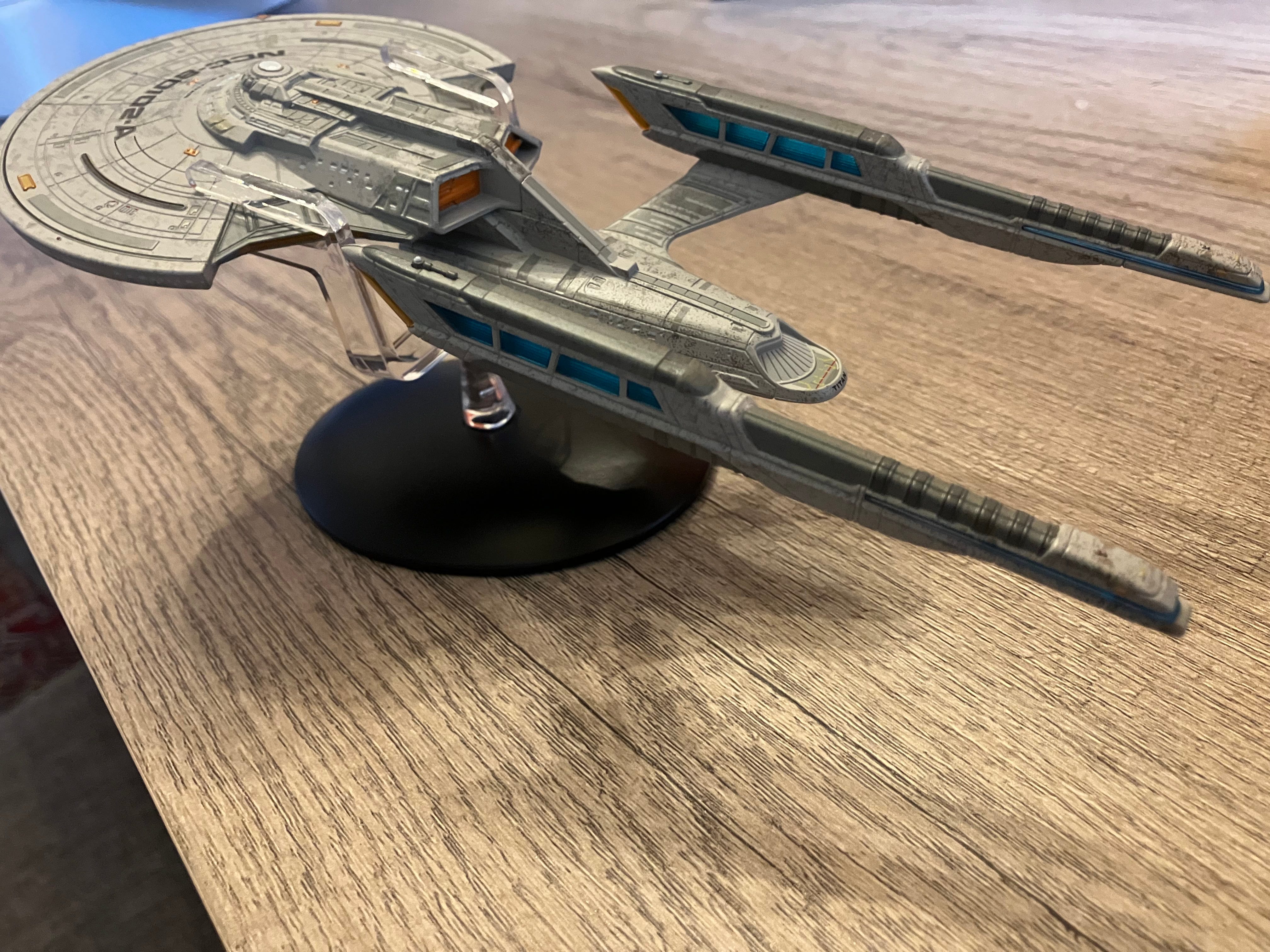
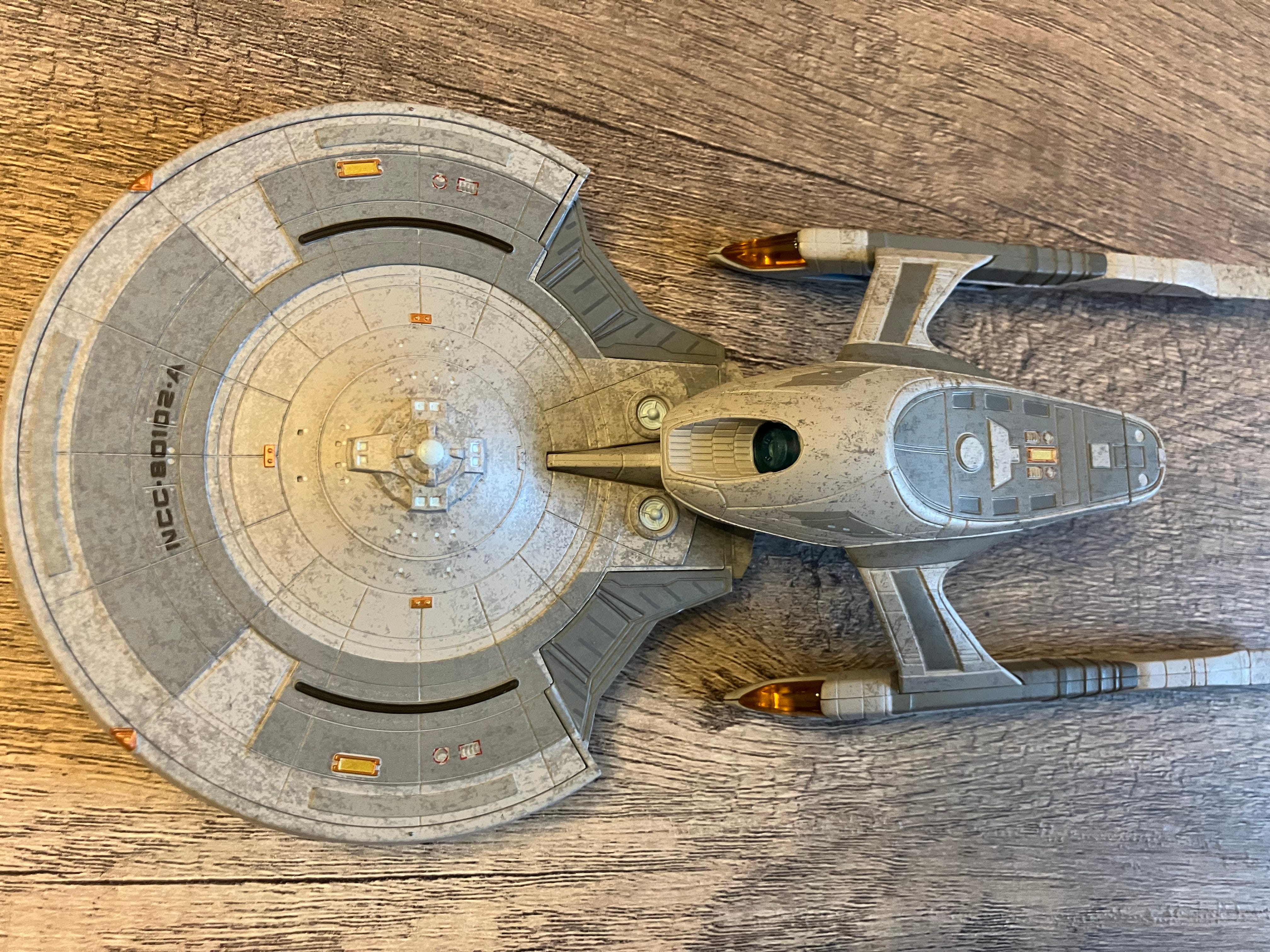
Now to the model. It’s a lovely thing. Diecast saucer with ABS plastic for much of the rest of the model. The detailing is easily on par with the later XL offerings from Eaglemoss, although I think the paint and detailing is a bit better. The scoring on the plating is a bit deeper and the paint is consistent and pleasant. the colored “clear” inserts for the warp nacelles and bussard collectors are well done and similar to what came before.
Often, Eaglemoss would skimp on the underside detailing, but not here. The transporter emitters and fueling ports are nicely detailed. Overall, it feels solid in the hand, sits well on the stand, and is a pretty piece — as the ship was in the show. I would love to see them take a crack at a similarly sized movie-era Enterprise.
About the size: Titan is just a hair shorter of 9” long. Compared to similar XL ships from Eaglemoss, 8-9” was the small ships; some were a foot in length. There will be non-XL sized vessels, and the advertised Enterprise-F is just shy of 11” stem to stern. There are going to be “normal” sized models and XL, a la Eaglemoss, it looks like.
Looking at their drop schedule, the first three ships are not XL and run between 7-9” in length. Titan is not listed as XL, but Enterprise-G is…I’m was guessing they’d be the same size with different livery, but maybe not. It looks like the shipping order, so far, is Titan in November, with Stargazer from Picard season 2 next, then Strange New Worlds’ USS Farragut for the start of the year. After that it look like probably Enterprise-F, Eleos and then Shrike, the villain ship, all from Picard season 3. There’s supposedly going to be Lower Decks content, as well.
Pricing is based on per unit or subscription. It’s $55 and no shipping handling with subscription and $65 plus $5 per unit for shipping without. XL ships are $85 and $95, respectively. Without a subscription, single purchase opens a month after they drop to members.
Is is worth it? That depends. If you’re a model collector of the old Eaglemoss stuff, a definite yes. The quality is there, and actually looks to be a bit higher. If the 7-8” range is their usual size, then it’s definitely a better deal than the old Eaglemoss stuff was. If you just want one or two specific vessels — and you can just buy direct the models you want as they drop; subscription not needed — probably. Collectable toys are a wee bit pricey these days, but that means that these aren’t as outrageous as the smaller Eaglemoss ships were decades ago. I would point out that some of the stuff I have is now selling online for three to four times what I paid.
Fanhome also looks to have picked up a lot of the old Eaglemoss build a model lines from DC, Fast & Furious, Marvel and Star Wars, as well as the build Enterprise-D, so if you didn’t get all the parts from Eaglemoss, you might still have a chance through Fanhome.
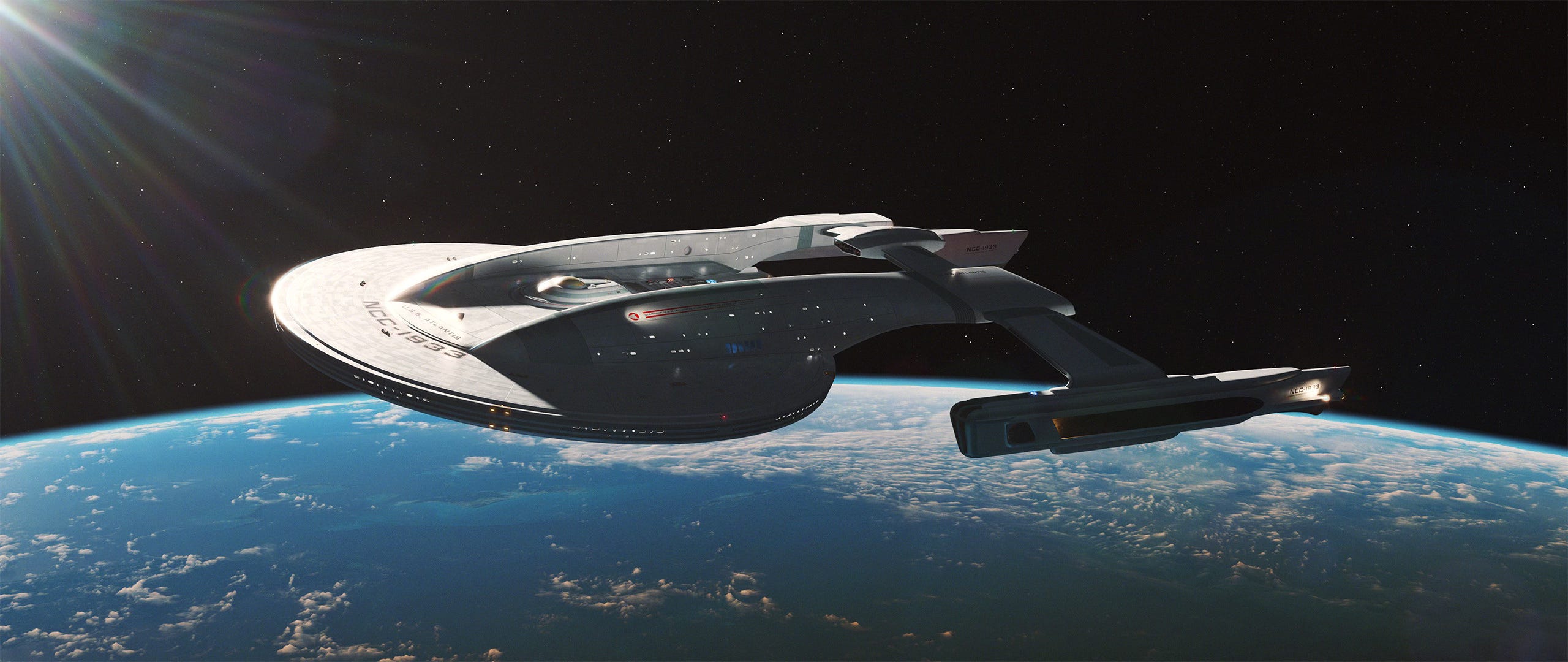
I saw this lovely design online — the USS Atlantis, Kusanagi-class by Diogo Vincenzi (here’s the ArtStation link) — and decided to stat it up for Star Trek Adventures 2.0.
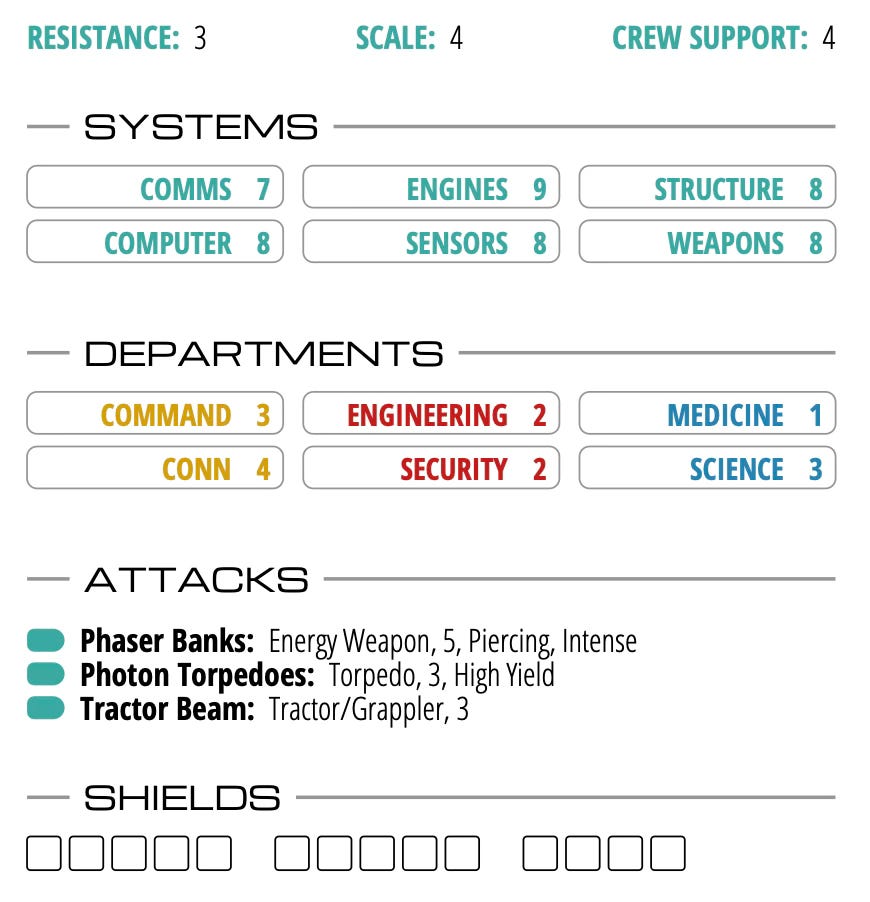
It looks like she should be running thirteen decks or so and the pontoons would give her a length similar to that of Enterprise from the era. I’m assuming a smaller crew, so perhaps between 250-300. Using the Miranda as a base, I threw this together using BC Holmes’ excellent website:
Launch Year: The hull numbering suggests this was post Miranda and pre-Excelsior, so I’m thinking 2275 for the initial run of the vessels.
Overview: Resurrecting spaceframe design queues from the original NX and the Walker-class, the Kusanagi-class was initially designed for patrol and combat, similar to the older Miranda class. Like the Miranda, this series was build with a rapid-firing torpedo pod, but where the Miranda were build with large shuttle bays to accommodate planetary landings by troops and materiel, the Kusanagi was built with speed in mind and naturally lead these to be outfitted for long-range reconnaissance and pathfinder missions. Like the Miranda, these vessels were seen operating well beyond their original expected service life, some seeing combat in the Dominion War.
Suggested Mission Profiles: Multirole Explorer, Pathfinder and Reconnaissance, Tactical Operations.
Naming Conventions: Many of these vessels took their names from mythological or Japanese naval vessels like Yamato and Musashi, Shahrat and Argo. Registry numbers range from 1900 to the 1990s. Notable examples: USS Atlantis, NCC-1933 and USS Yamato, NCC-1966.
Traits: Federation Starships, Kusanagi-class
Talents:
IMPROVED REACTION CONTROL SYSTEMS: Whenever the ship attempts to move through difficult terrain, reduce the Momentum cost of the difficult ter- rain by 1, to a minimum of 0.
HIGH-RESOLUTION SENSORS: The vessel’s sensors can gain large amounts of accurate data, though they are extremely sensitive. While the vessel is not in combat, any successful task assisted by the ship’s Sensors gains 1 bonus Momentum. Bonus Momentum may not be saved.
IMPROVED WARP DRIVE: Whenever the ship takes the Warp major action, roll a d20; if you roll equal to or under the ship’s Engines, you do not spend reserve power for the ship.
The copyright for 2d20 system is Modiphius, 2019. STAR TREK and related marks and logos are trademarks of CBS Studios inc. Image copyright ofDiogo Vincenzi. All Rights Reserved and no infringement is intended.
The Dune universe is anachronistic in its weapons thanks to the Holtzman generator — which much like shields in other sci-fi settings are the “magic” that keep you from getting your ship (or self) blown to smithereens. According the the Dune wiki: “Shields were produced by a Holtzman generator, the field deriving from Phase One of the suspensor-nullification effect. Shields can be calibrated to permit the passage of matter below given speeds. This is vital in personal defense shields, as one would suffocate within a shield that did not admit atmospheric gasses. Depending on the shield’s setting, the object’s speed while passing through the shield would range from six to nine centimeters per second. A shield could also be set to cover either the left or right side of a person if the specific need for it arose.”
Cool. So could your assassin rig/reprogram a personal shield so that it just suffocated the user?
Okay, not the point… This meant that lasguns — which if used against a shielded target cause a sub-atomic fusion reaction (an atomic blast) that could randomly occur at the shield generator, the laser emitter, or both — while powerful are more likely to end up in a fiery death for everyone in a multi-kilometer radius. (And I wonder — if there are more shielded folks in the area, would an nuclear reaction cause these shields to chain, causing multiple, rapid nuclear blasts in the same area…) Firearms will just see the bullets stop cold or ricochet (which is what I’ve had them doing in our Dune game.) Another point from on-screen (rather than the book) we saw was that hammering a shield hard enough, long enough, does seem to eventually overwhelm it. This was especially true with explosive ordinance against the Atreides ships during the Harkonnen raid. Perhaps enough whacks on a shielded area in rapid succession might do the trick. That would suggest that an auto-fire weapon, if it kept the rounds close enough to point of impact, might eventually overwhelm a shield. Or a succession of explosions close enough to the shielded person; at the very least, it might cause them to be tossed about.
So…blades, and blades that are cutting slow.
Which would seem to imply that fighting styles are going to have to be a lot less hack and slash, and much more a grapple and slow thrust affair. That means the weapons used are going to be very specialized. Gone are the big claymores, bidenhander, jian. They might be useful due to their length in stopping an attacker from getting to you in a fight, but their main use is crushing/slashing/hacking…the personal shield is going to stop that much energy. Other slashing-style weapons, like the katana and broadsword, are similarly going to be at a disadvantage.
Rapiers, panzerstechers, tucks are all thrusting weapons, and stabbing — it would seem — is more likely to be able to get through a shield; but the thrust and retreat tactic still relies on speed. Speed is energy. The shields should stop this handily — and with a thin blade like the rapier, could potentially damage the blade just as if you’d stabbed a wall with force.
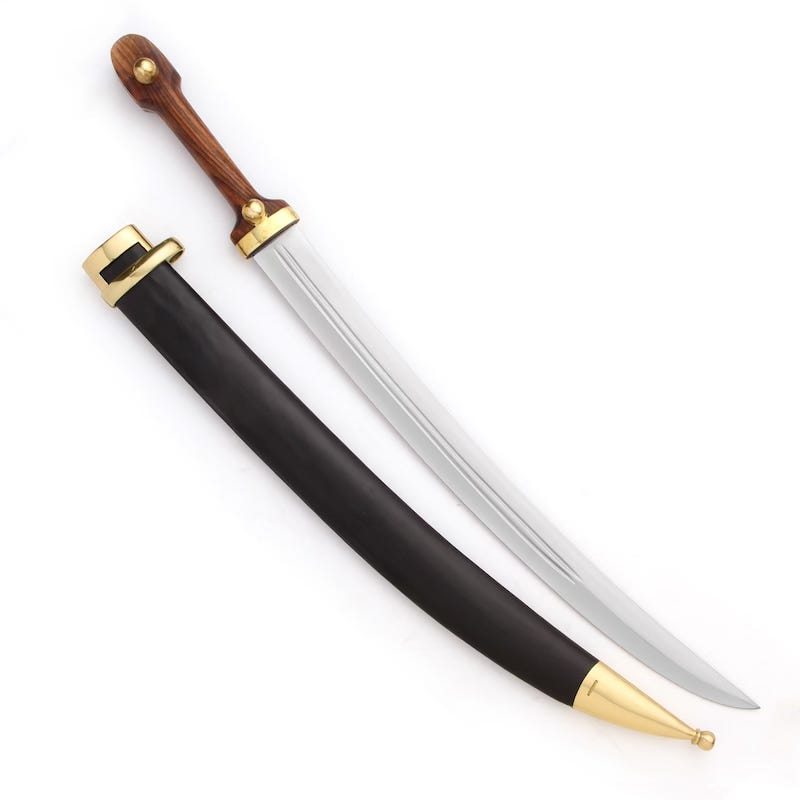
Shortswords and long knives, like the kindjal that the Ginaz swordmasters use (see above), would still afford some stand-off capability, blocking or turning attacks, but they would require you to get in tight with the target. However, the curve of the blade in some kindjali would make a slow thrust a bit more tricky. You would probably try and use your weight to control the opponent and get a good, slow push in through the shield. (It looks like, once through — at least in the movies — you can then thrust as hard as you like…) Weapons with a straight blade and good point, like the tuck, Italian stiletto, Sykes-Fairbairn, a navaja, or dirk would seem more useful here than the traditional blades of heavier of say a bowie or “combat-style” like the M-9 bayonet or Gerber Mark II with their angled point. However, a smaller point/blade means moreenergy in that point of impact…so the shield should more likely stop it, like a bullet. By that logic, the angled point coupled with a slow cut, expanding the area of energy, should be more effective in slicing through the shield, then move to a stab.
I was pretty pleased, on rereading Dune for the first time in forty years, that this last argument was one in the books, itself: Duncan Idaho favored the blade over the point for the reasons I suggested above.
The problem of the personal shield has led my wife and daughter, for whom I’m running a Dune campaign, to develop interesting techniques in a fight. Anytime they think there’s the chance of a lasgun with the opposition, the daughter made a point of smacking their shield with their sword or hand to make it shimmer and warn the opposing force, so not everyone in the area gets nuked. She was the one that posited that you would want to grapple (although, again, shields might make this difficult) or use your weight to try and limit the target’s movement before you strike with a slow push, not a fast thrust. (Keep in mind, she’s 13 and hasn’t read the books…this is just the martial artist in her working it out.)
It’s an interesting thought exercise that those with more blade time than me might have a good opinion on. Comments would be welcome.
Suggested Era: Any, but Strange New Worlds, is best.
Spotlight Characters: Science officers
Directives: Confirm health and welfare of survey mission, collect any new data.
SYNOPSIS
The ship receives a mission to survey a possible Class M moon of a gas giant around star SSC-1092, a dull F-class star. There are records that a civilian research mission was sent out forty years earlier, but they never returned. Investigate, look for new life, and catalogue.
OPENING LOG ENTRY
Science officer’s log: We have been dispatched to SSC-1092 to investigate long-range scans suggesting a Class M moon around the third planet. My research into the records show that this system has rolled up before as a prospective interest for Starfleet forthy years ago, but no action had been taken. Twenty years ago, a civilian research mission set out to investigate this world, but was never heard from again. We don’t even know if the vessel — S.S. Starview — even reached their destination.
MAJOR BEATS
1) Do the Science Thing
On arriving at SSC-1092, the captain can turn their operations over to the science officer with a “Let’s do the science thing”. Control+Command, Diff 1 to organize the different science departments to look for and collate data. Control+Conn, Diff 2 for the helm or tactical officer to start launching probes to the various major worlds — four gas giants and a solitary captured terrestrial on a highly eccentric orbit at 480from the ecliptic and on a sharp, long period hyperbolic orbit. There’s a wealth of data to collect, even though the system has ben remotely surveyed for decades.
Their primary target is SSC-1092c/4, the fourth moon of the third planet. Insight+Science, Diff 0 to glean that SSC-1092c, the gas giant their target orbits, is slightly larger than Jupiter and has a powerful magnetic and gravitational field that keeps it’s inner five moons warm. Momentum generated by extra successes can tell them that c/4 is barely Class M, but there’s a nitrogen-oxygen atmosphere with 11.2 bars of pressure at the surface, .8g surface gravity, and a hydrosphere of 54%. The moon has it’s own strong magnetic field that is fed by massive, power flux tubes coming from the planet’s N/S poles — strong enough transporters aren’t a safe option. There’s heavy cloud cover, so surface visuals aren’t happening, however, there are indications of plant life from the spectroscopic surveys of the air, which is breathable. Temperatures are cool, but within safe for most humanoids (comfortable for Andorians).
With a Insight+Security or Conn, DIff 3, hampered by the strong magnetic field, they will pick up power and heat sources on the ground! the signature doesn’t look like a major area of habitation — perhaps a ship? A momentum spend will reveal that it looks like a structure made of tritanium, with a subterranean portion underneath.
The crew can beam down but the magnetic field makes it difficult: Control or Daring+Conn, Diff 3 to get down safely. They could fly down in a shuttlecraft with a Control or Daring, Diff 2, the weather’s not bad, but interference on their sensors and communications with leave them a disadvantage.
2) A Strange New World
The interference from the magnetic field of the moon is the main danger. If they go down in a shuttle, a failed test will require another Daring+Conn, Diff 3 to avoid a static discharge into the hull that will hit with a Intensity 2. Once on the ground, Reason+Science or Conn, Diff 1 to remember to discharge any static the hull has picked up before exiting the craft, or the first person to make contact with the surface and the ship will create a circuit to ground and hit them with an Intensity 3 shock.
They are now on the surface of the wind-ridden, rocky world. There’s a lot of plant life around, mostly rhizomatic plants that grow low and wide, as well as fungi. There are strange jellyfish-like polyps with gossamer wings sprouting from the heads moving in the air currents. The clouds are thick and they can smell the sulphur of volcanic activity. The signal came from an old Y-Type freighter. It looks to have landed properly and all the cargo pods are intact..
Insight+ Science, Diff 2: The plant life is mildly reactive to their movement and touch. A scan of them shows their replication is not DNA, but a polysaccharide chains with amyloid fibril-catalyst to cause replication. There are analogues to grass and squat, mushroom-like trees — they’re using massive mycelial networks to absorb nutrients. Momentum spend to learn they should avoid touching them with bare hands; they secrete an acid to break down polymers into monomers. Insight+Science or Security, Diff 2: to notice that the plastic of their boot soles is being dissolved, but very slowly. They’re in no danger soon, but they should clean up afterward.
3) Starview
The team finds the ship is poor repair. There are vines and mushrooms growing all over the landing legs, sprouting here and there on the hull. ONly one of their two long-range shuttlecraft Starview launched is here. The access ramp to the airlock is down and the outer door open. A scan will show the life support and main power are still online, although the warp drive is shut down.
The inner hatch isn’t locked; they can get in without issue. Almost immediately, they will meet a slim, stoner type — Morrison — who will welcome them. They didn’t call for Starfleet; this is an independent colony. What are they doing here? He will insist, but in a friendly, calm manner that they don’t need any help…still they should talk to the boss.
If they ask about their mission, Morrison will tell them Starview landed 21 years ago and started their survey of the moon. They quickly realized the potential of this place. Those that didn’t want to stay left in the long-range shuttles a few years later. They should have been able to get back to Earth or Vulcan without issue. He will note that its unfortunate they didn’t get home, but he doesn’t seem emotional about it. Insight+Medical or Command, Diff 2: Morrison seems perfectly normal, but he’s definitely not showing signs of empathy.
There’s more of the crew here in the science module, four more of them. In addition to Morrison, who is the pilot for the ship, there’s Hailey, their biochemist; there’s Fitch, botanist; Welborn, another from the flight crew, Chu, the quartermaster; and Denton, the engineer. All of them seem pretty content, if a bit inebriated.
They’ve been doing their work for decades, and to fund themselves and keep supplies they can make here coming in, they’ve been trading with the Orions. They produce a bunch of medicinal materials from the local life, but what they were really known for was “the soup” — a hallucinogen that they produced for the Orions and other markets. It’s a calming psychotropic that has excellent results in treating anxiety, traumatic stress, and other mental diseases. Tweak the mix and it’s a beautiful ride. The security officer, if present, can test Reason+Security, Diff 2 to know “the soup” is a popular drug with some species out there, but can have serious side effects and can be deadly.
They will dispute that the soup is dangerous. The side effects that some worry about are fungal infections, but that’s part of why it works. The trick with everything here is to neutralize the amyloid; if you don’t they can wreak havoc on your nervous system. Some of the folks out there tinker with the soup and try to replicate or modify it; that’s what causes issues. They certainly don’t want to hurt anyone. Insight+Command or Medicine, Diff 3 — success tells them they aren’t completely truthful.
Chu will mention that the soup really puts you in touch with the universal mycelial network. It’s not really mushrooms, of course; it’s allegory for the energy patterns that connect the universe. There were a couple of guys that came through here a few years back — she’s not sure of when — but they had this idea about using these networks to create a drive system that you could use to run along these energy potentials faster than warp drive. What was the guy’s name… Stametz? The problem was the sheer number of possibilities made navigation nearly impossible beyond a few AUs.
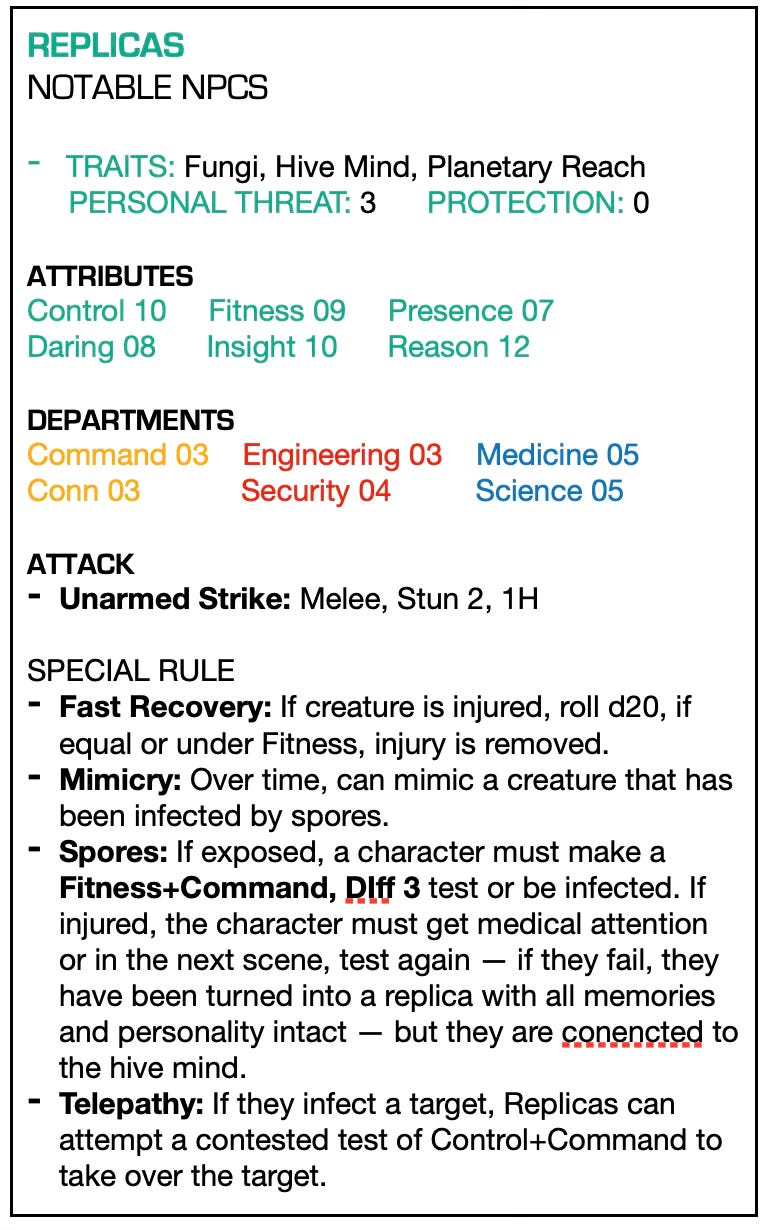
While they don’t seem dangerous, they’re wrong somehow. If they try to take a tricorder reading, they react by asking them not to. If the crew insists, the crew of Starview may get hostile. The issue is simple: none of these people are people, anymore. Their DNA has been rewritten by the amyloid fibrils and they are…local fungi pretending to be people.
If the characters can chart their way, diplomatically, they will find out from these replicas of the Starview’s crew that over time, the soup and other material the colonists ate infected them with bits of the life forms here. Many died, a few fled in the shuttle. Once the planetary network realized that the crew were sentient, and that the local flora had killed them, they attempted to reconstitute them. they were only successful with the ones that hadn’t died. It also gave the life of this moon access to some of their memories, knowledge, and personalities.
If the crew pose a danger to the collective of life on the moon, they will respond with a subtle release of spores to try and control the characters. They must test against a Control+Command, vs. an opposed test with the creatures or be open to suggestion. These replicas will suggest that they report the planet’s flora hostile to colonization, that the original survey team had died, and that they should move on. If a character fails, they suffer an Injury at Intensity 3. They will have to make a second test at the end of the scene, if they have not received medical treatment, or have the fungi start to slowly replace their body until they are eventually, a perfect replica. Only the sharply different physiology of the Andorians (or Bolians) will be immune the effects.
Any violence will make the Starview replicas believe they have no choice but to act in their defense. The whole of the ecosphere is connected, and fed by the heady magnetic field of the planet. If need be, they can reach out and… tweak the moon’s magnetosphere. They would not wish to, but they could destroy the characters’ ship with a thought.
If it comes to this, they will attack with a Control 10+Security 4, Diff 2, and the effect of Plasma Discharges is like Plasma Torpedoes: Short (only if they are in orbit), Damage 7, Persistent. After the first hit, the ship can attempt to do evasive maneuvers, but if it doesn’t leave orbit, they will continue to be attacked until the characters can convince the aliens to stop.
CONCLUSION
If the crew can find a diplomatic solution, they should be able to get their people back from the surface. If not, they may have to stage a desperate rescue attempt with a disadvantage for the Moon’s Magnetic Field and Sentient Biosphere.
The copyright for 2d20 system is Modiphius, 2019. STAR TREK and related marks and logos are trademarks of CBS Studios inc. Image copyright of Adobe Stock. All Rights Reserved and no infringement is intended.


 The Black Campbell