We were finally closing our “season finale” of the Battlestar Galactica game last night. The session before had seen two character deaths, and one nearly done for. And that was the first act… Last night saw three major plot moves, the most important being the culmination of the Lucky character’s plot arc, the next most the settling of Admiral Cain and Pegasus into the fleet.

The second act revolved almost exclusively around the defense council — led by President Pindarus (the father of Galactica‘s commander, a PC), player character VP Jones, the defense minister, and the security minister (another PC) — interviewing Cain about her actions since the Fall of the Colonies. There was a hard push for her having tried to execute her XO for refusing and attempting countermand her attack (this time on a Tauron shipyard the Cylons were using — a prime target, but a highly dangerous one), another for her stripping the Scylla and civilian ships for parts. They are not aware, yet, of the condition of the Six in the brig.

In the end, despite serious reservations, and her seeming unwillingness to submit to a change in operation command from her to Galactica, the characters decided having Cain and Pegasus‘ firepower was more important than pursuing her missteps while she was — to her knowledge — the only Colonial ship, and the entirety of the human race, left in the universe. She was on a mission of revenge — they convince her the missions has changed; she is now the guardian of mankind. The character in the game (and the show, I submit) is a creature of duty…having the civilian fleet and tens of thousands of people has given her new perspective. Much like the post-resurrection ship attack in the show, the admiral is getting time to breathe and reassess her situation.

As the admiral and the commander character were returning to their ships, the Cylons jump in right on top of the fleet — well within the defense perimeter, and the shooting starts. Two Cylon basestars jump in and are escorted by a massive, glowing, crystalline vessel — the Blaze that has been repeatedly seen in Lucky’s visions. He knows that this is the moment of truth — when the “two and ten vipers” have to ride into the flame (the Blaze.)

The next act was all battle. We used an even more stripped down very of the fleet combat rules in the BSG page here on the site. For each capital ship action, there would be two squadron level actions, and two personal fighter or raptor actions. The Cylons jump in and hammer the civilian and warships. Cloud 9 — which houses the government in our game (why stay on a small liner when you can have conference rooms and spacious cabins, and the best food still in the fleet?) — took a good hit, Pegasus got banged up, and they almost lost their wee escort vessel, Cygnus. One liner would eventually be destroyed.

The squadron combat was handled simply — both sides got to roll their alertness or intelligence, and their tactics skill, plus any assets applicable. The number rolled was the number of enemy fighters or raptors destroyed over a one-to-two minute period. The side with more numbers got a die step on the skills. This time around, I had the Cylons running with higher pilot and tactics skills to represent the experience the killed raiders had passed on to the Cylons. It was brutal — 40 vipers and 10 raptors lost over the course of the battle, and similar numbers for the Cylons.

In the end, Lucky and the squadron of rookies take a run at the Blaze, with their vipers attacked by strange ‘shard-like” glowing fighters or missiles that, on impact, simply disappeared their target. (We didn’t go into it, but they were destructively uploaded to the Blaze’s memory.) Lucky is the only one, thanks to liberal plot point use, to ram the Blaze. Having been prepared as an instrument of “God”, he is able to remain conscious of himself, even as he is incorporated into the Blaze. There was a virtual reality journey through Hades to the citadel of the Blaze, Dis, guided by the young girl/angel that had been helping him prepare. Finally, there was a battle of wills to destroy the Blaze, and Lucky wakes in an infirmary — his memory hazy, more like a dream, to find he is Colonel Aurelius, formerly of the battlestar Pleiades. The implication from the uniform flashes, etc. is that he is now resurrected 7000-8000 years in the past as the man who wrote the Aurelian Prophesies they used to guide them in the game ’til now. (It was also fan service for the gamer who was in the last iteration of the game…where the ship was Pleiades and Aurelius was the oracle.)

As for the “current” portion of the campaign, as Lucky hit the Blaze, there was a brilliant flash and the ship of lights was gone. The Cylons, stunned by their god abandoning them, fled and jumped away.

The goal was to keep the mystical elements of the show, but leave “god” more undefined and open to interpretation, but also to set up the idea that the Cycle of Time has seen a steady collapse of “gods” from once-near-omnipotent machine intelligences, through the Lords of Kobol, to Man and the Cylons. Like the Greek myth it’s stealing from, each “age” sees the heroes and gods as less — more flawed — than those who came before. It also allowed for us to have a heroic goodbye to a main character who has been in the campaign, but played by two players, before the current player leaves for San Francisco. (Selfish bugger!)

The final act saw the fallout of the battle and the shake up of the command structure the government demanded. The players mourned the loss of the popular Lucky, started putting the fleet back together with officers moved around, promoted or demoted. The president punished Cain tangentially by demoting her pet CPT Shaw, and her XO, Fisk for the Scylla incident (they opened fire on civilians, after all.) Other characters were moved to Pegasus to “keep an eye on” the admiral and to help her integrate into the fleet.

Overall, it was an exceptional game night. We ended, instead of the usual 9:30-10pm, at 11pm and none of us had noticed the time. Afterward, several of the players were obviously thrilled with the way the “episode” had gone and how the story is unfolding.
The pace ticked up dramatically over the last couple of sessions, and tonight was no different. The “season finale” episode titled The Blaze saw a pair of players’ marshals investigating the attempted murder of the CAG character, who has been receiving divine visions throughout the campaign, and finally understands that he is an instrument of God and is supposed to destroy “the Blaze” — the angry god that started the war between the Lords of Kobol and the exodus of the 12 Tribes to the Colonies. He discovers that God is a rather impersonal creature, but that the endless Cycle of the story the Blaze has been telling — its attempt to become God after “staring to long into Its Face” — has destroyed Man, the Lords, and other civilizations for millennia. He is at peace, knowing that his time is coming and that he can finally break this endless cycle of violence.

The marshals investigate the Cylon “priest” and his cult members and through their investigations realize that his movements connect with another series of investigations (more of a group of conspiracy theories) one of them has been tracking to a private yacht of a former building industrialist. They mount up and head for the yacht in the company of the marines, led by LT Thorne, send by Pegasus to “help” them.

On arrival, the one marshal’s sixth sense is going haywire. They discover the industrialist is a Cylon puppet, and that the ship is some kind of biomechanical horrorshow that is used to create puppets for the Cylons to use in the fleet. There was a spate of combat that left all the marines dead, one of the player characters on death’s doorstep. During the fight, they made an unfortunate decision: trying to save the injured character, they had the raptor copilot take him off to the medical ship while calling for reinforcements. This left them with no way off the ship. Their discovery had triggered the ship to set itself for self-destruct. By the time they had figured this out, the other marshal had been shot critically. They accounted for two Cylons and the industrialist puppet along the way.

The ships around the yacht picked up the energy surge and had to move off, leaving the two characters left to try a desperate move of venting themselves and hoping for the SAR raptor’s crew to catch them. In the catch, the marshal lost his grip and would die in space. The pilot character lost his grip when the yacht exploded and hit the raptor with debris. He also died.

This was just the first act…we’re not even to the good stuff, yet. Two different players lost a character, and another has one down for at least 2-3 weeks of game time. The loss of Thorne before the Boomer interrogation removes one of the hot button plot elements that led to trouble in the show and might lead to a more civil relationship between ADM Cain and the fleet.

This week’s game saw the pressure and speed of the plot continue to ratchet up. Coming off of the cliffhanger in which the CAG/oracle character (a PC) found himself toe-to-toe with a Cylon masquerading as an Eleusinian priest named Iblis (a little 1970s fan service!) and lost the fight pretty handily, I had to scramble for a realistic deux ex machina to save his ass — a much less offensive move in a universe where there is actual divine intervention happening.

I kept the player hanging for the first 15 minutes by starting with an “earlier that day…” and followed the early morning activities of one of the Colonial Marshals — a player character — who is collared by the aide to the security minister. The aide — a Cylon who has “gone native” — has been tracking the movements of people in the fleet, trying to find the unidentified Cylons in the fleet in an attempt to keep himself safe and continue to hold his rarified position in the government. He spins a story about Iblis taking too much of an interest in Lucky (the CAG/oracle.) Iblis had placed a call to Galactica requesting a meeting to talk about some of the visions Lucky has been having and the aide suspects this might be a ruse; Cylon activities have targeted important scientists, investigators, and now with a confirmed oracle in the fleet…he’d be a prime target.

This leads to the showdown between the marshal and aide versus Iblis, but not before Lucky (the oracle) witnesses Iblis try to murder his 19 year old chaplain’s assistant. In the middle of choking her, the young girl bursts into a brightly-glowing, winged vision that blinds the Cylon temporarily and which berates Iblis — stating that the events in motion cannot be stopped. Lucky has a destiny — to destry the Blaze, the Cylon “god.” Iblis drops her and she falls to the ground unconscious, the angelic vision gone. At this point there’s a bit of skirmishing, and the arrival of the Marshal and aide leads to Iblis being shot by the aide, who gives the credit to the marshal.

The incident is reported to the military and Admiral Cain dispatches marines to investigate, leading to a verbal showdown between the admiral and the security minister (also a PC) who manages to convince her to work with the civilian law enforcement, and points out that there is a functioning and legitimate civilian government to which her oath of office still applies. Due to good player character moves and rolls, Cain — while still a new, belligerent, and ambitious force in the fleet — is more quickly being brought to heel than she was in the show. Partly, this is because of established connections between Galactica‘s commander (a PC) who served under her when she was a commander, and knew her socially; and the president, who was a military man, a defense minister, and is a person she has respect for (unlike Roslin in the show.) Cain has a history with these folks and I figured this would give her a quicker sense of duty to them.

Another change made was the character of LT Thorne, the rapist interrogator from the show. He’s still a jerk, still committed the offenses against the Six they have, but he is portrayed by the crew of Pegasus in the show as this heroic figure who’s save lives and earn respect of the men — this doesn’t jive with what we saw onscreen. So i made Thorne less a monster, and more a man who views the Cylons as machines and his duty to his crew as paramount. He’s a jerk, but is quickly won over by Lucky during his interrogation, who realizes the man is scared, hurting from loss, and unmoored from his morality — much like many of the survivors. While a confrontation over the interrogation practices in Pegasus are most likely in the offing, there is the chance that this may play out differently due to the connections the characters are making emotionally with Cain and Thorne.

The marshal, meanwhile, is tracking down the personal effects of Iblis and planning on questioning his followers. These leads will be directing them to another threat in the fleet.

Introducing Cain early was not originally in my plan, but the nature of our Kobol — apparently inhabited, modern, and well-defended by the Cylons; watched over by some kind of supranatural ship or creature (the Blaze) — and the introduction of the resurrection ships led me to believe this was a good time to amp up the pressure with a new set of issues, but it also gives the fleet more firepower for a confrontation. The introduction of more supernatural aspects — angels (?), a ship or creature that is the Cylon god — make the Kobol mission more of a real showdown between the fleet and the Cylons than it was in the show. Additionally, according to some of the players, the constant revelations surrounding the history of the fight between the Blaze and the Lords of Kobol, and the possibility that this “story” has been told over and over again, has added more of a sense of exploration and discovery than we saw in the show.

We were able to finally get the whole crew together Thursday for play, and saw a lot of movement in the various plots. There was a set of romantic subplots that look to cause trouble at some point in the future when the CAG (a PC) may have to put one of the other PCs in harm’s way. The players attempted to prove that Boomer — her personalities collapsed together by hypnosis — is a reliable source of intelligence. She confirmed their target star as the location of Kobol and has been generally cooperative, although they’ve noticed she has fugues where she doesn’t track the conversation if they try to get certain kinds of information out of her, such as the identity of other Cylon agents.

The big discovery was signals from 300 years ago emanating from Kobol, and showing what appears to be a divergent human culture that worships the Blaze, has technology slightly ahead of the Colonies at that point, and early space travel and exploration. they appear to be a unified world government led by a theocracy, but there’s no indications of the twelve or thirteen “humanoid Cylon” models that they believe exist. As the ship gets closer, they should get more up-to-date information.

The second discovery was of a strange cathedral-like ship, guarded by four basestars and their fighter groups. A raptor crew managed to get PHOTINT and ELINT on the vessel that shows it to be some kind of command & control, comunications, or some other high-value asset vessel. Boomer confirns it to be a resurrection ship – one of 13 that ply space providing support for the Cylon’s “immortality.” While she doesn’t know the exact nature of their uploading, she knows that a loss of the vessel would result in any Cylons whose mind-states are connected to the ship would be mortal, and that tens to hundreds of thousands of copies would be killed. It’s a tempting target and the characters are slavering to have a go at the ship.

The other comment Boomer makes is that the Cylons attacked the Colonies to “bring the Tribes” home to submit to the Blaze, and that they are rebuilding the Colonies. Also, she tells them the resurrection ships  are a “gift from the Blaze” and that the loss of one of these ships would get the attention of this “god.” So the choice: hit the ship and get some paycack, possibly strike fear into the Cylons and force them to adjust their style of fighting due to sudden mortality, and possibly piss off a supranatural being; or let the target go in the hopes of negotiating with the Blaze, should the time come?

The session ended with recovered drone footage showing another raptor that appeared to be trailing the resurrection ship battle group. It’s not their ship…so who is out there?

After a few weeks with game cancelled thanks to the swine flu flattening everyone in my house, (kids — little bioweapons! I’ve got a cold, now, thanks to one…) we were finally able to play last week. It was mostly following up little character interaction vignettes, but there were also a few big “push” scenes that advanced the arc:

Our CAG (a PC) has been prone to divine visions throughout the game (he’s the son of an oracle), and has been delving into the Sacred Scrolls, but also the “Aurelian Heresies” — an apocrypha that appears to predate Mankind on Kobol, and possibly even the Lords of Kobol themselves. There are more ties to the Titanomachy (the period of the Titans, only mentioned tangentially in the TV series), and he delves into the Eleusian Mysteries with one of the cults that use the Heresies –which they call the Aurelian Prophecies. One of the introductory rituals is the use of kykeon — a combination of ambrosia, chamalla, and other things that produces a strong hallucinogenic brew. Lucky (the CAGs callsign) takes part and has been having more intense visions of The Blaze — the jealous god that started the war between the Lords and Man. (It’s a toss off line they cut from the Kobol episodes, but became a central theme for the campaign.) The Blaze seems to the “God” of the Cylons, but is also venerated  by the Eleusinians as part of their cycle of death, discovery, and rebirth. During his vision, he is escorted by a minor NPC, his young chaplain’s mate who appears as a winged creature of light. He has the vision of the two and ten vipers, slithering into fire, but only one survives…could that be him? Is he destined to destroy the Blaze?

At this point, the Blaze “sees” him. There is a psychic connection of some sort and he realizes that the Blaze, his gleaming diamond-like spacecraft, are one and the same — some kind of incredibly powerful and intelligent creature or machine, but not God. And this thing has been retelling the story of Kobol, the Colonies, and Earth for thousands of years. To break the cycle, they need to destroy the storyteller…but what is helping him to do this?

The second push moment was a hypnosis session between Lucky and the lawman Chaplain (a PC), and Boomer. They are attempting to help her assimilate her Cylon and “human” personalities and memories. They rolled incredibly well and manage to pull it off — Boomer is Sharon Valerii, now, but her Cylon memories and personality have been integrated. She’s smarter, harder, but the “human” personality is dominant. She offers to help them find the Tomb of Athena, where they can get their roadmap to Earth. The humanoid Cylons (now confirmed to have come from Kobol and are “humans” that followed the Blaze after the War with the Lords) know where the Tomb is, where Hephaestus’ Forge is, have investigated the halls of Olympus, which overlooked the “City of the Gods”, but they cannot access the many of the places the Lords of Kobol left behind. They can only be opened by the faithful; Cylons, the automated systems kill. She can take them there, but she cannot enter.

The end of the session had the crew starting to look for transmissions from Kobol, hoping to develop a better picture of the tactical, political, and societal situation on the planet.

The goal has been to use the show as a jumping off point, to take the elements that caught my imagination and use those to tell another version of the Cycle of Time, linking it to an interesting idea from Zachary Mason’s excellent The Lost Books of the Odyssey — the idea Phaedrans had that every person’s story was a tale told by someone else, and if you could find the storyteller (and kill him) you could be free of your story to live as you pleased. The idea of escaping the predestination built into the Galactica universe was, to me, an interesting one — free will versus divine will. So the game has become focused escaping the Cycle of Time (as, to a lesser extent I would propose, was the bringing Cylons and humans together in the show.)

My hope has been to accentuate the themes of the show, while taking a new and fresh direction, and allowing for moments of “fan service” where the players think they know where the game is going (“Oh, this episode is Bastille Day!”) but then letting them change the outcomes.

This past week, the players in my Battlestar Galactica campaign managed to gain some very important intelligence on their quest for Kobol and Earth, but more striking, they got just enough of a hint of the metaplot — that the Cycle of Time, which we’ve referred to time and again as “a story told over and over”, is leading them to re-enact the same basic themes that have befallen other civilizations — most notably the Lord of Kobol/Olympians, and their “parents”, the Titans. I introduced something called the “Aurelian Heresies” — an apocrypha of the Sacred Scrolls that supposedly long predates the Exodus from Kobol, and possibly Kobol itself. This was originally a bit of “fan service” to the players who had been in the last iteration of the BSG campaign, but over time, it has developed to be a central bit of background noise that now has become obviously important.

So why start a post on pacing with this anecdote? One of the hardest elements for a GM is pacing a campaign. Sometimes, you plan on a game running a few sessions and ending, only to have it run six years — like my Star Trek campaign from the early oughties. Other times, you have a plan for three or four “seasons” that will lead to some epic end. Any gamer who has played long enough knows how hard it is to achieve the endpoint of a game campaign. People move away and the game collapses; schedules change and the game collapses; something new and shiny is released and you dabble in it only to wind up playing that game for years, instead; or sometimes, you just don’t want the ride to end and you start throwing filler in to stave off the inevitable.

With the Battlestar Galactica game, the “season 1” pacing started slow — mostly character-driven episodes to realize the world and NPCs for the players, so that when the Cylon attacks occurred, they would feel the loss to some small effect as their character would. It was slow paced with lots of hints about the Cycle of Time and previous “Colonies” that had existed on the 12 Worlds long before the Exodus from Kobol should have happened. A few archeological digs in space found more evidence of similar human settlements long before there should have been any. Cylon infiltration was discovered. I had sold the game on the premise that they might even be able to stop the attacks and save the Colonies; I had no intention of honoring that. The total time was a bit over a year of game time with other games being played in a rotation.

“Season 2” was almost exclusively focused on hunting Cylon infiltrators and conspiracies in the Colonies. The episodes were no longer stand-alone or random, and the pace picked up considerably as they hunted the bad guys. Game time was only a few months, but it played over about six months. Toward the end, I made the decision to put the players’ charactes into some of the lead slots, instead of characters from the show. The Cylon attacks happen pretty much as they do onscreen in the Miniseries.

“Season 3” has been going about six months and is nearing the end. Total game time: two months. The players survive the attacks, fight Cylons, had a few “fleet episodes” to show the crime, bad conditions, and development of the political system. Then we started to find remains from the Kobol Exodus, evidence the Lord of Kobol and the humanoid Cylons share DNA and technology. The Blaze — a toss off line cut from the Kobol’s Last Gleaming episode became the main guide for the direction of the game: the Colonials fled the war between the Lords of Kobol and humans that followed this “god” in its shining diamond-like spacecraft. Then they found the directions to Kobol. Now they are on their way and through a few toss-off lines from an interrogation of Boomer, think the Blaze may have destroyed the Colonies to bring Man back to Kobol for one last chance at submission and redemption.

Now I find myself faced with the classic problem of a campaign sliding into the third act fast — do it string it out, as the show did,  and enjoy some gaming with these characters we love and a universe that is now very much our own? That was my immediate reaction. But sometimes, it’s better to throw it in fifth and punch it. Embrace the direction the game is going and the pacing.

One reason for this is the impending move of one of the players who has only been with us for a year or so, but has really livened up play. He’s been with us through the end of “season 2” and all of the “season 3” stuff playing one of the most important characters, our fighter pilot who is secretly an oracle. I want him to see the end of the game. So, it’s time to floor it.

I had an idea of what i wanted to do with Kobol this time around — in the first game, Kobol was “dead” as in the show, but there were things left from the Gods: Hephaestus’ Forge, the Tomb of Athena. This time, if the humanoid “Cylons” are some kind of apostate version of mankind that has been modified to work with the Colonial built centurions, it would suggest that Kobol is inhabited and at least mostly healthy. So what does that do for the characters trying to get to the Tomb of Athena? How do they pull it off?

One of the characters, the commander, talked about how, if the Blaze is waiting for them, perhaps they might be well served by at least hearing the god/thing/whatever out. This opened a new line of direction that I hadn’t anticipated. Essentially, there are now two main plot directions the game could take — they discover the path to Earth and lead the Cylons a merry chase; or they submit to the will of this “god” and head to Earth, perhaps as his emissaries.

That leaves me with two main lines and a few variations on a theme to be ready to work with, and ultimately, only four real “endgames” for Earth. This “season 4” will be at a faster pace and more tightly plotted than the others. I anticipate the campaign — the first and longest lasting of my “new life” that started in 2010, will come to an end in April.

I aim to make it shine.

The takeaway from the piece is this: for campaigns with an overarching plot — much like a movie or TV show — each of your Acts or Seasons should have it’s own unique flavor and pace, but always moving more swiftly toward the denouement of the season/act, and the overall course of the game. This allows the players to feel like they are making progress in their goals, and revealing any mysteries that might have been set in front of them. Because, in the end, people need a story to have an ending.

I’ve added a new “spacecraft construction” file that combines some of the rules from Serenity and Battlestar Galactica from which you could craft vessels for established properties like Star Trek or Babylon 5. It’s not set up for a GM or player to get into a lot of crunch — the fuel, cargo, and other aspects that were gone into in the Serenity RPG are stripped out and the weapons systems simplified to make converting other settings to Cortex easy. If you wanted to do a more Traveler-esque game, you might want to use these with the Serenity rules to give yourself a bit more realism.

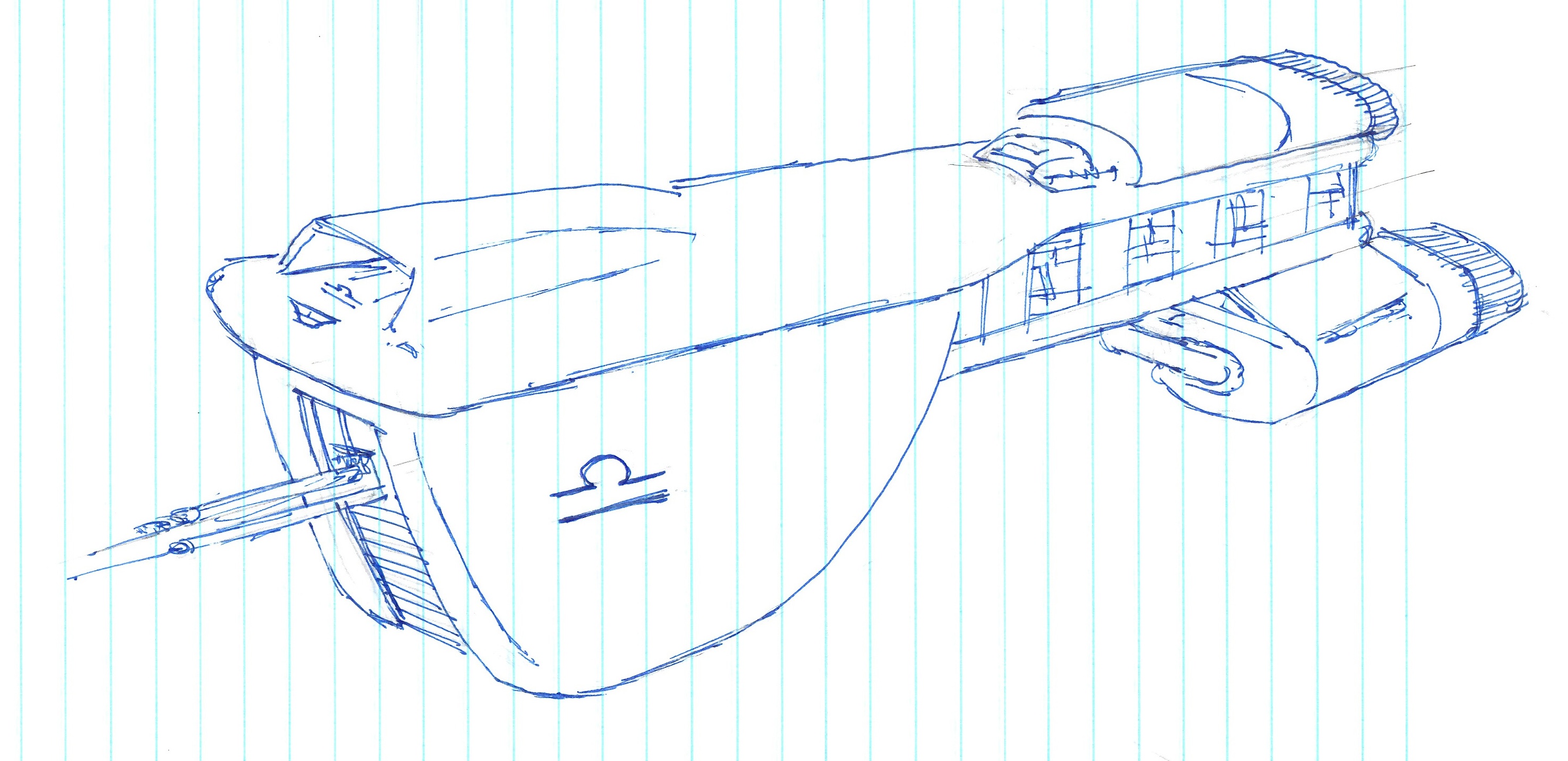
While it’s unlikely to be something a GM might use in their Battlestar Galactica campaign, I was bored so I statted up the Libran Galleon from our recent session:

Libra, a Galleon of Kobol

A quick sketch i whipped up for the session...

A quick sketch i whipped up for the session…

Length: 4835’     Beam: 1896’     Draught: 1619’     Decks: 65     Crew Complement: Unknown     Max Complement: Est. 40,000

ATTRIBUTES: Agility d4, Strength d12+d8, Vitality d6, Alertness d8, Intelligence d8, Willpower d6

Secondary Attributes: Life Points 30,  Armor 4W, 4S; Initiative: d4+d8, Speed: 3 [SL/JC]

TRAITS: Memorable d4, Rushed Construction d4

SKILLS: Mechanical Engineering d6, Medical Expertise d6,  Perception d4, Pilot d4

AUXILIARY CRAFT: 10-15 transports [est.]

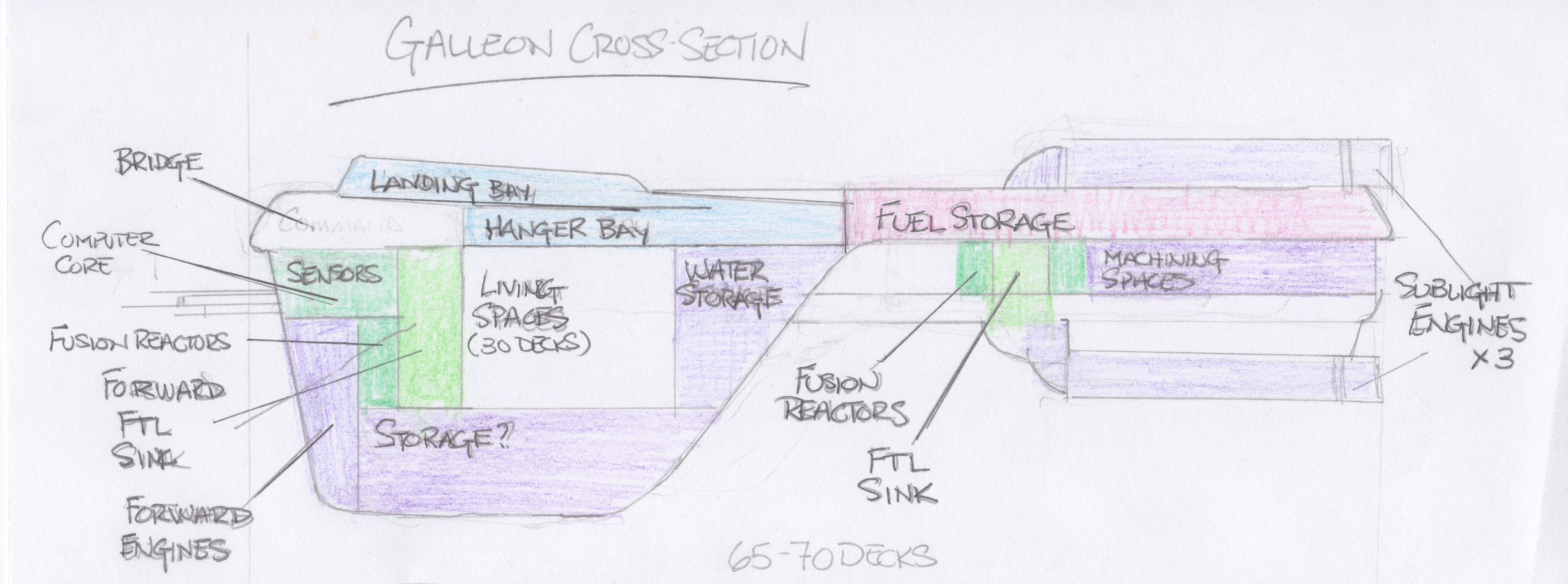
And another quick cross section for the session last week...

And another quick cross section for the session last week…

Tonight’s session revolved around the investigation of a galleon from Kobol, found orbiting the flux tube between a gas giant and it’s closest moon. The fleet had been looking for tylium to tank up, found it on this small moon that is on the verge of dropping into its parent gas giant — that planet badly attenuated by the nova that had created a planetary nebula around a white dwarf. The nebula has similar radiation signatures to Ragnar that damage Cylon circuitry…but also has high levels of gamma that make it unsafe for the fleet to hang in the area for long. (Inside the upper levels of the planet’s atmosphere, where the moon is scrapping, the magnetic field of the planet protects from that radiation…but the microwave interference is intense. The ship is just inside the atmosphere, and the mission must content with high winds, tremendous energy flows, and landing on a derelict that has a strongly charged hull.

The players stage a mission with the scientists they can find to work it: Baltar (now the new science minister for the fleet), an astronomer, a doctor and a few medical specialists, a deputy marshal with degrees in divinity, literature, and a minor in archeology. One of the PCs is playing Baltar, another one of the pilots on the mission. They have to fly through heavy chop, avoid the flux tube, and land the shuttle while making sure their shuttle’s electrical system is ready to handle the massive shock of touching down on the derelict. The landing is harsh and does some damage to the shuttle, but it’s still operational.

Once aboard the fan out and search a very small area of the craft. The hull is at an angle to the planet’s center of gravity, so “down” is about 25 degrees from the floor, toward the aft. They have to careful and most of the team got minor injuries slipping and falling. The descriptions of this ancient vessel were horror movie-esque: it’s dark, there’s the constant noise of the thin atmosphere outside hitting the hull and strange creaks and groans from a stressed hull and heat expansion and contraction. The ship has damage from millennia of exposure to the atmosphere, but also from weapons hits. They find bodies of the passengers, dead from explosive decompression. They find momentos — pictures, personal effects, all which evoke the same sense of panicked flight and loss as in their own fleet. These were people on the run, as well.

The interior is very stripped down; the ship was a refugee vessel — they didn’t bother with hiding wire conduits, air pipes, etc. They find toolboxes and other implements that are shockingly similar to what the Colonials use — screwdrivers, ratchet wrenches, staplers, etc. They see a large seal on the end of the hangar bay with a Phoenix symbol that is similar, but not the same as that of the Colonies. They find the astronomy compartment and star charts and other important pieces of information — most of it intact enough to take away, but who knows what will happen when it is exposed to air? They find the bridge, which I described to evoke the old McQuarrie design for Galactica from the original show…but sitting in the command chair is a massive figure — a blond man, of amazing physical beauty and proportions — 7 and a half to eight feet tall, well-preserved. He is dressed in black combat armor that has a vaguely Spartan quality to it, and is holding the pistol — perhaps an energy weapon — that he used to take his life. The sigil of Apollo adorns the armor.

They find the machine shops and they are staggering — 3D printers of incredibly advanced design for metal, plastics, flesh. And they find several gold-skinned androids fashioned to look like women, each with a unique face and body — the archeologist posits these are some of Hephaestus’ “golden women” that aided him in his forge. Their myth/religion is coming alive.

Eventually, they have to return to Galactica, which is providing overwatch for the mining vessels going after the tylium on the moon surface and we ended there for the night.

This was a big push episode — not only to push the game in a new direction from the show, but to heighten some of the conceits of the RDM Galactica — that the characters are playing out a variation of a story told over and over again, and how do they break the cycle? I’ve heightened the Greek myth aspects of the show and added more traditional science fiction elements — the Lord of Kobol existed, but were they simply some kind of souped-up humans, were they supernatural, and what was this “Blaze” that was warring on the Lords? Why did the humans have to flee Kobol, apparently guarded by Kobolians/Lord of Kobol? And who are the new humanoid Cylons — did the Cylons the Colonials created make these new fleshy versions (and why, if they despise humans so much?) or are they some kind of creation by Kobol? I’ve also pulled in elements from the old show — including the Ship of Light, which one of the PCs has seen in his visions of Kobol. But what is it — a ship?

Tonight’s adventure was fairly quick, partly because the player that runs a marine character didn’t show up — meaning a large portion of the action happened offscreen. In this, the players assault the mutineer-controlled Astral Queen. The last post talked about the deal that the PC commander had cut with one of the mutiny leaders, a Colonel Seii, and convinced him to aid in the raid of the prison barge by removing Tom Zarek from play, and how two other PCs — the vice president and a deputy marshal — had been captured.

The evening launched straight into the set-up. A raptor jams Astral Queen‘s DRADIS and comms while vipers set up a cordon. Four raptors approach — to are decoys and land on the hangar bays, trying to gain access, while another two deliver teams that burn through the hull to raid the ship with 20 marines (led by four officers — one of them a PC pilot.) The main conflict is quick — Seii had arranged for the main force of armed mutineers to be responding to the decoys while getting himself in close proximity to Zarek and his close confidants — and the mutineers are badly routed by the raptors using their navigation spotlights. (Anyone whose seen an aviation navlight knows they’ll burn your damned eyes out, practically. The pilot engaged a few bd guys, but quickly got to the bridge, where the vice president witnessed Seii staged a quick, violent takeover that killed Zarek.

The commander managed to portray the incident as infighting between the mutineers and painted Seii as a hero of the piece, hoping to bring the unjustly disgraced man into the Fleet again, and was able to convince the civilian authorities to go along with it.

The night’s action showed yet another sharp turn off from the show. Without Zarek as a constant distraction, the fleet politics are more stable, but it also allows one of the PCs — a member of the quorum, a former gang leader turned local politician, and unwilling ally of the Cylons in the fleet — to move into the main political antagonist for the game. There’s still the tension of the show, but the main characters of the show are steadily being sidelined for player characters and campaign-specific NPCs.

Next week: the Libran galleon mission.