Last week’s game session of Battlestar Galactica continued to see us pull from the RDM show, then twist it to fit our campaign. Events have led the fleet to look for more resources, as they don’t know how far their journey will take them. They’ve found tyllium on a moon in the upper levels of an attenuated gas giant in a highly hostile star system with a planetary nebula around a white dwarf. The radiation and ejecta are enough to be dangerous to the smaller ships, but also has the same Cylon-tech jamming signature of Ragnar. The upper atmosphere of the gas giant and it’s magnetic field cut much of the harmful radiation of the nebula, but has its own dangers.

They had found, in the previous night, a derelict galleon (they think) from Kobol that had the markings of the Libran tribe. They immediately add a mission to the hulk in addition to the mining operations they are going to have to run. The mining will be highly dangerous and the fleet population has been reticent to volunteer for hours of hard labor in a space suit exposed to high levels of radiation from the nebula and the planet’s electromagnetic field. As in the show, the vice president (a PC), decides to try and get some of the prisoners to volunteer for the work in exchange for points to release or expedited release for some of them.

As in Bastille Day, this leads to a hostage situation, with the Vice President, the Tauron delegate to the quorum (a former actress), and a PC police officer guarding them being taken by Tom Zarek and another leader of the mutiny — a new character named Janus Seii. Seii is a former colonel in the special forces that worked specifically for the Office of the President running high-level security checks, doing counterterroism, etc. He had been railroaded by the admiralty four years ago, allegedly for embezzlement of black bag funds, but there were always rumors that there was some political issue or that Seii had pissed off the wrong flag rank officers. He doesn’t even have a personnel file — he was being transferred under a simple convict number. Seii is convinced he was to be killed by some elements in the government and specifically the president, who was Minister of Defense at the time, and was not hot to save the colonel.

The prisoners move Astral Queen close to a few liners to prevent being shot down and issue an ultimatum — elections and release of the prisoners. The commander of Galactica (and son of the president) is a PC: he negotiates a meet with Seii in space, raptor to raptor and explains how the conditions in the fleet aren’t much better than prison, that they are willing to run elections — which were supposed to be in the offing in six months anyway, and agrees to release the 500 or so prisoners that haven’t taken part in the mutiny aboard Astral Queen. He has one condition for this — assassinate Tom Zarek. He’s a malcontent, arrested for terrorism and his first action is to take hostages and a ship. He’s a danger and will be divisive and dangerous force in the fleet. Seii agrees and offers to make sure the most dangerous of the prisoners are defending the ship when Galactica moves to board the vessel.

The sticking point is the president. The commander defends his father, but hears how Seii had been onto some kind of subversive or treasonous element in the contractors to the Fleet’s expeditionary fleet. He suspects he was onto the Cylon infiltrators that helped destroy their defenses, but he was shut down by large political forces — perhaps even President Adar — who were indebted to their contractors. Whether they knew it was Cylons, he doesn’t know. Whether the president is a Cylon “puppet”, he doesn’t know. They agree that the political and military leaders have to be tested for Cylon hardware, or bloodtests for being Cylons.

The evening ended there, but it’s opening the campaign to a new direction. Until this point, the characters were trying to follow the laws and norms of their society…now the commander is cutting corners. If it works, will he be horrified by his actions (or suffer consequences for acting without authorization by the civilian government), or if he’ll be tempted to take the easy route and start a slide toward military rule.

There was also a comedic/frightening bit with the Tauron delegate and the cop trying to escape that led him him getting beaten pretty badly, as well as discovering that the delegate is a drug addict. (They had arranged for first aid, took out the guard and prisoner/nurse, and “escaped” into the ship…where she helped him recover from his injuries with a judicious shot of morpha. She also partook. So, high as kites, outnumbered, and not overly competent, they were preparing to go Die Hard on the terrorists. Or hide. Or something…

The night’s play showed how you can take elements of a licensed property and play with them, keeping enough bits of an episode — in this case — to tease the players into thinking things might go one way, only to let their actions led you away from the path the original material took.
This week’s Battlestar Galactica continued to move away from the TV show canon, while trying to actually one-up the style and flavor of the same. Looking for resources to mine, a recon raptor discovers a moon orbiting in the upper limits of a gas giant’s atmosphere — the word have been severely attenuated by the white dwarf it orbits when the star went nova millennia ago. The whole system is engulfed in the planetary nebula of the nova, awash with radiation — including the signature that affects Cylons — and debris. It’s far too dangerous to hide the fleet in, but the moon is somewhat protected from the nebular radiation by the strong, also dangerous, magnetic field of the gas giant.

They jump in to do a survey of the moon, battling strong atmospheric currents, the magnetic field of the gas giant and the powerful flux tube along the field line connecting the moon to its primary. They discover remnants of a settlement, badly eroded by micrometeorite, gas friction, and other elements…perhaps a mine? they estimate, based on the damage the place has been there for over 2000 years.

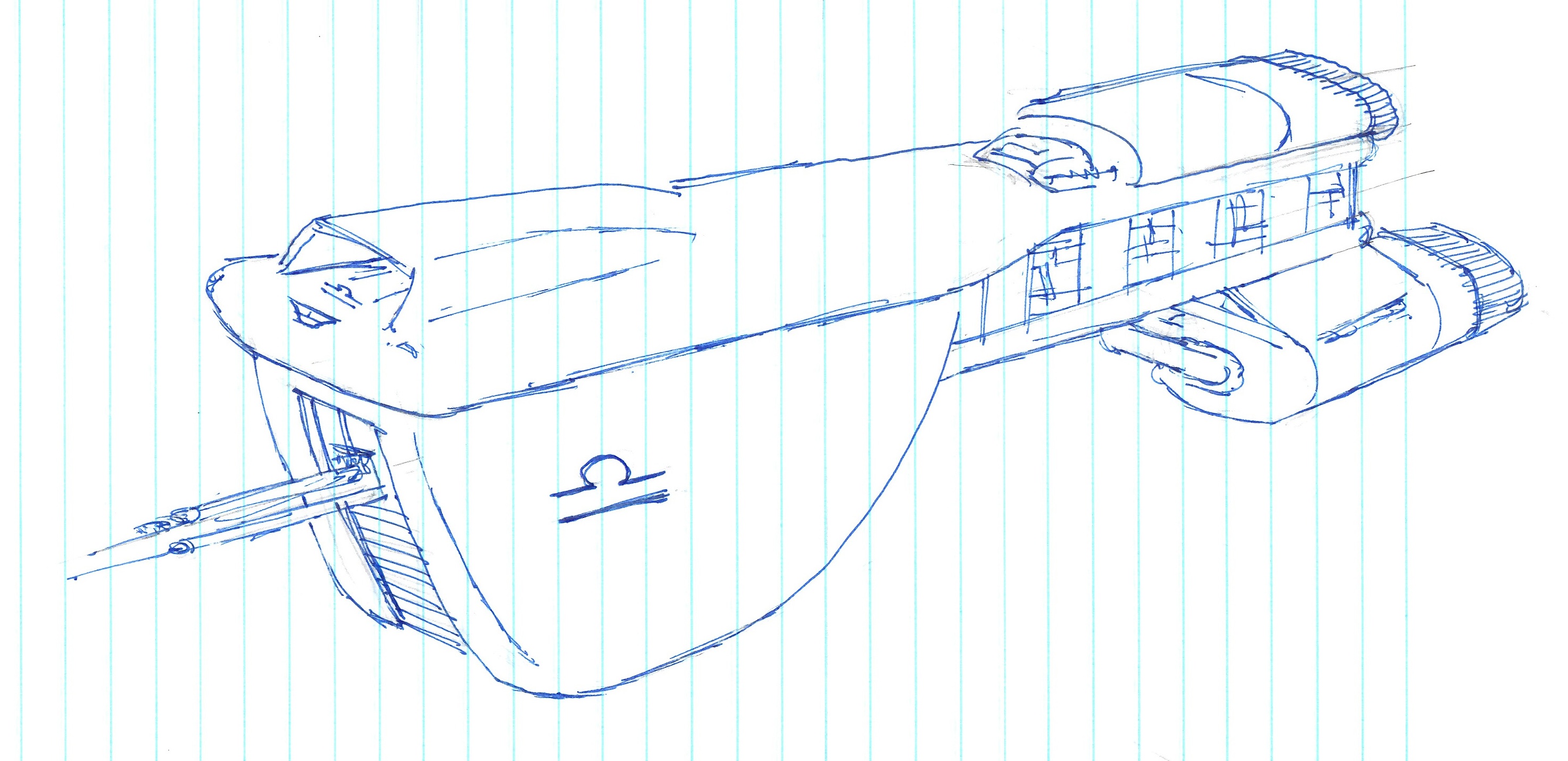
Despite the heavy DRADIS interference, they pick up on a massive object that seems to be trapped, circling the flux tube…it turns out to be an ancient, massive vessel that the pilot (the CAG, a PC) recognizes from a recurring dream I’ve been describing, as one of the galleons that brought humanity to the 12 Colonies!

A quick sketch i whipped up for the session...

A quick sketch I whipped up for the session…

The markings are those of Kobol-era Libra — the ancestors of the Librans, whose population we’d remarked on several times, has been historically much lower than the other Colonies. There was damage to the craft, indications of weapons impacts among the millennia of damage done floating in the atmosphere of the gas giant. They were making plans on how to board an investigate — having to take into account the heavy energy fields, the charges the recon raptor or shuttle’s hull would pick up, how to communicate through heavy communications interference, etc…

We ended there, but the hope is that the hulk will provide a key to the location of Kobol, and Colonial prehistory. The episode also shows how you can veer from the direct plot of an RPG setting based on an established property, and still keep — or enhance — the feel of the original material. In this case, the visions characters are having started as very ephemeral or confusing, but as events happen, they are making more and more sense.

One of the central tenets of Battlestar Galactica –both the 1978 and 2004 shows — was that the characters were trapped in events that were bigger than just their exodus. In the original show, the “ship of light” and its angelic beings were somehow interested in the plight of the Colonials; similarly, the Final Five were shown as being of light, draped similarly in white, and the “ship of lights” is riffed on in one of Starbuck’s paintings.

What I’ve been working toward is establishing that there may be some kind of cosmic force that is continually playing out this cycle of collapse, discovery, and rebirth over and over again, with differing protagonists and antagonists…but always toward some end that is unknowable. Kobol may be the home of godlike creatures that were overthrown by an angry, jealous “Blaze” (as per the cut scene in Kobol’s Last Gleaming), or maybe they themselves were just one set of oppressor-turned-oppressed in the Great Cycle.

I’ve kept the Scrolls of Pythia as a major plot point, but added the Aurelian Heresies — an apocrypha that might predate Kobol, itself — and which has strong influences from the Eleusian Mysteries of Greek myth — a cycle of decent into the underworld or some deadly event, self-discovery or rehabilitation, and the resurrection or rebirth of the character/civilization/etc. It ties tightly to Hades and his capture of Perephone, and I’ve dropped hints that “the Blaze” may have been Hades revolting against the Lords’ rule…but maybe not. Every point here has been to enhance the mystery and mysticism of the setting, but to temper it with some of the characters positing more sensible reasons — the Kobolians were some kind of alien race than made humans; the Kobolians were just exceptional humans; they were the Cylons of the Titans…

Don’t be shy when running a licensed setting to shred what you don’t like, pump up what you do, and go your own way. Your game is best thought as a reimagining, not a canon-inclusive sideshow. This gives the characters the chance to be the heroes, having real influence on their universe, instead of heroes playing in the shadow of the people in the property.

So, we’ve had a couple of good episodes running over the past few months in our Battlestar Galactica campaign that have centered on the emerging politics of the fleet. Unlike the show, where the government just sort of materialized as if by magic, or fleet has been hampered by the logistics of moving people and goods between, essentially, 78 islands in space. There’s a black market that has fired up almost immediately. There’s hoarding and other problems just trying to get a handle on what they have in the way of resources, how many people they have (still an estimate, but a pretty good one), and how to motivate people to work where needed.

The fleet immediately went on half rations for the civilians not working, 2/3rds rations for those working in essential areas (military, bioship, repair ships, etc.) and they’ve been trying to recruit people for the Fleet and marines. Of course, with no place to really do physical training and no time for basic training type stuff, the newbies are being thrown straight into OJT. Pilot trainees are learning their OCS manuals while at the same time trying to learn basic flight. Enlisted are right into occupational training. The marines are about the only people they have the time to train with weapons.

They are also putting together a Marshal Service to police the fleet for violent crimes — murder, assault, rape, human slaving (which they’ve already run across), hunt Cylon infiltrators, and hoarding (although there’s a question as to where property rights end…can they just take people’s things? What does that do for motivation?)

One of the B plots is finding resources to replenish the fleet. A raptor went missing this week’s game (Halloween night) and two of the characters had to go on a search & rescue to find them. The raptor had been investigating a system with two giant water worlds, and they quickly found the raptor on the ocean’s surface, riding a mat of algae, and afloat but sinking slowly and in the path of a massive hurricane. They had maybe two hours to effect a rescue. The ship was not answering, so they head down and find the bird has it’s side hatch open. Why? The crew are not answering and there appears no one is aboard. Why not?

One of the characters is winched down under the hovering raptor and boards to find the craft dead. A quick search turned up the seat covers, rubber gaskets, pages from the manuals, etc. …all gone. The character managed to work out these were all organic components and that’s when her pilot realized that the algae mat was moving — crawling onto the raptor. There were a few tense moments where the pilot investigating barely got out of the craft before monster ate her, and some of the slop was eating through her flight suit boot. (She managed to get it off in time.)

The players had been expecting a Cylon plot, or some kind of maintenance issue, so the introduction of their first confirmed multi-cellular life form — and a vicious one at that — made for a sharp turn from the show’s universe. But it also played well into how to introduce a bit of the haunting holiday into an established game.

I was reading over a couple of pieces on 11 Things to Help Your Players Be Better Roleplayers over on Gnome Stew, and the referenced 11 Ways to be a Better Roleplayer on LOOK, ROBOT and realized that several of their ideas were on display at this week’s game session.

The last few weeks have been a clusterf#$% regarding player attendance — between GenCon for one, another as a speaker at the Transformers convention over in England, and the third have to be away for work and other issues, we’ve been at least one player low all month. The past two weeks had me adapt to this by throwing together a murder mystery for our Battlestar Galactica game, set on one of the ships in the civilian fleet.

The two characters are members of the new Colonial Marshals Service, tasked with looking into violent crime, hoarding, and other immediate issues to fleet security. “Victimless” crime is ignored. However, in the aftermath of the Fall of the Colonies, there have been an understandable spate of suicides and suspicious deaths…they all have to be investigated. The veteran, Chaplain, is annoyed by this — he wants to focus on the Cylon menace, but I need the guy investigating crimes for this episode…right here, the player was doing what Grant highlighted in the second piece as points 3 and 4 — “Don’t Try to Stop Things” and “Take Control of Your Character”: The player didn’t pull the “my character wouldn’t do that” shtick — he followed the instructions of his boss, who told him he needed these cases closed and to get on it; the second character also had a case on the same ship — a missing 16 year old girl. The two decided to pool resources and investigate. The characters both bitched about their assignments — that was fully in character, and they were given the opportunity to harangue their boss…but they’re doing their jobs. In that, I was engaging in point 2 of Phil’s piece on Gnome Stew, Create Opportunities for the Players to Express Their Characters.

Points 3, 4 and 9 of the Gnome Stew article come into play here: One of the things I’ve always tried to do was act more as a director than a writer in games. The characters were given enough information to take action on their own. The players don’t lolligag — they immediately start looking into their respective cases. The whole time, I try to not just play the NPCs, but give possible queues that they might miss in the action, or might not have occurred to them while playing that tie into their character — getting inside the heads of the characters, as it were. Example: The new guy is a geek, an overweight former programmer than helped stop one of the prongs of the Cylon attack. He’s a coward, but he takes on the responsibility of being a cop seriously. As he realizes the parents of the missing girl are hiding something, and the younger brother is upset, I suggested that — this guy, the guy that no one would notice at college, that spent all his time playing a hero in RPGs and computer games, was suddenly the one guy that actually could make a difference and save this girl — he might find this both terrifying, but also an important moment for his self-esteem and personality. The player ran with it. They didn’t have to.

The veteran realizes that the suicide couldn’t possibly have happened as the report says — the safety protocols, etc. are too complex for a guy who was, in essence, the garbageman of the ship. He was murdered. The character is pissed, because now it’s not a check the box suicide investigation…he has to take it seriously. The two both run into a lot of stonewalling by crew and passengers and start to realize they are in real trouble…there’s something going on aboard the ship. They could, at this point, try to get backup or something, but they investigate further (Point 1: Do Something), checking the ship’s cargo manifests and the coming and goings of cargo ships and shuttles (the vessel is a major logistics hub for the fleet.) They also note the tattoos on the security men and crew of the ship — they realize it’s a Ha’la’tha (Tauron mafia) ship. They get the brother of the missing girl alone and find out she’s was sold to the HLT for extra food and clothing rations.

Point 3 for the GM: Keep things moving. Paraphrasing Raymond Chandler, the pulp mystery writer, when a scene bogs down, have guys with guns burst in. That’s what happened here. We’d been building up the suspense for a while and it was time to get things moving. The newbie’s questioning of the kid brings the gangsters after him. There’s a chase and hiding from the bad guys scene in a crew habitat that I described as being a lot like the living quarters in Outland. (I wanted the catwalks, the multiple tiers with points that would require jumping from level to the next. See the movie — it’s a great action set piece.) The vet has to come rescue him and they proceed to kick serious ass. Having done that, they find out they work for a HLT lieutenat operating out of the “box city” — an area of interconnected pressurized cargo containers (like those on a real cargo ship, but with pressure doors, etc.) The same place where the suicide-now-murder took place.

The encounter the bad guys, whom the vet taunts for their obvious lack of forethought on trying to kill them. “What do you think is going to happen? You’ll just wind up with more cops of the marines in here!” Of course, the gangsters are planning on scattering and changing their identities — easy enough with the terrible record keeping currently in the civilian fleet (it’s less than a month from the Holocaust.) It’s a Mexican (or in this case, Tauron, showdown…)

At this point I realize we’re getting close to quitting time for the night and seek to wrap the night before they get to the part where they rescue the girls. The question — do I go for the anticlimactic “Oh, you’re right, here’s the girls” ending, or step it up. I go Chandler — the area is suddenly sealed by other bad guys and the “big bad” (now just a minor functionary) tells them they’re all dead. The gangsters included. The trail will dead end here.

The area is getting vented and the characters had a series of misadventures trying to get to safety including attempting the classic air duct crawl…only to get stuck. Really stuck. Two botches in a roll stuck. At this point I invoke point 10 in Phil’s piece: Make Failure Interesting. The vet is stuck and goes seriously claustrophobic/ upset that after all the shit he’s been through with Cylons and other dangers, he’s going to die stuck in an air vent…and he doesn’t even know why! The players embraced failure, as grant suggested and ran with it. Eventually, they managed to get clear, but it gave a great half hour of entertainment.

One point grant had: Don’t try to stop things came into play here: the newbie is a coward, had been nearly killed, had to shoot a man, and he’s a wreck…his beloved top-end datapad was shot (saving his life) in the hab fight. He wants to get on the first ship off the craft, but the vet knows the HLT isn’t going to let them do that. They settle for hacking the comms system and firing off a report/call for backup from the CMS before they go after the big bad (see above.) The characters argue, they alter each other’s pans, but they don’t try to undo what the other player is doing. They built on it.

We ended for the night with the characters stuck on a gangster controlled ship, who were nearly killed by nameless baddies, but they know where the brothel/club that the HLT is running is on the ship and the newbie — cowardice pushed aside by pride and the chance to be a hero — is determined to save them.

The thing for players and GM to remember is that RPGs are a collaborative form of storytelling and play. The GM (at least in more traditional sorts of games) creates the outlines of the world and the players flesh it out with their actions. Sometimes it’s just offhand comments like the newbie stating the bad guys were trying to make their deaths look like accidents. Well, no, I was trying to come up with a quick ending that didn’t involve the characters getting killed by the ready to shoot villains…but it sounded good, so I ran with it. Take what the players are doing and mold it to work with what you intended — or it their idea’s better, purloin it [without telling them] and run with it. Ultimately, as long as everyone is having fun, you’re doing it right.

It’s been a while since I posted one of these, so here’s the latest from our BSG game:

The last  half dozen sessions have revolved around our version of the Water episode (see here for recap) and the fallout of the same. After clearing Aaron Doral of involvement in the murder of the master-at-arms, and dropping the suspect as he was attempting to vent the ship’s atmosphere at auxiliary damage control, the characters continue to investigate the sabotage of the water tanks, focusing on the mysterious pilot that was seen on the surveillance camera. They work out it was female, despite the helmet being on, and from the squadron patch that it’s one of the raptor pilots.

The investigation seems to clear all of the women the right size, but in their questioning of the alibis work out that Boomer’s timeline is questionable. In the course of discussing the situation, the new master-at-arms (one of the PCs) lets slip that they have a test for Cylon agents. They decide, just for safety sake, to test Boomer. When they go to arrest her, her programming trips and she nearly kills the MAA with a metal chair, but gets dropped by one of the other PCs. Injured, but not dead, they take her under guard to the infirmary for her shattered leg.

The doctor does surgery on Boomer’s leg, and while under anesthetic transmits their location to the Cylons. The battle that ensures when two basestars jump right into the middle of the fleet took two sessions to complete. They launch their fighters and the good guys are outnumbered 20 -1. Half of the fighters hold back as a screen for the basestars, but several hundred hammer the civilian and military ships. It was a very desperate fight, and our first real engagement of the campaign.

This gave us a chance to try out a really stripped down set of house rules for fleet combat. In it, the fighter squadrons get three actions to the capital ship’s one. To handle the fighter combat, the CAG (a PC) rolled his initiative versus the Cylon squadrons. To resolve combat between large numbers of fighter, I handled each squadron or group of fighters as a single unit. The CAG rolled his piloting skill and gunnery for the vipers, with the number of successes over the Cylon defensive roll being the number of fighters that were splashed; it was vice-versa for the Colonials. It ran fast and clean, and allowed for a big fight to be resolved in a night.

Galactica and the other military vessels did very well in the initial stages of the fight, mostly because the Cylons were concentrating on the civilians and damaged military craft first. As the toasters took serious damage in the first few capital-level exchanges, they changed their focus to the battlestars and hammered them. The fight took about five minutes game time, and once the fleet was jumped away, the characters ran for it. But not before they had taken serious damage — all three of the combat vessels were at half damage or worse. The fighters, on the other hand, did remarkably well, killing 20 Cylons to each viper lost. Another problem — two heavy raiders got through the point defense screen and landed in both of the landing pods (one crashing through the windows of the museum.)

The next session was a hard fought battle against a Cylon boarding party, while a PCin an unarmed shuttle attempted to bottle up the only functional heavy raider from escaping to report their position. For the Cylon fire team, I had two of the toasters carrying heavy machineguns, instead of just using their arm guns; another two used grenade launchers. They did not show fear or hold back when under fire (why would they?) which led to a nasty, but short fight in which the master-at-arms character is nearly killed and half his team is injured or killed as the Cylons punched through their defense and made for the CIC. Eventually, they were able to stop the machines, but not before there were a lot of bodies on the deck.

The first few times we encountered the centurions, they seemed a bit underpowered to me, but having made certain to apply their armor properly, they were damned tough opponents.

One of the things I liked about Babylon 5 and the reimagined Battlestar Galactica was that the characters had to make big decisions based on bad information, little sleep, and through the prism of emotional strain of surviving the apocalypse. It’s something that was present in my last BSG campaign, but it is firmly up front and center in the current game.

The last few game sessions revolved around the death of Sergeant Hadrian, the master-a-t-arms, found murdered near the water tanks. It gave me a chance to do a police procedural in the environment of Galactica. The characters chase down forensics evidence — surveillance cameras near the scene, fingerprints and other evidence on the murder weapon, and the like — there were a few red herrings in the episode, and they were tripped up by sabotage of the tanks ala the episode Water. They have to solve the murder and sabotage at the same time. One of the suspects is the still-present Aaron Doral. In our campaign, he was a Ministry of Education flunkie responsible for the museum transition on Galactica and who is now the Scorpia delegate to the Quorum of Twelve. Eventually, it turns out Doral was set up by a Cylon agent whom they stop in a desperate fight outside of auxiliary damage control, where the bad guy was aiming to vent the ship and kill the crew.

The B story, however, seems to indicate where the meat of the campaign is going to be: BIG decisions. As the new government gets its legs, they are trying to decide what the government, laws, and life of the fleet is going to look like. One of the characters is the commander of Galactica and he is already showing signs of authoritarianism. He’s been floating the idea of a military dictatorship, something the vice president character seems to be somewhat supportive of. What kind of law and law enforcement are they going to have for the fleet? Concentrate on violent crimes only? What about crimes involving coercion or other kinds of “force”? They have two cops…do they form a bigger police force? What kind of authority should they have? What kind of surveillance and expectations of privacy should you have?

These kind of issues don’t turn up often in the average dungeon crawl or setting where the players are “street-level”, but they make for good fun for characters that have some level of power. What happens when your fighter becomes king of the realm..? Do you rule as a “good king”? Even if you do, what kinds of freedoms can you give your people? How does power affect your decision-making process — can you stay “good” or do you let the power go to your head?

What about the street runner that becomes a corporate exec in Shadowrun  or Cyberpunk — do you sell out? Do you work to fix the system from the inside? Do you convince yourself you’re doing one, while actually doing the other?


We’ve had to sharply change gears on how we play the Battlestar Galactica campaign since the Fall of the Colonies. Up until the Cylon attack, it’s been mostly a Cold War spy/police procedural where one set of characters have been ferreting out the Cylon conspiracy, and another set have been dealing with the politics of the Colonies and how they are hampering the search. Now it’s a post-apocalyptic survival game.

First thing we’ve done is create groups of characters that have a certain sphere of influence. We can mix and match as works, but there are 1) political characters involved in the civilian fleet and the politics of running a small town on the run, 2) military to handle fighting Cylons and finding Earth, and 3) civilian characters whose fight crime, boredom, and dispair in the Fleet.

We’ve had two short episodes since the Fall. Our version of 33 only took about a day’s time, as the characters figured quickly that the Cylons were tracking the fleet and managed to locate the devices that were aiding the enemy. I had the white disk thingees we see in the miniseries (the one on the DRADIS console) play the role of trackers, tied into the DRADIS and navigation feeds, and powered by the ship’s power grid. Unplug them and they’re useless. There was an Olympic Carrier moment, but a shoot down is averted early on.

However, unlike the show, where the tiny government gets its act together fairly quickly, we’re addressing the chaos that 60,000+ people on about 92 ships (our Fleet is a bit bigger and has two battlestars and a few support ships surviving) that have had almost no time to mourn, come to grips with the enormity of what has just happened to them, and who are packed like sardines in some ships with terrible sanitary conditions, would face.

After the events of 33, the next adventure revolved around Vice President Jones — a player character — trying to get a decent census of the people in the fleet, and a sense of the conditions. Because the president and military are fixated on finding possible Cylon collaborators or agents in the fleet, they have stopped traffic between ships while the crews — tired, overworked, and grieving — try to figure out how many people they got and what their food/water/air situation is. There’s simply been no relief for people who are stunned by the Fall, and many can’t or won’t cope. When he arrives at the freighter Epheme, he finds the ship — which has pressurized container vessels packed with refugees — on the verge of mutiny. The people have been sealed inside the containers, because they have overloaded the ship’s water and waste systems. The ship has no water, and the sewage ship has yet to get to them. The place is an open sewer, and inside the containers, it’s worse. The characters have to avert a mutiny, convince the government to lift the no-fly order (and risk agents moving through the fleet), and then try to sort out how to move people.

The contrast between the lives of these people and the government types, sitting on Colonial One with only a small staff and press corps aboard, is marked, and made more obvious when the rump Quorum (only ten members chosen from the highest ranking officials from each Tribe they can find) votes to move from the small liner to Cloud 9 with its spacious staterooms, plentiful meeting spaces and convention halls, and amenities like dry cleaning service. Politicians, even in during the end of the world, still act like politicians.

It also gave us the chance to introduce a new PC, Quorum member from Aerilon who is a Cylon collaborator. His minder, a Cylon humanoid agent, got him from gang member and dock worker to community organizer, to politician in a few short years. He knows he was working for the enemy, but never expected them to actually attack. It should be an interesting tight-rope for the character to walk.

So what’s the point of all this? In your campaigns, it’s important to realize that — especially in fast moving, large events like battles, emergencies, etc. — the characters will never have full knowledge, or even accurate knowledge, of what’s going on around them. Think of the Boston Marathon bombings…even figuring out who the suspects were with mounds of photographic evidence took days, and over a week to start connecting them to those who aided them. In this game, after 3 days the Colonials still don’t have firm numbers on their survivors, don’t know how many lawyers to run courts, doctors to treat people, computer specialists, miners, and what have you they have in the fleet. To make these sorts of events real, you need to feed your players information. Then contradict it. Then do it again. Get them confused, worried, and make them act on imperfect knowledge. That’s how it really works, and when they screw up the consequences should lead to good drama and role play.

Voting is open over on Stuffer Shack for the 2013 RPG site of the year. So, if you’ve enjoyed the site, gotten good use out of the game-specific materials, or just wants to be a mensch…go over and vote for us!

There are a few game systems that do a nice job of handling large scale battles, and the participation of characters in them, but not all RPGs — particularly those that focus more on character and story — deal with the different scales of a Star Wars or Battlestar Galactica-style capital ships, fighters, people running around shooting stuff all at the same time kind of action, especially when you have characters operating at all of these levels.

We’ll use the latest Battlestar Galactica session I ran last week as an example (with some augmentation here and there to illustrate some points…) We have finally reached the events of the miniseries in our campaign, and the characters have replaced those of the show for this iteration of the story (search this site for “after action report” and you should be able to find postings that will explain more on this.) Last night was the breakout from Ragnar Anchorage, which meant going toe-to-toe with the Cylons. As in the series, Galactica — this time with the aid of other surviving military units — have to scatter the Cylons and hold the line over the anchorage while the civilian vessels jump to safety. This means coordinated capital ship action (one of the PC, Commander Pindarus, running that), Viper on Raider action with PCs flying the vipers, and we would have had another character aiding in damage control in the fight, had they attended that evening.

Battles in BSG, Star Wars, and Star Trek often take hours, not minutes, or the seconds of personal combat in many games. To capture the difference in scales, I suggest that at the start of combat, the capital level stuff goes first — battlestar and basestar exchange their initial salvos, and any character involved in gunnery or command of the vessel, or electronic warfare gets to take their actions for the round. Next goes the fighter/vehicle-level action, then the personal-level stuff. Now to show longer time frames of battles for such a fight, I typically allow the personal and vehicle scale players to have another two or three rounds to show the speed with which their combat or actions take before returning to the capital-level attacks. (In the case of the damage control stuff, I would most likely call these extended tests and have them roll at the same time as the capital level actions.)

Here Galactica launched her fighters, set up her flak barrier with the point defense, but before she could start wailing on the nearest basestar, they were hit by a missile salvo from the same. (They lost initiative.) Galactica returned fire relatively ineffectually for the first round. Next, the CAG rolled for the fighter groups. Here I was assuming his pilot and initiative counted for the vipers vs. the Cylons. They won, he rolled brilliantly for the first round of engagement and they splash a bunch of toasters and only lose one guy. The other pilot character got to duke it out one on one with a raider — she’s a pilot, it’s her schtick — always let your players get a chance to strut their character’s stuff, if you can help it.  The viper squadrons rolled again, this time only a few toasters go down and no vipers. A third go-round for pilots and blasting Cylons.

Galactica got initiative on the next round and did well, pasting the basestar hard. However the viper squadronds do almost nothing and the Cylons damage 12 of the vipers in the round. They break through and start a run toward the EW raptors, to try and clear the jamming the Colonials are using to keep the missiles from damaging the battlestar and civilian ships. The next two rounds are viper squadrons and pilot characters dogfighting with raiders.

The next capital round, the Cylons are done playing. Galactica gets a radiological alarm and the Cylons fire a nuke. The EW raptors jam it and keep the ship safe. Finally the civilian ships are all out. The next two rounds are the pilots attempting their combat landings before the ship jumps to safety.

Now originally, I had planned for a Cylon agent to have been activated in Galactica during the breakout and there to have been a fight between a marine PC and the bad guy that would have been resolved like a normal fight at the same time as the viper combat — three rounds of action to every one for Galactica and other capital ships. It would have happened in the CIC and anything that distracted the command staff, or injured them, etc. would have had an effect on the way Galactica was fighting during her rounds.

You can experiment with the time between capital ship rounds, but I find three is enough to allow for fast paced action for the characters in teh thick of things, but not so long that the commander and/or other characters involved in shiphandling get bored.

This is one of those game session reviews that might help — as with the last part — to show how you can take an established universe, a licensed product like Battlestar Galactica  or Star Trek, and make it your own while retaining elements of the original material. Last week saw part two of our version of the miniseries. (Recap of the first part.) Many of the same elements as the show were there, but with the necessary differences to make the game setting our own:

The ship made it to Ragnar Anchorage, but before going in to dock, they made contact through a series of repeater buoys to the crew of the station. (There’s a lot of important materiel in the eye of a storm on a gas giant…they’re going to have a maintenance and control staff.) They have to convince the XO of the station that they have clearance and a need to take materiel from the station, but finally get permission to dock.

The new president, former interim defense minister (and Commander Pindarus’ father), pulls together the rump government he has — Education Minister Laura Roslin, a quorum member from Picon, a Peoples’ Assemblywoman, Aaron Doral — the Deputy Director for Public Education that was in charge of turning Galactica into a museum, and the Colonial Budget Officer chairman (a new PC named Malcolm Jones) together, along with Commander Pindarus to decide what they do next. They need intelligence, and as Roslin points out, there’s a lot of shipping caught in the crossfire that need led to safety. There was a long bit of haggling over what to do, with the commander, quorum member, and Doral favoring finding the remaining elements of the Fleet and conducting a counterassault. They’re on the ropes and they’ll never be stronger. Roslin and the assemblywoman favor running with the civilian ships. But if they can “save” even one Colony world, they are in a better position to rebuild than if they run and have to start from scratch; the commander points out that technology backslide would probably take them another 2000 years to get back to where they are now.

The president decides to send raptors and shuttles to find ships, but more to collect intelligence on the progress of the battle. (At this point, they think they’ve lost maybe 80% of the fleet, max. — so 24-25 ships left.) While all this is going on, they dock with Ragnar, and the XO goes in with PC, SGT Cadmus, and a bunch of work gangs to load up the ship on munitions, medical supplies, food, and anything else not nailed down. The XO of the station is a sickly man named COL Conoy. He’s dodgy and takes the XO off to do the paperwork for the supplies — there could be more units coming and he wants to know what they take so he can supply others — but it’s a ruse. The man tries to kill the XO, but is stopped by the sergeant. They injure him badly but don’t kill him. While the PC wanted to, the XO says to the effect, “how we treat our prisoners is a reflection on us…and they need intelligence.”

Conoy (a humanoid Cylon like his counterpart int he series) came aboard yesterday as a crew replacement. He was able to frag the CIC of the station with an anti-personnel mine and secure most of the crew in a section of the station and vent the air. We left that subplot for the night with the SAR crews re-pressurizing the section and hoping to find survivors.

Meanwhile, the battlestar Minerva jumps in over Ragnar. They find out the Cylons have lost about 50% of their assault force after the older ships got in the fight, and the newer ones that figure out the CNP was the culprit for their technical troubles restarted their computers and physically cut their networks. But they’re still outnumbered, and intelligence shows they have much fewer ships than they thought. Most of the unaccounted for vessels are part of the expeditionary forces — they could be anywhere. Minerva and her escort Cygnus are in bad shape; the Cylons keep finding them, and quickly — even when they jump. The crew realizes they are being tracked and suspect that the ships are tagged some way. They figure out the Cylons must be tapping either navigation or DRADIS and find a device on the bottom of the DRADIS console they thought was part of the museum network.

Realizing they are weaker than they thought, the idea of running is the stronger argument…but run where? Another thing they considered: there are almost certainly Cylon agents in the fleet, and seeing the condition of Conoy, the commander realizes if they can stay in the storm at Ragnar long enough, they’ll be able to suss out who the bad guys are. But how long do they have to wait? We left it there for the night.

So the basic narrative of the miniseries and the show is mostly intact: the Cylons have attacked, the apocalypse is upon the characters, and they have to decide if they stay and fight, or run for it. Not being constrained to a four hour miniseries, we were able to explore a few issues in more depth: the arguments over stay or go were much more heated and for a while there they were looking at some variant of “find a safe spot for the civilians, then go secure the space over Aerilon [the planet with the least damage] and hold the line.” The characters are more affected by their losses, with the pair of pilot PCs being nearly unable to function. The commander is angry and wants to hit the Cylons hard, but he’s being rational…they can only do so much. Their knowledge of the human Cylons and the effects of Ragnar have them using the setting in a manner that the characters in the show did not and could lead to a fleet that is less likely to have Cylons in their midst. This gives the characters hope that they might be able to ignore that element of the show.

More realistically, there are surviving military units in disarray, but still fighting. However, the fog of war is keeping the PCs from knowing the whole story, or they have to act on incomplete or faulty intelligence. They know how many ships they have, but not the number of survivors: it could be 20,000, it could be 60,000. Keeping the characters in the dark makes their jobs harder, but also amps up the central emotional queues of this particular setting: uncertainty, paranoia, and fear.