The Dune universe is anachronistic in its weapons thanks to the Holtzman generator — which much like shields in other sci-fi settings are the “magic” that keep you from getting your ship (or self) blown to smithereens. According the the Dune wiki: “Shields were produced by a Holtzman generator, the field deriving from Phase One of the suspensor-nullification effect. Shields can be calibrated to permit the passage of matter below given speeds. This is vital in personal defense shields, as one would suffocate within a shield that did not admit atmospheric gasses. Depending on the shield’s setting, the object’s speed while passing through the shield would range from six to nine centimeters per second. A shield could also be set to cover either the left or right side of a person if the specific need for it arose.”

Cool. So could your assassin rig/reprogram a personal shield so that it just suffocated the user?

Okay, not the point… This meant that lasguns — which if used against a shielded target cause a sub-atomic fusion reaction (an atomic blast) that could randomly occur at the shield generator, the laser emitter, or both — while powerful are more likely to end up in a fiery death for everyone in a multi-kilometer radius. (And I wonder — if there are more shielded folks in the area, would an nuclear reaction cause these shields to chain, causing multiple, rapid nuclear blasts in the same area…) Firearms will just see the bullets stop cold or ricochet (which is what I’ve had them doing in our Dune game.) Another point from on-screen (rather than the book) we saw was that hammering a shield hard enough, long enough, does seem to eventually overwhelm it. This was especially true with explosive ordinance against the Atreides ships during the Harkonnen raid. Perhaps enough whacks on a shielded area in rapid succession might do the trick. That would suggest that an auto-fire weapon, if it kept the rounds close enough to point of impact, might eventually overwhelm a shield. Or a succession of explosions close enough to the shielded person; at the very least, it might cause them to be tossed about.

So…blades, and blades that are cutting slow.

Which would seem to imply that fighting styles are going to have to be a lot less hack and slash, and much more a grapple and slow thrust affair. That means the weapons used are going to be very specialized. Gone are the big claymores, bidenhander, jian. They might be useful due to their length in stopping an attacker from getting to you in a fight, but their main use is crushing/slashing/hacking…the personal shield is going to stop that much energy. Other slashing-style weapons, like the katana and broadsword, are similarly going to be at a disadvantage.

Rapiers, panzerstechers, tucks are all thrusting weapons, and stabbing — it would seem — is more likely to be able to get through a shield; but the thrust and retreat tactic still relies on speed. Speed is energy. The shields should stop this handily — and with a thin blade like the rapier, could potentially damage the blade just as if you’d stabbed a wall with force.
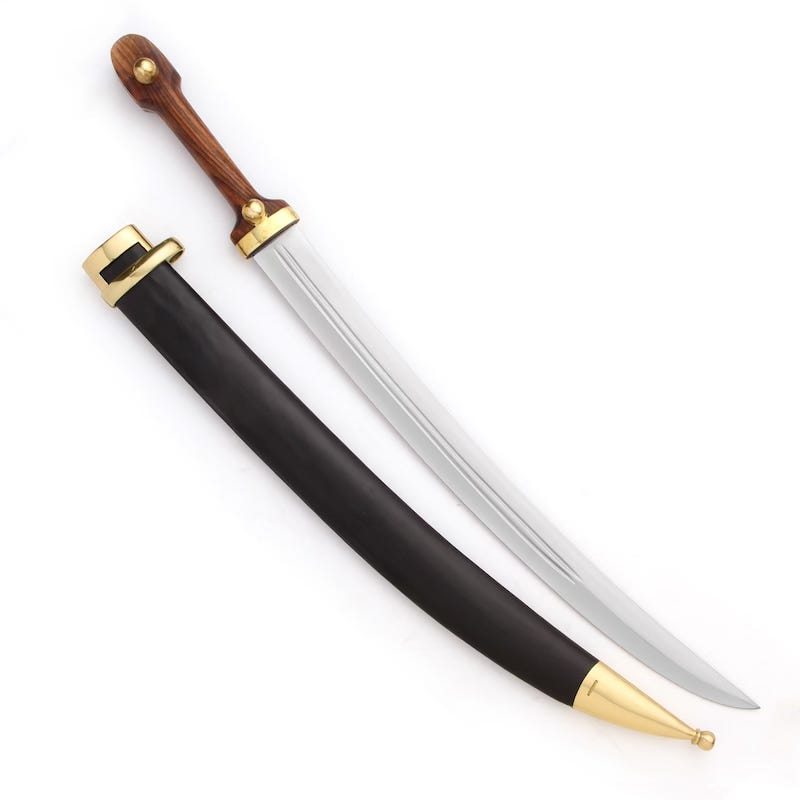
Shortswords and long knives, like the kindjal that the Ginaz swordmasters use (see above), would still afford some stand-off capability, blocking or turning attacks, but they would require you to get in tight with the target. However, the curve of the blade in some kindjali would make a slow thrust a bit more tricky. You would probably try and use your weight to control the opponent and get a good, slow push in through the shield. (It looks like, once through — at least in the movies — you can then thrust as hard as you like…) Weapons with a straight blade and good point, like the tuck, Italian stiletto, Sykes-Fairbairn, a navaja, or dirk would seem more useful here than the traditional blades of heavier of say a bowie or “combat-style” like the M-9 bayonet or Gerber Mark II with their angled point. However, a smaller point/blade means moreenergy in that point of impact…so the shield should more likely stop it, like a bullet. By that logic, the angled point coupled with a slow cut, expanding the area of energy, should be more effective in slicing through the shield, then move to a stab.

I was pretty pleased, on rereading Dune for the first time in forty years, that this last argument was one in the books, itself: Duncan Idaho favored the blade over the point for the reasons I suggested above.

The problem of the personal shield has led my wife and daughter, for whom I’m running a Dune campaign, to develop interesting techniques in a fight. Anytime they think there’s the chance of a lasgun with the opposition, the daughter made a point of smacking their shield with their sword or hand to make it shimmer and warn the opposing force, so not everyone in the area gets nuked. She was the one that posited that you would want to grapple (although, again, shields might make this difficult) or use your weight to try and limit the target’s movement before you strike with a slow push, not a fast thrust. (Keep in mind, she’s 13 and hasn’t read the books…this is just the martial artist in her working it out.)

It’s an interesting thought exercise that those with more blade time than me might have a good opinion on. Comments would be welcome.

Every hero household needs an enemy…here’s the enemy house of the Cailean. Known for the control of Ladinum, the southern continent of Alba II, the family manages the region for the Fujimori. Recently, they scored a major win in the competition with the Cailean for favor with the daimyo; Lady Haina married Lord Milo of the Mazzola, making inroads against the famously loyal and effective Cailean.

The Mazzola govern by the notion of Faufreluches — a place for every man, and every man in his place. Social mobility is limited, save for those that prove themselves useful. There are several major families in Ladinum, especially the rich Gorvonello Valley, who have great sway — the makers of weapons, vehicles, and spacecraft components. The house, and the region, tend to be religious — following a purer Orange Catholicism of the empire, rather than the Shinto-tinged version of their masters, the Fujimori.

House Mazzola

House Minor, Alba II

Domains: Primary, Industrial (Machinery); Secondary, Farming (produce)

Traits: Ambitious, Careful

House Symbol: A gold hammer on a red banner chased with gold.

House Reputation: Respected (25)

Rivals:

  • House Cailean — House Minor; reason, ancient feud
  • House Fujimori — House Major; reason, jealousy

House Skills: Battle: 5, Communicate: 7, Discipline: 4, Move: 6, Understand: 6

Notable Persons:

  • Ruler: Lord Milo Mazzola — middle-aged, ambitious, but not willing to rock the boat, just yet.
  • Consort: Haina (nee Fujimori) — Count Fujimori’s eldest daughter, jealous of her step-siblings.
  • Heir: Lord Milo Mazzola II — just come of age. Mother is fostering ambition.
  • Other Children:Satcha (daughter, 18 yo)Hiro (son, 16 yo)Ama (daughter, 10 yo)Chima (daughter, 6 yo)
  • Advisor: Sao Mazzola — Milo’s younger brother and highly ambitious. In secret affair with Lady Haina.
  • Councilor: Miko Tamura — Count Fujimori’s “spy”
  • Marshal: Frey Hondo — corrupt, but he has a code: no kids, no women, no innocents.
  • Swordmaster: Miko Zano — Swordmaster of Ginaz
  • Treasurer: Horl Murino — tied to the Cavom crime syndicate.
  • Warmaster: Bator Jin Golor

Notes on the Mazzola

Like the Cailean, the Mazzola have a militia that can be called upon by the Fujimori when required. The parade and daily uniforms are resplendent — blue jackets chased with gold piping over red pants, and a shako-style headdress and white belt for equipment. In the field or combat, this is discarded for a more practical dark blue blouse and red pants, with combat armor in a camouflage pattern. they typically carry shorter 65cm gladius-style one-handed sword and lasgun rifles. Only one unit is shielded infantry — their elite Corpo Falcone (Eagle Unit).

They follow the typical Imperial ranking structure:

  • Supreme Bashar — a field marshal in command of an army.
  • Caid — a flag rank officer in charge of a planet
  • Oberbashar — a senior general or admiral
  • Bashar — also called general or admiral
  • Subashar — also called a colonel or fleet captain
  • Bator — a colonel, usually commands a regiment or division; also a senior captain in a space fleet.
  • Commander — usually a space fleet rank
  • Subator — usually commands a battalion-sized element.
  • Levenbrech — commander of ground forces; usually commands a company-size element.; sometimes called a captain.
  • Immenbrech — a platoon leader, also called a lieutenant..
  • Subedar — or sergeant, leads a platoon or squad
  • Havildar — or corporal, leads a squad
  • Standard conscripts and soldiers are called troopers.

The 2d20 system and Modiphius Logos are copyright Modiphius Entertainment Ltd. 2020. Dune © 2021 Legendary. Dune: Adventures in the Imperium is an officially sub-licensed property from Gale Force Nine, a Battlefront Group Company. All Rights Reserved.

Original material — Alba II and locations, House Cailean, Fujimori, and Mazzola — copyright of Black Campbell Entertainment, but go ahead and use it. That’s what it’s here for. Just give us credit.

A follow on post to the yesterday’s post on Alba II, here’s the minor houses of that world. Cailean is the family that my players have been running for their game; the Mazzola were their main rival for the first “book”.

HOUSE CAILEAN

House Minor, vassals to House Fujimori.

Traits: Loyal, Meritocratic

House Crest: A boar’s head on tartan (blue and green primary, white and yellow striping).

House Motto: Never Forget.

Domains: Primary, Farming (Produce); Secondary, Artistic (Produce).

Rivals: House Mazzola — House Minor; reason, ancient feud.

House Reputation: Respected (30)

House Skills: Battle: 5, Communicate: 7, Discipline: 6, Move: 4, Understand: 5

Notable Persons:

  • Ruler: Donchard Colm Cailean — head of the Cailean, councillor to Fujimori. (Picturing a Brian Cox,-type)
  • Consort: Lady Aline (nee Aristona)
  • Heir: Laird Halan Cailean (25 yo and anxious to do something important)
  • Other Children: Malcolm Cailean (18 yo son)Bari Cailean (16 yo daughter)Ian Cailean (13 yo son)
  • Advisor: Laird Lorne Cailean — head of nascent house/clan, McCailean
  • Councilor: Laird Sean McCailean (cousin to Laird Colm)
  • Marshal: Marshal Donella Zyrhan 
  • Swordmaster: Lady Captain Siobhan Cailean — 22yo daughter and Swordmistress of Ginaz
  • Treasurer: Donal Baris
  • Warmaster: Bator Mak Drummond

Connected Nascent Houses: Calder, Drummond, McCailean, Mohr

Notes on House Cailean:

HOUSE CAILEAN was the first house to settle Alba II several thousand years ago. Much of the early history is half-legend, and even the Imperial Records have little on the first few millennia of Alban history. From the start, a rivalry with House Mazzola was established. Much of this has to do with early claims to the world, but as time has gone on, it is deeply tied to different views on the nature of government and its relationship to the people it governs.

The Cailean view their position as more of a steward of the people, rather than as a ruler. They have traditionally supported the education of their people and allowed for a certain amount of social mobility based on merit that the rigid framework of Faufruchles does not. The Mazzola, highly religious and socially static, view the Cailean attidues as “libertine” and dangerous. As a result, there is les incursion by official religious programming in Cailean lands than many places — one of the reasons for the 75th Padishah Emperor’s move to place the Fujimori over the Cailean and Mazzola on the planet.

They are famed for the Alban beef and stonefish — delicacies throughout the empire, as well as their excellent liquors: whiskies, gin, and ciders. Another point of fame comes from their liberal attitude toward education and expression: Alban, and specifically Cailean, poets, playwrights, and musicians are regular members of House Jongleur.

The peoples of Hyperborea view family as the center of life, and view those not part of the “clan” as something to be watched, if not outright distrusted. For this reason, most senior positions in the Cailean government and military are family, or closely trusted confidants. When a Cailean takes you as a friend or family, it is an unbreakable bond. They view the interfamilial court intrigue of the empire as distasteful and destructive. Cailean is a house with three main clans related to the noble house: the clans of Cailean, CalderMcCailean, and Mohr. There are other people and families related — the Moray and Stewarts — but these are the ones that are nobles. The House is lead by Laird Colm Cailean, or the Donchard and Laird of Ben Cailean & Glenmoran. His heir is Laird Halan Cailean. The Calder are lead by Laird Halan Calder, the Laird of Stanehome. He is a cousin to the main line. Laird Lorne, brother and advisor to Laird Colm, heads the recently created House McCailean, and is now Laird Lorne McCailean of Stainhome.

Their dialect is one of the purest forms of Galach in the Imperium — possibly going all the way back to Earth, itself. While most educated people also speak Nihon, the language of the Fujimori, once out of the cities, Galach is the dominant tongue in the north.

As a result, the Cailean Militia follows this rank structure:

  • Bashar — leader or the militia (Laird Colm)
  • Subashar — leads a division of militia
  • Bator — leads the air group
  • Commander — leads an air wing
  • Major — leads a regiment
  • Captain — leads a company
  • Lieutenant — leads a platoon
  • Sergeant — leads a squad
  • Corporal — leads a team
  • Trooper

The Cailean Militia are generally unshielded and wear light armor. Their uniforms are composed of a green, high-necked jacket over kilt in the Cailean tartan. Knee-high boots have a scabbard for the ceremonial dirk. This is topped off with a Glengarry cap and a fly plaid pinned with a Cailean badge in the house colors that is used as a blanket or cloak in the field. Standard equipment is a broadsword and lasgun rifle.

A new unit under Lady Siobhan, the Black Guard, wears the same uniform in black. They use shields and a Fujimori-style tanto.

To police the Cailean lands, the Cailean Constabulary is a separate force that can be used in ground defense situations. Their uniforms are blue, instead of green, and their carry the ceremonial dirk and a slug-thrower sidearm, as most of their encounters are unlikely to involve shielded opponents. The constabulary’s rank structure follows:

  • Marshal — military equivalent: bator; leads the Constabulary
  • Deputy Marshal — military equivalent: major; runs a city or province
  • Chief Inspector — military equiv. captain; leads investigation team
  • Detective Inspector — military equiv. lieutenant; leads investigations
  • Detective Constable —  military equiv. sergeant; conducts investigations
  • Constable — basic policing

The 2d20 system and Modiphius Logos are copyright Modiphius Entertainment Ltd. 2020. Dune © 2021 Legendary. Dune: Adventures in the Imperium is an officially sub-licensed property from Gale Force Nine, a Battlefront Group Company. All Rights Reserved.

Original material — Alba II and locations, House Cailean, Fujimori, and Mazzola — copyright of Black Campbell Entertainment, but go ahead and use it. That’s what it’s here for. Just give us credit.

After having watched the second Dune movie when it came out, my young teenage daughter, and the wife were quite taken with the setting. I knew there was a 2d20 game, Dune: Adventures in the Imperium out by Modiphius. Since we were between campaigns, I decided to buy the book and GM screen, and set to work creating something for the ladies. What I came up with was a world split between three cultures — a sort of 18th Century Scotland and Italy, and a Meiji-period Japan that was placed in stewardship over them.

Here is Alba II and it’s ruling family, the House Fujimori.

ALBA

Home Star: 

Taiyo (historically Alba) / HD223913, a G0V type star with a M1V companion, CPD-66 3810 B.

ALBA II

World Type: Habitable Forested/Ocean World.

House Affiliation: House Fujimori (major), Minor Houses Cailean and Mazzola

Military Power: Ground defense forces, a small space fleet, limited planetary defenses

Population: 500,000 million.

Industries: Primarily farming, fishing, and heavy machinery. Cailean known for their arts, especially poetry and song, as well as their superb liquors; Mazzola for their architecture, wine, and culinary skills.

Planet Notes:

Alba II has one satellite, Bano (formerly Elatha). The companion star to Taiyo is CPD-66 3810 B, a M1V red dwarf, called Sanakai — but to the majority of the planet it is “the Wee Yin” or it’s older name “Solino”. Solino/Sanakai is as bright as Bano in the night sky when it is in opposition to Taiyo, and is visible faintly when Taiyo is in the sky. At sunset and sunrise at certain times of the year, both stars are readily visible, with Sanakai having an apparent brightness of about a quarter of the main star. Also quite visible at night and even to the unaided eye during the day is Purana, or Gamma Tucanae, 11 light years away.

There are several continents on Alba, but the big three are Ladinum in the south — the lands of the Mazzola, Hyperborea in the north — settled by the Cailean, and Nanomi — which has steadily become the province of the Fujimori, along with the large Haino Island chain, where the world capital and spaceport, Ninga, lies. the Fujimori also directly control the mining and construction facilities on Bano.

There are several places of note: Ninga sports Shoja Castle, the seat of the Fujimori rule. Ben Cailean is the mountain fortress of the Cailean, perched over the largest city in their lands, Glenmoran. The Mazzola are based in Casseli Trento, in the beautiful city of Trento (which gives the region, Trentino, its name). Much of the heavy industry is owned by Mazzola and Fujimori-tied families throughout the Gorvanello Valley in Ladinum. Both the minor houses keep a smaller militia and are charged with law enforcement and tax collection in their regions.

Cultural Notes:

Alba II was settled by the Houses Cailean and Mazzola at roughly the same time. Most imperial histories on this world are a bit vague as to the start of colonization, but most evidence suggests the Cailean arrived between a half century and a full century earlier than the Mazzola. As a result many of the naming conventions in the north use Galach, while in Mazzola lands, the tongue of Nuladin reigns. The Imperial Society of Linguistics has noted that Alban Galach is the most unchanged of the Imperial tongue, going back to the original Anglo-Gallic roots.

A millennium ago, during the rule of the 75th Padishah Emperor, the Fujimori family was gifted with Alba to rule over. Initial resistance was quickly put down, with the Cailean quickly siding with their new masters. Attempts to introduce Nihon, as the language of Alba have been semi-successful. Most Albans can get by in Nihon, but once away from Nanomi and Haino, Ladinum and Galach are the chief languages spoken.

Alban beef, stonefish, barley, and whiskies are frequently found in the houses of the Great Houses, even when many don’t even know where or what Alba is. Trentino wines are similarly well thought of.

The Fujimori have been attempting to gain notice and support from the larger major houses for some time, and a recent marriage to a lady of the Richese family elevated them to a known name. With the misfortunes of their war with the Vernier, and their loss of Arrakis to the Harkonnen, the advantages of this marriage have no been realized. The official title of the ruler of Alba is Count Ariano Fujimori, Daimyo of Alba and Bano. His title of daimyo, is used on Alba. 

HOUSE FUJIMORI

House Major, rules Alba II and its moon, Bano.

Domains: Primary, Industrial (Machinery); Secondary, Military (workers) and Farming (Produce)

Traits: Cautious and Honorable

Rivals:

House Maros — House Major: reason, competition (Agricultural products); level — rival.

House Reputation: Respected (50)

House Skills: Battle: 6, Communicate: 8, Discipline: 7, Move: 4, Understand: 5

Notable Persons:

  • Ruler: Count Ariano Fujimori
  • Consort/Wife:  Countess Saia (nee Richese), sister of Count Iblan.
  • Consort: Michiko Nanuri — older than Saia, she was the first consort of the Count.
  • Heir: Lord Hanzo — 21 year old and eager to prove himself.
  • Other Children, Nanuri: Shoja — 30 year old son; playboy and lay-about.Haina Mazzola — the eldest child, 40 years old, and married to Lord Milo Mazzola.Ari — 24 yo daughter.
  • Other Children, Saia:Goro — a year younger than the heir, he is interested in affairs of state.Merce — 18 and desperate to become a swordmaster.Noemi — 15 yo daughter waiting for marriage.
  • Advisor: Kan Veli (mentat)
  • Councilor: Lord Colm Cailean
  • Marshal: Rikusa (colonel) Masa Nigura — secret supporter of Lady Haina.
  • Swordmaster: Rikusa Ao Morime — trained by the Swordmasters of Haino Island.
  • Treasurer: Ola Aramaki — a genius gifted to them by the Richese.
  • Warmaster: Bashar Ko Senda

The 2d20 system and Modiphius Logos are copyright Modiphius Entertainment Ltd. 2020. Dune © 2021 Legendary. Dune: Adventures in the Imperium is an officially sub-licensed property from Gale Force Nine, a Battlefront Group Company. All Rights Reserved. 

Original material — Alba II and locations, House Cailean, Fujimori, and Mazzola — copyright of Black Campbell Entertainment, but go ahead and use it. That’s what it’s here for. Just give us credit.

For a guy who was utterly disappointed by the playtesting of Modiphius’ John Carter of Mars RPG way back when, I’ve been playing a lot of 2d20 — a system I thought I’d never warm to. I’ll have a bit up on Star Trek Adventures — their 2d20 Star Trek game which I’ve been running now (on and off) for about a year with a surprising bit of success. In the wake of the second installment of Dune, which the wife loved, I thought I’d buy the RPG on the off chance I might run it for her and daughter. This review will encompass the core rules, The Great Game: House of the Landsraad, the Power and Pawns: The Emperor’s Court books, as well as the GM screen.

Dune is a much improved version of the 2d20 system (and if I’ve heard right, is used for their Chuthulu series of games), and from first glance at the quickstart, the version 2.0 of Star Trek Adventures. Really, I can’t impress on the reader how much improved the system is over the old one…but not just that, the things that made 2d20 so painful to engage with are improved: the writing is clear and concise, the indexing works — the stuff you look for in the index is where they say it is (unlike the execrable job that was done for STA), the color balance and use of typeface makes it readable where STA was an eyesore. (Fallout is equally well laid out and designed, written, and indexed.) This continues through the two supplements I quick picked up, as well, since while I saw the movies and read the Herbert novels way back last century — and boy, does that hurt to say — I’m not a real fan of the Dune setting after the first two books. However, while were on the usability and design of the materials, lets give a real round of accolades to the GM screen. There’s a way range of utility in GM screens — from the truly useless D&D screens and the practically unreadable screen for Aegean, to the serviceable like Hollow Earth Expedition and Star Trek Adventures screens (although in fairness, the ship combat cards that come with the latter are very useful), to the superb — Lex Arcana and Broken Compass/Outgunned screens where you can almost run the whole game off of the screens without referencing the core rules. Dune is in the last category: the screen features the combat sequence, the use of zones for different types of combat, difficulties, the use of momentum and determination, and the best of all , has the pg. the rules are located on in little bubbles on each chart so you know where to go if you do need a bit more. This wound up being useful on our first play test a few weeks ago.

The first 84 pages are dedicated to bringing you up to speed on the universe of Dune, a setting that is richly presented in the original novels and expanded n a bunch of books I haven’t read. There was a lot hinted at, and the size and scope of the Imperium is such that you could play in the setting without ever having to engage with any of the major players of the novels. Character creation is pretty straight forward and mostly moves linearly through chapters three and four. You create your house — be it a minor or major player, create a rival or rivals, then pick roles you will fill in the house from ruler or heir, to consort, to advisors and swordmasters and the like. You have two main sets of stats to run off of — there’s your Skills, like Battle or Move or Communicate; there’s Drives — motivations for the character to do something. Pick the most appropriate of the two and roll 2d20 (or more depending on other things) and get under the combined number for a success. you get two successes under the skill value, and if you have an applicable focus like “long blade” or “espionage” you get another. Beat the difficult of the task — a 1 if it’s a mundane task, or a 5 if it’s virtually impossible. Anything over the required amount generates momentum which can be used later to add up to 3d20, add aspects on a scene, gain a asset, etc. You have a drive statement that can, if you are playing to it, gain a determination (the really powerful game currency, which can erase an injury or give an auto 1 on a die….) The GM can invoke that statement, as well, to make you use that drive in a test (often to your disadvantage), and you can refuse but this gives the GM “threat” — momentum, but for the GM.

The use of two terms for momentum is a sticking point for me — it overly complicates the game currency, just as determination does.

Where Dune excels is losing the use of “challenge dice” — d6s that were specially marked for the respective games to give a character stress, or key a special aspect of the weapon, etc. They added more chance into play that could undo a particularly good test. (“Hey, I rolled six successes on a two success difficulty…but rolled two stress on my six dice of damage…”) That’s gone. You weapons, shields, vehicles, extra guys, whatever, are assets that add a die or more (up to 5d20 total) and extra success generate not just momentum, but do the damage. You have an asset of “sword 2” and rolled two successes over the necessary to hit? That’s 5 points to the other major NPCs “Battle” skill. Once you’ve got the skill to zero, you’ve won. You don’t have to kill the guy. You could injure, capture, whatever. Your choice; you won. For minor NPCs, you just drop them with whatever outcome you were looking for.

The use of zones gets a novel reworking. For duels, this involves trying to get through the guard of a character to the body. You can make this happen with a subtle attack, moving into the zone for your strike, or boldly — aggressively launching an attack to force the guard away and get to the person. For skirmishes, this works like 2d20 normally does, moving your character from one zone is an action, or you can boldly or subtly move and if successful, launch your attack after moving; you can also move the other person out of a zone — say, moving into a fight to push the attackers off an ally. This scales to large land battles, moving your forces from one objective to another and trying to push off the enemy, or launching an attack on them directly. Where it gets innovative is doing this for intrigue (social battles where you are trying to learn information or get close to a particular person) where you are trying to influence, gain information, or whatever from a person in a social setting. This recreates the medieval court intrigue that is central to the Imperium. It is also used for Espionage — similar theme, moving from one group or lead to another to get the information or contacts you need.

I liked this enough I ported it into the current side quest for the Star Trek Adventures game where the crew are trying to cut into the Orion Syndicate to find out who is dealing in Federation and Klingon war surplus after the war. (The game is set in the 1st season of Strange New Worlds.)

There’s a chapter on assets and how they work, another on the characters from the movies/books, and an adventure I haven’t used.

Layout, artwork, typefacing, paper and binding quality are all top notch, and this continues into the other material from the line I purchased. Power and Pawns digs into Imperial court life and gives a few more character options for the player. It also providess more insight into the other powers in the Imperium — the misterious Ix, who build machines that skirt right along the edge of the prohibition against “machines made in the image of Man’s mind”, the Tlelaxeu — the genetic engineers who are seriously creepy and played a major partin the play test I ran for the family; the Swordmasters of Ginaz, and CHOAM — the interstellar consortium of businesses that not-so-secretly run the whole show. I haven’t dug into this one quite as much, as we started with a minor house on a far-flung world. However, The Great Game is very useful, giving several chapters to expanding how the characters’ House works, how to run it, grow it, and interact with other Houses. There’s more on CHOAM, the Spacing Guild, and includes options for the players’ characters. Lastly, there’s a catalogue of the great houses of the empire.

Playtesting Dune over two nights, I ran an adventure where the characters stumbled onto smuggled Tlexlaxu artificial organs…but being smuggled off their world. The investigation took them through the spaceport to a smaller port town in their lands where a criminal gang was fronting the goods (not knowing what they were moving), to a small island and a distillery where a rogue Face Dancer — a Tlelaxu agent? — had set up a rogue lab using kidnapped girls to grow his organs. The distillery people, concerned for the safety of their families, and scared by the new “boss” and his ability to show up anywhere unannounced, had little idea what was going on, but knew it was bad. We ran the skirmish and dueling rule, as well as the espionage rules and they ran quickly and cleanly. The adventure was not hampered by the rules, and in a few places the use of assets and aspects on scenes (similar to how they work in Fate) lent flavor and options for the characters to use in their adventure.

So is it worth it? If you like the setting, absolutely. If you want a rules set you could cannibalize for another similar setting, probably yes. If you want rules that will port into 2d20 settings fairly easily, again, yes. The books are pretty, well written and laid out, and the setting is — when you really think about the genetic engineering end of things — potentially bonkers, as if seen in the later Herbert novels. I found The Great Game equally useful, and the GM screen is well worth it. As for the specialty dice? Not needed, and if you have any of the other 2d20 dice, they’ll work just fine.