One of the things that nearly all role playing games have in common is some form of “advancement” — experience points, advancement points, milestones; a point where the characters’ journeys and experiences lead to them getting better at certain things.

The oldest form of this was “leveling up” in Dungeons & Dragons — you would hit a certain number of experience points and would suddenly be better at fighing, have more spells to cast, gain hit points (get tougher), etc. It happens boop! just like that. You would gain XP for the events of a session based on the monsters opposed and other story aspects. Realistic? No — but it set the stage for RPGs, both tabletop and electronic, to come.

Other games came along that broke the experience/session pattern — James Bond: 007, for instance, gave you experience at the end of a mission, rather than per session. Marvel Heroic Roleplaying has a very nice system based on playing to the milestones you set for your character. As you address them, you gain points, rather than for the villain of the week you beat up. (I have a real soft spot for this mechanic!)

What is the best way to handle experience? This is usually where I should get wishy-washy and say “what works best for your campaign”, but after a few decades of doing this, i feel confident about this one: experience points (or whatever you call them), should be given at the end of a specific adventure or chapter in the same, unless there was some specific thing in the session that would have led to gaining or improving a skill. (Montage!)

Characters shouldn’t just jump in abilities after the equivalent of a day or two wandering in a dungeon, or fighting for a few days on the beach at Normandy. It takes time to process mental skills, it takes longer to hone physical prowess in something, and the better you are, the harder it is to improve that little bit more. (Just ask an Olympian…) I wouldn’t suggest just rolling this out on your game group without talking the reasoning through with them. you might get lynched. But here’s my reasoning:

1) Over the course of a session representing a day or more, a player should be able to learn one new skill at a very basic level. (If you want to give them advancement/session.) Didn’t you just say the very opposite thing a second ago? Not quite…okay, I did,

It’s really easy to learn a new skill at a truly basic level. One trip out to a firing range, and most people can get from not knowing how to work a firearm to being able to hit center mass(ish) most of the time. You can learn to ride a motorcycle or drive stick with a few hours practice. You’re not good at it, but you can do it. You can learn a couple of phrases of a new language, or start to parse bits of a language similar to one you are good with. You might have picked up just enough information to actually be dangerous to yourself, in that you might not be up to the difficulty of an ordinary task with the skill.

2) Most real development for the characters takes place in the spaces between the big moments. Sure, you kicked the snot out of those Imperial TIE fighters…but what did you learn? Most fighter pilots learn from their mistakes and successes during after action reports where they study gunsite footage and analyse what worked and why. This is why I say most points should be given at the end of a major chapter or adventure of a campaign.

3) One way to handle learning basic skills when you don’t have points is to go into “point debt.” I will allow characters who use a new skill well enough to learn the basics to take the skill on loan. s soon as they have the experience to cover it, they pay.

For more advanced skills, suggesting to your world-trotting archeologist could learn the various languages at his Linguistics skill (or whatever) if he has a certain length of time, then give him a discount on the cost of improving the language skill if he waits that length of time to buy it.

But what about…?

The improvement of skills, hit points, and the like is not the only sort of advancement players see. As they move through the game’s campaign, they might see themselves amass power or wealth. These benefits often come with responsibilities or other consequences. If your 20th level fighter has not carved his own petty kingdom, Conan-like, from the power structure of your fantasy world, how much of his time is now taken up with satisfying the needs of his people? What about that aqueduct they need? How about filling that granary for the winter? Whaddya mean my treasurer absconded with the kingdom’s cash? How does he account for justice? If he is a hard tyrant, how long before there is an usurper? Might that be his own friends?

This is a type of advancement that comes from role playing, and which could be tied to “leveling up” (“Hey, you’re a 13th level science officer now — you get your promotion to lieutenant commander!”) or through role playing. Recently, a player character that started as a raw lieutenant junior in our Galactica campaign got a surprise promotion to captain and squadron leader. (Ah…attrition!) We’re only just starting to touch on how this new responsibility is alienating from her old friends…she’s the boss now. She hasn’t found out, yet, that just doing things your own way when you are responsible for 8-10 vipers and pilots isn’t an option. She’s also under more scrutiny from the command, and who wants to lose a promotion? Pressure!

In a police game, maybe you finally get to run an op yourself. All eyes on you, tiger; don’t screw it up, or we’ll ask you where you don’t want to get assigned next. A private eye might have a few high-profile cases, and now has too much work. You hire a few more dicks, but are you pounding the streets or are you supervising Manny, Moe, and Jack half the time..?

By dropping responsibility on top of the characters, as well as position, you can help create challenges they can’t just swing their +5 Vorpal sword through to solve.

Then there’s the ultimate advancement…retirement (or death.) What is the consequence of a hero, king, whatever stepping away from his position? Do they just fade into obscurity, as General MacArthur said? Would it have been more appropriate for James T Kirk to have died ignominiously slipping in the shower? (Bones: “He was right…he did die alone.”) Or is it better to get dragged back into one last mission/case/fight? (“You did not just say that!”)

Advancement can be so much more than just handing out experience points.
This post came about from my thoughts on the graph in Runeslinger’s Spectrum of Play  article, as well as his Right Way to Game posts. The first has been reblogged here on The Black Campbell, but you can pop over to his Casting Shadows page to read more. His YouTube channel is probably even more useful.

There’s a lot of thought and opinion spilled into the series of tubes on how to play role playing games. The main point of contention is between those who like a game with a defined plot versus the “sandbox”, or a style of play in which the environment and the players’ actions (hopefully) give rise to some kind of adventure.

…we each will have our favorite ways to go about [gaming], and among the voices talking about them there may be some strident calls for one way over an other…The next step was to address the nature of the play environment itself with a look at the concepts of the sandbox and the defined narrative

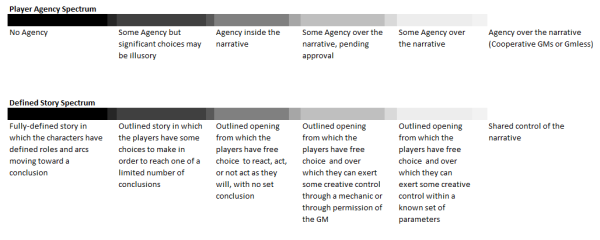
The quote is from Anthony Boyd (or Runeslinger), over at Casting Shadows. He has cobbled together a rather elegant continuum of play styles that address this argument. He separates the issue into matters of player agency — how much effect the player has on the narrative and outcome of a game; and defined story spectrum. I found the chart instructive in that if well describes how the the power  relationships of a role playing game between players and a game master/storyteller/etc.. or between players, is dependent on how well defined the story is. 

Spectrum1

I found this chart particularly pertinent after my recent post on a comparison test of the Firefly (Cortex) and Serenity (Cortex Plus) rules from Margaret Weis Production. In that test, we found that aspects of the system designed to spread narrative control, while fun, seemed to hamper the coherency of the story. 

He points out that …we like what we like, and given choice, we tend to pick our favorite options over the rest… Some new game may draw us in with its setting, but push us in a new or formerly avoided direction with its mechanics…” This was certainly part of the issue the gaming group had with Firefly — we’ve run Cortex for quite some time and have found it (mostly) to be an excellent set of rules for creating nuanced characters and handling most scenarios for an adventure. When it falls down, though, it tends to do it hard. One of those genres it did not handle well was superheroes. Marvel Heroic Roleplaying may have been a busy system with a lot of moving parts, but it emulated the flavor of comic books near perfectly. Firefly we all wanted to like…but we like what we like, and in this case, for not over the top science fiction, we like Cortex (the Battlestar Galactica or Cortex 1.1 version.)

But why was that the case? Partly it was a preference in most of the group for stories that have some kind of defined plotline to an episode and the campaign overall, while still allowing for character action to sharply change the outcome of the same. Firefly — like Fate and many of the new wannabe-artsy “indie” games — does that, but the ability of the players to set complications and assets added new visions of the plot that aren’t necessarily well-meshed with what has been ongoing.

To use a cinema or television analogy, you have too many writers in the writers’ room and not a strong enough head writer or executive producer to contain their disparate visions of the story or universe. All those shows that “jumped the shark” by wandering off course badly; nearly ever movie you’ve seen where you leave saying “it was so close to good!” is the result of multiple writing teams working to please a different audience in the production or direction staff of the show or movie. (Case in point: Spaight’s excellent draft for what would be Prometheus versus the disaster of Lindelof’s final script, coupled with Scott’s last minute changes.) Too many cooks, as the expression goes, spoils the soup.

In the chart above are two bands of specific points along a spectrum of implementation options ranging from ‘none’ to ‘total.’ I believe if you let your eyes roam across these bands, it should be pretty easy to spot roughly where your basic preferences lie. With a little effort, it should also be possible to spot where specific games require you to be to run them as intended. This might be useful in assessing if a game will be suitable for your group, or if an idea you have for a game will flow like you want within its confines, but I feel it has better uses yet. From my  perspective, it might offer a hint as to why a given campaign or group is or isn’t working for you, but will really shine when used to help add a new kind of scene, scenario, or mood to your toolbox of techniques.

This point is particularly well thought out. A quick look at the chart puts my gaming style at 3-4 on the player agency and the narrative of the chart. This suggests that the indie, GM-less systems aren’t going to be my cup of tea. The main reason: I really cut my teeth as a GM on espionage games where the villains had a specific plan, the players would investigate to uncover and stop it, and to emulate the spy movies we were aping, I had to design (and still do from time to time) my adventure around specific action set pieces, exposition scenes, and a denouement that was usually quasi-planned out. Player actions might cut some of these scenes, force me to add others, or change the ending, but there was an outline of “things that should happen…”

Think of it as similar to building rooms in a dungeon. The players can choose where to go, in what order and manner, but the very definition of the space and the hazards is essentially a plot based on action set pieces. So despite the appearance of a sandbox-like environment, dungeon crawling is in many ways the most restrctive – story-wise — an RPG can get. Players can have almost total agency in what they do, but ultimately the act of wandering the space of the adventure constructs action.

The sandbox gaming style is much more collaborative and reduces the role of the gamemaster or storyteller to an equal, or “but is more equal than others” position wherein they act as referee at most. This certainly has its place, but I have yet to see this style of play hold together a long-term campaign outside of LARP circles, where the gaming environment and the larger number of people require a more cooperative approach to character interaction.

The idea that your play style might dictate the sort of game you will like should seem self-evident, but is it when you are looking over the games in your LGS (or more likely perusing DriveThru these days…)? Firefly is a setting all of our gaming group enjoy, but the mechanics forced us further right on the player agency spectrum that most of us were comfortable with. I found it didn’t so much effect my style of gamemastering, but the complications mechanic forced me into narrative corners I had to duck and weave to get out of.

I’ve played in campaigns — a Shadowrun game leaps to mind from the ‘90s — where it was mostly sandbox. We were nearly all the way right on the narrative — there was a proposal put before the group we could take or leave (but wanting to do more than hang out at the bar and trade quips, we took the job) and we had to plan and execute the job with no GM input. The GM style was so hands off that the guy disappeared for about an hour and we found him working under his old project Porsche 911… Not the sort of engagement that brings folks together. The players were fully in control of the narrative for the session, and what happened is one or two of the people at the table naturally took on the “leader” role from the GM so that when he came back to the table and tried to referee the big action scene, he discovered we had managed to plan it out well enough to overcome the opposition with ease, and he obviously started moving the goal posts. It was frustrating for everyone — too many cooks in the kitchen. A modern GM might have allowed the success to happen and tried to set something up to go wrong later, or with a system like Fate tossed a complication in that would bite the players later.

In the end, is there a right way to game? No…but there is a right way for you and/or your group to game. It’s worth venturing out of your confort zone from time to time to see if you like something that isn’t quite what you are used to. I’ve been on a mission to try and like Fate, of late — both Atomic Robo and Mindjammer use it, and I like the settings…but the mechanics just don’t jive with how I or my group tend to play.

And that’s alright.

I’ve been pretty lucky to have adult — psychologically, if not physiologically — at my gaming table for the last thirty years or so (Am I really that old!?!), so this hasn’t been much of an issue for my games, but judging from some of the gaming boards and Facef#$% — I mean Facebook — discussions this is not the case for others.

That most cootie-rific of issues: romance!

I’ve covered a lot of the issues connected to romance at the game table in a few posts from the past —

1) This was a response to Dom Mappin’s piece on Gnome Stew in which I discuss the issue of romance between players. While the piece still has some good thought and advice, my opinion on it has matured to a 1) It’s none of your business what the players are doing together, and b) It’s none of your damned business what the players are doing together…but it can still screw up a group’s dynamics.

2) As to romance between characters: Just do it. Especially if you are looking for good motivations for characters, or for a more realistic world for the players to game in. Which naturally leads to sex and romance — where do you draw the line? G? PG? R? NC-17? That depends on the players and the nature of the game.

As with anything, romance in-game means you have to know your audience — who are the players and what do they want or abhor? As to romance between players? It’s going to happen, and it’s none of your damned business.

Last week I finally got my new 1930s pulp game fired up. It’s been a few months coming, but the momentum in the Battlestar Galactica game was such that i wanted to push through to the “season finale” which allowed me to write a major character out as the player was leaving for San Francisco. I chose to use Hollow Earth Expedition again, although I was sorely tempted to use Cortex or the old James Bond: 007 RPG for the rules set.

One of the issues was trying to get the characters to mesh well. I’m the only person with a strong grasp of the period, so I did most of the heavy lifting on character creation for the players, weaving the history of the preceding years into the characters — two served in WWI together, the aristocrat character spent a lot of time in Africa with the “Happy Valley Set” — known for their promiscuous sex life, rampant drug use, and other scandals; and tying how the Great Depression affected them or their families. With the characters well established came the hard part…how to get them together?

There’s a few ways to do this — I like teasers that introduce the players to their characters in little vignettes that showcase their strengths, weaknesses, and basic schtick. (A classic one is the teaser in Raiders of the Lost Ark.) That seemed like it would suck up too much time in this instance, and several initial ideas fell flat. Another good way is to start in media res — where the story is already under way. Open with either an action sequence or some aspect of the story. The basic mission is either revealed during play, or the players were prepped for it before play. Most teasers start in media res, but usually don’t have a direct connection to the main story. I decided for the later, with the characters meeting at the Travellers’ Club in London after the “lead” — a tomb raider named Tom Steele — had already retrieved the item central to the plot.

This brings up the last point…what brings the group together? For a military or espionage setting, you can make that easy: they are assigned to a mission together. For a superhero game, maybe they’re part of the same team. What kind of mission would get an aristocratic occultist/pornographer, his two-fisted manservant, and an slick-dressing and talking American tomb raider who was tossed from Oxford together, then get them out to China? I tried a few different ideas, but they all fell flat. What I needed was what Alfred Hitchcock called ‘a McGuffin.”

What’s a McGuffin? This is the thing that brings everyone together for an adventure, and the characters can have different reasons for engaging with the object. The most famous is probably the Maltese Falcon. In the book and the 1941 film, the Maltese Falcon is supposed to be a gold falcon that has been painted black. All the characters get roped into the action because they want the falcon, or in the case of Sam Spade (Humphrey Bogart in the film), he’s a private dick hired for a case that starts playing all sides off each other. Rosebud, the sled from Citizen Kane, is another: “Rosebud” is the last word spoken by the lead character and a reporter tries to track down what it pertains to. The Death Star plans, the Lost Ark — these are McGuffins. They might be central to the action, a red herring, or something that is, ultimately, unimportant beyond being the impetus for the story (think the briefcase in the trunk in Repo Men, or the diamond from Titanic.)

While doing some reading, I came across an interesting bit of old Chinese culture — the “death jade”, usually a small carving of a cicada, which is supposed to take ones spirit to its final resting place (or close enough.) Some were alleged to be used to store the spirit until resurrection. I took this idea, fused it with another idea concerning the Huangdi, the First Sovereign Emperor, and his quest for the Elixir of Immortality. What if the Huangdi’s death jade held his spirit? What happens if it’s used in a summoning?

And there was the first night. Pull the characters together for a summoning at a common friend’s house in Hampstead Heath. The summoning, rather than being the usual excuse for drink and debauchery turns out to work, with the acquaintance being possessed by the spirit of the emperor. Before people can react to the glowing eyed possessed man, enter the competition — in this case a bunch of black outfitted wushu-fighting types. the resulting fight in the library of the country house was classic Hong Kong chop socky meets Indiana Jones. Of course the bad guys get the death jade, meaning the tomb raider (who has not gotten his full pay yet) has to go after it. The occultist wants it for the obvious power.

The fight led outside to a car chase with a bunch of the bad guys on “hoopcycles” — a one-wheeled “motorcycle” — through the streets of London, and down into the Underground. This long action set piece took most of the night and was a blast.

Who are the bad guys? I had a vague idea. Why do they want it? They can guess. This week, i get to fill out the particulars and get them started on their way to China.

A last minute cancellation put me in a rough place this week. I had a new pulp game all set to go and one of the “leads” — who was necessary for the beginning of the game texted out after we were due to start. At first, I thought, “Great! Board game night!” but the last board game night revealed that one of the players is not the sort with which you want to have any kind of game that involves competition. Plan C — fire up the Battlestar Galactica “new season” on the fly.

I didn’t have much to work with ready, so instead thought about what kind of impact losing two of the major characters would have on the NPCs and the players, and ran with that. In this episode…we talked about our feelings. I pieced together how the president — who had thought himself inured to loss after the Fall of the Colonies — is beginning to fall apart with the death of his son in law. Now, all he has is his son, and the fear of losing the man (the commander on Galactica) hasn’t paralysed him, but he no longer feels empowered. The commander lost his best friend, the other PC was a trusted colleague, and his burgeoning love affair with another officer has been interrupted by her reassignment to Pegasus. He’s alone. Another character had been the dead pilot/oracle’s lover — she’s crushed, and has had to take over his duties as a squadron leader. How can she command her friends, knowing she might have to send them to their deaths…and can she do it?

Another aspect of the night was the goings on aboard Pegasus. ADM Cain is a constant presence in the background, but was never encountered. Instead, the pilot now squadron leader found herself touring the flight deck of the flagship. She noted immediately that everyone was locked down tight — humorless or at least very restrained, with a strong undercurrent of fear or anxiety. She was approached by some of the crew who were curious about Galactica, including a couple of enlisted men who were interested in the “robot girl” they had in custody. It was creep, and made moreso by one of the female officers telling her to be careful where she went alone on the ship.

They heard about Cain’s “razor” speech — that they had to be a weapon, until they couldn’t fight anymore, or until they won. The idea that, being alone and having no real hope, the ship has been on a mission of vengeance is palpable. Now the trick is to bring Cain around to her new mission, that of guardian. (It’s a similar character arc that the one player’s commander had to go through early on.)

So there’s a prime example of how my slightly tongue-in-cheek post from a few days ago can be put into use.

Most game designers are very concerned with the notion of “balance” in the games they make. Systems that use a point-based creation mechanic for character creation often have levels of generation points that allow a player to customize their character, yet are all bought for the same “level” — being it novice or beginner, experienced/whatever, or expert/master, etc. In Dungeons & Dragons, characters used to start at 1st level and work their way up, but later iterations allowed for starting at higher levels…but you still had the same approximate range of abilities.

Until you hit the min/maxers and rules lawyers that can manipulate the system to build a character more effectively than other players. (I have a mathematician in the group right now who is an expert at this…)

The point to this notion of “balance” is “fairness”. Young players, players that use gaming to vicariously experience success or greatness, often don’t like the notion of having a player be weaker or stronger than others in a campaign. Everyone wants to be the hero, and balance is supposed to push the players toward a more ensemble model, where everyone is equally important to the game. It’s a nice ideal — and one that I subscribed to for a long time — but it’s not really achievable.

Problem, the first: All players are not created equal. Maybe your characters were all created for X number of points, but you have a rules lawyer that has made a character perfectly tailored to the sorts of adventures you will encounter, making them the “go to guy” all the time. It’s great for that player; they’re almost always now the center of attention. Even if, somehow, you managed to have characters that were all highly specialized and had their particular spotlight moments in a game session, some players are more passive, and others more active — one guy may spend all his time in his room inventing things, and only becomes a factor in play when the fight is on. Maybe a player is particularly clever at using a “weak” character to achieve greatness. Maybe one of them is just too funny to reign in and makes the game enjoyable. These players are going to capture most of the airtime.

Problem, the second: It’s not the way good storytelling works. In books, movies, and television — even with ensemble casts — there’s normally a lead or two that the stories focus on. For example, let’s take any of the Star Trek series from The Next Generation on…there’s an ensemble that sees the whole cast get some screen time, but normally, the focus is on one or two of the characters per episode, and often over the course of the series. Let’s look at The Lord of the Rings (books and movies) — Frodo is the main protagonist on the quest to destroy the Ring, with Sam as his sidekick, but arguably just as important. But Aragorn is the lead for the portions involving the return of the king and opposing the forces of Mordor. Frodo is in no way Aragorn’s equal (and arguably not up to that of Sam, either…) But he is the lead and the lead not need be the biggest bad ass of the bunch. Even Merri and Pippin are stuffed into the middle of great conflicts, and probably couldn’t resist a late-night mugging in any modern city. It’s not about being bad ass; the interesting part of characters is their weaknesses and how they overcome obstacles. Simply hacking your way through a problem like Schwarzenegger might have a certain appeal, but it’s not especially memorable after the first hundred kobolds, is it?

Problem, the third: Not everyone wants to be the bas ass. I have a player whose real interest is in the politics and social machinations in nearly every game we play. He often winds up being the politician, ship captain, leader because that’s the sort of thing he likes. Even when he had action star-type characters, he would often use other characters as proxies in fights. Some guys thrive on being the ass-kicker and trying to suss their way through a mystery is either boring or taxing…they like to sit and wait until it’s time to break the “in case of emergency” glass on their barbarian and let the carnage begin.

So what’s the point of attempting game balance, other than an attempt to preserve some sense of Harrison Bergeron-esque enforced equality? I’d submit none.

Here’s an idea — when in the planning stages of a campaign, there are a few things the GM and players can do to create engaging characters that are appropriate to the sorts of adventures in store for them. On the players’ side is arguably the harder job — letting go of the ego long enough to create characters that have a reason to be together, more than focusing solely on your cool concept.

Example 1: I had a player that had his high concept character — a Starfleet engineer who was super-talented, so that he didn’t have to play by the rules and regulations. Great idea, save for a few points: 1) everyone in friggin’ Starfleet is smart, educated, and competent, 2) the character’s purpose is to spotlight hog and create artificial conflict (specifically with the GM and the adventure itself, I suspect), 3) he’s got no logical reason to be there, other than to annoy everyone else at the table.

Example 2: In a short-lived Supernatural game, one of the players decided to play the overweight, stereotypical hacker/geek that ran a supernatural conspiracy website. He was the outsider of the group, but was useful (and played very amusingly) enough that he was essential in the investigation portions of the adventures, but was completely out of his element once they found the creature of the week. The spotlight then shifted to the other characters. They meshed, even with the built in conflict between the characters because they needed each other, and — after a few encounters — wanted to work together.

The first example was built to the same number of creation points as the other characters, but was specialized in away that, while it could have been highly useful, was mitigated by the assholish persona of the character. No one went to him for help. The players and characters hated the character in question.

The second example created highly memorable moments in the game that were fun enough that the other players gladly gave up their moment just to watch the hacker have his long-winded, hysterically-funny meltdowns. The characters might have hated the guys (and there was one in particular) but the players loved him. He fit. He was built for less points than the bad-ass exorcist priests that were the “leads” of the game.

A last example might bring this home: Most of the players in my last pulp game were built by the GM (me), based on character concepts the players had and I fleshed out to make work better. (This was more a function of my knowledge of the period and the manner of game I was planning.) They were all customized to play to the concept. The brick was a combat monster and utterly useless in other venues…yet was played with such joyful idiocy that he rapidly became our “Jack Burton” of the game — in the center of things, but clueless. The archeologist lead was built for more points and was talented in almost everything, but tended to use the first character to get the action bits done because a) it gave the other players stuff to do, and b) the player is risk aversive and uses the others as meat shields in almost every game.

It was the character of an 11 year old street urchin, however, that was the surprise. Built to be much less experienced, talented, and having a lot of the social and physical downsides to being a small Chinese girl in 1936 Shanghai, she was nevertheless highly effective outside of her niche of thief because of out-of-the-box thinking by the player as well as an obvious delight at playing a unique character. Everyone had their niche, got their airtime, but also frequently worked together in ways that were memorable and unexpected.

So…what’s your point?

Build to a character concept and their role in the game and to hell with stat and/or skill advancement (except where applicable to the story), and focus on how these characters interact.

For instance, our current Battlestar Galactica game saw characters generally built at “veteran” level — the median for stats and skills, then given assets and complications that made them unique. But the commander was built to a slightly higher level — somewhere between the veteran and seasoned veteran. It made sense for the commander to be more experienced and talented…his role of leader might put him in a position of power over the other characters, but also limits his ability to participate in some of the action. Unlike the captains of Star Trek, BSG captains (andreal military leaders) tend to have to stand powerlessly in their CIC while they listen to their subordinates succeed or fail based on their mission plan. One of the lead characters in the ensemble is a viper pilot. She’s great at flying and fighting in the cockpit. She’s also a gullible prat who acts before engaging brain. It’s appropriate to the character. She was built with less points than the commander, but her role is such she sees much more of the action. She’s just not in on the big decision-making…that’s not her role.

By building characters and playing them to the role and concept envisioned, you can craft a group that all work together and enjoy the story, even if one of the characters is more of a lead that others. I frequently see one of the players’ characters as the “lead”, with the others as the main supporting cast, and try to rotate that central role between the players per campaign. But if you play one game (looking at you Pathfinder folks!) for thirty years, rotate who is the lead in a particular adventure — maybe Bumbo the Barbarian was the lead in the last couple of sessions, seeking revenge on the man that killed his family and burned his childhood village, but for the next few, he’s helping his thief friend Sticky Fingers snatch a valuable McGuffin. He’s the sidekick for this one.

For players, this means giving up the spotlight and being the sidekick from time to time. For the GM, it means making sure everyone gets to be the hero every once in a while.

We were finally closing our “season finale” of the Battlestar Galactica game last night. The session before had seen two character deaths, and one nearly done for. And that was the first act… Last night saw three major plot moves, the most important being the culmination of the Lucky character’s plot arc, the next most the settling of Admiral Cain and Pegasus into the fleet.

The second act revolved almost exclusively around the defense council — led by President Pindarus (the father of Galactica‘s commander, a PC), player character VP Jones, the defense minister, and the security minister (another PC) — interviewing Cain about her actions since the Fall of the Colonies. There was a hard push for her having tried to execute her XO for refusing and attempting countermand her attack (this time on a Tauron shipyard the Cylons were using — a prime target, but a highly dangerous one), another for her stripping the Scylla and civilian ships for parts. They are not aware, yet, of the condition of the Six in the brig.

In the end, despite serious reservations, and her seeming unwillingness to submit to a change in operation command from her to Galactica, the characters decided having Cain and Pegasus‘ firepower was more important than pursuing her missteps while she was — to her knowledge — the only Colonial ship, and the entirety of the human race, left in the universe. She was on a mission of revenge — they convince her the missions has changed; she is now the guardian of mankind. The character in the game (and the show, I submit) is a creature of duty…having the civilian fleet and tens of thousands of people has given her new perspective. Much like the post-resurrection ship attack in the show, the admiral is getting time to breathe and reassess her situation.

As the admiral and the commander character were returning to their ships, the Cylons jump in right on top of the fleet — well within the defense perimeter, and the shooting starts. Two Cylon basestars jump in and are escorted by a massive, glowing, crystalline vessel — the Blaze that has been repeatedly seen in Lucky’s visions. He knows that this is the moment of truth — when the “two and ten vipers” have to ride into the flame (the Blaze.)

The next act was all battle. We used an even more stripped down very of the fleet combat rules in the BSG page here on the site. For each capital ship action, there would be two squadron level actions, and two personal fighter or raptor actions. The Cylons jump in and hammer the civilian and warships. Cloud 9 — which houses the government in our game (why stay on a small liner when you can have conference rooms and spacious cabins, and the best food still in the fleet?) — took a good hit, Pegasus got banged up, and they almost lost their wee escort vessel, Cygnus. One liner would eventually be destroyed.

The squadron combat was handled simply — both sides got to roll their alertness or intelligence, and their tactics skill, plus any assets applicable. The number rolled was the number of enemy fighters or raptors destroyed over a one-to-two minute period. The side with more numbers got a die step on the skills. This time around, I had the Cylons running with higher pilot and tactics skills to represent the experience the killed raiders had passed on to the Cylons. It was brutal — 40 vipers and 10 raptors lost over the course of the battle, and similar numbers for the Cylons.

In the end, Lucky and the squadron of rookies take a run at the Blaze, with their vipers attacked by strange ‘shard-like” glowing fighters or missiles that, on impact, simply disappeared their target. (We didn’t go into it, but they were destructively uploaded to the Blaze’s memory.) Lucky is the only one, thanks to liberal plot point use, to ram the Blaze. Having been prepared as an instrument of “God”, he is able to remain conscious of himself, even as he is incorporated into the Blaze. There was a virtual reality journey through Hades to the citadel of the Blaze, Dis, guided by the young girl/angel that had been helping him prepare. Finally, there was a battle of wills to destroy the Blaze, and Lucky wakes in an infirmary — his memory hazy, more like a dream, to find he is Colonel Aurelius, formerly of the battlestar Pleiades. The implication from the uniform flashes, etc. is that he is now resurrected 7000-8000 years in the past as the man who wrote the Aurelian Prophesies they used to guide them in the game ’til now. (It was also fan service for the gamer who was in the last iteration of the game…where the ship was Pleiades and Aurelius was the oracle.)

As for the “current” portion of the campaign, as Lucky hit the Blaze, there was a brilliant flash and the ship of lights was gone. The Cylons, stunned by their god abandoning them, fled and jumped away.

The goal was to keep the mystical elements of the show, but leave “god” more undefined and open to interpretation, but also to set up the idea that the Cycle of Time has seen a steady collapse of “gods” from once-near-omnipotent machine intelligences, through the Lords of Kobol, to Man and the Cylons. Like the Greek myth it’s stealing from, each “age” sees the heroes and gods as less — more flawed — than those who came before. It also allowed for us to have a heroic goodbye to a main character who has been in the campaign, but played by two players, before the current player leaves for San Francisco. (Selfish bugger!)

The final act saw the fallout of the battle and the shake up of the command structure the government demanded. The players mourned the loss of the popular Lucky, started putting the fleet back together with officers moved around, promoted or demoted. The president punished Cain tangentially by demoting her pet CPT Shaw, and her XO, Fisk for the Scylla incident (they opened fire on civilians, after all.) Other characters were moved to Pegasus to “keep an eye on” the admiral and to help her integrate into the fleet.

Overall, it was an exceptional game night. We ended, instead of the usual 9:30-10pm, at 11pm and none of us had noticed the time. Afterward, several of the players were obviously thrilled with the way the “episode” had gone and how the story is unfolding.

The last two sessions of our game have been particularly brutal for the players’ characters — in two session, we’ve lost three PCs, almost lost another, and scads of popular NPCs, to boot. Over the years, I’ve seen a lot of players lose characters, either to bad rolls, bad decisions, a hostile GM, etc. Their reactions have varied from one player that claimed he was haunted by his character in a dream (the character [read, player] thought his death heroic, but he had actually done something incredibly stupid) and was upset that he wasn’t getting respect; to players who were overjoyed that their character went down doing something incredibly heroic, and just about every variant between. No matter the event, losing a character that you’ve invested a lot of time and effort on breathing life into, that you have used to vicariously experience danger, adventure, and heroism, can be a traumatic experience.

There are a few key points for players and gamemasters to keep in mind at point. First the players:

1) It’s only a game. It’s fantasy. It might not feel that way; good role playing can make the characters seem as real (and sometimes more so) that actual people in your life. But they’re not. And like all good things, they will eventually pass, as well, if the game goes long enough.

2) It’s not personal. Sometimes the dice screw you. (As infamously cried by a player in one campaign, who dropped to his knees in a moment of frustration and bellowed, “My dice are fucking me!”) Sometimes no amount of tweaking and hand waving by the GM is going to save you — as in the six, count ’em, six botches a player rolled trying to get control of his fighter in the middle of a massive battle, only to punch out and get humped on that last test, as well. Sometimes…it’s your time.

The same goes for when you make a bad tactical error in the game. Maybe you shouldn’t have read from the Book of the Dead. Maybe aggressing that company of Martian warriors armed with harsh words and stick wasn’t the epitome of strategic brilliance. Maybe taking that turn at high speeds on that twisty road by Lake Como in the spy agency’s Aston Martin was ill-advised. (That’s how they killed two DBS sedans while driving them to the shoot for the initial chase sequence in Quantum of Solace. Not while filming it. While commuting.) Sometimes…it’s your time.


2b) It’s not personal…except when it is: Yes — there are the old school DMs that take an adversarial pose in relation to the players and their characters, but that’s less common today. Your GM is (probably) not gleefully killing characters for his own enjoyment, then ritually burning your character sheet or keeping it as a trophy in his death room like some serial killer. Unless he is. Then it’s either time to find another person to play with, or it might be insanely cool in a freaky sort of way. YMMV. And on that note –A GM obviously looking to off your character might indicate an out of game issue that needs to be brought up and resolved.

Just don’t do it in his character death room.

3) If you are so torn up over a character’s death or incapacitation, or their failure, or their losing a loved one… you should reconsider your hobbies, at least for a little while.

As to the game master side of the equation:

1) If you are looking to off your player’s characters as a punishment for not showing up (more on this in a moment), or because you had an argument over whatever, or you’re just a malicious jerk like the lead character from Zero Charisma — see point 3 for the players. You’re not creating high drama; you’re being a jerk.

2) Try not to kill players’ characters when they are not there that night. a) It makes you seem like a jerk, b) the player is likely to see it as “punishment” for not attending, c) especially if they’ve been playing the character for a while, it makes the player feel they’ve been stripped of their agency. “I wouldn’t have done X” is a common refrain here.

This is one that I try to hew to, but inevitably, there’s going to be that “big fight” night that one of the players — usually one that’s going to be in the thick of things — doesn’t show up. At this point, I try to use GM fiat to avoid putting them in the crosshairs, but sometimes that just doesn’t work. I think we’ve only had it happen thrice in the last two decades that someone’s character was topped while they weren’t there. (Last week being the second time.)

3) Try and give the player some kind of “moment” in exchange for the loss — maybe the hero got blasted by that narco hit squad, but remember that grenade..? Good thing he had it to do a last action and save his team mates, huh? Or as their starfighter is coming apart around them, they set the nose toward the bad guy’s ship and do a bit of damage (or destroy it, if they roll well enough…) Or in the case one of the characters the other week, he last action before dying was to unlock his phone so the others could gain access to his notes on the bad guys. Or even just a nice dramatic death — something cool to go out on. (Think Tom Hanks’ shooting his .45 futilely at the German tank in Saving Private Ryan…useless, but damned cool.) I remember an early D&D campaign where my fighter had died, back to a tree, surrounded by bad guys — but he had provided a distraction for the rest of the team to achieve the victory over the Big Bad. This sort of thing gives the player something to hang their memories of the character on.

Characters’ deaths can be a hard moment in a gamer’s life, but it can also be a heroic memory to frame the character and campaign. Even useless deaths, in the right kind of game, can provide the proper tenor for campaign — “I can’t believe he’s gone…it was so useless!” is a very appropriate thing for a Call of Chthulu game, for instance, but sucks for a Hollow Earth  or other pulp style game. And while the character might be gone, there’s no reason you can’t reskin him or her with a slightly modified personality or stats — there are plenty of gamers who play the same thing (kinda like Harrison Ford or Paul Rudd…if the formula’s working, no need to change it.) There are gamers who like new and interesting challenges — character death gives you the opportunity to try something new.

In the end, it’s just a game.

I’ve already talked abouthow a gamemaster can try to “sell” his group on a new campaign, and how players can attempt to aid the success of a new game by how they design their characters. However, not all (or most) campaigns will come out of the gate running on all cylinders, with everyone happy about things are progressing — this is okay; it’s normal. So how do you work around the birthing pains of a new campaign? I like to use movie and television as a framework for this sort of thing, as readers of this site know by now…

The first adventure is a pilot. This is the ultimate sell on the game, much like it is on a television show. You’ve sold the premise to the network (your players, in this case), and now you have to sell it to the audience (in this case…the same people.)  Pilots, let’s be fair, often suck — especially when dealing with large plot arcs. Your best bet is to start small: the pilot is your chance to show off the world you’re playing in, and introduce the characters, and much like a TV pilot these may need some tweaking.

First, maybe the GM had an idea for a galaxy-spanning political space opera for a game (you can tell I’ve been reading through Mindjammer, can’t ya?) and it becomes apparent that your initial set up tended toward a more focused campaign dealing with the corruption of the characters’ home planet or organization…you can still do the former, but turning your attention toward what grabbed the players might require you to do a bit more development of a world or organization than you planned on. Or you were planning on playing in an established universe like Firefly, but the players are more interested in the cyberpunkish core world you presented, rather than playing at space cowboys on the Rim…retool and focus on life in the Alliance, and slowly introduce the down-on-their-heels worlds as a counterpoint.

Second, maybe your Big Bad isn’t that inspiring, or the players disappoint you by blowing the villain that was supposed to be a recurring character into his component DNA… Who was his boss? Create a more compelling bad guy. Don’t be afraid to steal your favorite baddies from movie, Tv, or books and reskin them for your game. (I’ve always been a fan of using Hilly Blue from Trouble in Mind — the character just clicked for me.)

But the big element, third: Characters often change between a pilot and a full launch of a show. That’s because their concept might not have been fully realized, or the character’s stats didn’t quite play out properly, or some aspect of the character just wasn’t clicking. For the first adventure (for us usually two or three sessions), the players are allowed to retool their character stats, etc. to match how they are playing the character. (Here’s a post on “fixing” a campaign that ties into this pilot model for a game start…)


This week’s game saw the pressure and speed of the plot continue to ratchet up. Coming off of the cliffhanger in which the CAG/oracle character (a PC) found himself toe-to-toe with a Cylon masquerading as an Eleusinian priest named Iblis (a little 1970s fan service!) and lost the fight pretty handily, I had to scramble for a realistic deux ex machina to save his ass — a much less offensive move in a universe where there is actual divine intervention happening.

I kept the player hanging for the first 15 minutes by starting with an “earlier that day…” and followed the early morning activities of one of the Colonial Marshals — a player character — who is collared by the aide to the security minister. The aide — a Cylon who has “gone native” — has been tracking the movements of people in the fleet, trying to find the unidentified Cylons in the fleet in an attempt to keep himself safe and continue to hold his rarified position in the government. He spins a story about Iblis taking too much of an interest in Lucky (the CAG/oracle.) Iblis had placed a call to Galactica requesting a meeting to talk about some of the visions Lucky has been having and the aide suspects this might be a ruse; Cylon activities have targeted important scientists, investigators, and now with a confirmed oracle in the fleet…he’d be a prime target.

This leads to the showdown between the marshal and aide versus Iblis, but not before Lucky (the oracle) witnesses Iblis try to murder his 19 year old chaplain’s assistant. In the middle of choking her, the young girl bursts into a brightly-glowing, winged vision that blinds the Cylon temporarily and which berates Iblis — stating that the events in motion cannot be stopped. Lucky has a destiny — to destry the Blaze, the Cylon “god.” Iblis drops her and she falls to the ground unconscious, the angelic vision gone. At this point there’s a bit of skirmishing, and the arrival of the Marshal and aide leads to Iblis being shot by the aide, who gives the credit to the marshal.

The incident is reported to the military and Admiral Cain dispatches marines to investigate, leading to a verbal showdown between the admiral and the security minister (also a PC) who manages to convince her to work with the civilian law enforcement, and points out that there is a functioning and legitimate civilian government to which her oath of office still applies. Due to good player character moves and rolls, Cain — while still a new, belligerent, and ambitious force in the fleet — is more quickly being brought to heel than she was in the show. Partly, this is because of established connections between Galactica‘s commander (a PC) who served under her when she was a commander, and knew her socially; and the president, who was a military man, a defense minister, and is a person she has respect for (unlike Roslin in the show.) Cain has a history with these folks and I figured this would give her a quicker sense of duty to them.

Another change made was the character of LT Thorne, the rapist interrogator from the show. He’s still a jerk, still committed the offenses against the Six they have, but he is portrayed by the crew of Pegasus in the show as this heroic figure who’s save lives and earn respect of the men — this doesn’t jive with what we saw onscreen. So i made Thorne less a monster, and more a man who views the Cylons as machines and his duty to his crew as paramount. He’s a jerk, but is quickly won over by Lucky during his interrogation, who realizes the man is scared, hurting from loss, and unmoored from his morality — much like many of the survivors. While a confrontation over the interrogation practices in Pegasus are most likely in the offing, there is the chance that this may play out differently due to the connections the characters are making emotionally with Cain and Thorne.

The marshal, meanwhile, is tracking down the personal effects of Iblis and planning on questioning his followers. These leads will be directing them to another threat in the fleet.

Introducing Cain early was not originally in my plan, but the nature of our Kobol — apparently inhabited, modern, and well-defended by the Cylons; watched over by some kind of supranatural ship or creature (the Blaze) — and the introduction of the resurrection ships led me to believe this was a good time to amp up the pressure with a new set of issues, but it also gives the fleet more firepower for a confrontation. The introduction of more supernatural aspects — angels (?), a ship or creature that is the Cylon god — make the Kobol mission more of a real showdown between the fleet and the Cylons than it was in the show. Additionally, according to some of the players, the constant revelations surrounding the history of the fight between the Blaze and the Lords of Kobol, and the possibility that this “story” has been told over and over again, has added more of a sense of exploration and discovery than we saw in the show.