Most of us know the name Hanoi Shan from quips in Buckaroo Banzai, but he was a character in the novels (allegedly based on real criminal cases) of H Ashton-Wolfe, a writer in the late 1920s/early 1930s. Hanoi Shan was based on the classic Yellow Peril villain Fu Manchu of Sax Rohmer, and only turned up in a handful of stories.

Coming up in our Shanghai-based Hollow Earth Expedition campaign is an encounter with the nefarious Hanoi Shan, who is based heavily on Ashton-Wolfe’s character, but with a liberal helping of Fu Manchu on top.

HANOI SHAN (aka An Loi Shan)

Thought to be, if not the head, then one of the leaders of the Silk Mountain Triad in French Indochina and southern China, Hanoi Shan was once a highly respected man of science. Indeed, this doctor and philosopher had trained at the Sorbonne and was a native colonial superintendent for the French in his native Annam, based in Hanoi. He is rumored to have always had shady connections with the triads, but after a hunting accident that had left him in a coma for months, Shan’s personality changed. He became bitter, angry, and a fervent anti-colonialist. (There are those that think he was always so, and that his support for insurgents in northern Indochina led the French to attempt to kill him…hence the “accident.”)

He is a master of chemistry and medical science, fusing the modern Western science with ancient Chinese philosophy and alchemy — the result is terrifying. While his gang members use guns, bombs, and the usual assortment of hand weapons to do their job, the Silk Mountain is most dangerous when Shan employs his scientific knowledge and deadly female assassins to poison his victims, be it to addle their minds or kill them altogether. Recently, he has gotten more and more ambitious, linking with other anti-colonial forces from the Kuomintang to the communists in preparation to open a new and vicious war on those that hold the East captive!

Shan is a tall, elegant gentleman who looks to be in his 50s — although his followers subscribe to the legend that he is muh, much older thanks to his alchemical knowledge. He is well-educated, stunningly intelligent, and terribly polite. He is rumored to have studied in Tibet hypnotism and has the power to cloud men’s minds. He dresses in fine Chinese attire, and usually has metal “claws” on his fingers (possibly poison delivering.)

Body: 2   Dexterity: 2   Strength: 2   Charisma: 3   Intelligence: 5   Willpower: 4

Size: 0   Move: 4   Perception: 9   Initiative: 7     Defense: 4     Stun: 4     Health: 6     Style: 4

Resources & Traits: Calculated Attack, Kung Fu (uses his knowledge of accupressure to use INT as base), Contacts 2: French colonial government, anti-colonial movements; Diehard, Intelligent, Iron Will, Psychic Ability (Cloaking); Rank 4 (Silk Mountain Triad); Skill Mastery, Academics & Science; Weird Science, Chemistry

Flaws: Criminal, Callous, Obsession

Languages: Vietnamese & French (native), Cantonese, English, German, Mandarin, Spanish, Tagalog, Tibetan

Skills: Academics 2/7, Athletics 2/4, Bureaucracy 2/7, Con 2/5, Craft, Chemistry 3/8, Diplomacy 2/5, Drive 2/4, Firearms 1/3, Gambling 1/6, Intimidation (Torture) 3/6, Investigation 1/6, Kung Fu 2/7, Linguistics 3/8, Medicine 3/8, Melee 2/4, Ride 1/3, Science 3/8, Stealth 2/4, Streetwise 2/5, Survival 1/6, Warfare 1/6


I saw this in a clip from the computer game L.A. Noire today was instantly smitten, so without further ado — the 1937-39 Delage D8-120S:

The Delage is a French automobile designed by Louis Delage (with funding from Delahayde) and powered by a 4.7 liter straight-8 motor, 120 hp (pretty darn good for the time!) Custom bodies were designed for the steel chassis (the above is a Georges Paulin’s design house.)

Size: 2   Def: 6   Str: 8   Spd: 100 mph   Han: 0   Crew: 1   Pass: 1   Cost: $10,000

One of the rules that my players like in particular from Hollow Earth Expedition is “taking the average” — where the character can take the average expected success of their die automatically.

Example: Jack is an athletics guy who needs to do some fast footwork across a crumbling stone wall to get to the heroine and rescue her.  Jack’s Athletics is a 6…and average expected success of 3.  The wall is wide but in sketchy condition — loose mortar, etc. — He need 3 successes to make it across.  Taking the average, he’s done it but without aplomb.

Now for the average every day stuff — driving a car down a road at normal speeds in normal traffic — you shouldn’t need to roll a test.  In some more important tests, taking the average allow you to succeed at more difficult tasks without risking a crappy die roll.  But that, in itself, can be a problem for players…when you have a high average (remember, HEX difficulties generally range from 1-5), you don’t really fail at anything.  That removes a certain sense of danger and chance from the equation.

So to address this, I propose a few tweaks to make taking the average not so pat.  On tests where there is danger, or something at stake, the character taking the average still get their average benefit, but they roll their dice anyway.  If they roll all failures they botch, even if they succeed.

Example:  Jack takes the average and goes over the wall fast and without risk of falling to his death, but when he rolls his six dice and gets all failures.  The GM decides that at the last moment, the wall collapses and he throws himself to safety on the altar platform that the damsel in distress is on.  Now they are on the 18′ rickety platform, their initial means of escape gone, and the natives below have them surrounded.

Or the GM could have gone with the wall crumbles, even though Jack didn’t fall through any fault of his own.


Well…not really.  I convinced the girlfriend to try gaming this weekend, and fired off a character and a solo one-shot adventure in Hollow Earth Expedition — a simple spy story set during the IV Winter Olympics in Germany.

The adventure was a straightforward spy story:  she runs into her old friend Col. Stringer, who is here working for MI6’s Z Section (although she doesn’t know this, at first.)  She goes to the ski chalet at the top of the Kreuzeck for lunch with the colonel, but he isn’t there — instead, he is skiing away, with a couple of goons in tow.  She gets some skis and gives chase only to see him apparently ski off a cliff face to his death.  Investigating, she finds out it’s the Gestapo that was chasing him, and through her cousin Sir George Paget — a British consul here for the Olympics — that he was working for His Majesty’s Government, and that he had vital intelligence on Nazi activities that the service was hoping to convince the recalcitrant British government of the dangers of Hitler and his cronies.  She finds a key, either a locker or safety deposit key, that the SS missed when sweeping his room and goes through the process of checking it with locers on the Kreuzeck, finally finding out that it is for safe deposit boxes on the Zugspitzekopf — the tallest peak surrounding Garmisch, and where Hitler is having a big party for the Olympic winners and other guests.  She has to wrangle an invitation to get to the Zugspitekopf (this was accomplished through the Mitford sisters, Diana and Unity, who were closely tied to Hitler and his friends) when she finds a small camera that Sir George insists she must get to him, or to the consulate in Innsbruch, 25 miles away in Austria.

The adventure was set up for ski chase action (the Kreuzeck sequence), for a possible attempt to search the colonel’s room before the Nazis (the player forwent that in favor of seducing and staying close to the lead investigator and stringing him along), and for discovery of her spy mission while on the Zugspitze (she does arouse suspicion, but not immediately).  I had panned for a fight sequence on the long tram line to the Zugspitzekopf, and for a possible horse-drawn carriage or car chase int he snowy streets of Garmisch.  The player almost got away without suspicion but a few bad rolls and she raises the suspicion of the Gestapo officer, who was taking her for a visit to the police station.  She managed to avoid this by starting the car and driving away, with the officer on the running board and trying to get to her.  She purposefully sideswiped a fountain in the town square, injuring the officer badly and making her escape into Austria before the police could catch her.

It was a 4 hour deal, start-to-finish, and played very well.  With some tweaking, it could work well for any system or espionage setting.

LADY ELIZABETH “BETTY” PAGET SAINT

Archetype: Adventuress     Motivation: Thrillseeker

ATTRIBUTES:   Body 2, Dexterity 3, Strength 2, Charisma 3, Intelligence 3, Willpower 3

Secondary Attributes:  Size 0, Move 5, Perception 6, Initiative 6, Defense 5, Stun 2, Health 5, Style 5

SKILLS: Acrobatics 2 (5), Athletics 2 (4), Brawl 2 (4), Bureaucracy 1 (4), Con 3 (6), Diplomacy 3 (6), Drive 2 (5), Firearms 2 (5), Investigation 2 (5), Larceny 1 (4), Linguistics 3 (6), Melee 2 (4), Performance 1 (4), Ride 1 (4), Stealth 1 (4), Streetwise 2 (5), Survival 2 (5)

RESOURCES & TRAITS:  Artifact 1: Bugatti 57 Coupe (blue/black), Attractive, Refuge 2: Plantation home in Kenya on the shore of Lake Victoria, Status 2

FLAWS: Addiction — tobacco, Danger Magnet, Hedonist, Thrillseeker

LANGUAGES: English (native), French, German, Italian, Swahili

HISTORY:  Lady Elizabeth is the only child of Lord Thomas Saint and Lady Helen Paget.  She was born on the Kenyan family plantation 1 June, 1910.  Her father was killed in action in East Africa during the Great War leading African volunteers against German troops on the border of German East Africa.  Her mother provided a base of operations for British troops on Lake Victoria and the plantation was attacked by German gunboats and sailors in 1916, but swiftly rescued by elements of the Kings Royal Rifle Corps (led by Cpt. Michael Stringer.)  They were evacuated to England shortly afterward.

After the war, Lady Helen and Betty settled in Paddington, West London, and Betty attended St. Mary’s School for Girls from 1918-1926.  Her mother died shortly after she graduated from school and Betty inherited the family fortune.  She had her interests hit hard in 1929, but still has enough income from her investments to live comfortably.  She has traveled extensively, making a name for herself as an explorer and hunter. She is a woman of action, perpetually on the move and trying new things.

She also has a reputation as a fast woman — many of her friends being part of the “Happy Valley Set” of colonials living in Kenya, where many of her hunter expeditions were based out of.

Lady Elizabeth is 5’6″, 130 lbs, with dark hair and eyes.  She has a flat in Hammersmith.

A lot of the Hollow Earth Expedition traits are designed to give characters certain shticks to play, but one area where they seem to be lacking is in traits for gun-bunnies.  A lot of the pulp characters of the 1930s were double gun wielding, shoot-a-bunch-of-guys types (The Shadow, The Phantom, etc…)  So here’s a few new gunner traits (and a revamped one) to give those twin nickel-plated 1911 users a bit more freedom:

RAPID SHOT (modified):  Prerequisite: Dexterity 3.  Your character can attack the same target tiwce, as per p. 69 of the core book, or they can attack two different characters at -2 die to each attack.  (So you can shoot mook #1 with your pistol at -2 dice, then mook #2 with the same penalty.  Requires the weapon to have a Rate of M or A.)  Can be bought twice — x2 the first attack is without penalty, the second at -2; x3 both attacks are with no penalty.

This will allow you to recreate the cowboy fanning the hammer on his Colt Peacemaker or blazing like sixty on his 1911…

COVERING FIRE!  Prerequisite:  Firearms 3, Weapon with a rate of M or A.  Your character has a knack for banging bullets off in a way that makes the enemy want to keep their heads down.  When laying donw cover fire, they gain a +2 die to their FRIEARMS test v. the enemy.   May be taken twice.

Covering Fire maneuver:  A character may attempt to aid a companion by keeping the head of the enemy down.  The character can roll a FIREARMS test (or if they don’t have the skill a DEX+CHA-2 die) v. the WILL of the enemy.  Each success over the WILL tests adds to the DEFENSE of the characters they are covering.

Suppressive Fire maneuver:  This is a bit different from covering fire — suppressive fire is designed to keep the enemy pinned down and unable/ unwilling to engage.  It requires a weapon with a Rate of M or A, or enough people working in concert (3+) to lay down enough fire.  With suppressive fire, the character may choose to use their Charisma instead of Dexterity (whichever is higher) and their Firearms skill v. the WILL+cover bonus of the enemy.  Every success over the WILL of the enemy keeps them from attacking for that number of combat rounds.  The characters may not actively defend while laying down suppressive fire.

Our Hollow Earth Expedition campaign, titled Gorilla Ace! for the eponymous character has been chugging along nicely since we first started joking with the idea of a lead character who was a gorilla and a pilot. We are now nine “issues” into the campaign and it shows no signs of stopping…

Here’s a brief list of the adventures, which one might turn into seeds for your own pulp-style campaign:

1: “Gorilla Ace and the Island of Terror!”  It’s June 1936, and WWI fly ace Rowland Cabot and his wife Jackie Jin Dr. Robert Stanford, a wealthy and connected doctor track down his missing medical school mentor. What they find on Ferrnando Po is a ppantation of slaves beg used by the evil Dr. Wasserman of the SS Medical corps as human guinea pigs — blending man and animal. During their escape, Cabot is accidentally dosed with formula that turns him into a giant gorilla man!

2: “Gorilla Ace and the Sky Pirates!”   On their way to England from Fernando Po, the team encounters a strange air vessel (think the SHIELD helicarriers and you’re close) committing piracy in the Straits of Gibraltar. They aid the Royal Navy in tracking the vessel to it’s secret base in Morocco, where they attempt to board and destroy the ship. (They wound up capturing it and bringing it into port.)

3: “Gorilla Ace and Perils of Celebrity”.   Now world famous, the team travels to London, only to have attempt by Nazi agents to kidnap him for study right off their ocean liner while at a stop in Bordeaux. On arrival in London, they are the toast of the town, but have to watch for British Union of Fascist agents tracking their every move.

4: “Gorilla Ace and the Attack of the Radio Men!”   Large robots spouting socialist rhetoric attack a gathering of the London aristocrats — including King Edward VIII — requiring the team and the Special Branch to thwart the robotic monstrosities. They track the fantastical contraptions’ heat Ray eye to a Swiss optician and learn of the figure behind the Radio Men…the infamous former NKVD agent “the Phantom”, hunted by his Stalinist enemies, and MI5 alike. Ended with a cliffhanger attack using a bomb in a special television set communicator…

5: “Gorilla Ace and the Lair of the Phantom!”  Gorilla Ace and his team discover the radio frequency controlling the Radio Men and track it to a warehouse in the East India Dockyards. Mayhem ensues when they run into more robotic giants and mooks on “hoop cycles”, leading to a chase on the vehicles through the London Underground. Jackie discovers the lair and learns of the Phantom’s plans to attack the British aristocracy at the heart during a speech in Parliament by the king to commemorate the upcoming 1936 Summer Olympics. James Bond style raid by Gorilla Ace and the Special Branch and the Phantom escapes.

6: “Gorilla Ace and the Hampstead Horror!”  The team are approached by a famed physicist and occultist looking for the secret of the radium engines the Radio Men used and that Dex Vincetti — the team’s mechanic has cracked. Dex and his notes are snagged up by zombies, leading to a meeting with MI6 occultist and agent Aleister Crowley (the crazy music thing is mostly an act to cover his espionage activities.). In a raid on the physicist’s home, they have to rescue Dex and stop a group of rich, idiotic occultists using a small radium-powered engine to heighten their mystic powers and open a gate to another dimension! Strange Chthulu-like critters are stopped from entering our world when they — of course — reverse the polarity.

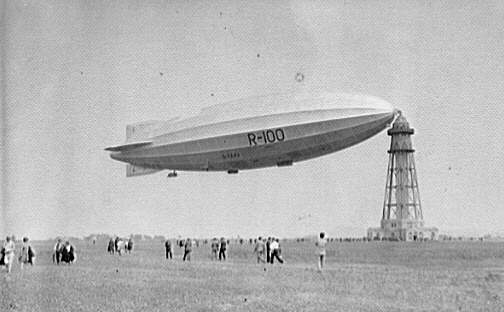
7: “Gorilla Ace and Murder on the R100!” The team is traveling home on the airship R100 when a member of the crew is found murdered and stuffed in a Canadian official’s car. The investigation turns up a missing bag of money from the cargo hold safe with $1 million Canadian missing. They have to stop the murderer (a ship radio operator) and the thief from escaping via parachute over Newfoundland coastline.  Ends with a chase through the interior of the ship and on the top of the hull.

8:  “Gorilla Ace at the National Air Races!”  September 1936 and the Gorilla Ace Flying Circus has entered into several of the contests.  Jackie Cabot flies the Women’s Air Derby from Los Angeles (Grand Central Airport in Glendale) to Cincinati (pot was $4000.)  There’s the 10 mile, 10 lap Thompson Cup speed races ($9000 that year.) and lastly, the Bendix Cup, a grueling 2300 mile endurance course with a $7000 pot at the end.)

9:  “Gorilla Ace and the Simian Menace!”  Gorilla Ace and company are attacked by real dogfighters while shooting the dogfighting stunts of the new Gorilla Ace! movie serials.  Their attackers chase them over the streets of Burbank and the 300 yard long, 100 yard wide fake African jungle for the aerial shots (while being filmed!), using their wits to outsmart their opponents.  (Wound up with all three bad guy planes down and GA!’s SEV3 destroyed.)   Later, after a wrap party at the Trocadero with other RKO stars like Fred Astair, Errol Flynn, and guys like Howard Hughes, they find their home ransacked, and at their hangar Dex and his notebooks are missing.  They find Dr. Stanford has been held hostage while thugs and LAPD detectives search his Laurel Canyon home for his notes on Gorilla Ace and his transformation.  They later have to get Dex and his notes back in a fight on top of a Los Angeles monument.  (Haven’t finished this one, yet, so don’t want to release spoilers…players read the blog.)

Still to come!

10:  “Gorilla Ace and the Thing from Inside the Earth!”  An earthquake unleashes an ancient horror on Los Angeles and only the Gorilla Ace Flying Circus can save the day!  The GAFC joins up with an elite group of scientists and inventors fighting weird dangers to the world.  (Will include Nikola Tesla, possibly an “Atomic Robo”-like character, Howard Hughes, Dr. Henry Jones Jr., and others…  Going for a 1930s Dr. Savage meets Buckaroo Banzai flavor.)

11:  “Gorilla Ace and the Werewolf of Manhattan!”…that’s all I have for it, so far.

12.  “Gorilla Ace over China!”  A mission to supply the American volunteers in China goes awry.  Possilby introducing a Jake Cutter-esque character.

Recently, I ran the 1936 National Air Races for our Gorilla Ace! pulp campaign.  HEX has some fairly crunchy rules for chase sequences in Secrets of the Surface World, pg. 145 (sidebar), which is essentially what a race is.  The problem I found with the SOSW rules are that they cut into the flow of a cinematic/comic book action sequence — you have to take the base combat speed, add the base speed in feet of the vehicle times the number of successes.  It’s not complex, but it requires a sudden jump into math, and that can throw the players out of the moment.

I decided to run the races differently.  One of the races was the Thompson Cup — a 10 mile course through pylons at different altitudes (but usually quite low to the ground) with 10 laps total…I had the characters roll for each lap — their PILOT sill plus the Handling of the aircraft.  They were competing against some of the best pilots in the world, so I used the average assuming the pilots they were racing had a Dexterity 4, Pilot 4, and a +2 Handling:  they had to beat a 5 per lap to lead the race.

Any successes were added to their next lap test — so if one pilot got a +2 success (a 7), they added that +2 dice to their next test.  If they missed the test by two, then had a -2 dice to their test.  There was also a lower success point that, if missed, meant they lost control of the vehicle (a PILOT 2 in this case and totally arbitrary…)  Another thing I added was a reliability test for the vehicles at the beginning — race planes are testy beasts and the characters’ mechanic had to run a test at the beginning of the race.  A failure would mean some kind of mechanic issue that would put the character out of the race.

This systems moved fast and kept the excitement of a fast moving race.

For the Bendix Cup — a transcontinental race — the length of the contest was such that running all 15 hours or so would also not work.  For an endurance/ navigation based race, I set up legs for the trip — in this case, New York to Cincinati, Cincinati to St. Louis, St. Louis to Midland Texas, Texas to Los Angeles.  Each leg requires a MECHANICS test v. 2 — a failure results in an incident where the pilot would have to put the plane down safely and would be out of the race; the other test was a navigation test that the pilot (and if they had a navigator a joint test) vs. 2 during the day, 3 at night.

Modifiers for the distance test are different:  Handling isn’t an issue, speed is.  So in this case, I took the average speed of a racing plane (about 250mph) and gave a +1 die bonus for each 25 mph over the average, -1 die for each 25mph under the average.  The number of successes adds to the next leg’s test and the success is cumulative.  During a leg where they had to stop for fuel (usually about ever 900 miles) they would lose -2 die due to the time on the ground.

I think these guidelines can work to aid in a fast paced chase sequence, as well.  The chased car escapes once the die benefits are either higher that the pursuit car’s driver skill rating (for instance, a mook chasing you with a faster car [assume a +1 die bonus], a +2 handling, and skill rating of 6 for a total of 9 [average 4+] is lost when the die benefit from your successes is higher than 4+).  Another option would be to give the bonus from successes to a DRIVE test to do some maneuver that would hide the vehicle from the pursuer — park behind a building, make an unexpected turn into an alley, take it off-road and park behind a convenient copse of trees — with a contested DRIVE (pursued) vs. PERCEPTION (pursuer) test.  If they don’t see you, you lost them.

Started a new Gorilla Ace! adventure this evening:  Murder on the R.100.  I wanted to do something different after a swath of superscience pulp advnetures, followed by the Chthulu-y one shot for the minor players on Wednesday.  I decided on something period and pulp-appropriate:  a murder mystery.

It started out simply enough as a teaser for an upcoming adventure, but I liked the setting — and found enough info on it — that I wanted to use it.  What to do on an airship..?  R.100, for those not into all things dirigible, was one of the last rigid-hull airships constructed by the British in 1929/1930.  She was constructed by the Vickers Company and the Airship Guarantee Company — designed by Neville Shute of On the Beach fame.  While Vickers was building her, the Air Ministry constructed R.101 — the goal was to prove that government could exploit air travel better than the private sector.

R.100 ran multiple seasons to Canada and back with a flawless service record.  R.101 suffered massive cost overruns, design flaws, construction snafus, and n her maiden flight to India went into the Normandy soil like a flaming lawn dart.  In response to being proven wrong, the Air Ministry canned the whole lighter-than-air project.

But that doesn’t work for my pulp game set in 1936!  In our universe, Vickers convinced the Air Ministry to continue the Imperial Ariship Scheme, but they are the sole operators.  R.101 did burn, but R.102 has been a success, and R.103 is soon to launch and replace the aging R.100.

(The US Navy program saw the loss of USS Akron under mysterious circumstances [it will turn up eventually], and USS Macon didn’t suffer her catastrophic failure.  USS Miami just launched.)

Some Hollow Earth Expedition stats:

Length: 719′   Diameter (largest): 133′  Gas Volume: 5.2 million cubic ft.  Usable Lift: 54 tons   Range: 4500 miles.   Ceiling: 15,000′ (usually flew at 2-5000′)

Size: 16   Def: 2   Struc: 18   Speed: 85   Handling: -2   Crew: 37   Passengers: 50   Cost: $2.5 million or so…

Traits:  Gas Bag — it’s bloody big and bullets go right through it without doing much.  First 2L are simply swallowed to empty space.

(In our version, R.100 has flown for seven years and her engines were upgraded form Rolls-Royce Condor IIIBs to Kestrals — lighter and more powerful for a top speed of 90 and 56 tons of usable lift.)

We set up the environment — the strange tramp steamer-like quality of the passenger area (nowhere as luxurious as Hindenburg), the open, airy quality of the ship, the poker games and communal dining lounge, and the relaxed, romantic atmosphere of the promenade decks with their large windows looking down on the Atlantic.  It’s roughly a 3 day trip from Cardington sheds in England to Montreal’s docking tower.   Most of the passengers are Canadian government and British business types.

Then one of the crewmen goes missing, and the search is on through the cramped catwalks, girders, exposed equipment of the interior of the hull, and even had a walk along the top of the hull during one sequence on a guide wire and harnesses for the riggers (for fixing damage to the canvas.) Eventually the missing man found bludgeoned to death and hidden in the button-up passenger compartment of a Canadian MPs SS100 Jaguar!  Who killed him, and why?

I haven’t finished the adventure and players read the blog so I’ll not spoiler it, but it’s a decent set up for a game…

Here’s more on R.100 and her sister ships.

Going to have some tie-ins to Greek mythology in my Hollow Earth Expedition campaign coming up.  To that end, I decided to write up centaurs as a creature/player race option…

CENTAUR (Follower 2)

Primary Attributes: Body 3, Dexterity 3, Strength 3, Charisma 2, Intelligence 2, Willpower 2

Secondary Attributes: Size 1, Move 6 (Run 12), Perception 6, Initiative 5, Defense 5, Stun 3, Health 6

Skills: Archery 5 (7), Athletics 5 (8), Brawl 5 (8), Stealth 3 (6), Survival 4 (6)

Talents: Alertness (+2 Perception)

Flaws: Addiction, alcohol; Herd Mentality; Lustful

Natural Weapon: Kick 8N

Once thought to be creatures of myth or allegory, Centaurs (and the female, Centaurides), roam the plains of the Hollow Earth near Atlantis and Shangri-La.  Usually, they are to be found in herds or in small hunting groups, but the occasional lone adventurer can be encountered almost anywhere in the interior world.

The centaur are a peculiar people — prone to great emotion and little self-control (as a rule.)  They are often drunkards, and when drunk, unpredictable.  When befriended, they are incredibly loyal and caring; when made an enemy, they are implacable and deadly, combining the best and worst traits of man and horse — they are fast, strong, smart, and vicious.

Character Template:

Attribute Adjustments: Size +1, Body +1, Intelligence -1, Willpower -1

Natural Advantages:  Quadruped (doubles speed)

Inherent Flaw:  Herd Mentality, Lustful

In Mongoose’s 2nd edition of the Babylon 5 Role Playing Game, the designers added an interesting mechanic which my players found fun to use:  influence.  Since the B5 universe involves intrigue and politics, the players are assumed to have to wrangle, call in favors, etc. to find out information or influence people they do not have direct contact with.

The character has a certain number of influence points in various fields — military (their own or other), society, media, political organizations, or criminal ones.  This is added to 2d6 and any modifiers to beat a set DC.    You can use influence to gain access to equipment and resources, or to pressure groups to aid you in some way.  This latter bit is particularly fun:  say your an agent from the Earth Intelligence Agencyon assignment in the field and you have to find out who is the Narn agent in charge in your location is, and get him to give you information on a group you’re after.  You tap your Earthgov influence of 12, roll 2d6 (7):  the difficulty to get this information is not hard, but the exerting the influence through the Narn government might be.  The difficulty to get aid from Earthgov is 10 — easily passed.  EIA pressures the Narn government for the contact — DC12, since you are are going a step further from your initial contact, you take a 5 penalty on the original roll…and still pass the test.  The Narn AIC is alerted to your presence and need for aid.  He has the information you need.  Now if say, you had needed the Narn to get information from the group, itself, and the GM had set that difficulty at 10, the cumulative penalties (two steps from your EIA contacts) would have provided a 7:  the Narn does not have what you want, but does have some of the information you need to point you in the right direction.

We liked this mechanic, so I ported it over to my Cortex games:  Battlestar Galactica and Serenity.  Here, your test roll would be Intelligence+Influence (Bureaucracy, Politics, Business, whatever…)  If you have Contacts that are applicable, add that die (this is “Friends in High/Low Places” in Serenity, or “…in Strange Places” in BSG.  Political Pull might also be applicable…  Set the initial difficulty, with a step up the difficulty ladder per faction you must go through (another route to go would be to add a die step difficulty per faction…)  So if your trader in Serenity needs to get hold of a smuggler working for the 14K Triad for get access to his supplier of X, he would tap his own contacts — say the Brotherhood of the White Chrysanthemum.

He rolls his Int d8, Influence d6 and Friends of d4 for a 7+3+3: 13.  Tapping his friend in the BWC is an Easy (3), who talks to a frienemy in the 14K (Average, 7), who talks to the smuggler (Hard, 11), who does give you the name of the purveyor of X…you needed a Formidable, 15 to get his assistance and failed.  What you don’t know — the smuggler does want competition and informed his supplier you were coming…and that he should dispatch you with haste.

This mechanic would be easily replicated in most game systems.  In the Decipher Star Trek game, a Negotiate or Investigate test might start with tapping Starfleet agents on a world, have them talk to Romulans, then to whatever group/faction they needed to talk to.  Set the initial TN, then add +2 for each step the request goes through (with possible additions for interaction stance, etc.)  Or have the degree of success moderate how many groups can be influenced in a chain.

For Hollow Earth Expedition, you would use the Bureaucracy or Streetwise skill (plus whatever bonuses for Ally, Contact, Mentor, or Fame) to make these remote influence tests:  each step away from your Ally/Contact/Mentor would be a step up the difficulty ladder.  (Say your connections to the Council of German Jewry give you a Easy task of asking your friends in the CGJ to contact their people in Berlin about the disposition of a friendly agent.  That Average to get information from Germany.  But say you need them to get a message to the agent, who is currently under surveillance by the Gestapo…that might be Tough, as the CGJ needs to go to a Jewish sympathizer in the polizei to get past the SS.

It’s an interesting mechanic, and one that my players seemed to find a lot of fun.