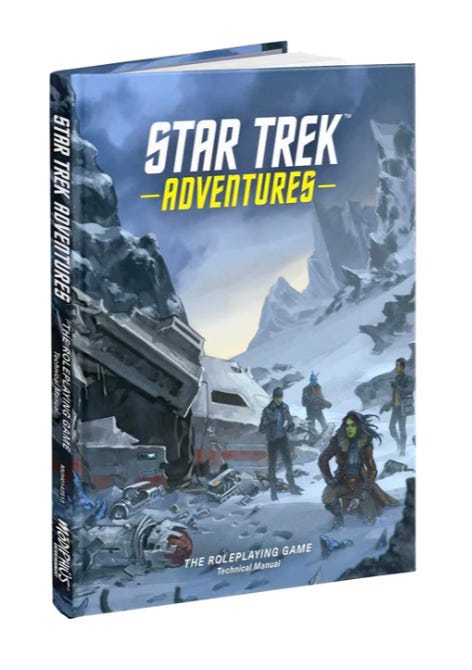
Modiphius had dropped its first supplement for the second edition of Stark Trek Adventures — the Technical Manual is a 129 pages of material on the various gear of the Star Trek universe. From the universal translator to tricorders, alien weapons to phasers, starship systems like the warp drive to replicators, the book gives some insight into the history and working of the toys of Trek.
There’s new career events choices for character building in the first chapter, as well as some nice talents for characters and service histories for starships that lean into the technical and the weird of the universe. There’s also a new section on space “mines” and the various different types. For those Discovery-philes, there’s material on the spore drive, and the quantum slipstream, transwarp, and protostar systems from the more recent shows also are featured.
Chapter 2 covers the usual equipment that the characters will encounter — from personal gear to replicators and holography. One of the better things that turns up in the chapters, and probably one of the best reasons to buy the book, is the charts for gear compications. Complications are one of the more important, and from what I’ve experienced, one the worst understood, game mechanics in the 2d20 system.
Chapter 3 is an odd choice that hasn’t, to my mind, ever features in a Trek RPG — diplomatic equipment, doctrine, and the like. There’s a large chunk of verbiage on the universal translator, and quite a few charts on complications for diplomatic missions and the use of the universal translator. Chapter 4 goes into scientific equipment, but also has some nice encounter and complication ideas for away teams. Chapter 5, similarly, medical equipment. The material here is influenced heavily by Strange New Worlds and Discovery — and real life: there’s cybernetics, genetic augmentations, and it even has PIke’s chair mentioned. 1966 Trek and the medicine of The Next Generationwas advanced…except for places that should obviously been more so — Worf’s spinal injury, for instance. They could wire LaForge for sight, but not get around a spinal injury with cybernetics?
Chapter 6 deals with the transporter, heavily, and as it is one of the main McGuffins for all the series…good. There’s a section on computer technology from Enterprise to Picard, and a section on the engineering gear of the various eras, plus the complications charts and suggestions. Chapter 7 deals with weapons and armor: from the various hand-to-hand instruments of the various alien races to the various energy weapons, each with a little crypto-history lesson.
Chapter 8 rounds it out with starship systems, and here I think the complications tables for the various different things — from shield or engines, to artificial gravity — will be a big help in starship combat missions.
The layout is clean and in the same design as the 2nd Edition rulebook. This is a good thing, as the LCARS look of the 1st edition, while evocative of the TNG/DS9/VOY era, was a pain to read for most folks. This is clean, neat, easy to read. The artwork is suitably improved, as well. The artwork for the Trek line has always been on the good side, but they’ve been getting it right for the last series of sourcebooks and 2E. While right now, it’s only available on PDF, the pre-order for the physical book is available on the Modiphius website. I suspect they’ll drop it for GenCon, but if it’s the usual hardcover (and seems to be), their track record on physical quality is pretty good.
So is it worth it? At $50 buck on the website for a 129 page book, that’s a bit steep, in my opinion. Hell, the core book isn’t much more expensive for twice the page count and the 2E starter set is selling for $35 on the website. My suspicion is, once we get past GenCon and the release of the book, you’ll be able to find it for a more reasonable $25-30 online. Is it worth buying, yes; at $50…you be the judge.
The copyright for 2d20 system is Modiphius, 2019. STAR TREK and related marks and logos are trademarks of CBS Studios inc. All Rights Reserved and no infringement is intended.
Spotlight Characters: Security and Science officers
SYNOPSIS
The ship is doing a routine patrol along the Romulan Neutral Zone when they receive a distress signal from Nimbus III.
OPENING LOG ENTRY
Captain’s Log, Stardate 56844.1: We are on a routine patrol along the Romulan Neutral Zone, close to the Nimbus system — the “Planet of Galactic Peace” — whose purpose is to allow the major powers of the Quadrant to meet and hash out their differences peaceably. In reality it is a sort of civilian Starbase 80 — a dumping ground for failed and disgraced diplomats. It is located in the Neutral Zone, and is the only point where Federation, Romulan, and Klingon ships may enter the zone.
MAJOR BEATS
1) Distress Call
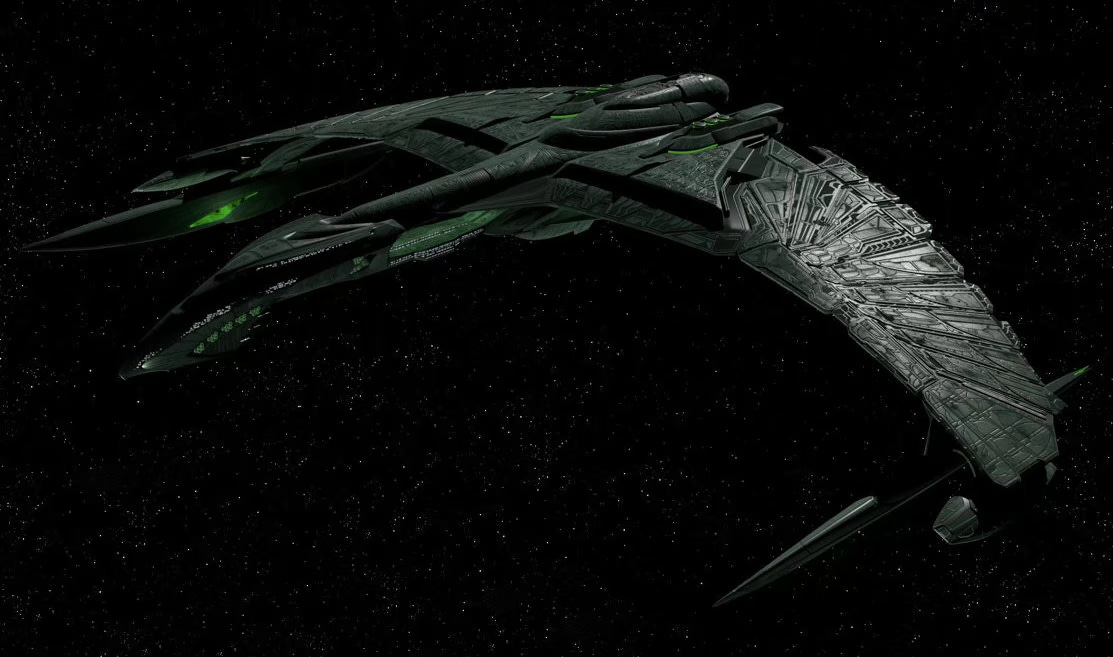
The ship will monitor some kind of high energy discharges only a few light hours away in the Romulan Neutral Zone. A successful scan of the area will reveal two Romulan warbirds duking it out. Both are in violation of treaty, but what are they doing fighting each other? As they watch, the Valdore-class warbird is destroyed by the older, larger D’Deridex, which quickly cloaks and disappears. A successful scan, difficulty 4 will reveal that just before the destruction of the warbird, there was a vessel launched and which quickly cloaked (for 2MP, they can determine it was a small scout ship, their equivalent of a runabout.)
They will pick up a faint signal a little while later. It’s the scout vessel, currently in the Nimbus system. “…need assistance… attacked by warbird {static] and ship destroyed… Have to get word to the high command… coup d’etat… Trying to make Nimbus III but losing control…” They will lose the signal, but not before the ship is spotted near Nimbus III, entering the atmosphere much too quickly.
Fortunately, they are authorized to enter the zone in a tight corridor of space to get to Nimbus III. A difficulty 2 navigation test should get them there in an hour or so.
2) Planet of Galactic Peace
A review of their records will show the Romulan ambassador is Shir’el — a diplomat that had worked to bring the Romulans into the Dominion War after the assassination of Senator Vreenak. The UFP Vincent Lorentz — a human from Centauri who had some personal issues that made him unsuitable for higher office. The Klingon ambassador is a former captain, Balek, who lost his attack wing during the war and has been parked on Nimbus III in disgrace. the world itself is mostly desert, although the settlers conned into coming to Nimbus with the promise of opportunity have managed to wrestle portions of it into (barely) arable land. The capital is Paradise City, and they will hear from any officials they contact that the scout ship never made it.
If they contacted the Romulan ambassador, he will relate that the scout ship must have gone down somewhere on the planet and that they will find it. Their assistance is not required. The Federation diplomat, however, will encourage them to find the ship and rescue the crew.
On arrival, they can start scanning for the ship. The helmsman can assist with a successful difficulty 1 test to set up a Polar Orbit scene trait that will aid in a more quick and efficient scan. This can be run as an extended test. Once they have found it, the wreck is near a small town of farms near an outcropping of rocky hills (that are absolutely not the Vasquez Rocks). The wreck is mostly intact, but there’s no life signs.
The mission directives are thus: 1) find and rescue the crew, 2) gather any intelligence regarding their claim of a coup d’etat — a coup against whom?
3) The Wreck
The scout ship is badly damaged — it looks like when their mothership blew up, the scout was hit with debris that eventually caused a lost of power and control systems. The computer core has been destroyed with a disruptor. Why? Before they can ask, a ground vehicle with a team of Romulans will arrive — and they are not friendly disposed. The leader Senek is looking for the crew, as well, and is highly suspicious of their presence.
Searching the area for life signs — there’s some small critters and plant life tenaciously digging into the dead soil of the planet. A difficulty 3 will find the Romulans from the scout ship, two life signs, hiding (of course) in a cave in the rocks. Work together with the Romulans or try to beat them to the crew?
4) Friend or Foe?
The crew are Tal Shi’ar officers who are hiding out from their people. Subcommander Valera and Lieutenant Tala had tried to reach the Federation ambassador, but their ship was barely under their control. Why not go to their ambassador? The reason is simple: they don’t know who to trust; they were attacked by Commander Suran of the warbird Triere. He’s one of the main commanders in the region.
If the characters had worked with the Romulans to find the crew, this is where the double cross happens and the Romulans attack!
They had uncovered one of the Tal Shi’ar’s research centers was experimenting with a danger weapon: a small thalaron radiation projector. Thalaron radiation can disrupt biological functions quickly and disastrously. These projectors had been built for some of their people who were concerned about the thawing relations with the Federation following the Dominion War, and are looking to murder the Praetor Hiren!
If the characters worked alone and beat the Romulans to the cave and the scout ship’s crew, they’ll arrive just in time for a fight.
5) Calling in the Cavalry
Once back on their ship, they can attempt to contact a Romulan commander that Valera trusts: Commander Donatra of the warbird Valdore. They will receive word that she is on her way, but at that moment Commander Suran’s D’Deridexuncloaks! He will demand the return of the scout’s crew or he will destroy their ship.
If a fight ensues, let it run until one side or the other is in real trouble. At that point, Valdore will arrive and Donatra will warn Suran off. She will take the Tal Shi’ar officers into her protection. They’ve done a real service; they made have just stopped a Romulan civil war.
CONCLUSION
The crew, several days later, will receive the news that a coup d’etat has occurred on Romulus and that a new Praetor, Shinzon, has ascended to rule. the rumor is some kind of biogenic weapon was used to kill much of the Romulan Senate! He has already offered to open talks with the Federation, and USS Enterprise under Captain Picard is on route to Romulus.
The copyright for 2d20 system is Modiphius, 2019. STAR TREK and related marks and logos are trademarks of CBS Studios inc. All Rights Reserved and no infringement is intended.
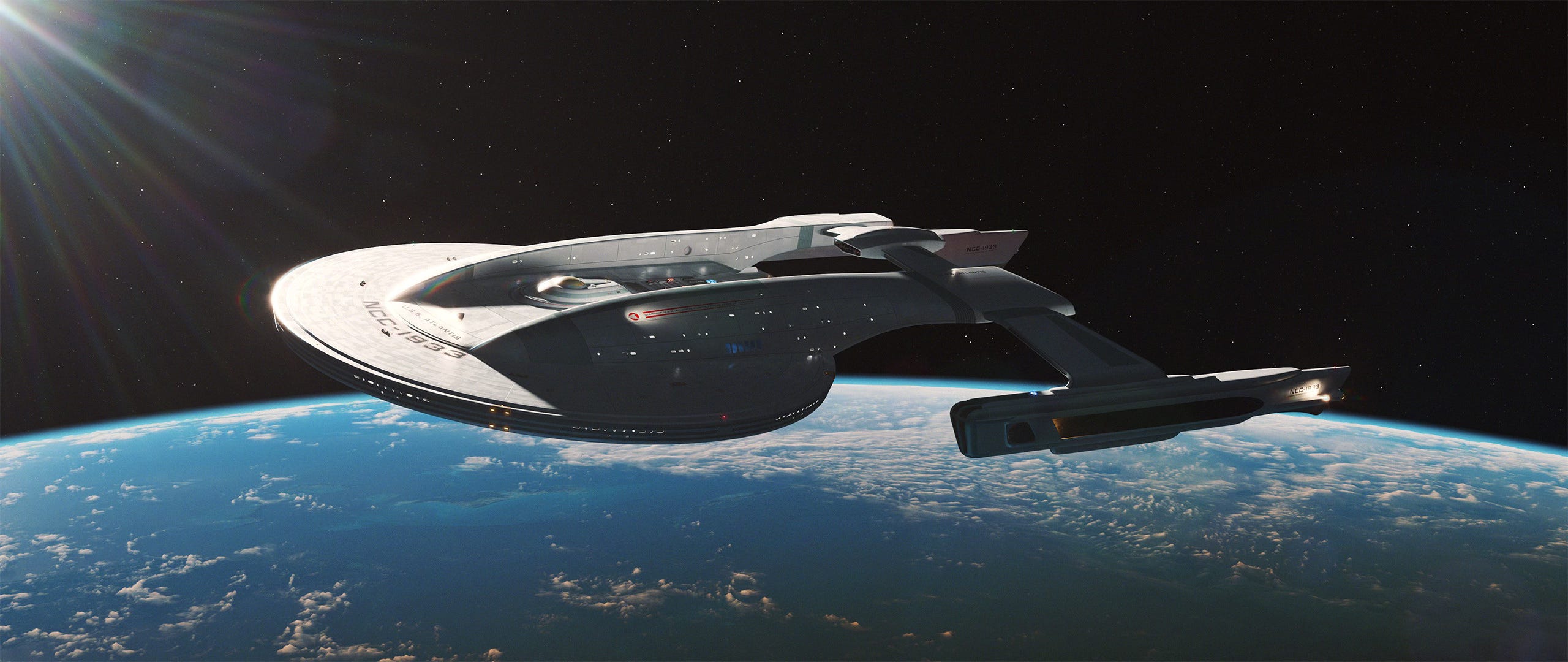
I saw this lovely design online — the USS Atlantis, Kusanagi-class by Diogo Vincenzi (here’s the ArtStation link) — and decided to stat it up for Star Trek Adventures 2.0.
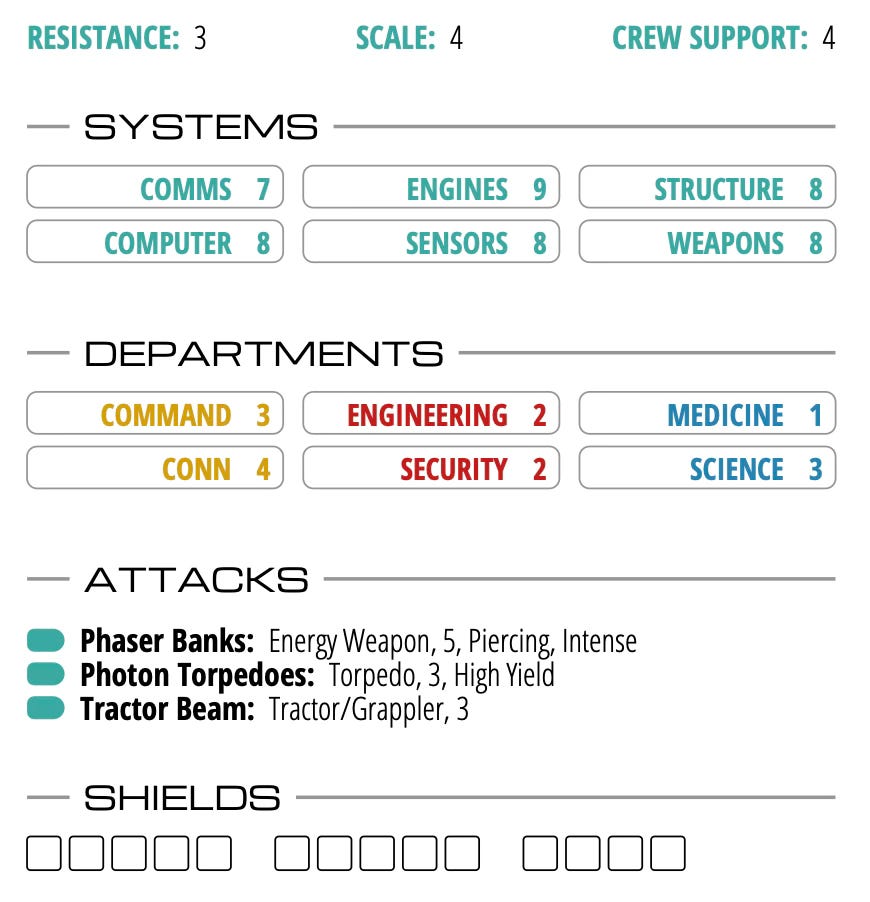
It looks like she should be running thirteen decks or so and the pontoons would give her a length similar to that of Enterprise from the era. I’m assuming a smaller crew, so perhaps between 250-300. Using the Miranda as a base, I threw this together using BC Holmes’ excellent website:
Launch Year: The hull numbering suggests this was post Miranda and pre-Excelsior, so I’m thinking 2275 for the initial run of the vessels.
Overview: Resurrecting spaceframe design queues from the original NX and the Walker-class, the Kusanagi-class was initially designed for patrol and combat, similar to the older Miranda class. Like the Miranda, this series was build with a rapid-firing torpedo pod, but where the Miranda were build with large shuttle bays to accommodate planetary landings by troops and materiel, the Kusanagi was built with speed in mind and naturally lead these to be outfitted for long-range reconnaissance and pathfinder missions. Like the Miranda, these vessels were seen operating well beyond their original expected service life, some seeing combat in the Dominion War.
Suggested Mission Profiles: Multirole Explorer, Pathfinder and Reconnaissance, Tactical Operations.
Naming Conventions: Many of these vessels took their names from mythological or Japanese naval vessels like Yamato and Musashi, Shahrat and Argo. Registry numbers range from 1900 to the 1990s. Notable examples: USS Atlantis, NCC-1933 and USS Yamato, NCC-1966.
Traits: Federation Starships, Kusanagi-class
Talents:
IMPROVED REACTION CONTROL SYSTEMS: Whenever the ship attempts to move through difficult terrain, reduce the Momentum cost of the difficult ter- rain by 1, to a minimum of 0.
HIGH-RESOLUTION SENSORS: The vessel’s sensors can gain large amounts of accurate data, though they are extremely sensitive. While the vessel is not in combat, any successful task assisted by the ship’s Sensors gains 1 bonus Momentum. Bonus Momentum may not be saved.
IMPROVED WARP DRIVE: Whenever the ship takes the Warp major action, roll a d20; if you roll equal to or under the ship’s Engines, you do not spend reserve power for the ship.
The copyright for 2d20 system is Modiphius, 2019. STAR TREK and related marks and logos are trademarks of CBS Studios inc. Image copyright ofDiogo Vincenzi. All Rights Reserved and no infringement is intended.
Suggested Era: Any, but Strange New Worlds, is best.
Spotlight Characters: Science officers
Directives: Confirm health and welfare of survey mission, collect any new data.
SYNOPSIS
The ship receives a mission to survey a possible Class M moon of a gas giant around star SSC-1092, a dull F-class star. There are records that a civilian research mission was sent out forty years earlier, but they never returned. Investigate, look for new life, and catalogue.
OPENING LOG ENTRY
Science officer’s log: We have been dispatched to SSC-1092 to investigate long-range scans suggesting a Class M moon around the third planet. My research into the records show that this system has rolled up before as a prospective interest for Starfleet forthy years ago, but no action had been taken. Twenty years ago, a civilian research mission set out to investigate this world, but was never heard from again. We don’t even know if the vessel — S.S. Starview — even reached their destination.
MAJOR BEATS
1) Do the Science Thing
On arriving at SSC-1092, the captain can turn their operations over to the science officer with a “Let’s do the science thing”. Control+Command, Diff 1 to organize the different science departments to look for and collate data. Control+Conn, Diff 2 for the helm or tactical officer to start launching probes to the various major worlds — four gas giants and a solitary captured terrestrial on a highly eccentric orbit at 480from the ecliptic and on a sharp, long period hyperbolic orbit. There’s a wealth of data to collect, even though the system has ben remotely surveyed for decades.
Their primary target is SSC-1092c/4, the fourth moon of the third planet. Insight+Science, Diff 0 to glean that SSC-1092c, the gas giant their target orbits, is slightly larger than Jupiter and has a powerful magnetic and gravitational field that keeps it’s inner five moons warm. Momentum generated by extra successes can tell them that c/4 is barely Class M, but there’s a nitrogen-oxygen atmosphere with 11.2 bars of pressure at the surface, .8g surface gravity, and a hydrosphere of 54%. The moon has it’s own strong magnetic field that is fed by massive, power flux tubes coming from the planet’s N/S poles — strong enough transporters aren’t a safe option. There’s heavy cloud cover, so surface visuals aren’t happening, however, there are indications of plant life from the spectroscopic surveys of the air, which is breathable. Temperatures are cool, but within safe for most humanoids (comfortable for Andorians).
With a Insight+Security or Conn, DIff 3, hampered by the strong magnetic field, they will pick up power and heat sources on the ground! the signature doesn’t look like a major area of habitation — perhaps a ship? A momentum spend will reveal that it looks like a structure made of tritanium, with a subterranean portion underneath.
The crew can beam down but the magnetic field makes it difficult: Control or Daring+Conn, Diff 3 to get down safely. They could fly down in a shuttlecraft with a Control or Daring, Diff 2, the weather’s not bad, but interference on their sensors and communications with leave them a disadvantage.
2) A Strange New World
The interference from the magnetic field of the moon is the main danger. If they go down in a shuttle, a failed test will require another Daring+Conn, Diff 3 to avoid a static discharge into the hull that will hit with a Intensity 2. Once on the ground, Reason+Science or Conn, Diff 1 to remember to discharge any static the hull has picked up before exiting the craft, or the first person to make contact with the surface and the ship will create a circuit to ground and hit them with an Intensity 3 shock.
They are now on the surface of the wind-ridden, rocky world. There’s a lot of plant life around, mostly rhizomatic plants that grow low and wide, as well as fungi. There are strange jellyfish-like polyps with gossamer wings sprouting from the heads moving in the air currents. The clouds are thick and they can smell the sulphur of volcanic activity. The signal came from an old Y-Type freighter. It looks to have landed properly and all the cargo pods are intact..
Insight+ Science, Diff 2: The plant life is mildly reactive to their movement and touch. A scan of them shows their replication is not DNA, but a polysaccharide chains with amyloid fibril-catalyst to cause replication. There are analogues to grass and squat, mushroom-like trees — they’re using massive mycelial networks to absorb nutrients. Momentum spend to learn they should avoid touching them with bare hands; they secrete an acid to break down polymers into monomers. Insight+Science or Security, Diff 2: to notice that the plastic of their boot soles is being dissolved, but very slowly. They’re in no danger soon, but they should clean up afterward.
3) Starview
The team finds the ship is poor repair. There are vines and mushrooms growing all over the landing legs, sprouting here and there on the hull. ONly one of their two long-range shuttlecraft Starview launched is here. The access ramp to the airlock is down and the outer door open. A scan will show the life support and main power are still online, although the warp drive is shut down.
The inner hatch isn’t locked; they can get in without issue. Almost immediately, they will meet a slim, stoner type — Morrison — who will welcome them. They didn’t call for Starfleet; this is an independent colony. What are they doing here? He will insist, but in a friendly, calm manner that they don’t need any help…still they should talk to the boss.
If they ask about their mission, Morrison will tell them Starview landed 21 years ago and started their survey of the moon. They quickly realized the potential of this place. Those that didn’t want to stay left in the long-range shuttles a few years later. They should have been able to get back to Earth or Vulcan without issue. He will note that its unfortunate they didn’t get home, but he doesn’t seem emotional about it. Insight+Medical or Command, Diff 2: Morrison seems perfectly normal, but he’s definitely not showing signs of empathy.
There’s more of the crew here in the science module, four more of them. In addition to Morrison, who is the pilot for the ship, there’s Hailey, their biochemist; there’s Fitch, botanist; Welborn, another from the flight crew, Chu, the quartermaster; and Denton, the engineer. All of them seem pretty content, if a bit inebriated.
They’ve been doing their work for decades, and to fund themselves and keep supplies they can make here coming in, they’ve been trading with the Orions. They produce a bunch of medicinal materials from the local life, but what they were really known for was “the soup” — a hallucinogen that they produced for the Orions and other markets. It’s a calming psychotropic that has excellent results in treating anxiety, traumatic stress, and other mental diseases. Tweak the mix and it’s a beautiful ride. The security officer, if present, can test Reason+Security, Diff 2 to know “the soup” is a popular drug with some species out there, but can have serious side effects and can be deadly.
They will dispute that the soup is dangerous. The side effects that some worry about are fungal infections, but that’s part of why it works. The trick with everything here is to neutralize the amyloid; if you don’t they can wreak havoc on your nervous system. Some of the folks out there tinker with the soup and try to replicate or modify it; that’s what causes issues. They certainly don’t want to hurt anyone. Insight+Command or Medicine, Diff 3 — success tells them they aren’t completely truthful.
Chu will mention that the soup really puts you in touch with the universal mycelial network. It’s not really mushrooms, of course; it’s allegory for the energy patterns that connect the universe. There were a couple of guys that came through here a few years back — she’s not sure of when — but they had this idea about using these networks to create a drive system that you could use to run along these energy potentials faster than warp drive. What was the guy’s name… Stametz? The problem was the sheer number of possibilities made navigation nearly impossible beyond a few AUs.
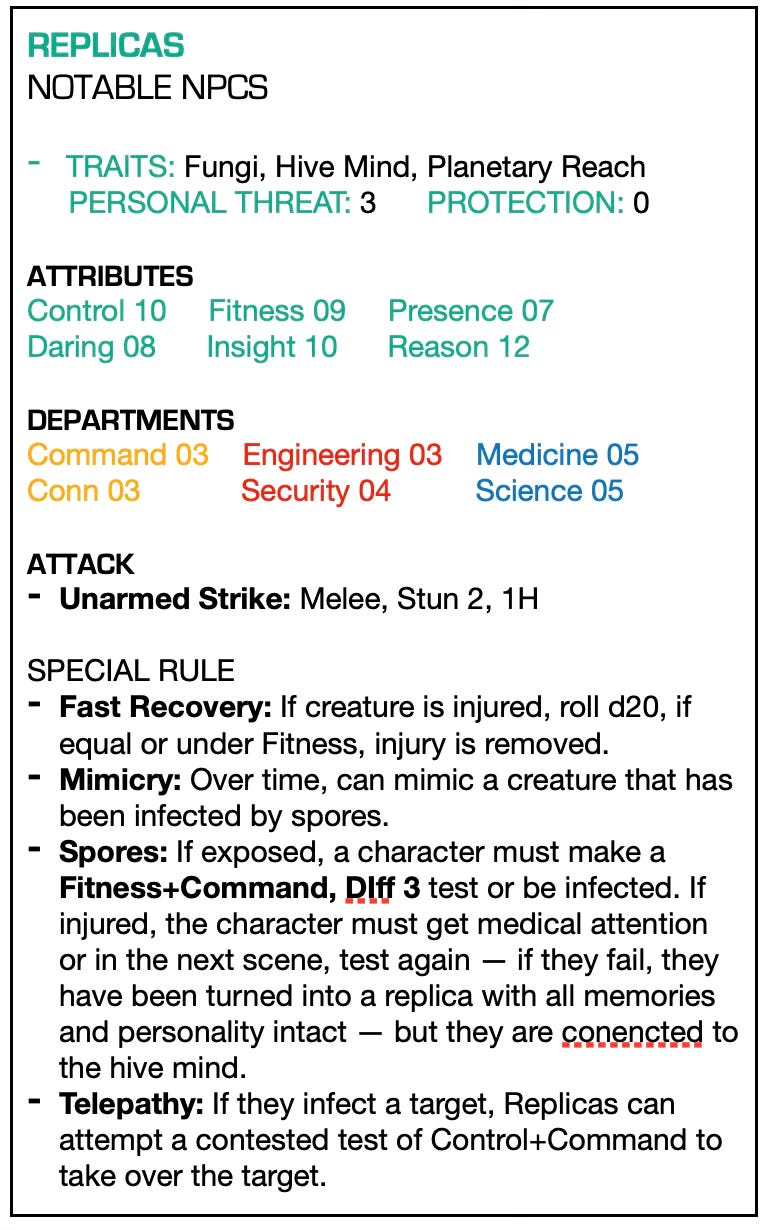
While they don’t seem dangerous, they’re wrong somehow. If they try to take a tricorder reading, they react by asking them not to. If the crew insists, the crew of Starview may get hostile. The issue is simple: none of these people are people, anymore. Their DNA has been rewritten by the amyloid fibrils and they are…local fungi pretending to be people.
If the characters can chart their way, diplomatically, they will find out from these replicas of the Starview’s crew that over time, the soup and other material the colonists ate infected them with bits of the life forms here. Many died, a few fled in the shuttle. Once the planetary network realized that the crew were sentient, and that the local flora had killed them, they attempted to reconstitute them. they were only successful with the ones that hadn’t died. It also gave the life of this moon access to some of their memories, knowledge, and personalities.
If the crew pose a danger to the collective of life on the moon, they will respond with a subtle release of spores to try and control the characters. They must test against a Control+Command, vs. an opposed test with the creatures or be open to suggestion. These replicas will suggest that they report the planet’s flora hostile to colonization, that the original survey team had died, and that they should move on. If a character fails, they suffer an Injury at Intensity 3. They will have to make a second test at the end of the scene, if they have not received medical treatment, or have the fungi start to slowly replace their body until they are eventually, a perfect replica. Only the sharply different physiology of the Andorians (or Bolians) will be immune the effects.
Any violence will make the Starview replicas believe they have no choice but to act in their defense. The whole of the ecosphere is connected, and fed by the heady magnetic field of the planet. If need be, they can reach out and… tweak the moon’s magnetosphere. They would not wish to, but they could destroy the characters’ ship with a thought.
If it comes to this, they will attack with a Control 10+Security 4, Diff 2, and the effect of Plasma Discharges is like Plasma Torpedoes: Short (only if they are in orbit), Damage 7, Persistent. After the first hit, the ship can attempt to do evasive maneuvers, but if it doesn’t leave orbit, they will continue to be attacked until the characters can convince the aliens to stop.
CONCLUSION
If the crew can find a diplomatic solution, they should be able to get their people back from the surface. If not, they may have to stage a desperate rescue attempt with a disadvantage for the Moon’s Magnetic Field and Sentient Biosphere.
The copyright for 2d20 system is Modiphius, 2019. STAR TREK and related marks and logos are trademarks of CBS Studios inc. Image copyright of Adobe Stock. All Rights Reserved and no infringement is intended.
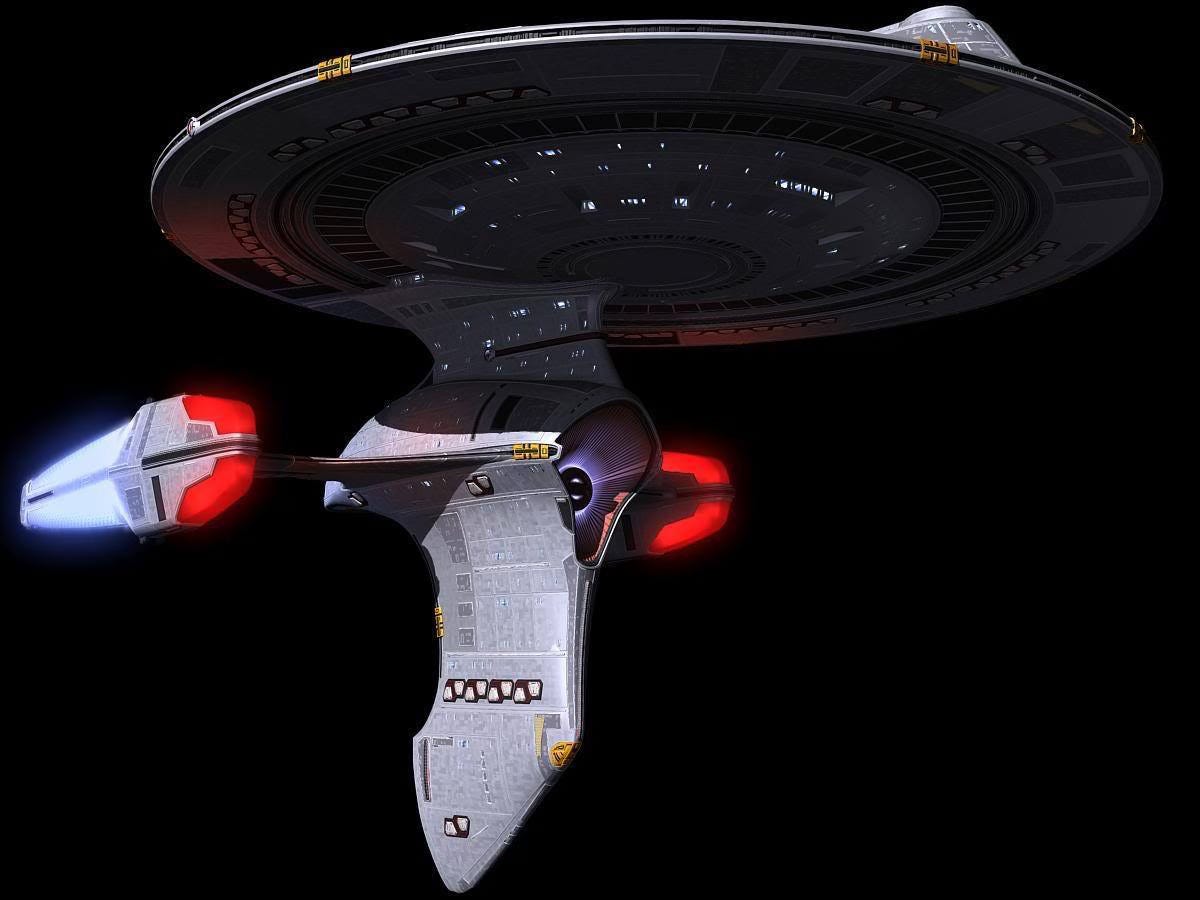
This design’s been floating around since at least the early aughties. If took a bit of digging to find the page for the guy, Atolm, on DeviantArt . He had a habit of taking strange shapes and crafting unique designs. This one, the Chariot-class, broke the mold by flipping the traditional long horizontally-oriented secondary hull and flipping it vertical. The result — to my eye — is magical.
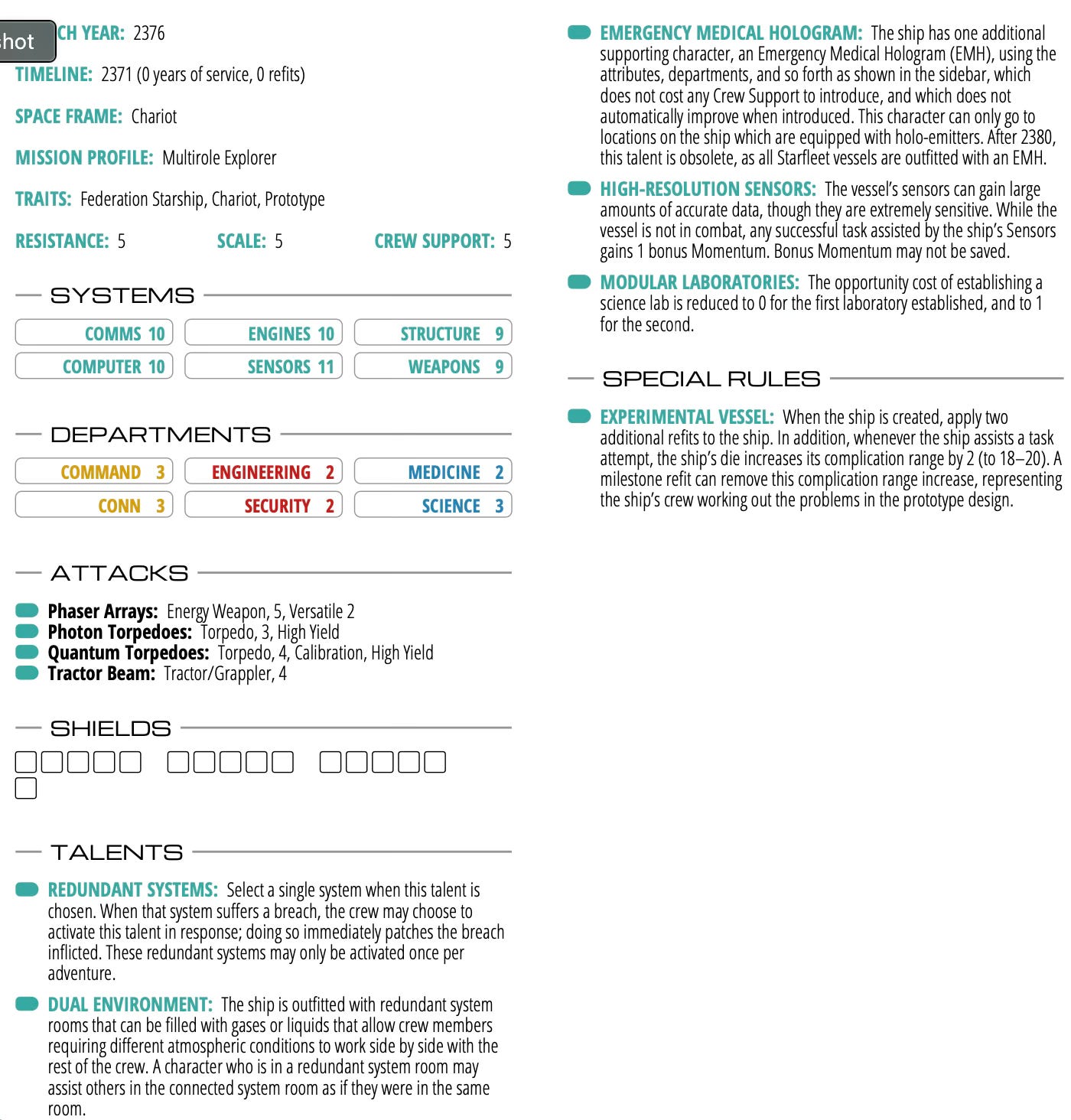
The Chariot-class was an attempt to get back to an exploration-focused fleet. With an unconventional hull design more centrally-placed warp nacelles, and better positioned center of mass, these ships were designed to be maneuverable, with a wide placement of sensor pallets to allow for better, high-resolution scans. Dual-environment cabins and locations, coupled with extensive redundant systems were aimed at more representation of member races aboard ship, and to improve survivability of the spacecraft; the addition of an emergency medical hologram likewise the survivability of the crew. Modular laboratories allowed the ships to pivot their focus as needed.
Designed as a multi-role explorer, Starfleet did not ignore the increasing severity of the threat landscape. The Chariot carries the latest phaser arrays the 360 degree coverage on all axes, plus photon torpedo systems upgraded to fire either photon or quantum torpedoes.
Auxiliary craft include 6 Type 6A or Type 11 Shuttlecraft, 6 Type 9 shuttlecraft, and 10 workbees.
The copyright for 2d20 system is Modiphius, 2019. STAR TREK and related marks and logos are trademarks of CBS Studios inc. Image copyright of Chris Reyes aka AtolmAzel — check out his stuff on DeviantArt. All Rights Reserved and no infringement is intended.
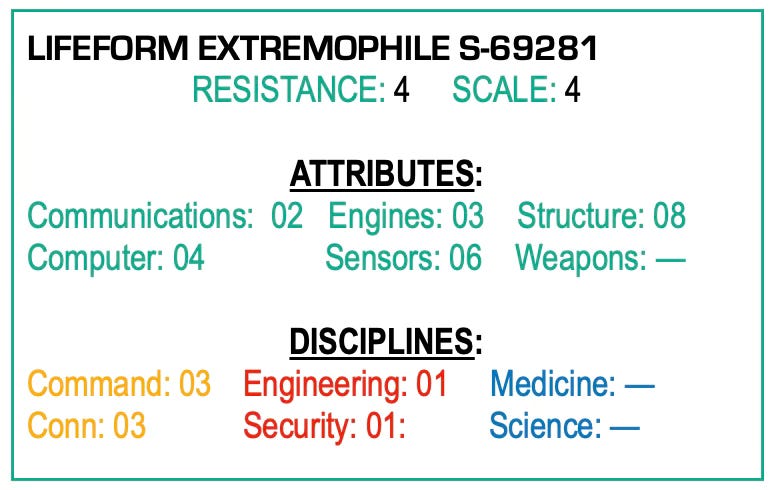
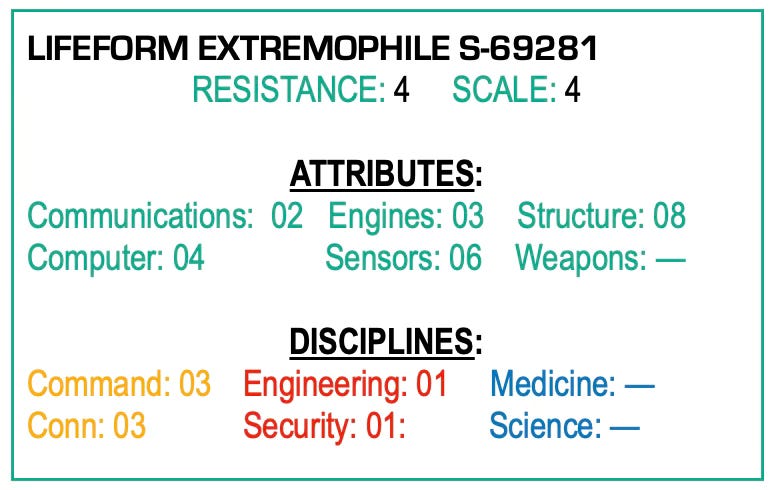
The ship is doing a survey sweep through an unremarkable system when they encounter a space-borne life lifeform.
OPENING LOG ENTRY
Science officer’s log: We are doing a sweep of system SSC-0913. The parent stars are a pair of unremarkable M4V main sequence stars of similar size. Both are 0.8 the size and brightness of Sol and are circling a barycenter 3AU from each star. Survey probes have been launched to map the system.
MAJOR BEATS
1) Do the Science Thing
While moving through the system, the flight control officers can set up courses for the probe with a Reason+Conn, Diff 2 to create an advantage of “Probe Data” for the science officer. The science officer can scan the system with a Insight or Control+Science, Diff 2 to gather information.
The system has a pair of red stars circling each other at roughly 6AUs with a barycenter that is littered with asteroids and gas in a bar-bell shape where the stars are pulling on them. Each star has a J-class gas giant companion at half an AU and 1.1 AU, respectively, with a T-class superjovian orbiting the pair at 12AUs out. But the real surprise: they note an anomalous vector change on one of the asteroids. It’s a bit smaller than their vessel and looks like it had an outgassing of material. It’s weirdly shaped — almost shrimp-like, and with a momentum spend of 1) it’s warmer than the surrounding rocks with a crust of nickel-iron, and the material expelled is a curious mixture of elements; another 2) the rock appears to have an extensive system of caves and is pinging back EM and heat signatures, as well as chemical signatures that indicate life. Lots of it!
They can reorient the probe to have another look or bring the ship in. As they get close, they can take another look. Insight+Science, Diff 1: their scans look to be making the rock outgas again, changing course and moving away. Whatever it is, it’s alive and responding to their scans. A momentum spend will also confirm there appear to be multiple life forms inside the network of caverns; some kind of ship? Ant attempt to communicate will not get a response, but the transmissions also seem to make the rock thrust away from them.
2) Beachhead
Control+Conn, Diff 2 to beam the landing party into the cave system. The extensive life signatures mean locking in on the party to return them will require a Control or Insight+Conn, Diff 3 to bring them back. (If they take transporter signal repeaters with them, this gives “Signal Repeater” trait that will give an advantage to this test.) The initial scan suggests a toxic atmosphere; they’ll need space suits.
As soon as they beam in, the creature will react to their transport and start to move away from the ship, requiring a Control+Conn, Diff 2 to stay in transport range, but not cause the creature to react.
Having beamed into one of the outer areas, they will find it has a more organic quality and are smaller than they were ready for. There’s no gravity, either. There are critters moving around the “corridors” and avoiding the team. Insight+Science, Diff 2: there’s everything from microorganisms up to creatures that are person-sized. Some of these look to be cleaning plague off of the corridor walls. If they have used their tricorders or set up signal repeaters (Control+Conn or Engineering, Diff 1), this counts as an Escalation 1. (What they don’t know: the radiation signatures of their equipment has drawn the attention of the creature’s immune system.)
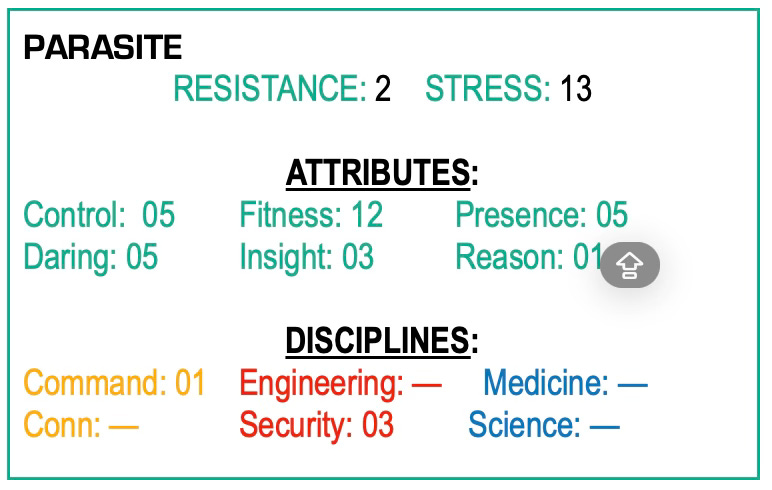
Exploring the interior will require a Control or Daring+Conn, Diff 2. The Spacewalk trait knocks this down to Diff 1. As they explore, a Insight+Science or Medicine, Diff 2 to note there are areas of damage — the walls of the corridors have collapsed exposing musculature and vascular material. A spider-like creatures is appears to eating the damaged tissue, like a maggot, then excreting material to “fix” the damage. A momentum spend or second test using Reason to determine it’s either had some form of disease or injury. With a +2 momentum spend — it’s damage. It looks like something has eaten its way through the flesh? If they scan — or have the ship scan — the creature, Insight+Science or Medicine, Diff 3 to locate the reason: the creature has some form of parasite. It’s a nematode of some sort, but big — ten to twenty meters long.
As they’ve worked their way into the interior, their comms get more and more spotty from interference. They’ve found a sort of energy plexus, where energy is surging through massive conduits through a central spine. Reason+Science or Medicine, Diff 2: the “digestive” system, maybe? What is it “eating”? Could it be absorbing radiation and channeling it through this system? Is it eating rocks?
3) Immune Response
The team’s communications and scans will attract the attention of the creature’s immune system and they will be aggressed by some kind of critter — an ameboid like thing with tentacles/cilia. It’s main target is the repeaters (the radiation is being deemed a threat.) Reason or Insight+Medicine or Science, Diff 1 to realize there is something about the repeaters the creatures are responding to. It will attempt to eat them. Using phasers will be an Escalation 2 and will bring more immune response.
Beaming out could be difficult. If they left a team with the transport repeaters, they will also be attacked — the leucocytes are going after the repeaters. They’re not interested in the crew — just the stuff that is transmitting. If they left them alone, the repeaters have been eaten; Control+Conn, Diff 3 to beam the team(s) out.
4) Call a vet…
If they’ve found the parasite, they can either monitor the activity for science-sake, or they can attempt to help creature S-69281 by going in and killing it. (When I ran this, the doctor actually got creative and they used the transporter to beam the brain out of the worm.) Any use of transporters, phasers, etc. caused the creature to try and escape. Inside, any use of phasers or other energy weapons will bring the leucocytes within two rounds. If they can damage the worm, this will distract the leucocytes, which will attack the worm.
CONCLUSION
The crew should have assisted the creature and learned a little bit about it’s biology and behavior. If they monitor it for a while, they will also find that some of the asteroids in the system have the creature’s larvae inside. They eat the interior of the asteroids and wear them as a shell once they are large enough to set off on their own.
The copyright for 2d20 system is Modiphius, 2019. STAR TREK and related marks and logos are trademarks of CBS Studios inc. Image copyright of Adobe Stock. All Rights Reserved and no infringement is intended.
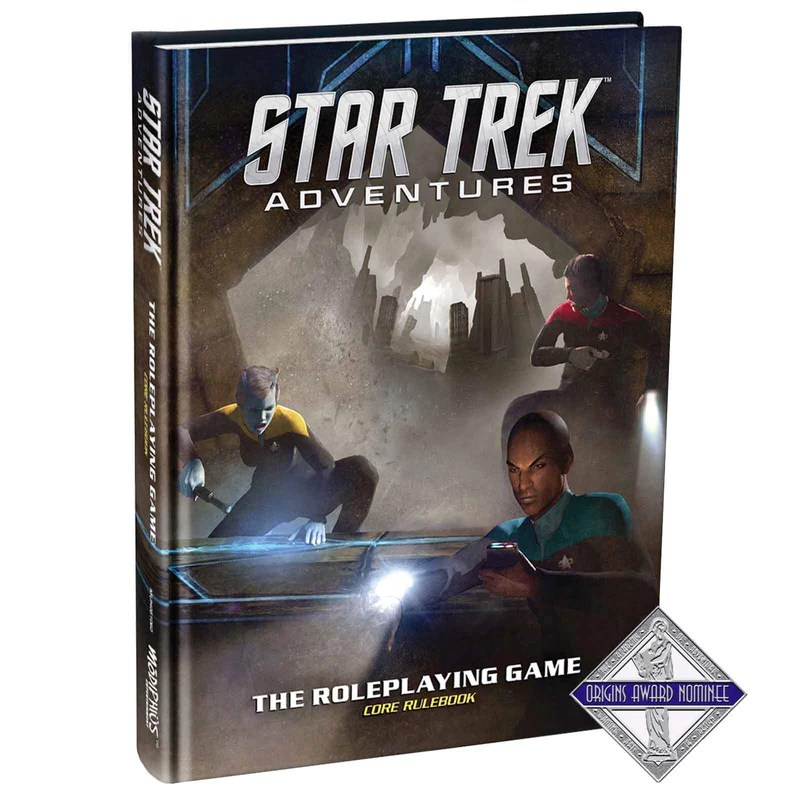
The game group finally came to grips with the 2d20 system when one of the players relieved me as GM to run Fallout back at the start of the summer. The system was manageable and with some knowledge of how it worked, I looked over the Star Trek Adventures core book I had a PDF of and decided “what the hell” and picked up the hardcover core book, the Utopia Planitia guide, and the Discovery guide, as well as a GM screen and the dice sets.
Quick backstory: back in the midsts of time, our group was one of the playtest groups for John Carter of Mars when Modiphius was rolling it out. We had found the rules almost indecipherable — not so much that the core mechanic is difficult (but it is a bit overly complicated), but that the writing was disorganized and, well, bad. We wound up dropping out of the playtest because we couldn’t get through an evening without throwing our hands up and making it up as we went. I didn’t touch 2d20 again, and avoided the games tied to it like the plague. Fallout seemed a bit better written and not running it meant I could learn the system without the annoyance of running the game, as well.
Back to Trek: I had run a “season” of Star Trek using the old Decipher rules, set in the second season of Discovery thanks to the excellent addition of Anson Mount’s Captain Pike. The writing was tighter and better than the uneven first season, and since the drop of Strange New Worlds, I’m a Trek fan for the first time since Enterprise screwed the pooch back in the early aughties. We had a good time with a system that was still mostly familiar, although it has some stumbling blocks.
For “season 2”, I swapped us to 2d20. The characters ported over very easily and were pretty close to what they were in Decipher. The combat monster Andorian was a bit more combat monstery, and the hot shot pilot was even better, but most of the characters were spot on. We built them up out of the book, then I double checked what I was doing with an excellent STA website. Our ship — USS Fearless, one of the last of the Walker-class, came together nicely, as well. The characters are defined by six attributes and six skills called departments (science, command, etc.) and it works nicely — though there can be some confusion as to which attributes handles what, and with a good argument, I let players use alternate departments. There are focuses which give extra successes, and values that can generate advancement milestones and determination points — one of the game currencies, in addition to momentum (called threat when the GM gets momentum, because two names for the same thing isn’t going to confuse some folks…)
I banged up a few “short treks” to ease the players back into their characters and system (a shore leave, then a save another ship from a strange anomaly adventure) before diving into our first action episode. I quickly started ignoring the Determination points rules; like Fallout there’s two different meta-game currencies…one too many. Another problem was that the determination rules’ index location was not where the actual rules for their use was.
The characters escorted a convoy of humanitarian aid ships to Coridan — a major producer of dilithium that was hit hard by the Klingon War, only to find out the Orion Syndicate had been “aiding” the world…by repairing then running their dilithium mines for the Coridanites. There was a street fight after making contact with a Starfleet Intelligence agent (and Orion female — their abilities are sharply curtailed in STA). The fight went great until — where are the stun rules for the phasers? A quick flip through the book to phasers…then to combat… turned into a long flip through the book. While another player tried to find the rules, I hit up the interwebz…nothing. Some players have loads of stress points, but the average seems to be in the range of 16. You’re not getting that kind of stress in a phaser rifle hit, so you can’t emulate the show where most humanoids go for nappy-time when you stun them. In the end, I house ruled that the character or NPC hit had to do a Fitness+Command or Security vs. the number of stress they took, or be stunned and unable to do anything for a number of rounds equal to the stress hit (or however long the plot needed them out for.)
The rules for extended tests work pretty well — we have a hacking scene where the characters had a gated activity: get onto the roof of a building (they beamed in overhead and paraglided in), patch physically into the building antenna and make it look like the hack was local and not from the starship, get past the security, and download the material. I set the Work rating as 10 successes and a Magnitude 1 (they would need to successes to succeed). Worked well, no issues. There was another fight using our stun rules, though it went lethal quickly.
After their missions to the surface, the Orions overreacted to the Federation agents getting data that showed the Orions were trading Coridan’s dilithium for Klingon surplus ships (I was using the Eaglemoss ships from Discovery for their cool gothic aesthetic…I have to admit, I hated the Disco Klingons, at first, but warmed to them when you could actually see what the ships looked like) and this led to a four on one fight between Fearless and a Bird of Prey, and three Orion Interceptors. This was our chance to try out the starship combat for STA, and I figured this was going to be as muddled as finding a straight answer to how quickly to healed stress and injuries. (Again…half the stuff you need was not where the index said it was.)
To our pleasant surprise, starship combat really worked well. We had a station card from the GM screen for everyone — pilot, ops and engineering, tactical, and the players used the inspired “minor character” rules where they could quick generate a bit player they could play to assist them in their actions. (It’s also excellent for when a character isn’t present — now you’re playing Ensign Snuffy in the redshirt… now find out how the monster works!) Initiative usually starts with the PCs and each station gets an action that can aid the others or can do their particular schtick. The bad guys get an action between the PCs, and the players can choose who goes when on the PC turns. We found this worked very well and allowed the players to strategize their actions and feel like they were actually more than just there to roll for a hit on another ship. Ops and Engineering don’t just fix damage here; there’s a lot of planning — fix some damage or manage the power track? Like the shows, the ships blow power on their maneuvers and firing, etc., and that has to be replaced by the operations manager or engineer, or you’ll find yourself unable to do much. By doing this, they were able to evade fire, set up advantages for a firing solution, manage the shield damage, and badly wreck the Orions while taking minimal damage themselves. Of all the sections of the game mechanics, this was probably where Star Trek Adventures shines the most.
The rules aren’t bad. For most basic tests, it works just fine. Combat is a hot mess once you aren’t punching or using melee weapons. Like many RPGs that tried to tackle the ST universe, they often run afoul of the damages the weapons do: phasers just vaporized people in the show. That could make for a short run for a character in combat. You would also think, for a show where the phrase “phasers on stun” is uttered a lot, having stun rules would be a good idea. Starship combat? Excellent.
Advancement is based on “milestones” — did you use or buck your values? Did you stick to the regulations, screw up, lose people under your command, etc.? These stack up and give you the ability to swap ratings on things, or with the arc milestones increase scores, add foci or values. One excellent bit — you can spend your milestones on minor characters that regularly aid you or the ship. The milestones also gives you dice to roll against your Reputation — another aspect of the game that the index doesn’t send you to “how to bloody use it” but rather a bland — you have reputation blurb. It can be spent for medals and commendation, or promotions. It looks like it was also supposed to be able to be used for social tests, but that’s not in the core book — it’s in the Klingon sourcebook. Helpful. There’s almost no real direction given on reputation and I’ve been house ruling on it.
But now for the real problem with Star Trek Adventures…it’s badly written. The rules should be easy to parse out, but there’s so much side chatter about momentum and determination that you can miss the main rule mechanic — roll two or more d20, get below the combo of attribute and department. If you get below the department — that’s an extra success (or two if it’s a focus.) Momentum can be used to buy extra dice, or a number of other things; determination does much less. you could easily combine the two into one currency. The problem with STA and other 2d20 products is that the rules are haphazardly scattered about the book — sometimes in places that defy reason. Worse, the index page is utterly f$%king useless. Half the things you would look for aren’t there, are under a different name, or send you to a page that the thing is mentioned but the use of which is not provided at that spot. Like determination. Or reputation. It feels like the book was churned out fast, an editor was employed sporadically, and they chucked it out the door. It’s been a few years since STA debuted…by now they should have fixed some of this with a second edition. (And the Klingon campaign book does, to an extent.)
So…is it worth it? This one’s a bit tough. The system is perfectly serviceable for most situations. It’s (I think) supposed to be on the rule light side, but isn’t. Personal combat needs serious reworking and starship combat is excellent. Advancement — both the milestones and reputation mechanics are half-baked. Character creation is quick and easy, and creature creation similarly easy. NPCs can be presented as novices or experienced, etc. with stock ratings like Attribute 9 and department 2. The ability to create a background character on the fly and let a player run it so they are in the scene is inspired. There’s a lot of good, but just as much that’s just…not finished for a major licensed product that’s been out for a while. Lastly, it’s a hot, damned mess from a writing, editing, and indexing standpoint, and that’s just not acceptable for a $60 book. So — if you want to run a Star Trek game and don’t want to do the heaviy lifting to write up material for a system you like, yeah, it’s sometimes a pain in the ass but worth it. If you are looking for the system that really captures the flavor of the series-eses, it’s not quite there. If you want a seamless play experience — nope. We’re at least six weeks of play into the season and I’m still looking rules up while trying to run the game.


 The Black Campbell