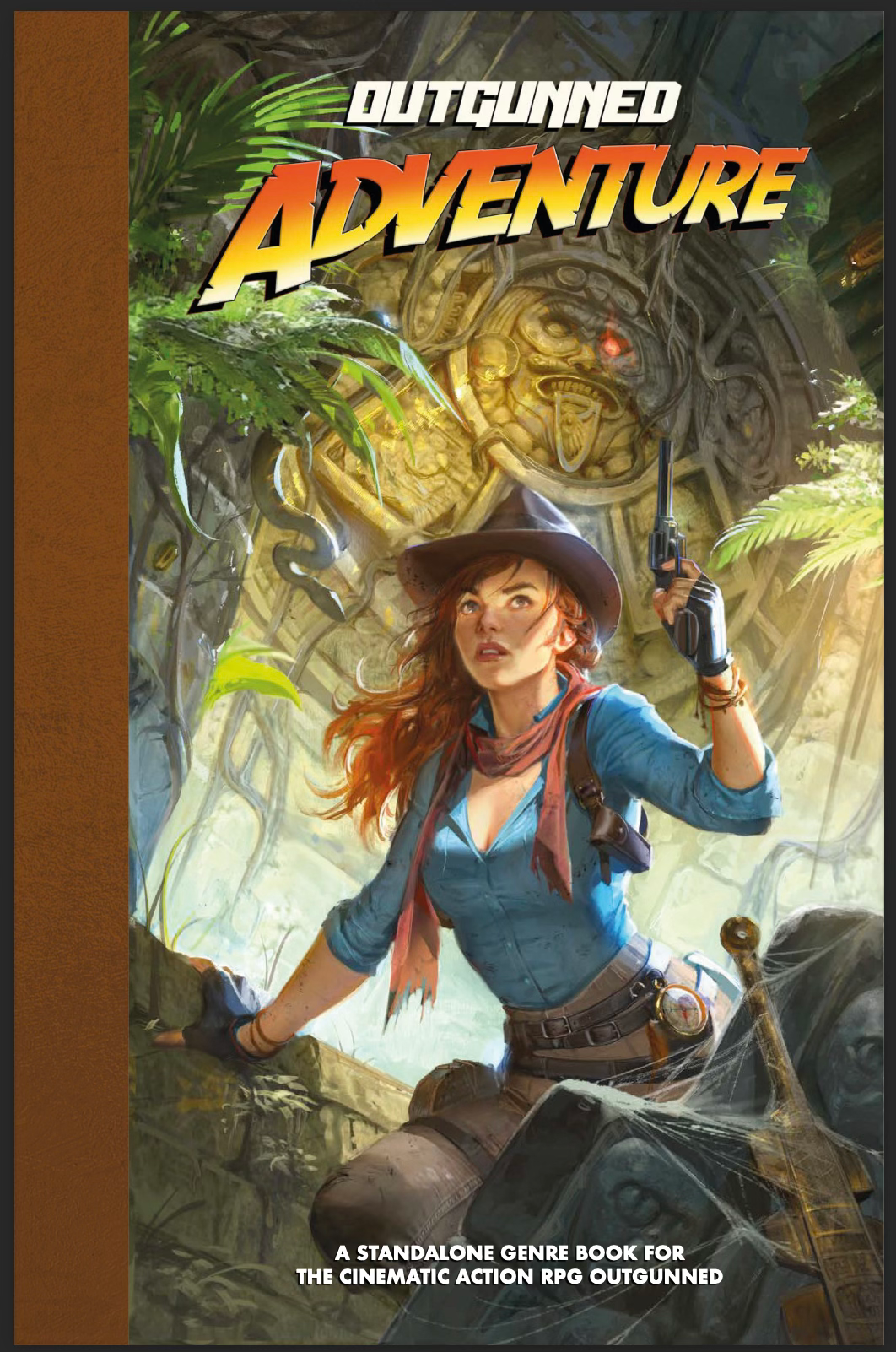
I still hold that the Broken Compass RPG and the Kickstarter that spawned it was one of the best bang-for-your-buck games I’ve ever bought. The Kickstarter (and now Backerkit) campaigns that 2 Little Mice ran were well orchestrated — with constant updates, quick turn-arounds that had the PDFs on time, and delivered their products on time or only slightly late for physical materials, in the case of Outgunned. Now, they are releasing Outgunned Adventure — the successor to Broken Compass. Their system now has a name: Director’s Cut, but it’s the same basic mechanics we’ve seen since BC, just with some tweaking here and there to improve the product. The PDF landed in my inbox a few weeks ago, and the physical product is in the offing. So how is it?
Excellent. There are a few differences in character creation: there is one less Attribute than in BC, and each attribute has four — rather than three — skills associated with it. You start with one pip in skills, two in attributes, and these get added to as you choose your role (Hunter, or Professor, for example) and your Trope (Like Action Archeologist). That’s the die pool you roll for a task, plus or minus a die per advantage or disadvantage gear or scene traits, etc. provide. You look for matches onthe die face, so you can use their fancy dice or normal d6s, just like in Broken Compass.

Only the players roll — you either take an action or a reaction to things happening. Tasks, challenges, fights — all the same mechanic. It’s dead simple and easy to learn and play. It’s Broken Compass, but with improvements.

What improvements? Gear, for one. It pulls the gear “feats” from Outgunned, and which I have suggested should be applied to Vehicles here. Strangely, the one set of rules they left out were the Chase rules, replaced by the Run rules in Chapter 5. The real additions to BC/Outgunned are made here: chapters five and six.

Chapter 5 gives us Temples & Traps, and makes suggestions for how ancient temples should be deployed in your adventures. Does it have to be a temple? No — it could just as easily be a library, ancient building, whatever. Traps gives suggestions for what kind of taps are cinematically appropriate and gives plenty of examples. After this are the Run rules — the trap is sprung, the bad guys are on your tail — You set up the number of turns they must run to escape the danger, what kind of reactions are appropriate, and what happens win or lose. It’s very Indiana Jones-flavored, but what about a car chase or the like. You could absolutely use this; it’s simpler in some ways than the “Need for Speed” car chase rules in Outgunned, but I think I would probably use those, instead. Chapter 6 delves into the Supernatural. It is a location, a creature, a treasure…and rules for what traits and dangers these opponents would pose. It also gives examples, once again. There’s a chapter after that on how to run the genre and a complementary adventure at the end.

At 250 pages, it’s the same general length as the other core books for Broken Compassand Outgunned. It will most likely be the same size for the books (9.5×6”) wth a hard cover and bookmark ribbon. the art is much improved from the more spare stuff in Broken Compass, and there’s more color art from Daniela Giubellini, and the few pieces that aren’t are — as with Outgunned — simple black & white (well, sepia-tone) line art. The writing and the translation from Italian to English is good; the tone is still more conversational than American audiences might be used to, but less so that Broken Compass (something one of my gaming group had remarked on while reading Outgunned was that it was a bit more polished.)

Is it worth it? Absolutely. You can find the pre-order page here.
A friend of mine turned me on to the Broken Compass role playing game that was being Kickstarted last year by a small Italian company, Two little Mice. (Man, the Italian RPG scene is hopping!) I’m a bit fan of the classic pulp era for a game setting (as evidenced by the plethora of 1930s stuff Black Campbell Entertainment has done for Fate and Ubiquity), so I dove in. About a month ago, all of the physical books and material came in. We had a week’s downtime from our Lex Arcana (another Italian game company!) to give it a try.

Broken Compass has the same goals that Fate and Ubiquity had — to make play fast and easy, and to get the rules out of the way. Fate does this well through extremely simple core mechnaics, but has a few elements — tagging scenes, for instance — that can be difficult for new players and for those used to the GM doing all the setting work to grab a hold of. Ubiquity does well until combat, where it bogs down into gronyard-like crunch. This system keeps it simple with core mechanics that do not change from managing a task, confronting a danger, or getting into a fight. the base die mechanic has the player roll a number of die equal to an attribute and skill and look not for a specific number, but for matches (kinda like Yahtze.) For basic tasks, you need a pair; for critical ones, three of a kind and so on. You could standard d6s or the company’s snazzy specialty d6s which feature the cardinal points of the compass (N,S, E, W, a broken compass, and a skull).

The character creation is simple and fast: pick two tags, like “action hero” or “femme fatale”, which give you an extra die on two of the six attributes (Action, Guts, Knowledge, Society, Wild, Crime) and on eight of the skills (there are three under each of the attributes. Simple. You’ll have between 3 and 6 dice to roll, not counting bonuses from gear and conditions. You get a two “expertise” tags that give you an extra die when appropriate. you start with 10 luck points — when you get to zero, you have a “luck coin” to help you out of danger. The system is not designed to kill a character (though it can), but give you conditions like, exhausted or scared — negative ones that take a die if you have it, or positives like confident or daring which add a die.

Villains and opponents are handled like a challenge (which don’t cause you to lose luck) or a danger (where you do get hurt.) A bunch of ordinary mooks attacking you might be a basic or critical danger, depending on their skill, or higher if they are a privileged henchmen or big bad. In a brawl, you roll an Action+Fight vs. the difficulty of the challenge, and take out the baddies dependent on how well you did, but if you fail, they do you an appropriate number of luck points (and possibly pick up a condition.) In a firefight, there’s the usual back and forth — first you shoot with Action+Shoot (or Guts+Shoot), then they shoot and you try to avoid with Action+Stunt. The GM rarely, if ever, rolls; it’s all on the players, who are encouraged to narrate their actions.

It plays very quickly and easily, and our first run of the game was as a playtest of an adventure for an upcoming product that usually would have been run in Ubiquity. I have to say, Broken Compass has won me over. It’s more intuitive than the +/0/- dice mechanic of fate, and simpler when it should be than Ubiquity — my go-to pulp action RPG systems to this point. The system is lightweight enough to carry any genre with a bit of tweaking.

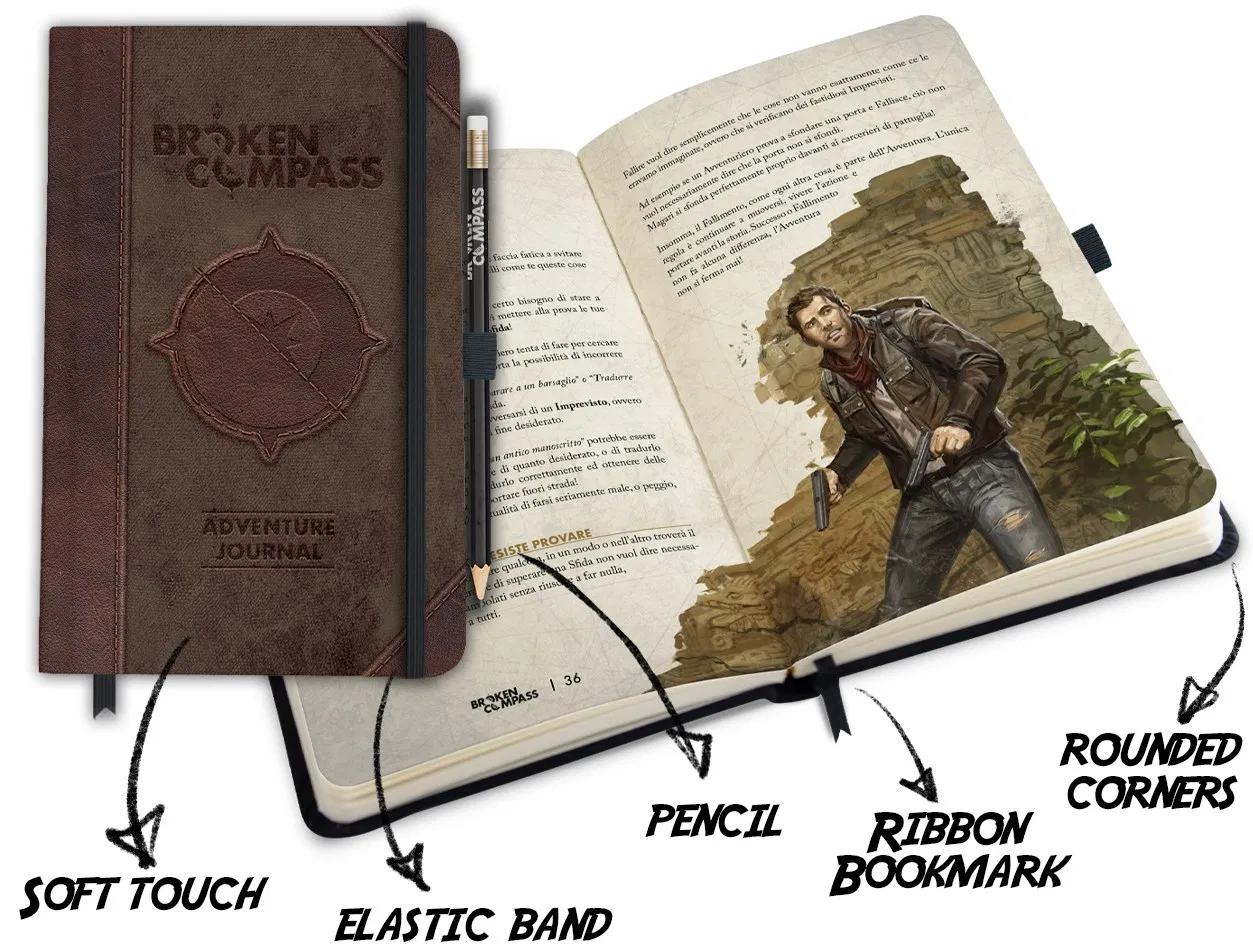
The physical product is superb! The core book or Adventure Journal features a classic pocket journal look: faux-leather with a proper stitch binding and heavy gloss paper in 9.5×6″ (the same size as the Fate books). The edges are curved, it’s got a bookmark ribbon, an elastic strap to hold it closed, and elastic pencil holder. It’s a brilliant bit of design. Internal layout is clear and simple, with a minimum of nonsense to distract. The art is good (although these days, with Free League and Wizards’ art design doing stunning work, this is good for most products out there) and the typeface and sizing is clear and easy to read. (The more I publish stuff, the more impressed i am by these things.) Here’s the example from Two Little Mice’s Kickstarter page:

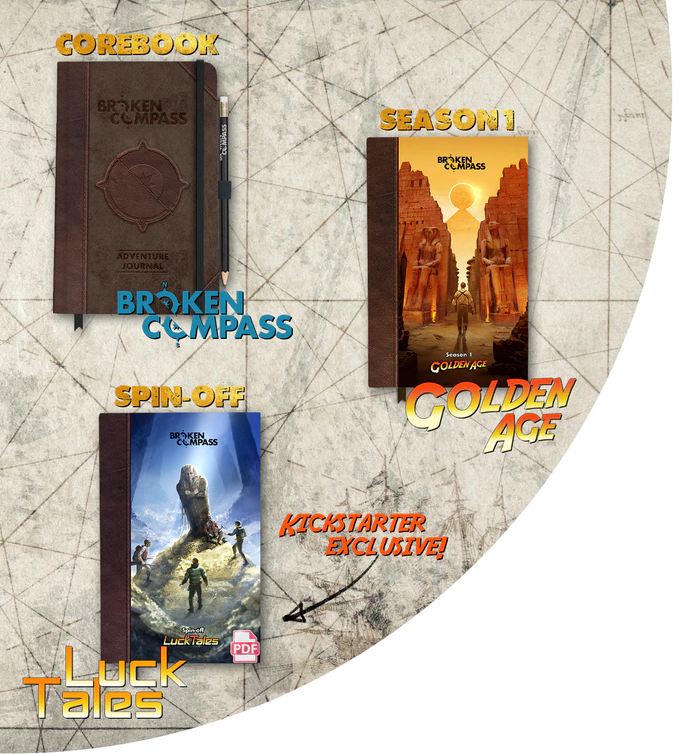
It came with a GM screen that is similarly sized: 9.5×6″/per panel, with a 4-panel spread on heavy cardboard with appropriate artwork on the player side, and most of the basic rules on the GM side. Again, clear, concise, and workable. I didn’t have to access the book more than twice during play. also included in my pledge was their First Season book Golden Age with some tweaks and canned adventures for the 1930s. A Spin Off: Luck Tales book similarly give a few new rules and adventures. There was a world map (circa 1999), a cloth bag of specialty dice, a plastic luck coin, and posters featuring the art from the book, as well as a Rival Passport (a listing of big bads for your game), an Adventurer Passport to record characters, and a selection of period postcards from exotic locales.

Two Little mice is currently running a Kickstarter for the next two “seasons” of the game — a pirate setting and a Victorian fantasy/steampunk setting, and the original books, GM screen, maps and dice with luck coin, and posters can be had with the right pledge.

So is it worth it? Absolutely. The physical materials are top-notch: the books are on good quality gloss paper, have a faux-leather cover, decent art with simple and clear layouts. The existing books can be had in PDF format on DriveThruRPG.com for $30 and $19.