I just wanted to post a thanks to Bill Armintrout and “The Miniatures Page” for pushing a bunch of traffic this way today.
October 2011
Monthly Archive
31 October, 2011
28 October, 2011
Well, after six months of fatherhood with little to no exercise, my blood pressure’s been hovering in the 150/100 range and I’m up to 191 lbs. as of yesterday. So today was my first day at the gym, swimming.
Despite the near total sedentary lifestyle, I did 10 laps in under 15 minutes with only two 1 minute breaks in a 25 yrd. (Olympic short length) pool. 350m or .21 mile. Not too shabby for just jumping back in.
28 October, 2011
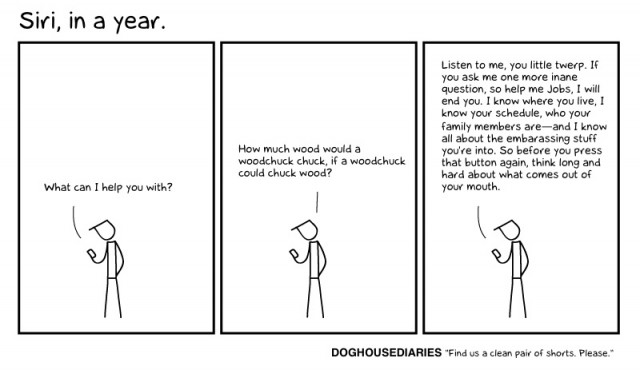
Find more at http://thedoghousediaries.com/
25 October, 2011
Mass Combat for Hollow Earth Expedition, Part 2
Posted by blackcampbell under Roleplaying Games | Tags: hollow earth expedition |[4] Comments
21 October, 2011
Mass Combat in Hollow Earth Expedition
Posted by blackcampbell under Roleplaying Games | Tags: hollow earth expedition |[4] Comments
During our game on Thursday, an interesting problem surfaced: The characters were attempting to raid an alleyway housing complex in 1936 Shanghai that was full of Indochinese gangsters of Hanoi Shan’s Silk Mountain Triad. There were roughly twenty “houses” with 3-4 floors, in a complex that had two entrances from the main thoroughfares on either side of the block. The road was tight, allowing only three men abreast, with no room for vehicles. they estimated the population at about 300-400 people, max.
The characters, led by one who is an Inspector in the Reserves (the SWAT of its day), has 100 officers and 20 Reserves. It was at this point I realized that Hollow Earth Expedition had no rules for mass combat that I could find quickly. (Now, I could be wrong, and if so would appreciate a comment to direct me to the pages in question…) So I had to wing it. But that led me to slap together some mass combat rules based on a few other systems out there.
First — how I did it. I assumed that no more than 20 or so could be engaging at a time as a means to keep the die rolling to a manageable level. Each side rolled 20 die, and each success was a man down/killed. It worked fine and allowed for a general idea of how the respective sides were doing, but completely ignored the influence of the commanding police officer (a PC), or the fact that the cops were all armed with Enfield #2 .303 rifles and a few had Thompsons. the bad guys were mostly rocking melee weapons, with a few having “box cannons” — the C96 Broomhandle in 7.63mm — and a couple of Mauser 98Ks. they should have been able to outmatch the numbers, save fo the tight spaces and defensive positioning of the bad guys, so I ignored any kind of mods for simplicity sake.
But I thought it removed the PC in the command position from really having an impact (the others were involved in a side operation that allowed me to simply run combat normally — 2 guys against a few dozen gangsters.
So…here’s my battle rules for HEX:
Figure out how many troops each side has and divide by 10. Use 10 of whatever you use for style point/chips/whatever to keep track; each is 10% of the respective force. Now compare the numbers. In the above scenario, only about a third of the people in the place were active triad members — it was about 200 guys vs. 125 cops. Round down that 2 to 1 odds, so the bad guys had a +1 advantage.
The two sides start with the Diplomacy/Leadership or Warfare skill of the commander. The side with the superior force adds that number to that dice pool (so the bad guys would have a +1 added to the “leader” of the gang (a senior mook, in this case) of 3. The lead cop had a Diplomacy of 4 and Warfare of 3 — I figure the Warfare can give him a synergy die to his DIplomacy…so a total of 5 to the bad guys’ 4.)
Now we add in some basic modifiers for the situation: superior weaponry +1, artillery or light cav support +2, air cover or tanks +4. Terrain: slight advantage (high ground) +1, entrenched or in defensible location +2, fortifications +4.
So the initial combat engagement would have given the cops a 6 (for the guns over melee weapons), but the triad 6 for the tight, easily defendible environment. Roll the dice. For each success, the force is reduced that number of markers (or that number x 10% of the force [in this case 10 cops or 20 gang members].) Works mostly the same, but gives the PCs, if they are in charge of troops, a chance to shine. You could break the forces up, as well — say each PC had had a section of 40 or so guys (4 guys/marker) and would get to roll for their men.
This makes it quickly scalable, and you can add in mods for senior commanders. Say they’re working for a general or other senior officer in a war time event. Each player is a company commander. The general or whoever rolls their Warfare or Leadership first (with mods if the GM wants to) and his successes add to the initial die pool — this represents the strategic position of the commanders and how it effects the tactical picture on the ground.
As the forces are diminished, you add the difference in survivors to the superior force. So if the initial police raid hammers the Triad with 3 successes (30% or 60 guys) and the cops only suffered 10 men or 10% losses, the next test, the police commander would have another +2 to his roll.
You could add in a morale test at the end of each move to see how the respective forces are holding up — a Leadership test vs. a target number equal to the number of markers lost. Example: the Triad got hammered on the initial assualt and the mook in charge needs to roll a Leadership test and get three successes to prevent a rout (and the police inspector one success.) The mook leader would roll three dice, the cop 6 (his Leadership of 4 plus the two markers more he has than the Triad boss.)
You could scale the combat for the number of troops, as well: for a “small” engagement like the one above, each combat round might be 1-5 minutes, but for a battalion level action, it could be 15 minutes, for a whole army an hour each round. Player characters could be doing their part or having specific combat scenes during these rounds.
It’s pretty easy and should allow the game not to get bogged down while allowing the players to influence the outcome of big battles, without having to resort to pre-determines outcomes.
19 October, 2011
Interesting Idea For Pick Up Games
Posted by blackcampbell under Roleplaying Games | Tags: gamemaster tips |Leave a Comment
It happens — one of your players who is integral to the plot that night doesn’t show up. Or you have a handful that are unreliable, or there’s a period of time that players get flaky on showing up (for us, it’s usually late summer when one that works in the movie industry is usually on set and another is doing the convention rounds; or it’s the holiday season.) So what do you do?
There’s the usual stuff — don’t play ’til you have the necessary folks for the adventure, have someone run/roll for the missing characters (this is my usual MO), play a board game or pick up game instead. One of the threads over at Gnome Stew had the idea of running a game or series of gmaes con-style — one shots that don’t require a lot of planning or character work.
Think of it as a sort of James Bond style game: You know the hero is going to be a certain way — we don’t have to delve into his weaknesses beyond the most basic — he’s a sucker for dames, his lovers don’t get past the end of the film, he’s relentless to bad guys. The Bond girls — there’s a femme fatale, one or two love interests that make themselves useful in some manner. There’s usually a local sidekick (Felix Leiter, Matthis, Tiger Tanaka, whoever…) The bad guys are fairy simple and have a nefarious plan. Come up with a few action sequences to string the exposition into. Go.
For the GM, think of it as writing a movie, rather than a series or series of books. There doesn’t have to be a lot of backstory, just enough to do the job. (Think Raiders of the Lost Ark — Indy’s really not a well-defined guy: he’s a cruise missile that goes after his prize without hesitation. He’s scared of snakes. He’s got a nemesis that usually bests him [Belloq]. He’s an eminent archeologist with friends all over the world to help him. He likes to use a whip and loves Marion. Done. Go.)
In this style, the GM writes up characters to fit the plot and has a basic notion of what’s going on. The James Bond system had a nice random mission generator in the For Your Eyes Only splatbook, and I’m sure other game genres have something similar. Keep it simple and keep it fast. One idea could be randomly giving characters to the players. I thought that using a system like Leverage or FATE where you could craft up archetypal characters for the genre and just let the players fill in the necessary bits of development on the fly might be conducive to this style of play.
Say, a fantasy game: You’ve got the main hero(ine) and their sidekick (a thief, usually, in the fantasy movies), and maybe the old wizard/sorceress to aid with esoteric knowledge exposition and handling magically stuff. Fill in the blanks — is the lead a bruiser like Red Sonja or Conan, a bit more trickster with animal friends like the Beastmaster, a wet-behind the ears but game for anything type like Perseus or Hercules? (Or Luke Skywalker, for that matter…)
Mix and match tropes, kill some stuff, a chase scene, big showdown with the bad guy that honked your team off for whatever reason…that’s a quick night or two’s play.
18 October, 2011
New Villain: Hanoi Shan
Posted by blackcampbell under Roleplaying Games | Tags: hollow earth expedition |Leave a Comment
Most of us know the name Hanoi Shan from quips in Buckaroo Banzai, but he was a character in the novels (allegedly based on real criminal cases) of H Ashton-Wolfe, a writer in the late 1920s/early 1930s. Hanoi Shan was based on the classic Yellow Peril villain Fu Manchu of Sax Rohmer, and only turned up in a handful of stories.
Coming up in our Shanghai-based Hollow Earth Expedition campaign is an encounter with the nefarious Hanoi Shan, who is based heavily on Ashton-Wolfe’s character, but with a liberal helping of Fu Manchu on top.
HANOI SHAN (aka An Loi Shan)
Thought to be, if not the head, then one of the leaders of the Silk Mountain Triad in French Indochina and southern China, Hanoi Shan was once a highly respected man of science. Indeed, this doctor and philosopher had trained at the Sorbonne and was a native colonial superintendent for the French in his native Annam, based in Hanoi. He is rumored to have always had shady connections with the triads, but after a hunting accident that had left him in a coma for months, Shan’s personality changed. He became bitter, angry, and a fervent anti-colonialist. (There are those that think he was always so, and that his support for insurgents in northern Indochina led the French to attempt to kill him…hence the “accident.”)
He is a master of chemistry and medical science, fusing the modern Western science with ancient Chinese philosophy and alchemy — the result is terrifying. While his gang members use guns, bombs, and the usual assortment of hand weapons to do their job, the Silk Mountain is most dangerous when Shan employs his scientific knowledge and deadly female assassins to poison his victims, be it to addle their minds or kill them altogether. Recently, he has gotten more and more ambitious, linking with other anti-colonial forces from the Kuomintang to the communists in preparation to open a new and vicious war on those that hold the East captive!
Shan is a tall, elegant gentleman who looks to be in his 50s — although his followers subscribe to the legend that he is muh, much older thanks to his alchemical knowledge. He is well-educated, stunningly intelligent, and terribly polite. He is rumored to have studied in Tibet hypnotism and has the power to cloud men’s minds. He dresses in fine Chinese attire, and usually has metal “claws” on his fingers (possibly poison delivering.)
Body: 2 Dexterity: 2 Strength: 2 Charisma: 3 Intelligence: 5 Willpower: 4
Size: 0 Move: 4 Perception: 9 Initiative: 7 Defense: 4 Stun: 4 Health: 6 Style: 4
Resources & Traits: Calculated Attack, Kung Fu (uses his knowledge of accupressure to use INT as base), Contacts 2: French colonial government, anti-colonial movements; Diehard, Intelligent, Iron Will, Psychic Ability (Cloaking); Rank 4 (Silk Mountain Triad); Skill Mastery, Academics & Science; Weird Science, Chemistry
Flaws: Criminal, Callous, Obsession
Languages: Vietnamese & French (native), Cantonese, English, German, Mandarin, Spanish, Tagalog, Tibetan
Skills: Academics 2/7, Athletics 2/4, Bureaucracy 2/7, Con 2/5, Craft, Chemistry 3/8, Diplomacy 2/5, Drive 2/4, Firearms 1/3, Gambling 1/6, Intimidation (Torture) 3/6, Investigation 1/6, Kung Fu 2/7, Linguistics 3/8, Medicine 3/8, Melee 2/4, Ride 1/3, Science 3/8, Stealth 2/4, Streetwise 2/5, Survival 1/6, Warfare 1/6
18 October, 2011
Hollow Earth Expedition: The Sky Rats
Posted by blackcampbell under Roleplaying Games | Tags: sky rats |1 Comment
For our Hollow Earth Expedition campaign, I decided to do some serious fan servicing in the creation of the “Sky Rats”, or the Foreign Volunteer Force aiding China against the Japanese. This is pre-Flying Tigers, mind you. It’s a hodge-podge of characters that work under the self-styled Colonel Trapp Sommers, a Clark Gable-esque American adventurer who is a bit rougharound the edges, but whose heart is in the right place; and Squadron Commander Joseph “Sky Captain” Sullivan — if you’ve seen the movie, you know who I mean.
Rounding out the FVF are a few characters from various movies and TV shows, as well as some homebrew ones (stats to follow…)
There’s LT Jake Cutter, former AA ball player recruited from his work flying for Pan Am and his drunken friend and mechanic Corky. And of course, his one-eyed dog, Jack. Rounding out the Sky Captain angle is Dexter Dearborn, the chief mechanic and tinkerer for the group, and the recently arrived in China Francesca “Frankie” Cooke, an adventuress fresh from India.
Other characters that haven’t been fleshed out yet include “Injun Joe” Malloy, a supposedly half Comanche, half Irish (really, all America mutt) warrior from Oklahoma (that much is true); Alan “Tommy” Gunn, a former RAF pilot who isn’t half the stick he brags of being; “Blackie” Washington, a black pilot from Mississippi who has been roaming the world flying and fighting for the underdog; Ling Wu, the first Chinese woman to fly combat missions (there was an actual female Chinese Air Force pilot about this time…) and — of course — karate ass-kicker.
18 October, 2011
My First Weekend With iOS 5
Posted by blackcampbell under Computers, Technology | Tags: ios 5, ipad 2 |Leave a Comment
Okay, I finally decided to take a chance and try to upgrade my iPad 2 to iOS 5 last week, after the disastrous first attempt. It finally went through, with no issues. So here’s what I’ve found: it’s a solid update, but it’s not going to change your life, bring you wealth and happiness, nor cause the stars to align and give us world peace, like most fanboys would have you think.
The bad: You don’t get Siri on the iPad. But then you’re not clogging the internet with useless questions to impress your friends with how Siri can do whatever. Also, iPhone users are seeing serious battery life issues thanks to iCloud synching, which drains your battery a whole hell of a lot faster than Flash ever did. One of the other culprits in this is the crap-laden Newstand app, which loads your machine up with publication specific apps (some were offered free — but not any issues…jus the app) which also ping the web regularly. You can’t delete newstand if you want to, nor hide it (easily) in a folder. It’s crap.
Also, if you have a first-generation iPad, it won’t do multitouch, as it will on iPad 2.
The good: You can use the dictionary function pretty much anywhere on the machine now. The notification center is nicer, less intrusive, but I’ve found mail doesn’t push to it particularly well. The iCloud synch for calendars and contacts is useful. I wouldn’t synch much else unless you want to have a machine that runs for 2 hours.
The really good: the Twitter integration is superb! Also, while it’s not really iOS specific, the Facebook app is near seamless. The ability to undock your keyboard and have it split for thumb use I thought would be useless — it’s not. It’s fantastically easy to type with.
The outstanding: Best of all, you’re off the iTunes synch if you dont’ want to. The iPad is now a stand-alone device. I tried wireless synching and while it takes a while, you can still use the device without issue. A top-notch improvement over the earlier iterations of iOS.
Since I run almost nothing through the iCLoud or iTunes wifi synch, I’ve had no battery issues, and have actually seen a slight improvement (I think) in battery life — about 1:10 hours/10% of battery. As said, I like the improvements to the keyboard, the wireless upgrades and synching, and find the device to be even more useful that before. I think my next experiment will be to see if I can type more comfortably over time with it that I could before. I find trying to do long manuscript work with the iPad can get tedious, and still prefer a physical keyboard.
18 October, 2011
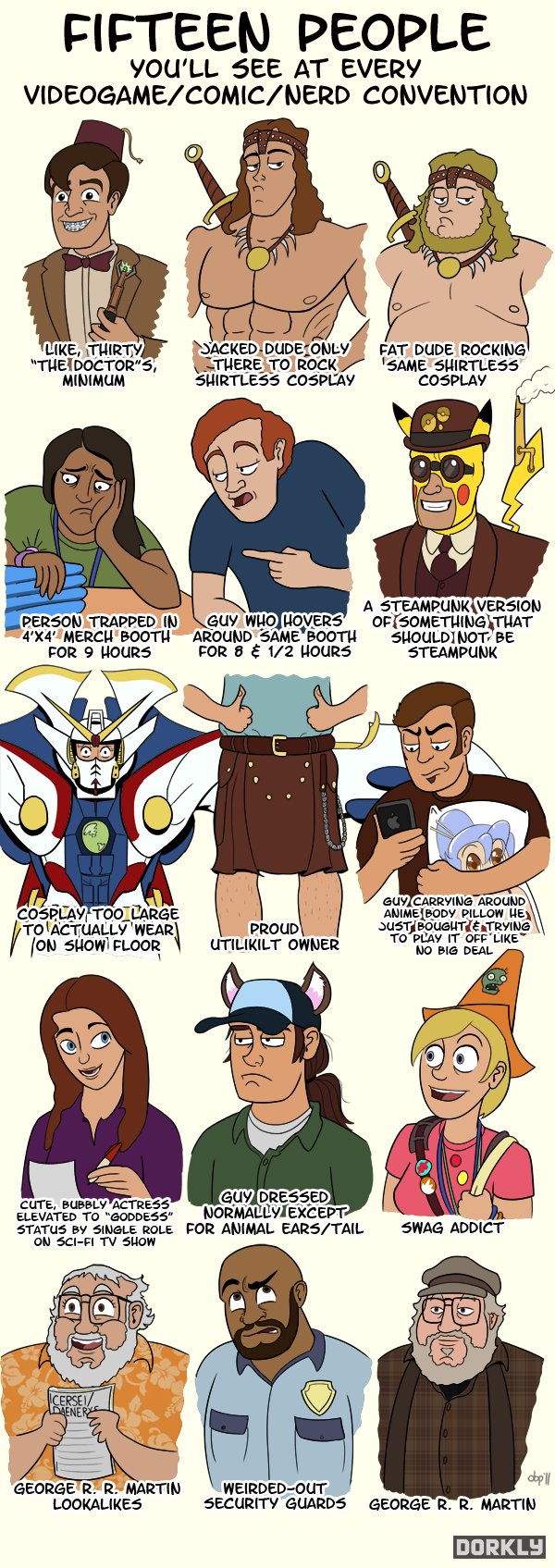
15 Types You’ll See At Every Convention
Posted by blackcampbell under Life UnconstructedLeave a Comment
 The Black Campbell