I bought one of the Tisas Service 1911s a few months back so I had a .45 I could use for our idiotic CCW setup here in New Mexico. Here, you qualify with the “largest caliber” you might carry in revolver and auto. I use my old 1917 issue Webley Mk VII for the revolver, but had to borrow a .45 auto to qualify every two years. The Tisas was ludicrously cheap, I had the cash, so boom — bought one. Other than feed issues that turned out to be a bad magazine, it ran flawlessly.
So imagine my delight when I found out Tisas was doing a commander-sized, bobtail 1911 in 10mm — God’s own caliber. I’ve been a 10mm fan through the drought of 10mm love in the ’90s after the FBI agents couldn’t shoot it, so they moved to .40S&W. I had an original Glock 20, but the grip angle on Glocks is (for me) awful. I’ve had the Tanfoglio — a pistol that was much maligned until people actually shot it, and now you can’t touch them for a reasonable price. I have a Kimber Camp Guard (which I carry on trips into the woods, etc.) and a Chiappa Rhino DS40 that went to Aria Ballistics to bore the cylinder out to 10mm. So a carry-sized 10mm? Yes, please.
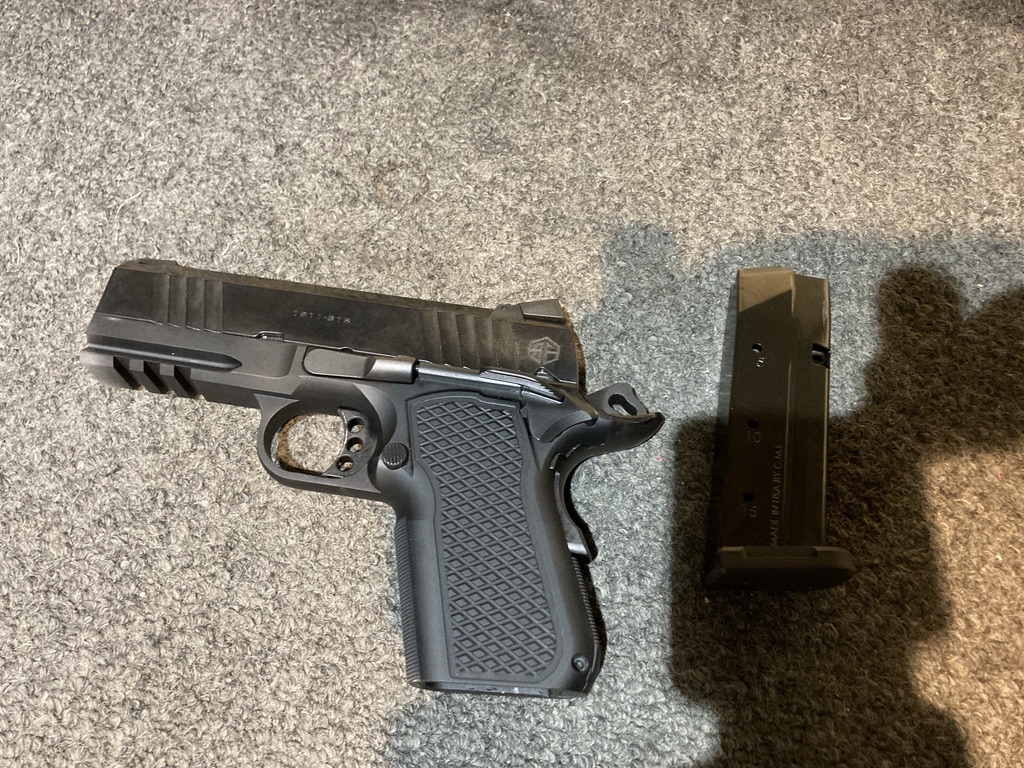
I’d seen the 9mm version of the Yukon in the local gun store, and it was superb. The 10mm is also top-notch quality. It’s a Series 70, and the fit and finish are on par with early Kimber — when they were excellent. Solid lockup on the barrel, fully supported barrel. No MIM parts, save the safety levers. Oh, yes — ambi safety standard. Thank you, Tisas; you’ve outdone most 1911 manufacturers, already. It’s got a gray Cerakote forgerd carbon steel frame and black forged carbon steel slide. The grips are G10 “sunburst” texture in gray. The slide stop and safety levers are black and complement the gray frame. The trigger and hammer are skeletonized and there’s a good beavertail. 25lpi texturing front and back on the grip, and an Ed Brown style bobtail.
It comes with an excellent hard case, cleaning rod and brush, bushing wrench (that you don’t need — it’s a standard spring cap set up), and two magazines — again, beating most of the other manufacturers there.
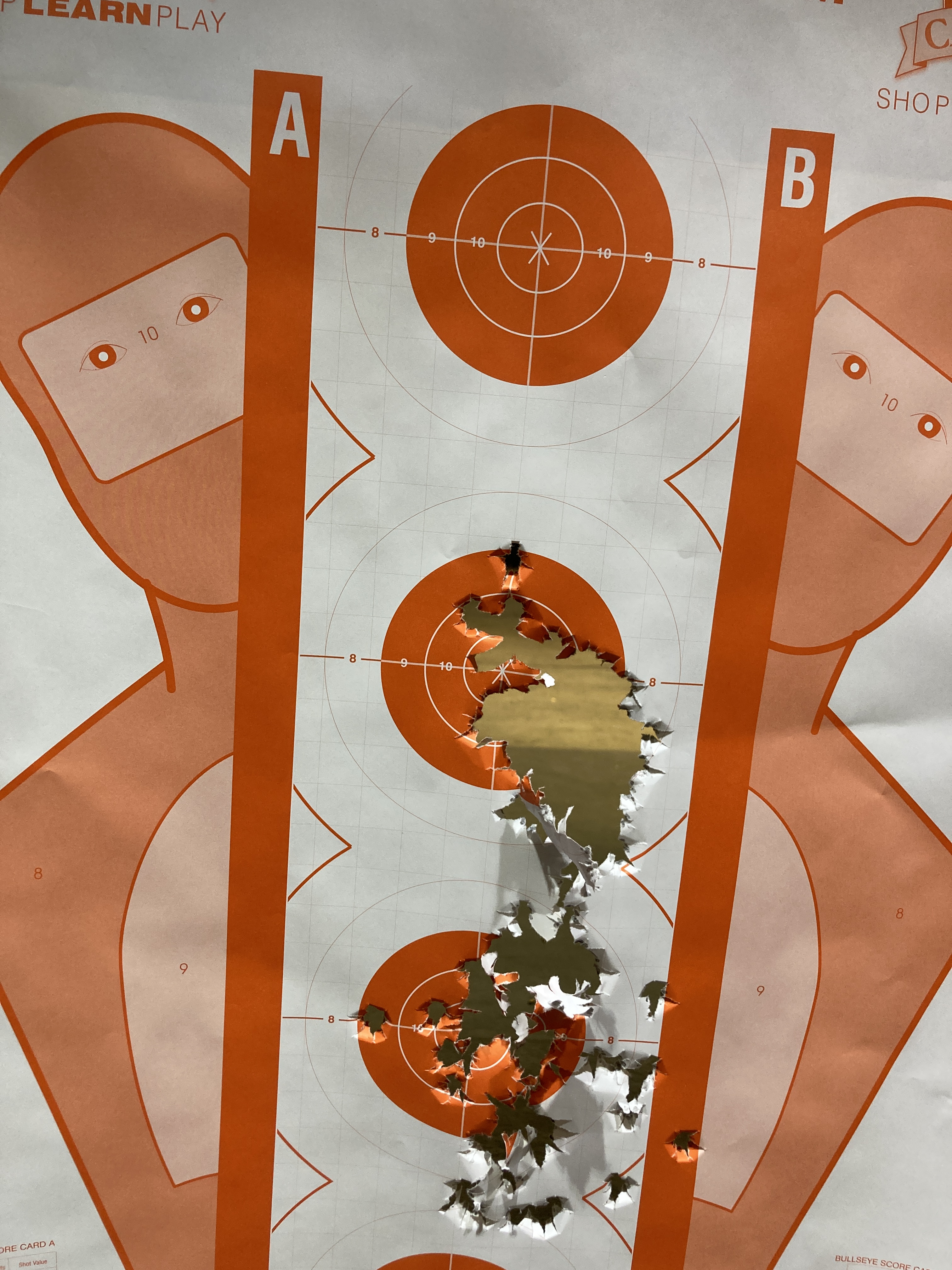
So how’s it shoot? Wonderfully. It’s accurate and presents as a 1911 should: very well. The U-notch rear and fiber optic front sight work well and allow fast acquisition. The recoil…is stout. Compared side by side with my Camp Guard — a standard Government model size — the Camp Guard soaked up the hottest rounds (155 grain, 1650fps) and was mostly comfortable to shoot and quick to do follow up shots. The Yukon has more muzzle flip than most 10s do, and the recoil is not uncontrollable, but it does take some wrestling to keep it on target for follow up shots and was slower to do so. Still, Mozambique drills allowed two in the 9 ring and a center head out to 10 yards with reliability. I did note, however, the safety on the right side of the frame was cutting up my thumb prettily after 50 rounds.
We ran 250 rounds of various loads — 135 grain frangibles that were more the short & weak style, 180 grain Blazer, the 155 grain Texas feral pig killer ammo. No malfunctions other than a few failures to go fully into battery that were definitely the operator getting tired (and bleeding all over the size of the pistol from his thumb). Weak on the locking rings and the slide rails was about what you would expect for a trip out like this. There was some.
Accuracy was top-notch, function was nearly flawless — and the flaws I suspect were me — and the fit, finish, and quality of manufacturer are as good as anything Colt, Springfield, or Kimber are putting out. At $720 before tax and shipping, is it worth it? Unequivocally, yes.
I tried one of these a few months back at the shooting range and was seriously impressed. Considering I had recently stumbled across my (then) new favorite pistol, the Springfield Armory Prodigy in the 4.25″ barrel, it was no small feat. I knocked out a “first impressions” post that still holds true. So, yeah, I bought one. Right up front — is it worth it? Every penny.
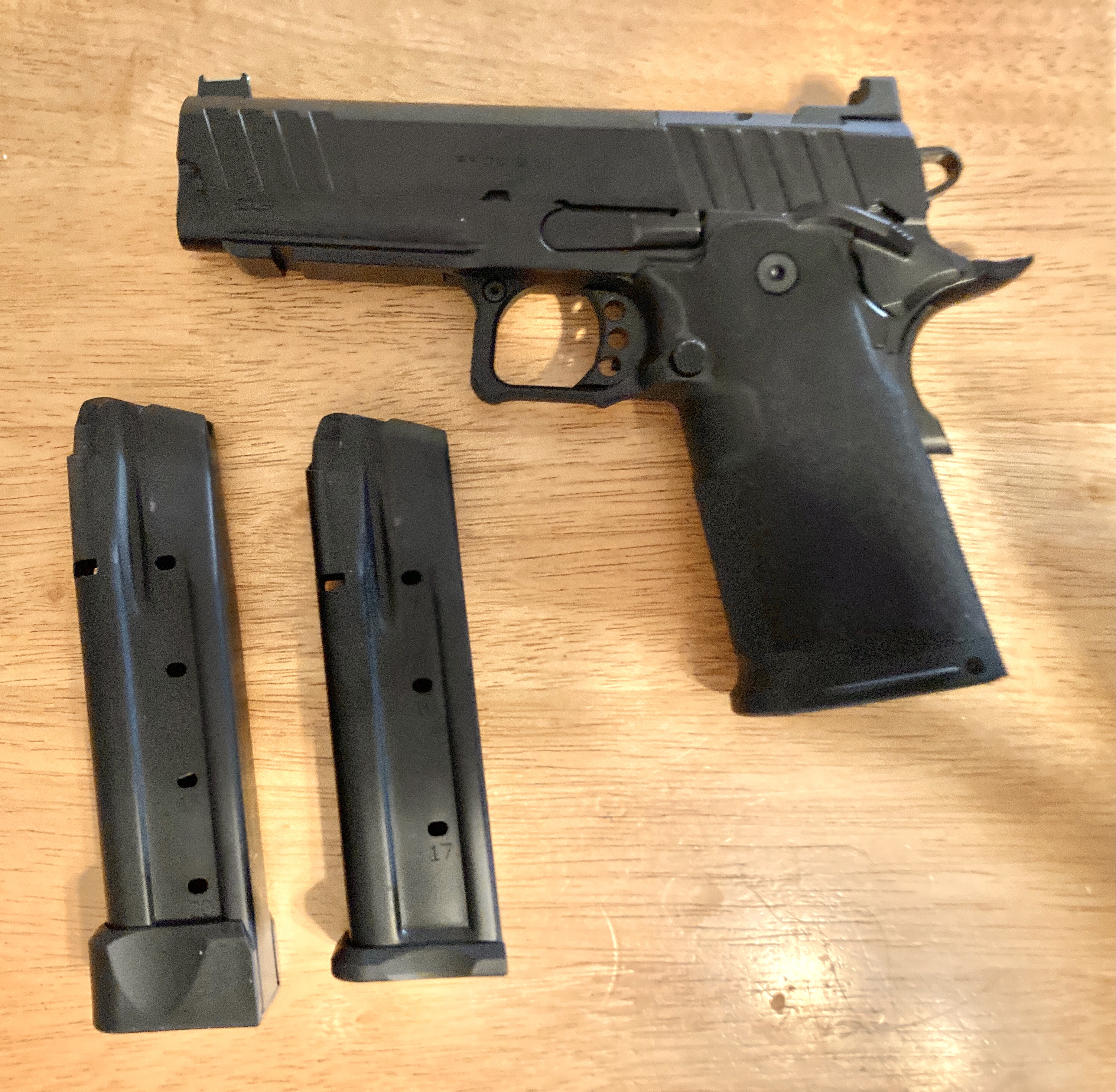
The S15 is an officer’s size 1911 that uses the Glock 48X magazine…so it takes the Shield Arms 15-round 9mm magazines for the same. The magazine that came with the gun was flawless. The three I bought later required a few trips to the range before you could squeeze the fifteenth round in. That said, there were no failures to feed.
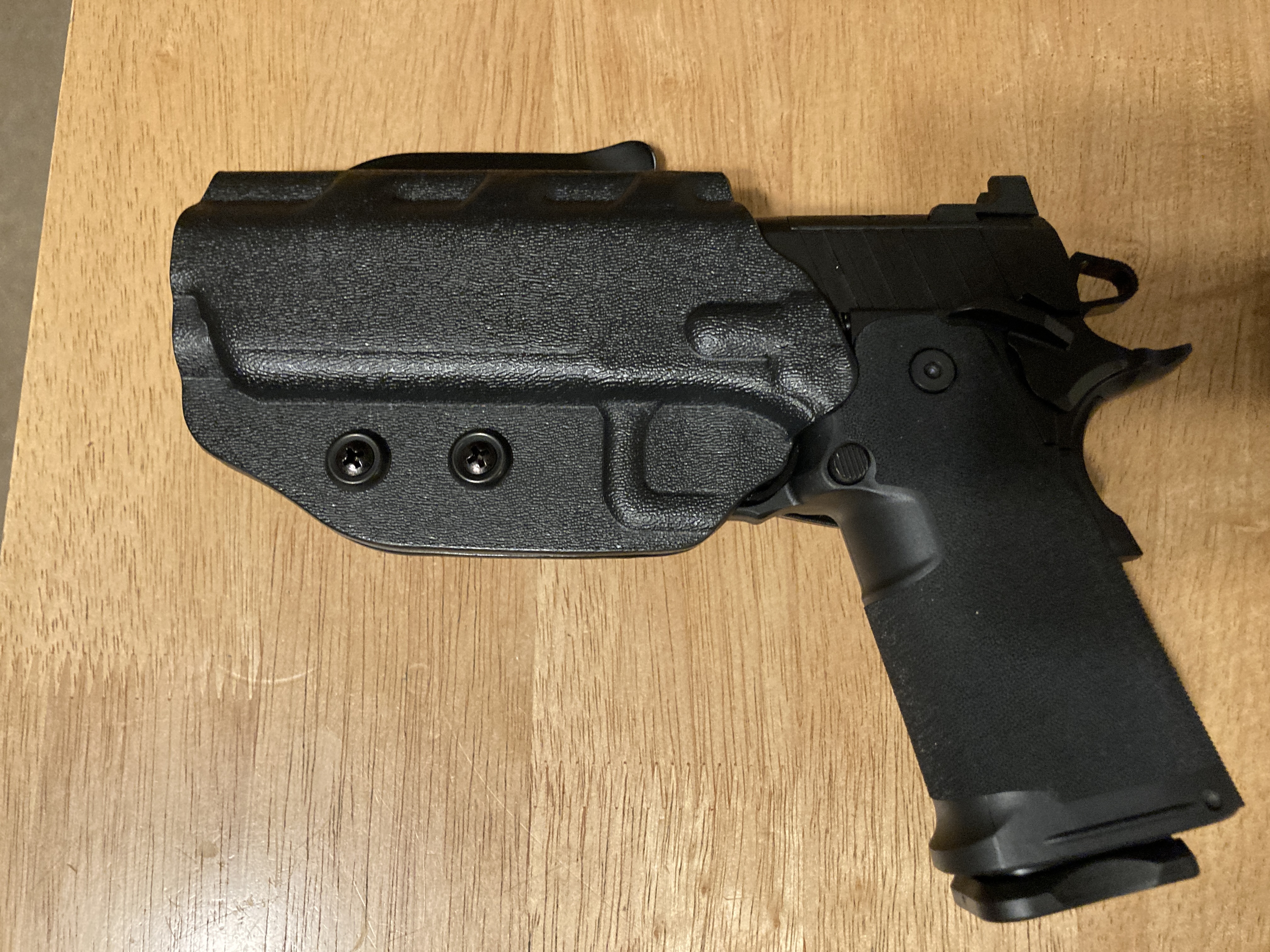
The pistol has a DLC (diamond-like coating) finish that is tough and stands up to abrasion extremely well. At about the 1500 round count, now, the pitol is showing some wear on the finish at the locking rings on the slide…but that’s it. The bull barrel is crowned and also finished in the same DLC (diamond-like carbon) coating the slide has. The finish is still very much intact. It’s glassy and very black, and looks good against the aluminum frame. It does love to hang onto fingerprints, however. I’ve been carrying it in a Galco Stow-N-Go IWB holster I had bought for the Springfield Prodigy, and at 28.5 oz. it’s a little heavier than the Colt Defender.
The pistol shoots incredibly well for me. My buddy that hits the range regularly with me is a Glock fanboi, so he has to work a bit on his aim due to the grip angle. I find it presents better than anything I’ve shot to date when drawn from the holster. The flat top of the slide is serrated to cut down on glare, but I find it also helps me shoot like a I used to years ago — no sights, point shooting where I simply use perspective to “run a road” from the flat top to the target. It’s fast and accurate (for me.) When taking time to use the sights — which are good, in the Novak style — this is one of the few pistols I used the trendy thumbs forward grip everyone seems to teach these days. One handed, two-handed, off-handed…the thing hits where I point with tight groups out to 15 yards with on issues. Beyond that, I’ve got to work a bit for sub-3″ groups. Old eyes.
The recoil is mild and the slide action is fast. Follow up shots are easy and smooth.
The grip is molded in aluminum with the grip panels part of the frame; there’s no changing grips, but it does allow the pistol to be incredibly thin at a hair over an inch wide. I’m finding it drops into the hand and presents like it’s part of me. Your mileage may vary. It’s got the usual higher end do-dads — beavertail, memory pad on the grip safety, skeletonized hammer and trigger. The trigger is excellent. It started off mid-line 1911 good but has smoothed out to a nice 4 lbs. with a hair of takeup before the wall and a crisp release. The reset is short and audible.
Now the negatives: It’s not cut for an optic. I don’t like them so this doesn’t bother me. It might you. Supposedly Alpha Foxtrot will be offering models cut for optics. It’s go no ambidextrous safety. As a lefty, this is annoying, although I find drawing and cocking the pistol is very easy while presenting. That said, even Tisas and Girsan are offering pretty everything but the bone-stock GI 1911s with ambi safeties. It’s a third or so of the market…economies of scale guys.
After 1500 rounds or so, there’s been one failure to go into battery. It never reoccured so I’m putting that down to operator error. No failures to eject, extract, feed, or otherwise function with absolute perfection. It is the single best handgun I’ve owned.
I bough the the 4.25″ Prodigy at the start of the year (2023) and I’ve been running it steadily every since. It’s relatively lightweight — a similar weight to the Springfiend Hi-Power clone — small enough to conceal without much effort, and it is utterly spectacular for accuracy. The complaints about needing a better flared magwell I think are overwrought; I’ve never had an issue with a magazine change. If there’s anything, it’s the plate/ rear sight assembly gets a bit loose after a few hundred rounds and needs tightened. I may just Loc-Tite it. I’m not planning on running an optic.
If I had one gripe — and it’s a small one — I would like to have had a flat strap to the slide. Over the years, I used a lot of pistols with a flat top and it made perspective shooting (using the flat to “run a road” to the target) quick and accurate without needing to use the sights save for more precise shooting. It’s why the Walther PPK suits me so well, why I love my Kimber Camp Guard and can shoot them quickly and with minute of bad guy accuracy while moving.
Reliability at 2000 rounds is this: one failure to go into battery, but that might have been me limp-wristing it while shooting one-handed. Even if it wasn’t, that’s a 0.05% fail rate. That’s completely acceptable for a self-defense handgun. Here’s the wear so far for 2000 rounds: pretty standard wear along the barrel sides and top where it impacts with the muzzle opening on the slide. Minimal wear on the locking lugs on the slide — this is better than most handguns I’ve seen at this round count. Wear on the rails and the top of the lower frame is well within what I would expect. The outer finish is still pristine, ever with holster use.
I know some folks had trouble with the initial run of the Prodigy — especially the 5″ version, but my experience with the commander-length has been just shy of flawless. For $1400 or so, it’s definitely worth it.
First, the backstory: Here in New Mexico, our concealed carry requirements are a bit mental. It’s obvious that the people that wrote them don’t know a ton about guns and how they work. There’s a qualification that needs to be done every two years, but the renewal is every four. Mostly, this is to make the instructors money, although I’ll admit maybe shooting your firearm once every two years is a real minimum. (In the military and police, quals were once a year…that seemed, even then, a bit long of an interval.) Oh, you do this at seven yards. You can practically hit someone with the weapon itself at seven yards. The real issue, however, is in addition to having to qualify for a revolver and semi-auto separately (okay — the manual of arms is different enough that basic handling might be an issue for some; but they’re still a point and click interface) and in the “largest caliber you plan to carry”. They’re looking at the number. Not if, say, 10mm is a whole lot more recoil than .45ACP, or .357 magnum is a bit more tricky to use for some than .38 special — no. Number big — that’s important. So that means that while I prefer a 10mm to most cartridges, I have to qualify with a .45 to basically carry whatever the hell I want.
Well, I guess technically I should be doing that with .50 calibers, but no.
That means once every two years I have to dust off my .455 Webley and borrow a .45ACP from someone. It’s stupid. I decided I’d rather have a cheap .45 I could make good enough hits at spitting range. In the local gun store, the excellent Right to Bear Arms, they had a few .45s. I’d been dickering about over buying one all summer, so far. There was a used Springfield Armory XD9 for about $400, then there was a no-name Turkish 1911 for about the same.
Enter the Tisas 1911A1 Service pistol. This is a seriously no-frills pistol. Old-school Colt Series 70 with no ambi-safety, a GI hammer and tang. No memory ledge on the mainspring grip safety. No real sights — they’re black, they’re small, but they work. The frame and slide forged carbon steel with a really good Cerakote finish in “basic black, sans pearls”; the barrel is cold hammer forged and bright silver. There’s no full-length guide rod nonsense here. Just the old style spring cap fitted into a bushing. It comes with two 8-round magazines, which puts Tisas way ahead of most stingy 1911 manufacturers, where you get one magazine and shut the hell up. Black plastic grips finish the package, though I’m tempted to throw a few shekels Tisas’ way for the wood grips with the US emblazoned on them.
In the shop the trigger was 1911 good, but not top of the line 1911 good; so better than most other pistols out of the box. It breaks at about 5 lbs but feels lighter, has a bit of takeup to the wall, and a crisp release. The reset is short and audible. You can feel a bit of movement in the grip safety as the mainspring moves, but I’ve felt that in high end guns, as well. Not a deal breaker. The slide runs smoothly and it’s sprung tightly. The hammer felt like it was scraping a bit against the frame, but there’s no indications of wear. I snapped it up today and headed out to the range with 100 rounds of Blazer Brass in 230 grain. No cleaning. No oiling. Let’s see how this POS fares.
Out of the box, without any of the usual care I would give a pistol before it’s first time out, I had four failures to go into battery; the shell just hung up a bit going into the pipe. It only happened on one of the magazines, and did not occur on the second. At 10 yards, I did the bottom group with the first box of ammunition. The initial right and low was due to my grip which was a bit off from shooting the Prodigy. A slight wriggle on the grip and most of it was in the orange. The upper group was the second box, with a bit of trailing down in the last magazine or two. That’s pretty good for a $400 Turkish pistol.
Even better, after getting it home and cleaning the thing, the finish in the high abrasion areas was completely unblemished save for the usual spots on the firing pin block. The Cerakote held up along the slide rails and the locking lugs; something a lot of pistols don’t pull off in a similar round count. (I seriously think the coating is better than on my Kimber Camp Guard, which at 2000 rounds is showing it’s age.) Function was smooth, save for the sense the hammer is still scraping a bit, but I’m not seeing indications of it. I may just be looking for something to bitch about.
The Tisas 1911 is imported by SDS out of Tennessee, which also handles Spandau and Tokarev. Allegedly, their own engineers go out to the plant in Turkey to oversee some of the development. I’ve heard rumors that Girsan and Tisas basically come off the same lines, but I don’t know if that’s true. In addition to coming with an extra magazine (and well done, Tisas!), the 1911 comes with a pretty nice hard case, the usual owners manual and other “by stuff” paperwork, a patch rod and brush, a bushing tool and a good trigger lock. It’s actually a solidly good presentation for a surprisingly good pistol.
The next outing, now that it’s been treated properly, we’ll see how it does and I’ll append this post. But for now: is it worth it? For the price, you cannot beat this. It’s a solid 1911 and as good as most I had in the 1990s for about the same price as in the 1990s. When a comparable Rock Island or badly finished Springfield GI is $650ish, the Tisas is better finished and in the ballpark on build quality and accuracy. Do it.
(Update: With a cleaning and decent lube job, the Tisas functioned flawlessly the second time out. Accuracy was excellent for a cheap-ass pistol with the old, barely-there sights; and good for a 1911…meaning better than a lot of the polymer framed guns out there. All of my issues were due to the extra magazine. I didn’t use it, and that seemed to mitigate the issues. I suspect I could have just shot it dirty with that magazine only and had the same results. The wear on the finish, again, is very, very minimal. I’m truly impressed with the Ceracoting on the gun. With a decent magazine, this is easily an acceptable carry weapon, if you don’t mind a full-size service pistol. With this second run, I have to redouble my recommendation: at $400, you cannot beat this if you’re looking for an entry 1911.)
My trend of buying guns this past year concluded with one of the best purchases I’ve made in 30 some years of shooting. If I had to pick the “best” pistol I’ve owned prior to this, it would be a tie between the Fort Smith Walther PPK and my 1917-issued Webley MkVI revolver. I spotted one of these before they became a big thing in the gun mags (by about a week) in my local gun store and after playing with it, plunked down money I really didn’t want to spend. I like the idea of a double-stack 1911. I’d shot a friend’s Para-Ordinance back in the 1990s and it had run like a dream with little recoil and solid accuracy, but it was heavy. I’d been thinking of a Rock Island 10mm double stack for a while — it’s hard to beat that price and RAI 1911s have never given me an issue.
I bought the commander-length 4.25″ Prodigy and got it for a hair under MSRP, and mitigated some of the price with a trade. At $1400, it’s the most expensive pistol I’ve bought (though the Chiappa modified for 10mm gets close.) Fit and finish are great. It’s a nice deep black, silky-smooth Ceracote finished with minimal lettering on the slide — Springfield Armory on one side, Prodigy on the other; there’s also a DS on the frame near the nose. The pistol uses a unique method to cut the weight and make the pistol incredibly thin for a double-stack 1911 (or 2011, os there, STI!) The frame is steel, but the grip is polymer and shifts the weight, even when loaded, to the front of the pistol. It’s just a hair heavier than my SA-35 with 17 rounds in it.
The design makes for a very controllable handgun with muzzle flip practically eliminated. The trigger is better than most stock 1911s and was pretty damned close to the weight and smoothness of the Staccato P I shot a few months back. The trigger breaks at 5 lbs., with no take-up, and nice crisp wall, and a solid, audible reset you can feel. The Prodigy features an ambi-safety — a must for a 1911 with a upswept beavertail, if you are a leftie. I’ve shot enough 1911s that using my trigger finger to pop the magazine and hit the slide stop is second nature, but an ambi safety is a must. The magazines that came with it are a 17 and a 20-round each, but 26-round extended magazines let you compete or play at being John Wick. The pistol will use Staccato magazines, supposedly. The 17 round is “flush”, which is bullshit — it hangs a quarter inch or so belong the magwell. I wouldn’t mind a 15 round that’s actually flush and would make carrying the Prodigy a bit easier.
The trigger guard is squared and undercut near the magazine release, and there are no finger grooves (which I hate!). The grip texture is tremendous. It’s subtle yet really sticks to the hand or glove, without tearing your hand up. Springfield calls it the “adaptive grip texture” and they use it on the Hellcat. It’s simply the best grip texture I’ve held on a pistol. After over a thousand rounds, the grip screws have not backed out. I kind of want it on my Walther PPQ.
Another “big deal” is the slide is cut for an optic. I have not joined the red dot brigade. i understand why some like them, but I haven’t found them to be any faster than iron sights. Your mileage may vary. The cut and plate system was developed i with Agency Arms, and the Prodigy uses their Agency Optic System (AOS) plates. The AOS plates have an integrated rear sight for the best possible sight picture. Each pistol comes with one AOS plate and a cover that also includes an integrated rear sight. You can order sights for other systems from Springfield. The cover/rear sight managed to back out it’s screws a bit after 1000 rounds and needs a torx wrench to tighten…which the pistol doesn’t come with. It’s got the AOS plate and cover, it’s god the hex wrenches for the grip module and the spring guide rod, but not the cover. Boo, Springfield.
The sights! Mine has a green fiber-optic front and a U-notch rear. It’s very quick to pick up and shoot with accuracy. At 20 yards, unsupported, I was getting 2-3″ groups with no work at all. I found it really likes a 6 o’clock hold; I hit consistently a bit high with it, but when drawing and reflex shooting it’s drilling right where I want.
Central to the pistol is the bushingless bull barrel. The guide rod for the main spring is a two-piece, and after a few hundred rounds has a tendency to work its way a little loose. A swap to a single guide rod is probably a good idea. That’s my only real complaint with the pistol and a quick aftermarket fix. (Or I just thumb tighten the thing every once in a while.) The recoil spring feels a bit light to me, and apparently there have been a few issues with the 5″ version binding up a bit, but I’ve had zero malfunctions in 1000+ rounds put through this Prodigy. I suspect the 5″ guns ship with the Hex red dot and that probably slows the cycle and causes some issues.
I spent a couple of weeks shooting it side-by-side with the SA-35, which is a great shooting pistol. The Prodigy has less recoil and better accuracy (and didn’t have teething issues like the SA-35)…it’s just a superlative weapon for about half the price of a Staccato. Side-by-side with my Walther PPQ, one of the best shooting polymer 9mms with a superb trigger — the Prodigy is heavy, but it’s much more controllable and accurate.
If you’re coming away with the impression I like this weapon, you’re wrong. This is easily my favorite 9mm handgun. Better than my beloved PPQ or the equally good CZ P10C. Better than my long-time favorite, the CZ-85 or the SA-35. Better than the superb Kimber Camp Guard 1911 in 10mm. (Man! A 10mm Prodigy…please!) It’s good enough I’m willing to put up with the weight and carry it, if I’m not rocking the little PPK.
I was able to get a DeSantis Pegasus (the Cazzuto) kydex holster for it with no issues. It’s an excellent holster with a paddle that’s not too wide — as many are — and pretty minimalist. Tension screws adjust the tightness, but after jumping up and down with it on, the pistol stayed put. It is adjustable for cant. The cut is for a 5″ 1911, so I might have to dremel that down a bit, but the pistol rides well, with the weight firmly in the body of the holster, not at the grip where it can try to bend outwards, and though it pokes out a bit (see my comment on a real “flush” magazine), it conceals well under a coat.
Man, do I want one of these in 10mm.
In the box is the pistol, a zip bag with two allen wrenches and the optic plate (but not a torx wrench), a 17 and 20 round magazine, and the usual cloth Springfield pistol case that can carry the pistol and two extra magazines. There’s the usual paperwork and guide book, and the government-mandated trigger lock.
So is it worth it? $1400 is a lot of dosh to throw around, and it’s cost another $100 or so to pick up a few 17 round mags if you’re thinking of carry the Prodigy. If you are a competition shooting, it’s definitely worth a look, especially priced against it’s competition (with the exception of the double stack Rock Islands — don’t make that face; they work.) To carry? It’s more expensive, and a bit bigger and heavier than many (and probably better) choices like the Hellcat, Shield, Glock 19 or P10C, but it’s still smaller in the 4.25″ than a Glock 17. For a bedside gun, especially if you have old eyes and want a red dot? This is a damned good choice. It really comes down to budget. If you can afford a grand and a half for a pistol, and you want an excellent weapon, do it. If you’re budget driven, not so much.
Update: I’ve got about 1500 rounds through the Prodigy now and have had one failure to feed that was quickly clear with a mag drop, then a quick slap and rack. It’s still the most accurate pistol I own and I have been carrying it. It’s a hair smaller than the SA-35, about the same weight, and utterly reliable. As to my desire for a Prodigy in 10mm? Girsan is bringing out a Witness2311 — 4.25″ barrel, 15 rounds of 10mm in a polymer-grip double stack 1911. Yes, please.
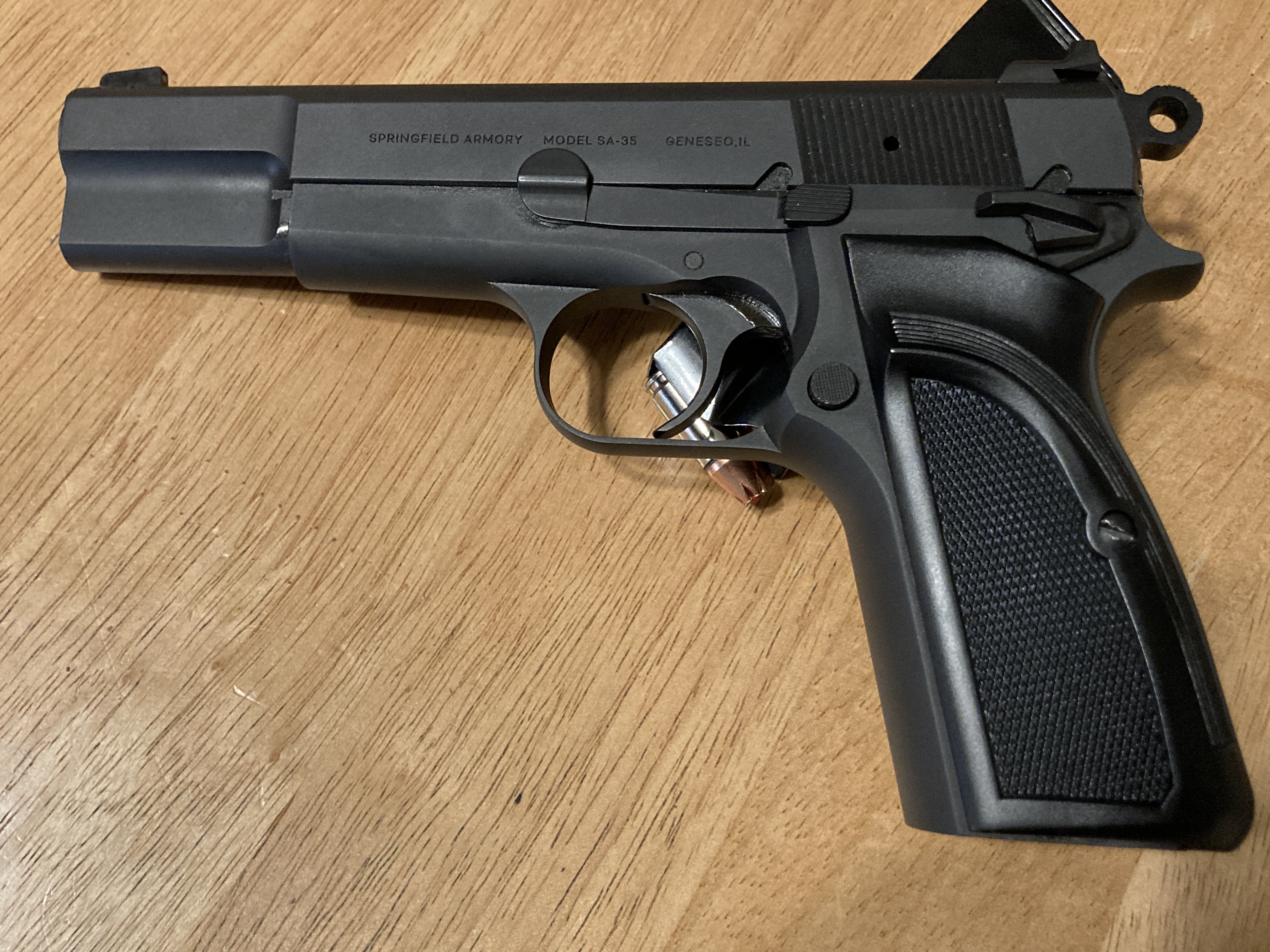
This past year, I made a couple of impulse buys when it came to weapons: a Kel-Tec KS7 and an RDB, a Walther WMP pistol, and the Springfield Armory SA-35, their copy of the venerable Browning Hi-Power. I did a review when I first had the pistol and at that point, it was headed back to the factory for warranty work. The pistol was returned in fairly quick time by Springfield, which — other than their propensity for not answering emails — did a sterling job with their customer service. After a few weeks, I had the SA-35 (which I continue to call “the Hi-Power” or occasionally “the Browning”) back in my grubby paws.
The warranty receipt seems to confirm a few of my suspicions: 1) they followed the Browning extractor design too closely, 2) they hadn’t nailed down the tooling for the same, and 3) there was some kind of head space issue that made extraction a problem. they had replaced the already replaced extractor, but had also cleaned and refinished the extractor channel. Most tellingly, and this seems to be a pretty standard thing from the online forums and the Facebook groups, they replaced the barrel. With it back, the main goal now was to beat the living hell out of it and see if it would fail. After a good cleaning, I took it out for a 350 round trip to the local outside range. No issues of any kind. Over the next few months, I poured about 1000 rounds through the SA-35 using every kind of ammo I could from the el-cheapo Blazer aluminum cased 115 grain to SIG-Sauer V-Crowns, Underwood Xtreme Penetrators in 115 gain to Norma range ammo in 124 grain and a box of 149 grain American Eagle.
The results: It ate just about everything without fail, save for the Blazer, which likes to stovepipe, but is clear with a quick swipe of the casing out of the port. One trip, it really didn’t like the American Gunner 115 grain XTP rounds and would fail to feed; another, no issues. Outside of that, no malfunctions. Overall, the failure rate was about 0.8%. One test this winter saw me toss the thing in the snow and mud and shoot it without issue. At that point, I decided it was reliable enough to get constitutionally “borne”, when I’m not carrying the newer Fort Smith Walther PPK (which has not failed — period.)
One thing I have noted is that the redesigned hammer that is supposed to stop hammer bite does nothing of the sort if you’re shooting the SA-35 with a high grip. I get whacked in the web of the hand consistently. I also find that the SA-35 shoots low and right (I’m a lefty) and really requires some work with the angle of eye to sight to get right…but weirdly, just drawing and reflex shooting: spot on. So I threw out the new school, thumbs-forward bullshit and started experimenting with different holds. After 30+ years of shooting for work and pleasure, I’ve found every type of pistol wants to be held differently. I started doing holster drills to see why I was true without aiming and with one-handed, but not with a “proper” grip. My hand, I found, was gripping with just a bit of space below the tang, every time.
The Hi-Power was designed when people were smaller, with smaller mits. They also shot one handed, for the most part, and this means you’re holding the pistol differently from how modern polymer and striker pistols want to be held. Shifting the grip just a hair lower, with the off-hand at a 4-5 o’clock position (again, leftie), the SA-35 was hitting true. To encourage the old-school grip, I ditched the nice walnut grips and got a set of the old plastic Browning grips with the sloped thumb ledge. The ledge not only gives your thumb a place to rest, but helped with the grip I found was working for me. It also makes it look a bit more “authentic”.
So — for a new review. The Springfield Armory SA-35 is an excellent knock-off of the Browning Hi-Power with a few features that make it easy to recommend, as later serial numbers seem to having fewer of the teething issues of the earlier models (mine is a 5000 range pistol.) The sights are good, with a front post featuring a white dot and a rear U-notch sight that is flat black. It’s very easy to get a sight picture and go. The elimination of the magazine safety is probably the most remarked change and it is an excellent one. The out-of-the-box trigger is about 5 lbs. and crisp with just a hair of take-up. It’s easily on part with most 1911s. After a grand through the pistol, the trigger is incredibly smooth with a reset that is barely audible. For those who are used to resets you can hear, this can be a bit of a pill; from time to time, I’ve gone to fire a second round and realized I hadn’t backed off the trigger enough. The grip angle, and the thinness of the grip is a plus for smaller hands. The interchangeability of parts with older Browning and aftermarket Hi-Powers is a definite advantage.
Takedown is the typical Hi-Power: Lock the slide with the safety, pop out the slide stop, take off the safety and ease the slide off, take out the spring and guide rod, then the barrel. Done. Reverse it to put it back together. After over a thousand rounds, the SA-35 is showing little wear in the slide/frame rails, a bit more on the top of the frame where the slide rides. It’s on par with most handguns with the number of shots through it.
The downsides: Possible issues with the extractor or barrel. There’s no texture on the front or back strap and bigger hands might find it squirrels a bit when banging away. Lefties — there’s no ambidextrous slide stop. And boo! to Springfield for not doing this. As with some of their 1911s, they don’t do an ambi safety and that’s just unacceptable, since other models have it. It’s a simple economy of scale thing: do it on all of the pistols and it’s cheaper. Brownings had an ambi safety, so this is a serious oversight to an otherwise excellent gun. I’m going to be throwing a set of ambis on sometime soon. In the box, you get a cloth pistol case, the pistol, the usual government-mandated junk, and only one magazine. Again — boo. The case is nice, though.
So is it worth it? If you had asked me after I bought it, I’d had erred on the side of “no.” Having gotten it and apparently sorted out, that changes to a firm “yes.” I got mine for the MSRP of $799 and the quality of the fit and finish is good, the excellent trigger and lack of magazine safety is a big draw, and the ack-compatibility with parts, equally so. If you want a high-capacity 9mm in the style of the 1911(ish) or a CZ without the DA/SA trigger, this is an excellent choice. For people with smaller hands, this would be an excellent choice over something like the Glock or XD series.
(The picture shows the Critical Defense ammo I’ve been using for carry. Mine loves it and has never given a malfunction on this or Critical Duty.)
I’m a 10mm fan. Have been since my first Glock 20 back in the ’90s. I’ve got a Kimber Camp Guard that’s superb, I’ve had a Tanfoglio Witness in 10mm that was a solid performer (and they used to be cheap, but no more…), and I’ve fired the Bren Ten and Colt Delta Elites. I’ve got a Aero Survival Rifle in 10mm. As said…a fan.
I was interested in Chiappa Rhino for a while. I like the idea of the six o’clock firing position — similar to the old Mateba revolver, but I wasn’t really looking for yet another caliber to have to buy. The 40DS (meaning 4″ barrel with double/single action) comes in 9mm, .38/.357 magnum, and .40…so was there a 10mm version? I queried Chiappa if they would do it, and got an unequivocal “no”…which is Italian for no.
Lo! and behold! however, there is a group that will modify the Chiappa Rhino .40 to 10mm. Aria Ballistics Engineering, Inc. out of Edgewood, Washington, will do this for you. They bore out the cylinder to accept the longer cartridge (and will do it to 10mm magnum), reharden the cylinder and frame, do a trigger job, and add a rubber grip. They can usually knock it out in a few weeks from when they get the revolver from you or Chiappa directly. I got lucky and they had a few they were working on so I didn’t have to pay the fee for the modification, but paid for the pistol straight off…for about the price the 40DS was online.
Yes, it’s a bit blurry… Size comparison with a full-size Kimber Camp Guard.
The stock Rhino has a great trigger, but the Aria 10mm lowered the trigger pull to 6 pounds in double action and just under 4 for single. The action is glass smooth, just like on a stock Chiappa, and strange due to the six o’clock firing position. The hammer isn’t the hammer; it’s a cocking lever. In single action, a little red pin pops up to let you know it’s ready. Decocking it is just like a revolver — pull and hold the cocking lever, then ease it down. The stock handle has a weird angle and feel, but it aims true.
The downside: You need moon clips for the .40S&W and 10mm. Chiappa sells a 10 pack for a reasonable price. It’s good for reloading quickly, but you can’t just drop rounds in.
The sights needed a bit of tweaking for height, but the rear is fully adjustable for windage and height, and the front is a bright fibre-optic. There’s a Piccatinny rail on the underside of the barrel for a light. In .40 Smith & Wesson, the Rhino has a stout recoil with zero muzzle flip. You get all the recoil inpulse in the thumb joint. That said, six rounds of double action rapid fired gave me a 3″ group at 15 yards. Now, in 10mm..? It hurts. All the recoil hits the thumb joint hard, but it’s accurate with a bit of work out to 100 yards.
With over a thousand rounds of .40S&W and 10mm combined through it, I’ve only had one issue — aluminum case Blazer will jam up the Rhino. The cases expand and bind up on the breech face.
So, is it worth it? A Chiappa online looks to go for about $1200. That’s about on par with the new Colts coming out (which are beautiful, by the way). In .40, the Rhino hits hard enough for most applications. With the Aria modifications, the 10mm is an excellent choice for the back country, but you could more easily go with the .357 magnum version. For me it’s definitely worth it; your mileage may vary.
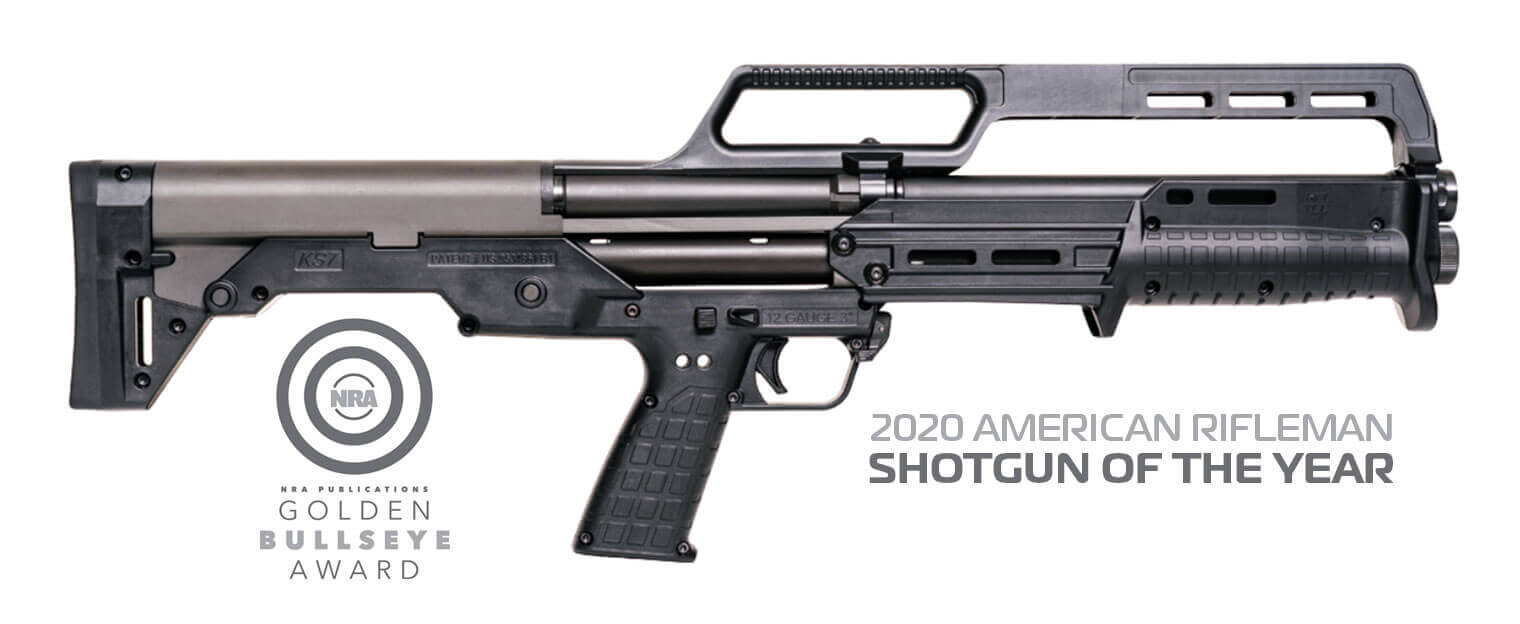
As per the last post on the Kel-Tec RDB, I’ve gone bullpup stupid this summer. Prior to picking up the RDB, I got a good price on a KS7 12 gauge shotgun by Kel-Tec that was in my local gun store. I’m not really a longarm guy and shotguns are some of my least favorite…so why buy it? Honestly? It looked really cool, like something out of a sci-fi movie. IT would fit well in the Aliens universe with the weird carrying handle. With a total length of 26 inches and an 18.5″ barrel, it’s a full size shotgun in a tiny package. As the name suggests, it accepts seven 2 3/4″ shells of 12 gauge.
Kel-Tec is pretty proud of this, as the official picture on the website suggests.
Open the cardboard box and you get a weapon that has a lot of plastic…it’s a Kel-Tec. the grip and pump use their “alligator pattern” texturing and it works better than you would think. The KS7 loads from the bottom, behind the grip and it’s a pretty unwieldy set up for the uninitiated. I’ve found that with practice, I can reload pretty quickly, but it’s not as simple as I would like. The body of the weapon is metal, and it’s double lined for safety, should things go wrong. The barrel and magazine tube are well-constructed, though the pump feels a bit rattly. That said, with full-length 12 gauge, it hasn’t malfunctioned. The carrying handle has a trench-style sight with a bright triangular fibre-optic bead in green. The sight works very. Picking up your point of aim is fast and intuitive, and out to 25 yards, it was hitting milk jugs with no issue. It functioned with everything from Fiocchi low-recoil 00-buckshot to Fiocchi #4, Berenicke slugs to Federal 00-buckshot. With a bit of run-in, the pump was much smoother and cycling improved. The key is a strong cycle stroke. The only trouble we had was running the pump less vigorously. That caused a double feed.
Takedown is easy: two pins in the grip assembly pop out, you angle the grip out from the back and pull the buttplate assembly (with the feed tines.) The bolt assembly comes out by racking the pump back and rotating the block 90 degrees. You unscrew the end of the magazine tube and pull the barrel forward. Done with disassembly. Reassembly is easy — reverse the process. The weapon stayed pretty clean through the first hundred rounds of testing, but needed a good takedown after out last trip out, when we had some issues I’ll discuss in a moment.
The good news: it will eat mini-shells. I could get eleven in the pipe and one in the breech for a total of twelve. The bad news: depending on the type, it might not do it reliably. the KS7 ate the Aguila Mini-shells in #7 and slug but if you didn’t firmly run the pump you could get a failure to eject and the next round would jam up — and worse, the shell might rotate. Not a great situation if you were using them for defense. That said, the Federal Shorty shotshells in #4 buckshot have run brilliantly, with no issues. The 00-buck, however, gave up an interest problem this morning: the last two rounds in the tube would spit out together and jam the shotgun. It did not replicate with the #4 nor with ordinary length shells. After disassembly, I found the follower was filthy and did not want to move easily. After cleaning the follower, tube, and oiling the little tooth assembly that catches and holds the shells in the magazine, the issue disappeared. As if as cold and wet, and I hadn’t cleaned that last bit, my suspicion is the follower was binding a bit and the retention hook wasn’t seating quite right. But I could be full of shit.
The good: the KS7 is well made and runs well, provided you aren’t shy about racking the thing. The sighting trench is very good, although you can swap it out for the Piccatinny rail system from the KSG, should you want other optics. It’s lightweight and short, making it an excellent home defense platform. It shoulders and comes on target fast. It transitions from target to target naturally and with ease. It will feed minishells, though I would run a few boxes to make sure which ones it likes before relying on them.
The meh: I found the pump to be a bit rattle-worthy. It’s not awful, but compared to the smooth, solid feel of my Benelli Nova, it’s underwhelming.
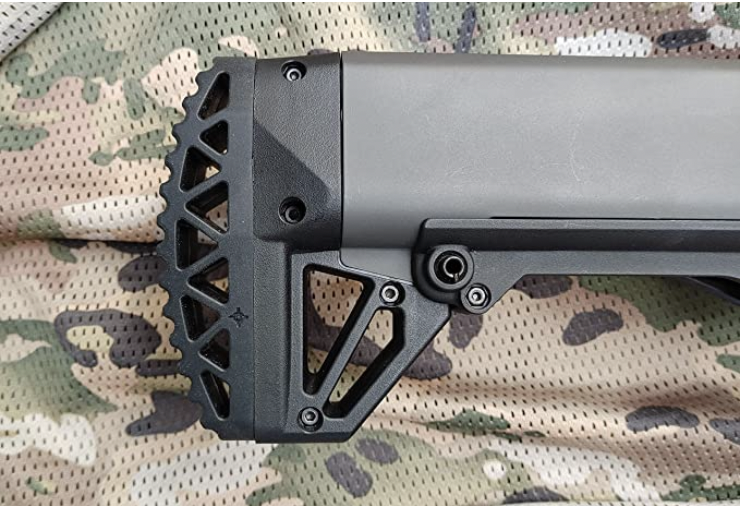
The bad: It’s very light. The buttpad is a slim bit of rubber. This equates to intense felt recoil. I’ve never been a big 12 gauge fan, and this KS7 was painful to fire after a few rounds. This was mitigated with a Missouri Tactical buttpad (and Kel-Tec does their own thicker pad), which made the experience much more pleasant. It’s still a 12-gauge, but it’s not painful to put a couple dozen rounds of buckshot through it now.
Trust me — if you’re thinking of buying a KS7, just get one of these and save yourself some pain.
So, is it worth it? MSRP on these is $530 and I found my cheaper than that. If you’re a shotgun person and want a bullpup for the house or vehicle, or for backpacking — it’s a great choice (if you buy the butt pad!); for home defense, it should be a solid choice. For competition and other applications, I’d pass.
I went on a bit of a bullpup kick this summer. I’ve always liked the form function of the bullpup, but most of them are — to be blunt — kinda crappy. The Steyr AUG is certainly cool in a 1980s action movie sort of way, but the trigger is awful. The FN2000 was a major malfunction waiting to happen. The Tavor is better, but it’s clunky and heavy, especially the shotgun version. The Springfield Hellion, or should I say the VHS-2 the Croatians use, ain’t too bad, but it’s ridiculously expensive. However, the P-90 and PS-90 (while not bullpups in the strictest sense) were excellent weapons. The bottom eject made for fewer malfunctions — in fact, I cannot remember the full-auto P-90 I fired in the ’90s, nor my civilian PS-90 ever having a malfunction of any kind. I even once ran a magazine with a loose/broken feed lip in the PS-90 and it worked.
I’ve never been a big rifle guy. Or a “big rifle” guy. The M-16 and M-4 in the military were fine: light, low-recoil, and easy to shoot, but even those I found just didn’t point naturally for me. All of the shitty weapons above (plus the superb P-90) did. They transition from target to target well, the recoil is more manageable, and they’re much more easy to use indoors.
I didn’t even know Kel-Tec was doing anything other than their venerable SUB-2000 series, so when I saw an RDB on the wall at a local gun store, I played with it — then found it for a realistic price online. (Markup on these at the LGS seem to be about $200 or so.) So for $700, I had a new rifle on the way.
First up — it’s Kel-Tec. There’s going to be a lot of plastic with their “alligator pattern” on the grip. It looks primitive. It works well. I’ve run a P-32 pistol from Kel-Tec for years as my “oh, shit!” gun and never had a malfunction, and the alligator grip texture keeps the little banger in place.
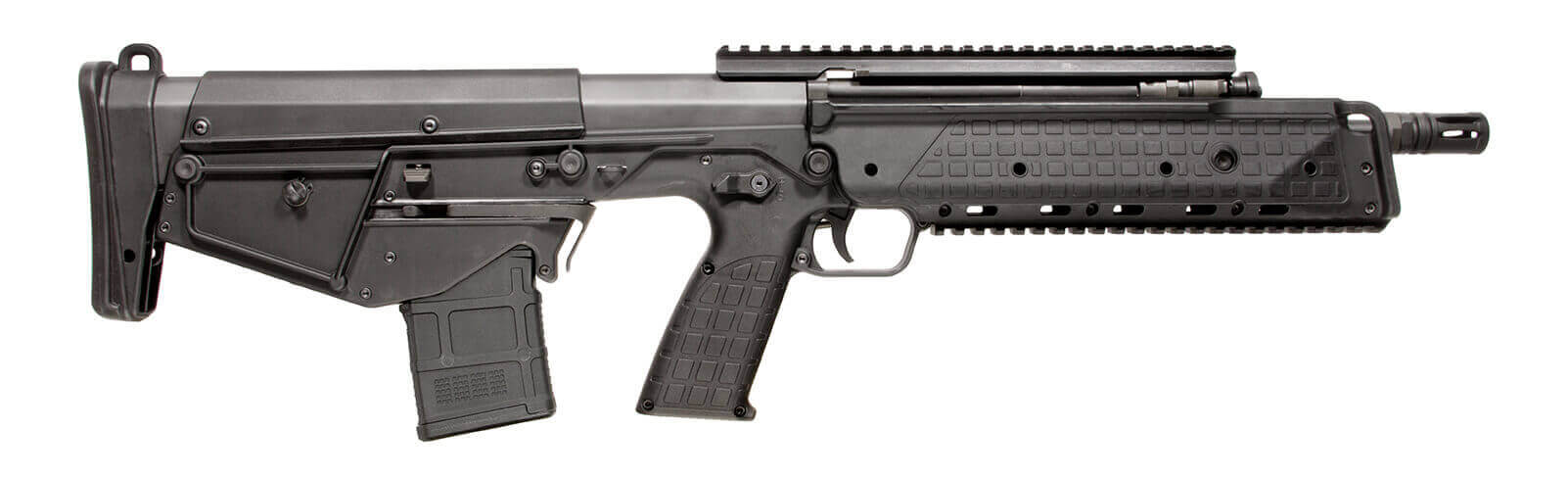
The official picture from the Kel-Tec website.
The stock is metal, and has a double layer over where the breech is so you don’t lose your face in a malfunction. The buttpad is a thin layer of rubber and does just fine absorbing recoil. The forward grip has a little give on mine, but it doesn’t feel chintzy. The barrel on mine is 16″ (the “Defender” variant), and the total length is 27ish inches. It weighs 7 lbs., so about on par with my AR-15. It uses STANAG magazines, so there’s compatibility with weapons like the AR-15. It is chambered in 5.56mm/.223 rem. and uses a short stroke gas piston system to cycle. PMAGs work just fine in it.
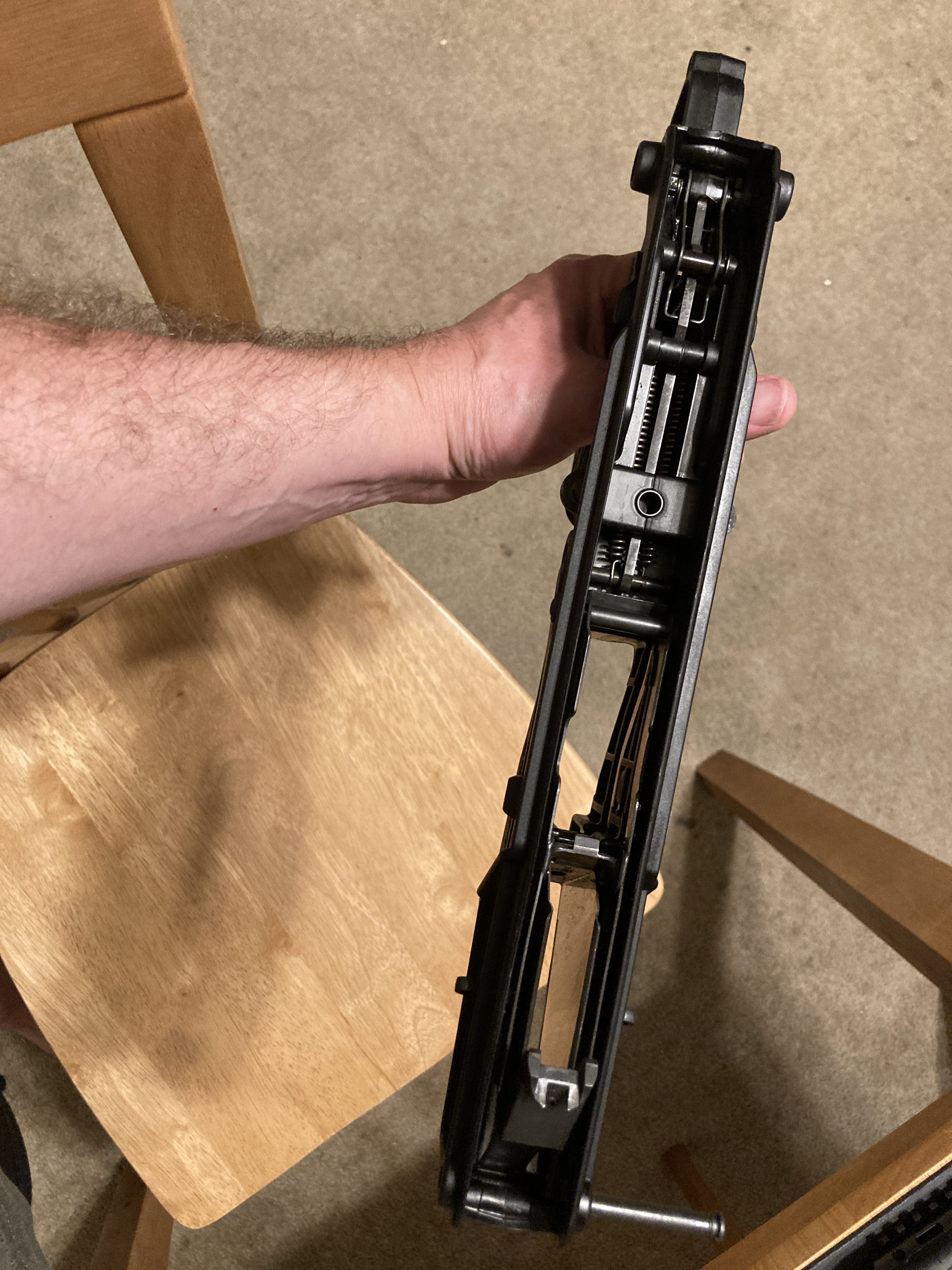
The weapon is dead simple inside — a bolt assembly that sits around the piston rod. When it fires, the bolt travels to the back on the weapon and drops the spent round through an ejection port behind the magazine before traveling forward to pick up the next round.. It expected this to be a point of failure; I was wrong. The trigger on bullpups is usualy awful. The RDB has a smooth pull with a bit of take up and a 5ish pound release. It’s as good as most out of the box ARs. The gas system is easy to access and adjust. There’s a couple of sling points on the front of the handgrip, on the top of the buttstock, and two points on the sides of the receiver/grip assembly. There’s a Pic-rail on the top for optics and flip up sights. I added a pair of UTG cheap pop-ups that worked without adjustment, and the Strikefire off of my AR pistol that needed a lot of drop on the point of aim to get sighted in.
So how does it run? I had no issues with 55 grain ammunition, but Hornady Black 75gr jammed up pretty spectacularly, with two rounds getting caught in the breech. Pulling the magazine and running the charging handle cleared it without issue, and a quick adjustment of the gas block has allowed it to run everything from 55gr to 79gr without malfunction for 1200 rounds. Most of the rifle stays clean but the area around the gas block and the rod are pretty dirty.
Accuracy is solid, with similar groups made between the RDB and a H-Bar AR for comparison. A recent trip out (in the pouring rain, no less) saw the RDB plant shot after show on a frying pan hung from a tree at 50 yards using the Strikefire red dot. Reliability was flawless since the gas was adjusted. Recoil is negligible, and certainly less than the H-Bar. The weapon’s balance allows for great controllability: it moves from target to target naturally, and sights in very quickly.
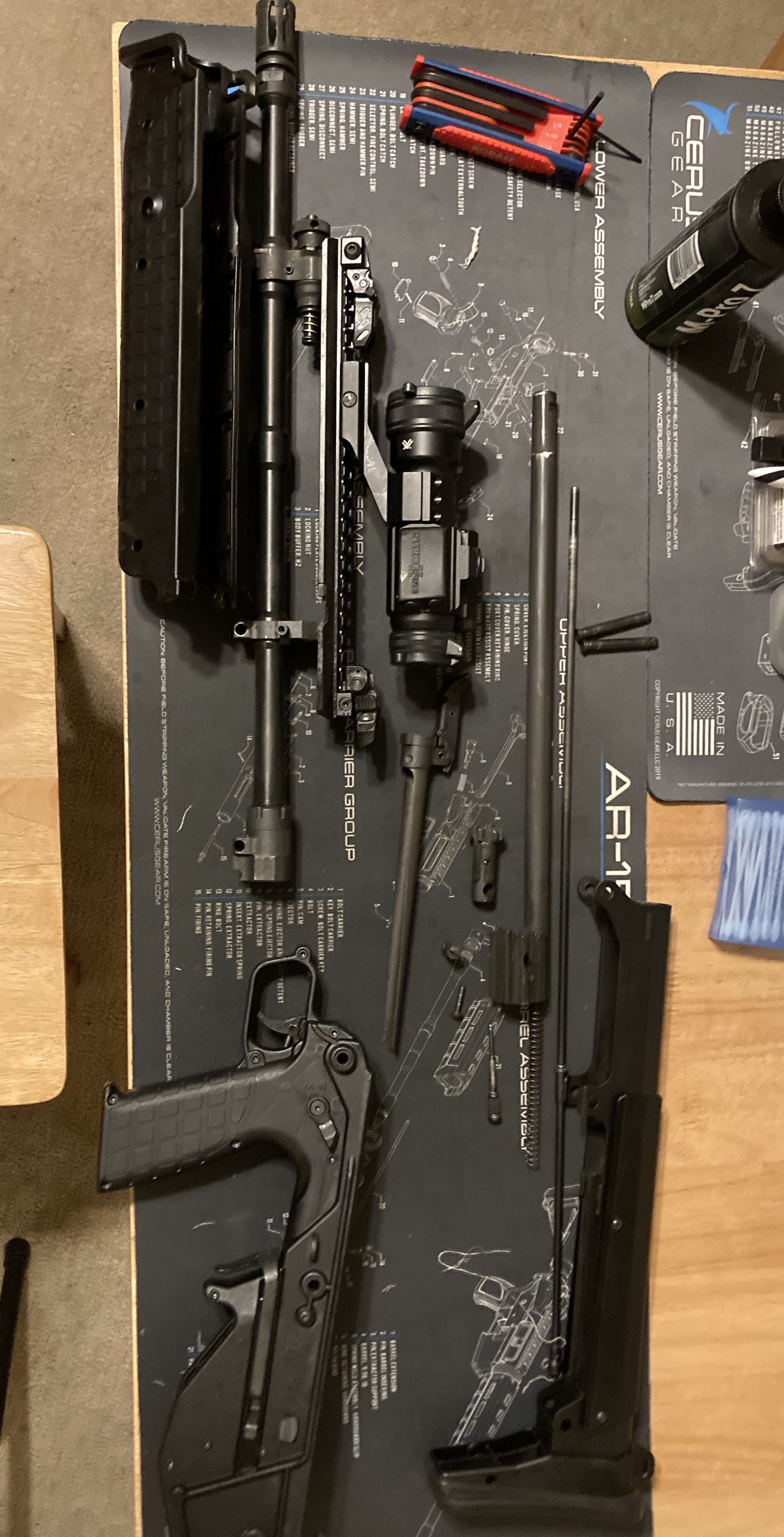
That’s it. Fully taken down, save for trigger internals.
Close up of the ejection port and the magazine well.
Takedown is simple. Two pins release the grip/receiver, from the barrel assembly. Pull the barrel assembly up a bit, or rotate the grip down and the barrel and bolt assemblies come right out. Putting it back together is just as easy, although sometimes getting the bolt face to lock requires a bit of wiggling. Wear over the thousand plus rounds has been minimal on the finish of the bolt and other friction points. Kel-Tec did a good job on this thing.
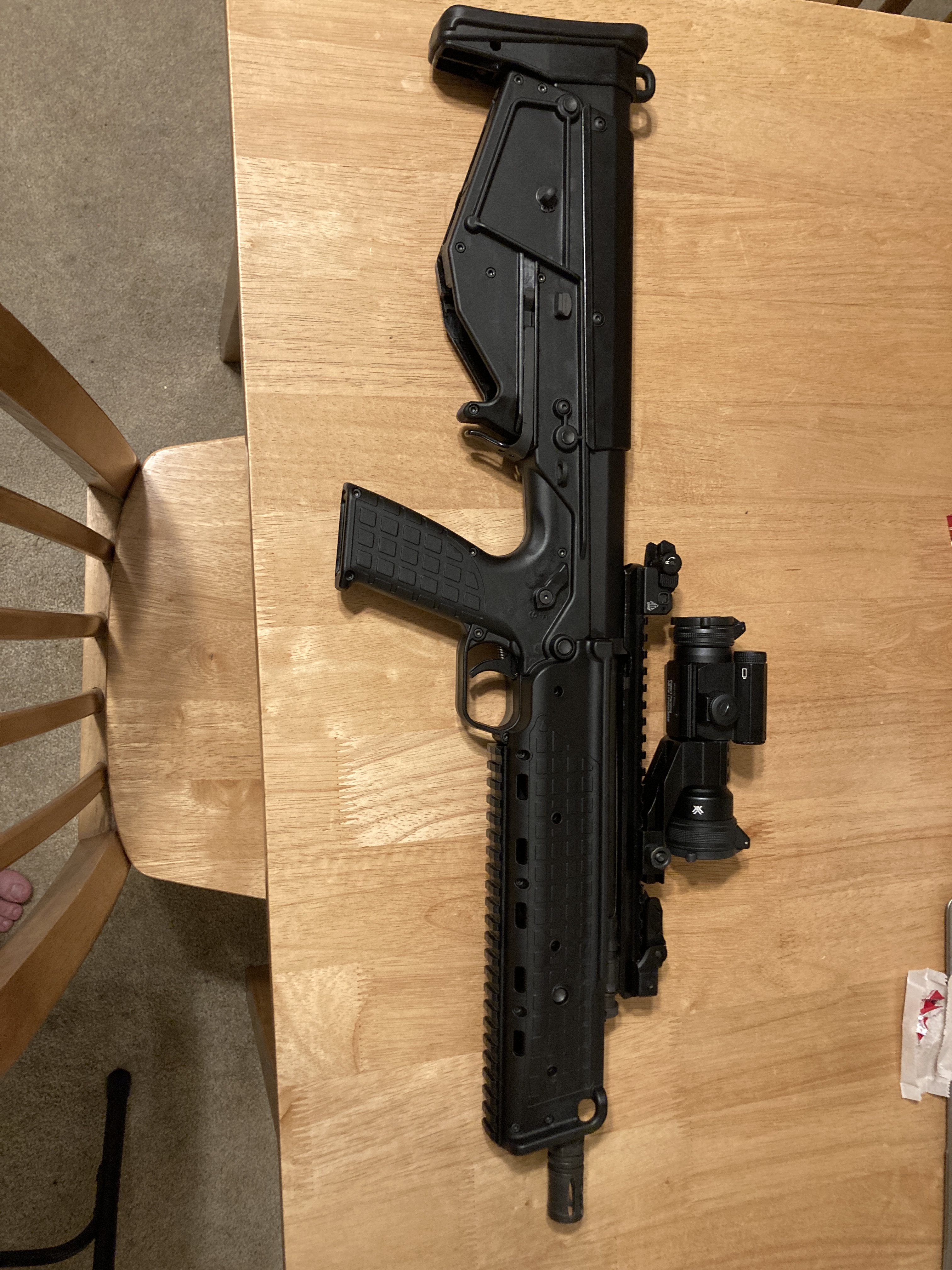
Reassembled.
So…is it worth it. A loud and unqualified yes. The MSRP is about $900 and yes, it’s worth it. Is it better than an AR? I think so, but your mileage may vary. The trigger is good, the balance is superb, it’s light and the size makes for an easy to use weapon.
I’ve got a few .22 long rifle firearms, but overall, I’m not a big rimfire fan. The ammunition quality is spotty, to be kind. I’ve had the bullet fall out of the casing from time to time on some brands (and not that long ago.) Also, the weapons are usually finicky as hell when semi-auto: my daughter’s PPK/S .22 is a great little gun with the right ammunition and at least two rounds through it. (The second round on any trip will fail to feed, then it will be flawless…it just needs to let you know it’s not down to play.) The Rock Island bolt action she has — great: but it’s a bolt-action so it runs like a top and is surprisingly accurate for a 16″ .22 with iron sights. The Kadet conversion for my CZ-85 eats every type of .22LR and just keeps running, but every .22 conversion I’ve used on my friends’ 1911? Crap.
So, it surprised the hell out of me when I went into the local range while the kiddo was rockwall climbing and saw the new Walther WMP in .22WMR (.22 mag for the uninitiated.) After playing with my stuff, I borrowed some time on the WMP. After 300 rounds of CCI 30 gr. Maxi-Mag and Remington green box 40 grain, I had an idea of how the thing functions.
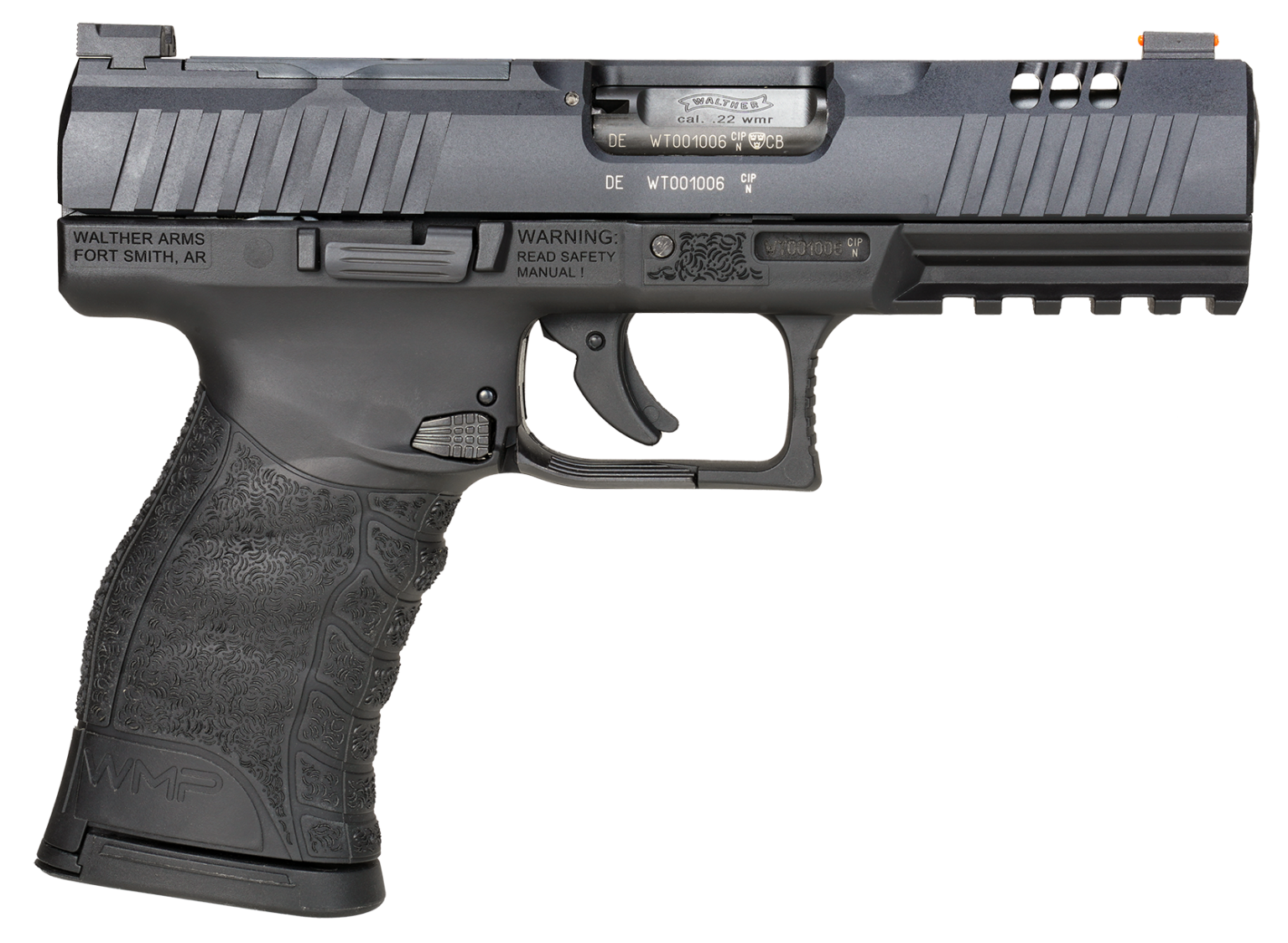
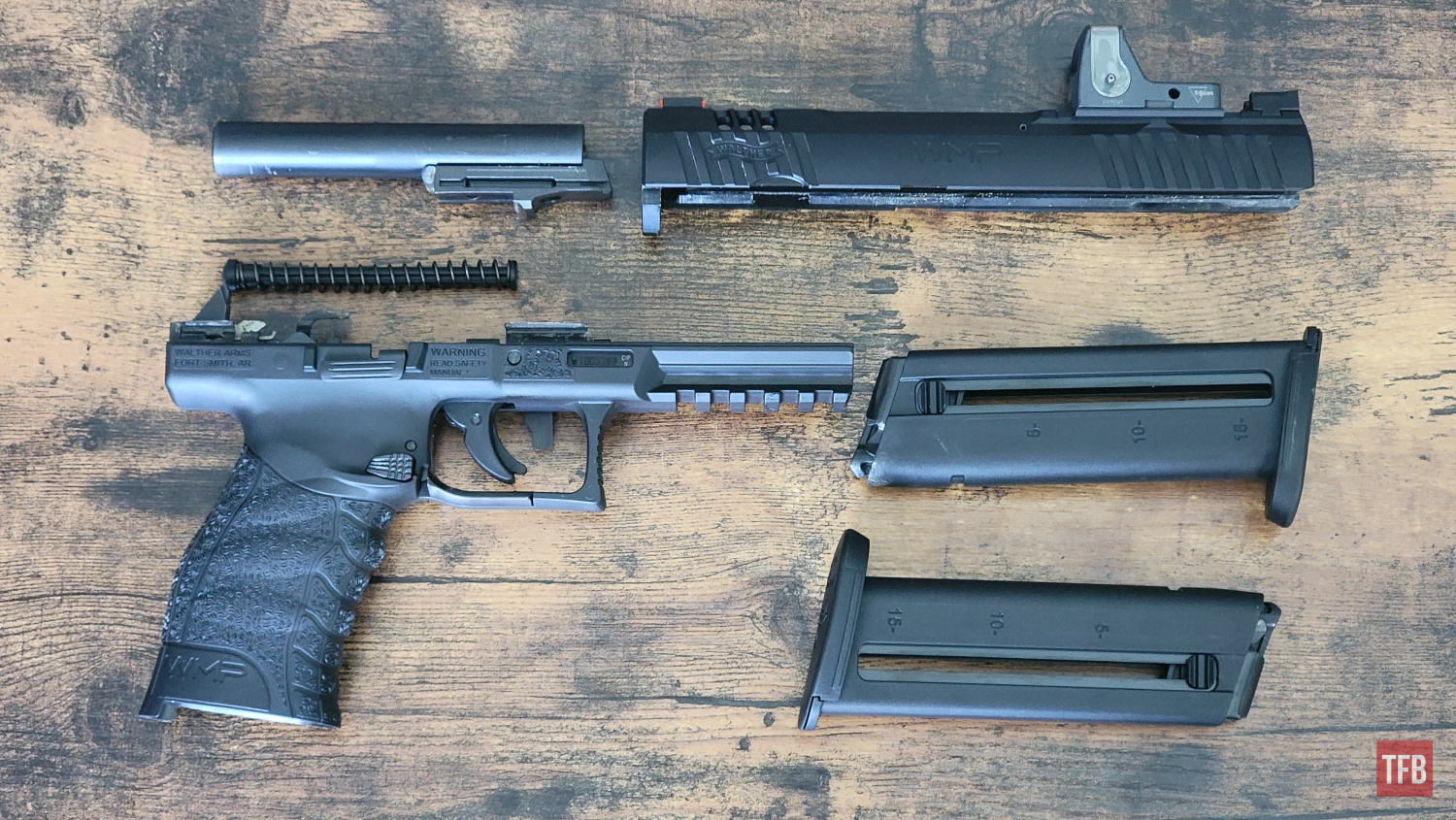
First impressions on the fit and finish: It’s a full size pistol with a 4.5″ barrel and an overall length of just over eight inches. The grip is 5.5″-ish. It’s not the lightest rimfire you’re going to handle and feel slightly heavier than my PPQ unloaded. (It’s 27.8 oz.) The grip is fantastic, as most Walthers since the P99 have been. The grip angle, finger swells and texturing is top-notch. The slide feels like aluminum, and when I looked it up — that’s it. It’s a hammer-fired pistol, which I like, personally. The sights are good — a fiber optic front and windage adjustable in the back. You get multiple sites of different heights to adjust elevation. There’s a plate system for red dot, in case lining up three dots is too hard for you. There’s cocking serrations fore and aft, and what looks like (but isn’t) porting in the slide — it’s just to lighten the slide for function. It’s got the usual blade safety in the trigger.
The weirdness starts for the magazine release, and honestly, I hope this catches on because it’s great. You can’t figure out a new manual of arms? Gotta have the “bullet button” to get the magazine out? It’s an ambi magazine release…but wait, there’s more. You also have paddle releases on either side of the trigger guard for the older Walther and H&K fans. They al can actuate the mag catch on the front of the 15 round magazine. Yes, 15. There’s a nice window to see the rounds and a little thumb button to help load the ammunition. The ammo is ever so slightly staggered, so I was expecting misfeeds. Didn’t happen.
Takedown is simple. Clear the pistol. Lock the slide to the rear, flip the slide catch down and pull the slide off. Pull the captured spring/guide rod, and the barrel. Done. It look like most polymer-frame pistols inside, but the trigger and magazine catch are more complicated than usual. It was easy to clean and reassemble without having looked at the instructions.
I vikked this from another site.
The barrel is fixed with the recoil spring underneath like most semi-autos, not with the spring around the barrel like the PPK. The barrel is thick, steel, and well made. Judging from the triple crown proof marks, Walther’s Umarex group is making this.
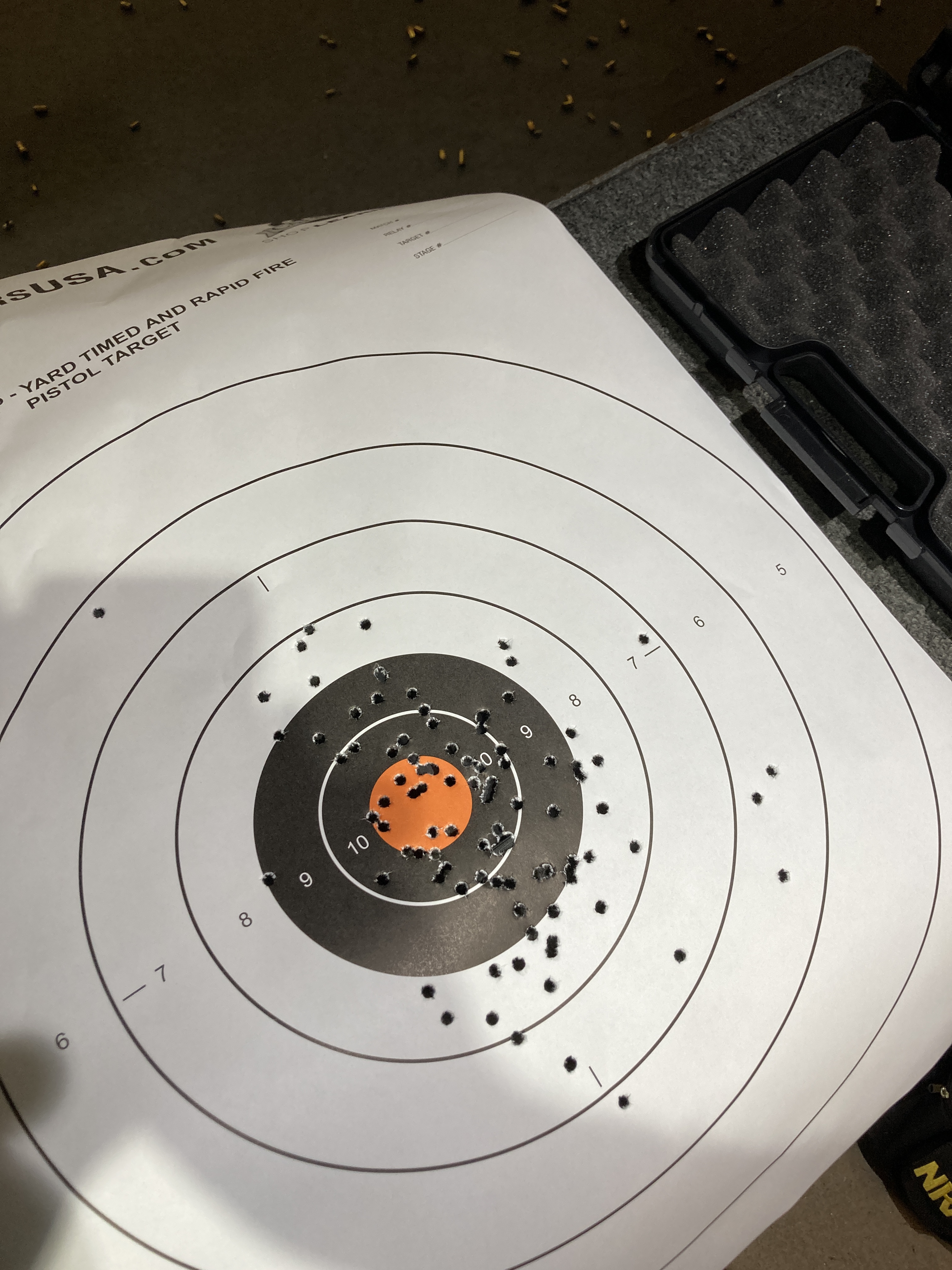
Second, how’s it shoot? One word: spectacularly. For one, much like the .22 TCM 1911s, if you miss your target, you just might set it on fire. The muzzle flash is movie-quality. The report is impressive. The accuracy..?
This is 50 rounds of “not taking my time.” 25 yards unsupported and a bit shaky after 150 rounds of 10mm.
It’s effortless to shoot. There’s almost no recoil, the sights were decent even for low light, and that was with no experience on this platform. The trigger is light — about 4 lbs. using my tip of my finger scale — and resets quickly and with a light audible click. Trigger quality has become Walther’s claim to fame; the WMP lives up to it. A few of the flyers were me double tapping too quickly from the muzzle blast.
The WMP functioned perfectly with the Remington 40 grain and gave two failures to feed (the slide didn’t get back far enough to pick up the next round) on the CCI 30 grain. Walther’s WMP website has ammo recommendations and they suggest 40 grain and speeds of 1875fps+. The 30 grain will “Work OK” according to the website. Both failures occurred at the end of the session, when the pistol was truly filthy and had come straight from the box without any cleaning. While apart, there was white packing grease in the slide rails — this probably was hampering cycling, as we had a couple of “is it going into battery” moments where the slide two stepped back into position with the 40 grain Remingtons. I’m going to blame the grease. After a quick rag cleaning on the line, the next fifty rounds wen’t downrange without issue.
As a light game or varmint pistol, it’s definitely serviceable. As a plinker it’s a tad expensive, ammo-wise; as a target pistol, it’s great. As a self-defense gun..? I wouldn’t want to touch this off inside in the middle of the night with no hearing protection, but at least you and the bad guy would be blind and deaf for a half hour. “Besides,” say the bigger is better bros, “it’s not enough gun…you gotta have a [pick you favorite caliber] to do the job right.” A 40 grain hollow point .22 mag moving at 1200 fps or s from a 4″ barrel gives about 125 ft-pounds of energy that puts you firmly in the .380 ACP range. And if the first shot didn’t kill, set on fire, or blind the target, you’ve got 14 more.
The Walther WMP was selling for $449 at my gun store. So is it worth it? If you are looking for a recoil-light pistol with enough power to dispatch a raccoon stealing your Cool Ranch Doritos™️ or a similarly aggressive wee beastie on a mountain hike, 15 rounds of really accurate .22 mag hollow points just might be the ticket. Or if you have to signal objects is space at night. (Seriously, the muzzle flash is epic.) I want one.




 The Black Campbell