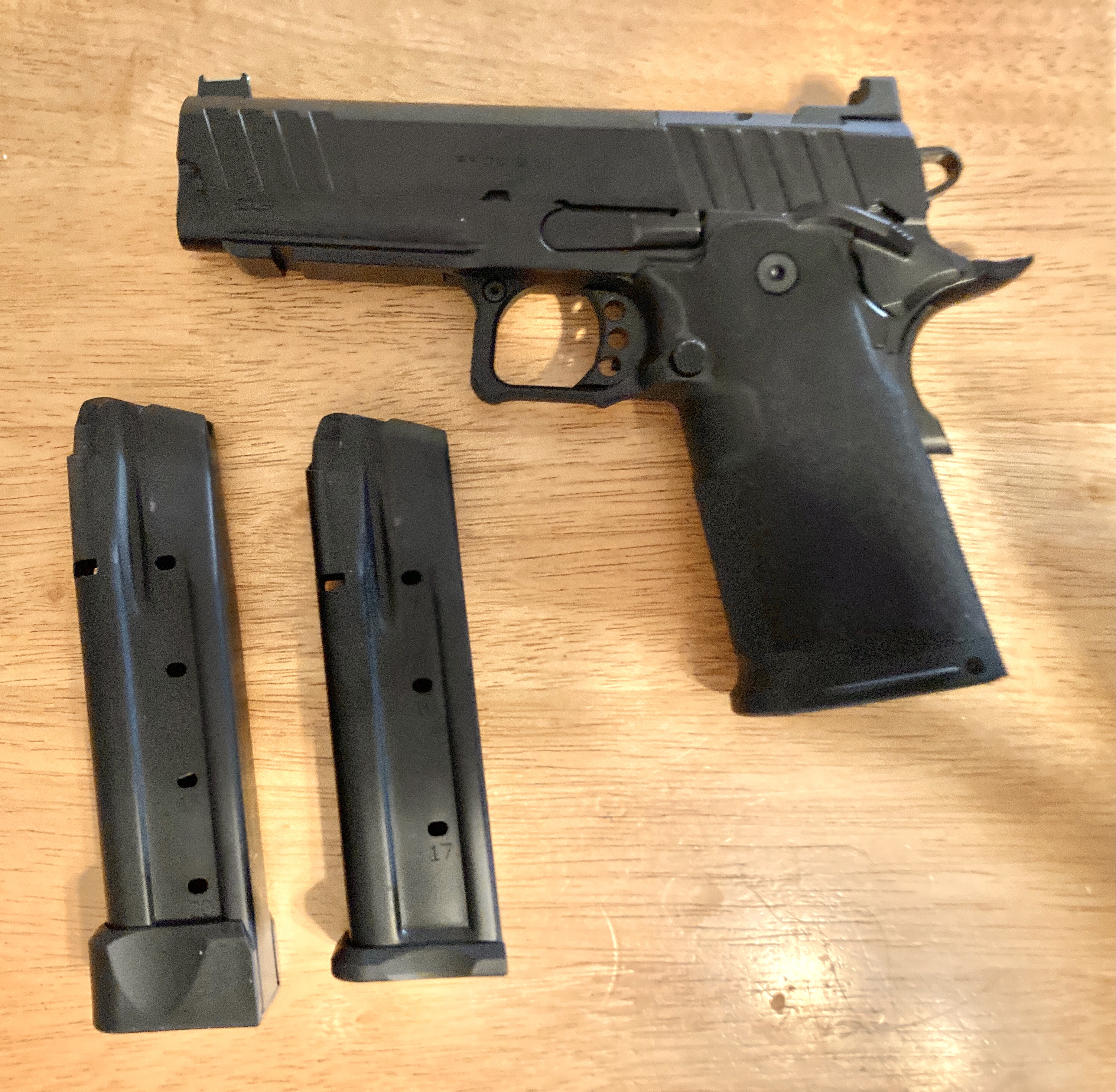
Curiosity got the better of me today. In the past, I’ve done some comparisons — the Springfield Armory SA-35 vs. the Inglis P-35 made sense. The Springfield Prodigy 4.25” vs. the Alpha Foxtrot 1911-S15. I hit the range to see how the Daniel H9, a handgun with a checkered reputation, but which for me has been an excellent firearm, would perform against the Prodigy, one of my favorite pistols. My gut was solidly on the side of the Prodigy.
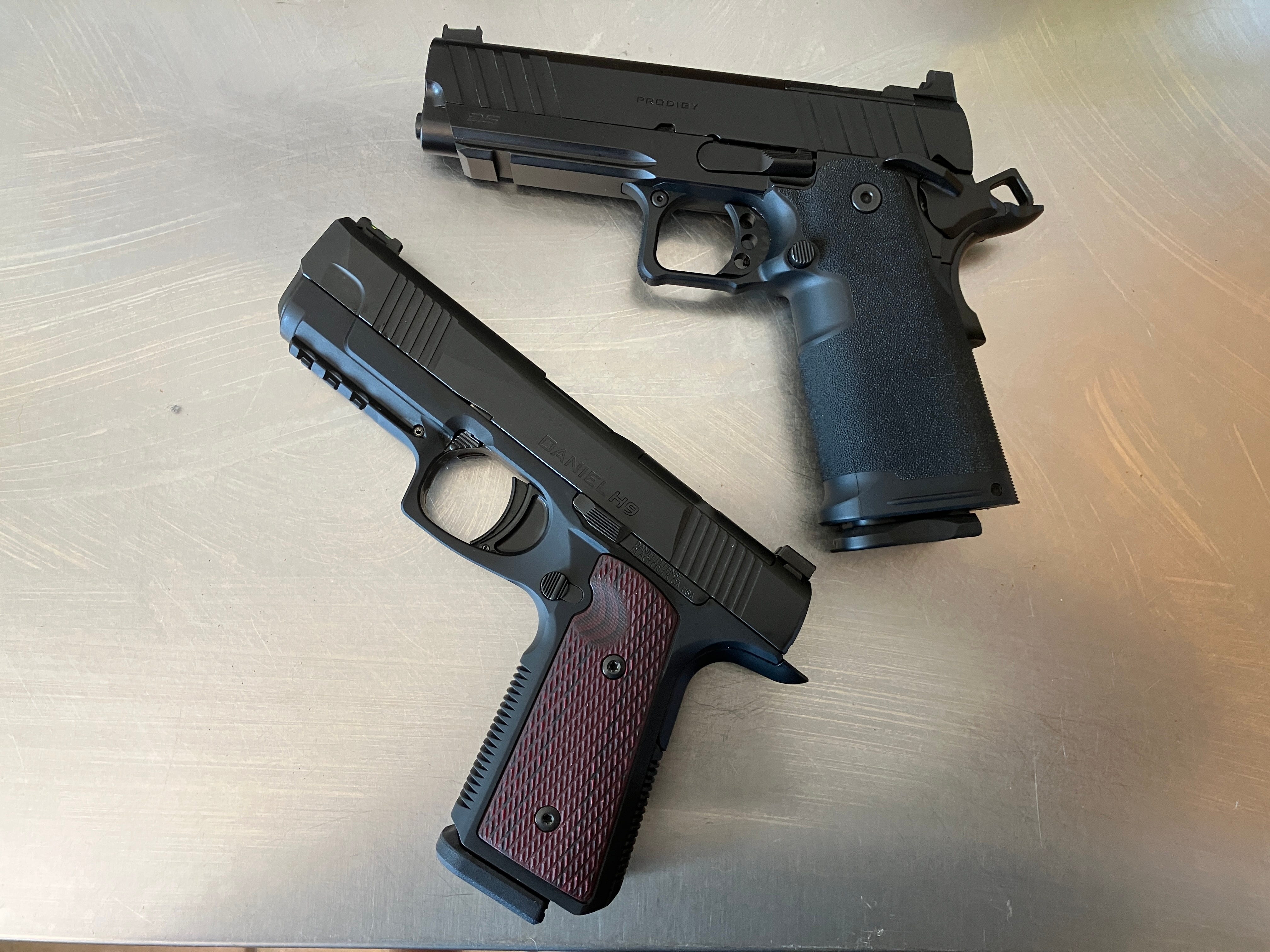
For the experiment, I wanted to be fair, so off came the light from the Prodigy, and both were loaded to 15 rounds for the longest strings. I thought this a pretty even match — the grip length is close to the same, with the Prodigy being .25” longer, but the H9 is also thinner, with a feel closer to that of the Browning High Power. The H9 grip angle is a bit more upright than the Prodigy. I tried to get a decent shot of the difference, but the reflectivity of the surface worked against me. Thankfully, Handgun Hero came through:
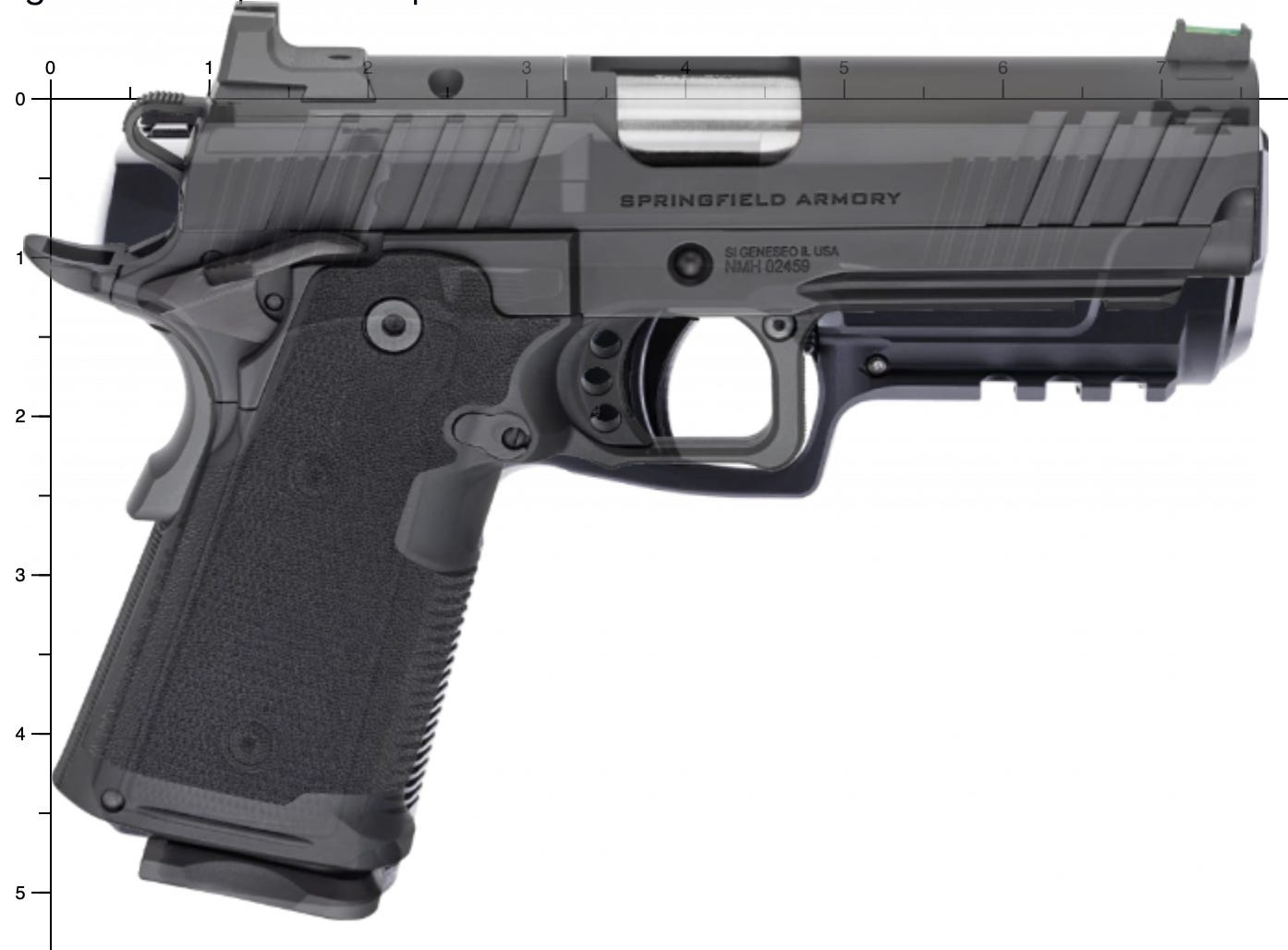
Lining the pistols up at the point where the grip and trigger guard are roughly even, you can see the angle is small, but present. The barrel lengths are almost the same — 4.25” to 4.28”, with the slide sitting back over the shooter’s hand, compared to the 2011-styled Springfield. It also shows how much lower the slide rides for the H9 over the Prodigy — the Springfield sits .6” taller than the Daniel. It’s also apparent how much lower the barrel would be when looking at the magazines side-by-side:
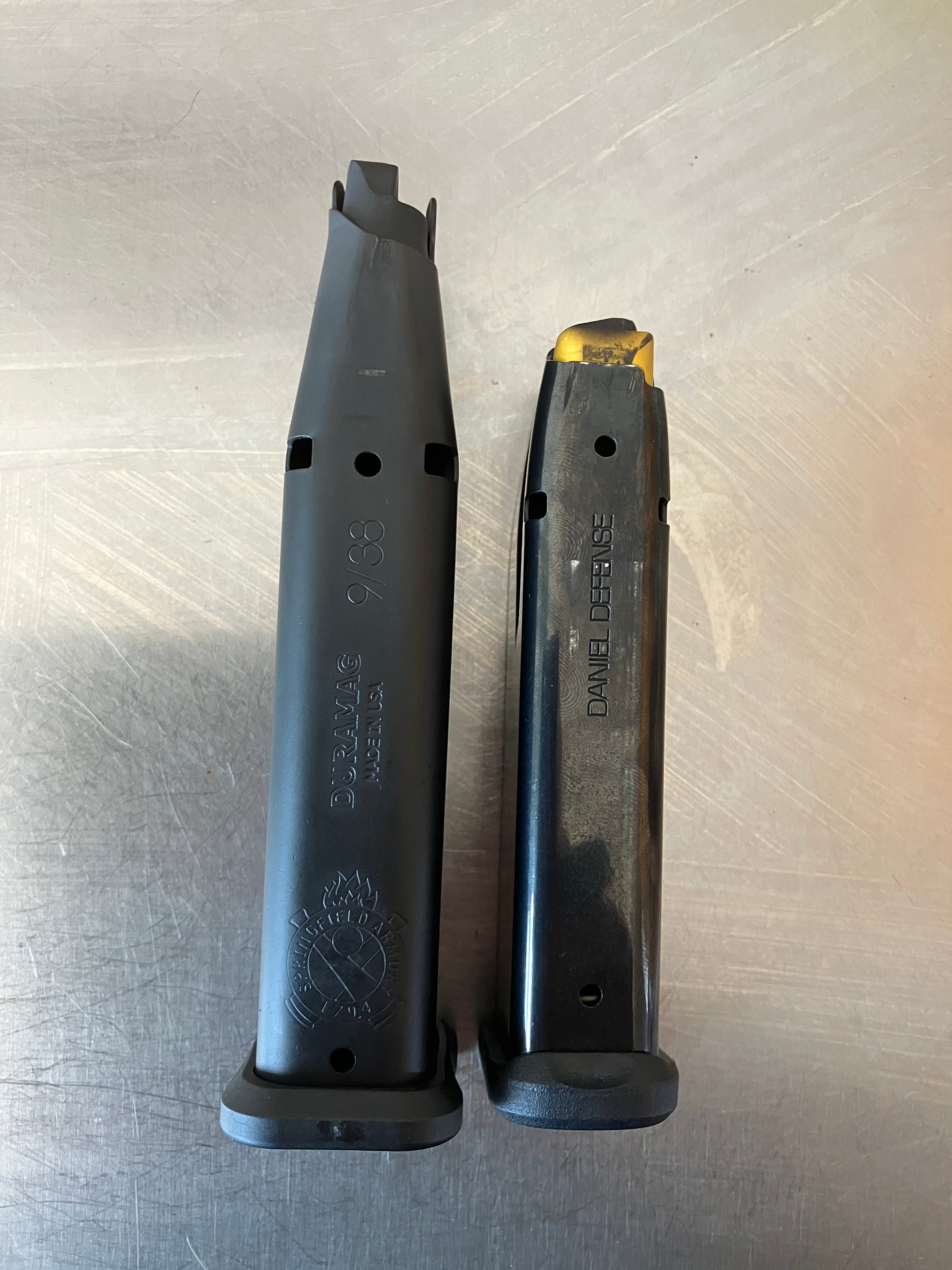
This gives them distinctly different feels in the hand, despite the “1911” grip angle and trigger. The Prodigy is ever so slightly heavier, even with two rounds pulled from the magazine, but I didn’t notice it, at all. If anything, the Prodigy feels more planted in the hand, with the H9 feeling a touch nose heavy. In shooting, the recoil impulse of the H9 is definitely more controllable: less muzzle flip and much faster return to point of aim. When firing one handed, the H9 felt much more stable in my hand; while the Prodigy felt like it was trying to squirrel to the right. (I’m a lefty.) Two-handed, the Prodigy is very controllable, but the muzzle flip from the taller slide is stronger. I’ve also seen this in the past when shooting the Prodigy next to the CZ-75 and SA-35, but in that case, the it felt like the Prodigy returned to point of aim faster than those two pistols.

The trigger on the H9 is supposed to feel like a 1911 and the weight on both was almost exactly the same — a hair under 5 pounds. The upside down safety blade throws some people on the H9; I don’t notice it at all. The trigger on the Prodigy has less takeup than the H9, but both hit a nice wall and break clean. The reset on them feels almost exactly the same. That said, I felt like I have a tendency to slap the trigger on the Prodigy more than the H9, and I saw that in some of the groupings over 100 round per pistol.

I would shoot them back to back with even number of rounds, and this also showed how the grip angle affected my point of impact. With the same point of aim, the Prodigy would hit high; if I followed with the H9, it would hit low. Start with the H9, I’d be right about on target, then the same with the Prodigy. Put that down to shooter error and the different height sights (the Prodigy have taller sights) but the picture is almost the same — U-notch with serrations on the back with a green fibre optic front. The Daniel, however, has a flat top to the slide and I find I tend to shoot a pistol better with a flat slide, as I tend to use perspective for quicker and more accurate shots even without getting as good a sign picture.

Over the course of shooting at 15 yards, unsupported, the tightest group for the H9 was three round triangle with about 0.76-.78” between them; the Prodigy produced a pair at 0.79” with a flyer that expanded that to 1.9”. On average, the groups were between two and two and a half inches, not really taking my time. Mozambiques at five yards from low port produced 2-3 inches between the initial double tap for both, and a clean center head hit for the Daniel, with the Prodigy scalping the target every time. Slow strings of six at seven yards gave sub two inch groups for both pistols, again with a slightly high point of impact for the Prodigy, slightly low for the H9.

Reliability: again, pretty equal. Using Fiocchi 115 grain ammo, the pistols were pretty dirty after the century mark, and yet functioned flawlessly. The Prodigy kicked out empties slightly forward and with a good six inch toss; the H9 pitches them slightly backward and aggressively. They tended to hit the bolster on the right side of my shooting lane and bounce into my shoulder and head. I’ve yet to shoot the H9 outside, but my guess is it will chuck shells a good couple of feet. In it’s defense, however, the Prodigy and H9 both have about 2500 vs. 2000 rounds through them. The Prodigy has never malfunctioned. The H9 has had light primer strikes if the firing pin channel gets too dirty.

So, which one “won”? If we’re talking speed of shooting and consistent accuracy at longer ranges — the H9 takes this one. Groups were consistent with one two flyers over 100 rounds and I could shoot it faster than the Prodigy. The Prodigy, however, wins hands down on reliability; it has never left me down. The H9 has suffered light primer strikes from time to time that seem to be tied to the firing pin channel getting dirty, but that’s the only issue I’ve run across. It happens rarely enough I wouldn’t be terribly concerned carrying it, but …

It really is almost too close to call, but I think the reduced felt recoil of the H9 wins this one from a shooting perspective. From a reliability standpoint, the Prodigy has it. It might be interesting to see how the H9 stacks up against the Inglis P-35, seeing as how they feel so similar in the grip. My gut is the H9 wins, but I kinda hope the P-35 smokes it.

Got a question on the grips for the H9 — they’ve VZ Grips G-10s. I thought the all black silhouette was a bit boring. — BC.

I bough the the 4.25″ Prodigy at the start of the year (2023) and I’ve been running it steadily every since. It’s relatively lightweight — a similar weight to the Springfiend Hi-Power clone — small enough to conceal without much effort, and it is utterly spectacular for accuracy. The complaints about needing a better flared magwell I think are overwrought; I’ve never had an issue with a magazine change. If there’s anything, it’s the plate/ rear sight assembly gets a bit loose after a few hundred rounds and needs tightened. I may just Loc-Tite it. I’m not planning on running an optic.

If I had one gripe — and it’s a small one — I would like to have had a flat strap to the slide. Over the years, I used a lot of pistols with a flat top and it made perspective shooting (using the flat to “run a road” to the target) quick and accurate without needing to use the sights save for more precise shooting. It’s why the Walther PPK suits me so well, why I love my Kimber Camp Guard and can shoot them quickly and with minute of bad guy accuracy while moving.

Reliability at 2000 rounds is this: one failure to go into battery, but that might have been me limp-wristing it while shooting one-handed. Even if it wasn’t, that’s a 0.05% fail rate. That’s completely acceptable for a self-defense handgun. Here’s the wear so far for 2000 rounds: pretty standard wear along the barrel sides and top where it impacts with the muzzle opening on the slide. Minimal wear on the locking lugs on the slide — this is better than most handguns I’ve seen at this round count. Wear on the rails and the top of the lower frame is well within what I would expect. The outer finish is still pristine, ever with holster use.

I know some folks had trouble with the initial run of the Prodigy — especially the 5″ version, but my experience with the commander-length has been just shy of flawless. For $1400 or so, it’s definitely worth it.

My trend of buying guns this past year concluded with one of the best purchases I’ve made in 30 some years of shooting. If I had to pick the “best” pistol I’ve owned prior to this, it would be a tie between the Fort Smith Walther PPK and my 1917-issued Webley MkVI revolver. I spotted one of these before they became a big thing in the gun mags (by about a week) in my local gun store and after playing with it, plunked down money I really didn’t want to spend. I like the idea of a double-stack 1911. I’d shot a friend’s Para-Ordinance back in the 1990s and it had run like a dream with little recoil and solid accuracy, but it was heavy. I’d been thinking of a Rock Island 10mm double stack for a while — it’s hard to beat that price and RAI 1911s have never given me an issue.

I bought the commander-length 4.25″ Prodigy and got it for a hair under MSRP, and mitigated some of the price with a trade. At $1400, it’s the most expensive pistol I’ve bought (though the Chiappa modified for 10mm gets close.) Fit and finish are great. It’s a nice deep black, silky-smooth Ceracote finished with minimal lettering on the slide — Springfield Armory on one side, Prodigy on the other; there’s also a DS on the frame near the nose. The pistol uses a unique method to cut the weight and make the pistol incredibly thin for a double-stack 1911 (or 2011, os there, STI!) The frame is steel, but the grip is polymer and shifts the weight, even when loaded, to the front of the pistol. It’s just a hair heavier than my SA-35 with 17 rounds in it.

The design makes for a very controllable handgun with muzzle flip practically eliminated. The trigger is better than most stock 1911s and was pretty damned close to the weight and smoothness of the Staccato P I shot a few months back. The trigger breaks at 5 lbs., with no take-up, and nice crisp wall, and a solid, audible reset you can feel. The Prodigy features an ambi-safety — a must for a 1911 with a upswept beavertail, if you are a leftie. I’ve shot enough 1911s that using my trigger finger to pop the magazine and hit the slide stop is second nature, but an ambi safety is a must. The magazines that came with it are a 17 and a 20-round each, but 26-round extended magazines let you compete or play at being John Wick. The pistol will use Staccato magazines, supposedly. The 17 round is “flush”, which is bullshit — it hangs a quarter inch or so belong the magwell. I wouldn’t mind a 15 round that’s actually flush and would make carrying the Prodigy a bit easier.

The trigger guard is squared and undercut near the magazine release, and there are no finger grooves (which I hate!). The grip texture is tremendous. It’s subtle yet really sticks to the hand or glove, without tearing your hand up. Springfield calls it the “adaptive grip texture” and they use it on the Hellcat. It’s simply the best grip texture I’ve held on a pistol. After over a thousand rounds, the grip screws have not backed out. I kind of want it on my Walther PPQ.

Another “big deal” is the slide is cut for an optic. I have not joined the red dot brigade. i understand why some like them, but I haven’t found them to be any faster than iron sights. Your mileage may vary. The cut and plate system was developed i with Agency Arms, and the Prodigy uses their Agency Optic System (AOS) plates. The AOS plates have an integrated rear sight for the best possible sight picture. Each pistol comes with one AOS plate and a cover that also includes an integrated rear sight. You can order sights for other systems from Springfield. The cover/rear sight managed to back out it’s screws a bit after 1000 rounds and needs a torx wrench to tighten…which the pistol doesn’t come with. It’s got the AOS plate and cover, it’s god the hex wrenches for the grip module and the spring guide rod, but not the cover. Boo, Springfield.

The sights! Mine has a green fiber-optic front and a U-notch rear. It’s very quick to pick up and shoot with accuracy. At 20 yards, unsupported, I was getting 2-3″ groups with no work at all. I found it really likes a 6 o’clock hold; I hit consistently a bit high with it, but when drawing and reflex shooting it’s drilling right where I want.

Central to the pistol is the bushingless bull barrel. The guide rod for the main spring is a two-piece, and after a few hundred rounds has a tendency to work its way a little loose. A swap to a single guide rod is probably a good idea. That’s my only real complaint with the pistol and a quick aftermarket fix. (Or I just thumb tighten the thing every once in a while.) The recoil spring feels a bit light to me, and apparently there have been a few issues with the 5″ version binding up a bit, but I’ve had zero malfunctions in 1000+ rounds put through this Prodigy. I suspect the 5″ guns ship with the Hex red dot and that probably slows the cycle and causes some issues.

I spent a couple of weeks shooting it side-by-side with the SA-35, which is a great shooting pistol. The Prodigy has less recoil and better accuracy (and didn’t have teething issues like the SA-35)…it’s just a superlative weapon for about half the price of a Staccato. Side-by-side with my Walther PPQ, one of the best shooting polymer 9mms with a superb trigger — the Prodigy is heavy, but it’s much more controllable and accurate.

If you’re coming away with the impression I like this weapon, you’re wrong. This is easily my favorite 9mm handgun. Better than my beloved PPQ or the equally good CZ P10C. Better than my long-time favorite, the CZ-85 or the SA-35. Better than the superb Kimber Camp Guard 1911 in 10mm. (Man! A 10mm Prodigy…please!) It’s good enough I’m willing to put up with the weight and carry it, if I’m not rocking the little PPK.

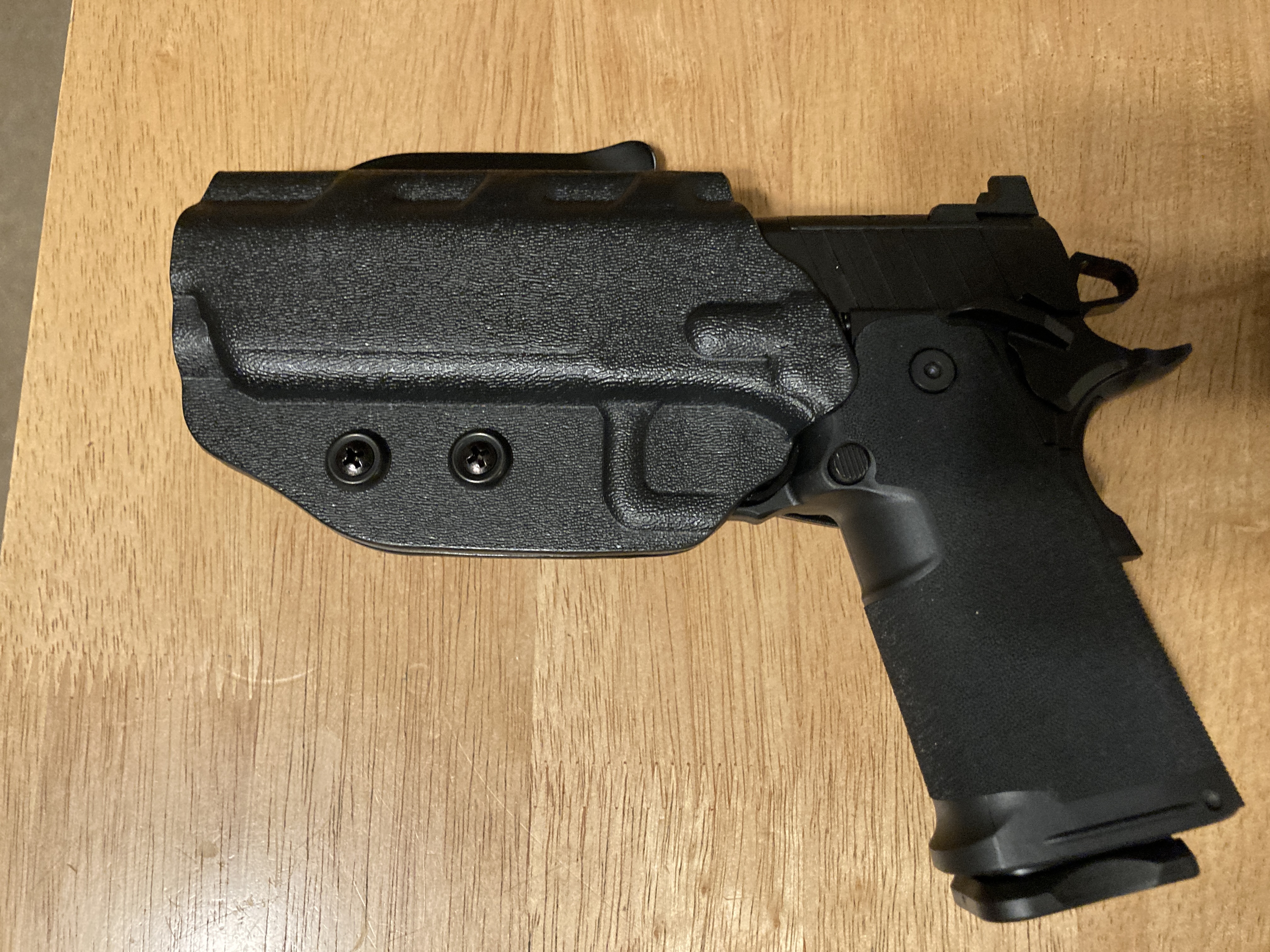
I was able to get a DeSantis Pegasus (the Cazzuto) kydex holster for it with no issues. It’s an excellent holster with a paddle that’s not too wide — as many are — and pretty minimalist. Tension screws adjust the tightness, but after jumping up and down with it on, the pistol stayed put. It is adjustable for cant. The cut is for a 5″ 1911, so I might have to dremel that down a bit, but the pistol rides well, with the weight firmly in the body of the holster, not at the grip where it can try to bend outwards, and though it pokes out a bit (see my comment on a real “flush” magazine), it conceals well under a coat.

Man, do I want one of these in 10mm.

In the box is the pistol, a zip bag with two allen wrenches and the optic plate (but not a torx wrench), a 17 and 20 round magazine, and the usual cloth Springfield pistol case that can carry the pistol and two extra magazines. There’s the usual paperwork and guide book, and the government-mandated trigger lock.

So is it worth it? $1400 is a lot of dosh to throw around, and it’s cost another $100 or so to pick up a few 17 round mags if you’re thinking of carry the Prodigy. If you are a competition shooting, it’s definitely worth a look, especially priced against it’s competition (with the exception of the double stack Rock Islands — don’t make that face; they work.) To carry? It’s more expensive, and a bit bigger and heavier than many (and probably better) choices like the Hellcat, Shield, Glock 19 or P10C, but it’s still smaller in the 4.25″ than a Glock 17. For a bedside gun, especially if you have old eyes and want a red dot? This is a damned good choice. It really comes down to budget. If you can afford a grand and a half for a pistol, and you want an excellent weapon, do it. If you’re budget driven, not so much.

Update: I’ve got about 1500 rounds through the Prodigy now and have had one failure to feed that was quickly clear with a mag drop, then a quick slap and rack. It’s still the most accurate pistol I own and I have been carrying it. It’s a hair smaller than the SA-35, about the same weight, and utterly reliable. As to my desire for a Prodigy in 10mm? Girsan is bringing out a Witness2311 — 4.25″ barrel, 15 rounds of 10mm in a polymer-grip double stack 1911. Yes, please.