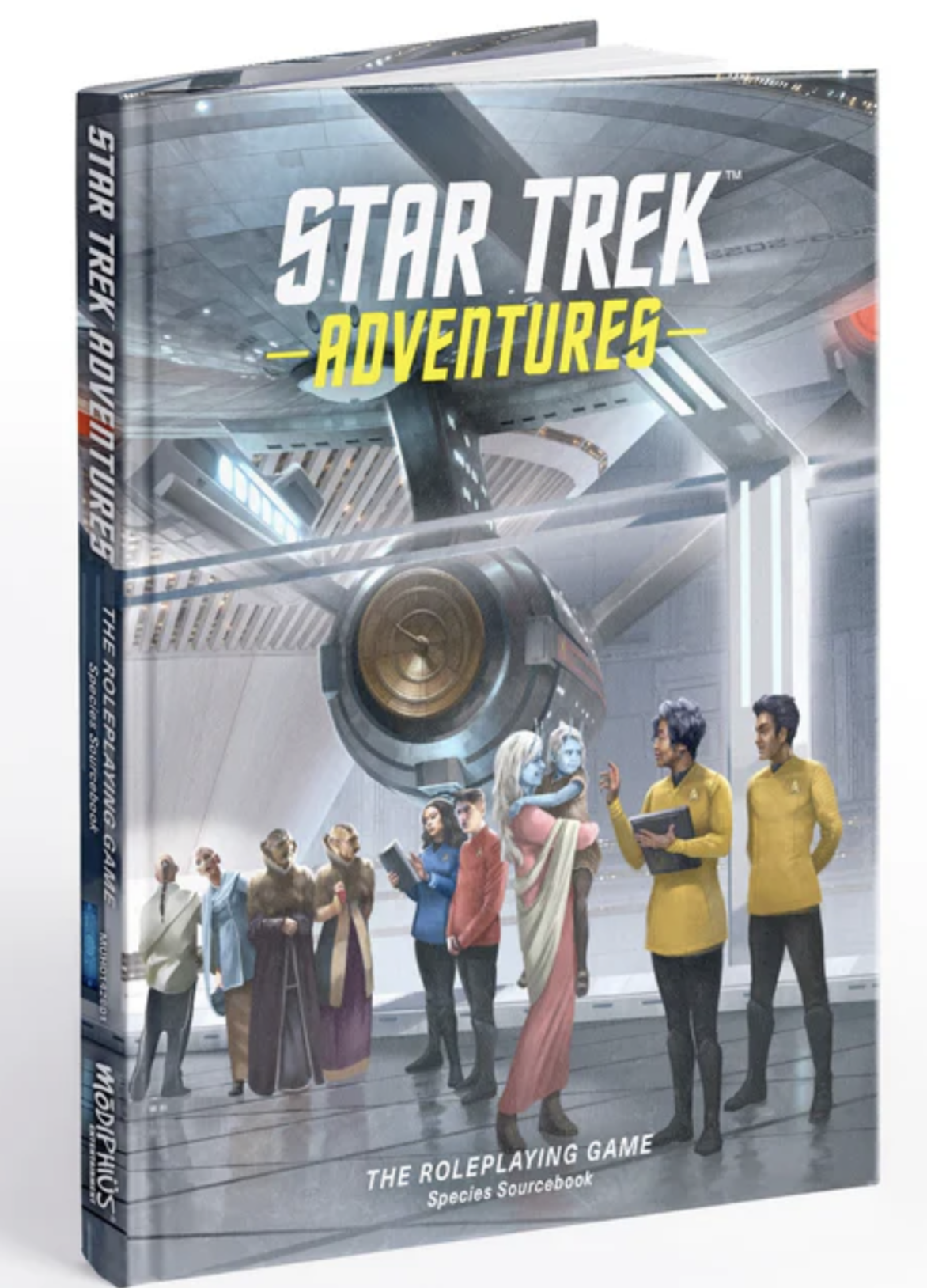
So, this dropped on my email list yesterday (Thursday) morning — Modiphius has hit us with another sourcebook for 2nd Edition Star Trek Adventures. This time, it’s the Species Sourcebook — the one I actually was hoping they would do. The PDF was already available with the physical book on pre-order and most likely due in about two to three months. This has been the production tempo thus over the last year for the line.
The artwork is consistent with the rest of the sourcebooks, with Paolo Puggioni — who gave us the excellent cover for the 23rd Century sourcebook — replacing Rodrigo Gonzalez Toledo on cover duties. The interior of the cover on this one is the first to not have some form of useful material — a map, uniform guide, or timeline, but the art is still quite nice. Unlike prior sourcebooks, we do see a fair amount of recycled artwork: the Barzan and Betelgeusans from The Federation-Klingon War Tactical Guide, Caitains, Efrosians, and Bolians from first edition works, just to name a few. Most of the pieces are good and yes, why spend for more art when you’ve got stuff right there?
So what do we get in the book?
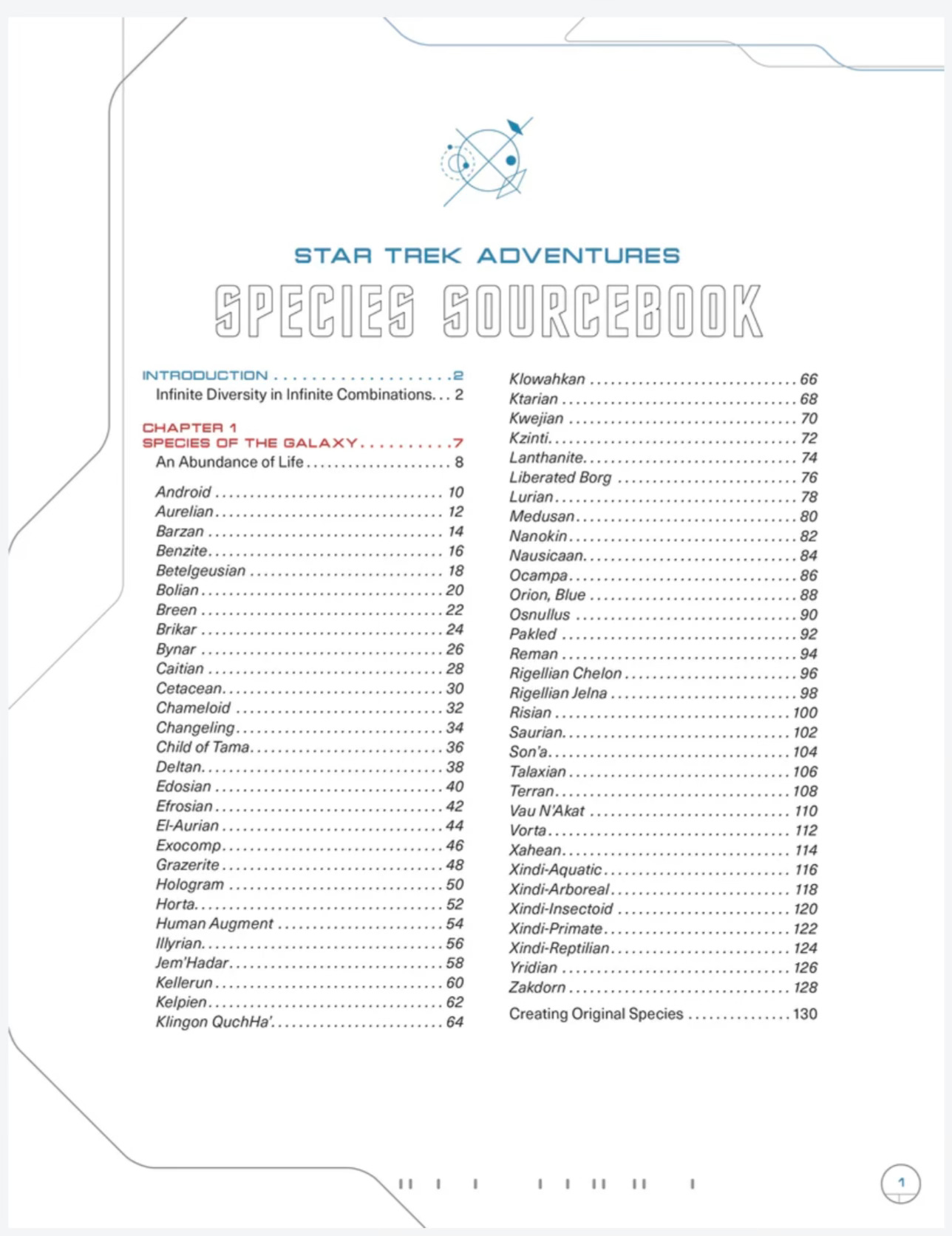
There’s a nice spread across the various shows and movies, and a few of these were originally included in the first edition, but didn’t make the cut for the core book in the latest iteration. A few are variations on a theme, but we do get Terrans for you Mirror Universe fans. There’s a heavy representation from the animated series — both TAS and Lower Decks, as well as Prodigy: Edosian, Aurelians, and Caitians, but I was especially amused by the Blue Orion (Or-ee-ons!) and Kzinti. There are some obvious choices: Deltans, Augments, Xindi, Klepians, Vorta and Jem’Hadar… The chameloid was an interesting addition, but the lack of Ariolo, Arcadians, and Coridanites from the same sourcebook as the Betelgeusan was curious. I did like the “human” Klingons from the original show being included.
I actually used the Medusans that very evening at Nerd Night™, and the Terrans will be useful very soon.
So, is it worth it? At 133 pages, it’s right in the ballpark for the current run of splatbooks for STA2, and while $60 is a touch much, in my opinion, for this particular book — it’s definitely worth it. I’m already seeing this one as a high use resource for the game.
The copyright for 2d20 system is Modiphius, 2019. STAR TREK and related marks and logos are trademarks of CBS Studios inc. All Rights Reserved and no infringement is intended.
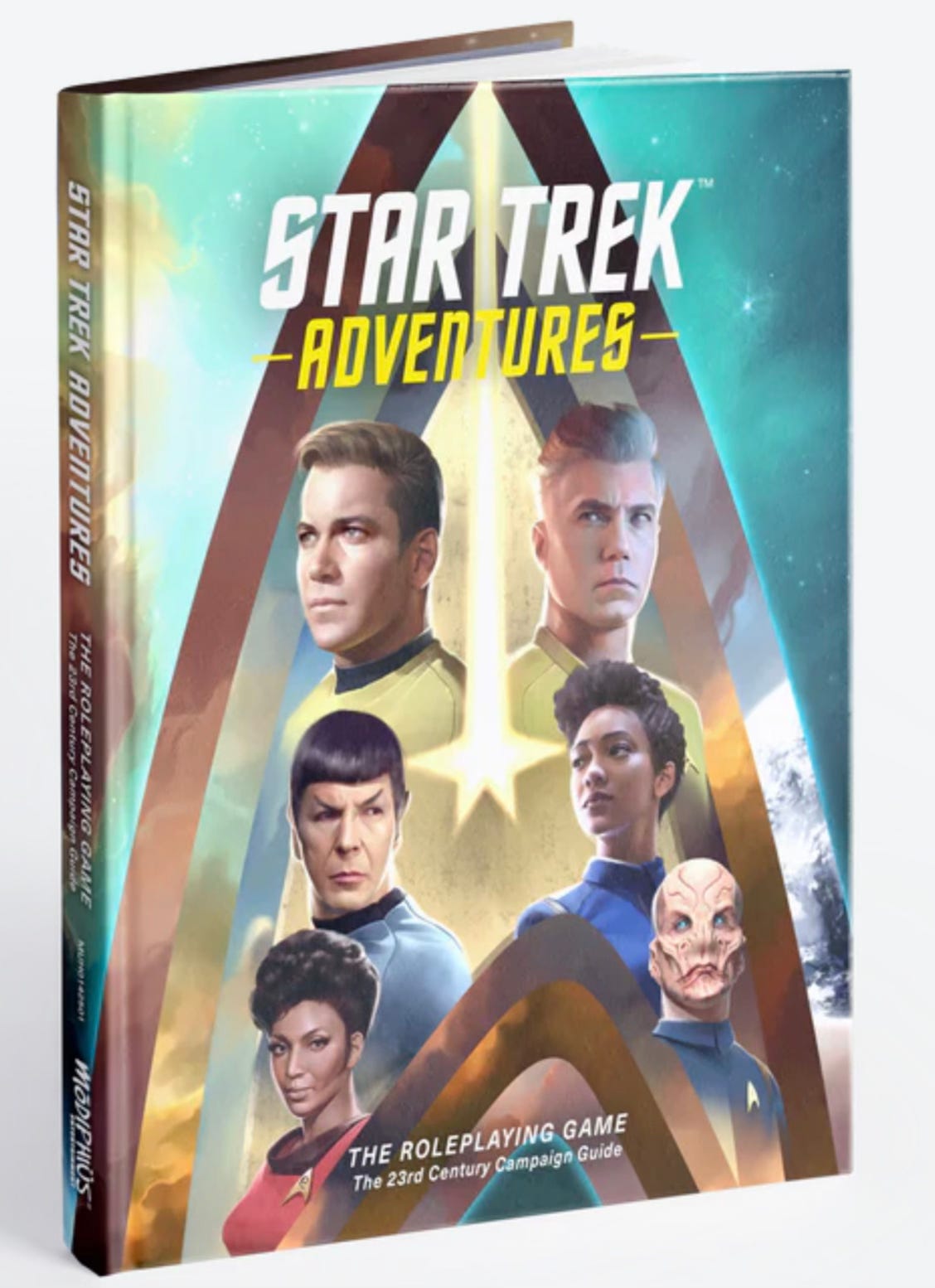
The third release for Star Trek Adventures is The 23rd Century Campaign Guide. This one (as with the new Species Sourcebook) kinda crept up on me. One thing Modiphius is doing well — and that Free League has been seriously falling down on with it’s Blade Runner and Alen lines — is dropping pre-orders once their material is ready to go…not making you wait a year for them to get it cleared by their licensors. Kudos to Jim Johnson for managing this line extremely well.
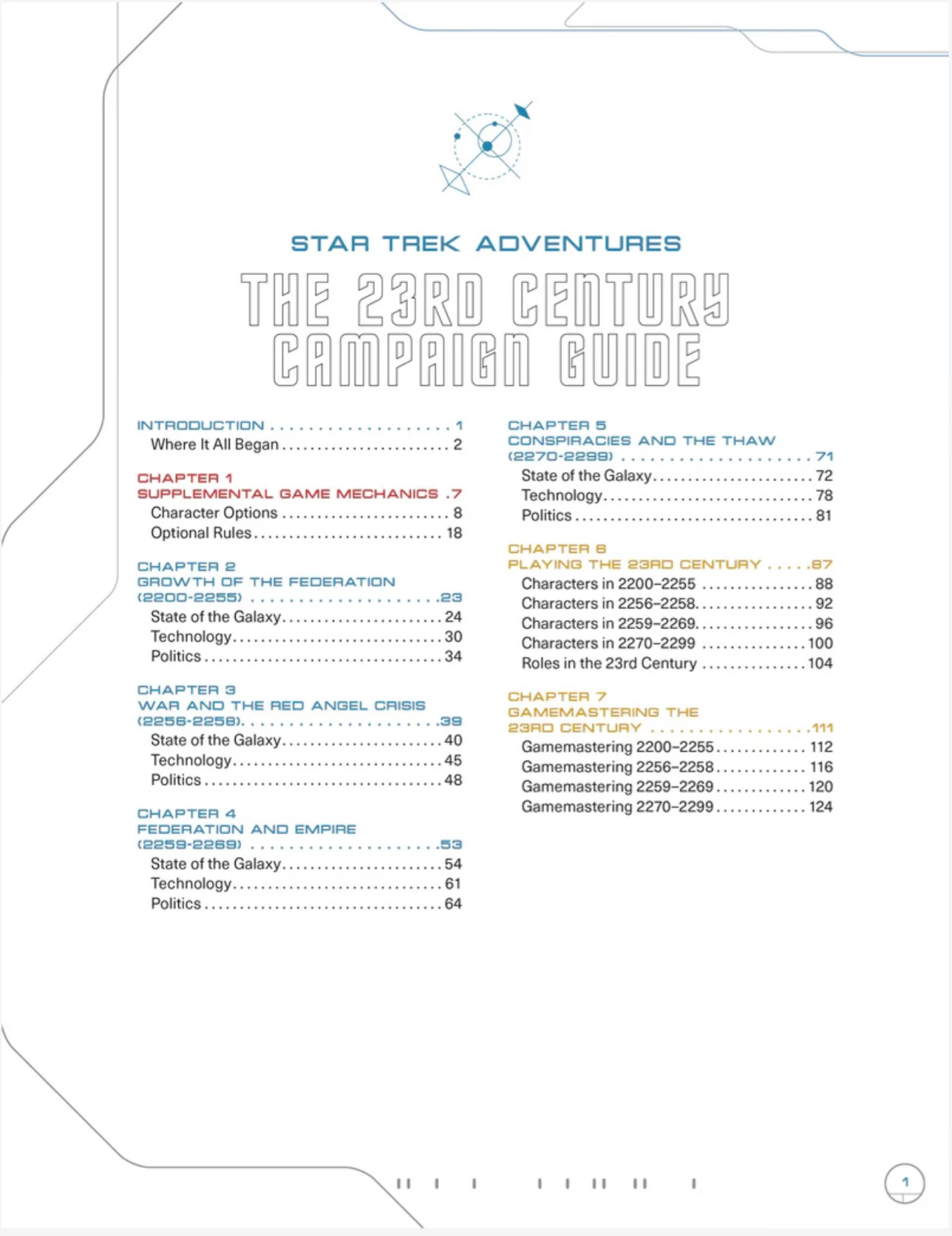
The guide provides a nice overview of the entire century — not just the events of Discovery through the old show movies. The chapters give a political and technological overview of the pre-Disco era (starting from the end of the Enterprise era), and they also focus a few pages on how each of the major polities are affected — the Federation, the Klingon and Romulan empires, the Cardassian Union, and the Orion Syndicate. The chapters are broken into the pre-Discovery period, the Disco/Strange New Worlds period, the Old Series, and the movie period. For those who have only a passing knowledge of the setting (especially the pre-Discovery and the original movies), this a fast entry into the 23rd Century. There is also a latter chapter on creating characters specific to the era, including suggested focuses, traits, and values. For those GMs with players who are unfamiliar with these period settings, this can help create characters consistent to the goings-on around them. It also ties neatly with the first chapter, which provides new lifepath options for having grown up on a species homeworld different from your own, a new civilian profession (free trader), and specific high-impact events from the various shows and movies. Was your character present for the V’Ger incident, or at the Khitomer Accords? Now you can have that as a specific event in character creation. The first chapter also has updated rules on scars, fatigue, and trauma borrowed from The Federation-Klingon War sourcebook for first edition. A final chapter gives tips for plotting adventures during the various series’ settings.
Artwork remains solidly good to very good, and Paolo Puggioni’s cover deserves a special shout-out. There’s a frontpiece on the inside over with the various uniforms of the period — much of it cribbed from other earlies books in the first and second editions, and the backpiece has a timeline for the “Prime” and “Terran” (read Mirror) Universes, as well as the execrable J.J. Abrams “Kelvan” timeline.
So, is it worth it? At 129 pages, $60 might be a bit hefty if you’re a confirmed Trekkie or just hit up the Memory Alpha site for information. I’m not certain how much use I’ll get out of this, but it is a good-looking book and well made, with plenty of useable game mechanics and ideas to launch off of. If cost is a problem and you don’t mind using the cheaper PDFs for reference — that’s definitely worth it.
The copyright for 2d20 system is Modiphius, 2019. STAR TREK and related marks and logos are trademarks of CBS Studios inc. All Rights Reserved and no infringement is intended.
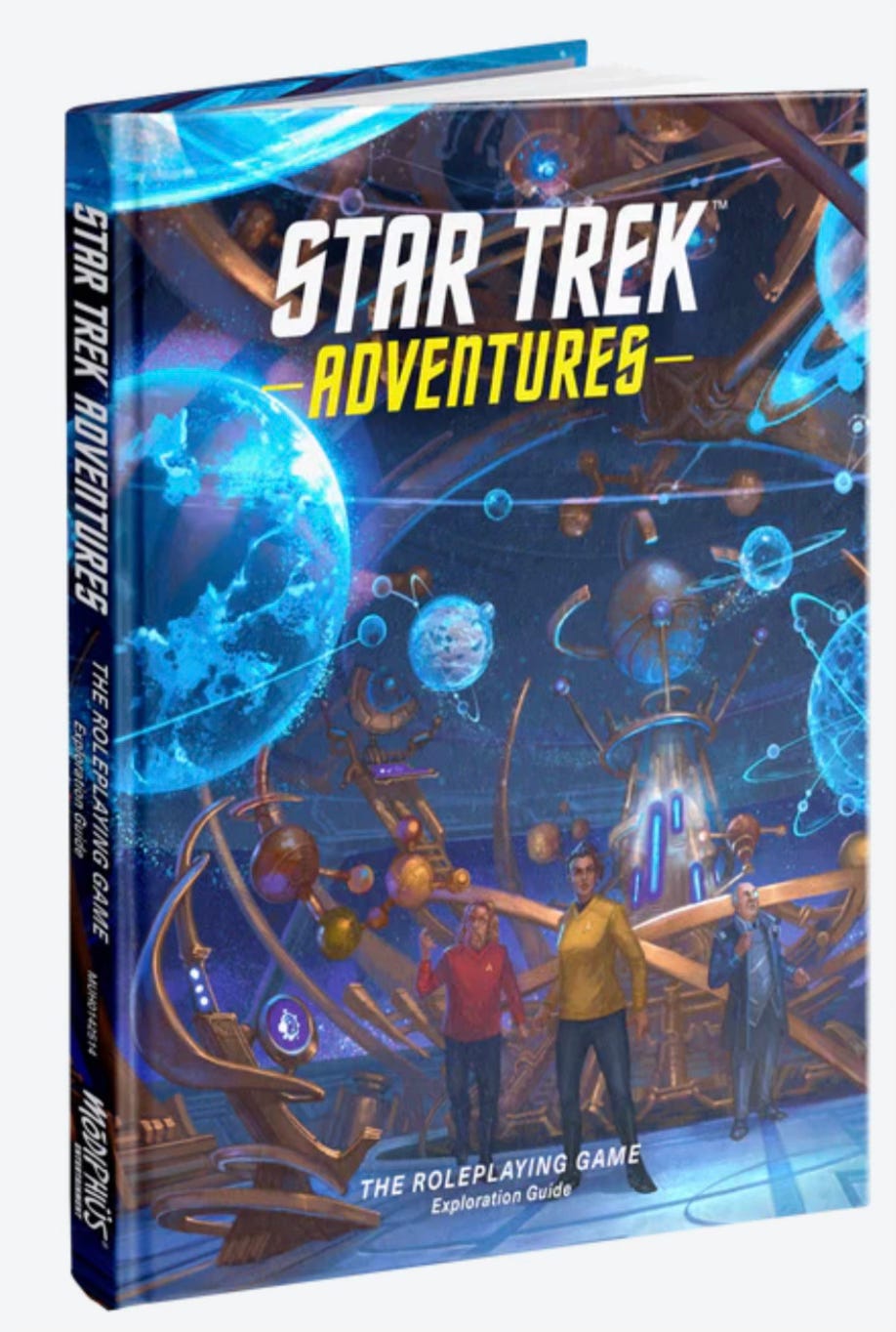
Modiphius has been on a roll with their Star Trek Adventures line since brining out the 2nd Edition rules set. Over the last year, there’s been four sourcebooks that have dropped. We already looked at the Technical Manual released in April 2025, which was followed by the Exploration Guide in October, then the 23rd Century Sourcebook around Christmas time, and the PDF for the Species Sourcebook just dropped yesterday.
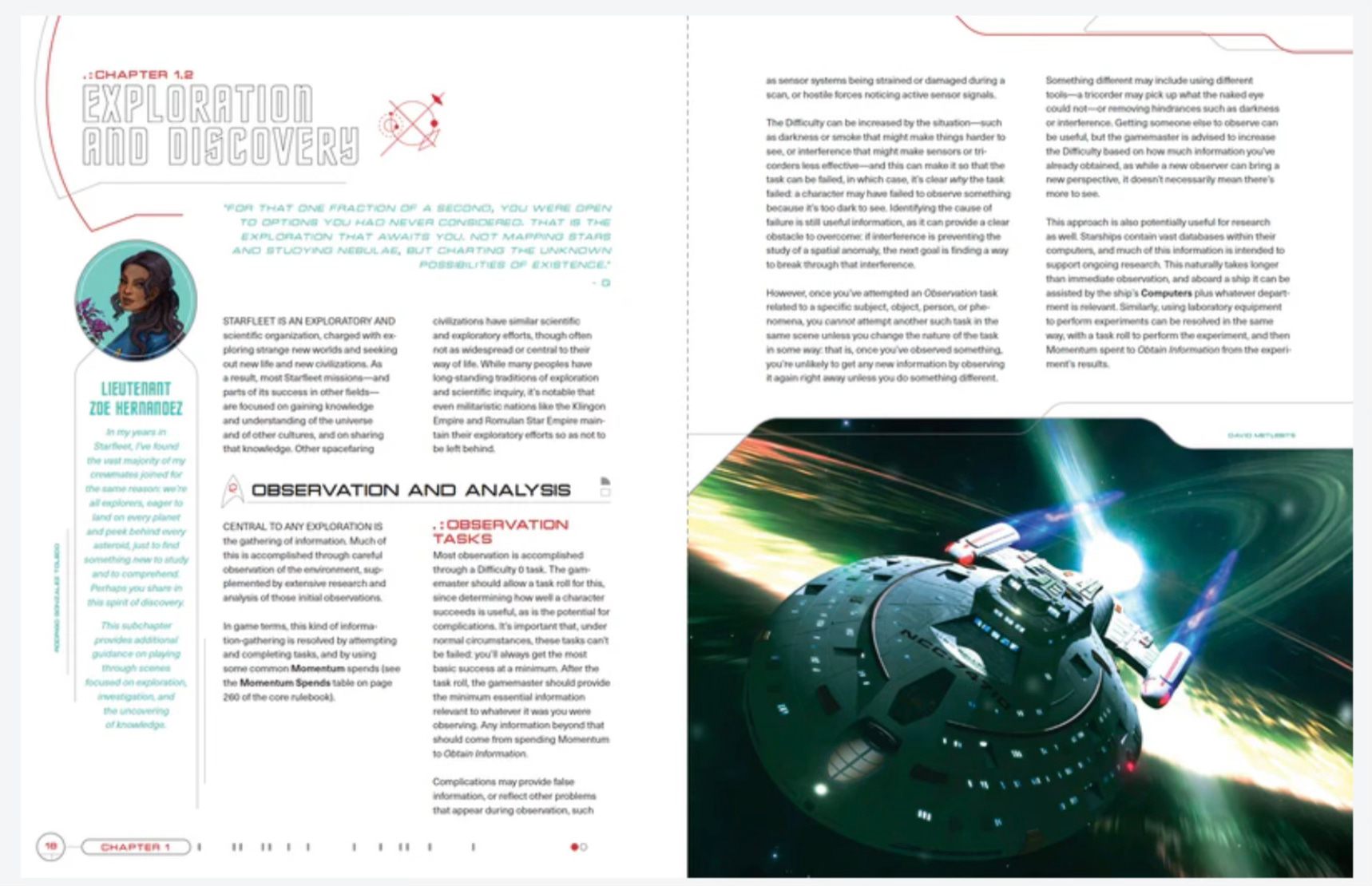
The Exploration Guide feels like it was peeled off from the Technical Manual, and feels like these could have been a single book. As it is, as 144 pages it’s a nice size to peruse or do a quick reference. The production values are good, and have been consistent across the 2nd Edition line, so far. It comes with a smallish folding map with Alpha and Beta Quadrants, c. 2259 on one side, and a 2401 version on the reverse. They are the same maps as seen in the frontpiece and backpiece the inner cover of the book. The maps are nice enough, but a bit small, compared to the old setting map that 1st Edition had from the old Geoffrey Mandel Star Charts book, and isn’t as easy to reference. The 25th Century map is especially mutes and hard to reference at the table.
The layout is consistent with the new look of 2nd Edition: bright, clean, and easy to read. Like the Technical Manual, the artwork is all new — I didn’t notice a reuse of prior artwork from first Edition or even the new core book. The cover is by the same artist as the prior book, and the artists used look to be the same. It gives a consistent flavor from the core book, to these two sourcebooks.
There’s new lifepaths, the Independent Archeologist and the Outpost Researcher, and about a dozen new career events, new talents, and the addition of civilian awards you can buy with advancement. It’s a new civilian focus that cuts throughout the book. The other chapters cover sector design, star and system design, and planetary design for your setting. I banged out a couple of worlds and systems — and it works well. Prior to this, I had been using the system creation rules from the Alien RPG’s Building Better Worlds sourcebook, with tweaks. The last chapter deals with specific biomes — ocean, jungle, etc. — and how to design specific features, plant and animal life. There’s also encounter tables for those that was random encounters.
So, is it worth it? The guide is pretty useful for putting together material for your game — especially if you are planning a campaign in a particular region (hence the sector design), and is a good follow-up to the Technical Manual. At 144 pages, it feels a bit thin for the $60ish bucks for the hardcover book, but if you are like me and prefer to work out of a physical resource, then yes — it’s worth it…maybe more so than the Technical Manual. If you’re good with PDF, the price point is certainly more forgiving.
The copyright for 2d20 system is Modiphius, 2019. STAR TREK and related marks and logos are trademarks of CBS Studios inc. All Rights Reserved and no infringement is intended.
I jumped on the pre-order for the Alien RPG waaaay back when it first came out in 2019. My game group wound up running a campaign that — trading out with other games a few weeks here and there — ran for about two years or so. (And may be coming back to the rotation soon…)
When I saw the ads for the “evolved edition” last year I was less than interested. It seemed a touch early for a second edition, and there was still material (Building Better Worlds and the Heart of Darkness set) coming out…so why change? Two things come to mind for the why immediately. Inflation — the cost of producing books has shot up. Alien and Blade Runner use black page color, which is expensive (and, I think, a bit harder to read) and the release of Alien: Romulus and a desire by Free League, Fox, or both to do something that included the new material.
I’ve been reading a lot of chatter back and forth about the new edition, which everything from “it’s a cash grab” and “the new look sucks” to “this is great” and “I like the new rules for…” With the holidays coming up and my propensity for buying stuff I want before the wife can get me gifts for birthdays, holidays, etc. I decided to make this one of my Christmas asks, though I was more interested in the Spinner that Master Replica had coming out. (Which will have a review soon.)
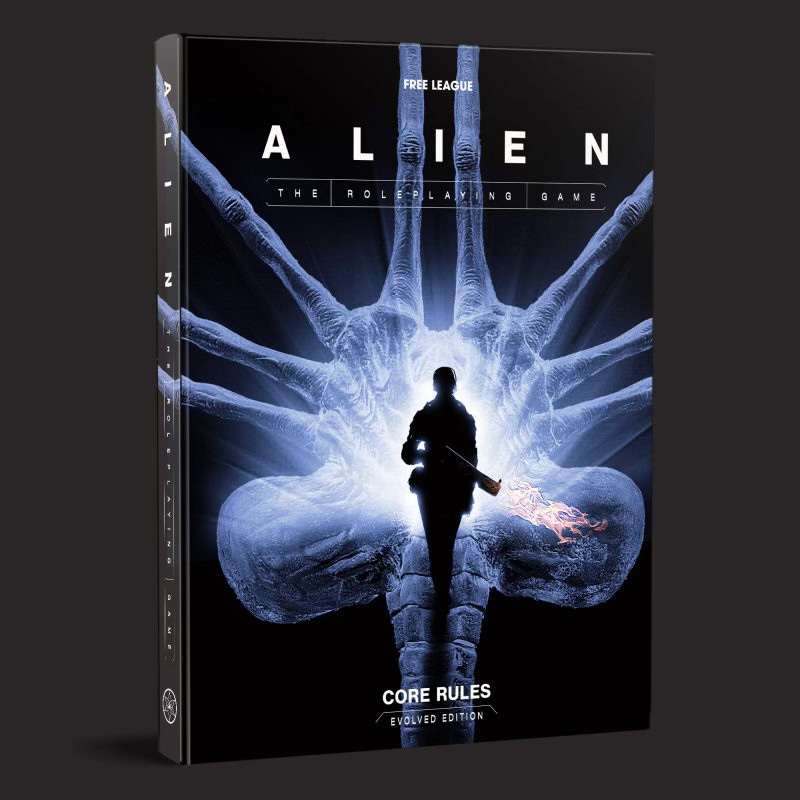
So, the Alien Evolved Edition RPG arrived for Christmas, and after having a few passes through it to see what was different (or not), let’s start with the good. The binding is much better than the older books, partly because of the reduced page count — down about 60 pages from the original. (More on that in a moment…)
There’s been a few clarifications on the basic die mechanic (which is terribly simple), and some changes to combat (specifically armor), the panic rules, and the addition of solo play rules and an optional “lifepath” style character creation. There’s also more material from the movies, on the setting, and the word count is much more beefy than the original book — which at 380ish pages had maybe half that in actual material — and comes in at 311 pages. And definitely has more stuff in it. more on that in a moment.
The lifepath character creation is tucked in the appendix, also with the “Last Survivor” solo rules. You can roll (or honestly just use it as inspiration) events in the character’s life to help build out what you want to play. No, Traveler fans, you cannot die in character creation. It’s a nice addition, especially for players who don’t have a strong grounding in the setting and need a bit of help.
The solo rules are — as with most solo rules sets — a series of ideas and random event charts to help a person play an adventure if they don’t have anyone to play with. Star Trek Adventures did this very well with their Captain’s Log — which really is half-play/half- fan fic creation, as you are supposed to write your adventure out as a log entry. It’s a neat conceit. Doing something like that for Last Survivor could be a way to charge it up a bit.
The main changes are things like armor. It used to be you rolled a number of dice equal to the armor rating and successes negated attack successes. Simple, but it meant armor did bugger all, or essentially stopped an attack. In A:EE, the armor rating kills off that amount of damage. More simple and more intuitive. It will play better.
The new panic rules include a “stress response” chart for non-panic, you’re just stressed out situations. I’m feel personally vindicated on this one (and peeved, since it was one of the first things I modded for Alien back in 2020. The old stress/panic set up could spiral, and fast, with bad rolls even in non-threatening situations, so I cooked up a “stressed out” table. Now you have an official one. Panic, similarly, got tweaked a bit so that you can now have multiple panic responses, instead of regularly stepping up through them. The mechanic for it is new: roll a d6, add your stress level, but now you reduce it by your resolve rating. Less chance of a full blown freakout, but it does look like it could lead to lesser panic responses early. This was a complaint I’ve seen online and which could be easily tweaked to reduce panicking too early (especially for marine characters, who should handle danger better than a crew of a space tramp steamer or colonists.)
While I consider the following “good” about the new book, you might be of a different opinion. The layout…
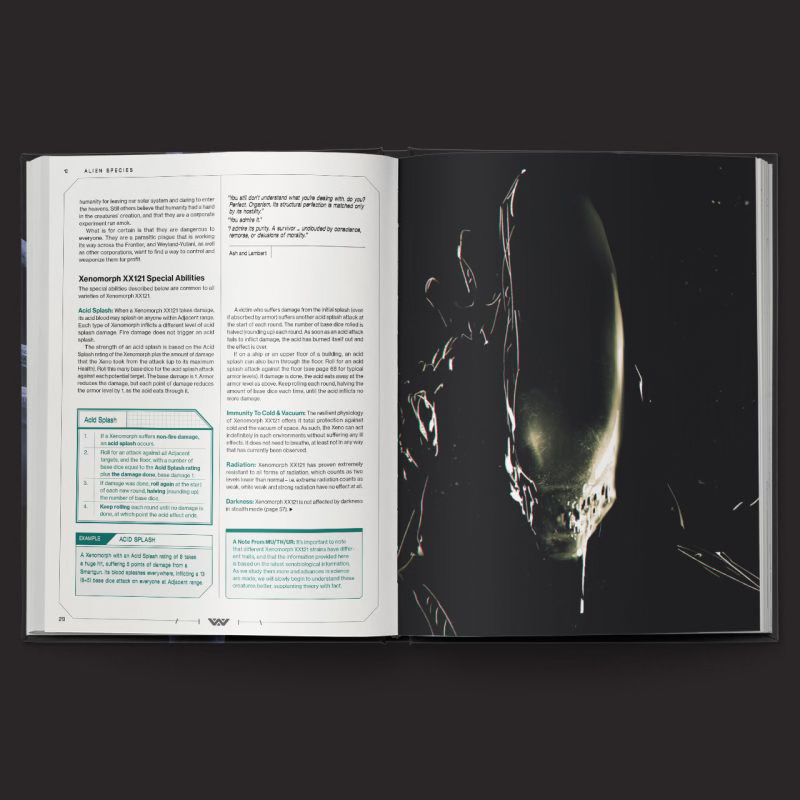
I get why some don’t like it. The original pages were black, with text boxes in a light green with black or dark green text, that while readable, meant that you got a lot less game but a more unified look with the artwork. And to be fair, the art was superb, atmospheric, and really leant to the enjoyment of the book. It was also very much Free League’s style at the time (as with the Tales from the Loop series of games and Blade Runner): half art book, half game book. The new layout — and I chose the above specifically as an example of this — loses a lot of that atmosphere for readability and a focus on the game mechanics and setting material. It’s much less pretty and less of an experience to read. It’s also much more useful from an information and usability standpoint. (It’s also probably much cheaper for Free League to print.)
Similarly, the gamemaster screen is more readable in the new format, with the player side showing art that looks like the circuity cubbyholes of MU/TH/UR’s vestibule in Nostromo, with the circuitry map on a screen in the middle. Looks nice, simple, but I think the original screen — on the player’s side — was better; the GM side is better in the new edition GM screen.
The bad? Not much. Some may complain about the inclusion of more material connected to Romulus — I like it. There’s more gear in the corebook, and even mundane stuff like water can have an impact, mechanically. All of this is, of course, something you can just ignore. That’s the nice thing about this edition; you can just use what you like and ignore the rest. The basic mechanics are the same: roll a number of dice equal to your ability and skill, set a 6 on one of them to succeed.
If anything, I’m a little disappointed they didn’t move to the die mechanic from Twilight: 2000 and Blade Runner. I like the different type of dice — but this system is basic to the point of utilitarian. It doesn’t get in the way. The stress/panic mechanic is still one of the best for urging the players to lean into the horror aspect of the game, instead of ignoring the impact that awful stuff happen ing around you has to a character.
So, is it worth it? At about $50-60 US for the core book, it’s a solid yes if you’ve wanted to get the Alien game and just haven’t. If you’re happy with the old version, it’s not a must — but after reading it, I’m happy I’ve got it, and I think it’s worth it for some of the extra gear, alternate rules, and added material from Romulus.
Normally, I wait until I have a physical copy for a review of a game, but Legend in the Mist is looking like a late spring/early summer timeframe for that. Kickstarted earlier this year, Sons of Oak promised “…[a] rustic fantasy tabletop RPG based on the acclaimed City of Mist.” It is essentially an engine similar to Powered by the Apocalypse, using “tags” to modify task rolls, rather than a plethora of modifiers. I was a little skeptical of the system — my experience with the PbtA games has been lackluster, but Sions of Oak give you the chance to try out the game with a comic book-style mini-adventure that plays like the old Create Your Own Adventure books of old — you chose an action, go to the appropriate page, and press on. It’s a novel way to teach the game, and the artwork..? The artwork is gorgeous. I must not have been alone in my assessment: the Kickstart pulled $855,000 or so. Pre-orders are still being taken and I went all in on the Ravenhome bundle.
The PDFs of the main books — both the core rulebook and Action Grimoire are already out, as is the PDF of the GM screen (which is actually useful!), as well as a few extra bits: a Halloween and Winter-themed short with creatures, etc, and a Dungeons & Dragons 5E conversion guide for the main character classes. If you preorder, you get these little “splatbooks”.
So first, the production values. Yes, I only have the PDFs to go by, for now, but these are gorgeous books. The artwork has a realistic animated film kind of look with multiple two page pieces that blend one into the other.
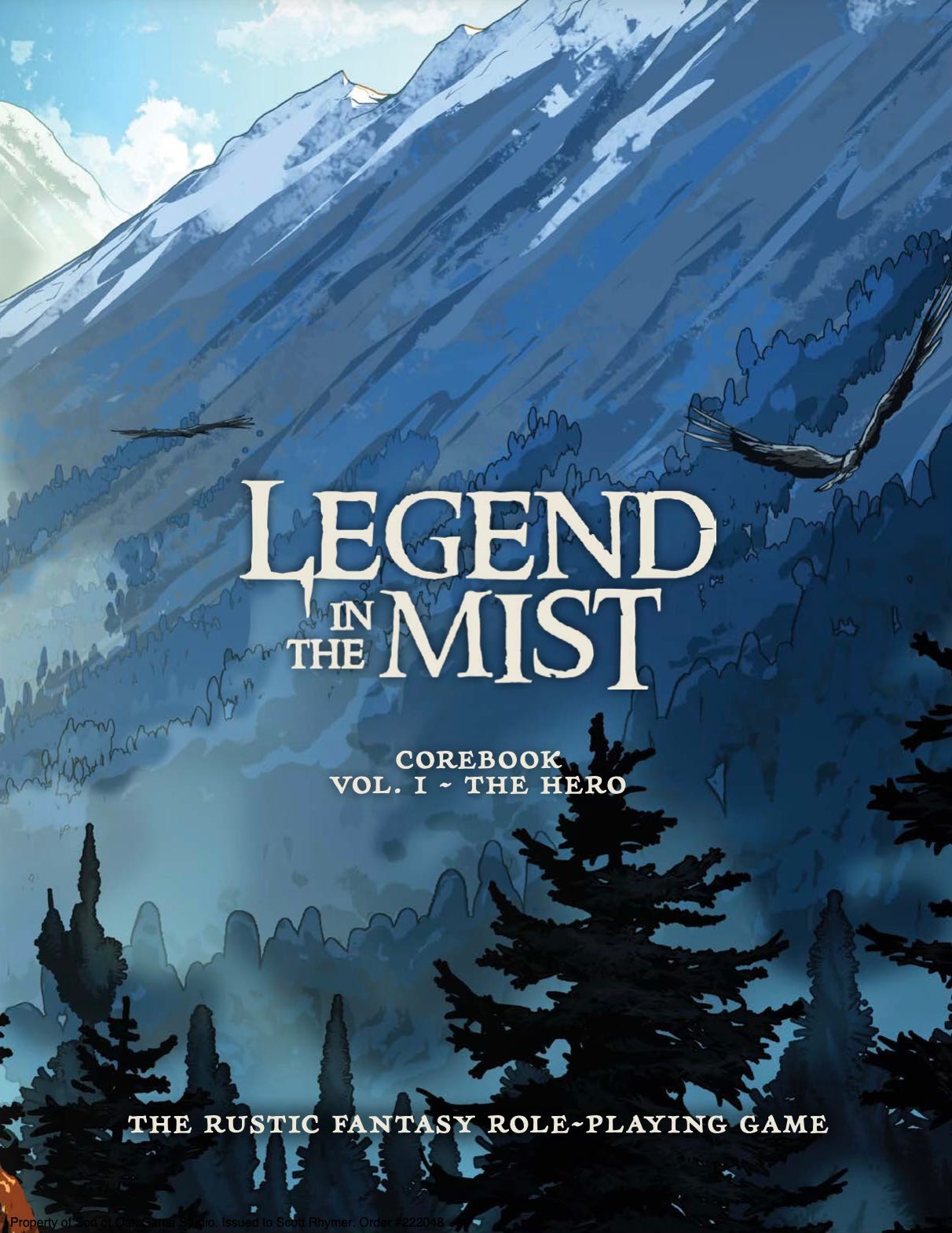
The title page…
You build a character by creating four “themes” — based on personality, your trade or job, background, etc. — and there are three “might” levels: origin, adventurer, and greatness, so you can play from rank amateur or average adventurer, to trained and skilled heros, to powerful heroes. You can choose from pre-existing themes like Artisan, or Prophetic Visions — there are “power tags” listed that give you a bump on your die rolls, depending on if they are applicable or not. You choose two and one weakness tag which might work against you in a scene. For instance, a Hunter might have a “Well Crafted Bow” and “Animal Lore”, with a weakness of “Ragged & Dirty”. You get four of these themes, plus a “backpack” for gear. There’s also a Fellowship Theme for group play explaining why you’re together.
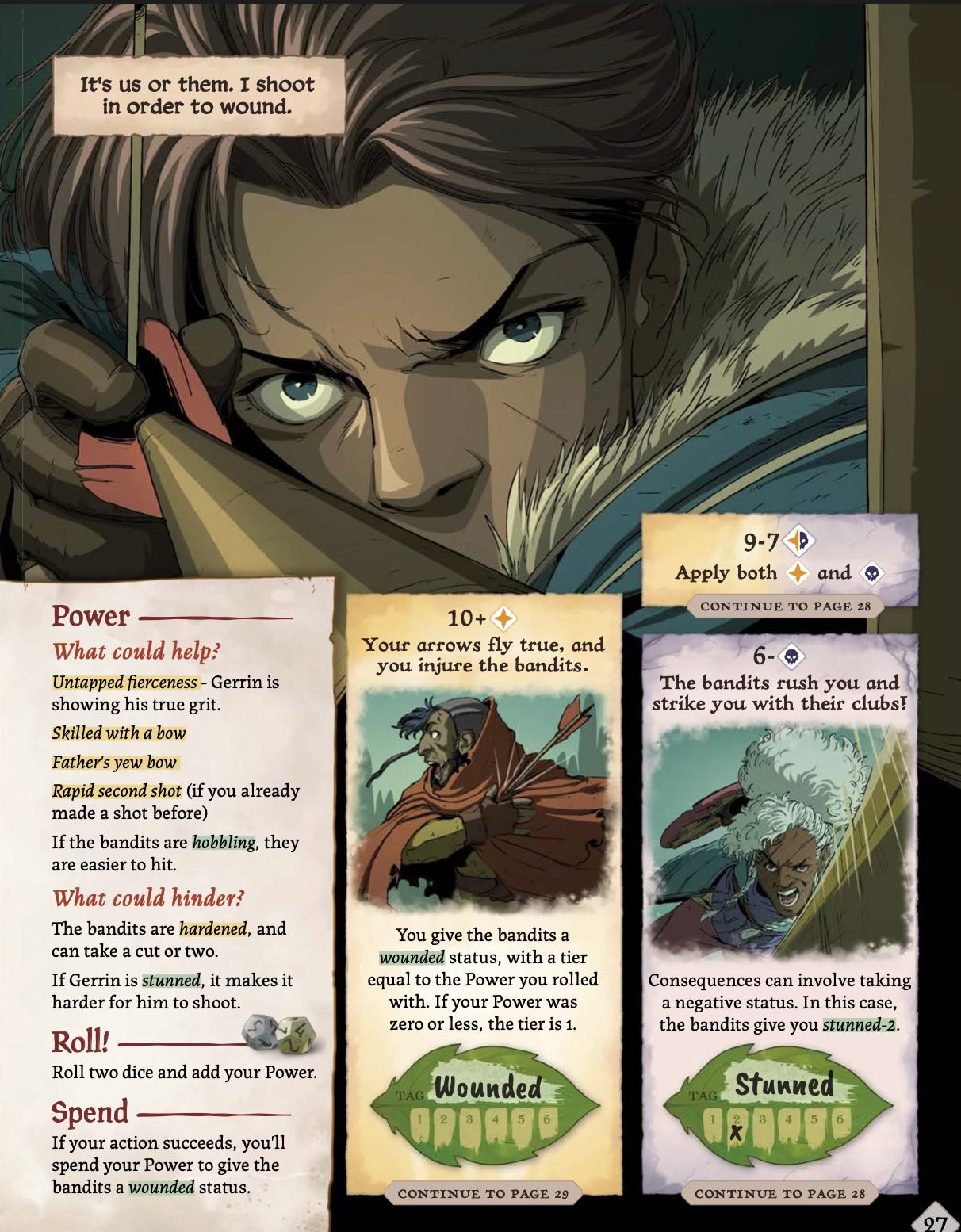
You’re ready to go. Play is simple: the GM gives you a situation, you tell them what you want to do to respond and figure out which tags work for the scene (which might have it’s own tags like “Bandits!” or “Heavy Downpour” that take away from your roll. Roll 2d6 added together to give you the result. A 10+ gives a success and depending on the tags, you give a “status” to your opponents or you overcome whatever obstacle you were meeting. A 7-9 gives a success, but with a consequence — a negative status to you. Six or lower is a consequence and you failed. For instance, say you were climbing a cliffside and had “Strong as an Ox” and “Athletic” tags that were appropriate — that adds 2 to your roll. However, it’s raining and the rock is slick for a -1 to your test. You roll a 7 (+2 for your tags and -1 for the rain for an 8.) You make it up the cliff, but you might have a consequence of “Scrapped Up” or it you were on a time limit you might be “Behind Schedule”. Here’s an example from the comic:
The books has plenty of examples of situations and opponents — all approached in the same way, and the Action Grimoire adds to the number of scenarios your could borrow from on the fly as a gamemaster. I ran two nights of Legend in the Mist using a vague idea of an adventure, and used the core book and Grimoire to slap together encounters that ran quickly and well. Both groups thought the game rules were simple and quick to understand, although trying to figure if a tag was appropriate had a lot of trying to stretch the meaning of the tags. Spitballing statuses was a bit tricky the first time out, but once it clicks, the game is easy to run — even off of the PDFs and a two page cheatsheet you can get off the Sons of Oak website.
The core book is a double volume coming in at a hefty 496 pages in PDF format, the Action Grimoire is another 103. Even the 5E splatbook is 25 pages.
So, is it worth the $50 for the core book and $20 for the Grimoire? Yes…and unreservedly so. One thing I’ve always disliked about Dungeons & Dragons is the staggering amount of rules you have to sift through, especially regarding magic. None of that here — it’s a simple engine for play, leads to good character creation and role play. It’s also just beautiful to leaf through.
All the artwork here is 2025 copyright the Sons of Oak Game Studio. No infringement is intended — only a good ol’ word of mouth assist for a good product.
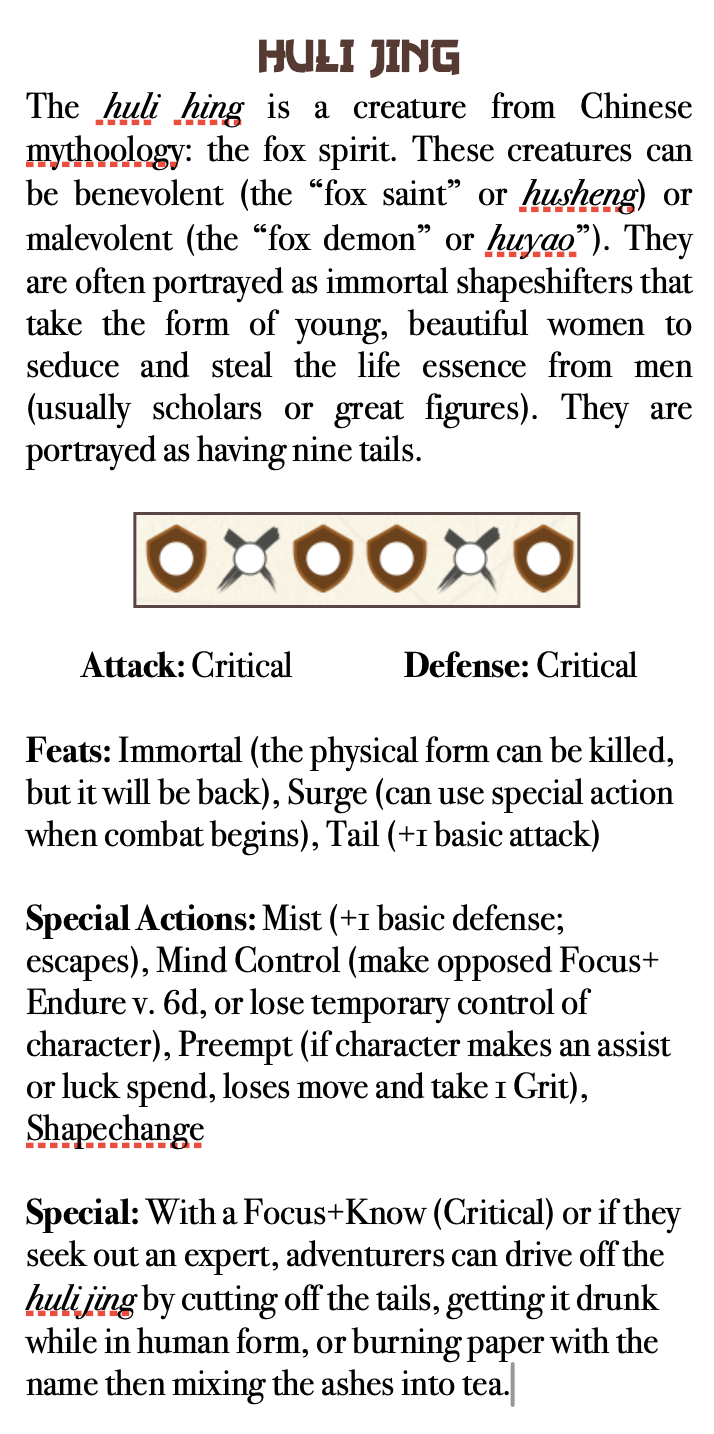
I’ve been running an Outgunned Adventure! campaign set in 1920s China. The most recent threat was a huli jing — a fox spirit. The creature is popular in Chinese, but also Korean, Japanese, and Vietnamese myth. These usually immortal creatures have nine tails in fox form and can shapeshift — usually into beautiful young women who seduce scholarly or important men to steal their knowledge and life essence. (You can guess how…) They can be driven off by catching them in fox form and cutting off their tails, or in human form by getting them drunk. Alternately, they can be driven off if you know the name by writing it on paper, burning the paper, and mixing the ashes in tea.
All the Franz Joseph fans from the ‘70s were in for a treat with the first episode of Strange New Worlds — the Saladin-class!
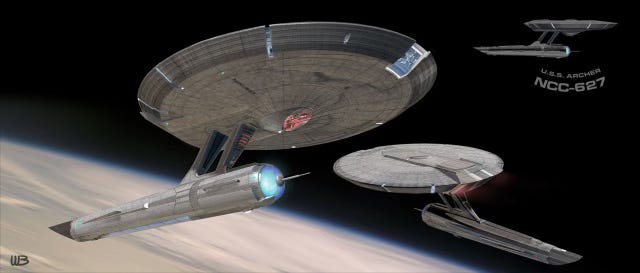
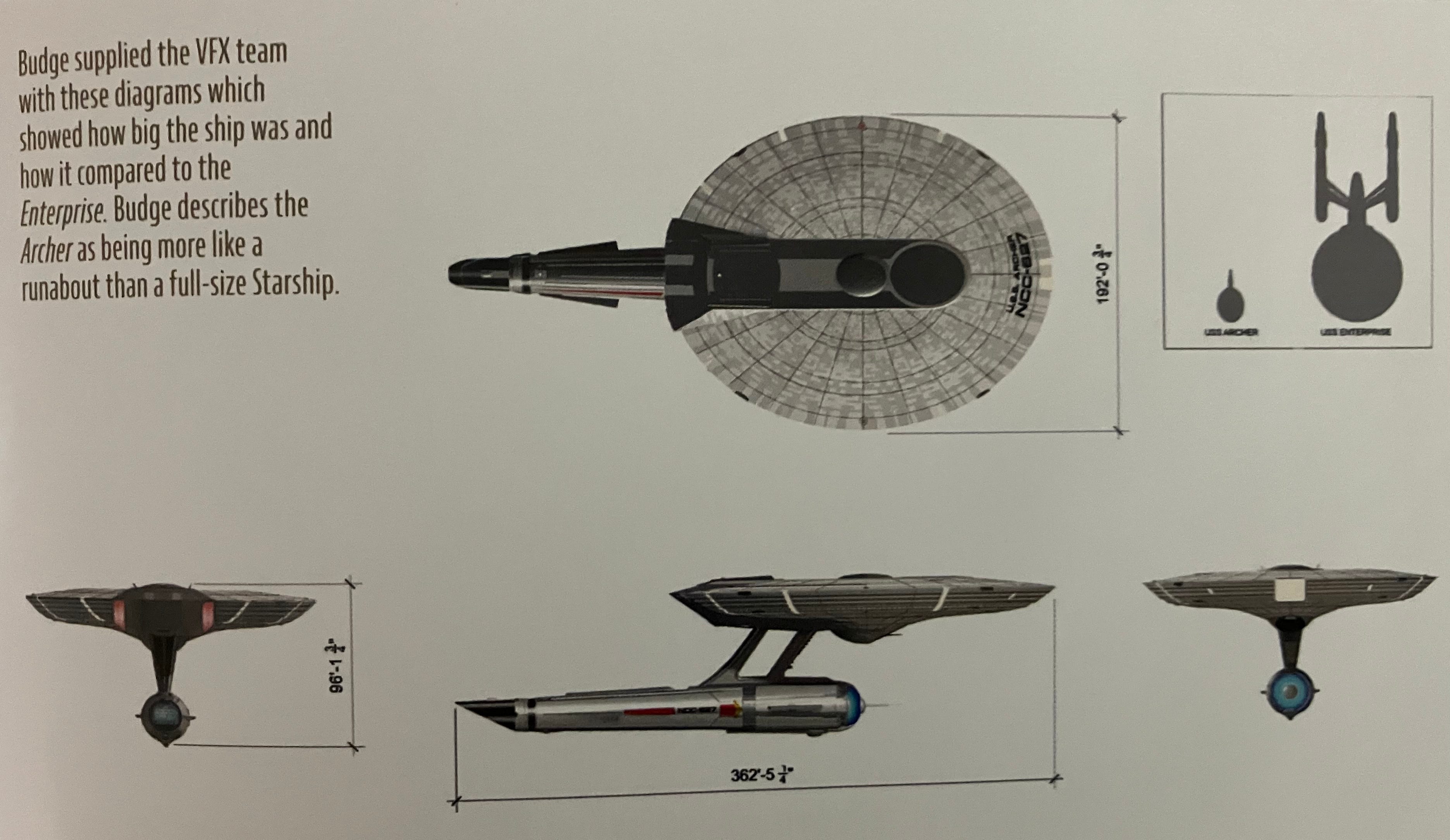
Nope…this is the Gral-class starship USS Archer, NCC-627. Fanhome dropped their latest model of the ship this month and the wee booklet that came with it describing the design process and thinking buffs out what we know about her: she’s small, has a crew of three, and is “more of a runabout than a starship”. There’s no mention of if it is armed, but if the Class C shuttlecraft had phasers, this mot likely does, as well — if only a bank or two.
She’s described as 110.47m long, 58m on the beam (making the saucer 77ish meters from bow to stern), and a draught on the dish of 10ish meters. The guide claims one deck, but the thickness suggests there could be two. The bridge is supposed to be at the bow (so that’s a window), and the slits along the sides also windows. That makes it about the size of two super-yachts side-by-side…more than enough space for a standard crew of 25-50 by SNW standards (with Enterprise having a crew of 210.)
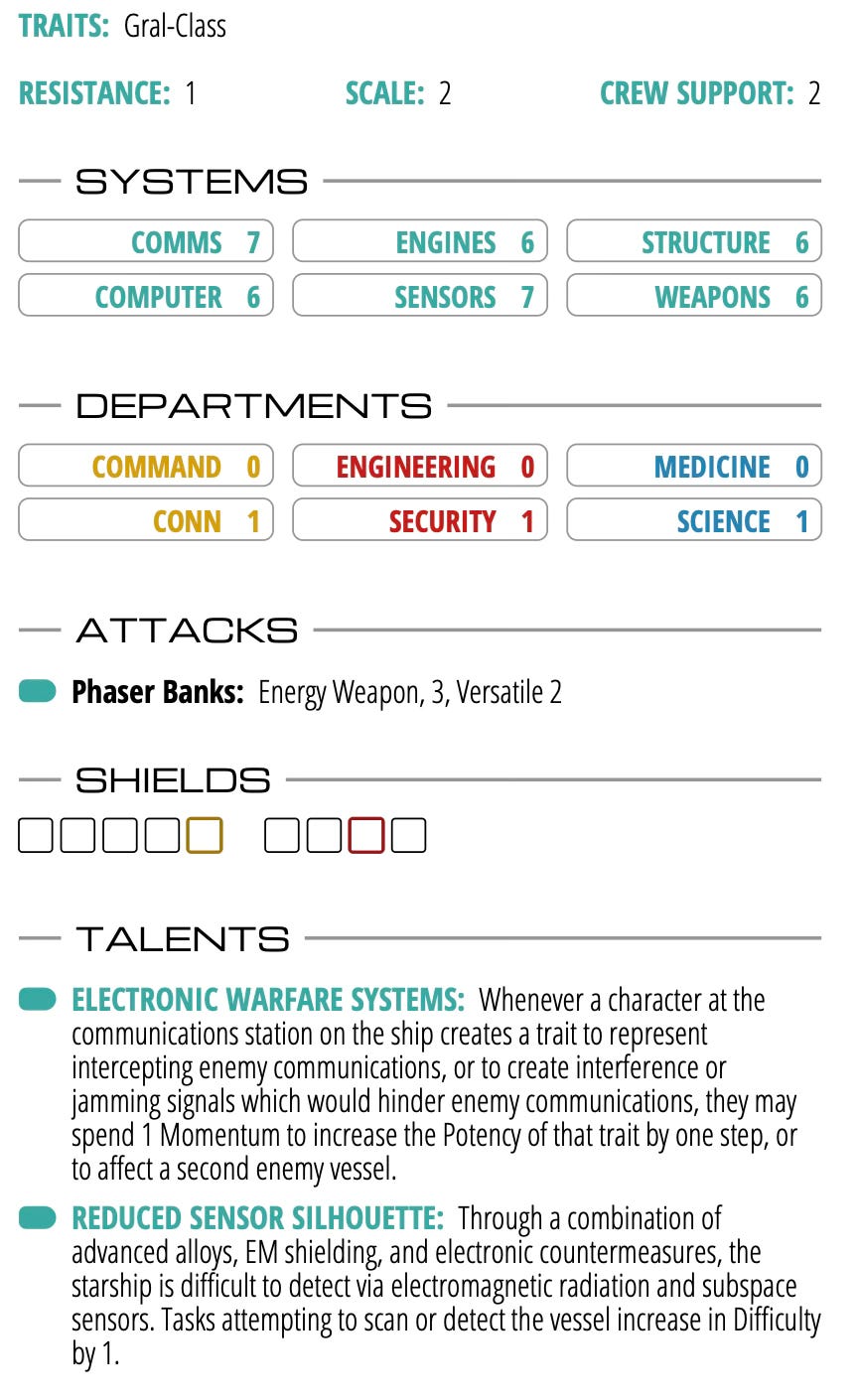
So here’s my take on the Gral — your lightyears may vary:
This build assumes these are used for covert missions in denied areas — either watching pre-warp alien cultures in secret or scouting the edges of the Neutral Zone. For our game, I’m assuming two decks, with most of the engineering areas in the space under the central raised section on the dorsal hull, and a crew of 25-30 standard, with the senior staff typically being lieutenant commanders.
Looks like I’m running Outgunned! on Thursday morning and evening. The adventure is The Lagos Job — and will run the players through character creation and a mission in the four hour block. Yes — we can do a full adventure and character creation in that time. Character creation is staggeringly easy, and with the stretch goals card deck, the players can find their roles and tropes and knock out their character in under half an hour. I’ve already done it with a five person table in that time.
Friday is Blade Runner — I’ll be running the original Electric Dreams adventure from the Starter Set with pre-gen characters from the same. Got a morning and afternoon game. I’ve played in this one last year at GenCon and it’s a good mission.
Saturday is my working the whole day — Alien, running the original Chariot of the Gods adventure. If I can get Free League to drop me a PDF (or if I can score a hard copy) of the new edition, I might even run the games using the new rules.
Sunday morning is Outgunned! again, then I have to move fast to catch my flight out of Indianapolis.
“Rum Row” is a 2-4 hour scenario for 3-5 players where the characters are roped into a bet — which crew can make the run from Bimini, stop to pick up alcohol at Rum Row and land it in Fort Lauderdale, then return to Bimini first? What could go wrong?
The scenario is written for Ubiquity, but we’ve added some suggestions on how to tweak for other systems like Spirit of the Century‘s FATE and Director’s Cut, the excellent engine for Outgunned Adventure by 2 Little Mice.
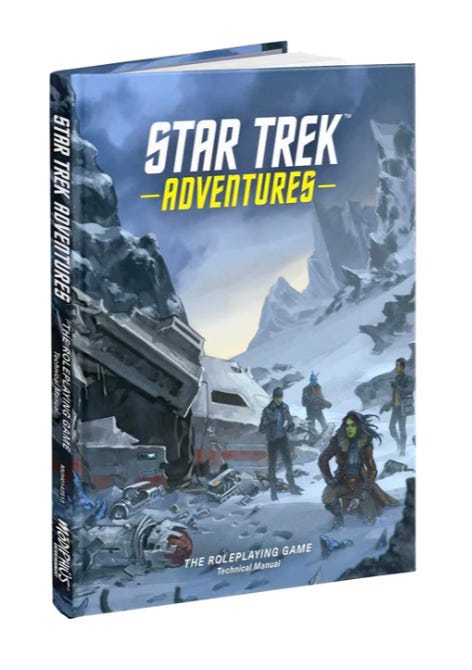
Modiphius had dropped its first supplement for the second edition of Stark Trek Adventures — the Technical Manual is a 129 pages of material on the various gear of the Star Trek universe. From the universal translator to tricorders, alien weapons to phasers, starship systems like the warp drive to replicators, the book gives some insight into the history and working of the toys of Trek.
There’s new career events choices for character building in the first chapter, as well as some nice talents for characters and service histories for starships that lean into the technical and the weird of the universe. There’s also a new section on space “mines” and the various different types. For those Discovery-philes, there’s material on the spore drive, and the quantum slipstream, transwarp, and protostar systems from the more recent shows also are featured.
Chapter 2 covers the usual equipment that the characters will encounter — from personal gear to replicators and holography. One of the better things that turns up in the chapters, and probably one of the best reasons to buy the book, is the charts for gear compications. Complications are one of the more important, and from what I’ve experienced, one the worst understood, game mechanics in the 2d20 system.
Chapter 3 is an odd choice that hasn’t, to my mind, ever features in a Trek RPG — diplomatic equipment, doctrine, and the like. There’s a large chunk of verbiage on the universal translator, and quite a few charts on complications for diplomatic missions and the use of the universal translator. Chapter 4 goes into scientific equipment, but also has some nice encounter and complication ideas for away teams. Chapter 5, similarly, medical equipment. The material here is influenced heavily by Strange New Worlds and Discovery — and real life: there’s cybernetics, genetic augmentations, and it even has PIke’s chair mentioned. 1966 Trek and the medicine of The Next Generationwas advanced…except for places that should obviously been more so — Worf’s spinal injury, for instance. They could wire LaForge for sight, but not get around a spinal injury with cybernetics?
Chapter 6 deals with the transporter, heavily, and as it is one of the main McGuffins for all the series…good. There’s a section on computer technology from Enterprise to Picard, and a section on the engineering gear of the various eras, plus the complications charts and suggestions. Chapter 7 deals with weapons and armor: from the various hand-to-hand instruments of the various alien races to the various energy weapons, each with a little crypto-history lesson.
Chapter 8 rounds it out with starship systems, and here I think the complications tables for the various different things — from shield or engines, to artificial gravity — will be a big help in starship combat missions.
The layout is clean and in the same design as the 2nd Edition rulebook. This is a good thing, as the LCARS look of the 1st edition, while evocative of the TNG/DS9/VOY era, was a pain to read for most folks. This is clean, neat, easy to read. The artwork is suitably improved, as well. The artwork for the Trek line has always been on the good side, but they’ve been getting it right for the last series of sourcebooks and 2E. While right now, it’s only available on PDF, the pre-order for the physical book is available on the Modiphius website. I suspect they’ll drop it for GenCon, but if it’s the usual hardcover (and seems to be), their track record on physical quality is pretty good.
So is it worth it? At $50 buck on the website for a 129 page book, that’s a bit steep, in my opinion. Hell, the core book isn’t much more expensive for twice the page count and the 2E starter set is selling for $35 on the website. My suspicion is, once we get past GenCon and the release of the book, you’ll be able to find it for a more reasonable $25-30 online. Is it worth buying, yes; at $50…you be the judge.
The copyright for 2d20 system is Modiphius, 2019. STAR TREK and related marks and logos are trademarks of CBS Studios inc. All Rights Reserved and no infringement is intended.

 The Black Campbell