Well, a lot of the stuff that has come in recently was Kickstarter between last year and the end of 2020, so the RPG bought this year was Mödiphiüs’ Star Trek Adventures, reviewed here. I had run a Star Trek game a few years ago, but I used the old Decipher system that had powered our long-running campaign of the early aughties. (A friend was a Trekkie, Enterprise was showing, I figured why not?)
Fast forward to this year. One of the other players has been running Fallout for us (review here) and the 2d20 system that had been so damned awful in playtesting years ago, was much better laid out and explained than when we were trying to struggle through the unedited playtest material for John Carter. I had popped for the PDF of the game a few years back never intending to play it, but maybe mine it for ideas at some point. After playing in Fallout, I had a pretty good sense of how the system worked, and what rules were a bit to wargame-y and would get conveniently ignored in a Trek game.
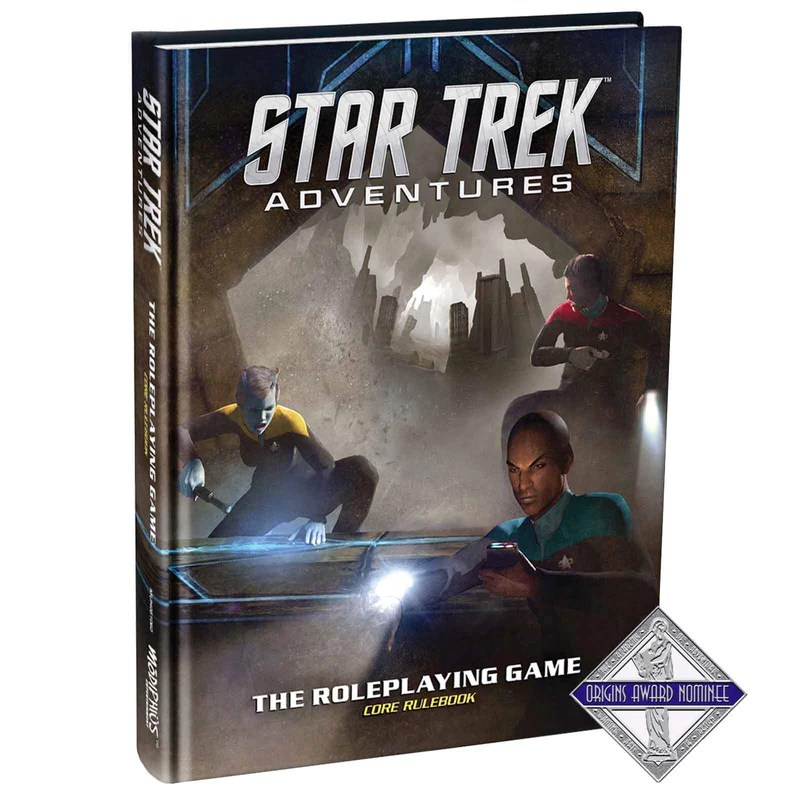
So I bought the Corebook bundle (comes with the PDFs for pretty much all the books expect Lower Decks and the Klingon supplement), a GM screen (which comes with an excellent set of starship combat sheets to aid players in what they can do when the photons start flying), and the Discovery-period sourcebook (more for the Strange New Worlds ties.) The goal is a “season 2” of the campaign we played a while back, using the 2d20 engine.
This post will also cover the Most Recent Game Bought post for tomorrow.
This was long enough ago I honestly don’t quite remember. I’ve been playing — starting with the box set of Dungeons & Dragons I got from Hess’ department store in…’78? ’79? maybe? Long enough that it was “dungeon master”, not gamemaster. I know it took a long time to find someone who wanted to play. There was a distant cousin I wound up running the game for, and there was an older guy who was running D&D at the local library, but I don’t remember his name, but I remember he didn’t make it very exciting; it was very rules oriented.
Once I had an actually group of friends playing by 1980, we played a lot — and I was usually the GM’d. We cycled through a lot of games — all the TSR offerings, then hit on James Bond:007, which was my favorite system until about a decade ago. It’s still damned good.
In college, others would take over running games, but they usually would last a few episodes then hand it off to me because they were busy or just didn’t have the time.
The only one that really sticks is the redheaded giant dude, totally spectrum, who ran Dungeons & Dragons for the group for about most of a session before we started working on peeling out the good gamers for our own group. This guy was stunningly misogynistic — after going through his 80 page bible on his game world, he gave us our characters, making sure the singular female got the cleric…who was mute. Better yet, he made sure his wife was getting us drinks and food. He had played once at our place and while stretching, he knocked the glass light cover off the kitchen ceiling. Shatter. Did he offer to clean up? Nope — he expected my then-wife to.
Then there was the goth Christian who ran Call of Chthulu — more on him later…
I decided to hedge my bets on this one and give the first RPG played with my daughter, and with the gaming group, this year. That gives me a chance to talk about two games!
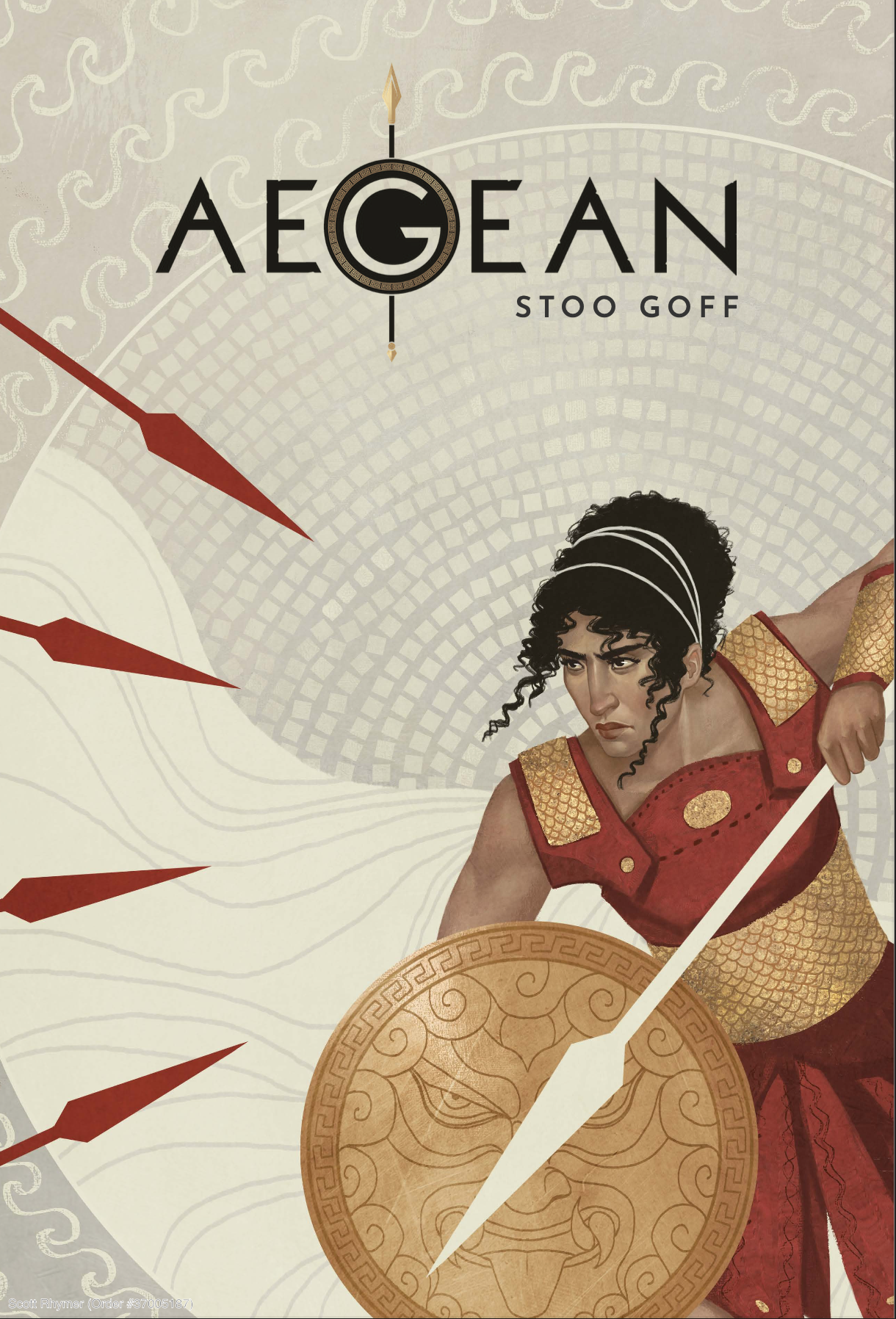
The first is the game I was playing with my daughter (and later the wife jumped in, as well): Aegean. This is a rules lite RPG set in ancient and mythic Greece. The players can be normal folks or demi-gods, and the there’s a couple of expansions that came along as stretch goals on the Kickstarter which ended way back in October of 2021, and which was supposed to be on backers’ doorsteps in Summer of 2022. Of course, between shutting the f***ing planet down and the attendant issues that caused, while the PDF has been in hand for a while, the printed materials (as of this writing) are still vaporware.
The system is simple — you have five attributes and fifteen of skills. To do something, add the appropriate skill and attribute and roll that number of ten-sided dice. Eights and above are successes, with 10 allowing you to activate a feat on your weapon, bank Resolve (their luck/story/hero point mechanic), give a success to a companion, or “invoke the fates”. It’s a pretty standard mechanic, especially for d6 games. It’s light, fast, and works. The character can embark on adventures from monster killing (a pretty common hero thing, even in Greek myth), to competing in contests at city games, to help to build up one’s polis — the city you are from. Players work together to create a basic polis and can get elected into the government.
Overall, the system is tight, there’s enough material to work with, and fans of the myths should be able to craft story arcs with ease. The production values, based off of the PDFs is very simple. Layouts are single column, block paragraph with easy to read typefaces. Art is at a minimum in the core book and teh follow-on Book of Heroes and Book of Empire — which I still haven’t had a chance to look through, as they came in which we were kicking the tires on other games systems at the time.
Aegean can still be pre-ordered at Kickstarter, and at DriveThruRPG. I should have gone with the print-on-demand version; proof for the print version were only spotted in April, so I’m expecting this to take another few months to see.
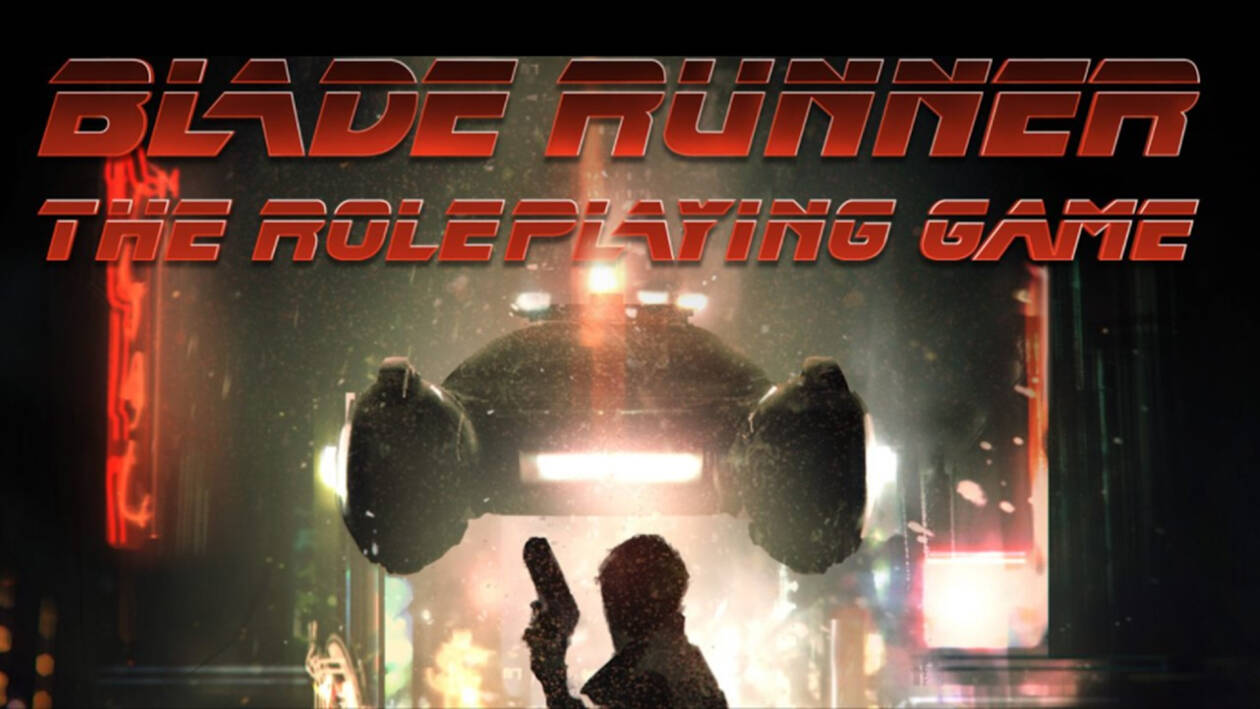
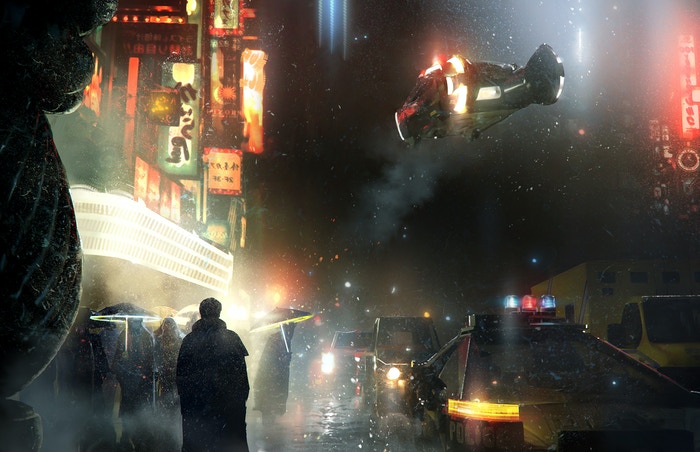
The other “first” for the game group was Free League’s Blade Runner. I love police procedurals and espionage adventures. Always did. Hell, they directed me into my former field of endeavor, before I got into teaching. Set in the rain-soaked, neon-lit, dystopian future of the movies, the game has the characters playing the eponymous police assassins. You can play a human or a replicant. I promptly ignored the need to be Rep-Detect and several of the characters are in other divisions of LAPD: a Robbery-Homicide detective (who caught the murder that started our campaign), a Special Investigations Service detective (they’ve got an…interesting history), and a pair of Blade Runners — an older experienced one with a dark secret, and a new Nexus 9.
The system is the Mutant Year Zero system, well the “2.0 version” I guess you might call it. Rather than rolling all d6s, the the characters roll between a d4 (really a d6 is the lowest for characters) up to a d12 depending on their attribute and their skill. A 6 or higher is a success, and a 10 or higher is a double success. (That sounds familiar…doesn’t it?) After having played Alien, where a wheelbarrow of die could seemingly not get you a success, this version of the MY0 engine (and which also powers Twilight:2000) seems to guarantee more consistent results for higher levels. It good enough I’ve been considering converting Alien over to the newer version — something Free League should seriously consider.
I’ve been enamored with the admitted-awful future of Blade Runner since I sat as a teen in the theater and watched it opening night. It still is a draw and I will admit this is the most I’ve enjoyed running a game since my five-year long epic Battlestar Galactica game ended.
Both games are good and worth a look. Aegean will set you back $25 on DriveThruRPG, Blade Runner more than that from Free League.
You see the memes on social media, you’ve heard the jokes about how — to be true to the experience of the game Dungeons & Dragons: Honor Among Theives should have ended about halfway through and the audience should have to wait through repeated re-schedulings to see the end. It’s funny. It’s also true.
Having been gaming for about 40 (man, I’m old!) years, one thing that has set my groups apart is that everyone usually commits to being there once a week. (Some groups, for a while, were meeting two to three times a week. We had no life.) That doesn’t mean that people canceled out for illness, or a special event, or what have you; but that the remainder of the group met to do something while that player was out. Sometimes it’s a board game night. Sometimes it’s movie night. Sometimes a cook-out or something social but not gaming. (Invite the significant others and family!)
So, I’ve been particularly lucky that this hobby has been a consistent and comforting norm throughout much of my life — even during my military service. International pandemic? Fuck that — it’s nerd night Thursday!
However, this summer has seen the steady encroachment of “other things” into nerd night. Work trips — unavoidable, yes; but there’s been a lot of them as every workplace seems to think they’ve got to “make up for time lost” wasting your time at conferences. Vacations — understandable. Vacationing over the last few years, unless you went to Florida (where the freedom is), was a bust. You want to make up for lost time. It got to the point where at least one of the group was out every single damned week of the summer.
We have a few techniques we use to get around the “X is gone this week” — someone else plays the missing person’s character if they are essential (or can’t just disappear for a time); the GM can run them although I’ve always found this can get tricky if the character gets killed (or you have to obviously fudge it); you can play a different game. We tend to rotate what we play on a semi-regular basis, so there’s usually a game and plot waiting where we can do a one-shot or add the missing player back in later.
Keep the momentum and the schedule going.
This is important for very simple human behavior reasons. Once something (or someone) slides out of a priority for a person, they tend to sideline it. As time goes on, it gets easier to replace that commitment with something or someone else novel. Eventually, you stop showing up. Friendships and hobbies, like any habit, survive on repetition. Break that chain and it’s harder and harder to weld it back together.
In our case, the last three to four months of vacation/work travel/illness has led to one of the core players — one that’s been consistent for 18 years (!) — to be out. A lot. The most recent call out is instructive. He’s off to GenCon last week, had work travel in the first week of August, but he was in this week…until a last minute call out to go to a concert. This is what I mean. Normally, it wouldn’t be a big deal, but after having screwed up the group and our scheduling most of the summer, this last minute call-out between call-outs is what I mean. It’s easier. Hey, come on, it’s no big deal; I’ve only canceled on you guys most of the summer.
And he’s right: it’s not a big deal. It’s a hobby, not a job…but it’s also friendships that have obviously become less important over time. The socializing outside of gaming for this one has been steadily on the decline to the point I still invite him and his significant other…but more to be polite. I know they’re not coming. (I’ve heard this a lot more from other friends talking about their interactions with their friends and families over the last three years. The global lockdowns destroyed a lot of people’s social lives.)
A few weeks before this last minute blow-off, I’d even asked if he wanted to quit or take a break (which is the same thing…) and was told “no, I’ve just been busy…” Well, we’re all busy. I work two jobs most of the year, am a parent with a spouse that needs attention, as well; and I have other friends and hobbies. I prioritize the game because I prioritize the people. I could go motorcycle or shoot with buddies. I could write more. I have a bunch of stuff to do, but I like my friends and this is our main (but not only) bond.
This is one of the reasons why game groups need to be friends. If you don’t see each other outside of the game — there’s really nothing there. Without that connection, things will inevitably draw a group apart. When you have that, the consistency flows; when you don’t…
I was writing the posts for RPGaDay this year in July, since inevitably I’m overtaken by events in August. It’s the start of the school year, so the day job kicks in, and the kiddo needs picked up and other school-related nonsense ensues. I’ll get a few poss in then not finish. No so this year; they’re all written and ready to drop.
One thing that struck me looking over it and a few of the RPGaDay posts from prior years is the remarkable consistency I’ve seen in certain related questions. My opinion of the “best game ever” or versions of that question always seems to go with the old James Bond:007 RPG or MWP’s Cortex. They’re different beasts: the former is a bit busy on the rules front, with levels of difficulty ranging across a wide spectrum, quality of roll ties into how well you do (which winds up being great for damage dealt), whereas Cortex is pretty lightweight, with just enough “crunch” for older-school gamers. Where both excel (Cortex moreso) was an attempt to use the uses to push roleplaying. For JB:007, it was the weaknesses system; for Cortex, the combination of abilities and weaknesses. As any first year English or film major should be able to tell you (if they graduated before about 2000), the weaknesses of a character is what makes them interesting. Supermen (and Marvelous women) are boring as dried shit. People who are flawed, weaker than their opponents but rise to the occasion, who fail but get back up — they’re the interesting ones.
I’ve noticed that I don’t mind complexity of rules when it’s necessary (JB:007), but despise it when it’s not (D&D and and to a certain extent Modiphius’ 2d20). I like simplicity, but sometimes games can get so minimalist that you lose something (Alien, by Free League and the three skills/attribute, which Broken Compass, a current favorite, also does. In the case of BC, however, TwoLittleMice seems to have realized this might have been a bit constrained and have gone to four skills per attributes. Madness!
I’m also hoping to find time to pump out reviews of Aegean, by Stoo Goff; Avatar Legends by Magpie Games, and Blacksad, based on the excellent noir anthropomorphic comics.
While I covered this in the posting on Fallout, the RPG, it bears repeating that my initial experience with the 2d20 system was pretty bad. Our group at the time had been on the playtesting for John Carter, but the initial rules information sent to us was pretty badly written to the point that we really had no bloody clue what was going on. After playing Fallout, however, and having read the (much better written) rules, i felt comfortable with taking 2d20 off of my “no way in hell” list.
I had run a Star Trek campaign back in the summer/fall of 2019 following the excellent second season of Discovery. I had initially been on the fence with the series — I liked some of what they did, and eventually came around to the gothy version of the Klingons they had introduced — or at least the aesthetic of the ships — but it was when they brought in Anson Mount’s terrific Captain Pike that they had me. I grabbed up the old Decipher Trek books and got the group into a game set during that season.
I did use the Disco version of the Klingons mixed with the movie period, kept their ships, and off we went with ten adventures set aboard USS Fearless, a Walker-class ship once commanded by Captain Garth (before the going nuts.) The Decipher rules are relatively simple, although they are obviously an attempt to mesh the superior rules set of Last Unicorn’s Trek with the dictats from Decipher. Starship combat is pretty clunky and wargame-y. That’s good for some but it can be a hard transition from roleplaying to board gaming.
So now, after dropping a bit of dosh on the Modiphius storefront, I have the Corebook bundle (w/pretty much all of the PDFs), the GM screen, the Disco sourcebook, and the Utopia Planitia Guide…plus the geeky dice. Needs the geeky dice, we do.
The basics: roll 2d20 and get under the combo of your attribute+discipline (skill); if you get under the skill, you get an extra success. The attributes are Control, Daring, Fitness, Insight, Presence, and Reason. There’s a bit of overlap between dexterity and willpower in control, but the rest are pretty straightforward. The disciplines are where the feel of the shows is well recreated: Command, Conn (basically anything tech operation related), Engineering, Security, Science, and Medicine. You have six focuses — specialities acquired in character creation, four values — short blurbs that aid with roleplaying and get some game currency (more in a minute). There’s also traits, but those are usually lumped up in your species.
Like other 2d20 games, there is a game currency for tweaking things — momentum — which you can spend to get extra d20s to roll on a test, allow you to reduce the time of an action, take additional actions, or add extra damage. These are communal and meant to be spent. Where the writers messed up, in my opinion, was naming momentum “threat” when the GM gets…momentum. It’s an unnecessary difference that can be confusing to the new gamer. Or even those that know what they’re looking at. Much like Luck in Fallout, Star Trek Adventures isn’t done with the in-game currency; there’s also “determination”, which you get from playing your character correctly. You can gain them by allowing the GM to use a value against you, and spending them allows you to reroll dice or gain another d20, or take an advantage on something. All this could have been done with momentum. A second game currency seems a bit fiddly.
Starship combat is better pot together than previous Star Trek games. There’s an attempt to keep the roleplaying going during ship-to-ship engagements, with each officer’s actions playing off of each other. Here, the engineer and operations officers are very important because to pull off maneuvers requires power — as in the shows — and these characters’ main job is to replenish and manage power when they aren’t fixing stuff that’s been shot up. It’s the first Trek game that’s really given ops guys and engineers something more to do than jury rig things in the fight.
Another inspired bit is the “supporter characters” option. Is your character not present in a scene? Maybe one of his subordinates was. There’s a thumbnail character you create and control if they’re part of your team, department, whatever.
The material for STA is pretty expansive, already, and they have overcome the dreaded “Klingon supplement” problem. (Ever damned Trek RPG seemed to fold as soon as a Klingon guide was announced or published.) There’s quadrant guides, there’s series guides for Discovery and Lower Decks, there’s guides to the departments, adventure modules, and of course…the Klingon core book and campaign. I figure we’re going to get a Picard guide pretty soon. There’s miniatures, there’s department-colored d20s with d6s for damage with the Starfleet arrowhead as a 6.
So is it worth it? Modiphius tends to be a bit pricey compared to some of the game companies, but at $50ish depending on where you look, the main book is reasonably priced, and the GM screen and kit is actually really good — almost essential. I think the Utopia Planitia guide is also a good buy for the wealth of ships it provides at $30ish. If you’re a Trek fan and gamer, and you want to take a spin in the best known sci-fi franchise, it’s worth it. I’d see if you could get the corebook and PDF bundle I got, which was most of the damned products for about $110. If you’re piece-mealing it, it’s going to get more expensive.
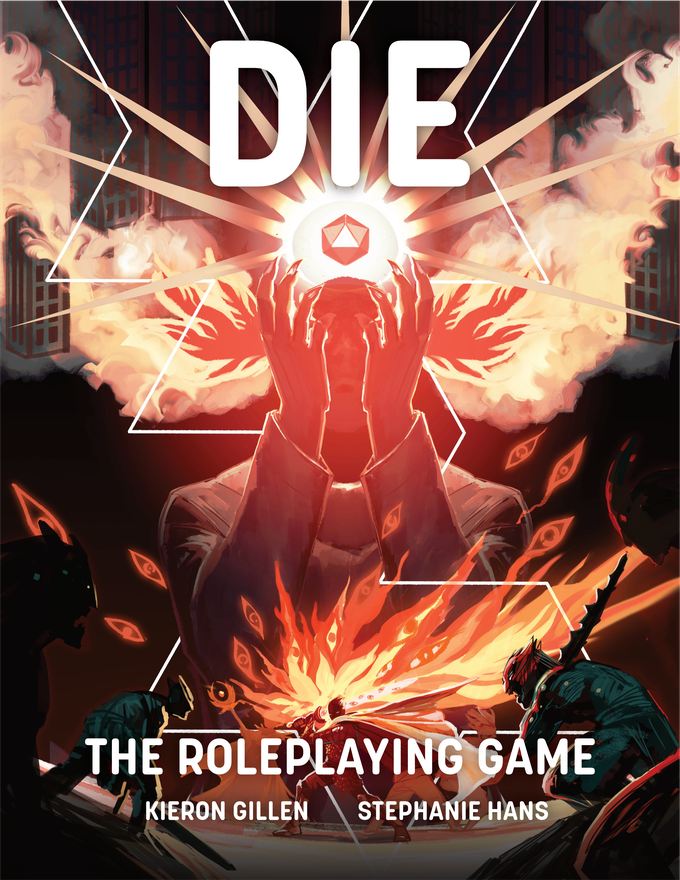
This has rolled across my Kickstarter feed a while back: DIE the Roleplaying Game. The conceit is one we’ve all seen — players of a game get sucked into the “real” thing. I’ve run a couple of mini-campaigns using this idea in the past, but this looked like it was attempting to get a lot more meta about it. Written by Kieron Gillen, a British comic book writer, and Stephanie Hans, a French comics artist, it was a tie-in to a comic series…or maybe the comic was a tie-in to the game. Either way, while you don’t need to have read the comic (and I hadn’t when we kicked the tires on the game last week, I have now).
The rules are really light with influences from several other light weight systems. The basic mechanics are a dice pool — roll the number of die equal to your attribute, plus or minus dice for various advantages and disadvantages, to do what you want. A success is scored on a 4 or higher; a 6 also gives access to a special effect. The rules beyond that are tied to whatever class you play, and these are roughly analogous to Dungeons & Dragons classes, but with a twist — or maybe perversion is a better word.
Before you get to your characters, or “paragons”, you create your players. This involves a session zero where you all decide the backstories and desires, disappointments, etc. of your player, and the connections between them all. The players then create their paragons. This actually was an interesting stage as paragons that would have been perfect for some of the gaming group were not chosen, and paragons perfect for the players were taken.
There are six classes and the game is really set up to be played by six or fewer players. You can have two playing the same class, but that isn’t recommended. There’s the dictator –the bard as monster; you can control people and their emotions with “the Voice”. In the comic, this is used to horrific and tragic effect. It tied synergistically to the Emotion Knight. In the comic, one of the characters is a “Grief Knight” powered by his sadness; the Dictator in the comic powers him up with the Voice…but it’s a pretty awful thing to do. There’s the fool, who is the rogue analogue. So long as they are being foolish, they are pretty much untouchable. Their friends? That’s another issue. There’s the neo — a cyberpunk “wizard” if you will that is powered by “fair gold” — which is found in the “Fallen”, the game’s zombie/orc/bad guys you can kill without remorse (until you know their backstory…) There’s the Godbinder, a cleric who cuts deals with gods for some pretty damned powerful effects…but that debt has to get paid. Lastly, there’s the Master, which goes to the gamemaster; they are a player, after all. The Master is the wizard — he can bend and break the rules, but only so far before the power of DIE — a 20-sided world with different settings per facet — come calling.
(Since I was the GM, I took the Master, of course. My player was the not-great looking buy charismatic drama geek raised by a single mom with all sisters, and who has a tendency to play only female characters. His master is a soft-core leather fetish redhead…of course.) Each of the classes has their own special die — a d4 for the Dictator, d6 for the Fool and so on up to the Master with the d20.
The conceit is that you are either coming back together after a time from your last being together to play a game, but we tweaked that to the “last big game of the summer before we go to college”. You get sucked into the game and then the fun (or horror) begins. The basic premise is that the players wouldn’t necessarily want to go into the game. In the comic, the friends get sucked back to DIE after having barely survived it in their youth. The setting is supposed to be dark fantasy, but you can go light or REALLY dark (see the comics, of which there are four graphic novels.)
Our setting, we decided together was based on the stuff the players all did in the ’90s (we set the game in 1995), so we leaned into a Shadowrun-kind of campaign. The dictator is very much straight out of a White Wolf Vampire game, the Ecstasy Knight is armored up like a low rent Batman, the Fool is a dual pistol wielding street samurai, and the Master…well, I mentioned that.) Following the arrival in a knockoff Night City, they get attacked by Fallen (again, a suggested start for the game), and in the fray, the Master gets spirited away.
Afterward, they find out at their favorite bar from the games they had played, that the world is now in terrible danger and is starting to fall apart. They have a choice to make to save DIE and its inhabitants — they must all agree to play the game, or to leave the game…but they’re short a member.
That’s where we left it last week and we’re picking it up at Nerd Night this week.
It’s an interesting setting and depending on the group you have to play, this could be either light fun that has a dark underside, or a straight-up horror, “oh, shit!” quality to it. The system and its pretenses are interesting, and I could see this being a game to roll through on a semi-regular basis.
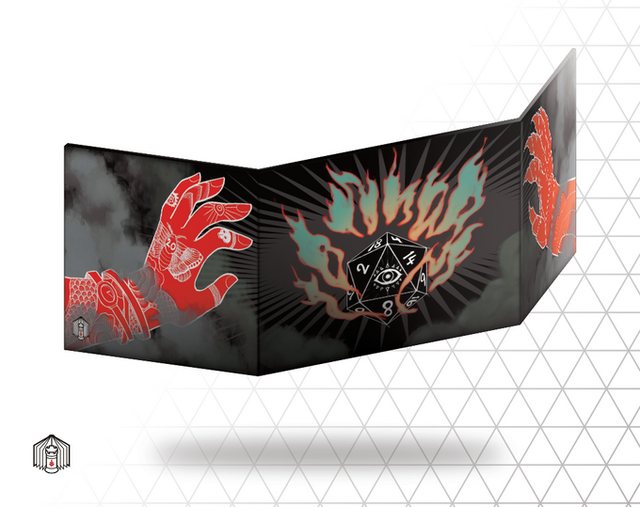
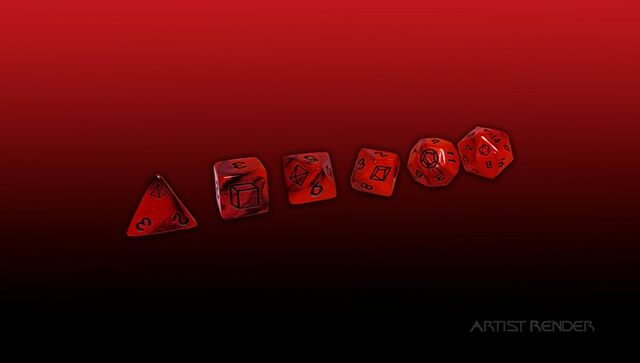
To the physical aspects of the game. Hans’ artwork is superb and provides a good sense of what the flavor of the game is supposed to be. There’s bits and pieces from the comic book, but for the most part, the imagery is taken from the sample characters that were used by the authors and their playtesters. It’s well written and understands that needs of getting the rules right and making them easily comprehensible, and the artistic end where you’re setting up the world for the players. The book is hardcover and well-bound; there’s no slop here — it’s high quality. The GM screen is equally good — heavy stock with cool but not distracting artwork on the player side. There’s the basics for the rules on the GM side, but…well, there’s not a lot there. Lastly, it came with a nice heavy cardstock dice box with a magnetic clasp. Inside six red polyhedrons with the top number an image of the die type. Yes, they’re cool. And since everyone get one specifically for their character, they stand out from the d6 die pool, and are supposed to.
This was the first new game in a while that my game group got really excited for, and we had a blast with the player/character, initial introduction session. The game is available through the link above and the comics are available on Amazon or a decent local comic store. (That’s where I got mine.)
So is it worth it? To get the book and all the attendant dice, etc. will set you back £90 or about $100. The quality of the artwork, the production values on the book and attendant materials, is well worth it. If the setting intrigues, do it. I feel I got my money’s worth, and I’m even going to pop for the Fair Gold I hadn’t added on during the Kickstarter.
As for the comics — they are very well done. The writing is a bit forced at the start, but once the plot gets rolling, it’s got a nice flow, the characters are rich and well-written, and the story gets progressively more involved and interesting. I’ll stop there as there’s tons of spoilers. The whole series set me back $60 and was more than worth it. Hell, I may have to have a look at The Wicked + The Divine.
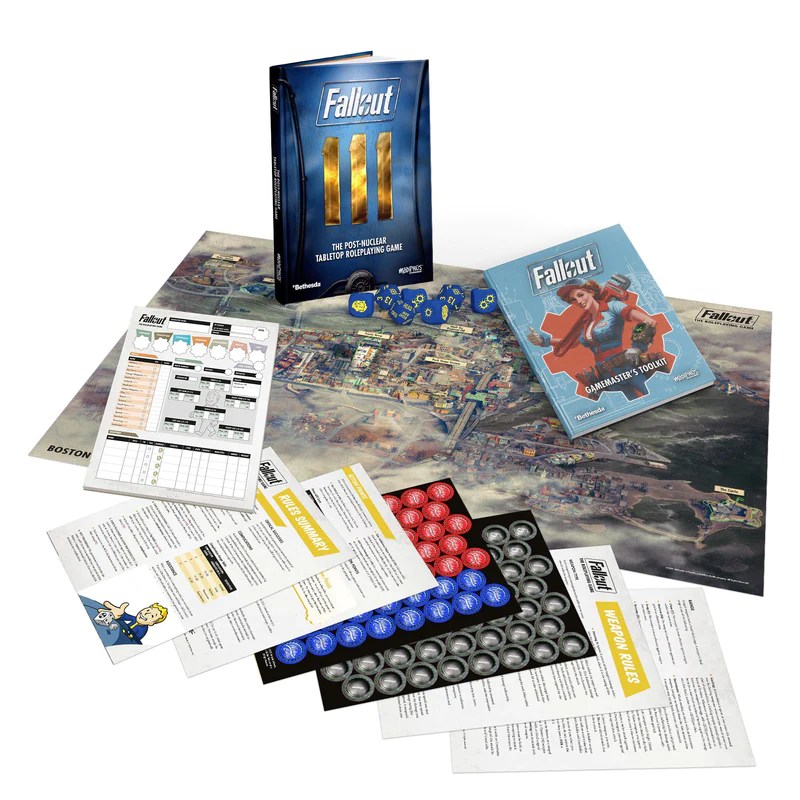
Recently, I’ve been given an exceedingly rare reprieve from running the game(s) when one of the players wanted to kick the tires on Fallout, the 2d20-driven RPG by Modiphius. He had done either the pre-order or Kickstarter on the game and got the GECK box set, with includes all of the GM bundle, some cool Nuka-Cola bottle caps to use for AP (more on that in a minute), maps, etc., etc…
I will admit to being less than enthusiastic about trying the game. I haven’t played any of the video games, although they look quite interesting. The rest of the players all have experience with them. Our group, years ago, had been on the playtesting for the 2d20 John Carter game and had been thoroughly put off by the overly complicated rules — made worse by terrible writing of the same. (Therein lies one of the great issues of RPG writing. You need creative writers to make the settings and other elements interesting, but you need the technical writer to do the actual rules descriptions. They’re seriously different skill sets.) We essentially could not figure out what the hell we were doing — and that was six people, two of them game writers. Because of that, I’ve avoided 2d20 like the plague. Back to present: We ran the basic adventure presented in the box set, and said player-now-GM put together a few more episodes, so I’m reviewing after a good month or two of playing the game.
The basic mechanics are simple: roll 2d20 and try to get under the combination of attribute (here called S.P.E.C.I.A.Ls — a call back to the video game. So shooting a gun would be Small Gun (for hand weapons)+Agility to give you the number to roll under. If you get under the skill, it’s two successes. If that skill is also “tagged”, you get an extra success. For many tests, your difficulty is measured from a zero on up. Zeros are an automatic success, but rolling to get extra successes is a good idea. If a difficulty is two, you need two successes to pull it off, and so on. In opposed tests, whoever gets the highest number of successes wins. Any extra successes generate Action Points — represented in the GECK edition by the Nuka-Cola bottlecaps. (It’s fun flicking these things back and forth with the GM.) If you role a 20, some complication occurs.
Now that wasn’t so hard, was it?
Action Points allow you extra d20s to roll on a test, allow you to reduce the time of an action, take additional actions, or add extra damage. These are communal and meant to be spent. You make them back pretty quickly, so hoarding them is actually pretty useless. The GM also gets AP equal to the number of players involved in the game and can use them for similar effects. Still pretty simple.
But…there is also an attribute called Luck, and this generates Luck Points that are used for re-rolling damage or a d20, changing your position in the turn order, or adding an aspect to the scene. You regain these by looking at some trinket of importance to you, finishing a mission/quest, or a milestone (if using milestones instead of experience points for advancement.) The use of a second game currency is — in my opinion confusing and redundant. It would have been better to keep one or the other. Since Luck is an attribute in the video games, as well; combining them into Luck might have made it just a bit less cumbersome.
Combat feels very old school. There’s a die for hit location. There’s armor for physical, energy, and radiation for each body section. (I’m assuming this parallels combat in the video games…) Radiation exposure can rob you of Hit Points until you get access to the right treatment (Radaway, rightaway!) Actions are broken into major and minor actions and you get one each unless spending AP. When you hit, you roll d6s that have blank faces (zero damage), a bullet hole (1 or 2 damage depending on the number of holes, and the smiling Vault Boy character, which gives you damage and activates any special feature of the weapon used. It felt a bit mechanical to me, but also the guy running hasn’t GM’d in a long time, so that might be an artifact of him learning the rules and sticking to them.
A lot of the book is dedicated to the environment and how to move around, scavenge, map, and otherwise survive in the Wasteland near Boston, as well as setting up shelter or a town. Again, I’m assuming this parallels a lot of the elements of the latter Fallout games — and the other players have confirmed this. There’s a lot of resource management here. You take effects from hunger, thirst, and other conditions, so finding safe food is important.
The book is packed with material from Fallout 4‘a Boston setting, and the artwork is gorgeous. The print books included are well done — handsome, good paper, and well bound (the core book), or stapled in magazine form. The dice are well crafted, as are the bottle caps (at least in this edition) and the PDFs that came with the bundle have all the materials in file sizes that won’t blow up your printer.
Having played for a few weeks, I now have a good handle on the 2d20 rules. They’re not bad. Not my favorite, to be sure, but fully serviceable. In fact, I even went ahead and bought the core bundle for Star Trek Adventures based off of the experience — but that’s another review for another day.
So is it worth it? If you are a fan of the Fallout series and a gamer — yes. If you have someone to run it that knows the universe and the tone the game is looking for — yes. Otherwise, I’d pass on this one. Modiphius tends to be a bit on the spendy side for RPGs.
One area that I found lacking in the otherwise magnificent Lex Arcana roleplaying game was mass combat. The characters, admittedly, play the equivalent of “secret agents” in an alternative Roman empire, but the military plays a central part in the politics and activities of the Empire. In our campaign, the characters have uncovered a plot by a group of Vandals and Othrogoths to cross the border in force as they are being pushed west by the other tribes behind them. Word has been sent to Rome to gain reinforcements for the imminent attack, but it’s now a waiting game. The next episode would have this force assault across the Danube on the castra at Submuntorium — the gateway to Augusta Vindelicorum and the both the main roads of Aurelia and Claudia Augusta.
It’s going to be a big fight, with 1700 Romans in the castra against a force of around 8,000 migrants with half of that fighting age men. The 4-1 odds are mitigated a bit by the need for the barbarians to cross the Danube, then get by the wall of the German Lines. There are siege engines in play — battering rams, catapults, and ballista — so a lot of moving pieces. I could have just pre-decided the results, but wanted the players, now in positions to aid the commander of the defensive force, to have some kind of impact. I needed rules of a light legion-scale fight.
My first pass was to make some lightweight rules that used the units as NPCs, but that seemed a clunky. I settled on using Lex Arcana‘s prolonged action rules to handle it.
MASS COMBAT AS A PROLONGED ACTION:
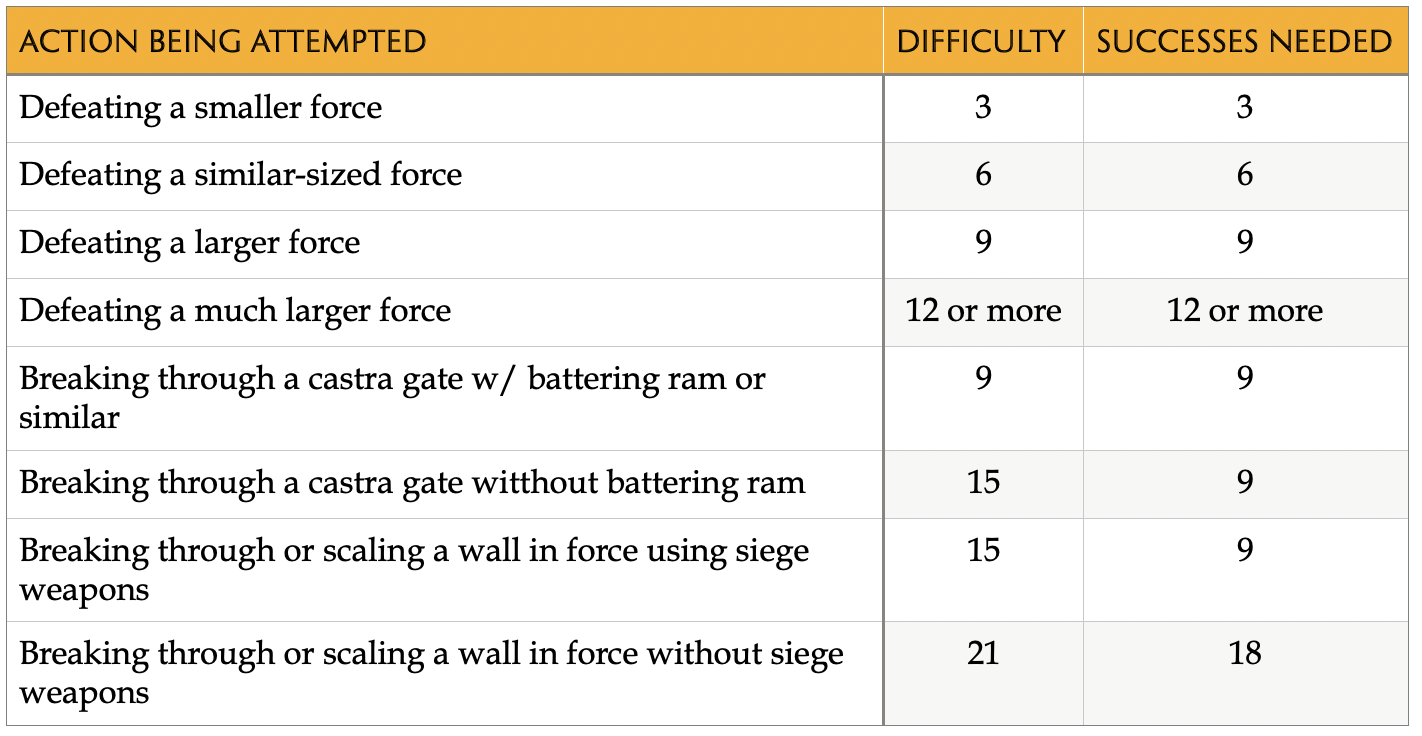
During a force on force event, both sides must roll for successes, with a total number of successes based on certain goals. Difficult for the tests is determined by a combination of the number of forces or the obstacle (castle walls or gates, etc.) that need to be overcome.
For the test, the leader of the particular unit — be it a contubernium or a legion, rolls the DE BELLO of the type of NPC found in the uint or it’s commander. For instance, a century of Roman soldiers would be represented by a Legionaire or a Centurion, as per the NPC examples in the rulebook. Characters can use their TACTICS or other skills that might be appropriate to aid in the roll because, well, they’re the heroes in the story. As always, a GM is encouraged to alter these to suit the tastes. For overcoming a castle wall or gate, a smaller unit might have a higher DT.
Ex. The 2nd Century of the II Audriatrix engages a turma of barbarian cavalry. Rome needs a DT3 on the unit’s DE BELLO and three successes to win the day. The barbarians need a DT9 and nine successes, but the GM decides the mobility and use of bows gives them an advantage and lowers the DT to 6. Both sides roll their DE BELLO with a specialty of Tactics for the centurion commanding the 2nd; the barbarian commander a 2d5 for his men. Both sides roll: the centurion is havimng an off-day, it seems, with a 5 result. He’s got a single success. The barbarian rolled a 9 — a success!
Both sides continue the engagement. This time, one of the player characters chooses to rally the troops with a command test on DE SOCIETATE of 12 — and between the centurion’s 7 and the PC’s they score a 14 — a complete success that will rout the remaining barbarian forces. The barbarian commander is on a lucky streak and got a 10, allowing him to reroll and add to the original score. He rolls a 3, giving him two successes. The Romans needed three successes and have four — the barbarian force is destroyed, utterly. The barbarians got a total of three successes, six short of what they needed. The day belongs to Rome.
How many people did the respective units lose? In the case of the barbarians, it was a complete disaster. They’re either all dead, or a few escaped according to what the plot needs. The Romans, hower, got hit hard on that last foray. So how many are injured or wounded? The GM could fudge this — a third of the unit (3 successes of nine needed) so 33 imjured or dead.
Another way would be to use the size of the unit attacking as a base. The turma — 30 barbarians — scored one and then four successes. Taking a tenth of their size (3) as the base, then multiplying it by their success (the first only just succeeded, so 3 injured; and the second foray gave them double the damage, 6 for a total of 9 dead. (In this case, I’d go with 9 dead and about 25 injured.)
It’s not perfect, but it squares with the existing rules of Lex Arcana.
I remember seeing Blade Runner in the theaters in 1982 and being stunned by the visuals, the noir flavor, and the “big questions” that the movie asked. I was 15 or 16, at the time. The movie stuck with me, and with the release of the director’s cut, cemented as my favorite movie. I was adamantly opposed to the sequel movie, almost offended by the very notion — even though I had preferred the director’s, then the “Final Cut” more than the original release version. (I especially like that the Final Cut is just a cleaned up release of Ridley Scott’s workprint — a giant “up yours!” to the producers that mucked with the picture before release. Then I surrendered and watched Blade Runner: 2049 because Denis Villeneuve is a superb director and the original writer was in. I was not disappointed: although it’s long at three hours, the movie is gorgeous, well-acted and written, the movie score by Hans Zimmer blends well with the original Vangelis soundtrack, and the pacing is better than the original. Overall, I found it to be a better movie.
So I was all in when Free League, the Swedish RPG company that’s given us the excellent Tales From the Loop, Forbidden Lands, and Alien, announced their Kickstarter to push Blade Runner: The Roleplaying Game out the door. (You can still do a late pledge!)
The game is up to the usual Free League standards, with atmospheric art that evokes the world of the movies, straightforward writing for the rules and good interstitial pieces to set the tone (a difficult task, as I can attest to, having started in RPGs doing the latter, then graduating to the former.) The layouts are clean, and similar in style to the Alien RPG. The game is set in 2037, after the revocation of the ban of replicants and draws from the two movies, the Black Lotus animated series, and hints from a few of the books and comic books. The players can play a replicant or a human, and the differences show up in their attributes vs. skills — humans are usually around longer and have higher skills; replicants are younger (unless you’re one of those old models…) and have higher physical and mental attributes, but lower skills in general. There are rules for key memories and relationships that can be roleplayed for “promotion points” that allow you to improve the character. There are also “humanity points” that allow a character to become more human or empathic, and lastly there’s a Chiyen point — essentially the “currency” of the world. This is not a game where you sweat money; you either have chiyen to buy something, or you’re reduced to basics until you get some.
The characters, like most FL games based on the Mutant Year Zero ruleset have four attributes: Strength, Agility, Intelligence, and Empathy that tie to certain skills. There are three generalized skills under each (for instance Connections, Insight, and Manipulation under Empathy). The dearth of skills in the MYZ systems worked well for Tales from the Loop, but my players thought them a bit lacking for Alien, so I was interested to see what they thought of the changes made for Blade Runner. The main differences are, similar to their Twilight: 2000 RPG reboot, the characters are graded on their skills and attributes with an A-F scale (although players are never lower than D in Blade Runner.) These equate to a die d12 for an A down to d6 for a D; players roll their skill and the attribute die and want to hit a 6 or higher to have a success. Ten or higher is a critical success.
The simplicity of the d6 die pool from Alien is gone, but the group seemed to prefer this for several reasons. 1) There’s a visual and tactile difference in your abilities with different die (and for those who like different dice, this can be more fun!) 2) It’s more simple that simple the d6 die pool but we found — strangely — your ability to get a success was enhanced with the two dice. We’ve had games were well over a dozen dice were rolled and no successes. 3) With an advantage or disadvantage, you gain another of the lowest die you were rolling, or on a disadvantage, lost that lowest die.
Combat is vicious, and more so than Alien. The damage is set for weapon types plus the number of successes rolled and taken from your health, which represents stamina, pain, etc. Critical success roll a die based on the weapon (or your Strength for HTH and melee) and do some form of damage that lasts, similar to Alien. Additionally, you still take stress like in Alien, but it comes out of your Resolve — your “mental health”. Critical damage to your resolve can break you temporarily. I found I thought this would be an excellent 2nd Edition for Alien, which is already pretty bloody deadly. For this initial release of the game (I have the “early release” beta of the PDF), the characters are all assumed to be members of the LAPD and Blade Runners of some sort, but with a bit of finagling, you could fudge civilian characters without much trouble.
The setting is outlined over 80 or so pages. There’s information on the government, media, Wallace Corporation, etc. There is also a decent bit of material on the structure of the police department, how promotion points play into commendations, promotions, or use for gear or other benefits. There’s a nice section on police procedures and how to work a crime scene that would make a good handout.
Some art from the book.
Our first play session was just a few days ago, and afterward I talked to the group about the experience. We all seemed to prefer the use of different dice. (I was skeptical, but it works better than the d6 pools.) The addition of a DRIVE skill that wasn’t tied to your attribute, but rather the maneuverability of the vehicle was a nice touch. The ability to aid other players by throwing in a skill die into the pool was a good addition — during their sweep of the streets after they caught a triple homicide, the character with the best EMPATHY+CONNECTIONS rolled, while the other two players involved rolled their skill and added successes.
So…is it worth it? The core book is likely to be somewhere in the usual $60 range. It’s got good art, a playable system, and loads of information to be able to hit the ground in this universe. I’d say yes, it’s worth it. Even at the $130 or so my pledge was gives me the starter set, the core book, and all the digital add-ons. I don’t feel I lost out at that price, either.