Roleplaying Games


The default for a character motivated by discipline is usually a military or similarly employed person. Discipline is central to military training, but it need not be due to how most folks view this word. When you’re young, discipline is often extrinsic — there are rules, parents, teachers, coaches — and the most commonly associated thing with discipline is punishment. As an adult, discipline might still be extrinsic: I don’t want to go to jail. I don’t want to lose my job…but the most successful people tend to be ones where discipline comes from within. Discipline, the Swanson Pyramid of Greatness tells us jokingly is “The ability to do a boring thing over and over again” but it’s more than that.

Discipline is the ability to restrain your emotions. It is the ability to push yourself past your limits, fears, or to do that boring thing over and over again. Ask anyone who exercises regularly — it’s getting past that first (and most recent) “I don’t want to” to do what you have to. The lack of discipline is the main point of failure for most new college students. It’s the point of failure that causes corruption, and by extension the collapse of trust not just interpersonally, but at a societal level.

So, here’s two versions of a character driven by discipline. The first was crafted quickly in the excellent Outgunned!system by Two Little Mice. I based this on someone I know well — Robert Moray is an interrogator, former army, well educated, and worked as a contractor through the global war on terror. He sought out for his ability to create rapport above all else. He’s the guy you send to schmooze drug dealers and other criminals; or send in with a team to collect a high value target to interrogate. He’s not a brute, but can rise to the occasion. His main ability is his ability to be what he needs to be, to full invest in that persona, then use it to be who his target needs him to be. The downside to something like this is that deep down, the good person doing this job for “the greater good” has had to do awful things and his conscience attacks whenever he’s not in the thick of it. The scary thing is how easily it is for him to put that all away and be who he needs to be at that moment.
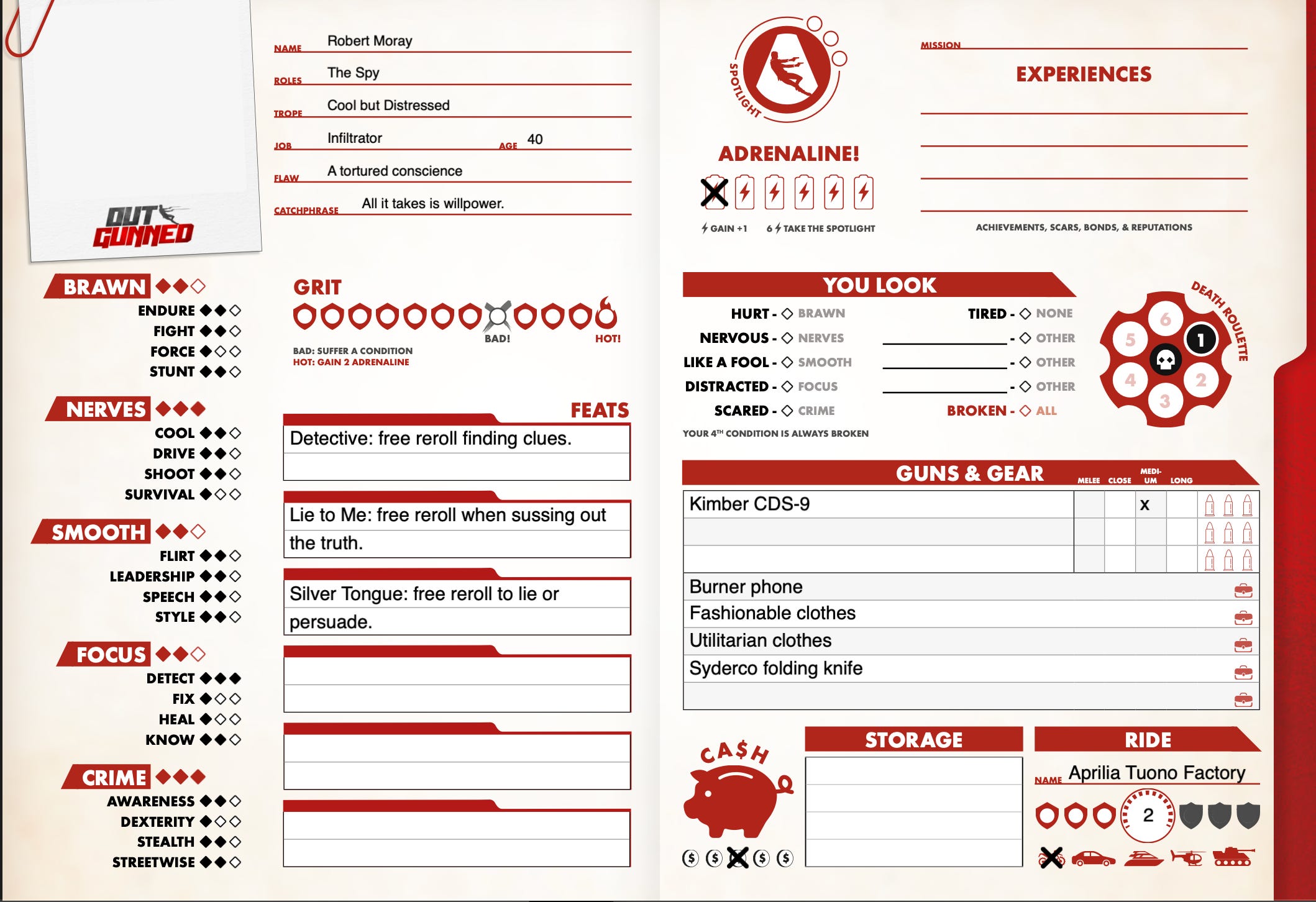
What is it that keeps the demons at bay? What is it that helps him keep his cool when he needs? What allows him to smile at a bad guy and treat him like his best friend when he wants to put a bullet in him? Discipline — the ability to control himself.

The second choice for this is a character that will probably pop up a couple of times this month. A major NPC, she was written up as a player character — a habit I have for central NPCs that will show up on a regular basis in a campaign, and will even likely be aiding the player’s characters. This one was originally crafted in the old Decipher Star Trek system, but is presented here in Modiphius’ Star Trek Adventures format at what would have been the start of the campaign.
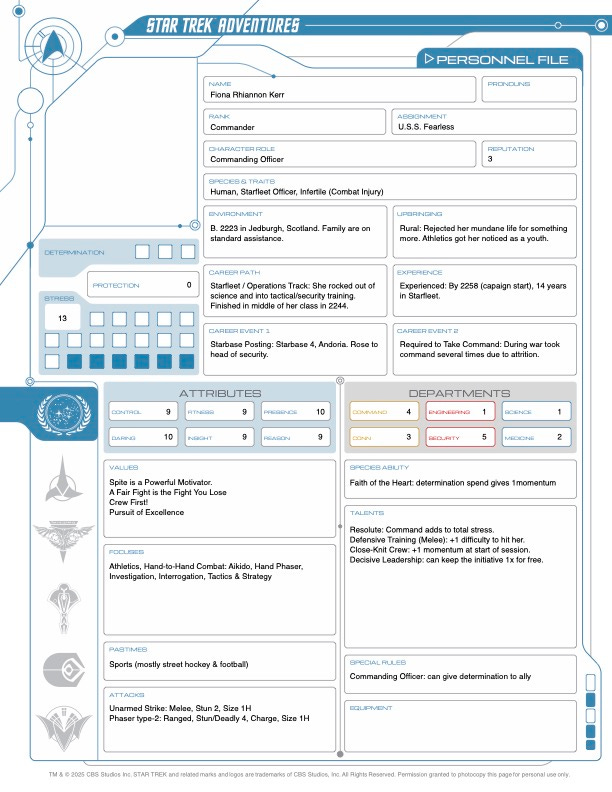
Kerr’s driving force has always to be better than she is. A council housing kid, Fiona was driven to escape mediocrity. She wasn’t a great student, but an excellent athlete. She barely made it into the academy, rocked out of science but landed in security operations when her physicality and personal skills allowed her to graduate in the middle of her class. Despite excellent fitness reports while a security officer and later head of security on the starbase at Andoria, she was overlooked for promotions, due to the lack of prestige of assignment, but also the influence of an admiral and a former instructor with a grudge.

However, her tenacity and fearlessness during a crisis on the starbase brought her to the attention of Captain Garth of Izar, who snatched her up for his chief tactical officer and pushed through promotions to get her up to where she should have been. With the outbreak of the Federation-Klingon War, she was able to show what she could do with inspiring leadership, a good head for tactics, and an absolute refusal to surrender or show fear. At the Battle of Deneva Prime, she rescued her medical personnel and killed the commander of a Klingon force in hand-to-hand combat, and was gutted in the process. She barely survived, but is infertile and badly scarred in the abdomen. At the war’s end, she was Garth’s hand-picked successor, and while she was given the office of captain, she was denied the rank and remained a commander. (Her former instructor, again…)

Kerr is a fierce opponent and a loyal friend, she awards merit and scorns sloth. She has a vicious temper and sharp tongue, but she can be very diplomatic when it suits her. Or in Captain Garth’s words, “If her people or her personal reputation is on the line, Fi won’t stop and she won’t allow you to win out of sheer spite.”

The copyright for 2d20 system is Modiphius, 2019. STAR TREK and related marks and logos are trademarks of CBS Studios inc. All Rights Reserved and no infringement is intended.
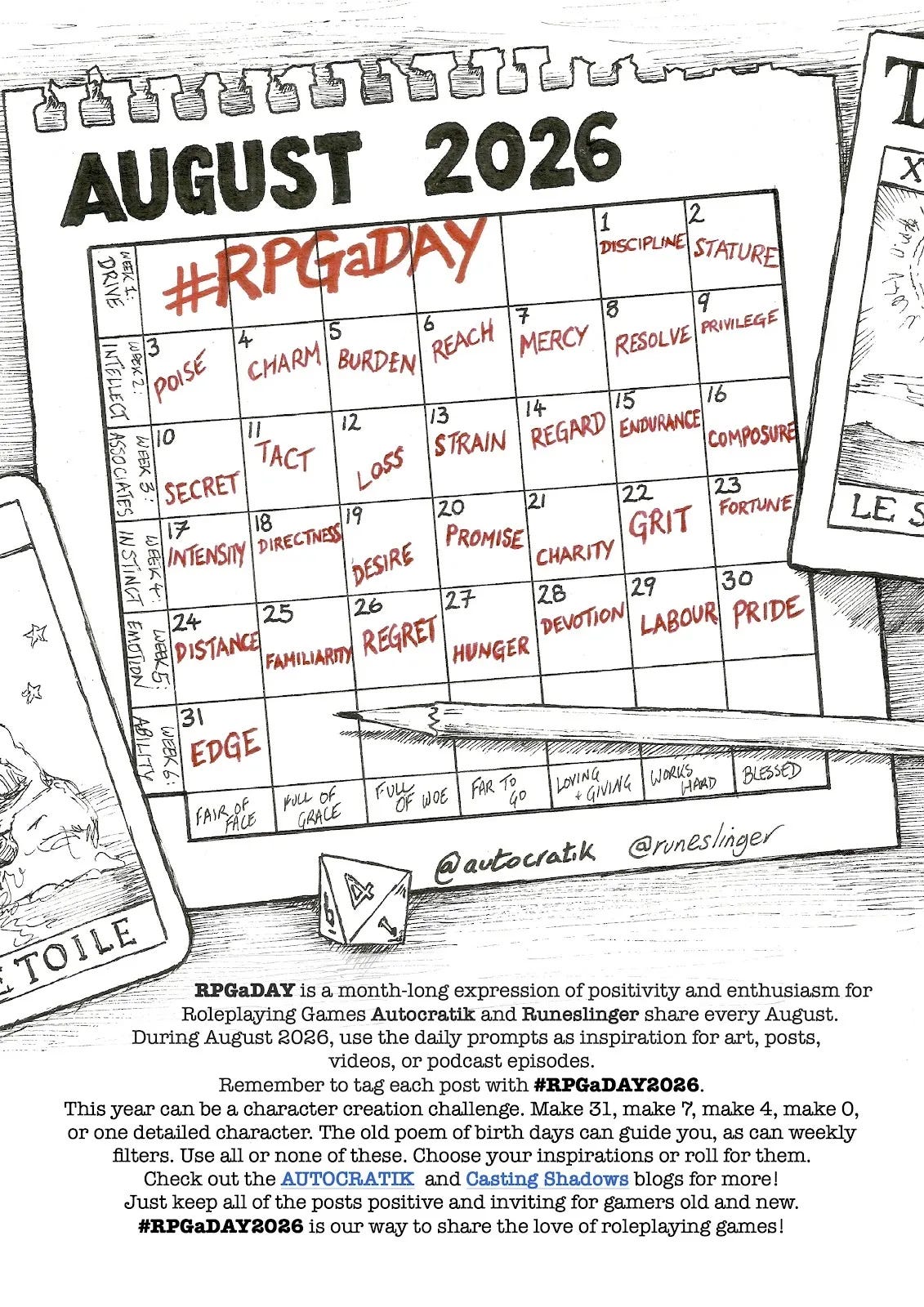
In preparation for RPGaDay this year, I’ve been thinking about characters that fit one or more of the prompts. This naturally led to how we create characters in roleplaying games. 

There are, broadly, two ways to do this: the stats/race/class come first, or the idea comes first. For a lot of the early RPGs, that first path was often more common. Example: in the bad ol’ days of Dungeons & Dragons and the d20 stuff that followed (Gamma WorldTop Secret, etc…), a lot of players would maybe have a preferred class and race in D&D, or know they wanted to play a G-Man in Gangbusters, but often the stats came first — strength, constitution, what have you. My elven wizard has X in wisdom. From there, after minutes agonizing over a name, (I’ve always found this amusing…) you might start to throw together a basic picture of who the character was, or just let it form in play.

Nothing wrong with this. It’s fast and gets you into the game with a minimum of preparation, and way back when roleplaying was more of an extension of wargaming, players were much more interested in combat as the thing. Character was often secondary. There are fewer of these RPG systems, these days — Lex Arcana is a good example of this, but mostly you have to look back to older stuff still being played to see this focus on “roll playing”. It’s kept D&D in the public eye for decades, and it’s one of the reasons it’s still the most popular game system on the planet.

The second is to have an idea for a character up front. You have, at least, the bare bones of a persona you want to inhabit for a few hours at the gaming table. For instance: I want to play a private eye that is not hard-boiled, but surprisingly kind and empathetic — and this naiveté is he main weakness in a noir setting, where societal corruption is usually a theme in the background. I don’t have much else built in, yet, but it’s a great idea with good hooks — a character less likely to resort to violence, a guy that genuinely cares about the people he’s helping, and a glaring weakness that, for once, isn’t simply he’s a sucker for a dame. Why is he like this? Maybe he’s a war veteran and violence repulses him…but he’s good at it, and hates that part of him. 

A change came in RPGs around the ‘90s. You started to see games more focus on this second style of play — “role playing” — immersing yourself in a character and a world. There were hints of it showing in the ‘80s. James Bond: 007 had the idea of “weaknesses”, something any English major will tell you is what makes a hero interesting. It was a central part of comic book RPGs like DC Heroes and Marvel Superheroes, if only because limitations to a character’s powers were part of the tropes of the genre. 

When building your character, a few simple questions help get this started: who is this person — what is their defining trait? Why do they do what they do? What or who matters to them? What or who do they hate? Where are they from and how does that affect how they act? Right now, there are a few systems on store shelves that are really good at helping a player create a character, not just a set of numbers. The standouts for this approach to gaming, where the system helps you flesh out a character and the stats encourage playing the strengths and weaknesses are Legend in the Mist and the Avatar games, both based on and a refinement of, the Apocalypse World engine; and specifically two of the 2d20 systems from Modiphius: Star Trek Adventures and Dune: Adventures in the Imperium; and the very rules-lite Die: the Roleplaying Game, based on and developed in tandem with, a comic book of the same name.

Each of these systems revolve around the development of the character less from the level-up standpoint of roll-playing, and more from a how do they change as people. The best of the bunch for the theater kids out there is Die. You develop, together, not just your character in the world of Die, but the player playing that character; the other players also have input on who this person is. Then the players’ own desires and failings inform not just the character — an expression of their wish fulfillment — but the enemies, stories, even the settings that adventure in. It’s very meta. It’s also very cool.

As good in Legend in the Mist (and their City of Mist), where characters are not about their stats, at all. You have four themes — devotion, skill or trade, some physical characteristic, for example — and “tags” short descriptors that may or may not help you in an action, like Charming or Strong as an Ox. These each add a +1 to a simple 2d6 test. There are weakness tags per theme, as well, and these are essential to the improvement of the character. Your weaknesses and failures help you learn; not your successes…much like real life. You goal milestones level you up, in so much as allow you to change themes and tags as you grow. 

Similarly, Star Trek Adventures and Dune have your goals, values, and weaknesses built into the character at creation and they have mechanical impacts in play. In Dune, your Values (Power, Duty, etc…) and your Skill (in broad terms like Understand or Battle) add together to give you your target number for a test. If a test does not impact your Duty, say, but your Faith in leaders or a system, that alternate Value is used for your test. STA has Value statements that give you game currency that can help supercharge an action — for instance, resisting intimidation, or taking an action that might seem futile might play into a Value or Spite is a Powerful Ally. These help drive a player to have their character act in ways that might not always be in their interest. Addicted to Love is one character’s Value in our STA game. He falls in love easily — and gains game currency for taking the hit due to the value, like being a sucker for seduction or persuasion by women.

The matrix above shows character beats that are useful both for individual character, but also for a group’s character, or even overarching themes for a campaign. This is something starting groups sometimes miss: why they are working together. There are a few easy ways around this: you all got hired for a job and meet in the stereotypical tavern; if you’re in a military, police, or other service setting — you all got assigned there recently; or happenstance — our plane went down and now we’re all we’ve got. Building out why they are there and how they interact at the start is an extra step that slows getting right into the action…but it does help create interesting games.

Of the systems noted above, Son of Oak’s Mist games do this well. in Legend in the Mist, you build your “fellowship” along with your characters. You not only have tags for your players, but ones for the group as a whole. you decide what the relationship is to the other players and that can be used as a tag when interacting with each other. Die has the players build their player/characters together, define how they view themselves and their friends, as well as what kind of world they would be interested in playing.

So as we roll into RPGaDay, I’m hoping to use these prompts not just to showcase character ideas, but how these can be used for group dynamics and story ideas.

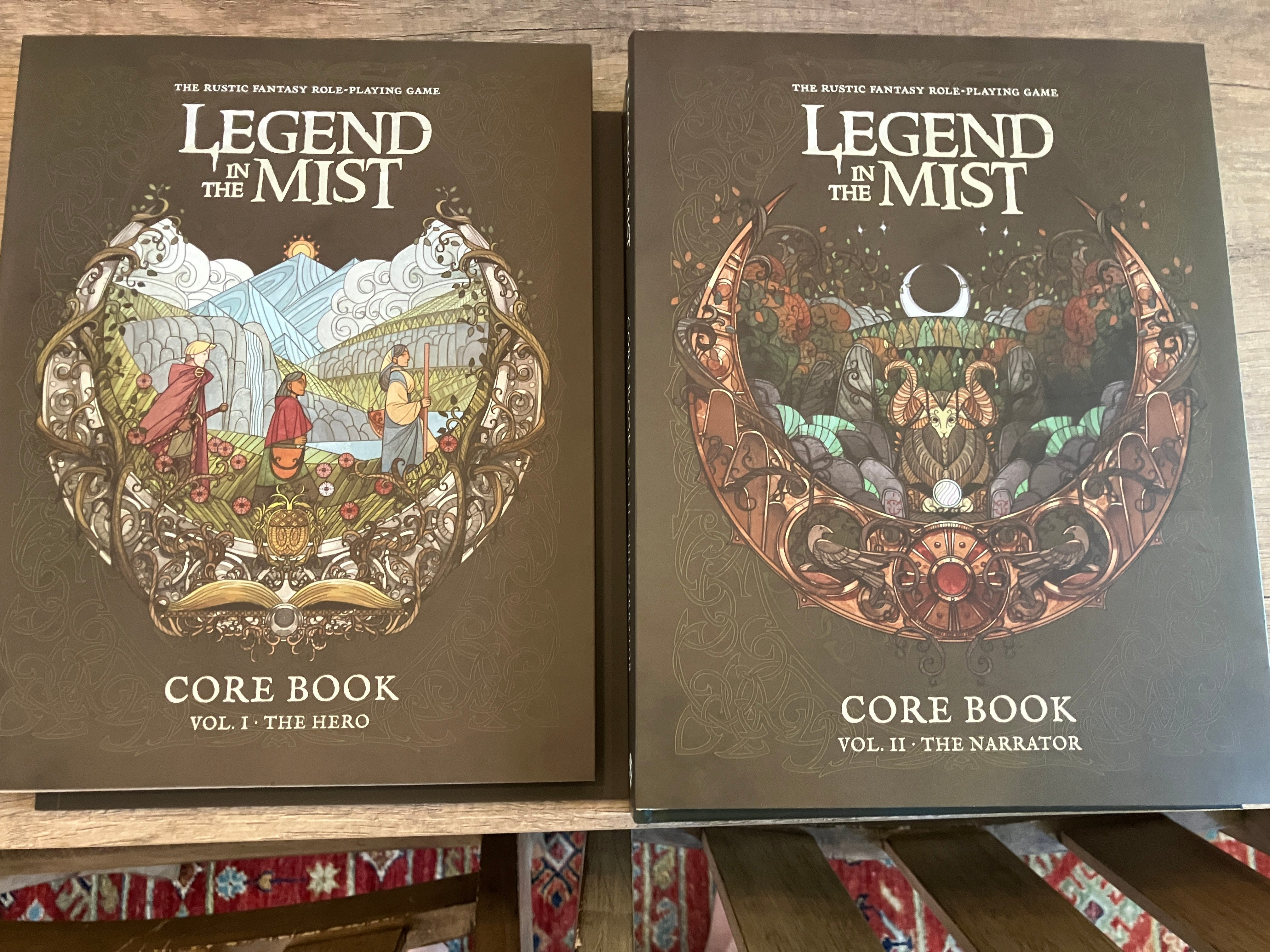
After a year’s wait, the Legend in the Mist, Son of Oak’s “rustic fantasy” roleplaying game, physical product finally arrived. I had Kickstarted the full thing after looking through the Quickstart last year. Since then, my game group has been kicking the tires on Legend in the Mist, since the PDFs dropped last fall, but this past week the physical copies finally arrived. So were they worth the wait?

WordPress has been a bit quicky on multiple images in galleries, so to see the pictures, you might want to pop over to The Black Campbell Review over on Substack.

My box set arrived with the two core books (with optional dust covers), the Hearts of Ravensdale campaign and setting book, GM screen, a pack of maps and tokens, the Action Grimoire, the “river pebble” dice (d12s set up as d6s) and dry-erase theme cards for creating characters, as well as a dozen or so premade characters sheets for the campaign.

The cardboard on the box is high quality and made of good stock, and of course, covered in the excellent artwork from the books. Binding on the books is excellent, and paper and print quality is likewise. The core books and Ravensdale are hard cover, while the Action Grimoire is softcover — however the adhesive quality on the binding is superb. Even the cover sheets on the material are gorgeous and printed on premium stock. The character sheets and theme cards, and the “status/tag leaves” are coated for dry erase use — a handy thing with the system’s creating and “burning” of tags and statuses. We used them this Thursday, and they do the job as they are supposed to. The theme cards I suspect would be more useful for short campaigns or games where the players will be changing their tags and the like frequently.

Most likely, players will wan to create their own characters, but the character pack comes with pre-generated roles. Like the rest of the game materials, SoO really went all out: instead of single sheet character profiles, they are two-page, folding profiles with full artwork, and coated for dry erase use. They include a short “how to play” and example actions for the characters.

The resin “water pebble” dice are in nice pastel colors with a figure are the 6. I have the acorn dice coming next week — did I need them? No, but so far the production quality on this game has been so good, I feel like rewarding the Son of Oak for their efforts. (I bought a set of their acorn d6s, and they are adorable and really lean into the “rustic” flavor.)

The GM screen is on heavy stock and the material is highly useful. With a bit of imagination and creativity, you could probably run the game without any referring to the books, as they give a slew of examples of how to use their tag system for consequences on failure.

If you want a first impression review of the system, you can find it here. So far, our paytests have showed LitM to be quick and easy to play, and it encourages more storytelling and role-playing beats than other fantasy systems. That said, the use of tags and statuses can be a bit of a learning curve, and this ties into character creation. Nearly all of the players leaned heavily on having a lot of tags in their core competencies — this system’s equivalent of min-maxing — and they would frequently find themselves left short on other important skills.

The Heats of Ravensdale setting is well realized, with plenty of places to adventure, more theme kits and challenges that can be used for adventures outside of the setting. (I’ve running a 800s Viking campaign, right now; we’re pulling from it for material.) I haven’t really gone through the book, yet; but from a physical production side — it’s a (rustically?) fantastic product.

So, is Legend in the Mist worth it? Unreservedly, yes. In this case, the whole Ravensdale Bundle runs about $200. Compared to the core books for Dungeons & Dragons, it’s a steal for everything you get.

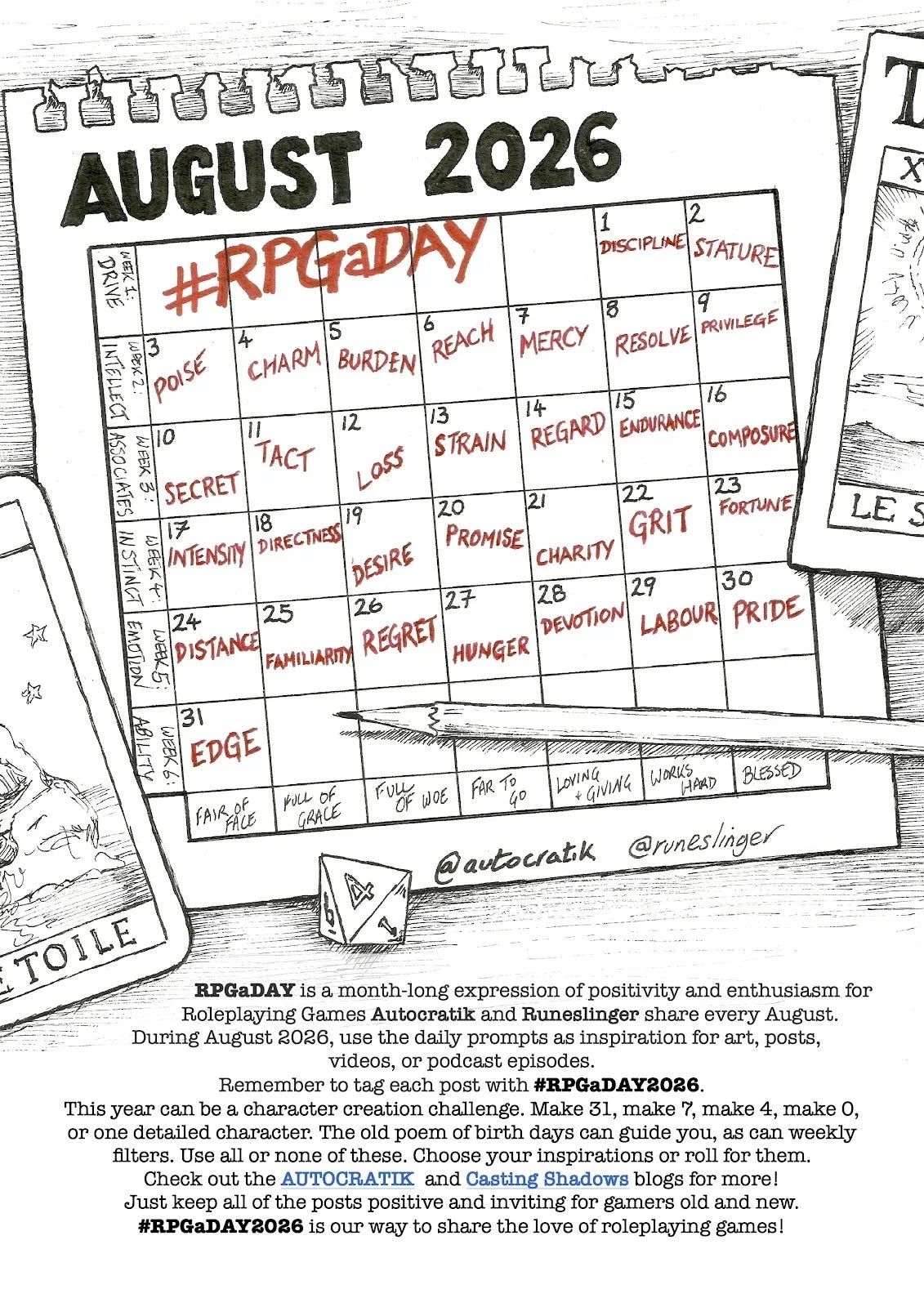
I’ve been remiss in doing the RPGaDay for several years, now. The day job required a lot of attention in August, and the last few years saw the school year start in July, so I rarely had time to do more than a few posts. This is the first year without a schedule in the way, so let’s see if we can do a post a day this month.

Here’s the prompt for this year:

The prompt calls for character creation, and I doubt I’m going to do 31 characters — but posts on how to integrate some of these themes in character creation, creating motivations, and challenges feels like the right way to go.

As always during RPGaDay, readers are encouraged to comment with their own ideas and approaches to gaming. This is about enjoying our hobby. So, August 1, RPGaDay starts

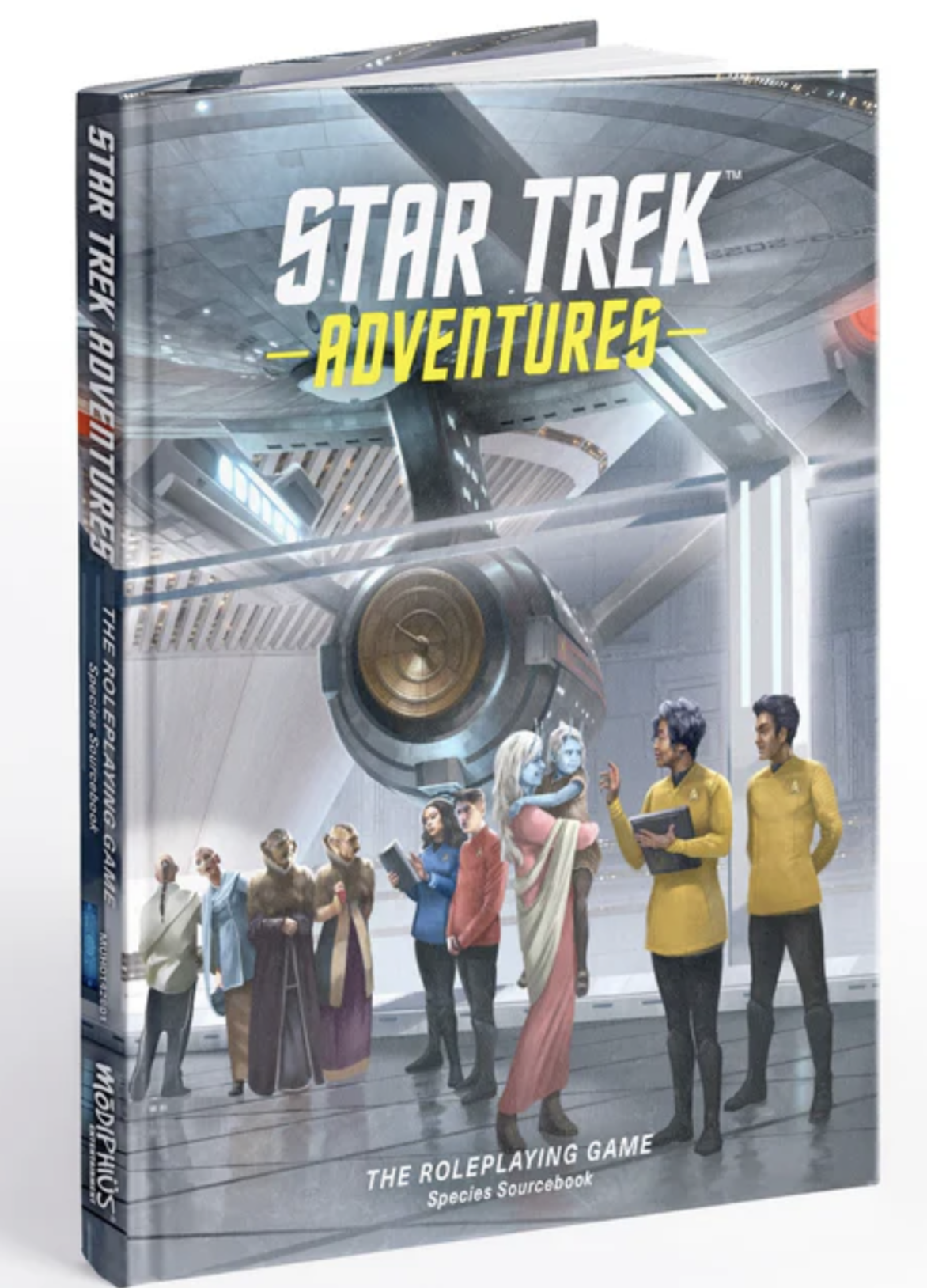
So, this dropped on my email list yesterday (Thursday) morning — Modiphius has hit us with another sourcebook for 2nd Edition Star Trek Adventures. This time, it’s the Species Sourcebook — the one I actually was hoping they would do. The PDF was already available with the physical book on pre-order and most likely due in about two to three months. This has been the production tempo thus over the last year for the line.

The artwork is consistent with the rest of the sourcebooks, with Paolo Puggioni — who gave us the excellent cover for the 23rd Century sourcebook — replacing Rodrigo Gonzalez Toledo on cover duties. The interior of the cover on this one is the first to not have some form of useful material — a map, uniform guide, or timeline, but the art is still quite nice. Unlike prior sourcebooks, we do see a fair amount of recycled artwork: the Barzan and Betelgeusans from The Federation-Klingon War Tactical Guide, Caitains, Efrosians, and Bolians from first edition works, just to name a few. Most of the pieces are good and yes, why spend for more art when you’ve got stuff right there?

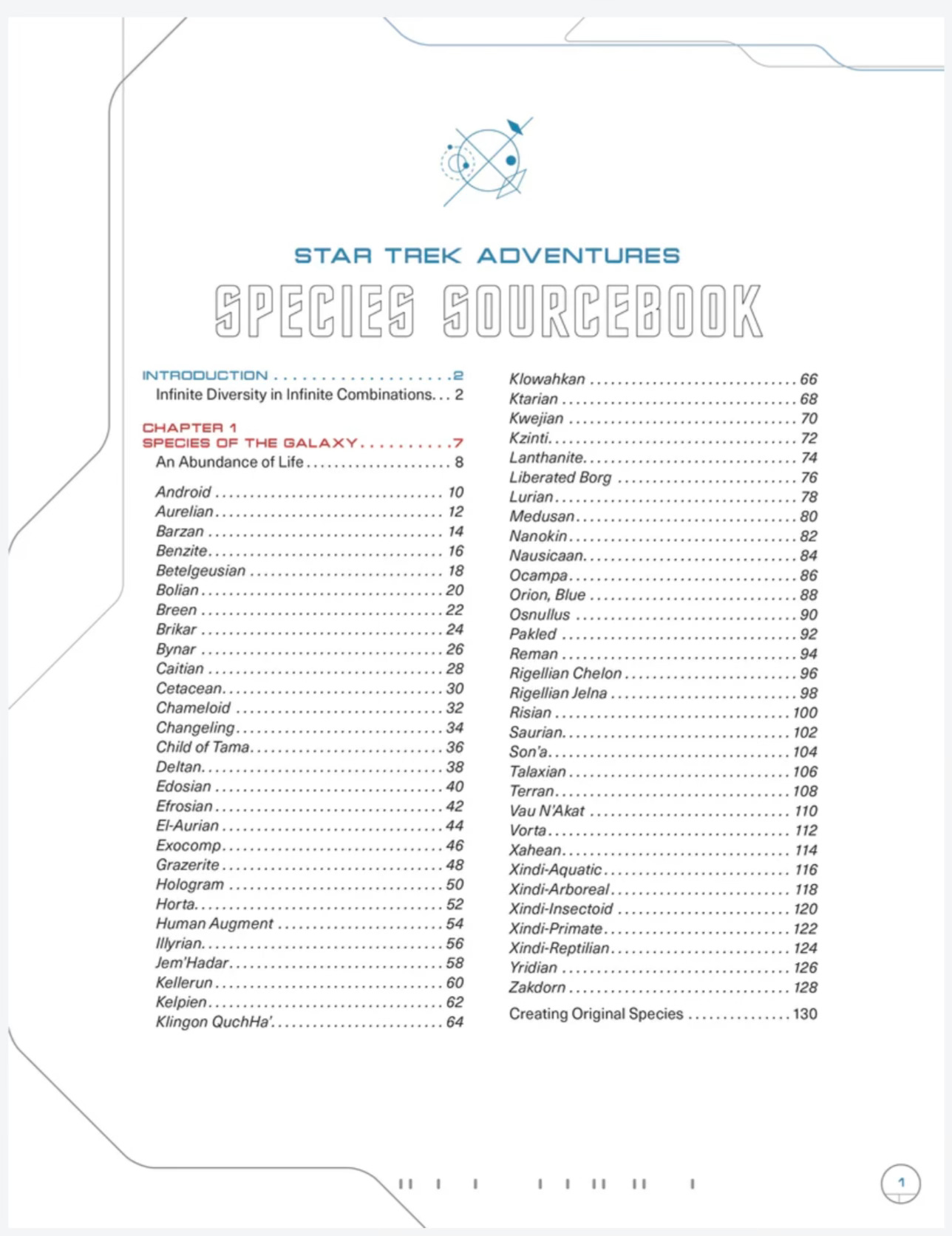
So what do we get in the book?

There’s a nice spread across the various shows and movies, and a few of these were originally included in the first edition, but didn’t make the cut for the core book in the latest iteration. A few are variations on a theme, but we do get Terrans for you Mirror Universe fans. There’s a heavy representation from the animated series — both TAS and Lower Decks, as well as Prodigy: Edosian, Aurelians, and Caitians, but I was especially amused by the Blue Orion (Or-ee-ons!) and Kzinti. There are some obvious choices: Deltans, Augments, Xindi, Klepians, Vorta and Jem’Hadar… The chameloid was an interesting addition, but the lack of Ariolo, Arcadians, and Coridanites from the same sourcebook as the Betelgeusan was curious. I did like the “human” Klingons from the original show being included.

I actually used the Medusans that very evening at Nerd Night™, and the Terrans will be useful very soon.

So, is it worth it? At 133 pages, it’s right in the ballpark for the current run of splatbooks for STA2, and while $60 is a touch much, in my opinion, for this particular book — it’s definitely worth it. I’m already seeing this one as a high use resource for the game. 

The copyright for 2d20 system is Modiphius, 2019. STAR TREK and related marks and logos are trademarks of CBS Studios inc. All Rights Reserved and no infringement is intended.
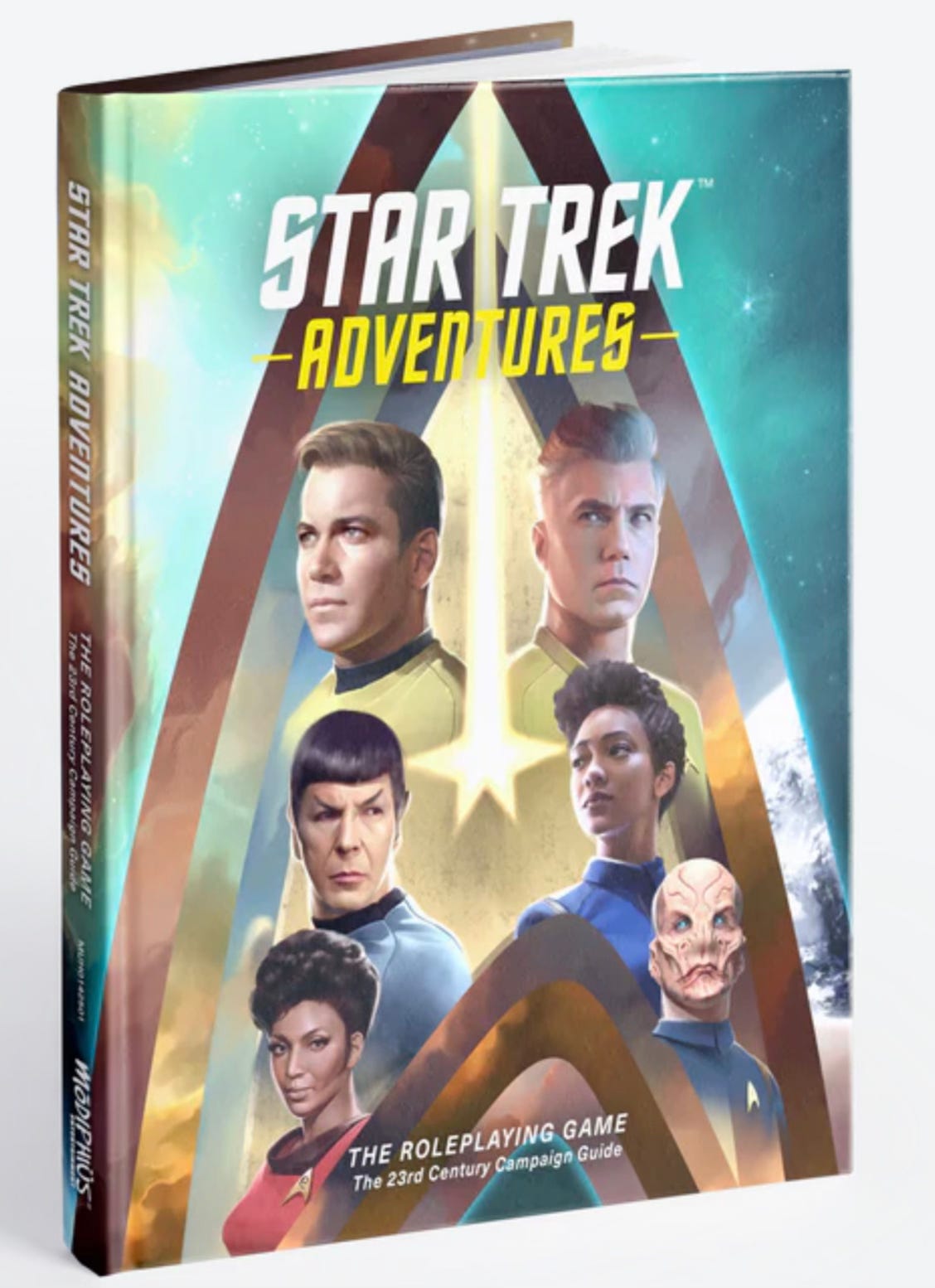
The third release for Star Trek Adventures is The 23rd Century Campaign Guide. This one (as with the new Species Sourcebook) kinda crept up on me. One thing Modiphius is doing well — and that Free League has been seriously falling down on with it’s Blade Runner and Alen lines — is dropping pre-orders once their material is ready to go…not making you wait a year for them to get it cleared by their licensors. Kudos to Jim Johnson for managing this line extremely well.

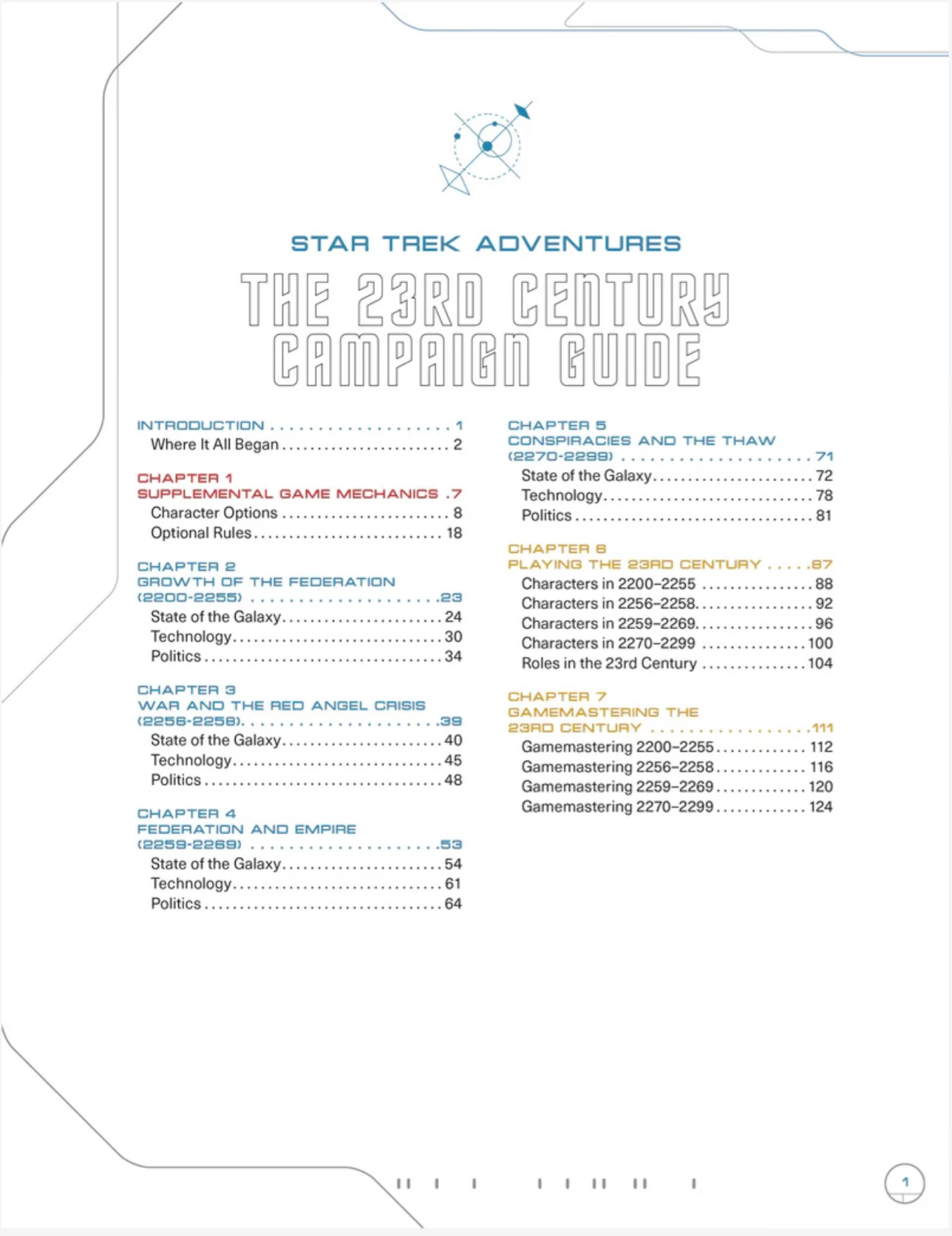
The guide provides a nice overview of the entire century — not just the events of Discovery through the old show movies. The chapters give a political and technological overview of the pre-Disco era (starting from the end of the Enterprise era), and they also focus a few pages on how each of the major polities are affected — the Federation, the Klingon and Romulan empires, the Cardassian Union, and the Orion Syndicate. The chapters are broken into the pre-Discovery period, the Disco/Strange New Worlds period, the Old Series, and the movie period. For those who have only a passing knowledge of the setting (especially the pre-Discovery and the original movies), this a fast entry into the 23rd Century. There is also a latter chapter on creating characters specific to the era, including suggested focuses, traits, and values. For those GMs with players who are unfamiliar with these period settings, this can help create characters consistent to the goings-on around them. It also ties neatly with the first chapter, which provides new lifepath options for having grown up on a species homeworld different from your own, a new civilian profession (free trader), and specific high-impact events from the various shows and movies. Was your character present for the V’Ger incident, or at the Khitomer Accords? Now you can have that as a specific event in character creation. The first chapter also has updated rules on scars, fatigue, and trauma borrowed from  The Federation-Klingon War sourcebook for first edition. A final chapter gives tips for plotting adventures during the various series’ settings.

Artwork remains solidly good to very good, and Paolo Puggioni’s cover deserves a special shout-out. There’s a frontpiece on the inside over with the various uniforms of the period — much of it cribbed from other earlies books in the first and second editions, and the backpiece has a timeline for the “Prime” and “Terran” (read Mirror) Universes, as well as the execrable J.J. Abrams “Kelvan” timeline.

So, is it worth it? At 129 pages, $60 might be a bit hefty if you’re a confirmed Trekkie or just hit up the Memory Alpha site for information. I’m not certain how much use I’ll get out of this, but it is a good-looking book and well made, with plenty of useable game mechanics and ideas to launch off of. If cost is a problem and you don’t mind using the cheaper PDFs for reference — that’s definitely worth it.

The copyright for 2d20 system is Modiphius, 2019. STAR TREK and related marks and logos are trademarks of CBS Studios inc. All Rights Reserved and no infringement is intended.
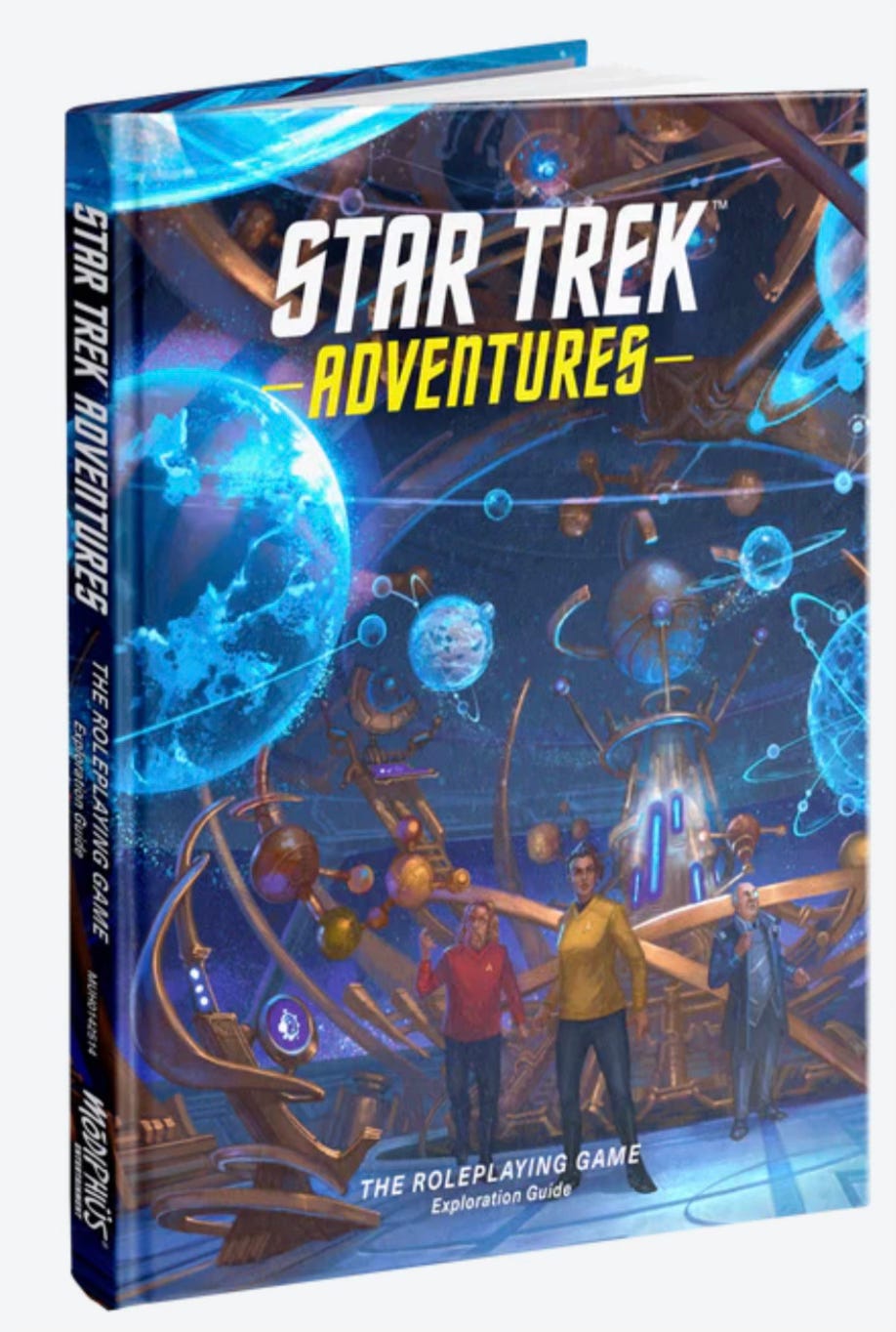
Modiphius has been on a roll with their Star Trek Adventures line since brining out the 2nd Edition rules set. Over the last year, there’s been four sourcebooks that have dropped. We already looked at the Technical Manual released in April 2025, which was followed by the Exploration Guide in October, then the 23rd Century Sourcebook around Christmas time, and the PDF for the Species Sourcebook just dropped yesterday.

The Exploration Guide feels like it was peeled off from the Technical Manual, and feels like these could have been a single book. As it is, as 144 pages it’s a nice size to peruse or do a quick reference. The production values are good, and have been consistent across the 2nd Edition line, so far. It comes with a smallish folding map with Alpha and Beta Quadrants, c. 2259 on one side, and a 2401 version on the reverse. They are the same maps as seen in the frontpiece and backpiece the inner cover of the book. The maps are nice enough, but a bit small, compared to the old setting map that 1st Edition had from the old Geoffrey Mandel Star Charts book, and isn’t as easy to reference. The 25th Century map is especially mutes and hard to reference at the table.

The layout is consistent with the new look of 2nd Edition: bright, clean, and easy to read. Like the Technical Manual, the artwork is all new — I didn’t notice a reuse of prior artwork from first Edition or even the new core book. The cover is by the same artist as the prior book, and the artists used look to be the same. It gives a consistent flavor from the core book, to these two sourcebooks.

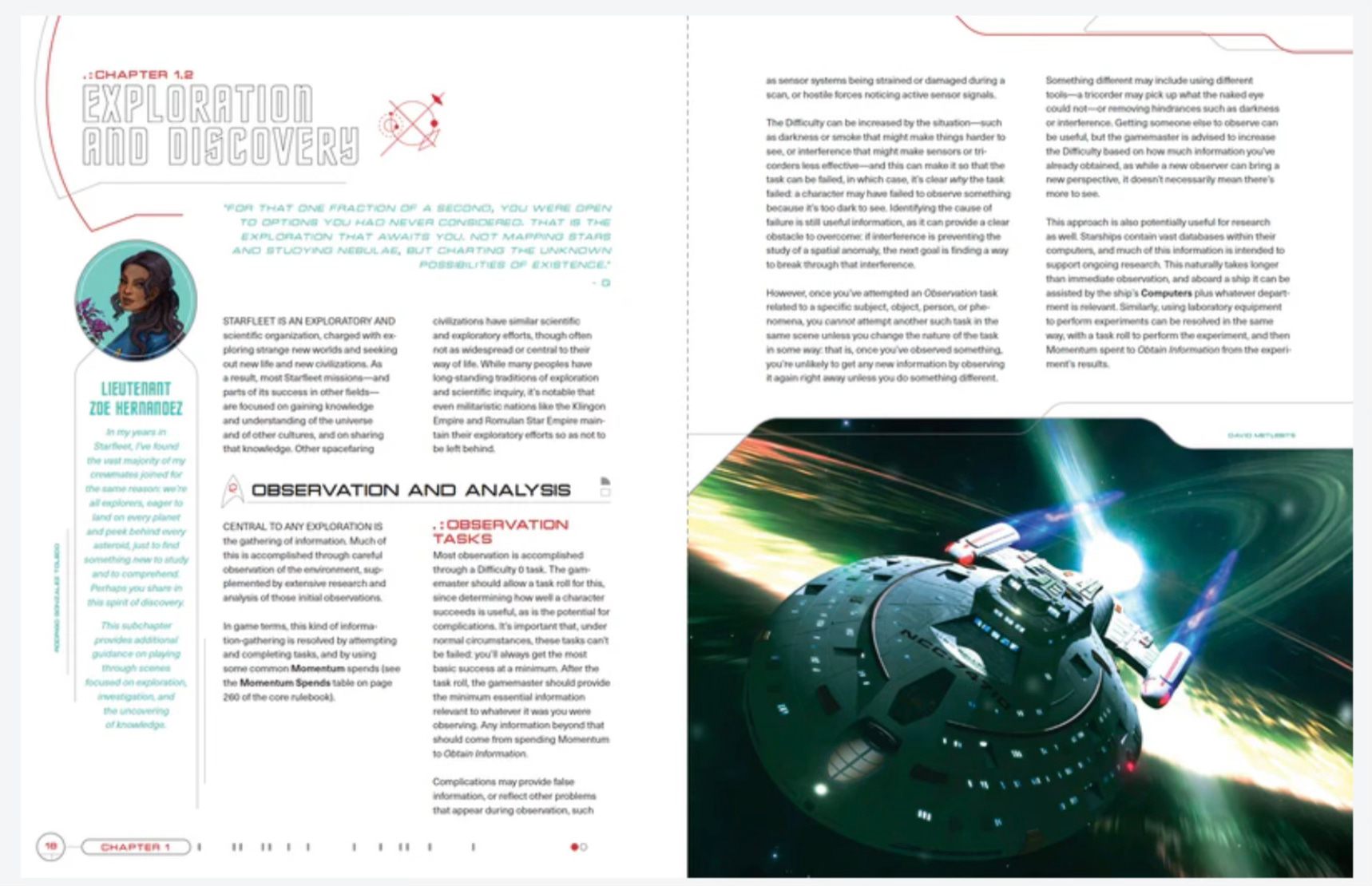
There’s new lifepaths, the Independent Archeologist and the Outpost Researcher, and about a dozen new career events, new talents, and the addition of civilian awards you can buy with advancement. It’s a new civilian focus that cuts throughout the book. The other chapters cover sector design, star and system design, and planetary design for your setting. I banged out a couple of worlds and systems — and it works well. Prior to this, I had been using the system creation rules from the Alien RPG’s Building Better Worlds sourcebook, with tweaks. The last chapter deals with specific biomes — ocean, jungle, etc. — and how to design specific features, plant and animal life. There’s also encounter tables for those that was random encounters.

So, is it worth it? The guide is pretty useful for putting together material for your game — especially if you are planning a campaign in a particular region (hence the sector design), and is a good follow-up to the Technical Manual. At 144 pages, it feels a bit thin for the $60ish bucks for the hardcover book, but if you are like me and prefer to work out of a physical resource, then yes — it’s worth it…maybe more so than the Technical Manual. If you’re good with PDF, the price point is certainly more forgiving.

The copyright for 2d20 system is Modiphius, 2019. STAR TREK and related marks and logos are trademarks of CBS Studios inc. All Rights Reserved and no infringement is intended.
I jumped on the pre-order for the Alien RPG waaaay back when it first came out in 2019. My game group wound up running a campaign that — trading out with other games a few weeks here and there — ran for about two years or so. (And may be coming back to the rotation soon…)

When I saw the ads for the “evolved edition” last year I was less than interested. It seemed a touch early for a second edition, and there was still material (Building Better Worlds and the Heart of Darkness set) coming out…so why change? Two things come to mind for the why immediately. Inflation — the cost of producing books has shot up. Alien and Blade Runner use black page color, which is expensive (and, I think, a bit harder to read) and the release of Alien: Romulus and a desire by Free League, Fox, or both to do something that included the new material.

I’ve been reading a lot of chatter back and forth about the new edition, which everything from “it’s a cash grab” and “the new look sucks” to “this is great” and “I like the new rules for…” With the holidays coming up and my propensity for buying stuff I want before the wife can get me gifts for birthdays, holidays, etc. I decided to make this one of my Christmas asks, though I was more interested in the Spinner that Master Replica had coming out. (Which will have a review soon.)

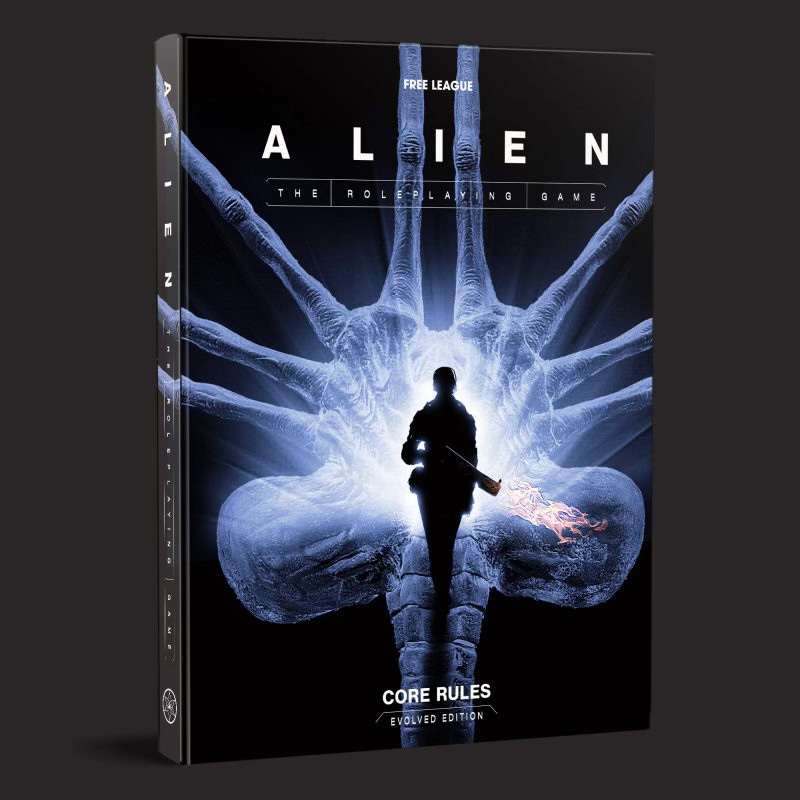
So, the Alien Evolved Edition RPG arrived for Christmas, and after having a few passes through it to see what was different (or not), let’s start with the good. The binding is much better than the older books, partly because of the reduced page count — down about 60 pages from the original. (More on that in a moment…)

There’s been a few clarifications on the basic die mechanic (which is terribly simple), and some changes to combat (specifically armor), the panic rules, and the addition of solo play rules and an optional “lifepath” style character creation. There’s also more material from the movies, on the setting, and the word count is much more beefy than the original book — which at 380ish pages had maybe half that in actual material — and comes in at 311 pages. And definitely has more stuff in it. more on that in a moment.

The lifepath character creation is tucked in the appendix, also with the “Last Survivor” solo rules. You can roll (or honestly just use it as inspiration) events in the character’s life to help build out what you want to play. No, Traveler fans, you cannot die in character creation. It’s a nice addition, especially for players who don’t have a strong grounding in the setting and need a bit of help.

The solo rules are — as with most solo rules sets — a series of ideas and random event charts to help a person play an adventure if they don’t have anyone to play with. Star Trek Adventures did this very well with their Captain’s Log — which really is half-play/half- fan fic creation, as you are supposed to write your adventure out as a log entry. It’s a neat conceit. Doing something like that for Last Survivor could be a way to charge it up a bit.

The main changes are things like armor. It used to be you rolled a number of dice equal to the armor rating and successes negated attack successes. Simple, but it meant armor did bugger all, or essentially stopped an attack. In A:EE, the armor rating kills off that amount of damage. More simple and more intuitive. It will play better.

The new panic rules include a “stress response” chart for non-panic, you’re just stressed out situations. I’m feel personally vindicated on this one (and peeved, since it was one of the first things I modded for Alien back in 2020. The old stress/panic set up could spiral, and fast, with bad rolls even in non-threatening situations, so I cooked up a “stressed out” table. Now you have an official one. Panic, similarly, got tweaked a bit so that you can now have multiple panic responses, instead of regularly stepping up through them. The mechanic for it is new: roll a d6, add your stress level, but now you reduce it by your resolve rating. Less chance of a full blown freakout, but it does look like it could lead to lesser panic responses early. This was a complaint I’ve seen online and which could be easily tweaked to reduce panicking too early (especially for marine characters, who should handle danger better than a crew of a space tramp steamer or colonists.)

While I consider the following “good” about the new book, you might be of a different opinion. The layout…

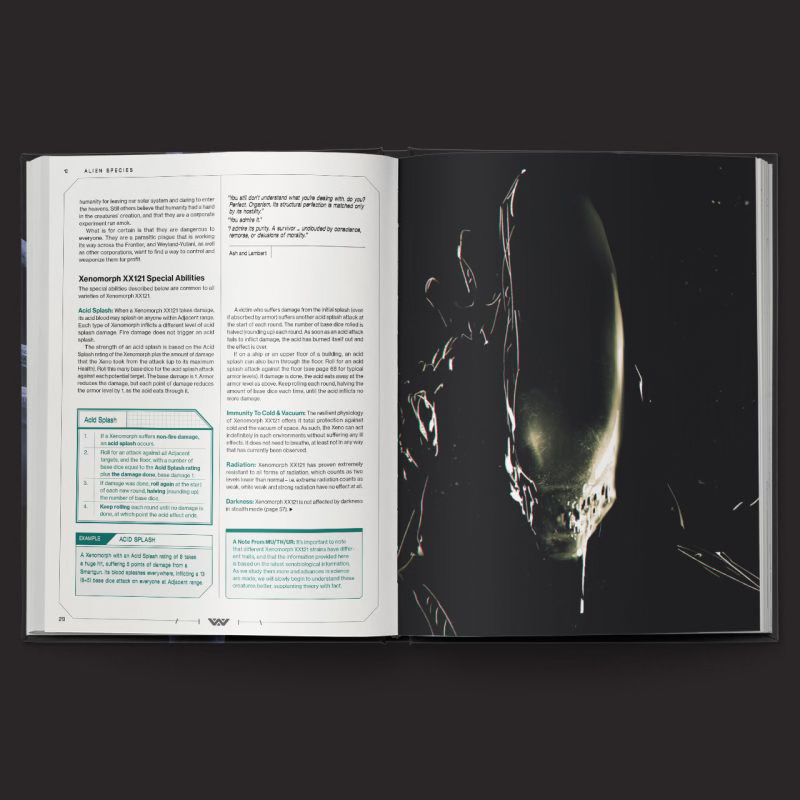
I get why some don’t like it. The original pages were black, with text boxes in a light green with black or dark green text, that while readable, meant that you got a lot less game but a more unified look with the artwork. And to be fair, the art was superb, atmospheric, and really leant to the enjoyment of the book. It was also very much Free League’s style at the time (as with the Tales from the Loop series of games and Blade Runner): half art book, half game book. The new layout — and I chose the above specifically as an example of this — loses a lot of that atmosphere for readability and a focus on the game mechanics and setting material. It’s much less pretty and less of an experience to read. It’s also much more useful from an information and usability standpoint. (It’s also probably much cheaper for Free League to print.)

Similarly, the gamemaster screen is more readable in the new format, with the player side showing art that looks like the circuity cubbyholes of MU/TH/UR’s vestibule in Nostromo, with the circuitry map on a screen in the middle. Looks nice, simple, but I think the original screen — on the player’s side — was better; the GM side is better in the new edition GM screen.

The bad? Not much. Some may complain about the inclusion of more material connected to Romulus — I like it. There’s more gear in the corebook, and even mundane stuff like water can have an impact, mechanically. All of this is, of course, something you can just ignore. That’s the nice thing about this edition; you can just use what you like and ignore the rest. The basic mechanics are the same: roll a number of dice equal to your ability and skill, set a 6 on one of them to succeed.

If anything, I’m a little disappointed they didn’t move to the die mechanic from Twilight: 2000 and Blade Runner. I like the different type of dice — but this system is basic to the point of utilitarian. It doesn’t get in the way. The stress/panic mechanic is still one of the best for urging the players to lean into the horror aspect of the game, instead of ignoring the impact that awful stuff happen ing around you has to a character. 

So, is it worth it? At about $50-60 US for the core book, it’s a solid yes if you’ve wanted to get the Alien game and just haven’t. If you’re happy with the old version, it’s not a must — but after reading it, I’m happy I’ve got it, and I think it’s worth it for some of the extra gear, alternate rules, and added material from Romulus.

Normally, I wait until I have a physical copy for a review of a game, but Legend in the Mist is looking like a late spring/early summer timeframe for that. Kickstarted earlier this year, Sons of Oak promised “…[a] rustic fantasy tabletop RPG based on the acclaimed City of Mist.” It is essentially an engine similar to Powered by the Apocalypse, using “tags” to modify task rolls, rather than a plethora of modifiers. I was a little skeptical of the system — my experience with the PbtA games has been lackluster, but Sions of Oak give you the chance to try out the game with a comic book-style mini-adventure that plays like the old Create Your Own Adventure books of old — you chose an action, go to the appropriate page, and press on. It’s a novel way to teach the game, and the artwork..? The artwork is gorgeous. I must not have been alone in my assessment: the Kickstart pulled $855,000 or so. Pre-orders are still being taken and I went all in on the Ravenhome bundle.

The PDFs of the main books — both the core rulebook and Action Grimoire are already out, as is the PDF of the GM screen (which is actually useful!), as well as a few extra bits: a Halloween and Winter-themed short with creatures, etc, and a Dungeons & Dragons 5E conversion guide for the main character classes. If you preorder, you get these little “splatbooks”.

So first, the production values. Yes, I only have the PDFs to go by, for now, but these are gorgeous books. The artwork has a realistic animated film kind of look with multiple two page pieces that blend one into the other. 

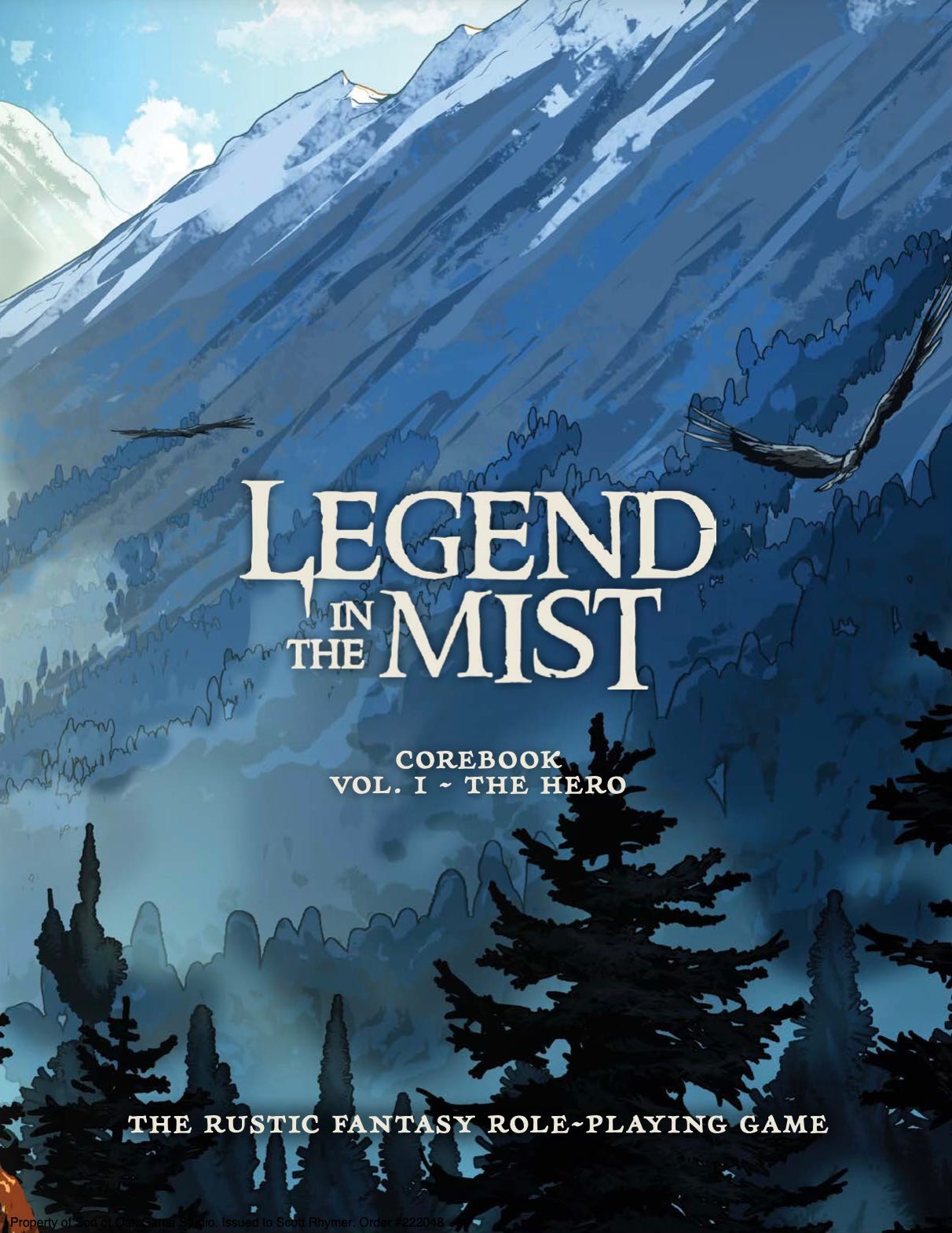
The title page…

You build a character by creating four “themes” — based on personality, your trade or job, background, etc. — and there are three “might” levels: origin, adventurer, and greatness, so you can play from rank amateur or average adventurer, to trained and skilled heros, to powerful heroes. You can choose from pre-existing themes like Artisan, or Prophetic Visions — there are “power tags” listed that give you a bump on your die rolls, depending on if they are applicable or not. You choose two and one weakness tag which might work against you in a scene. For instance, a Hunter might have a “Well Crafted Bow” and “Animal Lore”, with a weakness of “Ragged & Dirty”. You get four of these themes, plus a “backpack” for gear. There’s also a Fellowship Theme for group play explaining why you’re together.

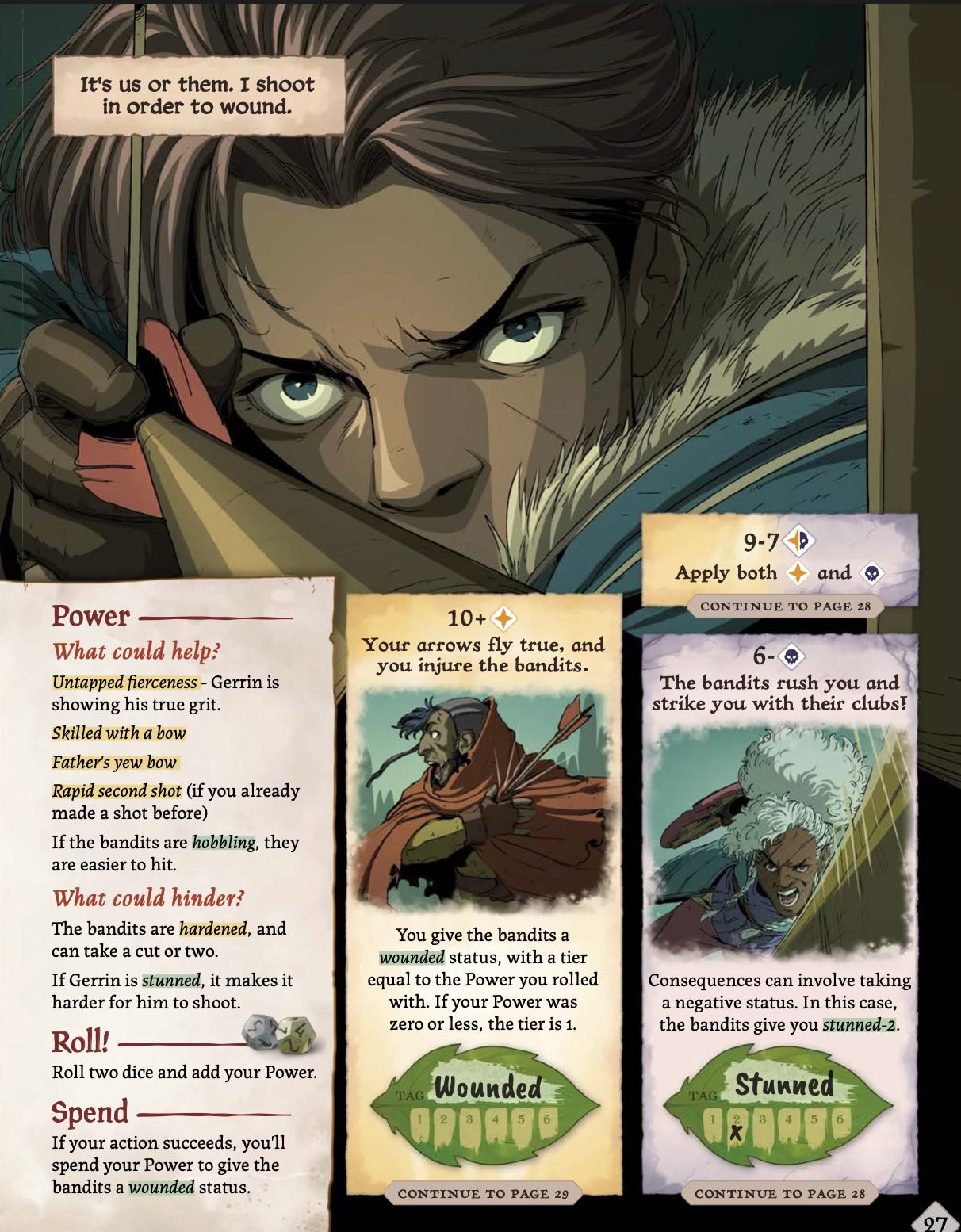
You’re ready to go. Play is simple: the GM gives you a situation, you tell them what you want to do to respond and figure out which tags work for the scene (which might have it’s own tags like “Bandits!” or “Heavy Downpour” that take away from your roll. Roll 2d6 added together to give you the result. A 10+ gives a success and depending on the tags, you give a “status” to your opponents or you overcome whatever obstacle you were meeting. A 7-9 gives a success, but with a consequence — a negative status to you. Six or lower is a consequence and you failed. For instance, say you were climbing a cliffside and had “Strong as an Ox” and “Athletic” tags that were appropriate — that adds 2 to your roll. However, it’s raining and the rock is slick for a -1 to your test. You roll a 7 (+2 for your tags and -1 for the rain for an 8.) You make it up the cliff, but you might have a consequence of “Scrapped Up” or it you were on a time limit you might be “Behind Schedule”. Here’s an example from the comic:

The books has plenty of examples of situations and opponents — all approached in the same way, and the Action Grimoire adds to the number of scenarios your could borrow from on the fly as a gamemaster. I ran two nights of Legend in the Mist using a vague idea of an adventure, and used the core book and Grimoire to slap together encounters that ran quickly and well. Both groups thought the game rules were simple and quick to understand, although trying to figure if a tag was appropriate had a lot of trying to stretch the meaning of the tags. Spitballing statuses was a bit tricky the first time out, but once it clicks, the game is easy to run — even off of the PDFs and a two page cheatsheet you can get off the Sons of Oak website.

The core book is a double volume coming in at a hefty 496 pages in PDF format, the Action Grimoire is another 103. Even the 5E splatbook is 25 pages.

So, is it worth the $50 for the core book and $20 for the Grimoire? Yes…and unreservedly so. One thing I’ve always disliked about Dungeons & Dragons is the staggering amount of rules you have to sift through, especially regarding magic. None of that here — it’s a simple engine for play, leads to good character creation and role play. It’s also just beautiful to leaf through. 

All the artwork here is 2025 copyright the Sons of Oak Game Studio. No infringement is intended — only a good ol’ word of mouth assist for a good product.

I’ve been running an Outgunned Adventure! campaign set in 1920s China. The most recent threat was a huli jing — a fox spirit. The creature is popular in Chinese, but also Korean, Japanese, and Vietnamese myth. These usually immortal creatures have nine tails in fox form and can shapeshift — usually into beautiful young women who seduce scholarly or important men to steal their knowledge and life essence. (You can guess how…) They can be driven off by catching them in fox form and cutting off their tails, or in human form by getting them drunk. Alternately, they can be driven off if you know the name by writing it on paper, burning the paper, and mixing the ashes in tea.

« Previous PageNext Page »