In preparation for RPGaDay this year, I’ve been thinking about characters that fit one or more of the prompts. This naturally led to how we create characters in roleplaying games.
There are, broadly, two ways to do this: the stats/race/class come first, or the idea comes first. For a lot of the early RPGs, that first path was often more common. Example: in the bad ol’ days of Dungeons & Dragons and the d20 stuff that followed (Gamma World, Top Secret, etc…), a lot of players would maybe have a preferred class and race in D&D, or know they wanted to play a G-Man in Gangbusters, but often the stats came first — strength, constitution, what have you. My elven wizard has X in wisdom. From there, after minutes agonizing over a name, (I’ve always found this amusing…) you might start to throw together a basic picture of who the character was, or just let it form in play.
Nothing wrong with this. It’s fast and gets you into the game with a minimum of preparation, and way back when roleplaying was more of an extension of wargaming, players were much more interested in combat as the thing. Character was often secondary. There are fewer of these RPG systems, these days — Lex Arcana is a good example of this, but mostly you have to look back to older stuff still being played to see this focus on “roll playing”. It’s kept D&D in the public eye for decades, and it’s one of the reasons it’s still the most popular game system on the planet.
The second is to have an idea for a character up front. You have, at least, the bare bones of a persona you want to inhabit for a few hours at the gaming table. For instance: I want to play a private eye that is not hard-boiled, but surprisingly kind and empathetic — and this naiveté is he main weakness in a noir setting, where societal corruption is usually a theme in the background. I don’t have much else built in, yet, but it’s a great idea with good hooks — a character less likely to resort to violence, a guy that genuinely cares about the people he’s helping, and a glaring weakness that, for once, isn’t simply he’s a sucker for a dame. Why is he like this? Maybe he’s a war veteran and violence repulses him…but he’s good at it, and hates that part of him.
A change came in RPGs around the ‘90s. You started to see games more focus on this second style of play — “role playing” — immersing yourself in a character and a world. There were hints of it showing in the ‘80s. James Bond: 007 had the idea of “weaknesses”, something any English major will tell you is what makes a hero interesting. It was a central part of comic book RPGs like DC Heroes and Marvel Superheroes, if only because limitations to a character’s powers were part of the tropes of the genre.
When building your character, a few simple questions help get this started: who is this person — what is their defining trait? Why do they do what they do? What or who matters to them? What or who do they hate? Where are they from and how does that affect how they act? Right now, there are a few systems on store shelves that are really good at helping a player create a character, not just a set of numbers. The standouts for this approach to gaming, where the system helps you flesh out a character and the stats encourage playing the strengths and weaknesses are Legend in the Mist and the Avatar games, both based on and a refinement of, the Apocalypse World engine; and specifically two of the 2d20 systems from Modiphius: Star Trek Adventures and Dune: Adventures in the Imperium; and the very rules-lite Die: the Roleplaying Game, based on and developed in tandem with, a comic book of the same name.
Each of these systems revolve around the development of the character less from the level-up standpoint of roll-playing, and more from a how do they change as people. The best of the bunch for the theater kids out there is Die. You develop, together, not just your character in the world of Die, but the player playing that character; the other players also have input on who this person is. Then the players’ own desires and failings inform not just the character — an expression of their wish fulfillment — but the enemies, stories, even the settings that adventure in. It’s very meta. It’s also very cool.
As good in Legend in the Mist (and their City of Mist), where characters are not about their stats, at all. You have four themes — devotion, skill or trade, some physical characteristic, for example — and “tags” short descriptors that may or may not help you in an action, like Charming or Strong as an Ox. These each add a +1 to a simple 2d6 test. There are weakness tags per theme, as well, and these are essential to the improvement of the character. Your weaknesses and failures help you learn; not your successes…much like real life. You goal milestones level you up, in so much as allow you to change themes and tags as you grow.
Similarly, Star Trek Adventures and Dune have your goals, values, and weaknesses built into the character at creation and they have mechanical impacts in play. In Dune, your Values (Power, Duty, etc…) and your Skill (in broad terms like Understand or Battle) add together to give you your target number for a test. If a test does not impact your Duty, say, but your Faith in leaders or a system, that alternate Value is used for your test. STA has Value statements that give you game currency that can help supercharge an action — for instance, resisting intimidation, or taking an action that might seem futile might play into a Value or Spite is a Powerful Ally. These help drive a player to have their character act in ways that might not always be in their interest. Addicted to Love is one character’s Value in our STA game. He falls in love easily — and gains game currency for taking the hit due to the value, like being a sucker for seduction or persuasion by women.
The matrix above shows character beats that are useful both for individual character, but also for a group’s character, or even overarching themes for a campaign. This is something starting groups sometimes miss: why they are working together. There are a few easy ways around this: you all got hired for a job and meet in the stereotypical tavern; if you’re in a military, police, or other service setting — you all got assigned there recently; or happenstance — our plane went down and now we’re all we’ve got. Building out why they are there and how they interact at the start is an extra step that slows getting right into the action…but it does help create interesting games.
Of the systems noted above, Son of Oak’s Mist games do this well. in Legend in the Mist, you build your “fellowship” along with your characters. You not only have tags for your players, but ones for the group as a whole. you decide what the relationship is to the other players and that can be used as a tag when interacting with each other. Die has the players build their player/characters together, define how they view themselves and their friends, as well as what kind of world they would be interested in playing.
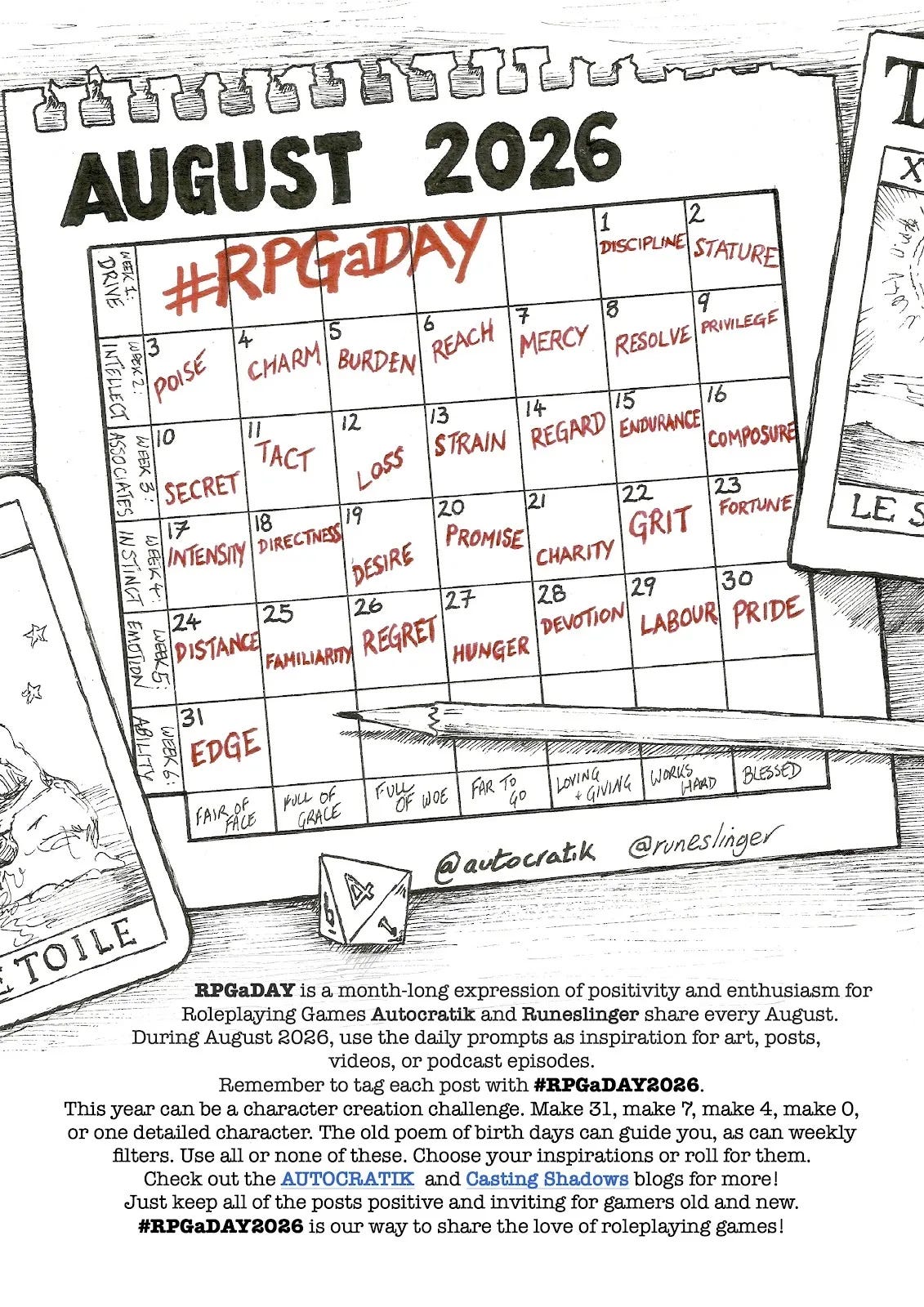
So as we roll into RPGaDay, I’m hoping to use these prompts not just to showcase character ideas, but how these can be used for group dynamics and story ideas.

