Roleplaying Games


The official “gillmen” in Hollow Earth Expedition‘s Mysteries of the Hollow Earth sourcebook are anthropomorphic fish people. They have legs, and are pretty unseemly things. I was originally going to ignore them, but a possible angle to the current campaign has given me a possible use for an aquatic race. I just don’t like these ones…

05b9db24b04505837d649cee3db2e738I decided I wanted something with a more Abe Sapien vibe from Hellboy, but I also wanted them to be alien; a tail was something I thought was needed.

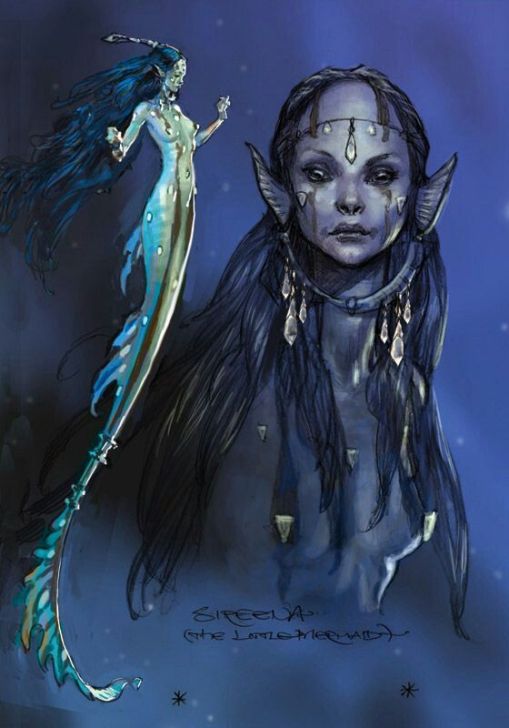
The obvious choice was to go full merfolk… But all the merfolk images tended to be sexy mermaid crap.

Then I stumbled onto Ian McCaig’s on the left. Similar enough to the Abe Sapien look I wanted.

So I reworked the Gillman package into the Mermen package.

Mermen

Ancient, mysterious, and the subject of intense superstition, merfolk are one of the more populous races in the Hollow Earth, but are rarely directly encountered. Their appearance ranges from truly alien — gilled, long tails, scaled, to strangely human. Some have even been rumored to have legs!

Physiologically, from the “waist” up they appear nearly human, but caudally they have long tails. Their faces are eerily human, but will large, dark eyes, gills to the sides of the head and neck. They have no apparent ears, but hear through their skin, using a form of echolocation. Additionally, they possess Ampullae of Lorenzini, like sharks, and can sense fain electrical fields, allowing them to find prey more easily. Some merfolk are known to wear jewelry about their bodies and it has been speculated that this may enhance this ability. Some have “hair” that look to be some kind of protective growth and tend to only be seen on the females.

Culture

Very little is known about the culture of the merfolk, other than they travel in “pods” of “schools” of a dozen to perhaps three or four dozen. They communicate through a complex tonal language that can be heard for tens of miles when they are underwater and is sometimes mistaken for whale-song by those from the Outer World. Some of the merfolk have been known to lure sailors to their deaths but hypnotizing them with certain frequencies and progressions in their songs.

They are romantic, impulsive, artistic, and philosophical, but they are also hardly pragmatic as a race in the highly competitive environment they live in can be.

They appear to believe in something called the “Great Deep” — an allegory for eternity. They claim to have been “created” by the Ancients that once populated “the World”, as most of the beastmen were.

Language

There are some that claim to have talked to these creatures, and that some have learned the speech of other denizens of the Hollow Earth.

Mermen Zero Level Skills

All mermen are assumed to have at least zero level (see the sidebar in Secrets of the Surface World) in Athletics, Brawl, Melee, Performance, Stealth, and Survival

Mermen Characteristics

Starting attribute adjustment: +1 Body, +1 Dexterity, -1 Strength, -1 Charisma

Natural Advantages: Aquatic (double movement rate  in water, but half Dexterity (round down) and movement on land; Captivate: Can use Performance to entrance a target for the number of rounds equal to their number of successes over the target’s Willpower; Gills: can breath in water; Echolocation: can “see” without light; Electroreception: can sense electrical fields in water, +2 perception in water; Siren Call: This is a longer version of Captivate that can only be used in non-violent situations. The length of time is in minutes equal to the number of successes over the target’s Willpower.

Normal Flaws: Dry Skin (after an hour will take 1N damage for each hour not hydrated.), Primitive

So, the game group was off on travel, or other things, this week, so I dropped in on the local gaming Meetup here in Albuquerque. They were playtesting Traveler, the “ultimate edition” or “5th edition.” Sounded good — I liked Traveler back in the day, had a lot of the wee black books, and it was our sci-fi mainstay through the ’80s.

There were other sci-fi games that hit the shelves in the first big RPG wave: Star Frontiers, which was D&D’s d20 but with aliens; there was Universe — which had a gorgeous star map and not much else; and the execrable Space Opera, which along with the original The Morrow Project, remain my benchmarks for unplayability. Traveler really was the only game in town through most of the ’80s. The system mechanic was simple tests had a base 7 or lower, with mods, rolled on two dice. That was it. It was hard-ish science fiction, you could get dead quickly — so quickly, in fact, that your character could die in character creation.

There are a lot of died-in-the-wool Traveler fans who like this. It’s still as stupid as it sounds.

Traveler got the GDW treatment in the late ’80s with Megatraveler and Traveler: 2300, which was Twillight: 2000 in space! There was a reprint of the original rules in the ’90s. There was the d20 3.5 edition version Mongoose put out. Now there’s The Ultimate Edition! by Marc Miller himself!

My first whiff of trouble was when the guy running it mentioned the book was 650+ pages. The original rules were something like 70. Worse, he told us that on the game’s forums you weren’t allow to say “it wasn’t a game…” What the hell did that mean? We found out quickly. A quick perusal of the table of contents shows the “characters & life” chapter to be 140 pages long. There are entire — good! — games with a core book that long. Combat is 96 pages. Ninety. Six. To be fair, only 24 pages of that is actual rules; the rest is a mind-numbing collection of charts and rules for making just about everything.

We decided to do a short run from one world to another in our trading vessel. Time to buy some cargo and get passengers. This took 20 minutes (no role playing, 20 minutes of chart checking), 3 charts, and a fucking calculator. I wasn’t in as bad a shape as the other players, as I remembered the world rating scheme (eHex, Miller calls it now.) well enough to remember where the tech ratings, etc. were.

So the night be fore we shipped out, we decided to hit the bar for drinks and the inevitable barfight. A throw beer bottle injured one of the characters, then we had  20 minutes of talking about the new Captain America: Civil War while the guy tried to decipher the rules for a simple punch up. Everything is based on range in T5, and you get the number of dice for a test on the range increments. 2d6 seems to be the standard for most tests, rolling below the attribute and skill. Fair enough.

But for fisticuffs, it’s a straight attribute+skill minus the other guy’s to get the base number to hit. With normal mundane guys packing 7 for stats and nothing else, we found we could literally not punch a guy, and the one character could not, under any circumstances be hit physically. If they backed off and lazed his ass, sure, but apparently, no one bruises their knuckled in the Third Imperium. It was the single worst set of mechanics I’ve seen since, well, Space Opera. (That’s not fair…we could never finish character creation in Space Opera. Just in case you haven’t pick up on the subtlety: Space Opera is one of the worst games ever committed to paper.) The entire combat system seemed to assume you would shoot each other.

So, deciding that after 30 minutes of close dancing with the yokels would lead to terminal boredom, we shipped out. Well, tried. We have to jump three sectors, so that’s three dice to roll, but one of them is a “fate” dice, or something similar. The GM rolls it and keeps it secret to work against your roll. So the navigator rolls against his 15 in attributes and skills, and rolls a 10. In any other game, a success by five’s pretty good…but the GM rolled a six, so we were hosed. We could “recalculate” our results, which we were informed takes 24 hours, and would require him to roll three dice (so it would be harder than the initial roll.)

One of the players pointed out that this was similar to debugging code, yadda yadda, and was realistic. I pointed out my iPhone has enough computational power to do orbital mechanics in a few minutes. Why recalculate asked another player. We could get drunk for 24 hours and just start from scratch easier.

We decided to just forgo space combat tests at this point, as we had wasted two hours of our lives. In short, this was one of the worst gaming experiences I’ve ever had — the system was absolute dogshit. The mechanics looked almost like some sexagenarian Grognard decided that all this playability and focus of story and characters in recent game design was missing the point of gaming — charts, you see, charts! are the centerpiece of a good game. And who wants to be able to just roll dice and know what happened? It’s so much better when you need to rent time on the local supercomputer to hash out if your character died before you started playing it.

Traveler 5 is one of the worst bits of game design I’ve ever seen. There’s no design cohesion from one section to the next, and the entire point seems to be to wring the last chance of fun out of play. I don’t seem to be the only one saying this, either.

Style: 2 out of 5 — it’s all black and white, save a few glossy pages, and is dense typeface. Substance: 4 out of 5…if you love charts and dense mechanics that are difference for every situation, otherwise it’s 2 for the utter lack of playability. It’s the Space Opera of the 21st Century.

Is it worth it? Not just no, but fuck no. Go buy the old black books and have fun.

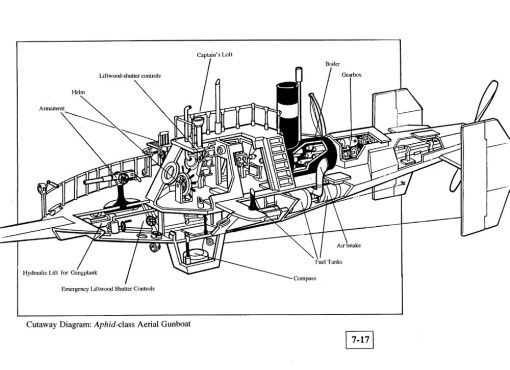
APHIDcutaway


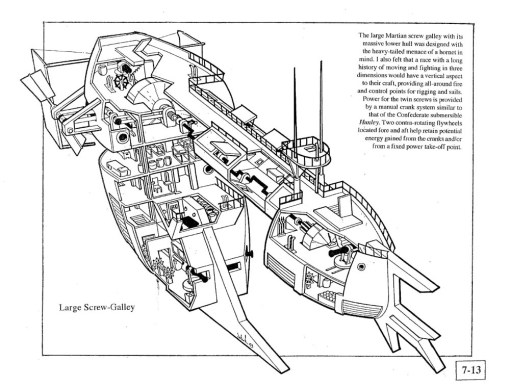
hullcuttercutaway

Here are a few of the Royal Navy aerial flyers currently active in 1889…

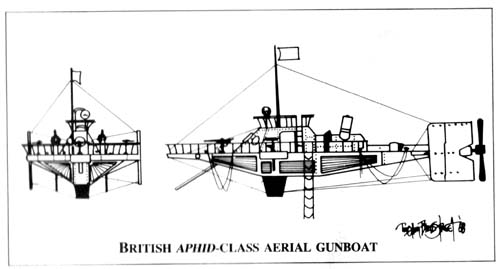
Aphid-Class Aerial Gunboat

Aphid

The Aphid-class was the first aerial gunboat designed by the Royal Navy, and one of the most successful. While small at 130′ in length, and 50′ in beam, and hastily constructed in 1881, they are well armed and have some thin metal-clading to protect the crew in combat.

In 1886, these vessels underwent refit to use forced draught boilers that kept the same horsepower, but lowered the total mass of the vehicle, allowing for the use of a long-four gun, rather than the original short-four without loss of performance.

Currently, there are four of these gunboats in operation: Aphid constructed in 1881 is stationed at Parhoon, Ladybug (built 1881, lost 1887), Sandflea (built 1882) at Meepsoor, Firefly (built 1882, lost 1889), Wasp (built 1888) stationed at Syrtis Major, Hornet (1888) at Parhoon. Two are under construction — Honey Bee and Bumble Bee and both are expected to launch in weeks.

SIZE: 8   DEF: 4   STR: 14   SPD: 30   CEIL: VH   HAN: -2   CREW: 15   COST: £23,330; WEAPONRY: 4′ short cannon (fore*) — Dmg: 10L   Rng: 500′   Rate: 1/2   Spd: S   Size: 2; 2 1 lb. Hotchkiss Rotary Cannons (side mount) — Dmg: 8L   Rng: 500′   Rate: 1/2   Spd: S Size: 2; 2 Nordenfeldt machineguns (broadside) — Dmg: 5L   Rng: 250′   Cap: 40 (m) Tate: A   Spd: S.

*The upgraded Aphid has a 4″ long gun on the fore — Dam: 10L   Rng: 750′   Rate: 1/2   Spd: S   Size: 2.

Locust-class Aerial Gunboat

The first ship designed and built for the Royal Navy on Earth, these are essentially Aphid-class gunboats reworked for Earth’s gravity. For that reason, these boats have less armor and smaller guns to compensate for the needs of terrestrial flight.

The original chief of construction wanted to forgo the minimal armor for more firepower and has been critical of the performance of the vessels, but the Admiralty currently anticipates no changes to the design.

There are five Locust-class gunboats in service on Earth: Locust, built in 1886, and Dragonfly (1887) serve with the Channel Fleet; Tse Tse (1887) with the Pacific Fleet; Yellowjacket  (1887) with the Mediterranean Fleet, and Grasshopper (1888) with the Atlantic Fleet.

SIZE: 8   DEF: 4   STR: 13   SPD: 25   CEIL: VH   HAN: -2   CREW: 15   COST: £24,500; WEAPONRY: 4′ short cannon (fore an stern tower) — Dmg: 10L   Rng: 500′   Rate: 1/2   Spd: S   Size: 2; 2 1 lb. Hotchkiss Rotary Cannons (side mount) — Dmg: 8L   Rng: 500′   Rate: 1/2   Spd: S Size: 2; 2 Nordenfeldt machineguns (broadside) — Dmg: 5L   Rng: 250′   Cap: 40 (m) Tate: A   Spd: S; 2 rocket batteries (one upward, one downward firing) — Dam: 6L   Rng: 500′   Rate: 1/2   Spd: S   Size: 2.

Dauntless-Class Aerial Gunboat

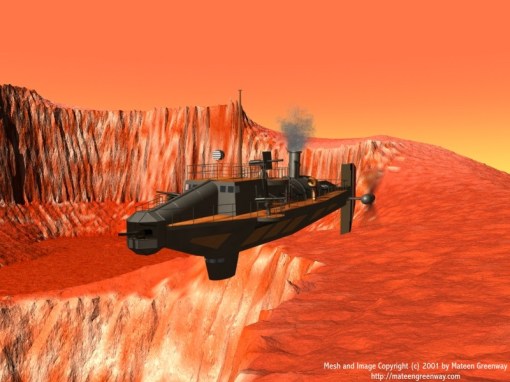
The sleek Dauntless looks lovely, and performs poorly. Much of the problem stems from the slight transit the turreted forward 4″ long gun has, providing only a limited angle of fire to the front. The armor makes the ship heavy and slow to turn. Conventional boilers were replaced with forced draught boilers for HMS Danger and after.

courtesy of Mateen Greenway

courtesy of Mateen Greenway

There are only two of these aerial flyers in service: Dauntless built in 1884 patrols Syrtis Major, Daring was launched in 1886 and lost within weeks, and Danger, launched in 1887 and on station at Parhoon.

SIZE: 8   DEF: 4   STR: 14   CEIL: VH   HAN: -2   CREW: 15   COST: £23,330; WEAPONRY: two 4′ short cannon (forward turret and stern tower) — Dmg: 10L   Rng: 500′   Rate: 1/2   Spd: S   Size: 2; 2 3 lb. Hotchkiss Rotary Cannons (wing mount) — Dmg: 9L   Rng: 500′   Rate: 1/2   Spd: S Size: 2; 2 Nordenfeldt machineguns (broadside) — Dmg: 5L   Rng: 250′   Cap: 40 (m) Tate: A   Spd: S.


I have a class I teach that deals with time and the creation of “time” as we think of it, but this video is a pretty good primer for those that haven’t thought about it.

Time standardization wasn’t a thing until 1847, when the railways in England needed to simplify their scheduling. As the video points out, most towns set their clocks from the point the sun was the highest in the sky. But even in a small area like Britain, the difference between noon in Yarmouth and noon in, say, Penzance — a whole 120 or so miles from one side of the island to the other — is different. Train schedules necessitated time be “standardized” in Britain.

This is why the scheme was known as “railway time.” For those of you running games before 1847, there’s no time zones. There’s no fixed time save local; there were trains, however, and getting to a place when you thought you would was often problematic. You might wind up spending an evening on a railroad bench waiting for the next train because it left a few minutes before you arrived.

By 1855, all of Britain was on GMT (Greenwich Mean Time), but Time Zones as we know it didn’t come into being until 1883 when the American rail companies adopted the “one hour” time zone similar to what we know today. Most of the world was on some form of standardized time zones by 1900, but there were loads of local variations. In the US, actual implementation of the StandardTime Act was in 1918, so even those with Victorian or Wild West period games can work this in — it might be noon on the town clock, but it’s 11:45 on the rail platform.


I finally got a few moments to work on converting some more of the ships from the old Space: 1889 game to the new Ubiquity version. We’ve already had a guest poster give his rules and reasoning behind his work, and now it’s my turn. The old Space: 1889 and the connected Sky Galleons of Mars boardgame were directed more at the old school minis and wargaming crowd. In fact, while I occasionally use minis to clarify certain battle scenes, Space: 1889 was the last game in which I would shift from roleplaying game to wargame when it was time for a fight.

Ubiquity really isn’t set up this style of play — not that you couldn’t find a way to combine the old school wargame with the more narrative-oriented play of the new game. To that end, my stats on the cloudships and aerial flyers of the Space: 1889 world will be more Ubiquity-directed, and may not satisfy the person looking for more “crunch” in their aerial antics over the sands of Mars; I direct those players to the link above.

So why are the stats what they are? Some are going to have similar complaints about the lack of uniqueness between the vessels. (Similar complaints were levied at Cortex, which could be made crunchy PDQ.) Here’s why the stats are what they are. Size — in Ubiquity, animals were lumped into size categories that were exponential. If you were a certain weight or size, you might jump to the next category, and at a certain point, it was assumed the Defense of the thing would be too great for you to do much harm. The ships are lumped into those size categories. Defense is usually just cribbed from similar vessels in the Secrets of the Surface World sourcebook, but a good rule of thumb would be assume the material (4 for wood, 6 for metal) and if armored, add half again (6 for wood, 9 for metal). The size of the vehicle is going to make it very easy to be hit, so Defense here is going to be based off the physical material.

Structure is pretty basic — what’s the material plus the size modifier. For instance a wood (4) ship of size 8 has a Structure of 12 as it’s base; a metal (6) one would be 14. To give a bit of variability, you could factor in armor, but what I’ve wound up doing is going with that base, then looking at the damage a vessel could take in Sky Galleons. An Aphid-class, for instance, has a total of 10 points for its hull, and 2 armor. I assumed the 14 and added 2 for the armor to get the Ubiquity version. A more massive ship that was still in the Size 8 category for physical size I rounded up a few points in the initial write-ups; Now I look at the armor and total structure. If it’s lower in the old rules, it gets boosted in the new; if it’s higher in the old rules, it gets that structure in the new rules (although a few places I’ve ignored that — like with the Warm Winds, which would have been stronger than an Iowa-class battleship.) I err on the weaker numbers in general on the assumption that liftwood vessels, as with all aircraft, have an inherent flaw…they lack support against gravity. Hit in the right place, do enough damage in the wrong place, and the superstructure can come apart, regardless of the overall damage taken. As any WWII combat pilot that got a wing shot off — the rest of plane might’ve looked great as it went into the ground like a f#$%ing dart.

I would suggest adding in the very low to very high altitude ceilings in your game. Divide the structure by the number of altitude zones, and assume that once that amount of structure is removed, the ship loses an altitude zone.

So here’s a few more Martian cloudships:

Sky Runner Medium Screw Galley

Wth five decks and a crew of 32, these screw galleys are usually out of the shipyards at Karkarham, but are found in service all over the Red Planet.

SIZE: 16   DEF: 4   STR: 20   SPD: 20   CEIL: VH   HAN: -2   CREW: ~32   COST: £25,600; WEAPONRY: 3 heavy guns (fore and wing mounted): Dmg: 8L   Rng: 250′   Rate: 1/2   Spd: S   Size: 2

Endtime Medium War Galley

This is the mainstay of the Oenotrian sky navy, and has been turned out in large numbers. It is the smallest vessel to mount a lob gun, and the heavier weight gives it limited ceiling and a sluggish speed, and the focus on firepower disadvantages these ships with shorter range of fire than the human gunboats.

SIZE: 16   DEF: 4   STR: 20   SPD: 15   CEIL: H   HAN: -2   CREW: 45   COST: £31,500: WEAPONRY: Rod gun (fore) — Dmg: 8L   Rng: 500′   Rate: 1/2   Spd: S   Size: 2; Lob Gun (amidships) — Dmg: 10L   Rng: 250′   Rate: 1/2   Spd: S   Size: 2; 2 heavy guns (wing-mounted) — Dmg: 8L   Rng: 250′   Rate: 1/2   Spd: S   Size: 2.

Skyfire Heavy War Galley

The Oenotrian Sky Navy has two of these brutes in service. The design is conservative — a typical double deck forecastle, a thin spine to the five decked aft hull. The screw requires 42 people just to operate at full efficiency, and it is heavily armed and has a ram-prow (see below.)

SIZE: 16   DEF: 6   STR: 22   SPD: 15   CEIL: H   HAN: -4   CREW: ~95   COST: £105,400; WEAPONRY: 4 Rod gun (2 fore, 2 aft, behind bulkhead) — Dmg: 8L   Rng: 500′   Rate: 1/2   Spd: S   Size: 2; 2 Rouge gun (broadside, behind bulkheads) — Dmg: 8L   Rng: 250′ Rate: 1/2   Spd: S   Size: 1; 8 heavy guns (broadside, behind bulkheads) — Dmg: 8L   Rng: 250′   Rate: 1/2   Spd: S   Size: 2; 10 tether mines — Dam: 12L   Rng: up to 500′   Rate: 1/2   Spd: S   Size: 1

Prow Ram: With a successful Pilot test, the Skyfire can do up to it’s DEF in damage to an opponent ship. With +1 success, the ship is stuck into the target and boarding can commence through a hatch in the ram, or from the main deck.

First off, the advertising campaign for this has been very well done. I’d swear almost every frame of the movie has been in an ad, but they’ve done a good job of keeping many of the plot elements hidden or had created red herrings with the edits. The movie went in a direction I didn’t quite expect.

So, yeah, there may be some spoilers.

The movie is a direct sequel not just to The Winter Soldier, the second Cap installment, by also Avengers: The Age of Ultron. The event of both movies lead quite naturally to the events of this movie. If anything, this film probably should have been called Avengers: Civil War.

There is a teaser that takes place in 1991 that is a pivotal moment for the plot, and the way the movie plays out, it will be the main red herring throughout. The title sequence leads us to Lagos — where the Avengers are tracking Cap’s old number two and HYDRA agent, Rumlo, as he is engaged in a plot to steal a biological weapon. The team takes out the trash, but in the fray, a number of people are hurt and killed by a bomb (including 11 Wakandans, which brings the Black Panther angle into play.)

Meanwhile, Tony Stark — at MIT giving a keynote lecture and dropping grants on the students there — gets sidelined by a State Department worker whose child was killed in Sokovia during the events of Ultron. I highly suspect there is a plot line that hit the cutting room floor about this being a deliberate attempt to get Stark to support the Sokovia Accords — a United Nations attempt to grab oversight of the Avengers (and, it is implied, other “enhanced” people. They don’t tie it to the Inhumans and events in Agents of SHIELD and that is unfortunate. It would have grown the scale of the consequences of the accords, without growing the scale of this movie.)

Stark, and his friend Col. Rhodie (War Machine), and Vision — both, in many ways, Stark’s creations (and Vision directly so) sign onto the oversight when the Secretary of State and former general and Hulk tormentor,  Thaddeus Ross puts it to the team. Black Widow also thinks some kind of oversight is needed, as well. Stark makes an excellent case that they need to be supervised and directed, that they are loose cannons, but I would suggest that he is only partially correct…outside of the events of Thor and the events of the original Avengers film, which are fomented by extraterrestrial (Asgardian) actions, nearly every major screw up the Avengers are part of is Stark’s doing. Ultron is the direct result of this arrogant, undisciplined asshat playing with things he doesn’t understand; he almost makes it worse (and may still have) by creating Vision in direct opposition to Cap’s objections. Sokovia is his mistake. And the Vision remains a big question mark as to motive in the Marvel Cinematic Universe

The other side is Captain America, his sidekick Sam Wilson/Falcon, and Wanda Maximov/Scarlet Witch. Cap — having seen some pretty terrible things happen due to bureaucratic machinations — the almost nuking of New York by the military, the destruction of SHIELD by the cancerous infiltration of HYDRA — is naturally suspicious of Ross and the accords. (I was surprised that Ross’ nemesis being Avengers member Bruce Banner was never specifically referenced…why should they trust this guy?) In many ways, the “Bucky”/Winter Soldier angle in the ads is the McGuffin to get the fight started, but it’s much deeper: this is a fight between those elements of the state that seek to control, and the individual’s right to choose their path.

As events proceed, we learn that Maximov (who is being blamed for the Lagos incident) is under house arrest “protective custody” at the Avengers compound. A prisoner guarded by Vision. Cap and Falcon get on the trail of Bucky after he allegedly blows up the Sokovia Accords signing event, killing the Wakandan king and setting Black Panther against Team Cap for the rest of the movie. When Cap brings the Winter Soldier in alive, and outside the law as he hasn’t signed the Accords, he is stripped of his shield.

Stark makes a real appeal for Cap to join the team and sign. That if they don’t do it now, they’ll be made to do it later. It’s a good argument, and the one used by state tools for millennia to get people to cede a little freedom for a bit of security. By doing this, all the things Cap did that are illegal would be magically made right by the power of law. It’s not that he did the wrong thing; it’s that his actions weren’t sanctioned. Worse, in many ways, the one member of the Avengers that should be in a jail cell is Stark for creating Ultron, but like the rich and powerful throughout time, he’s signed on with the new power structure and is insulated from his former actions; hell, he’s in a position of authority as de facto leader of the Avengers.

In the end, however, Civil War isn’t a grandiose movie. It’s a personal one. Events split the team apart and lead to a number of excellent action set pieces, but nothing on the scales of the Avengers movies, or the final fight in The Winter Soldier. This is a good thing. All the action proceeds from the goals of the characters, and they are defined by the same. The end fight is not a city-destroying event; it destroys friendships and people.

The characters in the movie are all driven by some form of vengeance. Stark and the villain Zeno, T’Challa/Black Panther — they are motivated by anger; Cap, on the other hand, is motivated by redemption — for Bucky, but also for himself, and for the rest of the Avengers. This plays out so clearly in the final fight, that I found myself saying aloud, “Fuck Stark.”

All of the characters get a few good beats — from the snarky and spiteful word battle between Hawkeye and Iron Man, the interaction between Wanda and Vision, to the wonderful intro of Spiderman (really, this kid deserves all the attention he’s getting) and the humorous bright spot he and Ant Man bring to the movie, to the reawakening friendship between Cap and Bucky — the writing is good, the acting is spot on, and the direction (other than one awful “shaky cam” fight scene) is tight. The music and the choice of font for the title cards during scene changes gave it a strange, almost ’70s flavor.

I found the movie a touch long, but they’re doing so much with the various story threads, I think it would have been hard to cut it down much more. I thought it was, character-wise, the best of the Marvel films; story-wise, I think The Winter Soldier still holds that honor. The fight scenes weren’t as interminable as the Avengers and CA: TWS. One element that it retains from the other Captain America films is this subversive edge. Rogers represents the American ideal, but in all of his films, he is beset by the American reality. In the first movie, he isn’t a hero — he’s a marketing gimmick or a “lab experiment” until he disobeys the will of authority to rescue the 107th; in The Winter Soldier he bucks the burgeoning surveillance and security state, and again, goes outside the law to do the right thing; and in Civil War, he repeat the pattern. Team Iron Man is the face of society and authority, forcing you to do what they think is right for the whole; Team Cap represents those who will go outside the law to do what is right for the person.

These characters represent that push and pull between “the Man” and those people that want to be left the hell alone. In this way, this is one of the most libertarian movies since Serenity.

So is it worth it? Absolutely! On my scale, this is a definite “full price” movie. I will most likely see it in the theater a second time. Of the Marvel movies (excluding Guardians of the Galaxy, which I consider more of a stand-alone franchise), this and The Winter Soldier are easily the best of the crop. They manage to cover much of the same ground as the DC movies have been trying to do, but without the dreary darkness DC seems to think is necessary to tackle issues of law vs. justice, the individual vs. society, the ramifications of people with extraordinary powers.

Go see it.
Play tonight was truncated by scheduling issues, and one of the players was out for this week (and next, as will another of the players.) This necessitated some tap dancing on my account to keep us moving for the weeks folks were away.

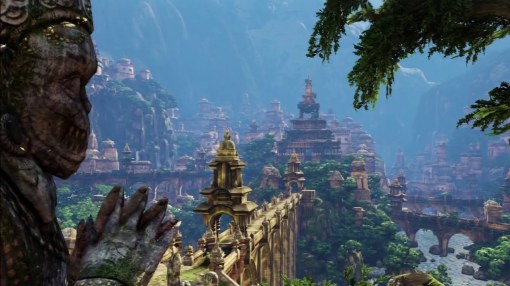
After having gone through the Eye of Shambala, the characters found themselves in a strange jungled valley, surround by craggy high mountains, a small, bright sun overhead, and a large — seemingly abandoned — ancient city in front of them. maxresdefaultImage cribbed from one of the Uncharted games…

The night’s adventure revolved around trying to figure out where they were and exploring the city in front of them. The height of the sun, the hot and humid aid, the Aian architecture (complete with monkey god statues and the pagoda-like stylings on the bridges, led them to believe they were somewhere near Borneo.

There was some character bits — Olga, the Russian girl they’d picked up — clues them in on the Russians that attacked them in Lhasa: members of the Bekhterev Brain Institute, the girl was a powerful telepath; the man had the ability to use his will to bend people’s perceptions. “Just like the Shadow!” enthused Zara. They also learned that Olga was a focus for magical energy, a sort of battery. There was a bit between her and Hunter, the Terra Arcanum overseer, whom she nearly killed while under the telepath’s spell. He also had been nearly taken over by the woman and confirmed her story.

Armed with a few handguns and almost no ammunition, they set out to search the city before risking returning to Tibet…they don’t know what has happened with the GPU and Nazi agents. Hunter’s assumption is the Tibetans have “handled” them by now.

The city is obviously old, possibly even older than the pyramids! and the stonework is unbelievably advanced. There are indications of combat — with fire damage, artillery (Hunter thinks) strikes, and the occasional bleached skeleton. Eventually, they make their way to the temple complex in the center of town where Hunter accidentally reveals that he can read the ancient language, Atlantean. This is “The Center of the World, where the Gods reside.”

Inide, they find skeletons piled on each other of massive beings — 8 feet tall, at a glance — and while investigating, they disturb a section of dirt and plant material, only to have a half dozen giant centipedes — 6 feet long, fast — suddenly lunge out at them. (This was an especially pleasant bit of creepy horror, as one of the players is seriously creeped out by the bastards.) In the ensuing firefight with the creatures, Gus Hassenfedlt shows his use with judiciously careful shots with Zara’s little .32 Astra, managing to kill two of the creatures, injuring one. Gould similarly injures one with the Tokarev he took off of a Russian. They drive off the creatures, but not before Hunter stps on a weakened section of floor and disappears into darkness below (that player was not present.)

The characters got after him, only to find the section below that had also collapsed, spilling him into the waters below the island the temple complex sits in. Gus rappels using a vine and discovers a crypt filled with these creatures, including one with four arms! Gould chases along the bridges and waterfronts trying to catch Hunter, only to hit a section of balcony over the water that breaks off, dumping him into the rushing waters, only to be taken over a series of waterfalls (guess who’s not here next week!)

This leaves Zara and Gus, with Olga and Dr. Heiser, the German philologist and historian (and Thule Society member) to be captured by the secret inhabitants of the city — giant apemen, similar to the creatures they encountered in Africa. they are taken to one of the sections of the city in better repair, where they see females and children apemen. One of the creatures addresses them in Chinese, then decent French. He is Kordas, their “natural philosopher”, who learned the language from the traders in San Antonio.

They learn that they are in “Argatha” — the city of the Gods. This is the birthplace of the asuras and devas, those beings that (the apes assume) created the World. The unmoving sun overhead is the greatest of them. They’ve been in Agatha for hours, yet the sun hasn’t moved. Where are they? “The world” is the only response Kordas has, but he tells them that there are people who are drawn into the world from strange realms outside the world. They don’t have much more knowledge of the outside world (if it is outside…) The apes also recount that another race destroyed the asuras and devas, or they did it to themselves, but it’s been so long, there’s no record of what happened.

This is all terribly interesting to Heiser — who thinks the Argatha, Ultima Thule, and other lost cities might be one and the same place. (He’s wrong, of course!) And who are these other people that might have destroyed the asuras and devas?

When they learn that there was a member of their group that could open the Eye of Shambala, they are stunned — the ancients have long been dead. There are descendants, but most of them cannot operate the old artifacts. They ask for descriptions and are pleased that the man does not appear to be “Vril.” (I’ve decided the Vril-ya of the setting need to be pumped up a bit…)

After collapsing from fatigue in the never-ending day, the characters are setting off to locate their missing friends.

So — to compensate for folks being out for a week or two, we’ve split the party, so the one set of players will be able to continue without much issue for the next session. It also keeps them stuck in this strange place they’ve find themselves in — they can’t use the Eye without Gould — and badly prepared and armed (they’ve each got a handful of ammunition left), the environment will be much more of a challenge for them.

Well, we’ve made to the Hollow Earth in our Hollow Earth Expedition campaign (or have we..?) So it’s time to start working on what my version looks like. To that end, I spent the weekend digging through the Mysteries of the Hollow Earth sourcebook to see what Jeff Combos and the boys at Exile did with it. The last time i ran the game, we never got out of 1930s China, save for a short adventure on the East Coast of the US. This time I’ve committed myself to go full pulp, so Hollow Earth (or is it Venus? Or an alternate reality?) it is.

The characters had gone through an eye-like Stargate-ish artifact called the Eye of Shambala that was stored under the Potala Palace in Tibet and emerged in a setting cribbed from the Shangri-La in the Uncharted series of video games (I haven’t played them, but the visuals are great…and look to be highly influenced by the Shangri-La of Sky Captain and the World of Tomorrow.)

A few of the things I’ve already started playing with:

Shangri-La — is this it? Or is it actually on the Surface World but only accessible through the Eye? This place looks uninhabited, which would fly in the face of the paradisiacal valley where people live long, idyllic lives.

How much dinosaur? Is the whole of the place dinosaur filled, or only certain bits?

The big one was how to incorporate Buddhist and Hindu mythology into the setting. Seems appropriate that sections of the Hollow Earth (or is it?) would have “nations” of a fashion — places where the devas and asuras ruled, places where their cousins, the Æsir and Vanir, or the Titans/Olympians might have ruled. We know the Atlanteans were around, but are these the same people as folks of Ultima Thule, or Hyperboreans? (Answer: no…and yes.)

That leads to the two races I know are going to have to get used — the Titans and the Vril-ya. The Titans don’t work for me. I see where they were going, but I’d rather go with these being the direct descendants of the creatures humans on the Surface World once called gods, but brought low by their own infighting. Perhaps a few of the old codgers are still around and ruling little fiefdoms? I also wanted to do a tie to the Mars from Revelations of Mars — and the Dheva are the link there.

The multi-armed thing works well with the Hindu angle. Perhaps the people of Mars and the Titans have a common lineage? One might be the experimental product of the other? It would also be a good reason for the animal-people of the Hollow Earth: all this is the result of the Titans or old gods playing around?

As for the Vril-ya — I’m not sure I want to use the “official” version. I think they might have to be modified to be the Atlanteans/Thule/Hyperboreans. Maybe they were caught in the crossfire of the War Between Gods?

I’m still musing on where I want to go with this, but I tend to be a sucker for using mythology in my games (the Battlestar Galactica campaign took a sharp turn into Greek myth coupled with transhumanism.) and the idea of playing with Hinduism is alluring, especially as their gods die and are reborn.

Known as “the Ghost”, Lenshev’s ability is to use his powers of will and concentration to mask the presence of people and things…he “clouds men’s minds”, to quote a popular radio show.

Archetype: Spy     Motivation: Duty     Health:  7

Body: 3     Dexterity: 3     Strength: 2     Charisma:  2    Intelligence: 2     Will: 4

Initiative: 5     Defense: 6     Stun: 4     Move: 5     Perception: 6

SKILLS: Acrobatics 5, Athletics 5, Bureaucracy 5, Con 3, Diplomacy 3, Firearms 5, Investigation 4, Larceny 4, Martial Arts, Systema 6, Stealth 6, Streetwise 3, Survival 3

RESOURCES: Rank: Captain, GPU

TALENTS: Finesse Attack, Systema; Iron Will, Iron Jaw, Psychic Ability: Cloaking

LANGUAGES: Russian (native), English, French, German, Mongolian

FLAWS: Callous, Sadist, Vow

WEAPON: Pair of nickel-plated  Tokarev TT-33

« Previous PageNext Page »