Roleplaying Games


Memorial Day started with a gaming session to preface our cookout. When last we’d left the characters, they were jailed by the chua te or pirate “lord” Van Trihn in his citadel outside of the trading port of San Antonio. They’d figured out Dr. Gould was of Atlantean blood and planned to sell him to the Vril-ya. The boys were in one cell, the girls in another, and Captain Santiago — a pirate they’d had a run in was in the third.

As the pirates didn’t look to speak English, the characters had been plotting in that language how they were going to effect an escape before they could be sold into slavery or worse… Gus was still badly injured from his run in with the formidable major domo of the chua te, a 7’2″ monster named Tongo from darkest Africa. Hunter was still dressed, and even had his stiletto, and assured the others he could get the lock open with it. Santiago, it turned out, spoke English, and pointed out the only way they were getting out of here was with his help — his crew would surely be waiting for him, to aid his escape; if they release him, he will aid their plans.

Zara had formulated a way to keep the pirates’ minds off of the boys. She and Olga distracted them (and Gould) in fine “scandalous” fashion (one of Zara’s flaws.) While the pirates were ogling their affections, Hunter got the door open in a flash with his Larcency skill and he and Gus were on the guards. Gus’ injuries hampered his efforts, but he wound up pinning the one to the cell door, where Olga promptly ran the guard through with his own dragon sword. Hunter continued to impress with his combat skills, taking on a pirate with his stiletto.

Freed, the group armed up and stealthily reconnoitered the ground floor of the fortification Trihn castle sat on. They came on some of the guards and subdued them for more firearms, but through the rife port, they noted ships maneuvering out to sea…then a sudden barrage of smoke from the broadside of one. Moments later, the rescue plan Santiago’s people had put in motion was cause chaos in the citadel, as the two ships fired on the castle and Trihn’s flagship Sea Snake, a 6-mast war junk.

Through smoke and falling masonry, the character rush to the main courtyard, dropping a few bad guys in the process, and find themselves face-to-face with a half dozen pirates. An exchange of fire left most of them downed, and Olga and Hunter quickly did for the others…then the main event started: Tongo arrived, throwing his mongwanga, which would have taken Hunter’s arm off but for a judicious use of style points. Gus put a 4 gauge round through his pecs, but that only served to bring the monstrous giant down on him.

Lady Zara bravely took the man on, and was thrown across the courtyard. Gus used that moment to knock the man back through a cannon hole behind him. (The player is another writer, and understands the importance of villains that can come back to pursue you…) Cannon shots tore through the castle and forced the characters to flee to the main gate, just as it was blown open with a keg of powder by men from Santiago’s Hercules, and Curiosity, commanded by Captain Tomas Franco (or as he calls himself, Professor Franco of the Academie des Sciences) who was determined to rescue his acquaintance’s niece.

Into a longboat and rowing for their lives, they catch up to Curiosity and make good their escape. Behind them, the Sea Snake is getting ready to pursue. With 20 16 lbs and 16 32 lb broadsides, she’s more than a match for Franco’s 16 gun sloop of war, which is already shot up by their exchange. The characters aid in repairs and Gould in seeing to the injured, and soon they are pulling away from the junk.

In this place, however, there is no horizon, and the white and red sails of the junk fall further behind, obscured by distance, but always visible in the spyglass or binoculars. After discussing the man’s arrival in “the World” — in this case through some kind of portal in an Olmec temple in the Yucatan in 1924 — he has been exploring the place, first as a hand on a ship, now as a “pirate” captain.

After some rest and thinking on the matter, they convince him to put themashore with letters for home, and copies of notes and other materials for the Academie, and they arrange a meeting with him in a few months, after they’ve had a chance to resupply and come back for a real expedition.

They make their way with an incredible Survival test to orient themselves and after three weeks of trudging through the interior of the mountains, find their way back to Argatha — the city of the devi and asuras, and now home to the apemen. The rules for working together (badly positioned in the core rulebook just before the skills chapters — seriously, these need to be back with the other rules for die rolling!) gave the party an incredible Survival dice pool of 13! Trapping, fishing, knowing the botany well enough to fake it, etc. was assumed to be skills that one or the other character had an expertise in, and they easily arrived.

Finding the German, Dr. Heiser, still in the town, working with the ape’s natural philosopher Kordas on the manuscripts and other inscriptions on the buildings, he’s been compiling evidence to take back to the Surface World. This includes the skeletons of the devi that were entombed under the temple floor. After a few days of recovery, the characters finally drag all their discoveries to the cave with the Eye of Shambala, or whatever it is called, and go back through to Tibet.

They are surprised to find monks waiting sentinel over the device. Quickly, they call for the Dalai Lama and Billy Fish, their Ghurka guide. It turns out that although they’ve been, by Hunter’s watch and estimation, gone for 42 days, they have only been gone three days since the firefight with the Soviets!

At that point, we broke for the week, to celebrate those that gave all to their country.

Hooah.
We left the Hollow Earth Expedition game last week with the characters in a cliffhanger showdown with pirates in the muddy streets of San Antonio — a trading outpost in “the World” that was a melting pot of different races on the coast, a few days downriver from Argatha, the City of the Devi, where the Eye of Shambala deposited them.

The fight was on, with Lady Zara taking a pop at the pirate captain, only to come zero on the successes. He drops her with a smack of his pistol. Hunter, a former Marine during the Great War, proves supremely effective with his spear and take two of the pirates.  Gustav, furious at nearly getting his head blown off, pummels the captain insensate. Zara’s monkey, Rigoletto had distracted one of the men by jumping in his face and scratching him, allowing Gould, with some judicious use of style points, to takes out another, and injure a second. Finally, Zara drops one of the baddies with her bow.

While they are taking stock and grabbing guns and other things from the pirates, they are surrounded by more — Asians, this time, and led by a 7’2″ African named Tongo. Tongo and his crew are “black flags”, pirates under the chua te or “lord” Van Trihn, the pirate king of San Antonio. They were called by Phan Li, the brother owner who watched them take out Captain Santiago –a troublemaker at the best of times. Trihn himself arrives to thank them and drag Santiago and his remaining thugs off to a certain ill fate. After Zara charms them, and vice-versa, they are invited to dinner at the Citadel.

There they meet other captains — Papa Tome, the French Creole from Louisiana who sailed into a fog bank off of Bermuda in 1889, and emerged here; Tomas Franco, an acquaintance of Zara’s uncle Trevor, who was lost through a “vortex” in an Olmec temple he’d discovered in the Yucatan in 1924; Trihn arrived after his ship came through a storm in the South China Sea when he was a young man. None of them look as aged as they should be. Franco speculates, having traveled all over the “Inner World” as he calls it, that people with a particular psychic resonance or character are drawn into this place, that it seeks them out.

Through the party, the characters get roaring drunk and gorged on food. Zara lets slip that they are looking to return to the Surface World, and that they hope to return. Gould drunkenly hints at Atlanteans and Atlantis to Franco. Eventually, Trihn figures out one of them has “the blood”… He tells his story, of how he has secured the prosperity of San Antonio by protecting the crews of the town from the monsters and creatures that roam the waters of the Straits of Varuna. He shows them this insurance policy — a mermaid named Osha that is either the daughter or an important personage in their pod or school or whatever they call it. None dare attack their ships, now.

After dropping off, the characters (save Zara, whose “deep sleeper” flaw came into play) find themselves captured by Trihn’s people. They want to trade Gould to the Vril-ya, who will pay well for those with the blood. gould tries to negotiate his way out, offering to broker modern gun deals to the pirates from the surface world in exchange for their freedom. It looks like the pirate might go for it, but his mistress Phan Li is more savvy, and we broke on the characters in cells under the palace.

The guards had missed Hunter’s stiletto, and he is just waiting for the chance to pick the lock of the door. Zara has been hurling invective at the guard and anyone else who will listen (or not), and Gus is recovering from the savage beat-down he took fighting the mighty Tongo.

They players were formulating escape plans from picking the lock and scooting for Argatha, to dealing straight with the pirates (who would most likely want to keep the women hostage to insure their return), to escaping and going the way they wouldn’t expect — to sea, possibly with the aid of their fellow prisoner, Captain Santiago.

These are all good setups for continued adventures, and showed the players were really getting into the world and situations. Also, we’ve been falling into a nice pattern of cliffhangers for the end of the evenings, something I hope to maintain.

The campaign picked up after a week off with the characters in the mythic city of Argatha, a place where the sun never moves from its place high over head. The characters had gone through the Eye of Shambala to this place, expecting…well, Shangri-La, and instead finding a deserted and damaged city with a Hindu-Annamese vibe to the architecture, and strange plants and animals that were “almost prehistoric” in the words of Dr. David Gould, the member of the group with “Atlantean blood.”

Originally, two of the players were going to be around last week, so I split the party, and this evening started with Lady Zara, Gus, Olga, and Dr. Heiser, the Thule Society philologist and historian a “guests” of the apemen that inhabit Argatha. They had learned of an ancient war that was fought between the devi and the asura, and the following destruction of these “gods” by an advanced civilization that Heiser assumes is the Thule, and John Hunter — our Terra Arcanum overseer — thinks is Atlantis.

After having earned the trust of the apes, who have no real animosity toward the party, but also don’t much care what happens to them, they were able to trade the firearms that they had (they were almost out of ammunition) for swords, spears, and bows. Heading out with an apeman guide, Uth, into the wilds of “the World”, intent on finding Hunter and Gould, who had been washed downriver and over a waterfall, Zara resolved to go to San Antonio — a trading post the apes claim is at the mouth of the river, three days hard travel from Argatha.

Meanwhile, those two men had found each other, rested in the boughs of a tree, and were busily trying to find food and make weapons. Gould’s compass showed that the magnetic field was small, irregular and most likely highly localized. It is useless for navigation. Hunter has a working wristwatch and a stiletto; Gould a pocketknife. They are, in a word, screwed. They start marking the river-facing trees and rocks to let people know where they are, and after a few hours stumble onto a clearing where something has been hunting: there are animal remains of creatures that had been cleaned for food, and a tapir-like creature was in a snare trap, hanging from the tree overehead.

At that point, they are aggressed by a trio of velociraptors and find themselves in desperate straits, with Hunter bitten on the ass, and Gould driven up into a tree. Before things get too hot (and with a judicious use of style points) suddenly they find themselves watching a fight between the raptors and a trio of…cat people. A mother and her young male cubs has been hunting the area and assault the raptors. In the middle of the fight, Gus and Uth burst out of the bushes to save their friends (they had gotten excellent tracking rolls), followed by Zara (armed with a bow) and Olga (armed with a bullwhip one of the apes had traded.)

The fight quickly showed a problem with the velociraptor write-up. The 3 body and 5 dexterity meant that the characters had, in essence, no chance of killing these beasts. Even the fast and effective team of panthermen were having issues. (GM, say “oops!” Read the write-ups frst, Scott!) I quickly scaled their dexterities down to a reasonable 3 — still making them incredibly dangerous, but making them animals…not some super-monster.

With the raptors dispatched, the panthermen and Uth are suddenly at each other’s throats — the apemen and the more solitary cat people appear to have some kind of animosity. Gould and Gus attempt, and fail, to cool things off, but surrounded by a larger number of opposition, and not understanding each other, the panthermen decamp.

The characters carve up the raptors for dinner, and they turn out to be delicious. Uth points them in the direction of San Antonio, but he will go no further; the people of that town and the apemen do not get on.

They travel to the town — a smudge of dirt, stink, and activity surrounded by a wide alluvial delta. From a high vantage point, they see the horizon curves…up! disappearing into the haze of humidity.

Surrounding the town, there are farms where men are growing crops (using slaves in some instances) and husbanding dinosaurs and other strange creatures. The town is surrounded by a wooden wall, protected by a wood fort with cannon. The place has a wooden plaque over the gates: San Antonio Founded 1653. 

Inside they find a town with muddy streets, loads of poor and homeless, brothels, trading warehouses, and a wide beach with tents for the crews of the ships berthed in the sea — which they later find out are the Straits of Varuna — Chinese junks, caravels, other styles of ship from the 1400s to 1800s. The people of the town are universally human, mostly Asian (they hear Chinese, but also Annamese), the others are a collection of folks from everywhere.

At the church, a Franciscan friar named Julian takes them in and explains the place. It is a port of call for many in the area, run by the chua te, Captain Van Trihn and his crew. They keep the place safe from the other monsters out there. They find out that, though Julian was born here in the World, Father Ricardo — who once ran the place — was from what he called the “outer world.” The father was pulled into “the World” through a whirlpool in a place called the South China Sea — a story others have also related. Others have come by different means. The characters start positing the hollow Earth theory is correct, and even try to guess as to how gravity works here, and why the sun remains so constant in the sky.

Without money, they cobble together their belongings and are lucky enough to realize that Lady Zara’s silver flask and cigarette case will aid them. Soon they have supplies for the trip back to Argatha, including booze for the DT-addled Gould, and a flintlock rifle for Gus. As they are preparing to head out of town, they run into a crew of men who want to buy Zara and Olga (the dangers of having a character who is “attractive” in a pirate haven), and after some issues with language and Zara’s being a haughty English lady (How dare she know her own worth!?!), they find themselves in a fight…

At which point we broke for the night.

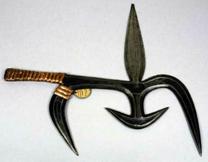
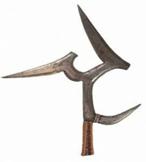
I needed a signature weapon for a possibly upcoming privileged henchman, and I settled on the mongwanga — a weapon that I’d only seen in the Q Manual for the old James Bond: 007 game.

The mongwanga is an Africa throwing “knife” that has multiple blades, angled to prove weight and spin for a throw. They are heavy, and with training are highly effective for parry maneuvers in melee combat. Here are a few examples of a mongwanga…

image183image182

Mongwanga     Damage: 2L   STR: 2   Spd: A   Special: Thrown range: 10 feet

The official “gillmen” in Hollow Earth Expedition‘s Mysteries of the Hollow Earth sourcebook are anthropomorphic fish people. They have legs, and are pretty unseemly things. I was originally going to ignore them, but a possible angle to the current campaign has given me a possible use for an aquatic race. I just don’t like these ones…

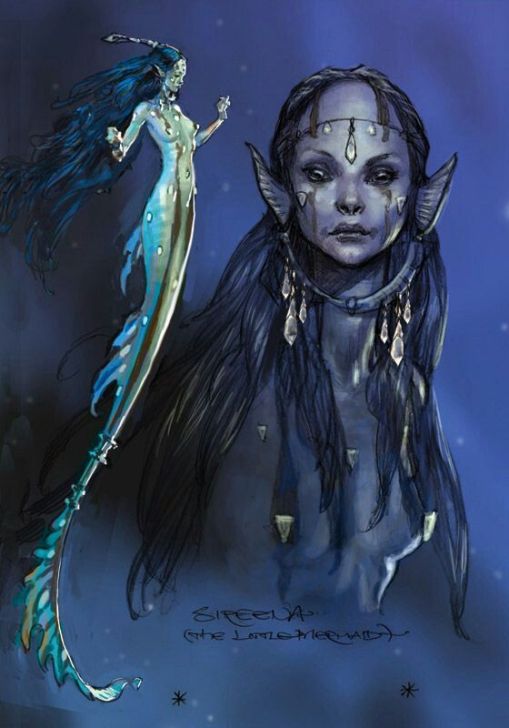
05b9db24b04505837d649cee3db2e738I decided I wanted something with a more Abe Sapien vibe from Hellboy, but I also wanted them to be alien; a tail was something I thought was needed.

The obvious choice was to go full merfolk… But all the merfolk images tended to be sexy mermaid crap.

Then I stumbled onto Ian McCaig’s on the left. Similar enough to the Abe Sapien look I wanted.

So I reworked the Gillman package into the Mermen package.

Mermen

Ancient, mysterious, and the subject of intense superstition, merfolk are one of the more populous races in the Hollow Earth, but are rarely directly encountered. Their appearance ranges from truly alien — gilled, long tails, scaled, to strangely human. Some have even been rumored to have legs!

Physiologically, from the “waist” up they appear nearly human, but caudally they have long tails. Their faces are eerily human, but will large, dark eyes, gills to the sides of the head and neck. They have no apparent ears, but hear through their skin, using a form of echolocation. Additionally, they possess Ampullae of Lorenzini, like sharks, and can sense fain electrical fields, allowing them to find prey more easily. Some merfolk are known to wear jewelry about their bodies and it has been speculated that this may enhance this ability. Some have “hair” that look to be some kind of protective growth and tend to only be seen on the females.

Culture

Very little is known about the culture of the merfolk, other than they travel in “pods” of “schools” of a dozen to perhaps three or four dozen. They communicate through a complex tonal language that can be heard for tens of miles when they are underwater and is sometimes mistaken for whale-song by those from the Outer World. Some of the merfolk have been known to lure sailors to their deaths but hypnotizing them with certain frequencies and progressions in their songs.

They are romantic, impulsive, artistic, and philosophical, but they are also hardly pragmatic as a race in the highly competitive environment they live in can be.

They appear to believe in something called the “Great Deep” — an allegory for eternity. They claim to have been “created” by the Ancients that once populated “the World”, as most of the beastmen were.

Language

There are some that claim to have talked to these creatures, and that some have learned the speech of other denizens of the Hollow Earth.

Mermen Zero Level Skills

All mermen are assumed to have at least zero level (see the sidebar in Secrets of the Surface World) in Athletics, Brawl, Melee, Performance, Stealth, and Survival

Mermen Characteristics

Starting attribute adjustment: +1 Body, +1 Dexterity, -1 Strength, -1 Charisma

Natural Advantages: Aquatic (double movement rate  in water, but half Dexterity (round down) and movement on land; Captivate: Can use Performance to entrance a target for the number of rounds equal to their number of successes over the target’s Willpower; Gills: can breath in water; Echolocation: can “see” without light; Electroreception: can sense electrical fields in water, +2 perception in water; Siren Call: This is a longer version of Captivate that can only be used in non-violent situations. The length of time is in minutes equal to the number of successes over the target’s Willpower.

Normal Flaws: Dry Skin (after an hour will take 1N damage for each hour not hydrated.), Primitive

So, the game group was off on travel, or other things, this week, so I dropped in on the local gaming Meetup here in Albuquerque. They were playtesting Traveler, the “ultimate edition” or “5th edition.” Sounded good — I liked Traveler back in the day, had a lot of the wee black books, and it was our sci-fi mainstay through the ’80s.

There were other sci-fi games that hit the shelves in the first big RPG wave: Star Frontiers, which was D&D’s d20 but with aliens; there was Universe — which had a gorgeous star map and not much else; and the execrable Space Opera, which along with the original The Morrow Project, remain my benchmarks for unplayability. Traveler really was the only game in town through most of the ’80s. The system mechanic was simple tests had a base 7 or lower, with mods, rolled on two dice. That was it. It was hard-ish science fiction, you could get dead quickly — so quickly, in fact, that your character could die in character creation.

There are a lot of died-in-the-wool Traveler fans who like this. It’s still as stupid as it sounds.

Traveler got the GDW treatment in the late ’80s with Megatraveler and Traveler: 2300, which was Twillight: 2000 in space! There was a reprint of the original rules in the ’90s. There was the d20 3.5 edition version Mongoose put out. Now there’s The Ultimate Edition! by Marc Miller himself!

My first whiff of trouble was when the guy running it mentioned the book was 650+ pages. The original rules were something like 70. Worse, he told us that on the game’s forums you weren’t allow to say “it wasn’t a game…” What the hell did that mean? We found out quickly. A quick perusal of the table of contents shows the “characters & life” chapter to be 140 pages long. There are entire — good! — games with a core book that long. Combat is 96 pages. Ninety. Six. To be fair, only 24 pages of that is actual rules; the rest is a mind-numbing collection of charts and rules for making just about everything.

We decided to do a short run from one world to another in our trading vessel. Time to buy some cargo and get passengers. This took 20 minutes (no role playing, 20 minutes of chart checking), 3 charts, and a fucking calculator. I wasn’t in as bad a shape as the other players, as I remembered the world rating scheme (eHex, Miller calls it now.) well enough to remember where the tech ratings, etc. were.

So the night be fore we shipped out, we decided to hit the bar for drinks and the inevitable barfight. A throw beer bottle injured one of the characters, then we had  20 minutes of talking about the new Captain America: Civil War while the guy tried to decipher the rules for a simple punch up. Everything is based on range in T5, and you get the number of dice for a test on the range increments. 2d6 seems to be the standard for most tests, rolling below the attribute and skill. Fair enough.

But for fisticuffs, it’s a straight attribute+skill minus the other guy’s to get the base number to hit. With normal mundane guys packing 7 for stats and nothing else, we found we could literally not punch a guy, and the one character could not, under any circumstances be hit physically. If they backed off and lazed his ass, sure, but apparently, no one bruises their knuckled in the Third Imperium. It was the single worst set of mechanics I’ve seen since, well, Space Opera. (That’s not fair…we could never finish character creation in Space Opera. Just in case you haven’t pick up on the subtlety: Space Opera is one of the worst games ever committed to paper.) The entire combat system seemed to assume you would shoot each other.

So, deciding that after 30 minutes of close dancing with the yokels would lead to terminal boredom, we shipped out. Well, tried. We have to jump three sectors, so that’s three dice to roll, but one of them is a “fate” dice, or something similar. The GM rolls it and keeps it secret to work against your roll. So the navigator rolls against his 15 in attributes and skills, and rolls a 10. In any other game, a success by five’s pretty good…but the GM rolled a six, so we were hosed. We could “recalculate” our results, which we were informed takes 24 hours, and would require him to roll three dice (so it would be harder than the initial roll.)

One of the players pointed out that this was similar to debugging code, yadda yadda, and was realistic. I pointed out my iPhone has enough computational power to do orbital mechanics in a few minutes. Why recalculate asked another player. We could get drunk for 24 hours and just start from scratch easier.

We decided to just forgo space combat tests at this point, as we had wasted two hours of our lives. In short, this was one of the worst gaming experiences I’ve ever had — the system was absolute dogshit. The mechanics looked almost like some sexagenarian Grognard decided that all this playability and focus of story and characters in recent game design was missing the point of gaming — charts, you see, charts! are the centerpiece of a good game. And who wants to be able to just roll dice and know what happened? It’s so much better when you need to rent time on the local supercomputer to hash out if your character died before you started playing it.

Traveler 5 is one of the worst bits of game design I’ve ever seen. There’s no design cohesion from one section to the next, and the entire point seems to be to wring the last chance of fun out of play. I don’t seem to be the only one saying this, either.

Style: 2 out of 5 — it’s all black and white, save a few glossy pages, and is dense typeface. Substance: 4 out of 5…if you love charts and dense mechanics that are difference for every situation, otherwise it’s 2 for the utter lack of playability. It’s the Space Opera of the 21st Century.

Is it worth it? Not just no, but fuck no. Go buy the old black books and have fun.

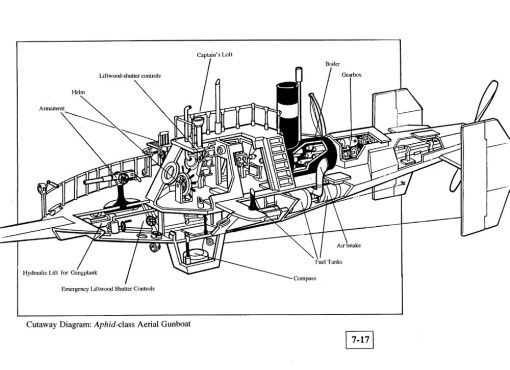
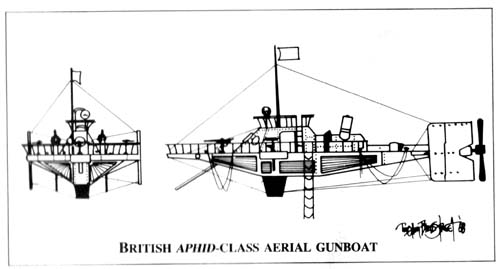
APHIDcutaway


hullcuttercutaway

Here are a few of the Royal Navy aerial flyers currently active in 1889…

Aphid-Class Aerial Gunboat

Aphid

The Aphid-class was the first aerial gunboat designed by the Royal Navy, and one of the most successful. While small at 130′ in length, and 50′ in beam, and hastily constructed in 1881, they are well armed and have some thin metal-clading to protect the crew in combat.

In 1886, these vessels underwent refit to use forced draught boilers that kept the same horsepower, but lowered the total mass of the vehicle, allowing for the use of a long-four gun, rather than the original short-four without loss of performance.

Currently, there are four of these gunboats in operation: Aphid constructed in 1881 is stationed at Parhoon, Ladybug (built 1881, lost 1887), Sandflea (built 1882) at Meepsoor, Firefly (built 1882, lost 1889), Wasp (built 1888) stationed at Syrtis Major, Hornet (1888) at Parhoon. Two are under construction — Honey Bee and Bumble Bee and both are expected to launch in weeks.

SIZE: 8   DEF: 4   STR: 14   SPD: 30   CEIL: VH   HAN: -2   CREW: 15   COST: £23,330; WEAPONRY: 4′ short cannon (fore*) — Dmg: 10L   Rng: 500′   Rate: 1/2   Spd: S   Size: 2; 2 1 lb. Hotchkiss Rotary Cannons (side mount) — Dmg: 8L   Rng: 500′   Rate: 1/2   Spd: S Size: 2; 2 Nordenfeldt machineguns (broadside) — Dmg: 5L   Rng: 250′   Cap: 40 (m) Tate: A   Spd: S.

*The upgraded Aphid has a 4″ long gun on the fore — Dam: 10L   Rng: 750′   Rate: 1/2   Spd: S   Size: 2.

Locust-class Aerial Gunboat

The first ship designed and built for the Royal Navy on Earth, these are essentially Aphid-class gunboats reworked for Earth’s gravity. For that reason, these boats have less armor and smaller guns to compensate for the needs of terrestrial flight.

The original chief of construction wanted to forgo the minimal armor for more firepower and has been critical of the performance of the vessels, but the Admiralty currently anticipates no changes to the design.

There are five Locust-class gunboats in service on Earth: Locust, built in 1886, and Dragonfly (1887) serve with the Channel Fleet; Tse Tse (1887) with the Pacific Fleet; Yellowjacket  (1887) with the Mediterranean Fleet, and Grasshopper (1888) with the Atlantic Fleet.

SIZE: 8   DEF: 4   STR: 13   SPD: 25   CEIL: VH   HAN: -2   CREW: 15   COST: £24,500; WEAPONRY: 4′ short cannon (fore an stern tower) — Dmg: 10L   Rng: 500′   Rate: 1/2   Spd: S   Size: 2; 2 1 lb. Hotchkiss Rotary Cannons (side mount) — Dmg: 8L   Rng: 500′   Rate: 1/2   Spd: S Size: 2; 2 Nordenfeldt machineguns (broadside) — Dmg: 5L   Rng: 250′   Cap: 40 (m) Tate: A   Spd: S; 2 rocket batteries (one upward, one downward firing) — Dam: 6L   Rng: 500′   Rate: 1/2   Spd: S   Size: 2.

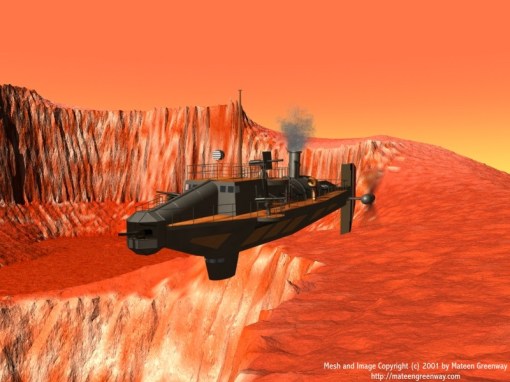
Dauntless-Class Aerial Gunboat

The sleek Dauntless looks lovely, and performs poorly. Much of the problem stems from the slight transit the turreted forward 4″ long gun has, providing only a limited angle of fire to the front. The armor makes the ship heavy and slow to turn. Conventional boilers were replaced with forced draught boilers for HMS Danger and after.

courtesy of Mateen Greenway

courtesy of Mateen Greenway

There are only two of these aerial flyers in service: Dauntless built in 1884 patrols Syrtis Major, Daring was launched in 1886 and lost within weeks, and Danger, launched in 1887 and on station at Parhoon.

SIZE: 8   DEF: 4   STR: 14   CEIL: VH   HAN: -2   CREW: 15   COST: £23,330; WEAPONRY: two 4′ short cannon (forward turret and stern tower) — Dmg: 10L   Rng: 500′   Rate: 1/2   Spd: S   Size: 2; 2 3 lb. Hotchkiss Rotary Cannons (wing mount) — Dmg: 9L   Rng: 500′   Rate: 1/2   Spd: S Size: 2; 2 Nordenfeldt machineguns (broadside) — Dmg: 5L   Rng: 250′   Cap: 40 (m) Tate: A   Spd: S.


I have a class I teach that deals with time and the creation of “time” as we think of it, but this video is a pretty good primer for those that haven’t thought about it.

Time standardization wasn’t a thing until 1847, when the railways in England needed to simplify their scheduling. As the video points out, most towns set their clocks from the point the sun was the highest in the sky. But even in a small area like Britain, the difference between noon in Yarmouth and noon in, say, Penzance — a whole 120 or so miles from one side of the island to the other — is different. Train schedules necessitated time be “standardized” in Britain.

This is why the scheme was known as “railway time.” For those of you running games before 1847, there’s no time zones. There’s no fixed time save local; there were trains, however, and getting to a place when you thought you would was often problematic. You might wind up spending an evening on a railroad bench waiting for the next train because it left a few minutes before you arrived.

By 1855, all of Britain was on GMT (Greenwich Mean Time), but Time Zones as we know it didn’t come into being until 1883 when the American rail companies adopted the “one hour” time zone similar to what we know today. Most of the world was on some form of standardized time zones by 1900, but there were loads of local variations. In the US, actual implementation of the StandardTime Act was in 1918, so even those with Victorian or Wild West period games can work this in — it might be noon on the town clock, but it’s 11:45 on the rail platform.


I finally got a few moments to work on converting some more of the ships from the old Space: 1889 game to the new Ubiquity version. We’ve already had a guest poster give his rules and reasoning behind his work, and now it’s my turn. The old Space: 1889 and the connected Sky Galleons of Mars boardgame were directed more at the old school minis and wargaming crowd. In fact, while I occasionally use minis to clarify certain battle scenes, Space: 1889 was the last game in which I would shift from roleplaying game to wargame when it was time for a fight.

Ubiquity really isn’t set up this style of play — not that you couldn’t find a way to combine the old school wargame with the more narrative-oriented play of the new game. To that end, my stats on the cloudships and aerial flyers of the Space: 1889 world will be more Ubiquity-directed, and may not satisfy the person looking for more “crunch” in their aerial antics over the sands of Mars; I direct those players to the link above.

So why are the stats what they are? Some are going to have similar complaints about the lack of uniqueness between the vessels. (Similar complaints were levied at Cortex, which could be made crunchy PDQ.) Here’s why the stats are what they are. Size — in Ubiquity, animals were lumped into size categories that were exponential. If you were a certain weight or size, you might jump to the next category, and at a certain point, it was assumed the Defense of the thing would be too great for you to do much harm. The ships are lumped into those size categories. Defense is usually just cribbed from similar vessels in the Secrets of the Surface World sourcebook, but a good rule of thumb would be assume the material (4 for wood, 6 for metal) and if armored, add half again (6 for wood, 9 for metal). The size of the vehicle is going to make it very easy to be hit, so Defense here is going to be based off the physical material.

Structure is pretty basic — what’s the material plus the size modifier. For instance a wood (4) ship of size 8 has a Structure of 12 as it’s base; a metal (6) one would be 14. To give a bit of variability, you could factor in armor, but what I’ve wound up doing is going with that base, then looking at the damage a vessel could take in Sky Galleons. An Aphid-class, for instance, has a total of 10 points for its hull, and 2 armor. I assumed the 14 and added 2 for the armor to get the Ubiquity version. A more massive ship that was still in the Size 8 category for physical size I rounded up a few points in the initial write-ups; Now I look at the armor and total structure. If it’s lower in the old rules, it gets boosted in the new; if it’s higher in the old rules, it gets that structure in the new rules (although a few places I’ve ignored that — like with the Warm Winds, which would have been stronger than an Iowa-class battleship.) I err on the weaker numbers in general on the assumption that liftwood vessels, as with all aircraft, have an inherent flaw…they lack support against gravity. Hit in the right place, do enough damage in the wrong place, and the superstructure can come apart, regardless of the overall damage taken. As any WWII combat pilot that got a wing shot off — the rest of plane might’ve looked great as it went into the ground like a f#$%ing dart.

I would suggest adding in the very low to very high altitude ceilings in your game. Divide the structure by the number of altitude zones, and assume that once that amount of structure is removed, the ship loses an altitude zone.

So here’s a few more Martian cloudships:

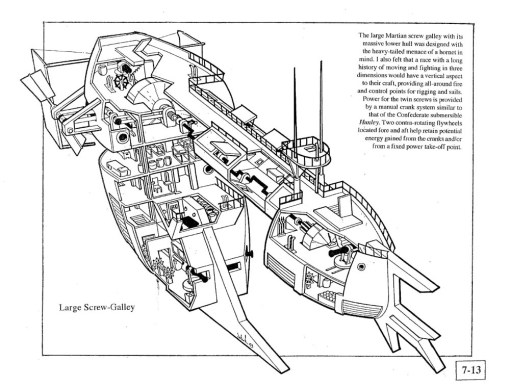
Sky Runner Medium Screw Galley

Wth five decks and a crew of 32, these screw galleys are usually out of the shipyards at Karkarham, but are found in service all over the Red Planet.

SIZE: 16   DEF: 4   STR: 20   SPD: 20   CEIL: VH   HAN: -2   CREW: ~32   COST: £25,600; WEAPONRY: 3 heavy guns (fore and wing mounted): Dmg: 8L   Rng: 250′   Rate: 1/2   Spd: S   Size: 2

Endtime Medium War Galley

This is the mainstay of the Oenotrian sky navy, and has been turned out in large numbers. It is the smallest vessel to mount a lob gun, and the heavier weight gives it limited ceiling and a sluggish speed, and the focus on firepower disadvantages these ships with shorter range of fire than the human gunboats.

SIZE: 16   DEF: 4   STR: 20   SPD: 15   CEIL: H   HAN: -2   CREW: 45   COST: £31,500: WEAPONRY: Rod gun (fore) — Dmg: 8L   Rng: 500′   Rate: 1/2   Spd: S   Size: 2; Lob Gun (amidships) — Dmg: 10L   Rng: 250′   Rate: 1/2   Spd: S   Size: 2; 2 heavy guns (wing-mounted) — Dmg: 8L   Rng: 250′   Rate: 1/2   Spd: S   Size: 2.

Skyfire Heavy War Galley

The Oenotrian Sky Navy has two of these brutes in service. The design is conservative — a typical double deck forecastle, a thin spine to the five decked aft hull. The screw requires 42 people just to operate at full efficiency, and it is heavily armed and has a ram-prow (see below.)

SIZE: 16   DEF: 6   STR: 22   SPD: 15   CEIL: H   HAN: -4   CREW: ~95   COST: £105,400; WEAPONRY: 4 Rod gun (2 fore, 2 aft, behind bulkhead) — Dmg: 8L   Rng: 500′   Rate: 1/2   Spd: S   Size: 2; 2 Rouge gun (broadside, behind bulkheads) — Dmg: 8L   Rng: 250′ Rate: 1/2   Spd: S   Size: 1; 8 heavy guns (broadside, behind bulkheads) — Dmg: 8L   Rng: 250′   Rate: 1/2   Spd: S   Size: 2; 10 tether mines — Dam: 12L   Rng: up to 500′   Rate: 1/2   Spd: S   Size: 1

Prow Ram: With a successful Pilot test, the Skyfire can do up to it’s DEF in damage to an opponent ship. With +1 success, the ship is stuck into the target and boarding can commence through a hatch in the ram, or from the main deck.

« Previous PageNext Page »