Roleplaying Games


First off, the advertising campaign for this has been very well done. I’d swear almost every frame of the movie has been in an ad, but they’ve done a good job of keeping many of the plot elements hidden or had created red herrings with the edits. The movie went in a direction I didn’t quite expect.

So, yeah, there may be some spoilers.

The movie is a direct sequel not just to The Winter Soldier, the second Cap installment, by also Avengers: The Age of Ultron. The event of both movies lead quite naturally to the events of this movie. If anything, this film probably should have been called Avengers: Civil War.

There is a teaser that takes place in 1991 that is a pivotal moment for the plot, and the way the movie plays out, it will be the main red herring throughout. The title sequence leads us to Lagos — where the Avengers are tracking Cap’s old number two and HYDRA agent, Rumlo, as he is engaged in a plot to steal a biological weapon. The team takes out the trash, but in the fray, a number of people are hurt and killed by a bomb (including 11 Wakandans, which brings the Black Panther angle into play.)

Meanwhile, Tony Stark — at MIT giving a keynote lecture and dropping grants on the students there — gets sidelined by a State Department worker whose child was killed in Sokovia during the events of Ultron. I highly suspect there is a plot line that hit the cutting room floor about this being a deliberate attempt to get Stark to support the Sokovia Accords — a United Nations attempt to grab oversight of the Avengers (and, it is implied, other “enhanced” people. They don’t tie it to the Inhumans and events in Agents of SHIELD and that is unfortunate. It would have grown the scale of the consequences of the accords, without growing the scale of this movie.)

Stark, and his friend Col. Rhodie (War Machine), and Vision — both, in many ways, Stark’s creations (and Vision directly so) sign onto the oversight when the Secretary of State and former general and Hulk tormentor,  Thaddeus Ross puts it to the team. Black Widow also thinks some kind of oversight is needed, as well. Stark makes an excellent case that they need to be supervised and directed, that they are loose cannons, but I would suggest that he is only partially correct…outside of the events of Thor and the events of the original Avengers film, which are fomented by extraterrestrial (Asgardian) actions, nearly every major screw up the Avengers are part of is Stark’s doing. Ultron is the direct result of this arrogant, undisciplined asshat playing with things he doesn’t understand; he almost makes it worse (and may still have) by creating Vision in direct opposition to Cap’s objections. Sokovia is his mistake. And the Vision remains a big question mark as to motive in the Marvel Cinematic Universe

The other side is Captain America, his sidekick Sam Wilson/Falcon, and Wanda Maximov/Scarlet Witch. Cap — having seen some pretty terrible things happen due to bureaucratic machinations — the almost nuking of New York by the military, the destruction of SHIELD by the cancerous infiltration of HYDRA — is naturally suspicious of Ross and the accords. (I was surprised that Ross’ nemesis being Avengers member Bruce Banner was never specifically referenced…why should they trust this guy?) In many ways, the “Bucky”/Winter Soldier angle in the ads is the McGuffin to get the fight started, but it’s much deeper: this is a fight between those elements of the state that seek to control, and the individual’s right to choose their path.

As events proceed, we learn that Maximov (who is being blamed for the Lagos incident) is under house arrest “protective custody” at the Avengers compound. A prisoner guarded by Vision. Cap and Falcon get on the trail of Bucky after he allegedly blows up the Sokovia Accords signing event, killing the Wakandan king and setting Black Panther against Team Cap for the rest of the movie. When Cap brings the Winter Soldier in alive, and outside the law as he hasn’t signed the Accords, he is stripped of his shield.

Stark makes a real appeal for Cap to join the team and sign. That if they don’t do it now, they’ll be made to do it later. It’s a good argument, and the one used by state tools for millennia to get people to cede a little freedom for a bit of security. By doing this, all the things Cap did that are illegal would be magically made right by the power of law. It’s not that he did the wrong thing; it’s that his actions weren’t sanctioned. Worse, in many ways, the one member of the Avengers that should be in a jail cell is Stark for creating Ultron, but like the rich and powerful throughout time, he’s signed on with the new power structure and is insulated from his former actions; hell, he’s in a position of authority as de facto leader of the Avengers.

In the end, however, Civil War isn’t a grandiose movie. It’s a personal one. Events split the team apart and lead to a number of excellent action set pieces, but nothing on the scales of the Avengers movies, or the final fight in The Winter Soldier. This is a good thing. All the action proceeds from the goals of the characters, and they are defined by the same. The end fight is not a city-destroying event; it destroys friendships and people.

The characters in the movie are all driven by some form of vengeance. Stark and the villain Zeno, T’Challa/Black Panther — they are motivated by anger; Cap, on the other hand, is motivated by redemption — for Bucky, but also for himself, and for the rest of the Avengers. This plays out so clearly in the final fight, that I found myself saying aloud, “Fuck Stark.”

All of the characters get a few good beats — from the snarky and spiteful word battle between Hawkeye and Iron Man, the interaction between Wanda and Vision, to the wonderful intro of Spiderman (really, this kid deserves all the attention he’s getting) and the humorous bright spot he and Ant Man bring to the movie, to the reawakening friendship between Cap and Bucky — the writing is good, the acting is spot on, and the direction (other than one awful “shaky cam” fight scene) is tight. The music and the choice of font for the title cards during scene changes gave it a strange, almost ’70s flavor.

I found the movie a touch long, but they’re doing so much with the various story threads, I think it would have been hard to cut it down much more. I thought it was, character-wise, the best of the Marvel films; story-wise, I think The Winter Soldier still holds that honor. The fight scenes weren’t as interminable as the Avengers and CA: TWS. One element that it retains from the other Captain America films is this subversive edge. Rogers represents the American ideal, but in all of his films, he is beset by the American reality. In the first movie, he isn’t a hero — he’s a marketing gimmick or a “lab experiment” until he disobeys the will of authority to rescue the 107th; in The Winter Soldier he bucks the burgeoning surveillance and security state, and again, goes outside the law to do the right thing; and in Civil War, he repeat the pattern. Team Iron Man is the face of society and authority, forcing you to do what they think is right for the whole; Team Cap represents those who will go outside the law to do what is right for the person.

These characters represent that push and pull between “the Man” and those people that want to be left the hell alone. In this way, this is one of the most libertarian movies since Serenity.

So is it worth it? Absolutely! On my scale, this is a definite “full price” movie. I will most likely see it in the theater a second time. Of the Marvel movies (excluding Guardians of the Galaxy, which I consider more of a stand-alone franchise), this and The Winter Soldier are easily the best of the crop. They manage to cover much of the same ground as the DC movies have been trying to do, but without the dreary darkness DC seems to think is necessary to tackle issues of law vs. justice, the individual vs. society, the ramifications of people with extraordinary powers.

Go see it.
Play tonight was truncated by scheduling issues, and one of the players was out for this week (and next, as will another of the players.) This necessitated some tap dancing on my account to keep us moving for the weeks folks were away.

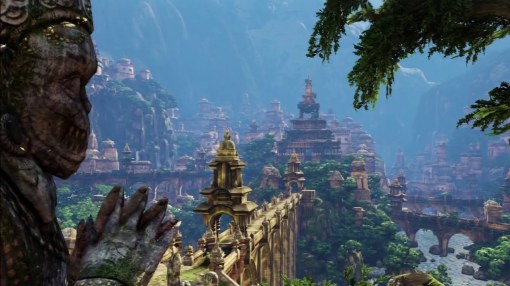
After having gone through the Eye of Shambala, the characters found themselves in a strange jungled valley, surround by craggy high mountains, a small, bright sun overhead, and a large — seemingly abandoned — ancient city in front of them. maxresdefaultImage cribbed from one of the Uncharted games…

The night’s adventure revolved around trying to figure out where they were and exploring the city in front of them. The height of the sun, the hot and humid aid, the Aian architecture (complete with monkey god statues and the pagoda-like stylings on the bridges, led them to believe they were somewhere near Borneo.

There was some character bits — Olga, the Russian girl they’d picked up — clues them in on the Russians that attacked them in Lhasa: members of the Bekhterev Brain Institute, the girl was a powerful telepath; the man had the ability to use his will to bend people’s perceptions. “Just like the Shadow!” enthused Zara. They also learned that Olga was a focus for magical energy, a sort of battery. There was a bit between her and Hunter, the Terra Arcanum overseer, whom she nearly killed while under the telepath’s spell. He also had been nearly taken over by the woman and confirmed her story.

Armed with a few handguns and almost no ammunition, they set out to search the city before risking returning to Tibet…they don’t know what has happened with the GPU and Nazi agents. Hunter’s assumption is the Tibetans have “handled” them by now.

The city is obviously old, possibly even older than the pyramids! and the stonework is unbelievably advanced. There are indications of combat — with fire damage, artillery (Hunter thinks) strikes, and the occasional bleached skeleton. Eventually, they make their way to the temple complex in the center of town where Hunter accidentally reveals that he can read the ancient language, Atlantean. This is “The Center of the World, where the Gods reside.”

Inide, they find skeletons piled on each other of massive beings — 8 feet tall, at a glance — and while investigating, they disturb a section of dirt and plant material, only to have a half dozen giant centipedes — 6 feet long, fast — suddenly lunge out at them. (This was an especially pleasant bit of creepy horror, as one of the players is seriously creeped out by the bastards.) In the ensuing firefight with the creatures, Gus Hassenfedlt shows his use with judiciously careful shots with Zara’s little .32 Astra, managing to kill two of the creatures, injuring one. Gould similarly injures one with the Tokarev he took off of a Russian. They drive off the creatures, but not before Hunter stps on a weakened section of floor and disappears into darkness below (that player was not present.)

The characters got after him, only to find the section below that had also collapsed, spilling him into the waters below the island the temple complex sits in. Gus rappels using a vine and discovers a crypt filled with these creatures, including one with four arms! Gould chases along the bridges and waterfronts trying to catch Hunter, only to hit a section of balcony over the water that breaks off, dumping him into the rushing waters, only to be taken over a series of waterfalls (guess who’s not here next week!)

This leaves Zara and Gus, with Olga and Dr. Heiser, the German philologist and historian (and Thule Society member) to be captured by the secret inhabitants of the city — giant apemen, similar to the creatures they encountered in Africa. they are taken to one of the sections of the city in better repair, where they see females and children apemen. One of the creatures addresses them in Chinese, then decent French. He is Kordas, their “natural philosopher”, who learned the language from the traders in San Antonio.

They learn that they are in “Argatha” — the city of the Gods. This is the birthplace of the asuras and devas, those beings that (the apes assume) created the World. The unmoving sun overhead is the greatest of them. They’ve been in Agatha for hours, yet the sun hasn’t moved. Where are they? “The world” is the only response Kordas has, but he tells them that there are people who are drawn into the world from strange realms outside the world. They don’t have much more knowledge of the outside world (if it is outside…) The apes also recount that another race destroyed the asuras and devas, or they did it to themselves, but it’s been so long, there’s no record of what happened.

This is all terribly interesting to Heiser — who thinks the Argatha, Ultima Thule, and other lost cities might be one and the same place. (He’s wrong, of course!) And who are these other people that might have destroyed the asuras and devas?

When they learn that there was a member of their group that could open the Eye of Shambala, they are stunned — the ancients have long been dead. There are descendants, but most of them cannot operate the old artifacts. They ask for descriptions and are pleased that the man does not appear to be “Vril.” (I’ve decided the Vril-ya of the setting need to be pumped up a bit…)

After collapsing from fatigue in the never-ending day, the characters are setting off to locate their missing friends.

So — to compensate for folks being out for a week or two, we’ve split the party, so the one set of players will be able to continue without much issue for the next session. It also keeps them stuck in this strange place they’ve find themselves in — they can’t use the Eye without Gould — and badly prepared and armed (they’ve each got a handful of ammunition left), the environment will be much more of a challenge for them.

Well, we’ve made to the Hollow Earth in our Hollow Earth Expedition campaign (or have we..?) So it’s time to start working on what my version looks like. To that end, I spent the weekend digging through the Mysteries of the Hollow Earth sourcebook to see what Jeff Combos and the boys at Exile did with it. The last time i ran the game, we never got out of 1930s China, save for a short adventure on the East Coast of the US. This time I’ve committed myself to go full pulp, so Hollow Earth (or is it Venus? Or an alternate reality?) it is.

The characters had gone through an eye-like Stargate-ish artifact called the Eye of Shambala that was stored under the Potala Palace in Tibet and emerged in a setting cribbed from the Shangri-La in the Uncharted series of video games (I haven’t played them, but the visuals are great…and look to be highly influenced by the Shangri-La of Sky Captain and the World of Tomorrow.)

A few of the things I’ve already started playing with:

Shangri-La — is this it? Or is it actually on the Surface World but only accessible through the Eye? This place looks uninhabited, which would fly in the face of the paradisiacal valley where people live long, idyllic lives.

How much dinosaur? Is the whole of the place dinosaur filled, or only certain bits?

The big one was how to incorporate Buddhist and Hindu mythology into the setting. Seems appropriate that sections of the Hollow Earth (or is it?) would have “nations” of a fashion — places where the devas and asuras ruled, places where their cousins, the Æsir and Vanir, or the Titans/Olympians might have ruled. We know the Atlanteans were around, but are these the same people as folks of Ultima Thule, or Hyperboreans? (Answer: no…and yes.)

That leads to the two races I know are going to have to get used — the Titans and the Vril-ya. The Titans don’t work for me. I see where they were going, but I’d rather go with these being the direct descendants of the creatures humans on the Surface World once called gods, but brought low by their own infighting. Perhaps a few of the old codgers are still around and ruling little fiefdoms? I also wanted to do a tie to the Mars from Revelations of Mars — and the Dheva are the link there.

The multi-armed thing works well with the Hindu angle. Perhaps the people of Mars and the Titans have a common lineage? One might be the experimental product of the other? It would also be a good reason for the animal-people of the Hollow Earth: all this is the result of the Titans or old gods playing around?

As for the Vril-ya — I’m not sure I want to use the “official” version. I think they might have to be modified to be the Atlanteans/Thule/Hyperboreans. Maybe they were caught in the crossfire of the War Between Gods?

I’m still musing on where I want to go with this, but I tend to be a sucker for using mythology in my games (the Battlestar Galactica campaign took a sharp turn into Greek myth coupled with transhumanism.) and the idea of playing with Hinduism is alluring, especially as their gods die and are reborn.

Known as “the Ghost”, Lenshev’s ability is to use his powers of will and concentration to mask the presence of people and things…he “clouds men’s minds”, to quote a popular radio show.

Archetype: Spy     Motivation: Duty     Health:  7

Body: 3     Dexterity: 3     Strength: 2     Charisma:  2    Intelligence: 2     Will: 4

Initiative: 5     Defense: 6     Stun: 4     Move: 5     Perception: 6

SKILLS: Acrobatics 5, Athletics 5, Bureaucracy 5, Con 3, Diplomacy 3, Firearms 5, Investigation 4, Larceny 4, Martial Arts, Systema 6, Stealth 6, Streetwise 3, Survival 3

RESOURCES: Rank: Captain, GPU

TALENTS: Finesse Attack, Systema; Iron Will, Iron Jaw, Psychic Ability: Cloaking

LANGUAGES: Russian (native), English, French, German, Mongolian

FLAWS: Callous, Sadist, Vow

WEAPON: Pair of nickel-plated  Tokarev TT-33

Galina was introduced this week as one of the members of the GPU’s Special Department, Section 2 — psychics working for the Bolsheviks. She is a telepath and mind controller. Tall and slim, she has blue eyes with an Asian cast to them and red-brown hair.

Archetype: Psychic     Motivation: Duty     Health:  6

Body: 2     Dexterity: 2     Strength: 2     Charisma:  3    Intelligence: 3     Will: 4

Initiative: 7     Defense: 4     Stun: 2     Move: 4     Perception: 7

SKILLS: Acrobatics 4, Athletics 4, Bureaucracy 5, Con 6, Diplomacy 6, Empathy 6, Firearms 4, Investigation 6, Linguistics 6, Science, Biology 6

RESOURCES: Rank: Lieutenant, GPU

TALENTS: Natural Linguist, Psychic Ability: Telepathy, Mind Control; Quick Reflexes

LANGUAGES: Russian (native), English, French, German, Mongolian

FLAWS: Callous, Sadist, Vow

WEAPON: Tokarev TT-33

So, tonight saw the culmination of the party’s attempts to find the Eye of Shambala, and the start of a new chapter in their adventures.

Having left off in Lhasa, Tibet, the team arrived a day after the Germans, led by Dr. Albert Heiser and Haupsturmfuhrer Werner. A tense dinner for the team is thrown by the village elders, and the Germans are (of course) invited. That evening, everyone has intense dreams — Gould dreams of a faceless creature calling to him, calling him son, and dreams of trackless red desert and lush, improbable jungle landscapes; Zara dreams of a particular encounter in Africa she had; Gus Hassenfeldt of losing him father (for a time) to the Great War…

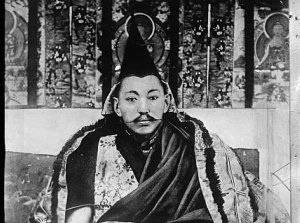
13thDalaiLama1910The next morning, they are taken to meet the 13th Dalai Lama, who is concerned and intrigued by the sudden arrive of people in airplanes, and intent on seeing the Eye — an artifact of great import, but one that has resisted their every effort to unlock its mysteries. Even the purest of heart cannot open the Eye. Gould admits that he did just this think in Africa. Only the Ancients could do this! He is a descendent of the people from the birthplace of the world!

Before they can get much further on this, Gould noticed a strange droning noise no one else does, sees shadows from the windows no one else does. Then all hell breaks loose — the monks warn the Dalai Lama that men have invaded the Potala Palace, and the sound of automatic gunfire comes from the city. It’s not the Nazis, Werner has no automatics! At that moment, an airship — SSSR-V6 — appears out of nowhere! At the same time, strange, ghostly things invade the audience chamber! (All the characters did well enough to sense these invaders, but only Gould could see them for what they were — Russian soliders, and two that held back, a man and a woman. He senses the pull of the man, the attempt to bend Gould’s perception with his will.

After having dropped hints about the Bekterev Brain Institute and Olga’s connection to the same, I thought it was time to up the ante…if you’re going to hint at Russian psychics, you give the audience Russian psychics. (Looking at you, George Lucas and Steven Speilberg!) The man, Arkady Lenshev is known as “the Ghost” and can make people and things disappear with the power of concentration; the girl, Galina Obreva, is a mind reader and mind controller.

Olga recognizes the misty figures and warns them it’s “Section 2!” Then the fight is on — Gus throws a heavy bronze vase at one of the figures and drops it, where it turns into a Russian soldier. Obreva takes over Werner before he can fire his PPK, and makes him take a shot at Gus. Before this can happen, however, Zara throws Rigoletto — her capuchin monkey — at the Nazi and throws off his aim. Hunter attempts to save Gould and gets into a fight with the stereotypical Russian man-mountain and doesn’t do so well.

Gould runs for it, gets out into the hallway only to be squared off with the Ghost, who is impressed — no one has ever seen through his cloak before. Gould fakes a surrender, gets close, and manages to get a knee in Lenshev’s soft and danglies. He’s just getting the Tokarev out of the man’s holster when a half dozen soldiers burst in.

The others are deep in a fight. Other Russian mist figures grab Olga, but Gus manages to get one off of her and choke him out. Olga is taken over by Galina and nearly busts Hunter’s head open with her knout, then is knocked unconscious by the monstrous, Ivan Drago-esque Russian soldier. Hunter struggles out his revolver and is about to take a shot, but is taken over by Galina for a moment (the plaer got an incredible Will roll!) and realizes it’s her trying to take him over. He is able to shoot the big Russian in the back.

The Russian backup arrives just in time to make things more complex. Zara, Gould, Hunter, and Werner gun down a bunch of the bad guys while retreating after the Dalai Lama and his monks. As they are making good their escape, Werner’s German troops show up and a gun fight ensues.

The characters escape, and led by the monks, get to the Dheva Cave where the Eye is held. Gould’s presence opens the eye, and his connection to it is even more powerful with Olga in proximity — it’s the first hint of why the Russians want her back: she is a focus for magic; her presence enhances the connection of magicians and magical objects to their source of power. The sounds of fighting move closer, and Gould grabs Olga and jumps through, with Hunter and the others following close.

On the other side, they arrive in a cave and startle a bunch of bats, which drives them out into the daylight. The characters find themselves in a hot, humid, and mountainous jungle. The air is thick, the sun small and incredibly bright, and around them are the grand ruins of an ancient city…Shambala or Shangri-la!?!

That was where we ended the night, with the characters finally having reached some exotic and unknown locale. The hollow earth? Some jungle on Earth? An alien world?


I needed a new talent that would work well with the new bad guy organization we introduced last week — the Special Department of the GPU. The group is in charge of the psychic and magical research of the Soviets, and one of the standard tropes of the period was the connection to sexual promiscuity in “sorcerers.”

To that end, I created the following. Feel free to use or alter it:

Magical Focus

The character is a repository of magical energy. Maybe they aren’t capable of using this energy themselves, but others can tap into it through a variety of methods — maybe they need their blood, maybe they need to touch the focus, or maybe there is some kind of tantric component. However it works, a sorcerer can add a +1 to their sorcery roll if they are able to gain access to the however the focus works.

The focus themselves can pass magical energy to the spellcaster by taking 2 non-lethal damage in exchange for +2 dice to the sorcery test.

Normal: The character has no special value to sorcerers.

Talent: See above. The magical focus talent can be taken up to two times.

A little tweaking was needed this week for one of the NPCs in our current campaign. Here’s the result…

Olga Markova

Born in Kiev, 6 June 1911, Olga was the second child of Samuel Markov and his wife, Rachel. Her brother, David, is two years older. Her parents were Jewish, and ran a successful tailors shop. Her father was lightly involved in socialist politics, but avoided trouble. With the Revolution in 1917, her father moved swiftly to join the local Soviet, and avoid becoming a target. Her father was a member of the Ministry for Jewish Affairs under the Ukrainian  People’s Republic, and once the Bolsheviks arrived in force, he quickly joined the Yevsektsiya — the Bolshevik organization designed to eradicate Jewish culture and Zionist movements — in 1921.

An ally of Trotsky, when the Yevsektsiya was disbanded in 1929, Samuel fell afoul of the new GPU. Her parents were executed, her older brother David was sent to one of the new “gulags” in Siberia. 17 year old Olga became the plaything of Mikhail Ruslan, one of the local GPU Special Department officers. From there things get strange, and a lot of hearsay surrounds her background.

Ruslan was a protege of Gelb Bokii, the head of the Special Department, who was a close ally to both Lenin and Dzerzinsky. In addition to running the work camps, Bokii frequently was tasked with strange, esoteric operations. One of those operations under his oversight was the Bekhterev Brain Institute, where experimentation on “psychometry” and other mental abilities was conducted. He also was in charge of missions to find objects of power, and to investigate the location of Hyperborea. Olga was frequently at the Brain Institute, and was supposedly “very important” to Alexandr Barchenko — the head of the BBI — and was a regular attendee of the orgiastic gatherings of the Special Department at the Kuchino dacha.

Eventually,  in early 1932, Olga contacted the Bosphorous Hebrew Relief Fund, leaking information that Ruslan and Barchenko would be in the Crimea. The Rabinowitz Group attempted to kill the two men, but missed, having been intercepted by GPU agents. Olga, however, killed Ruslan and injured Barchenko, before escaping with one of the Rabinowitz thugs. This earned her a ticket to Istanbul, where she has been working wth the group ever since.

Olga has quickly established herself as a competent spy and blood-thirsty assassin of Cheka agents. She even made an attempt on Trotsky, himself, but missed. Most people do not see her coming; she uses her good looks and aloof demeanor to draw in her targets. Among the Rabinowitz Group she has a powerful reputation for her absolute calm in tense situations, the collection of whip scars on her back, and her vicious use of a great knout when questioning enemies.

Recently, she and her companions have become aware that she is of great interest to the Special Department’s Section 2 — their “mystical” investigations unit — and that Bokii, himself, wants her returned unharmed. There are several theories as to why: 1) she is a latent psychic, 2) she has some kind of mystic competency, and most likely 3) she has captivated several of the men or the Special Department.

Archetype: Spy     Motivation: Revenge     Health: 5     Style: 5


Height: 5’8”     Weight: 110 lbs     Hair: Black     Eyes: Green     Age 22

ATTRIBUTES: Body: 2   Dexterity: 3   Strength: 2   Charisma: 3   Intelligence: 3    Willpower: 3

Secondary Attributes:  Size: 0   Move: 5   Perception: 6   Initiative: 6   Defense: 5   Stun: 2


RESOURCES & TALENTS: Attractive; Finesse Attack: Systema and Melee; Magical Aptitude; Magical Focus: Can act as power source and focus for other magicians

FLAWS: Callous, Criminal; Hunted, GPU and other occult groups

LANGUAGE: Russian & Yiddish (native), French, Hebrew

SKILLS: Acrobatics 1/4, Athletics 2/ 4, Con 2/ 5, Diplomacy 1 / 4, Firearms 2/ 5, Investigation 2/ 4, Language 2/ 4, Martial Arts, Systema 2/ 5, Melee 2/ 5, Performance, Acting 1/ 4, Stealth 2/ 5, Streetwise 1/ 4, Survival 1/ 3

WEAPONS:

Knout Damage: 1N   Rng: 8’   Rate: 1   Spd: A

Ithaca Field Gun 12 gauge, sawed-down: Damage: 4L   Attack Rating: 9 (4+)L    Rng: 25’

Cap: 2   Rate: M   Spd: A

Tonight’s session saw the characters finally end their pause in Istanbul. The city proved to be an excellent set piece for the multi-group intrigue and provided enough exoticism to set the stage for the more strange settings ahead.

One of the things the characters did last time that surprised me was they glommed onto one of the NPCs that was to be a possible love interest for the Dr. Gould character — our Spanish Jewish doctor with Atlantean blood who can activate ancient Atlantean artifacts with his presence. However, she proved intriguing enough that the “lead” in the game, Lady Zara, asked her along for the ride.

A few days later, I stumbled on a Facebook post in the Hollow Earth Expedition group that tied so well into the current plot, and specifically this NPC’s background, that I had to rewrite this week’s adventure quickly to include more bad guys and intrigue, and also hang a few more possible plot lines. This was a post on The Bloshevik’s Occult War, over on the Espionage History Archive website. It’s classic pulp/conspiracy theory goodness. If you want all the details, go read it.

What I applied: The characters found out from the local Terra Arcanum master Hunter (the new Terra Arcanum overseer PC) has been answering to that the GPU (the Unified State Political Directorate) Special Department has somehow gotten word of Gould’s Atlantean nature, possibly from a leak in the Terra Arcanum group, possibly from a leak in the Gestapo, and now have an interest in him. More worrying is their intense interest in Olga Markova, the knout-weilding assassin with the Rabinowitz Group.

They’ve learned that her father was part of the group charged with eliminating Jewish culture and influence in the Soviet Union, but fell afoul of Stain in the 1929 political war with Trotsky. Her brother is in a gulag (in reality, the gulags were the GPU Special Department’s deal.) She, however, had been taken under the wing of a Special Department officer, and was of direct interest to Aleksandr Barchenko, the head of the Bekhterev Brain Institute — the cynosure for the Soviet psychometric research; she is also of direct interest to Gelb Bokii, the head of the department. The Terra Arcanum think she’s a GPU spy.

Her Rabinowitz allies say that’s bunk. She set up the man who had held her as a sex slave — Mikhail Ruslan — and Barchenko for a hit by the Jewish mobsters during a vacation in the Crimea. The Group missed, but one of their hitters saw Olga finish off Ruslan and injure Barchenko. She even took a pop at Trotsky in Istanbul but missed. There’s no way she’s a communist agent.

Gould tends to believe this story. He’s seen the knout marks on Olga’s back. He knows there’s something special about her — he can just feel it, but doesn’t know what. If the Soviet’s occult and psychic bureau wants her so badly, he must be right!

Things come to a head when Yakov Blumkin, a GPU assassin and dealer in Jewish relics from the Ukraine, attempts to scoop her up in the Grand Bazaar, only to be stopped by our big game hunter, Gus Hassenfeldt. Blumkin reveals her treacherous nature and that she will turn on them, which feeds into Gus’ opinion of her. He “gives” her location to the Russians, keeping them off the party’s tail long enough for them to meet back at Zara’s S-36 seaplane so they can high-tail it out of town.

This led to a firefight between a dozen Soviet agents, who show up in a couple of cars while Zara is backing the plane out into the water to take off. During the action, Hunter drops a few of the bad guys, and Hassenfeldt blows up a car with a lucky shot to the gas tank from this .425 Wesley-Richards.

The group flies to Simla, where they get aid from some of the Terra Arcanum’s friends in the British government there. After a night of official parties and some debauchery, they load up the plane with their cold-weather gear, oxygen bottles, and a Ghurka on loan to them with family in Lhasa, and off they fly.

Their arrival in Lhasa leads to a big reception from the people, who are not used to seeing an airplane, much less two! Yes…there is a Fokker F.XII with Lufthansa markings already on the ground here. The Gestapo has beaten them to Tibet!

They find out the Germans, headed by Hauptsturmfuhrer Werner and Dr. Heiser (the men that tried to lure Hassenfeldt into their expedition), have already been to see the Dalai Lama and the Eye of Shambala. The headman of the village is making the arrangements for them to meet with the esteemed religious leader the next day…

Next up, they finally get to the Eye of Shambala.

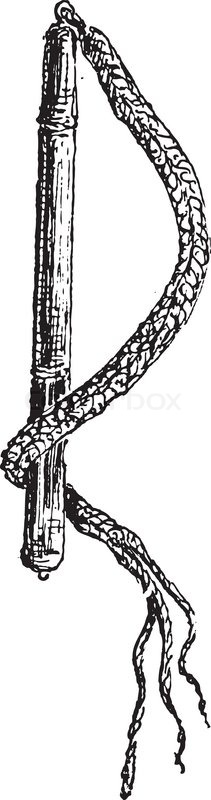
Knout is Russian for a type of scourge or whip. Often they had multiple rawhide thongs attached to a stout and long handle (like a cat o’ nine tails), but could also be a single, whip body that was less flexible than a bullwhip; these were more like oversized saps. These were used to punish criminals and political offenders until their use was abolished in 1845, and replaced with that of the pletti.

A variation, known as the great knout, consisted of a handle about 60 cm (24 in) long, to which was fastened a flat leather thong about twice the length of the handle, terminating with a large copper or brass ring to which was affixed a strip of hide about 5 cm (2 in) broad at the ring, and terminating at the end of 60 cm (24 in) in a point. This was soaked in milk and dried in the sun to make it harder. some versions replaced the lead shot or iron rings at the ends with fish hooks.

cossack knout

The pletti was a shorter, triple thonged knot that usually had lead balls woven into the ends.

knout

Knout or pletti:   Damage: 1N   Range: 6′   Str: 1   Spd: A

Great knout:   Damage: 1N (1L hooks version)   Range: 10′   Str: 1   Spd: A


« Previous PageNext Page »