Roleplaying Games


At first, I thought this was a really weird prompt, but thinking on it — there’s a lot of older games out there that we wish weren’t gone. And to paraphrase Dr. McCoy, “they’re not really dead so long as we’re still playing them…” So the best second-hand purchase is probably the basic rulebook and GM box set for James Bond: 007 RPG from Victory Games. I’ve said (a lot) before that this was most likely the game I ran the most from 1983 until around the 2000s — not coincidentally because I drifted into that community through the army for a while and lost my taste for it.

An honorable mention has to go to the eBay score where I picked up pretty much all of the books for Jovian Chronicles — a anime-inspired, hardish sci-fi setting that I’ve wanted to run, but the mechanics are terrible and I’ve never been quite able to find an “in” to the setting. It’s rich, there’s tons of stuff, and there’s a background story in the materials that can be quite limiting. I guess I just never quite got to the point of dumping the background story material so that I could “make it my own.”

That’s why eBay and places like Wayne’s Book Store (thanks to Runesligner for turning me on to these guys), and Noble Knight all allow the dedicated (and sometimes money stupid) gamer to find all that stuff we used to love, but that is out of print.

Gah…! I looked up Wayne’s to get the link and there’s something I want.

See?

This one’s a tough one. I realized, looking at the wall of gaming books across from me that a lot of the stuff I run is licensed material now. It wasn’t always the case. The only real licensed game I ran was James Bond: 007 by Victory Games, and while I had bought a few like the execrable Indiana Jones RPG that was really an unfinished set of rules, I remember playing Ghostbusters once and it was fun, and the DC Heroes game from the 1980s, but that was it. It wasn’t until the 1990s that licensed games started to really multiply.

Let’s see: there was West End Games’ easy and rules lite Star Wars — which is still better than the ones that came after. It was the king of the dice pool games — nothing like needing a wheelbarrow for your big climactic battle with a stardestroyer. There was the Last Unicorn then Decipher Star Trek systems, the weird Babylon 5 game that I ran for about two years straight. In the aughties, however, there were a bunch of these — Firefly or Serenity, depending on the flavor of Cortex you liked; Supernatural, Dresden Files, Battlestar Galactica — and that was just Margaret Weiss Games. Doctor Who, Avatar, and now Alien and Blade Runner. The goes on…

My favorite license? Hands down, Blade Runner. I love police procedurals. I love moral and ethical dilemmas. I love cyberpunkish settings. It’s got all that, in a setting I love, with solid, rules lite mechanics, great artwork, and a solid creative team on it.

But my favorite licensed RPG..? I think that’s a tie, really. For the longest time, it would have been — without contest — James Bond: 007. The mechanics were elegant and innovative for the time, it was perfect for the ’80s and my fascination with spy movies, action movies, Bond, cars, guns, you have it. We played the hell out of it and I’m on my third boxed set and main book. I modified the rules for a cyberpunk campaign and a Stargate campaign, and the system worked without much tweaking. A few different games split my attention about the middle of the aughties and JB:007 got less and less table time…then we just never got back to it.

One of the reasons is the other licensed RPG that ties with JB:007 — Battlestar Galactica. I loved the reimagined show, as most vets I know did. It was produced by a guy, Ronald D. Moore, that had been naval ROTC and did a rotation on the frigate WS Sims. He actually knew what military life was like — something pretty rare since the WWII and Vietnam vets in Hollywood aged out. It presented “realistic” version of the Galactica universe — not one where your civilization gets wiped out and next week your at the casino planet hanging out, but where the impact and consequences are dire. There’s moral and ethical dilemmas — something my daughter has noted I seem to like in my movies. Best of all the lightweight, simple rules of the early Cortex system — but improved from the Serenity rules set — lent to roleplaying over roll-playing. I wound up running the best campaign I’ve ever done in that game and setting — one that lasted five years and was so damned satisfying when it ended that I still look back on it six years later and wish we were still playing it.
If I’m still alive? Sure, I’ll probably still be playing RPGs. I hope so.

What will I be playing? Who knows? We’re in a golden age of RPGs, right now. There’s more people playing than ever, more games being published successfully thanks for Kickstarter and DiveThruRPG; and who knows what’s coming that will be awesome?

More to the point: I hope my kiddo is still gaming in 20 years. Still dreaming, still having fun. I think that would make it all worth it.

As I was saying a few days ago with the favorite one-shot post, I don’t tend to do one-shot modules, but I do buy some — especially campaign settings — because I cannabalize them for ideas, creatures, etc. there have been a few good ones for a number of games, and some real standouts.

I liked the setting guide for the Odyssey of the Dragonlords, a Greek-inspired setting for D&D 5th Ed. The artwork and the maps and other material that came with it was gorgeous, and the write-ups for playable centaurs, satyrs, etc. as well as versions of the Greek monsters of myth was well done. Better than the Mythic Odyssey of Theros that Wizards turned out…and that’s also quite good. I’ve borrowed from it, but I haven’t run it.

Probably the best published adventure I’ve bought is Destroyer of Worlds, an Aliens-style, colonial marines- oriented adventure for Alien written by Andrew Gaska. His intro adventure for the Alien RPG, Chariot of the Gods is one of the few published adventures I’ve run with almost no modifications. His Heart of Darkness, the final adventure in the “trilogy” has some really good stuff to mine, but I doubt I’ll run it straight as we’ve already had an adventure at 26 Draconis — and I think ours was actually better. But there’s some gold in there to be used.

This one I’ve remained remarkably consistent on since RPGaDay started eight years ago: Cortex. Not the new Cortex or “Fate-ified” Cortex of Leverage and Marvel RPG or later Margaret Weiss Games productions (may MWG rest in peace…) but the one that powered Serenity and more specifically Battlestar Galactica and Supernatural. The rules were simple and elegant, and the few bits that weren’t could easily be ignored. It’s still my favorite balance between simple rules and storytelling, and something more substantial than newer lite systems like Broken Compass (although that is a very good system, as well.)

A tight second is the rules set for James Bond: 007 RPG from the 1980s, and again — I’ve been really steady on this one, as well. It did a good job of evoking the movies, leaned into the product placement mentality with the different ratings for guns, cars, etc. and was the first game to really get away from random damage — making injury based on the quality of the hit. I often find myself tempted to bust it open and run something using JB:007.

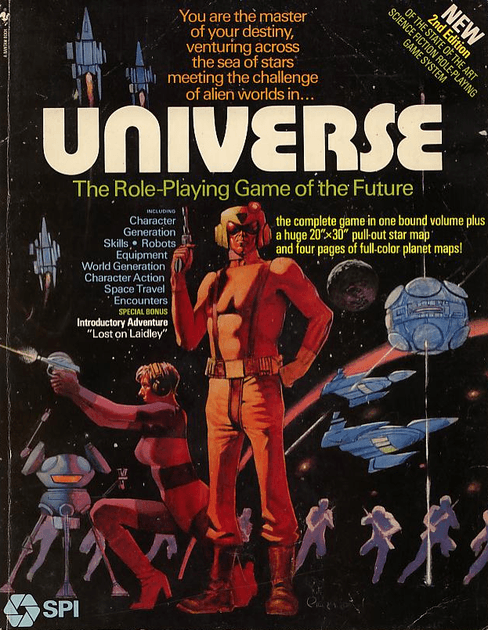
This prompt is amusing. With Amazon and the internet, you can find all those old games — often in good shape! — so if you wish it, you can have it. That said, part of me really wishes I had an old science fiction game called Universe that SPI (I think it was) put out in the early to mid ’80s. It had this spectacular map of the nearest stars that was pretty accurate (for a 2d representation of three dimensions), and I remember the rules being decent, if not as simple as Star Frontiers, but lightyears better than the execrable Space Opera, which we also tried and which has never been bested in my mind for truly awful mechanics until the unfortunate Traveler 5 or whatever that shit was that was published a few years ago.

It’s probably awful by today’s standards, and I realize that there’s a lot of sentimental BS — this was the sci-fi game we settled on in the high school group after Star Frontiers. It was supposed to be SPI’s answer to GDW’s Traveler, if I remember.

Having written this, I of course, hit the interwebz and found the game on eBay and Noble Knight for a ludicrous $175ish (but in excellent shape — so probably as close to new as possible.)

I don’t tend to use modules and campaign guides to run them, but to mine them for ideas. I’ve never run one without tearing it apart and modifying it for the players/characters/campaign we’re playing. However, when we were kicking the tires on Alien a few years ago, I wound up using the Chariot of the Gods adventure to try and lure the group in and kickstart a campaign. The players wrote up their own characters instead of using provided ones. The premise was simple — a missing Weyland-Yutani ship, Cronus, is discovered by a group of salvage operators who find the science module/lifeboat is missing and most of the crew gone, save for a few in hypersleep. The ship is almost dead and they have to get it fired back up. After the crew gets wakened, the requisite horrible stuff starts happening. There’s a third act where a competitor ship shows up, but I ditched that as we got to the end and the characters did some clever things to survive aboard Cronus long enough to go into hypersleep with the ship supposedly on course for the nearest port.

It’s a good adventure and well written, as is the “sequel” a campaign instead of a one-shot “cinematic” adventure — Destroyer of Worlds. The adventure takes place on a colony world on the edge of American space. There’s the the UPP — the setting’s “commies”, if you will, invading because of a secret lab producing the bioweapons. The characters are looking for some deserters from the colonial marines and things, as one might expect, go pear-shaped. The setting of the colony is extensively presented and I wouldn’t mind running a few adventures on the world before the events of DoW. It wound up giving me ideas for creating and running the colony world that some of the players’ characters have landed on after a hit job in Tokyo went bad and they had to run for it.

So while I don’t tend to run published adventures very often, I do find them useful for inspiration or finding material to use. If you’re a new GM, however, they can be a real lifesaver — cutting the prep time down, allowing you to often hit all the rules mechanics for players to learn, and reducing the intimidation factor that running a new game for a group of people can inspire.

This year’s RPGaDay is really exposing my lack of dork. I’ve only been to two conventions in my life. One was back in the ’80s in Philadelphia where I met some cool folks and had to leave early due to food poisoning. The other was a sci-fi and comic convention in Albuquerque about five years ago, and I went to that one to support a friend that was having a time of it and just wanted to go have fun.

I think my favorite purchase was the P90 airsoft gun I found for him to go with his Stargate (Atlantis, if i recall) costume. It wasn’t for me — I wanted him to have a good time and the $100 or so was worth it. I think I bought myself an Eaglemoss Akira-class starship model (one of the wee ones…) The convention was also good for the fee pics he got to take with various actors because i was making a joke of him posing with all these cosplayers — I would take a picture of the person, but only his elbow, arm, small bit would be in frame. (Yes, there was also a proper one with him in the shot.) It was so well received that the actor from Voyager (Garret Wang?), the bad guy/kid from Karate Kid, and a bunch of other guests took pics with him for free to be in on the joke. (They got tipped well — they’re not working for free.)

Sadly, we’re not friends anymore.

I guess someone needs to convince me to go to a convention.

This one’s easy. It’s also a tale of how some folks take gaming way too seriously.

Early ’90s. I had just moved back to my hometown in Pennsylvania and couldn’t find a group. I wound up introducing a regular customer that hung out at the gas station I was working nights at to gaming. I was running Space:1889 using the old GDW rules and the Cloudships and Gunboats minis for the ship combat. A few sessions ensued, a few more folks from the local college joined in.

In an epic battle between the heroes, who had been stranded at a British frontier station on Mars after the cloudship was damaged in a fight, they found themselves pitted against a large force of Martians from a local “empire”. They were fighting to get back to the station after an unsuccessful foray, and running out of ammunition and support, they needed to withdraw. But not this guy. While shouting that he would bring down the might of the British empire (or some such), he charged alone into a horde of baddies.

And died really quickly and ignominiously.

This was done even after the classic GM letting you know you’re idea is truly stupid — “You sure about that?” It was also the way he played the character that made this more comic than tragic or even brave. Afterward, he let me know that he felt the other players weren’t giving Sir Diesalot his appropriate due and that he had a dream where the character had “haunted him” over their lack of respect.

So, he was out of the group quickety-quick. That’s a bit too much lack of reality for me, and honestly, gaming was probably not the healthiest pastime for him, it would appear.

This guy and the “ninja” from my time in Philadelphia are two of the reasons that I vet gamers in a neutral area (you don’t get my address until I know you’re not a kook) and we’re pretty fussy about newcomers.

There’s a few I wouldn’t mind playing, and some that had incredible longevity in our various iterations of the game group. From 1983 until about 2010, I regularly would run James Bond:007, and from 1989 until a few days ago, I ran a Space:1889 game — although I stopped using the GDW mechanics pretty early. We tried FUDGE (the original FATE), settled on Castle Falkenstein (with heavy modifications) to power it through the 1990s and 2000s until it rolled off the game rotation in favor of Hollow Earth Expedition.

So what do we still play? Dungeons & Dragons has recently rejoined the rotation with the latest game group. I hadn’t played it since our big campaign in high school that ended wonderfully. That was Advanced D&D and I didn’t play it again, save for one disastrous game night with a horrorshow of a person running, until 2016 when I coaxed a few old friends back into gaming by doing a Rome-based D&D campaign. Old West End Games’ Star Wars got trotted out for a bit a few years ago, as did the old Decipher Star Trek system.

Setting-wise, however, the big boy is Space:1889 — it was the game that got me into Victorian history (mostly because I wanted verisimilitude in the game world) and eventually led me into history as a field of study. I’ve been running it for my daughter recently, and she loves the setting. However, to drive the game, I’m using the Broken Compass rules. They’re clean, quick, and for a pre-teen that’s the ticket to getting through a “mission” or “adventure” in a night or two.

« Previous PageNext Page »