Roleplaying Games


After a few weeks with game cancelled thanks to the swine flu flattening everyone in my house, (kids — little bioweapons! I’ve got a cold, now, thanks to one…) we were finally able to play last week. It was mostly following up little character interaction vignettes, but there were also a few big “push” scenes that advanced the arc:

Our CAG (a PC) has been prone to divine visions throughout the game (he’s the son of an oracle), and has been delving into the Sacred Scrolls, but also the “Aurelian Heresies” — an apocrypha that appears to predate Mankind on Kobol, and possibly even the Lords of Kobol themselves. There are more ties to the Titanomachy (the period of the Titans, only mentioned tangentially in the TV series), and he delves into the Eleusian Mysteries with one of the cults that use the Heresies –which they call the Aurelian Prophecies. One of the introductory rituals is the use of kykeon — a combination of ambrosia, chamalla, and other things that produces a strong hallucinogenic brew. Lucky (the CAGs callsign) takes part and has been having more intense visions of The Blaze — the jealous god that started the war between the Lords and Man. (It’s a toss off line they cut from the Kobol episodes, but became a central theme for the campaign.) The Blaze seems to the “God” of the Cylons, but is also venerated  by the Eleusinians as part of their cycle of death, discovery, and rebirth. During his vision, he is escorted by a minor NPC, his young chaplain’s mate who appears as a winged creature of light. He has the vision of the two and ten vipers, slithering into fire, but only one survives…could that be him? Is he destined to destroy the Blaze?

At this point, the Blaze “sees” him. There is a psychic connection of some sort and he realizes that the Blaze, his gleaming diamond-like spacecraft, are one and the same — some kind of incredibly powerful and intelligent creature or machine, but not God. And this thing has been retelling the story of Kobol, the Colonies, and Earth for thousands of years. To break the cycle, they need to destroy the storyteller…but what is helping him to do this?

The second push moment was a hypnosis session between Lucky and the lawman Chaplain (a PC), and Boomer. They are attempting to help her assimilate her Cylon and “human” personalities and memories. They rolled incredibly well and manage to pull it off — Boomer is Sharon Valerii, now, but her Cylon memories and personality have been integrated. She’s smarter, harder, but the “human” personality is dominant. She offers to help them find the Tomb of Athena, where they can get their roadmap to Earth. The humanoid Cylons (now confirmed to have come from Kobol and are “humans” that followed the Blaze after the War with the Lords) know where the Tomb is, where Hephaestus’ Forge is, have investigated the halls of Olympus, which overlooked the “City of the Gods”, but they cannot access the many of the places the Lords of Kobol left behind. They can only be opened by the faithful; Cylons, the automated systems kill. She can take them there, but she cannot enter.

The end of the session had the crew starting to look for transmissions from Kobol, hoping to develop a better picture of the tactical, political, and societal situation on the planet.

The goal has been to use the show as a jumping off point, to take the elements that caught my imagination and use those to tell another version of the Cycle of Time, linking it to an interesting idea from Zachary Mason’s excellent The Lost Books of the Odyssey — the idea Phaedrans had that every person’s story was a tale told by someone else, and if you could find the storyteller (and kill him) you could be free of your story to live as you pleased. The idea of escaping the predestination built into the Galactica universe was, to me, an interesting one — free will versus divine will. So the game has become focused escaping the Cycle of Time (as, to a lesser extent I would propose, was the bringing Cylons and humans together in the show.)

My hope has been to accentuate the themes of the show, while taking a new and fresh direction, and allowing for moments of “fan service” where the players think they know where the game is going (“Oh, this episode is Bastille Day!”) but then letting them change the outcomes.
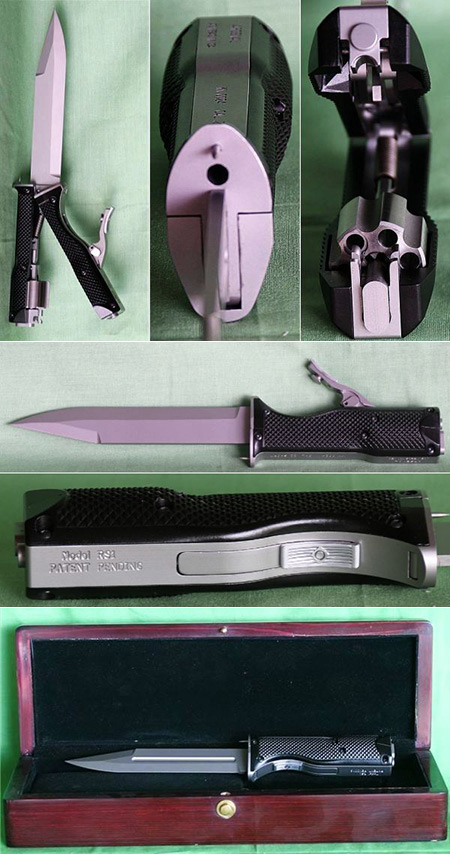
Arsenal Arms created a “ballistic knife” — a combat knife with a six shot .22LR revolver cylinder inside the handle of the knife. The gun is actuated by turning a portion of the trigger, which levers up and for every squeeze, a round is fired. Some of the game stat stuff is conjecture based on videos on the web, as I’ve not actually seen one of these. The trigger looks very heavy and awkward, so accuracy is going to suffer severely. The cylinder looks like it might be off the NAA pocket revolvers, so you can probably carry an extra cylinder (if you can figure out how to keep the rounds in, and hot swap the cylinder. Reloading looks like you’d have to take the cylinder out, knock the rounds that don’t fall free, out, then feed and replace the cylinder before closing.

gun-knife

G.R.A.D. MODEL RS1 BALLISTIC COMBAT KNIFE

PM: o  DC: +2   CON: +1   DRAW: 0

(as gun) PM: -1   S/R: 1   AMMO: 6   DC: D   CLOS: 0-1   LONG: 3-6   CON: +1   JAM: 97+   DRAW: 0   RL: see GM information… COST: ~$2000

GM Information: the RS1 is designed to be a last ditch weapon, so reloading was not a priority. To hot-swap a cylinder, the reload time can be dropped to 3 rounds, to feed the cylinder in the weapon new rounds takes 5 rounds.

(Ed. If anyone has one of these and care to correct me on elements of the function, etc., please do…)

Here’s some vid of the thing in action:

1545217_10202989107196414_1987803967_n

This past week, the players in my Battlestar Galactica campaign managed to gain some very important intelligence on their quest for Kobol and Earth, but more striking, they got just enough of a hint of the metaplot — that the Cycle of Time, which we’ve referred to time and again as “a story told over and over”, is leading them to re-enact the same basic themes that have befallen other civilizations — most notably the Lord of Kobol/Olympians, and their “parents”, the Titans. I introduced something called the “Aurelian Heresies” — an apocrypha of the Sacred Scrolls that supposedly long predates the Exodus from Kobol, and possibly Kobol itself. This was originally a bit of “fan service” to the players who had been in the last iteration of the BSG campaign, but over time, it has developed to be a central bit of background noise that now has become obviously important.

So why start a post on pacing with this anecdote? One of the hardest elements for a GM is pacing a campaign. Sometimes, you plan on a game running a few sessions and ending, only to have it run six years — like my Star Trek campaign from the early oughties. Other times, you have a plan for three or four “seasons” that will lead to some epic end. Any gamer who has played long enough knows how hard it is to achieve the endpoint of a game campaign. People move away and the game collapses; schedules change and the game collapses; something new and shiny is released and you dabble in it only to wind up playing that game for years, instead; or sometimes, you just don’t want the ride to end and you start throwing filler in to stave off the inevitable.

With the Battlestar Galactica game, the “season 1” pacing started slow — mostly character-driven episodes to realize the world and NPCs for the players, so that when the Cylon attacks occurred, they would feel the loss to some small effect as their character would. It was slow paced with lots of hints about the Cycle of Time and previous “Colonies” that had existed on the 12 Worlds long before the Exodus from Kobol should have happened. A few archeological digs in space found more evidence of similar human settlements long before there should have been any. Cylon infiltration was discovered. I had sold the game on the premise that they might even be able to stop the attacks and save the Colonies; I had no intention of honoring that. The total time was a bit over a year of game time with other games being played in a rotation.

“Season 2” was almost exclusively focused on hunting Cylon infiltrators and conspiracies in the Colonies. The episodes were no longer stand-alone or random, and the pace picked up considerably as they hunted the bad guys. Game time was only a few months, but it played over about six months. Toward the end, I made the decision to put the players’ charactes into some of the lead slots, instead of characters from the show. The Cylon attacks happen pretty much as they do onscreen in the Miniseries.

“Season 3” has been going about six months and is nearing the end. Total game time: two months. The players survive the attacks, fight Cylons, had a few “fleet episodes” to show the crime, bad conditions, and development of the political system. Then we started to find remains from the Kobol Exodus, evidence the Lord of Kobol and the humanoid Cylons share DNA and technology. The Blaze — a toss off line cut from the Kobol’s Last Gleaming episode became the main guide for the direction of the game: the Colonials fled the war between the Lords of Kobol and humans that followed this “god” in its shining diamond-like spacecraft. Then they found the directions to Kobol. Now they are on their way and through a few toss-off lines from an interrogation of Boomer, think the Blaze may have destroyed the Colonies to bring Man back to Kobol for one last chance at submission and redemption.

Now I find myself faced with the classic problem of a campaign sliding into the third act fast — do it string it out, as the show did,  and enjoy some gaming with these characters we love and a universe that is now very much our own? That was my immediate reaction. But sometimes, it’s better to throw it in fifth and punch it. Embrace the direction the game is going and the pacing.

One reason for this is the impending move of one of the players who has only been with us for a year or so, but has really livened up play. He’s been with us through the end of “season 2” and all of the “season 3” stuff playing one of the most important characters, our fighter pilot who is secretly an oracle. I want him to see the end of the game. So, it’s time to floor it.

I had an idea of what i wanted to do with Kobol this time around — in the first game, Kobol was “dead” as in the show, but there were things left from the Gods: Hephaestus’ Forge, the Tomb of Athena. This time, if the humanoid “Cylons” are some kind of apostate version of mankind that has been modified to work with the Colonial built centurions, it would suggest that Kobol is inhabited and at least mostly healthy. So what does that do for the characters trying to get to the Tomb of Athena? How do they pull it off?

One of the characters, the commander, talked about how, if the Blaze is waiting for them, perhaps they might be well served by at least hearing the god/thing/whatever out. This opened a new line of direction that I hadn’t anticipated. Essentially, there are now two main plot directions the game could take — they discover the path to Earth and lead the Cylons a merry chase; or they submit to the will of this “god” and head to Earth, perhaps as his emissaries.

That leaves me with two main lines and a few variations on a theme to be ready to work with, and ultimately, only four real “endgames” for Earth. This “season 4” will be at a faster pace and more tightly plotted than the others. I anticipate the campaign — the first and longest lasting of my “new life” that started in 2010, will come to an end in April.

I aim to make it shine.

The takeaway from the piece is this: for campaigns with an overarching plot — much like a movie or TV show — each of your Acts or Seasons should have it’s own unique flavor and pace, but always moving more swiftly toward the denouement of the season/act, and the overall course of the game. This allows the players to feel like they are making progress in their goals, and revealing any mysteries that might have been set in front of them. Because, in the end, people need a story to have an ending.

I’ve added a new “spacecraft construction” file that combines some of the rules from Serenity and Battlestar Galactica from which you could craft vessels for established properties like Star Trek or Babylon 5. It’s not set up for a GM or player to get into a lot of crunch — the fuel, cargo, and other aspects that were gone into in the Serenity RPG are stripped out and the weapons systems simplified to make converting other settings to Cortex easy. If you wanted to do a more Traveler-esque game, you might want to use these with the Serenity rules to give yourself a bit more realism.

Most players would probably agree that they want their characters to be hearty and hale — playing a weak or sick character is “no fun.” I would say that means they haven’t considered the role playing aspects that disease can bring to the table when a character has some kind of chronic injury or disease.

One of the player characters in a former Hollow Earth Expedition game had the flaw “dying” — in this case, he had emphysema from chain smoking (which he still was doing.) The character didn’t see much limit, mechanically, until he was pushing himself physically. For the most part, it entailed the player wheezing and coughing when playing the character — little touches that may the character realistic. But once in a foot chase, or a protracted fight, he was hampered in his dice pool from the disease. As a result, the character was the master of the knockout blow; if he couldn’t finish a fight in a few moves, he knew he would get put down. It required the player to think differently about what actions he could take in an action sequence, or if he should attempt to talk his way through encounters.

There’s a character mentioned in the piece on age from the other day that addresses the idea of chronic injury — a character that has back issues from skiing and car accidents, as well as a recent broken arm. His physical activity isn’t necessarily curtailed, save where the use of the arm or things like running are concerned. It’s mostly just roleplaying the fact he’s got a bad back.

Disease can be something as innocuous as allergies.  Most environmental allergies — hayfever and the like — are uncomfortable, can make the character tired and irritable (not to mention snuffling, sneezing, and blowing your nose have a tendency to give away your position at the most disadvantageous moments.) They can make for challenges that don’t have to be immediately life threatening, but can make for obstacles that need to be addressed in a different way. It’s hard to sneak up on someone when you’re in a coughing jag from your 3 pack a day habit, or you sneeze explosively in the middle of a car chase.

Chronic injuries could be something as small as arthritis — you are still functional, but maybe that heavy trigger pull on your revolver is problematic at the best of times — to missing limbs, which have an obvious limiting factor. But I’d point out there is a motorcycle racer in Australia missing his left leg and arm. It required modifying his bike, but he wins races. Similarly, this could lead a character in a game that might be considered “unplayable” to simply have to work around his issues.

One thing I’ve noted is that players tend to choose one of two age groups for their characters — they are either in the prime of their life, somewhere in the 20-something range, or they are very close to the age of the player themselves. For some types of campaign, the late teens/early 20s coming of age story is appropriate; a lot of fantasy campaigns, this is a good starting point for a first level character. For modern games, late 20s is usually the default starting age — this is about the period where a character would have finished college or whatever prior experience would give them the in two the spy/cop/mercenary world.

But some of the best characters I’ve seen in our games over the year were when folks broke the mould and played something different. One was an aging college professor/archeologist that was absent minded to the point of forgetting major details the players needed, the other was a 12 year old Chinese street urchin. Both characters required the players to think about what their player could do, how they would think, and what their limitations were…and for good characterization, it’s the weaknesses that make them interesting.

Most recently, we have a character who isn’t old — mid-40s — but who has had a few fairly traumatic accidents: a ski accident in his background that left the character with a chronic injury that hampered him in physical efforts. During the course of play, he’s been in a car accident that broke his arm (leaving him unable to fight or function for three months of game time), and who nearly had his neck broken in a fight. He’s a mess, and while he’s still young enough to be spry, the aches and pains are starting to catch up with him. Recently, the player started to reference his crappy reading eyesight, requiring him to use reading glasses. His vanity keeps him from using them as often as he should, but the character is more human for it.

The kid was a particular challenge for the player — how would a 12 year old peasant girl living on the streets of Shanghai react to things? She had to reach back to how she thought as a young girl to try and look at what would scare the character, how she would problem solve, and also had to take into account that the girl did not have the strength and training that some of the bad guys had. It broke her out of her comfort zone, but the player was able to come up with some unique solutions to some of the problems presented to her.

In a modern or sci-fi setting, it’s entirely possible for an older man or woman to be adventuring and be just as capable as their companions. Modern medicine, fitness, and diet allow for people to be active, strong, and resilient well into their 60s. They’re still rarely going to be holding the line in a foot race with a young man or woman, but they are realistically able to survive an action sequence. This isn’t so much the situation in the medieval period, where the average lifespan was 40 and hard living and bad diet broke a person much quicker. Bad medicine also meant injuries were more likely to be debilitating.

Thinking about not just the physical aspects of age, but the mental ones, is a good challenge for a player, as well. The youthful arrogance and feeling of invincibility disappears as one progresses through their 20s. The surety of their opinion gives way (if they’re paying attention) to an understanding they don’t know every damn thing. By 40, most folks have had kids and have priorities that match king or country; they also start to learn patience, or at least to tolerate things that might have caused non-career-enhancing actions (as a sergeant once described is to me.) Most of the folks I know over the age of 55 reach a point where, even if they give a shit, they often are willing to sit on the sidelines of an issue and see how it plays out. There’s also a feeling of entitlement that comes with aging, a different kind of arrogance that comes with looking at younger people doing the same stupid crap you did at their age, and knowing that no matter what you say, they’re going to do it anyway.

These kinds of insights that a player could glean from paying attention to the opinions and actions of their elders or the kids coming up behind them, could be useful in crafting an interesting and realistic character.

I’m getting in just under the wire here in the US for this month’s blog carnival, which is being hosted over at RPGBlogCarnivalLogocopyCasting Shadows.

This month’s theme was “Taking Charge”, and I found the various pieces regarding this a bit odd — almost none of them seemed to address what those two words — for me — implied. How and who takes charge in a role playing game campaign or session.

I’m, I suppose, pretty old-school in some ways, when it comes to the role of game mastering an RPG. I started playing around 1979ish (give or take a year; I honestly don’t remember) with the old box set of Dungeons & Dragons. The role of the DM, in those days, was antagonistic toward the players. You crafted a dungeon or other environment in which the players attempted to find treasure, kill monsters, or do some event that was central to the setting. You populated the play space with traps and opponents to challenge the players in what often seemed like a blatant attempt to do their characters in. The players were more the DM’s opponents; the character sheets might have stats, but ultimately, you as a player tried to outthink the DM. However, ultimately, the “DM was God” in those days.

I never really cottoned to the idea of gamemaster (note the shift of term) as antagonist. I wanted to craft situations and plot lines that the characters could respond to  and alter. Our little game group moved quickly out of D&D to TravellerGamma WorldTop Secret and James Bond — settling in mostly on JB:007. Despite the move to a more narrative style, as some might call it, the GM was still the guy that built the world, presented the adventuring opportunities, and ran the opposition. The GM was still in charge, and the players were still trying to overcome the obstacles he or she set.

The idea of balance of power between the player and the GM started to take a hold in the 1990s, and I found it tied to the White Wolf games of the time, where the gamemaster was more a arbiter, and the bulk of the “action” was interpersonal interaction. This idea of GM as simply a judge or just another player is particularly popular in the indie games of recent years. The players have the power to not just react to the story, but often to use mechanical aspects of the game to change the outcome of events or even the storyline itself. The GM is not in charge. Sometimes, they don’t even exist.

You can imagine what my preference is: I like a strong GM presence or involvement, but ultimately, the players have to do something…and that drives how the story unfolds. So how does a GM take charge without creating, as a recent commenter stated, “hack novelists [sic] shitty drama”?  You can present an interesting setting (in a lot of the bigger games or licensed settings, a lot of that legwork’s been down for you) or atmosphere — something particularly good for sandbox games — and incentivize the players to go after the adventure bread crumbs you drop by tying those adventures to their character’s motivations. If you are playing in a game where the characters are part of a hierarchical organization, this is relatively easy — a character in a military unit, a government organization, etc. has to follow the instructions of their leadership, or they get canned/court martialed/ or similarly penalized. They can riff on how they do something, but they are still running through the scenario.

Depending on what kind of game you are playing, taking charge could mean extensive planning and NPC creation — particularly useful in more crunchy espionage or mystery games. It could be wrangling the players to show up for game. I will usually toss out a “who’s in?” email once a week. We all know we’re playing weekly at a certain time and place, but sometimes schedules change, venues must be shifted. Knowing who is showing up is essential to knowing what you are doing as a GM.

But what about the other players..? How do they take charge? 1) Know your character and play them. Don’t sit on the sidelines (unless it’s someone else’s turn to shine at that moment. 2) Grab onto the clues or opportunities presented to the character and do something. Don’t sit there drinking Mountain Dew and eating pizza…play, Have fun. 3) Sometimes you’ll know where the GM is trying to get you to go. If the players don’t want to go there, try to give the GM some kind of opportunities to help you go elsewhere. If you want to figure out the plot, or get to the big fight scene the GM is trying to get you into…go for it. Embrace the story and the fun that creates will help everyone move the story alone. You won’t have to take charge — it’ll just happen.


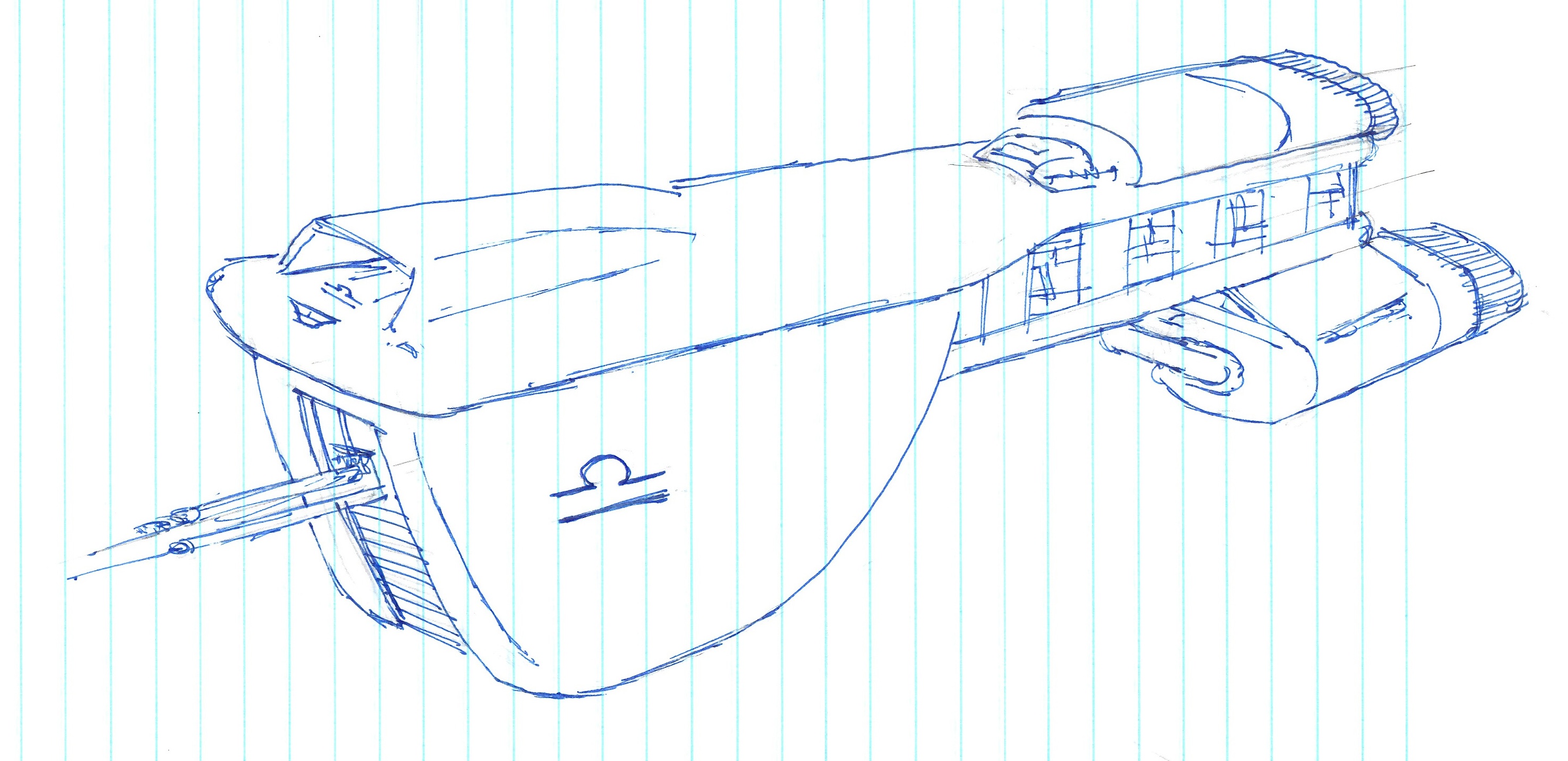
While it’s unlikely to be something a GM might use in their Battlestar Galactica campaign, I was bored so I statted up the Libran Galleon from our recent session:

Libra, a Galleon of Kobol

A quick sketch i whipped up for the session...

A quick sketch i whipped up for the session…

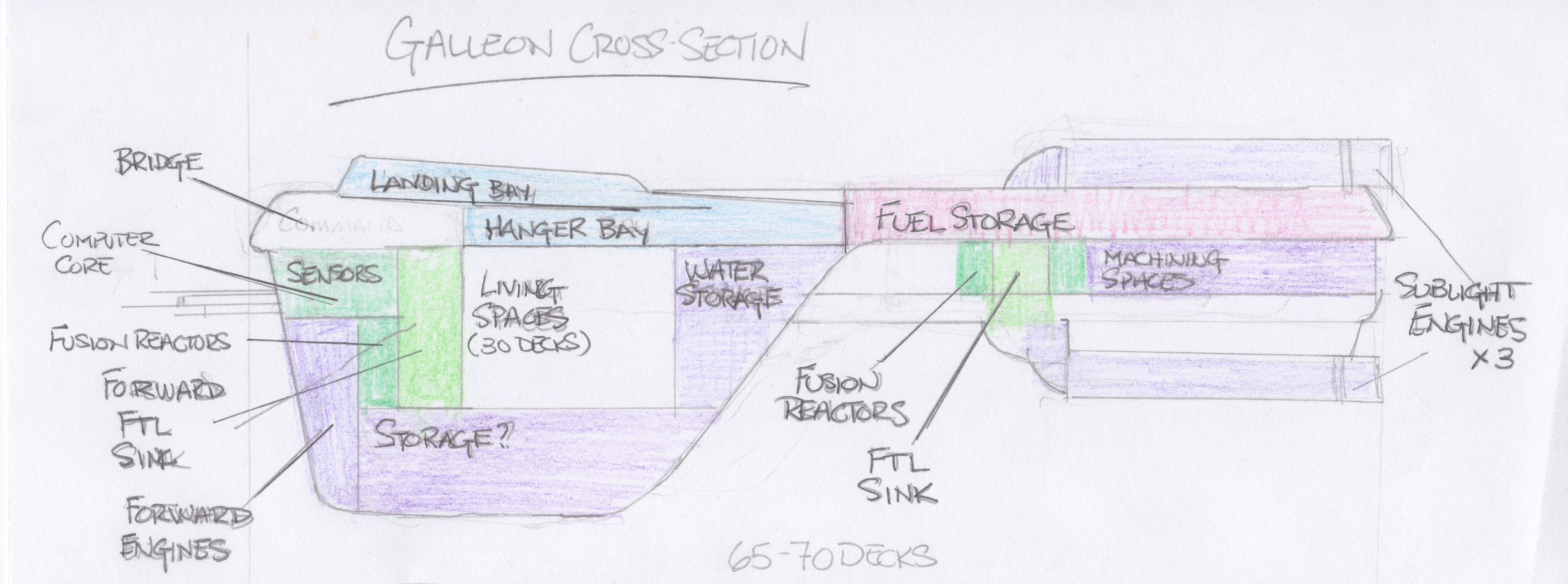
Length: 4835’     Beam: 1896’     Draught: 1619’     Decks: 65     Crew Complement: Unknown     Max Complement: Est. 40,000

ATTRIBUTES: Agility d4, Strength d12+d8, Vitality d6, Alertness d8, Intelligence d8, Willpower d6

Secondary Attributes: Life Points 30,  Armor 4W, 4S; Initiative: d4+d8, Speed: 3 [SL/JC]

TRAITS: Memorable d4, Rushed Construction d4

SKILLS: Mechanical Engineering d6, Medical Expertise d6,  Perception d4, Pilot d4

AUXILIARY CRAFT: 10-15 transports [est.]

And another quick cross section for the session last week...

And another quick cross section for the session last week…

I saw a poster for this movie at the local indie movie house while out on a group motorcycle ride and lo! it was available on iTunes for rent. $3.99 and an hour and a half later, I had watched Zero Charisma — a little movie out of Chris Hardwick’s Nerdist duchy (it’s not quite an empire, yet.)

Zero Charisma centers around a small gaming group lead/ruled over by gamemaster Scott Weidermeyer, who is pretty much everything I counsel against on this blog. He’s an awful person in many respects — selfish, angry to the point of near constant abuse of everyone around him, insecure, and in his real life, a loser. (He works at a Chinese-owned eatery called, wonderfully, the Donut Taco Palace III.) Scott is leading his four friends…well, more like vassals, through three years of a quest that will eventually center on a showdown he’s been crafting in his mind. Problem: one of the gamers gets a phone call during their game (a major faux pas) and has a major row with his wife who is looking to leave him. He tells the group he can’t play anymore…ever.

It’s a huge blow to Scott, for whom the game is pretty much the only safe spot he has in life. His mother shows up later, having abandoned him and his grandmother to “grow marijuana in Mexico” and who is a worse person than her son. The grandmother is pretty abusive, but more in that disappointed-as-hell-in-you manner; she obviously loves him, but wants him to sort his shit.

The recruitment drive is on for a new player but most of the gamers, unfortunately for the group, know Scott. Finally, he stumbles onto a new prospect at the local game store he’d been fired from (and sales went up 200% — you know this guy, trust me, if you’ve been gaming awhile): Miles, a hipster-type who used to play D&D and thought it might be fun to find a game. Miles is everything Scott isn’t — personable, funny, talented, and successful — with a website on comics, movies, and gaming that had “millions” of viewers (versus Scott’s 14 visitors a week to his gaming blog.) He even shows up with a six pack for everyone the first night, which sets off alarm bells for Scott.

Almost immediately it’s a battle of wills between the two for who is going to control the game group, with outright conflict breaking out when Scott fudged a die roll to thwart Miles during a game, only to be outted by Miles hot-as-hell girlfriend. (“You don’t even know how to play!” “I know cheating when I see it.”)

Zero Charisma seems to be marketed as a comedy, but it’s not very funny — Scott is a tragic character in many ways, but is so unlikeable that he’s hard to identify with. His nemesis, Miles, is likeable but is hipster douchey, especially in a key scene at the denouement, so he’s a bit hard to side with. However, watching the movie I knew all these guys after 30 years of gaming. It was funny because so much of the stereotyping was true — but it’s stereotypes that were much more common in gaming 20 years ago. Had this been made in 1990, it would have been spot-on for much of the gaming community, but now it represents a small, and aging population.

The movie is stripped down and does a lot with a little. The writing is good, but there is a lack of respect for what gaming means to a lot of folks — something Role Models hit on much better. The acting is very good, with relative unknowns doing sterling service.

Overall, I’d put it in the “rent it or see it at a matinee” level of movie, if you’re a gamer. If not, I’d say pass on this one.

« Previous PageNext Page »