Does chess or Parcheesi or Go count? Probably not.
The oldest RPG I’ve played was pretty new at the time — the original Dungeons & Dragons boxed set. The one where you didn’t even have die, but had to cut out chits and shake them in a cup. The rules were fairly simple, especially compared to the encyclopedias you need now just to know all the bits your characters do.
The oldest game we still play is Space: 1889, although I’m running the old setting with the new, lite Broken Compass rules. The oldest rules set we used up until about 2010 was the James Bond:007 RPG. It’s still worth a look.
Well, a lot of the stuff that has come in recently was Kickstarter between last year and the end of 2020, so the RPG bought this year was Mödiphiüs’ Star Trek Adventures, reviewed here. I had run a Star Trek game a few years ago, but I used the old Decipher system that had powered our long-running campaign of the early aughties. (A friend was a Trekkie, Enterprise was showing, I figured why not?)
Fast forward to this year. One of the other players has been running Fallout for us (review here) and the 2d20 system that had been so damned awful in playtesting years ago, was much better laid out and explained than when we were trying to struggle through the unedited playtest material for John Carter. I had popped for the PDF of the game a few years back never intending to play it, but maybe mine it for ideas at some point. After playing in Fallout, I had a pretty good sense of how the system worked, and what rules were a bit to wargame-y and would get conveniently ignored in a Trek game.
So I bought the Corebook bundle (comes with the PDFs for pretty much all the books expect Lower Decks and the Klingon supplement), a GM screen (which comes with an excellent set of starship combat sheets to aid players in what they can do when the photons start flying), and the Discovery-period sourcebook (more for the Strange New Worlds ties.) The goal is a “season 2” of the campaign we played a while back, using the 2d20 engine.
This post will also cover the Most Recent Game Bought post for tomorrow.
This was long enough ago I honestly don’t quite remember. I’ve been playing — starting with the box set of Dungeons & Dragons I got from Hess’ department store in…’78? ’79? maybe? Long enough that it was “dungeon master”, not gamemaster. I know it took a long time to find someone who wanted to play. There was a distant cousin I wound up running the game for, and there was an older guy who was running D&D at the local library, but I don’t remember his name, but I remember he didn’t make it very exciting; it was very rules oriented.
Once I had an actually group of friends playing by 1980, we played a lot — and I was usually the GM’d. We cycled through a lot of games — all the TSR offerings, then hit on James Bond:007, which was my favorite system until about a decade ago. It’s still damned good.
In college, others would take over running games, but they usually would last a few episodes then hand it off to me because they were busy or just didn’t have the time.
The only one that really sticks is the redheaded giant dude, totally spectrum, who ran Dungeons & Dragons for the group for about most of a session before we started working on peeling out the good gamers for our own group. This guy was stunningly misogynistic — after going through his 80 page bible on his game world, he gave us our characters, making sure the singular female got the cleric…who was mute. Better yet, he made sure his wife was getting us drinks and food. He had played once at our place and while stretching, he knocked the glass light cover off the kitchen ceiling. Shatter. Did he offer to clean up? Nope — he expected my then-wife to.
Then there was the goth Christian who ran Call of Chthulu — more on him later…
I decided to hedge my bets on this one and give the first RPG played with my daughter, and with the gaming group, this year. That gives me a chance to talk about two games!
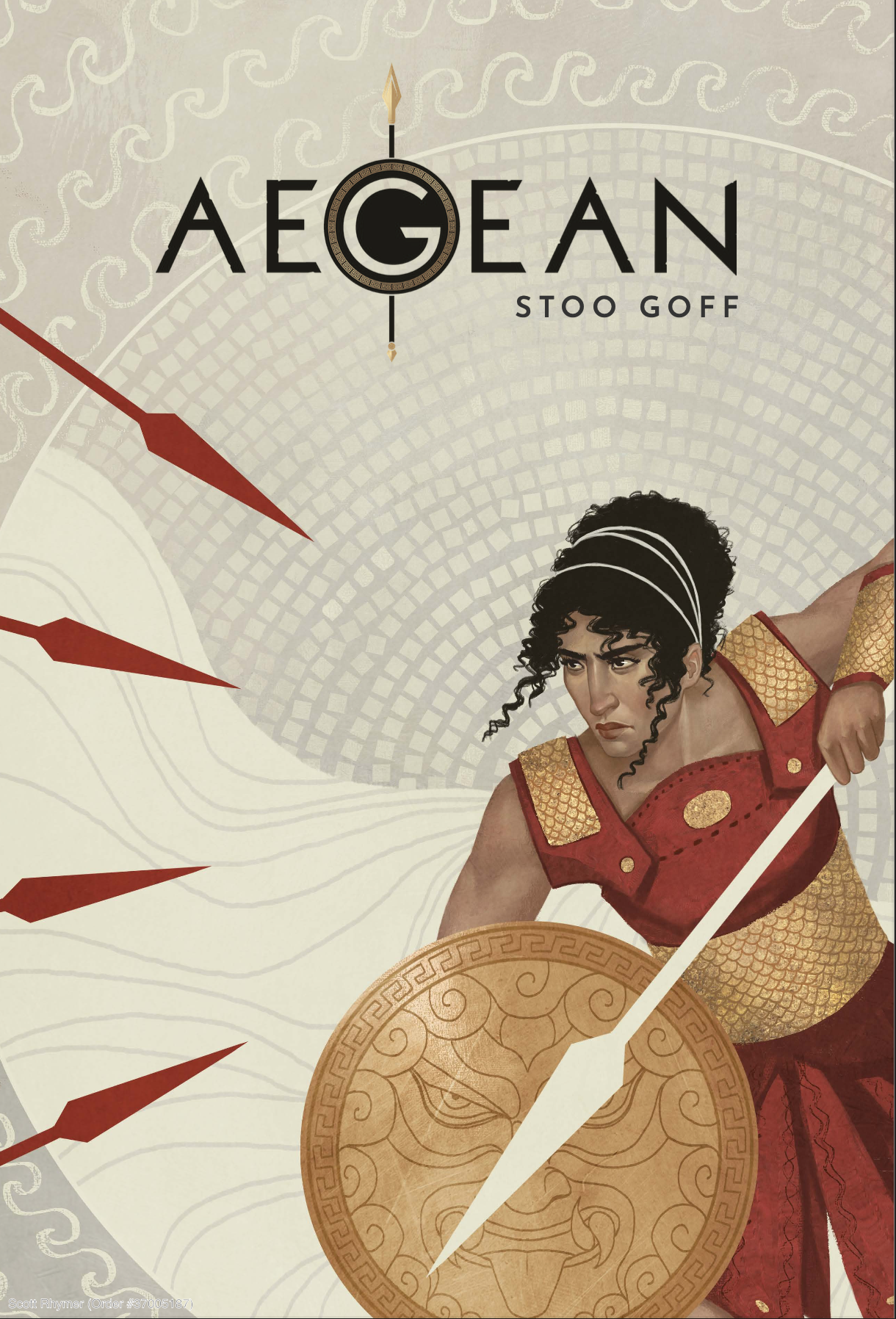
The first is the game I was playing with my daughter (and later the wife jumped in, as well): Aegean. This is a rules lite RPG set in ancient and mythic Greece. The players can be normal folks or demi-gods, and the there’s a couple of expansions that came along as stretch goals on the Kickstarter which ended way back in October of 2021, and which was supposed to be on backers’ doorsteps in Summer of 2022. Of course, between shutting the f***ing planet down and the attendant issues that caused, while the PDF has been in hand for a while, the printed materials (as of this writing) are still vaporware.
The system is simple — you have five attributes and fifteen of skills. To do something, add the appropriate skill and attribute and roll that number of ten-sided dice. Eights and above are successes, with 10 allowing you to activate a feat on your weapon, bank Resolve (their luck/story/hero point mechanic), give a success to a companion, or “invoke the fates”. It’s a pretty standard mechanic, especially for d6 games. It’s light, fast, and works. The character can embark on adventures from monster killing (a pretty common hero thing, even in Greek myth), to competing in contests at city games, to help to build up one’s polis — the city you are from. Players work together to create a basic polis and can get elected into the government.
Overall, the system is tight, there’s enough material to work with, and fans of the myths should be able to craft story arcs with ease. The production values, based off of the PDFs is very simple. Layouts are single column, block paragraph with easy to read typefaces. Art is at a minimum in the core book and teh follow-on Book of Heroes and Book of Empire — which I still haven’t had a chance to look through, as they came in which we were kicking the tires on other games systems at the time.
Aegean can still be pre-ordered at Kickstarter, and at DriveThruRPG. I should have gone with the print-on-demand version; proof for the print version were only spotted in April, so I’m expecting this to take another few months to see.
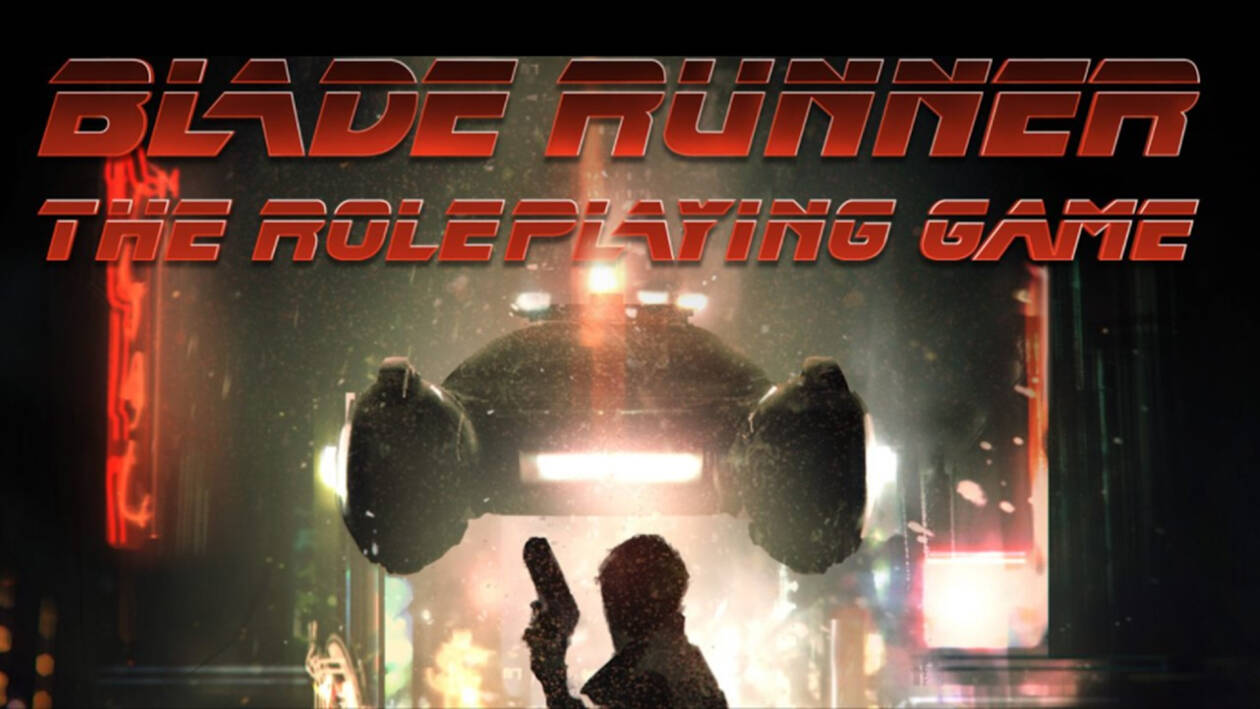
The other “first” for the game group was Free League’s Blade Runner. I love police procedurals and espionage adventures. Always did. Hell, they directed me into my former field of endeavor, before I got into teaching. Set in the rain-soaked, neon-lit, dystopian future of the movies, the game has the characters playing the eponymous police assassins. You can play a human or a replicant. I promptly ignored the need to be Rep-Detect and several of the characters are in other divisions of LAPD: a Robbery-Homicide detective (who caught the murder that started our campaign), a Special Investigations Service detective (they’ve got an…interesting history), and a pair of Blade Runners — an older experienced one with a dark secret, and a new Nexus 9.
The system is the Mutant Year Zero system, well the “2.0 version” I guess you might call it. Rather than rolling all d6s, the the characters roll between a d4 (really a d6 is the lowest for characters) up to a d12 depending on their attribute and their skill. A 6 or higher is a success, and a 10 or higher is a double success. (That sounds familiar…doesn’t it?) After having played Alien, where a wheelbarrow of die could seemingly not get you a success, this version of the MY0 engine (and which also powers Twilight:2000) seems to guarantee more consistent results for higher levels. It good enough I’ve been considering converting Alien over to the newer version — something Free League should seriously consider.
I’ve been enamored with the admitted-awful future of Blade Runner since I sat as a teen in the theater and watched it opening night. It still is a draw and I will admit this is the most I’ve enjoyed running a game since my five-year long epic Battlestar Galactica game ended.
Both games are good and worth a look. Aegean will set you back $25 on DriveThruRPG, Blade Runner more than that from Free League.
You see the memes on social media, you’ve heard the jokes about how — to be true to the experience of the game Dungeons & Dragons: Honor Among Theives should have ended about halfway through and the audience should have to wait through repeated re-schedulings to see the end. It’s funny. It’s also true.
Having been gaming for about 40 (man, I’m old!) years, one thing that has set my groups apart is that everyone usually commits to being there once a week. (Some groups, for a while, were meeting two to three times a week. We had no life.) That doesn’t mean that people canceled out for illness, or a special event, or what have you; but that the remainder of the group met to do something while that player was out. Sometimes it’s a board game night. Sometimes it’s movie night. Sometimes a cook-out or something social but not gaming. (Invite the significant others and family!)
So, I’ve been particularly lucky that this hobby has been a consistent and comforting norm throughout much of my life — even during my military service. International pandemic? Fuck that — it’s nerd night Thursday!
However, this summer has seen the steady encroachment of “other things” into nerd night. Work trips — unavoidable, yes; but there’s been a lot of them as every workplace seems to think they’ve got to “make up for time lost” wasting your time at conferences. Vacations — understandable. Vacationing over the last few years, unless you went to Florida (where the freedom is), was a bust. You want to make up for lost time. It got to the point where at least one of the group was out every single damned week of the summer.
We have a few techniques we use to get around the “X is gone this week” — someone else plays the missing person’s character if they are essential (or can’t just disappear for a time); the GM can run them although I’ve always found this can get tricky if the character gets killed (or you have to obviously fudge it); you can play a different game. We tend to rotate what we play on a semi-regular basis, so there’s usually a game and plot waiting where we can do a one-shot or add the missing player back in later.
Keep the momentum and the schedule going.
This is important for very simple human behavior reasons. Once something (or someone) slides out of a priority for a person, they tend to sideline it. As time goes on, it gets easier to replace that commitment with something or someone else novel. Eventually, you stop showing up. Friendships and hobbies, like any habit, survive on repetition. Break that chain and it’s harder and harder to weld it back together.
In our case, the last three to four months of vacation/work travel/illness has led to one of the core players — one that’s been consistent for 18 years (!) — to be out. A lot. The most recent call out is instructive. He’s off to GenCon last week, had work travel in the first week of August, but he was in this week…until a last minute call out to go to a concert. This is what I mean. Normally, it wouldn’t be a big deal, but after having screwed up the group and our scheduling most of the summer, this last minute call-out between call-outs is what I mean. It’s easier. Hey, come on, it’s no big deal; I’ve only canceled on you guys most of the summer.
And he’s right: it’s not a big deal. It’s a hobby, not a job…but it’s also friendships that have obviously become less important over time. The socializing outside of gaming for this one has been steadily on the decline to the point I still invite him and his significant other…but more to be polite. I know they’re not coming. (I’ve heard this a lot more from other friends talking about their interactions with their friends and families over the last three years. The global lockdowns destroyed a lot of people’s social lives.)
A few weeks before this last minute blow-off, I’d even asked if he wanted to quit or take a break (which is the same thing…) and was told “no, I’ve just been busy…” Well, we’re all busy. I work two jobs most of the year, am a parent with a spouse that needs attention, as well; and I have other friends and hobbies. I prioritize the game because I prioritize the people. I could go motorcycle or shoot with buddies. I could write more. I have a bunch of stuff to do, but I like my friends and this is our main (but not only) bond.
This is one of the reasons why game groups need to be friends. If you don’t see each other outside of the game — there’s really nothing there. Without that connection, things will inevitably draw a group apart. When you have that, the consistency flows; when you don’t…
I was writing the posts for RPGaDay this year in July, since inevitably I’m overtaken by events in August. It’s the start of the school year, so the day job kicks in, and the kiddo needs picked up and other school-related nonsense ensues. I’ll get a few poss in then not finish. No so this year; they’re all written and ready to drop.
One thing that struck me looking over it and a few of the RPGaDay posts from prior years is the remarkable consistency I’ve seen in certain related questions. My opinion of the “best game ever” or versions of that question always seems to go with the old James Bond:007 RPG or MWP’s Cortex. They’re different beasts: the former is a bit busy on the rules front, with levels of difficulty ranging across a wide spectrum, quality of roll ties into how well you do (which winds up being great for damage dealt), whereas Cortex is pretty lightweight, with just enough “crunch” for older-school gamers. Where both excel (Cortex moreso) was an attempt to use the uses to push roleplaying. For JB:007, it was the weaknesses system; for Cortex, the combination of abilities and weaknesses. As any first year English or film major should be able to tell you (if they graduated before about 2000), the weaknesses of a character is what makes them interesting. Supermen (and Marvelous women) are boring as dried shit. People who are flawed, weaker than their opponents but rise to the occasion, who fail but get back up — they’re the interesting ones.
I’ve noticed that I don’t mind complexity of rules when it’s necessary (JB:007), but despise it when it’s not (D&D and and to a certain extent Modiphius’ 2d20). I like simplicity, but sometimes games can get so minimalist that you lose something (Alien, by Free League and the three skills/attribute, which Broken Compass, a current favorite, also does. In the case of BC, however, TwoLittleMice seems to have realized this might have been a bit constrained and have gone to four skills per attributes. Madness!
I’m also hoping to find time to pump out reviews of Aegean, by Stoo Goff; Avatar Legends by Magpie Games, and Blacksad, based on the excellent noir anthropomorphic comics.
After a few weeks of ownership, here’s a few things to know going into owning a Moto Guzzi V7.
1 — It makes noises like it’s haunted:
When it’s sitting after a ride moaning like the ghost of whateverthehell Ebenezer Scrooge’s late partner was called**, don’t worry; the gas tank’s just a bit overpressurized because you filled it to the top or it’s really hot out. You can just open the gas cap (slowly!) or leave it and terrorize your family when they go into the garage.
2 — It’s really cold-blooded:
When you take off from a cold start and the thing lugs in first and second gear like there’s something wrong, again — fairly normal. Kinda like driving a Ferrari 365GTB — until it’s warmed up a few blocks down the line, it’s best to run a little tall in the gearing. I find a block or two running in the 3k+ on the tachometer and it wakes up. (Addendum: Some of this is the fueling. Apparently, GuzziTech has a widget that will enrich the mix and get rid of a lot of the low end lag. The bitchy shifting, however, is completely an issue with the transmission oil needing to get moved around. That takes a few blocks, then she’s fine. SCR)
3 — No, you don’t have the peg clearance you think you do:
I’ve scuffed hard parts on this thing since the first test ride. I had to take the angle feelers off the bottom of the driver pegs because they were ground to point and were catching on my bloody pants. Hell, I went into a tight turn a gear higher than I tought I was and scrapped the kickstand (which protected the nice chrome pipes. Dial your suspension up a few notches and butt scoot like a professional racer or you’re gonna hit things. A least on the V7. (Addendum: After riding the bike for a while, I realized a major part of the issue is the engine never sounds like it’s straining — even redlined. I tend to ride by sound and compared to my 2010 Thruxton and 2020 Enfield Interceptor, the V7 sounds like it’s barely working. On the mountain twisties that had me hit the damned kickstand while folded against the pipe I did a quick check of my speedo…I was a good 10 mph faster than I thought I was. It’s got plenty of clearance…I’m just riding it like a lunatic! SCR)
4 — You’ve got incredible range on the thing:
My gas reserve comes on at 3.8 gallons on a 5.5 gallon tank. That’s a bit overly cautious to my mind. I usually get about 190 miles on that 3.8 gallons. That makes for a total range of around 300 miles. That’s cars with shitty gas mileage ranges. (Addemdum: It’s been getting a steady 54mpg on the “summer” gas here in New Mexico, and 50mpg on the ethanol-heavy “winter” gas. SCR)
Speaking of gas…
5 — It’ll drink anything, but stick with higher octanes:
It’s run fine at 6000′ in altitude and 90F degree weather on 85 octane but a regular diet is probably not Italian enough for it. Stick with higher octanes.
6 — Yes, people are going to want to talk to you:
…but they’re all going to be old dudes talking about when they had that Monza back in the ’80s and such. Be prepared for a plethora of questions on how reliable it is. It seems ever biker that’s never owned one thinks they’re shit because some guy told them once…and ever Guzzi owner says they’re bulletproof, except for the one time (or two, or three) when something (usually electrical) happened.
Like the modern Royal Enfields, everyone is judging the new Guzzis by horror stories from back when, let’s face it, every bike kinda sucked except for Honda.
( **For those who aren’t literarily inclined, it’s Jacob Marley.)
So…I did a thing. I had test ridden the new V7 Special ( the “gray stripe” color, as the catalogue calls it, but it’s a deep midnight blue metallic flake) a few times over the past few weeks. After decades of waiting for a Guzzi dealer to hit Albuquerque, we’ve finally got one in the shape of Motopia New Mexico. i’ve wanted a Guzzi, and specifically the V7, for quite a while…but the test rides were good, but the bike wasn’t speaking to me like the Royal Enfield 650 Interceptor had. Each ride, I found the bike excellent in build quality, a bit clunky on the transmission, lacked the ground clearance of the Enfield, but had superb power delivery and once moving, the V7 is incredibly smooth. While at the shop looking into another issue and to let my 12 year old daughter drool over the Aprilia RS660, I noticed the V7 Special was gone. Yay! Temptation removed, I could settle in to figure out what was next in the odyssey of my hopped-up Interceptor. Except, it was out of a test ride with a buddy of mine who has a habit of buying the bikes I’m interested in before I can.
Yes, it’s a silly pissing match sort of thing, but seeing him ride up with his wife on the back, I suspected he was (to her chagrin) going to go for it. While they were dickering about inside, I got the sales manager working up a deal for me on the bike. I literally bought it out from under him.
Within a week, I’d hit the first service and got the valves checked and the fluids changed for a $350 hit. But now I have a better idea of how the bike behaves and how it’s likely to as it breaks in.
So first the good stuff. The deal had a 1.9% finance rate. That’s low right now, so if you’re thinking of one of these, it’s a good time. The machine is well made, although I could do without all the yellow inspection marks all over the thing. I understand this allows you to see if bolts are backing out, but I’m not flying a C-130 here. It does something Triumph doesn’t anymore — it has a friggin’ tool kit. So did the Enfield. Time for Triumph to step it up a bit. For the prices they’re charging they’re getting a bit Scottish with the stuff that some might don’t matter. Like a damned tool kit. Tires are a standard size — 150/70-17 like most Bonnevilles and 100/90-18 up front. It’ll be a breeze to get rubber for it. I already checked and my favorite shoes for the Thruxton are available for it. (The Shinko 712s. Trust me on this one.)
As suspected, for long rides, this machine is a dream. I did several 60 mile days, taking the bike up to the top of Sandia Crest, a climb of 4000ish feet over 13 miles with 120 turns in about 15 minutes. That’s a bit slow for me when there’s no traffic; the ground clearance on the pegs was such that i was scrapping pegs on every damned turn until I had to start doing the racer-style butt scoot on the saddle to stop it. An adjustment to the rear shocks — it was on the lowest setting so I bumped it one and that sorted it out except for some of the turns with negative cambers. It did stiffen the ride a bit, so it’s not as plush, but the bike is handling very well. I went for a long haul with some friends on sport bikes who promptly went for triple digits on their machines. I stuck to a reasonable (for New Mexico) 85mph for most of the first half of the ride. The Guzzi soaked up all but the worst bumps, and even managed to negotiate a surprise 35mph turn that they really meant 35mph. I was well over that and the V7 went through the turn without murdering me. (Butt scooting to the rescue!)
While stopped for lunch in a small town called Mountainair, we had an interesting encounter with the locals. A grandma in with her family for lunch followed the female rider we were with out to enthuse over the bikes, how she was a rider, and begging to get taken on a ride. The other guys were hoping to ignore her ’til we went away, but what the hell. Being nice to someone isn’t that much of an imposition. The shit that happens to you on a bike…
So I ran her around Mountainair for about 10 minutes. Hitting 70mph on the highway with no issues. The bike ride well with someone on pillion: it turns agreeably, stays very stable, and the passenger had plenty of room to handle acceleration. (No — she didn’t want a helmet.) I normally avoid passengers; the Guzzi is built for it. After Mountainair and my close encounter, we headed back to the city. It was about 100ºF and we were getting cooked, so we were moving at about 90 the whole way. No issues at all. The V7 is ready, eager even, to reach for the redline at 6500rpm. (It’s doing about 115 at that point). Vibration was at a minimum for the ride, saddle comfort was good enough I wasn’t tired or sore after about 3 hours in the seat plus lunch time. Over the course of the run, the motor felt like it really smoothed out in the 3000-3500rpm range, where it had been buzzy for the first 300 miles or so. Other reviewers have mentioned this and it seems to be a function of the bike needing to be run in some. After the oil change, the motor has been much smoother, shifting is better but still has a pretty audible clunk when up shifting. I suspect that will also get better over time.
The ranges and fuel mileage were a bit up and down during the first 600 miles. The bike was telling me I was getting 55-56mpg, but when I would fuel up, it was closer to 50mpg. (The Mountainair run was done at pretty high speeds, so that made sense.) Since the oil change, the fuel mileage is up dramatically — about what the bike has been claiming. I have noted that the low fuel light comes on at about 3.7 gallons, leaving about 1.8 gallons in reserve. That’s a hell of a reserve. The light comes on around 175 miles on the tank, although since the oil change I’ve put 195 miles on it and the light has not lit up as of this writing. I expect it should hit about 200 miles. So conservatively, the 5.5 gallon tank has 250 or so miles in it. That is exceptional and would allow for touring even in spots where gas stations get kinda think in the American Southwest.
Brakes are adequate. They’re a Brembo 4-pot on the front (only one side…) and a Brembo two-pot on the back. They work, and the rear quite well for slow speed on dirt, and the front feels good and aren’t too abrupt, but they’re not award winning. Fortunately, the engine braking on the motor with the shaft drive is very good. The suspension, once ticked up a step got much more firm and the handling — which is good and very neutral — improved.
Since the first service, I have seen an improvement in gas mileage and overall smoothness in operation. The gearbox appears to be a little more pliant, but it’s not the light and smooth flick of the Enfield or a modern Triumph. The motor is still characterful. It’s really hard to describe it; I imagine it’s feels a lot like an classic motorcycle. The mirrors are ugly but they work. There’s nasty DOT mandated stickers on the tank and the steering bridge that are on there. I found brushing the stickers with warm water and diskwashing detergent soaks and weakens them, and they come up easily with a softer object to scrape them up. I keep my fingernails short so I used a tire valve cap and lightly scraped them off with no damage to the finish. I’ve no idea how to get the yellow inspection marks off. They appear to be paint, not grease pencil. might try a light WD-40 rub. The beefy-looking transverse twin looks old-school and it is a breeze to get to almost everything. If you do you’re own maintenance, this is probably a good choice.
The down sides: I find it weird that a boutique-ish brand of bike doesn’t engage in branded gear, but outside of stuff for the V85 “adventure” bikes, there’s not much in the way of things like riding jackets, tee-shirts, nor is the accessory catalogue impressive: not much in the way of flyscreens, or aftermarket mirrors and pipes. They’re out there, but you have to hunt a bit. Agostini does pipes for the V7 including a nice shorty exhaust that would allow you to get into the wheel easier when servicing it. BAAK does a nice side cover replacement with small leather bags that are big enough for a hat and sunglasses, or the tool kit, if you don’t want to put it under the seat. I’m new to the Guzzisti thing, so I might just not be looking in the right places.
The V7 Special was an impulse buy, and a tough decision, surprisingly. I’ve wanted one for as long as I’ve been riding, and I’ve tried a few — the V7 750, the excellent Griso — but with the “two bikes to the garage” rule I’ve agreed to, it was lose by beloved 2010 Triumph Thruxton or the superb Enfield Interceptor to gain the Guzzi. Even after I’d dropped off the Enfield, I wasn’t sure I’d made the right choice…pretty much until the last day or two. The V7 Special is an excellent machine — well made, superbly comfortable, with a bit of tweaking on the suspension capable of getting a bit of the hooligan, and the range is phenomenal. Paint quality is exceptionally high — possibly the best I’ve seen on a motorcycle. It’s not the fastest thing out there, but it’ll crack the ton with gusto and it gets there plenty fast.
Overall, it feels a lot like a nicer, quirkier…well, Italian, Bonneville. It’s got 65hp and 54 ft-lbs. of torque that is channeled very quickly with the shaft drive and compared to the Bonneville 900s’ 60hp and 55 ft-lbs., they’re pretty evenly matched, though the power comes on lower in the rev range with the Guzzi. Having traded my Street Twin for the stock Enfield because the Indian-made bike was lighter, more maneuverable, and faster (both with acceleration and top speed), I suspect the Guzzi, which is about as fast off the line as the souped-up Interceptor but a bit slower on the top end will hang with but most likely pull away from a the Triumph Bonnies in a straight-up race.
So…is the V7 Special worth it? Hell, yes — especially if you can get it for the MSRP or close. The new Street Twin is MSRP $9900 (so assume $12ish out the door in the US) and the Guzzi is $8950 — a grand less for a nicer, faster bike from a more exclusive manufacturer. That said… the 650 Interceptor is a tight match for both those machines and comes in at $6149. If you’re a bit tight on cash and looking for a classic standard motorcycle, the Enfield is really hard to beat, but the Guzzi pulls it off with an undefinable style and “character” to the motor.
I love my Apple MacBook Air with the M1 chip. It is easily the best laptop I’ve owned…until today. The M1 Air is still one of the faster small laptops you can get. It’s light, there’s no fans to distract, and it will go all day long. The screen is good and sound as well. The downside to all of this thin, light beauty: you get exactly two Thunderbolt ports, and tough s#!t if you want more. You have to buy an external dock to get USB or HDMI or SDXC card support For the most part, that’s not an issue, but I use the laptop at my workplace (a high school) and sometimes I want to show a movie or pull something up that isn’t on the Google crapps that we use at the school. Oh, gee — I forgot the dock, so no HDMI connection. It’s a small thing, but it was enough that when i realized my gear was three years old it might be time to upgrade. (It’s not really necessary, that Air is still plenty fast and has plenty of battery life.)
Enter the MacBook Pro 14″. I looked at the new Airs and they’re nice but not enough to get me off the old 13″ Air. The Pros, on the other hand had three things to attract: the standard machine had twice the SSD (512 GB) and RAM (16 GB), it had an HDMI and SDXC card port, two Thunderbolt ports that honestly should have been left out for a USB port, but the big one — the MagSafe power cable. This was a great thing in the old Intel MacBooks and getting rid of it (and I understand the power and data thing of Thunderbolt — yes, it’s good) was a mistake, as anyone who trips over their cord and pulls their $1000 machine off a table or desk and attest to.
Performance: It’s fast. I transferred the whole of my old Air in under 40 minutes using the Thunderbolt cable. Audio and video playback is fast and smooth, even over the internet. The M2 Pro chip is supposed to have a 10-core CPU and 16 core GPU with a 16 core Neural Engine — that’s for the spec-happy folks. For those that don’t do the technospeak: it’s really, really fast for most things. I did a couple of quick page layouts and mock-ups through Adobe and had no slow down. A bunch of open tabs in Safari and a couple of open documents in Pages, and running a movie — no slow down. It’s good.
It’s got the new WiFi6, but my network doesn’t; when you fire up a new MacBook Pro, you might have issues connecting where it shows you are online in the icon in the top bar, but keep getting a “you’re not connected to the internet” warning. Apparently, it doesn’t figure this out on its own. It can run up to two external displays, plays Video in HDR, ProRes and Dolby; the sound is great and will do Dolby Plus. The trackpad is quick and responsive, the keyboard is quiet and on par with the old Air for comfort and response. I did find the higher front end took some getting used to, but I do seem to type better.
Other than the annoying bezel cut on the top of the screen for the 1080p Facetime camera, the screen is big and bright. The colors are amazing — I pulled up the 2008 Speed Racer to get an idea of how it handled color and wow! does it do color. (Apple’s claiming a billion colors.) It’s a Liquid Retina XDR display with 3024-by-1964 resolution, and a claimed peak 1600 nits brightness in HDR. Sound is good and delivered by two speakers on either side of the keyboard. I think this is where the M2 Pro really shines.
The size isn’t radically larger than the Air — about the same thickness as the back edge of the Air, but all over; it doesn’t taper at 0.6 inches. The width is a good half inch or so wider at 12.3″, and it’s a bit deeper at 8.7 inches. It weighs in at a claimed 3.5 pounds — about a half pound more than the Air. I carry my laptop to work and back on a motorcycle most days; I like light. This is noticeably heavier. It’s not some POS HP laptop my workplace would saddle me with, however. With the dock, power cables and other stuff i would carry with the Air, it probably came out to about the same weight.
So, is it worth it? On the fence on this one. I like having the HDMI and SDXC access — I use it. The lack of USB is disappointing. The rest of the machine is fantastic, but compared to the excellent MacBook Air 13″ with the M1 chip — is it twice the machine for twice the cost? No. It’s a great laptop, no doubt, but I think Apple’s pricing is a bit…enthusiastic. If you’re looking for a workaday computer — grab an M1 MacBook Air; if you need something with a bit of firepower, however, and between desktop publishing and other data-pushing I do, the Pro is probably a better choice.
(Update: I’ve had the MacBook Pro for a few days now and the experience has been steadily better. The annoying bezel for the camera tends to fade into the background if you are concentrating on your work, but man — it’s ugly. And on a laptop this good-looking that stands out. I’ve dragged it around with me on the motorcycle and it’s not noticeably more heavy than the Air was. The battery life is excellent, but Zoom meetings eat! the battery. I was losing 10% of the battery per hour while teaching an online class, although the students did comment that the camera was giving a much better picture…I’m not sure that was a good thing for the poor wretches to see. Watching movies, working on the internet and in Pages and Adobe eat the power at a much more reasonable speed. I’m down about 10% over two hours or so of work, so the claimed 18 hour battery time seems about right. The Magsafe power box loaded up the battery from 20% to full in about an hour and a half. That means the quick charge and the battery life are about on par with the MacBook Air, which seems reasonable, even with the increase in computational firepower. I still think it’s about $300 too expensive, but it’s a good machine.)
I had to bow out of this last year due to the school year schedule and other issues, but Black Campbell will take part this year (by writing all of the posts this month and scheduling them for next month.
After a two year hiatus to recover from shenanigans at my day job, COVID nonsense, and the other assorted issues, including serious burnout, we will be starting to release new material by the end of the year for Ubiquity, but also system-agnostic adventures.