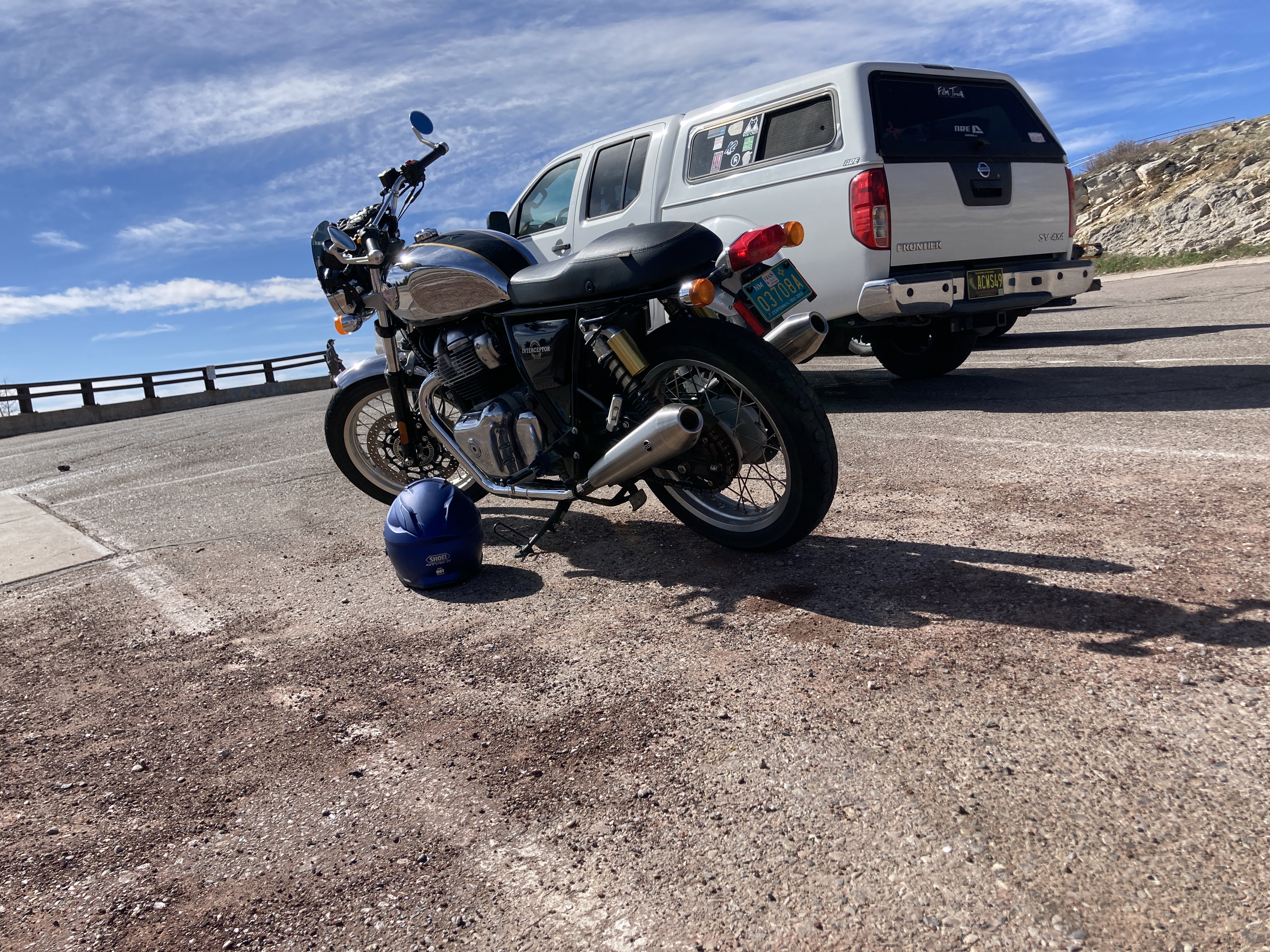
I’ve wanted a Guzzi for over a decade. I loved the look of the transverse twin motor, I like the idea of shaft drive (as I am terrible at keeping up with chain maintenance…), they were on par with Triumph for pricing (when Triumphs were on the cheap side; now they’re usually cheaper) and there just weren’t a lot of them around. That’s partly because their dealer network is kind of sparse in the United States, so getting warranty work is tough, and because the support for the dealer by Piaggio Group is — unimpressive. So, I wanted one, but didn’t want the hassle of trying to find someone to work on them.

This changed a few months ago when out excellent local Triumph/Royal Enfield dealer here in Albuquerque — Motopia New Mexico — picked up Aprilia and Moto Guzzi. Already a few people I know have picked up the V85TTs and V1000 Mandellos, but for me, the V7 is Moto Guzzi. I got a chance to take one out this morning and it’s time for a first impression review. I’m going to compare the V7 to the bikes that are it’s competition — the Royal Enfield 650 Interceptor (and more specifically my hopped up 650) and the new Bonneville 900cc (and my old 2010 Thruxton).

LOOKS AND BUILD QUALITY

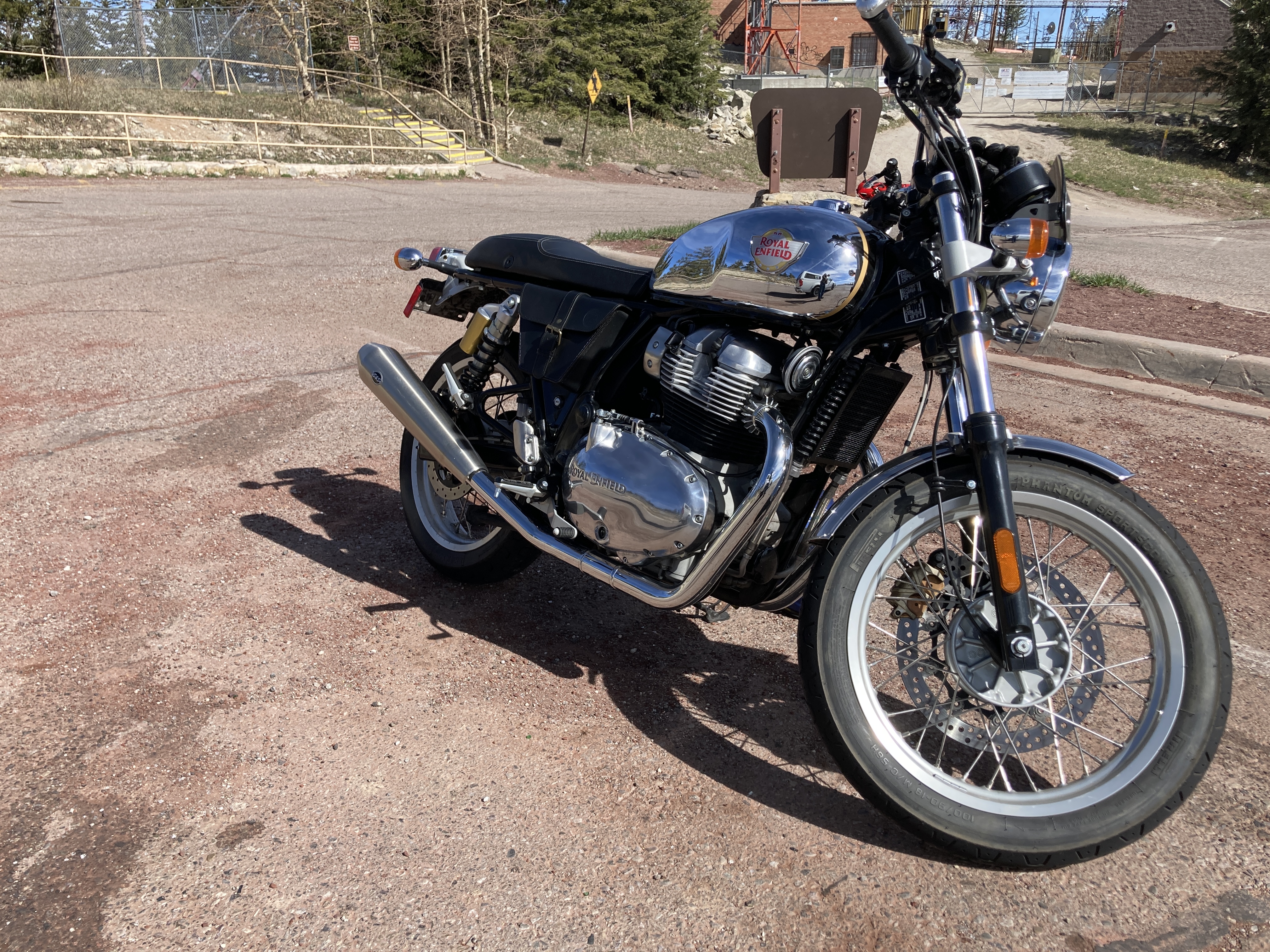
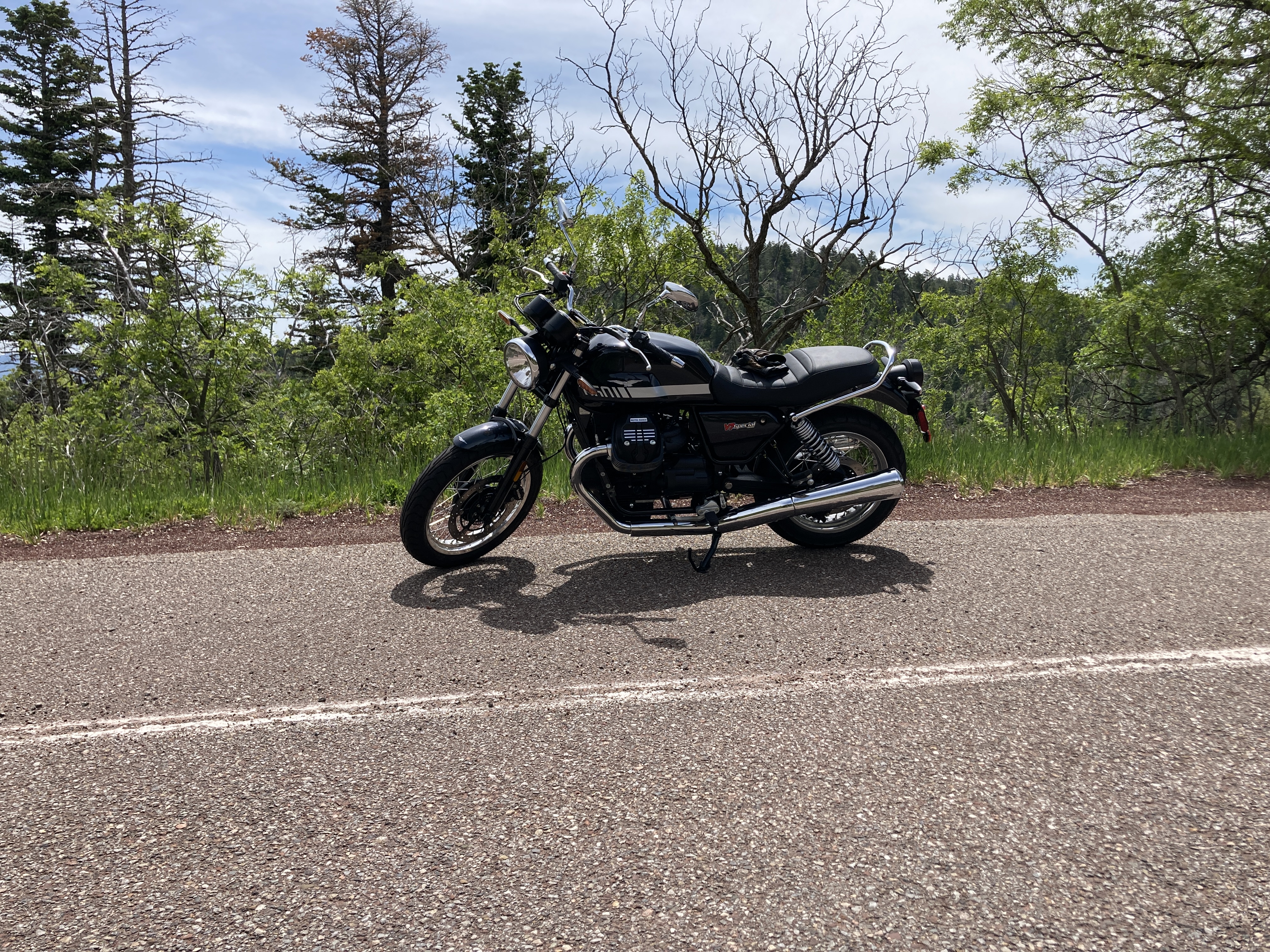
Just look at it — it’s gorgeous. The chrome and paint quality are top-notch, it’s got the dual clocks for the speedo and tach. The build quality of the welds, the frame coating, everything — it’s on par with anyone else out there now, and the paint quality is probably better than most. The spoked wheels and chrome exhaust set this off beautifully, but for the more modern-oriented rides, the matte black V7 Stone has mag wheels and everything is blacked out with LED lights all around. (For some reason, Guzzi kept a traditional bulb in the headlamp for the Speciale.) The saddle has a nice stitched Moto Guzzi on the back. The twin heads of the motor sticking out the sides is way cool.

Compared to the new Bonnevilles, it’s comparable (although I think cooler looking), and compared to the Interceptor, it’s a definite step above. The Enfields are well made, but the 650’s still look a bit old-school beside the V7 (or even the new 350s Enfield is turning out.)

It also sounds good with the stock pipes. It purrs and at higher rpm growls, but it’s never loud or obnoxious.

RIDE QUALITY

The suspension on the Guzzi is plush. During my ride, I did twelve miles on a pretty crappy, grooved concrete, section of I-40 that makes most bikes I’ve ridden jump around and get a bit niggly on the front end. The Enfield on the same section, ridden right after the Guzzi, was feeling every bump, nook, rut, and was letting me know. The Guzzi glided over it. It’s better than the Triumph — new, and definitely my old Thruxton (which I’ve done all day rides on), and much better than the Enfield.

The saddle is wonderful. It does demand you improve your posture, you heathen; slumping was gettign me right in the tail bone, but when I sat up, it became an all-day saddle. The bend in my knees (I’m 5’8″ish) was perfect, feet on the pegs at the arch, just a little bent forward to reach bars, with my arms relaxed. I could easily see touring about on the V7. In comparison, the T100 Bonneville is comfortable in just about any position — I think with the Bonnies, the seat’s a tie. Even with the touring saddle, it’s loads better than the Enfield. Compared to Thruxton’s bench-like seat, or the MK Design brat saddle I have so I can have a matching chrome seat cowl..? It’s luxurious.

The V7 also sits a bit lower than the Bonneville and is a good inch shorter than the Interceptor. Coming to a stop in town, you can plant your foot without issue. For the shorter rider, this would be a welcome thing.
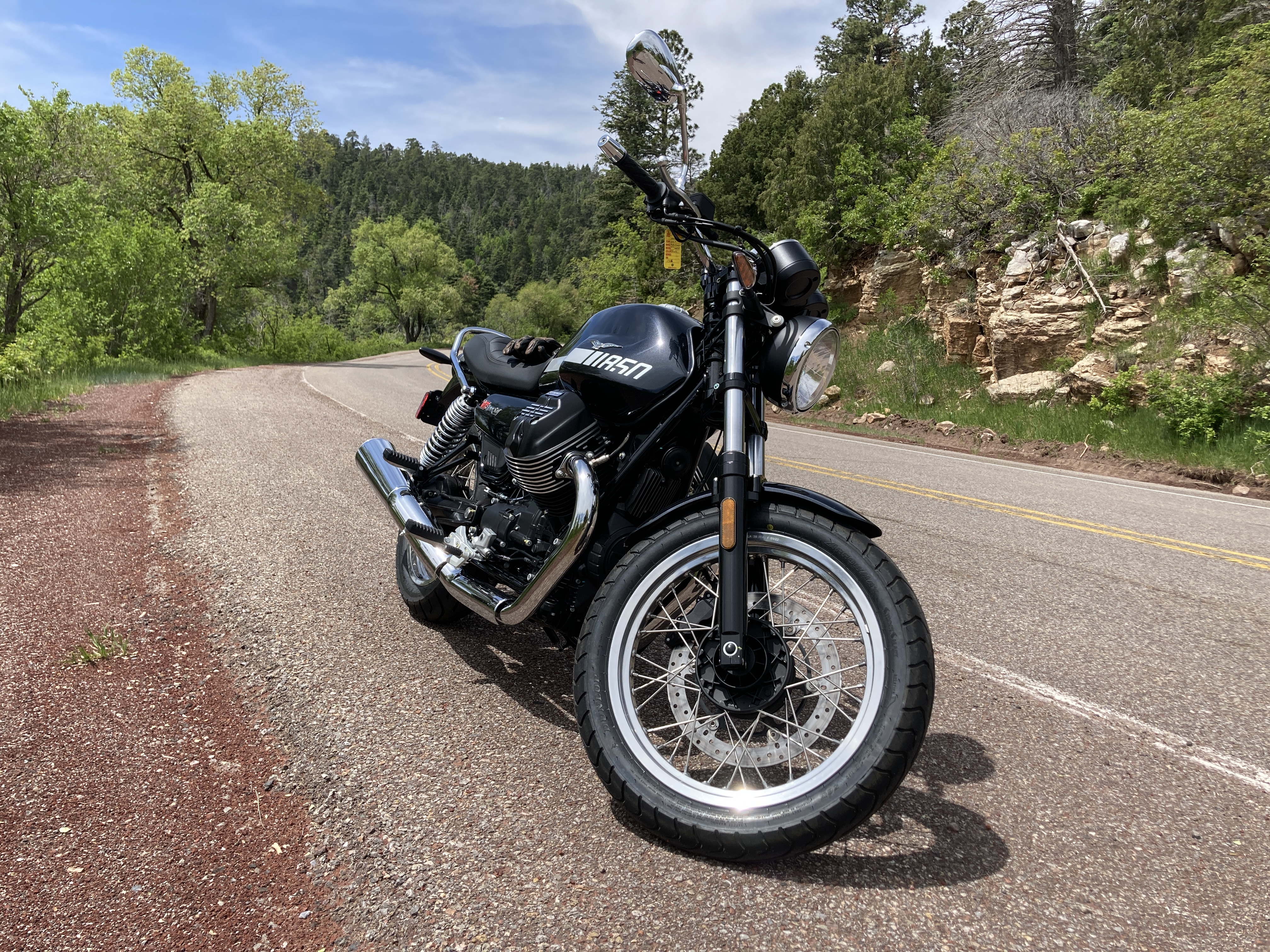
POWER DELIVERY

If you’re a sportbike guy/gal, the numbers on this thing aren’t going to impress: 65hp near the redline and 53 ft/lbs of torque around 5k on the tachometer. That’s a bit less than the 900cc water-cooled Bonnevilles and about on par with my older Thruxton. Compared to a stock Interceptor, it’s a rocket — the Enfield normally turns out 48hp and 30ish ft/lbs of torque near the top end, but the gearing on the Indian-made bikes is fantastic, so these things scoot much faster off the line than your would expect and most can hit about 115mph under perfect conditions. My Interceptor has had a high-performance cam and domed high-compression pistons fitted and the tune has pulled her up to a sea level performance of about 62hp and 44 ft/lbs of torque, and it comes on hard about 3000 rpm.

I hit I-40 from the same on ramp with both the V7 and my Interceptor. The V7 definitely got up and going in comparable time up to about 60mph, but was much faster to 85 after that. Both bike were running 85 mph and the V7 was turning about 5000 rpm — the same as the 650 (which has a redline 1000 rpm higher than the Guzzi.) Top end on the V7, running at just shy of the 6500 rpm was 110 mph. At 7000 rpm, the Enfield was moving at 115 and was working. The V7 never feels stressed; the power just stops about 6000 rpm.

The gearbox and clutch are on par with the modern Bonnies. The clutch pull is non-existent, and slightly better than the Enfield. It’s incomparably good compared to the older Thruxton. The bike slips through the gear with a slight clunk going down the gears, but you don’t feel it going up. I suspect this is however they have to transfer power to the shaft drive. It simply falls into 1st with a light push on the pedal. The Enfield, on the other hand, wins here. The gearing on the Interceptor is butter smooth, to the point where it’s easy to get lazy shifting gears and not give it enough of a kick to change.

The engine breaking with the shaft drive is crazy good. Drop a gear and let off the throttle, and you dump speed — from 80 to 60 mph in a blink of an eye. It’s really, really good. It also makes the butt of the bike dip, the exact opposite of what you would expect from a chain driven bike. It’s better than any of the other choices in this respect.
HANDLING

I had the V7 out for a little over an hour and rode 50 miles — in town traffic, highway, and some fairly tight twisties on the Sandia Crest Road. It puttered about the city with no issues. Changing lanes was as simple as shrugging my shoulders in the right direction. On the highway, it was similarly good. Carving the canyons, however, is where I started to run into the V7’s limits. I’ve ridden this road countless times with a number of different bikes, and on the first good long hard right hand turn, I ran into a slight issue. When you hit the throttle, the transverse twin wants to lean to the right…and it did. This lead me to scrape the pegs and my toe in a place I’ve never hit before. I got similarly close in a few of the other turns, nicking the toe of my boot where normally, I’d have clearance.

Could it do the turns? Yes…but you might want to do some body lean or butt sliding to keep her from listing over to far in a turn. The clearance simply isn’t there. Also, exiting a turn and romping on the throttle will bring you up out of a left turn quickly, but make you work in a right hand turn. It’s kinda like flying a Sopwith Camel, I suppose.

MAINTENANCE AND OWNERSHIP

The V7, like most Guzzis, has an enormous fuel tank: 5.5 gallons. A friend bought the V85TT and thought the gas gauge was broken, because it wasn’t showing gas — he was basically empty and still got 100 miles out of it before stopping for gas. According to the bike’s instrumentation, it was averaging 46mpg. That means a whopping 225 miles range, if you’re being conservative.

Speaking of the instrumentation: the Stone has a simple single LED gauge. The Special has a twin clock with an LED panel in the speedo for odometer, trip mileage and gear indicator (which doesn’t show when the odometer is up, but does on all other screens.) It’s controlled with a mode button on the throttle side — a weird place to put it and it feels like an afterthought. The rest of the switch gear is nice, but the mode lever feels chintzy.

Talking to a bunch of Guzzi owners over the years, the main complaint is usually electronics. The maintenance intervals are 10,000 km (or about 6000 miles), so on par with the Enfield and older Triumph, and a bit short compared to the new Bonnevilles. According to the boys at Motopia, the valve adjustments and other maintenance are easier and less shop time intensive, but it does run a funny oil — 10w60. Otherwise, the cost of ownership should be about on par with most other bikes.

SO IS IT WORTH IT?

The MSRP for the V7 Speciale is just over $9000, and figure your dealer is going to hit you for another $1500-2000 for tax, title, license, set-up, sunspot protection, hair loss prevention, and whatever else they can, so reasonably — $11k. I think that’s about $2000 too much, but compared to the other machines in this category, it’s on the cheaper side. Here, it beats the Triumphs by a grand or more. The Interceptor, which is not as refined on looks, but is otherwise just as good a bike, comes in at $6000. If you’re on a budget, you simply can’t beat the Enfield 650s. If you’re not — I think the V7 is an excellent value, with a motor that feels more alive and active than the Bonneville, and which has a better look and ride.
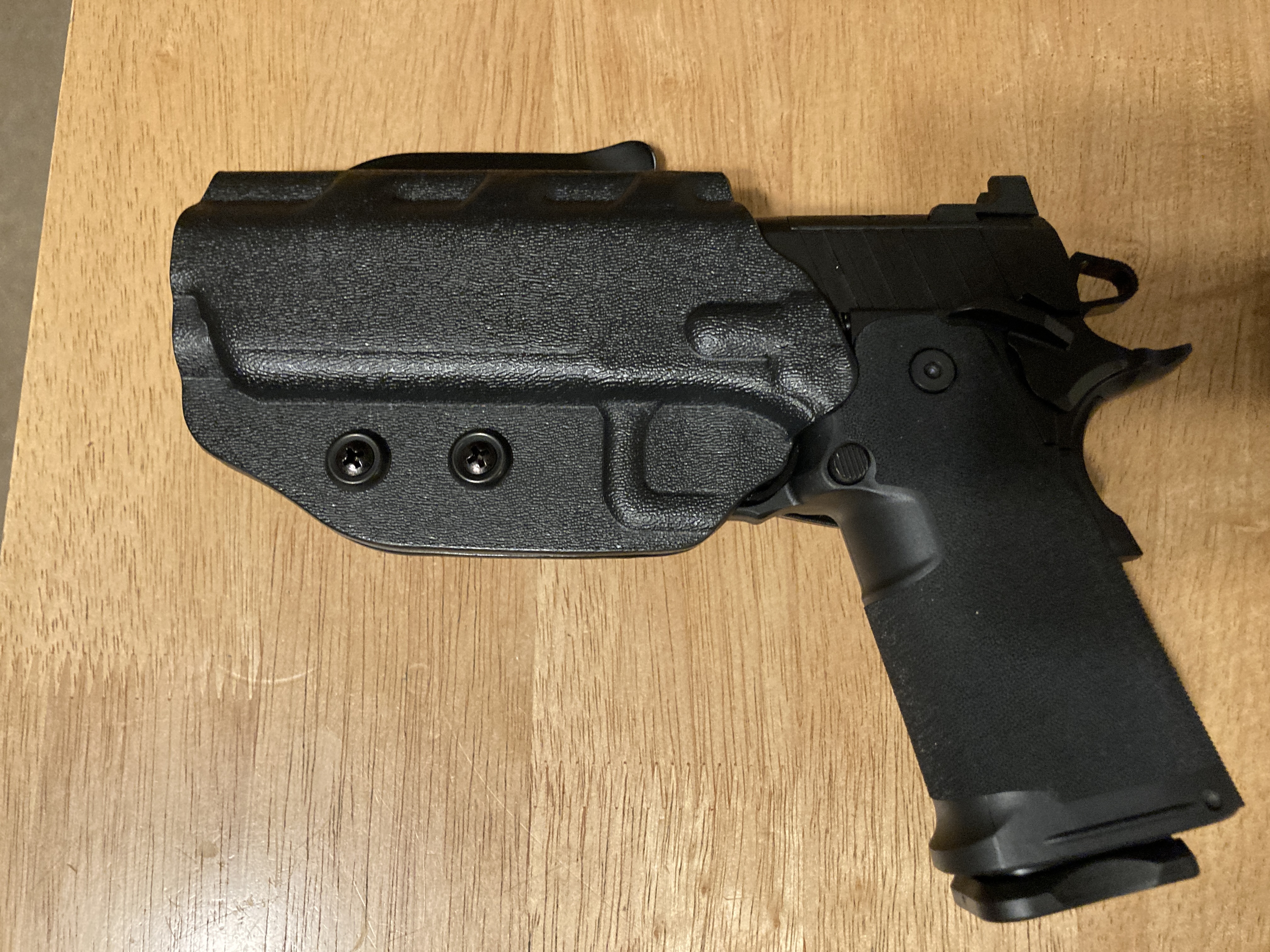
My trend of buying guns this past year concluded with one of the best purchases I’ve made in 30 some years of shooting. If I had to pick the “best” pistol I’ve owned prior to this, it would be a tie between the Fort Smith Walther PPK and my 1917-issued Webley MkVI revolver. I spotted one of these before they became a big thing in the gun mags (by about a week) in my local gun store and after playing with it, plunked down money I really didn’t want to spend. I like the idea of a double-stack 1911. I’d shot a friend’s Para-Ordinance back in the 1990s and it had run like a dream with little recoil and solid accuracy, but it was heavy. I’d been thinking of a Rock Island 10mm double stack for a while — it’s hard to beat that price and RAI 1911s have never given me an issue.

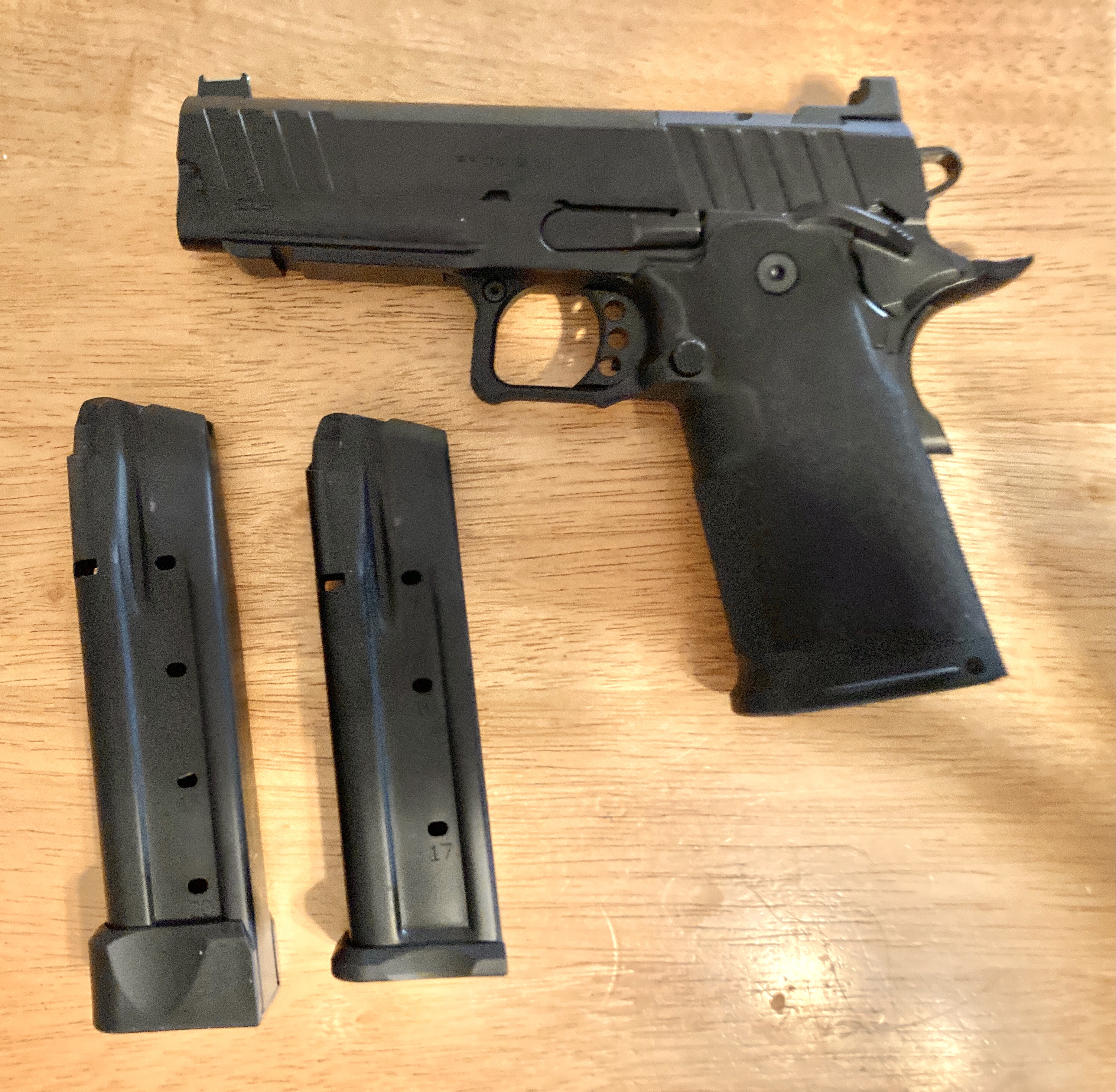
I bought the commander-length 4.25″ Prodigy and got it for a hair under MSRP, and mitigated some of the price with a trade. At $1400, it’s the most expensive pistol I’ve bought (though the Chiappa modified for 10mm gets close.) Fit and finish are great. It’s a nice deep black, silky-smooth Ceracote finished with minimal lettering on the slide — Springfield Armory on one side, Prodigy on the other; there’s also a DS on the frame near the nose. The pistol uses a unique method to cut the weight and make the pistol incredibly thin for a double-stack 1911 (or 2011, os there, STI!) The frame is steel, but the grip is polymer and shifts the weight, even when loaded, to the front of the pistol. It’s just a hair heavier than my SA-35 with 17 rounds in it.

The design makes for a very controllable handgun with muzzle flip practically eliminated. The trigger is better than most stock 1911s and was pretty damned close to the weight and smoothness of the Staccato P I shot a few months back. The trigger breaks at 5 lbs., with no take-up, and nice crisp wall, and a solid, audible reset you can feel. The Prodigy features an ambi-safety — a must for a 1911 with a upswept beavertail, if you are a leftie. I’ve shot enough 1911s that using my trigger finger to pop the magazine and hit the slide stop is second nature, but an ambi safety is a must. The magazines that came with it are a 17 and a 20-round each, but 26-round extended magazines let you compete or play at being John Wick. The pistol will use Staccato magazines, supposedly. The 17 round is “flush”, which is bullshit — it hangs a quarter inch or so belong the magwell. I wouldn’t mind a 15 round that’s actually flush and would make carrying the Prodigy a bit easier.

The trigger guard is squared and undercut near the magazine release, and there are no finger grooves (which I hate!). The grip texture is tremendous. It’s subtle yet really sticks to the hand or glove, without tearing your hand up. Springfield calls it the “adaptive grip texture” and they use it on the Hellcat. It’s simply the best grip texture I’ve held on a pistol. After over a thousand rounds, the grip screws have not backed out. I kind of want it on my Walther PPQ.

Another “big deal” is the slide is cut for an optic. I have not joined the red dot brigade. i understand why some like them, but I haven’t found them to be any faster than iron sights. Your mileage may vary. The cut and plate system was developed i with Agency Arms, and the Prodigy uses their Agency Optic System (AOS) plates. The AOS plates have an integrated rear sight for the best possible sight picture. Each pistol comes with one AOS plate and a cover that also includes an integrated rear sight. You can order sights for other systems from Springfield. The cover/rear sight managed to back out it’s screws a bit after 1000 rounds and needs a torx wrench to tighten…which the pistol doesn’t come with. It’s got the AOS plate and cover, it’s god the hex wrenches for the grip module and the spring guide rod, but not the cover. Boo, Springfield.

The sights! Mine has a green fiber-optic front and a U-notch rear. It’s very quick to pick up and shoot with accuracy. At 20 yards, unsupported, I was getting 2-3″ groups with no work at all. I found it really likes a 6 o’clock hold; I hit consistently a bit high with it, but when drawing and reflex shooting it’s drilling right where I want.

Central to the pistol is the bushingless bull barrel. The guide rod for the main spring is a two-piece, and after a few hundred rounds has a tendency to work its way a little loose. A swap to a single guide rod is probably a good idea. That’s my only real complaint with the pistol and a quick aftermarket fix. (Or I just thumb tighten the thing every once in a while.) The recoil spring feels a bit light to me, and apparently there have been a few issues with the 5″ version binding up a bit, but I’ve had zero malfunctions in 1000+ rounds put through this Prodigy. I suspect the 5″ guns ship with the Hex red dot and that probably slows the cycle and causes some issues.

I spent a couple of weeks shooting it side-by-side with the SA-35, which is a great shooting pistol. The Prodigy has less recoil and better accuracy (and didn’t have teething issues like the SA-35)…it’s just a superlative weapon for about half the price of a Staccato. Side-by-side with my Walther PPQ, one of the best shooting polymer 9mms with a superb trigger — the Prodigy is heavy, but it’s much more controllable and accurate.

If you’re coming away with the impression I like this weapon, you’re wrong. This is easily my favorite 9mm handgun. Better than my beloved PPQ or the equally good CZ P10C. Better than my long-time favorite, the CZ-85 or the SA-35. Better than the superb Kimber Camp Guard 1911 in 10mm. (Man! A 10mm Prodigy…please!) It’s good enough I’m willing to put up with the weight and carry it, if I’m not rocking the little PPK.

I was able to get a DeSantis Pegasus (the Cazzuto) kydex holster for it with no issues. It’s an excellent holster with a paddle that’s not too wide — as many are — and pretty minimalist. Tension screws adjust the tightness, but after jumping up and down with it on, the pistol stayed put. It is adjustable for cant. The cut is for a 5″ 1911, so I might have to dremel that down a bit, but the pistol rides well, with the weight firmly in the body of the holster, not at the grip where it can try to bend outwards, and though it pokes out a bit (see my comment on a real “flush” magazine), it conceals well under a coat.

Man, do I want one of these in 10mm.

In the box is the pistol, a zip bag with two allen wrenches and the optic plate (but not a torx wrench), a 17 and 20 round magazine, and the usual cloth Springfield pistol case that can carry the pistol and two extra magazines. There’s the usual paperwork and guide book, and the government-mandated trigger lock.

So is it worth it? $1400 is a lot of dosh to throw around, and it’s cost another $100 or so to pick up a few 17 round mags if you’re thinking of carry the Prodigy. If you are a competition shooting, it’s definitely worth a look, especially priced against it’s competition (with the exception of the double stack Rock Islands — don’t make that face; they work.) To carry? It’s more expensive, and a bit bigger and heavier than many (and probably better) choices like the Hellcat, Shield, Glock 19 or P10C, but it’s still smaller in the 4.25″ than a Glock 17. For a bedside gun, especially if you have old eyes and want a red dot? This is a damned good choice. It really comes down to budget. If you can afford a grand and a half for a pistol, and you want an excellent weapon, do it. If you’re budget driven, not so much.

Update: I’ve got about 1500 rounds through the Prodigy now and have had one failure to feed that was quickly clear with a mag drop, then a quick slap and rack. It’s still the most accurate pistol I own and I have been carrying it. It’s a hair smaller than the SA-35, about the same weight, and utterly reliable. As to my desire for a Prodigy in 10mm? Girsan is bringing out a Witness2311 — 4.25″ barrel, 15 rounds of 10mm in a polymer-grip double stack 1911. Yes, please.

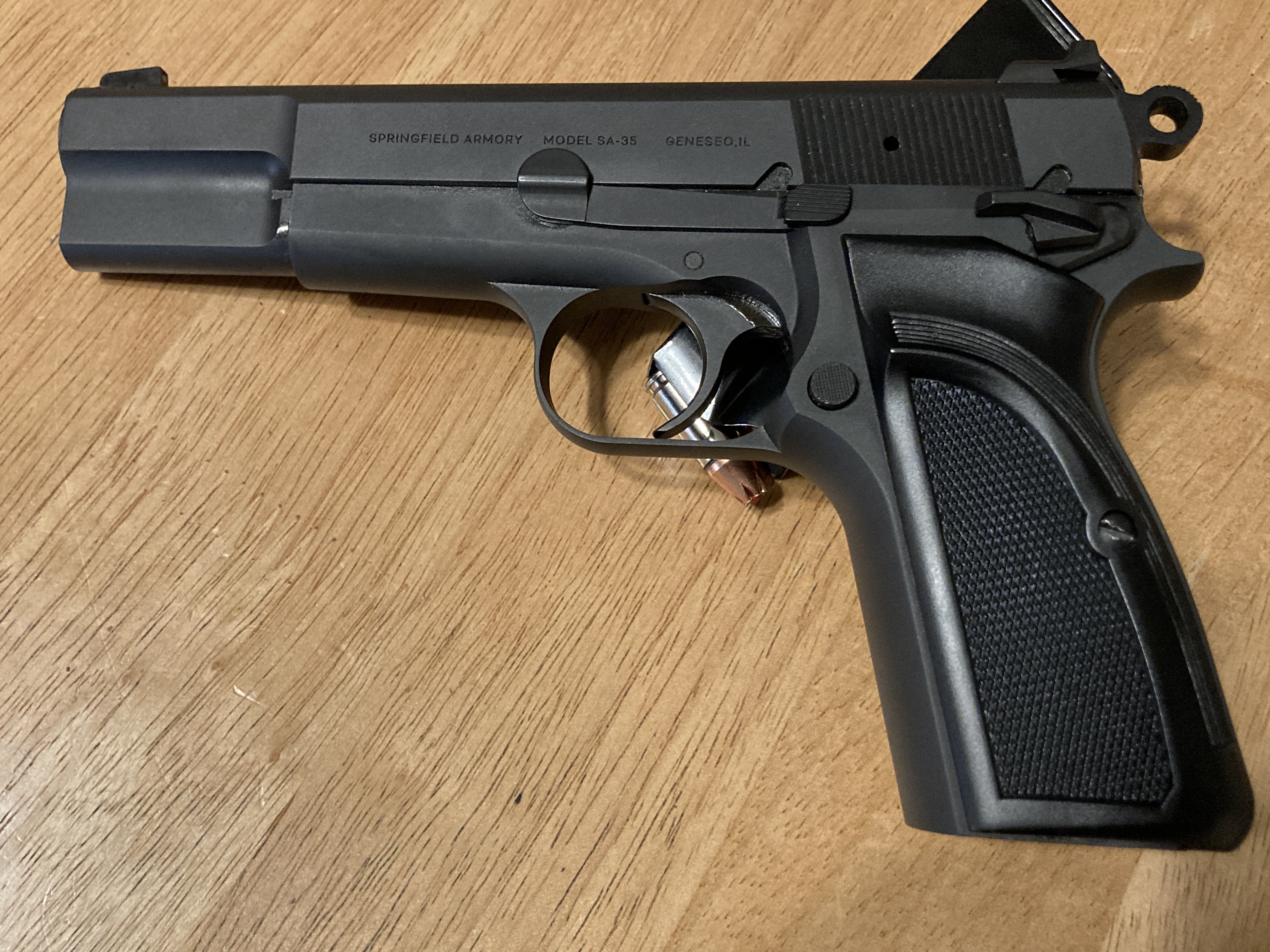
This past year, I made a couple of impulse buys when it came to weapons: a Kel-Tec KS7 and an RDB, a Walther WMP pistol, and the Springfield Armory SA-35, their copy of the venerable Browning Hi-Power. I did a review when I first had the pistol and at that point, it was headed back to the factory for warranty work. The pistol was returned in fairly quick time by Springfield, which — other than their propensity for not answering emails — did a sterling job with their customer service. After a few weeks, I had the SA-35 (which I continue to call “the Hi-Power” or occasionally “the Browning”) back in my grubby paws.

The warranty receipt seems to confirm a few of my suspicions: 1) they followed the Browning extractor design too closely, 2) they hadn’t nailed down the tooling for the same, and 3) there was some kind of head space issue that made extraction a problem. they had replaced the already replaced extractor, but had also cleaned and refinished the extractor channel. Most tellingly, and this seems to be a pretty standard thing from the online forums and the Facebook groups, they replaced the barrel. With it back, the main goal now was to beat the living hell out of it and see if it would fail. After a good cleaning, I took it out for a 350 round trip to the local outside range. No issues of any kind. Over the next few months, I poured about 1000 rounds through the SA-35 using every kind of ammo I could from the el-cheapo Blazer aluminum cased 115 grain to SIG-Sauer V-Crowns, Underwood Xtreme Penetrators in 115 gain to Norma range ammo in 124 grain and a box of 149 grain American Eagle.

The results: It ate just about everything without fail, save for the Blazer, which likes to stovepipe, but is clear with a quick swipe of the casing out of the port. One trip, it really didn’t like the American Gunner 115 grain XTP rounds and would fail to feed; another, no issues. Outside of that, no malfunctions. Overall, the failure rate was about 0.8%. One test this winter saw me toss the thing in the snow and mud and shoot it without issue. At that point, I decided it was reliable enough to get constitutionally “borne”, when I’m not carrying the newer Fort Smith Walther PPK (which has not failed — period.)

One thing I have noted is that the redesigned hammer that is supposed to stop hammer bite does nothing of the sort if you’re shooting the SA-35 with a high grip. I get whacked in the web of the hand consistently. I also find that the SA-35 shoots low and right (I’m a lefty) and really requires some work with the angle of eye to sight to get right…but weirdly, just drawing and reflex shooting: spot on. So I threw out the new school, thumbs-forward bullshit and started experimenting with different holds. After 30+ years of shooting for work and pleasure, I’ve found every type of pistol wants to be held differently. I started doing holster drills to see why I was true without aiming and with one-handed, but not with a “proper” grip. My hand, I found, was gripping with just a bit of space below the tang, every time.

The Hi-Power was designed when people were smaller, with smaller mits. They also shot one handed, for the most part, and this means you’re holding the pistol differently from how modern polymer and striker pistols want to be held. Shifting the grip just a hair lower, with the off-hand at a 4-5 o’clock position (again, leftie), the SA-35 was hitting true. To encourage the old-school grip, I ditched the nice walnut grips and got a set of the old plastic Browning grips with the sloped thumb ledge. The ledge not only gives your thumb a place to rest, but helped with the grip I found was working for me. It also makes it look a bit more “authentic”.

So — for a new review. The Springfield Armory SA-35 is an excellent knock-off of the Browning Hi-Power with a few features that make it easy to recommend, as later serial numbers seem to having fewer of the teething issues of the earlier models (mine is a 5000 range pistol.) The sights are good, with a front post featuring a white dot and a rear U-notch sight that is flat black. It’s very easy to get a sight picture and go. The elimination of the magazine safety is probably the most remarked change and it is an excellent one. The out-of-the-box trigger is about 5 lbs. and crisp with just a hair of take-up. It’s easily on part with most 1911s. After a grand through the pistol, the trigger is incredibly smooth with a reset that is barely audible. For those who are used to resets you can hear, this can be a bit of a pill; from time to time, I’ve gone to fire a second round and realized I hadn’t backed off the trigger enough. The grip angle, and the thinness of the grip is a plus for smaller hands. The interchangeability of parts with older Browning and aftermarket Hi-Powers is a definite advantage.

Takedown is the typical Hi-Power: Lock the slide with the safety, pop out the slide stop, take off the safety and ease the slide off, take out the spring and guide rod, then the barrel. Done. Reverse it to put it back together. After over a thousand rounds, the SA-35 is showing little wear in the slide/frame rails, a bit more on the top of the frame where the slide rides. It’s on par with most handguns with the number of shots through it.

The downsides: Possible issues with the extractor or barrel. There’s no texture on the front or back strap and bigger hands might find it squirrels a bit when banging away. Lefties — there’s no ambidextrous slide stop. And boo! to Springfield for not doing this. As with some of their 1911s, they don’t do an ambi safety and that’s just unacceptable, since other models have it. It’s a simple economy of scale thing: do it on all of the pistols and it’s cheaper. Brownings had an ambi safety, so this is a serious oversight to an otherwise excellent gun. I’m going to be throwing a set of ambis on sometime soon. In the box, you get a cloth pistol case, the pistol, the usual government-mandated junk, and only one magazine. Again — boo. The case is nice, though.

So is it worth it? If you had asked me after I bought it, I’d had erred on the side of “no.” Having gotten it and apparently sorted out, that changes to a firm “yes.” I got mine for the MSRP of $799 and the quality of the fit and finish is good, the excellent trigger and lack of magazine safety is a big draw, and the ack-compatibility with parts, equally so. If you want a high-capacity 9mm in the style of the 1911(ish) or a CZ without the DA/SA trigger, this is an excellent choice. For people with smaller hands, this would be an excellent choice over something like the Glock or XD series.

(The picture shows the Critical Defense ammo I’ve been using for carry. Mine loves it and has never given a malfunction on this or Critical Duty.)

One area that I found lacking in the otherwise magnificent Lex Arcana roleplaying game was mass combat. The characters, admittedly, play the equivalent of “secret agents” in an alternative Roman empire, but the military plays a central part in the politics and activities of the Empire. In our campaign, the characters have uncovered a plot by a group of Vandals and Othrogoths to cross the border in force as they are being pushed west by the other tribes behind them. Word has been sent to Rome to gain reinforcements for the imminent attack, but it’s now a waiting game. The next episode would have this force assault across the Danube on the castra at Submuntorium — the gateway to Augusta Vindelicorum and the both the main roads of Aurelia and Claudia Augusta.

It’s going to be a big fight, with 1700 Romans in the castra against a force of around 8,000 migrants with half of that fighting age men. The 4-1 odds are mitigated a bit by the need for the barbarians to cross the Danube, then get by the wall of the German Lines. There are siege engines in play — battering rams, catapults, and ballista — so a lot of moving pieces. I could have just pre-decided the results, but wanted the players, now in positions to aid the commander of the defensive force, to have some kind of impact. I needed rules of a light legion-scale fight.

My first pass was to make some lightweight rules that used the units as NPCs, but that seemed a clunky. I settled on using Lex Arcana‘s prolonged action rules to handle it.

MASS COMBAT AS A PROLONGED ACTION:

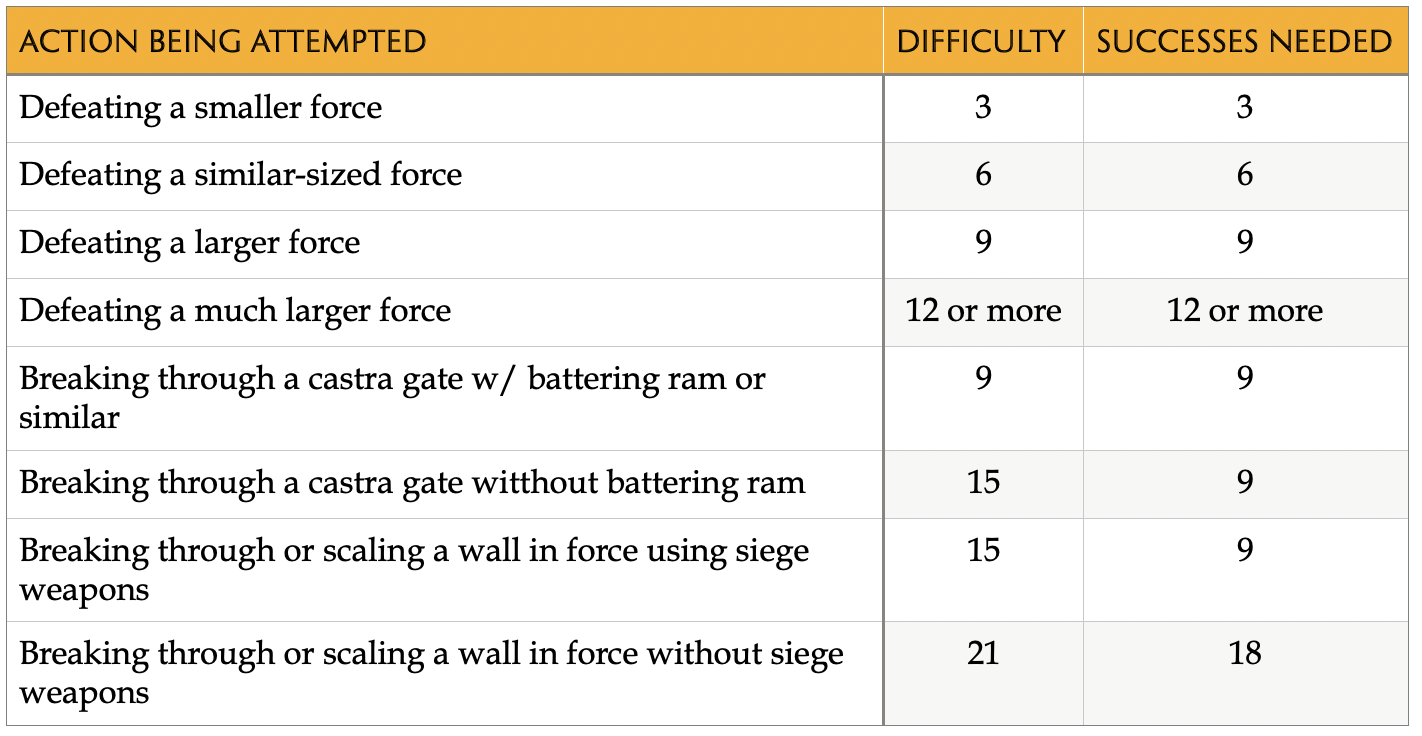
During a force on force event, both sides must roll for successes, with a total number of successes based on certain goals. Difficult for the tests is determined by a combination of the number of forces or the obstacle (castle walls or gates, etc.) that need to be overcome.

For the test, the leader of the particular unit — be it a contubernium or a legion, rolls the DE BELLO of the type of NPC found in the uint or it’s commander. For instance, a century of Roman soldiers would be represented by a Legionaire or a Centurion, as per the NPC examples in the rulebook. Characters can use their TACTICS or other skills that might be appropriate to aid in the roll because, well, they’re the heroes in the story. As always, a GM is encouraged to alter these to suit the tastes. For overcoming a castle wall or gate, a smaller unit might have a higher DT.

Ex. The 2nd Century of the II Audriatrix engages a turma of barbarian cavalry. Rome needs a DT3 on the unit’s DE BELLO and three successes to win the day. The barbarians need a DT9 and nine successes, but the GM decides the mobility and use of bows gives them an advantage and lowers the DT to 6. Both sides roll their DE BELLO with a specialty of Tactics for the centurion commanding the 2nd; the barbarian commander a 2d5 for his men. Both sides roll: the centurion is havimng an off-day, it seems, with a 5 result. He’s got a single success. The barbarian rolled a 9 — a success!

Both sides continue the engagement. This time, one of the player characters chooses to rally the troops with a command test on DE SOCIETATE of 12 — and between the centurion’s 7 and the PC’s they score a 14 — a complete success that will rout the remaining barbarian forces. The barbarian commander is on a lucky streak and got a 10, allowing him to reroll and add to the original score. He rolls a 3, giving him two successes. The Romans needed three successes and have four — the barbarian force is destroyed, utterly. The barbarians got a total of three successes, six short of what they needed. The day belongs to Rome.

How many people did the respective units lose? In the case of the barbarians, it was a complete disaster. They’re either all dead, or a few escaped according to what the plot needs. The Romans, hower, got hit hard on that last foray. So how many are injured or wounded? The GM could fudge this — a third of the unit (3 successes of nine needed) so 33 imjured or dead.

Another way would be to use the size of the unit attacking as a base. The turma — 30 barbarians — scored one and then four successes. Taking a tenth of their size (3) as the base, then multiplying it by their success (the first only just succeeded, so 3 injured; and the second foray gave them double the damage, 6 for a total of 9 dead. (In this case, I’d go with 9 dead and about 25 injured.)

It’s not perfect, but it squares with the existing rules of Lex Arcana.

I’ve been remiss in reviewing this.

I’m a 10mm fan. Have been since my first Glock 20 back in the ’90s. I’ve got a Kimber Camp Guard that’s superb, I’ve had a Tanfoglio Witness in 10mm that was a solid performer (and they used to be cheap, but no more…), and I’ve fired the Bren Ten and Colt Delta Elites. I’ve got a Aero Survival Rifle in 10mm. As said…a fan.

I was interested in Chiappa Rhino for a while. I like the idea of the six o’clock firing position — similar to the old Mateba revolver, but I wasn’t really looking for yet another caliber to have to buy. The 40DS (meaning 4″ barrel with double/single action) comes in 9mm, .38/.357 magnum, and .40…so was there a 10mm version? I queried Chiappa if they would do it, and got an unequivocal “no”…which is Italian for no.

Lo! and behold! however, there is a group that will modify the Chiappa Rhino .40 to 10mm. Aria Ballistics Engineering, Inc. out of Edgewood, Washington, will do this for you. They bore out the cylinder to accept the longer cartridge (and will do it to 10mm magnum), reharden the cylinder and frame, do a trigger job, and add a rubber grip. They can usually knock it out in a few weeks from when they get the revolver from you or Chiappa directly. I got lucky and they had a few they were working on so I didn’t have to pay the fee for the modification, but paid for the pistol straight off…for about the price the 40DS was online.

Yes, it’s a bit blurry… Size comparison with a full-size Kimber Camp Guard.

The stock Rhino has a great trigger, but the Aria 10mm lowered the trigger pull to 6 pounds in double action and just under 4 for single. The action is glass smooth, just like on a stock Chiappa, and strange due to the six o’clock firing position. The hammer isn’t the hammer; it’s a cocking lever. In single action, a little red pin pops up to let you know it’s ready. Decocking it is just like a revolver — pull and hold the cocking lever, then ease it down. The stock handle has a weird angle and feel, but it aims true.

The downside: You need moon clips for the .40S&W and 10mm. Chiappa sells a 10 pack for a reasonable price. It’s good for reloading quickly, but you can’t just drop rounds in.

The sights needed a bit of tweaking for height, but the rear is fully adjustable for windage and height, and the front is a bright fibre-optic. There’s a Piccatinny rail on the underside of the barrel for a light. In .40 Smith & Wesson, the Rhino has a stout recoil with zero muzzle flip. You get all the recoil inpulse in the thumb joint. That said, six rounds of double action rapid fired gave me a 3″ group at 15 yards. Now, in 10mm..? It hurts. All the recoil hits the thumb joint hard, but it’s accurate with a bit of work out to 100 yards.

With over a thousand rounds of .40S&W and 10mm combined through it, I’ve only had one issue — aluminum case Blazer will jam up the Rhino. The cases expand and bind up on the breech face.

So, is it worth it? A Chiappa online looks to go for about $1200. That’s about on par with the new Colts coming out (which are beautiful, by the way). In .40, the Rhino hits hard enough for most applications. With the Aria modifications, the 10mm is an excellent choice for the back country, but you could more easily go with the .357 magnum version. For me it’s definitely worth it; your mileage may vary.

As per the last post on the Kel-Tec RDB, I’ve gone bullpup stupid this summer. Prior to picking up the RDB, I got a good price on a KS7 12 gauge shotgun by Kel-Tec that was in my local gun store. I’m not really a longarm guy and shotguns are some of my least favorite…so why buy it? Honestly? It looked really cool, like something out of a sci-fi movie. IT would fit well in the Aliens universe with the weird carrying handle. With a total length of 26 inches and an 18.5″ barrel, it’s a full size shotgun in a tiny package. As the name suggests, it accepts seven 2 3/4″ shells of 12 gauge.

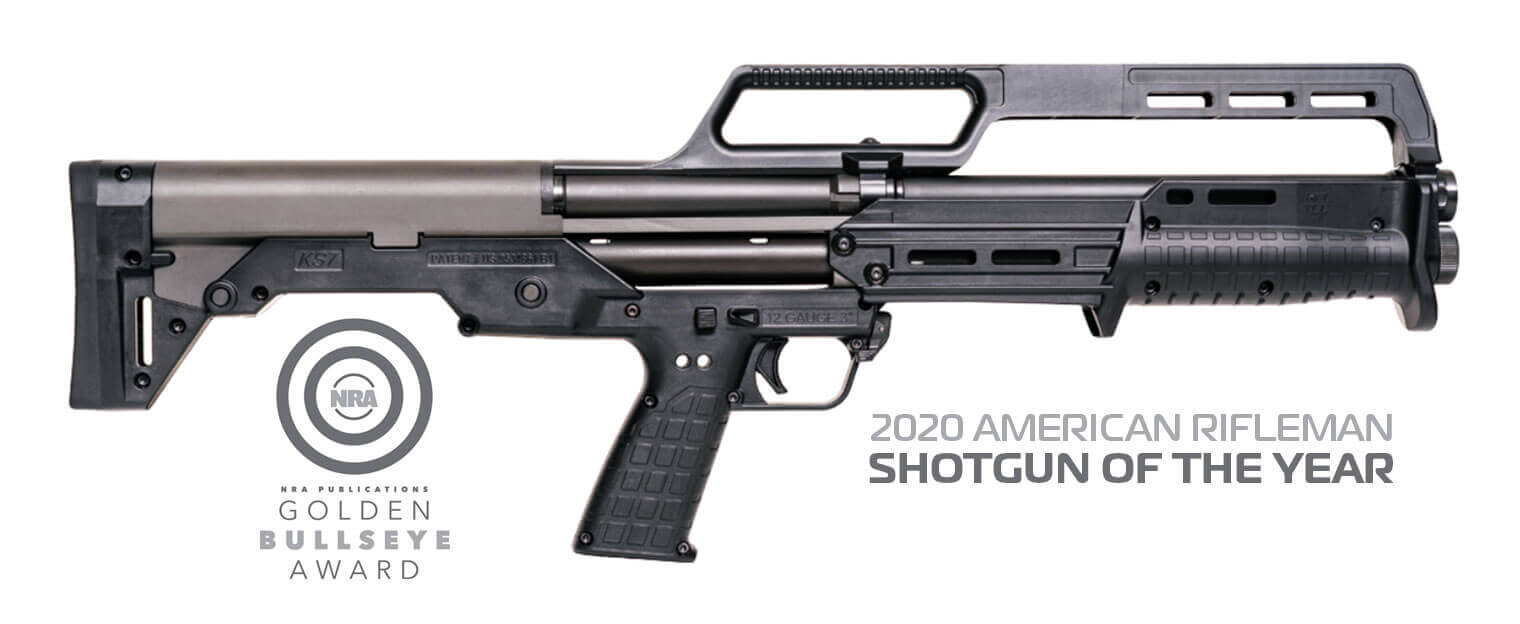
Kel-Tec is pretty proud of this, as the official picture on the website suggests.

Open the cardboard box and you get a weapon that has a lot of plastic…it’s a Kel-Tec. the grip and pump use their “alligator pattern” texturing and it works better than you would think. The KS7 loads from the bottom, behind the grip and it’s a pretty unwieldy set up for the uninitiated. I’ve found that with practice, I can reload pretty quickly, but it’s not as simple as I would like. The body of the weapon is metal, and it’s double lined for safety, should things go wrong. The barrel and magazine tube are well-constructed, though the pump feels a bit rattly. That said, with full-length 12 gauge, it hasn’t malfunctioned. The carrying handle has a trench-style sight with a bright triangular fibre-optic bead in green. The sight works very. Picking up your point of aim is fast and intuitive, and out to 25 yards, it was hitting milk jugs with no issue. It functioned with everything from Fiocchi low-recoil 00-buckshot to Fiocchi #4, Berenicke slugs to Federal 00-buckshot. With a bit of run-in, the pump was much smoother and cycling improved. The key is a strong cycle stroke. The only trouble we had was running the pump less vigorously. That caused a double feed.

Takedown is easy: two pins in the grip assembly pop out, you angle the grip out from the back and pull the buttplate assembly (with the feed tines.) The bolt assembly comes out by racking the pump back and rotating the block 90 degrees. You unscrew the end of the magazine tube and pull the barrel forward. Done with disassembly. Reassembly is easy — reverse the process. The weapon stayed pretty clean through the first hundred rounds of testing, but needed a good takedown after out last trip out, when we had some issues I’ll discuss in a moment.

The good news: it will eat mini-shells. I could get eleven in the pipe and one in the breech for a total of twelve. The bad news: depending on the type, it might not do it reliably. the KS7 ate the Aguila Mini-shells in #7 and slug but if you didn’t firmly run the pump you could get a failure to eject and the next round would jam up — and worse, the shell might rotate. Not a great situation if you were using them for defense. That said, the Federal Shorty shotshells in #4 buckshot have run brilliantly, with no issues. The 00-buck, however, gave up an interest problem this morning: the last two rounds in the tube would spit out together and jam the shotgun. It did not replicate with the #4 nor with ordinary length shells. After disassembly, I found the follower was filthy and did not want to move easily. After cleaning the follower, tube, and oiling the little tooth assembly that catches and holds the shells in the magazine, the issue disappeared. As if as cold and wet, and I hadn’t cleaned that last bit, my suspicion is the follower was binding a bit and the retention hook wasn’t seating quite right. But I could be full of shit.

The good: the KS7 is well made and runs well, provided you aren’t shy about racking the thing. The sighting trench is very good, although you can swap it out for the Piccatinny rail system from the KSG, should you want other optics. It’s lightweight and short, making it an excellent home defense platform. It shoulders and comes on target fast. It transitions from target to target naturally and with ease. It will feed minishells, though I would run a few boxes to make sure which ones it likes before relying on them.

The meh: I found the pump to be a bit rattle-worthy. It’s not awful, but compared to the smooth, solid feel of my Benelli Nova, it’s underwhelming.

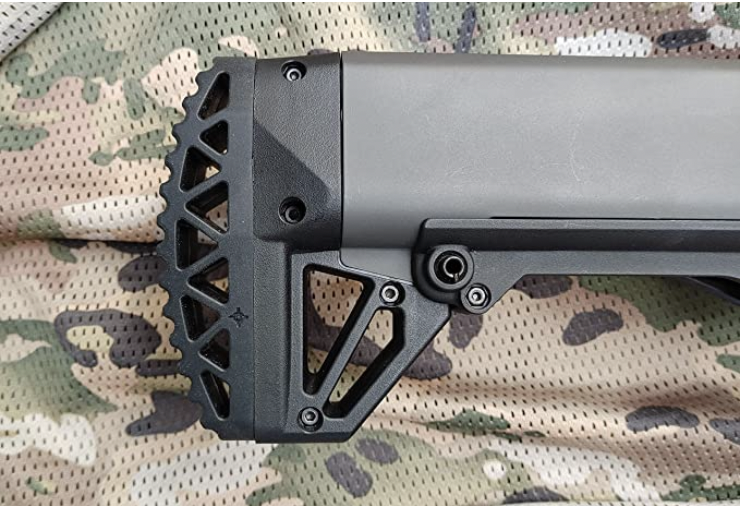
The bad: It’s very light. The buttpad is a slim bit of rubber. This equates to intense felt recoil. I’ve never been a big 12 gauge fan, and this KS7 was painful to fire after a few rounds. This was mitigated with a Missouri Tactical buttpad (and Kel-Tec does their own thicker pad), which made the experience much more pleasant. It’s still a 12-gauge, but it’s not painful to put a couple dozen rounds of buckshot through it now.

Trust me — if you’re thinking of buying a KS7, just get one of these and save yourself some pain.

So, is it worth it? MSRP on these is $530 and I found my cheaper than that. If you’re a shotgun person and want a bullpup for the house or vehicle, or for backpacking — it’s a great choice (if you buy the butt pad!); for home defense, it should be a solid choice. For competition and other applications, I’d pass.

I went on a bit of a bullpup kick this summer. I’ve always liked the form function of the bullpup, but most of them are — to be blunt — kinda crappy. The Steyr AUG is certainly cool in a 1980s action movie sort of way, but the trigger is awful. The FN2000 was a major malfunction waiting to happen. The Tavor is better, but it’s clunky and heavy, especially the shotgun version. The Springfield Hellion, or should I say the VHS-2 the Croatians use, ain’t too bad, but it’s ridiculously expensive. However, the P-90 and PS-90 (while not bullpups in the strictest sense) were excellent weapons. The bottom eject made for fewer malfunctions — in fact, I cannot remember the full-auto P-90 I fired in the ’90s, nor my civilian PS-90 ever having a malfunction of any kind. I even once ran a magazine with a loose/broken feed lip in the PS-90 and it worked.

I’ve never been a big rifle guy. Or a “big rifle” guy. The M-16 and M-4 in the military were fine: light, low-recoil, and easy to shoot, but even those I found just didn’t point naturally for me. All of the shitty weapons above (plus the superb P-90) did. They transition from target to target well, the recoil is more manageable, and they’re much more easy to use indoors.

I didn’t even know Kel-Tec was doing anything other than their venerable SUB-2000 series, so when I saw an RDB on the wall at a local gun store, I played with it — then found it for a realistic price online. (Markup on these at the LGS seem to be about $200 or so.) So for $700, I had a new rifle on the way.

First up — it’s Kel-Tec. There’s going to be a lot of plastic with their “alligator pattern” on the grip. It looks primitive. It works well. I’ve run a P-32 pistol from Kel-Tec for years as my “oh, shit!” gun and never had a malfunction, and the alligator grip texture keeps the little banger in place.

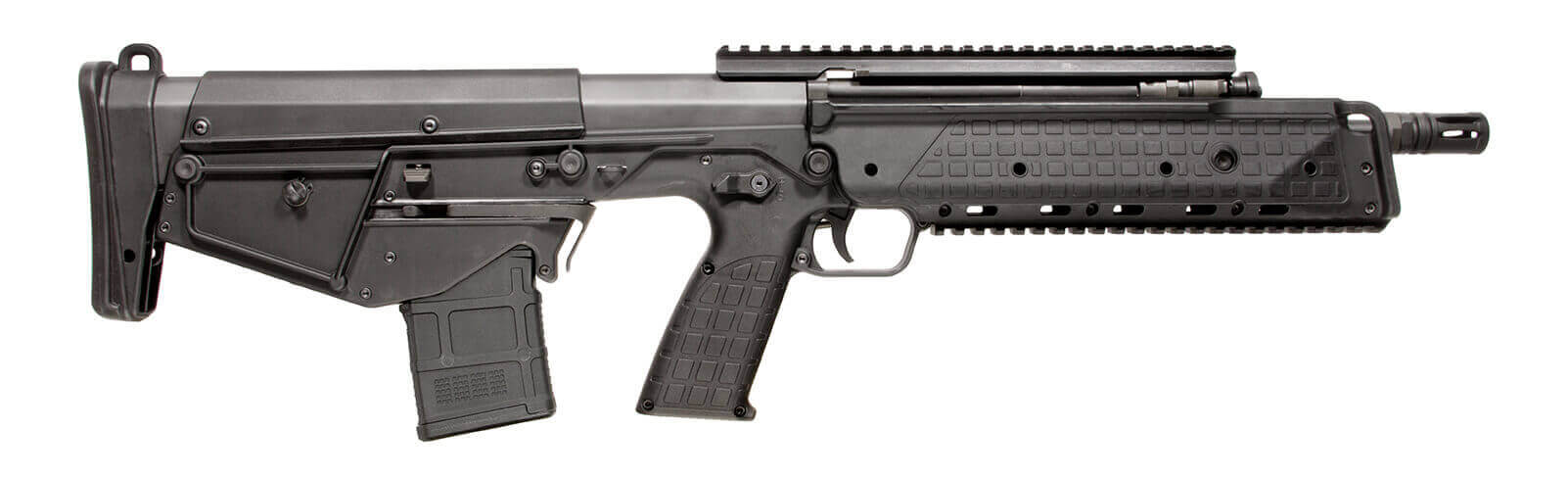
The official picture from the Kel-Tec website.

The stock is metal, and has a double layer over where the breech is so you don’t lose your face in a malfunction. The buttpad is a thin layer of rubber and does just fine absorbing recoil. The forward grip has a little give on mine, but it doesn’t feel chintzy. The barrel on mine is 16″ (the “Defender” variant), and the total length is 27ish inches. It weighs 7 lbs., so about on par with my AR-15. It uses STANAG magazines, so there’s compatibility with weapons like the AR-15. It is chambered in 5.56mm/.223 rem. and uses a short stroke gas piston system to cycle. PMAGs work just fine in it.

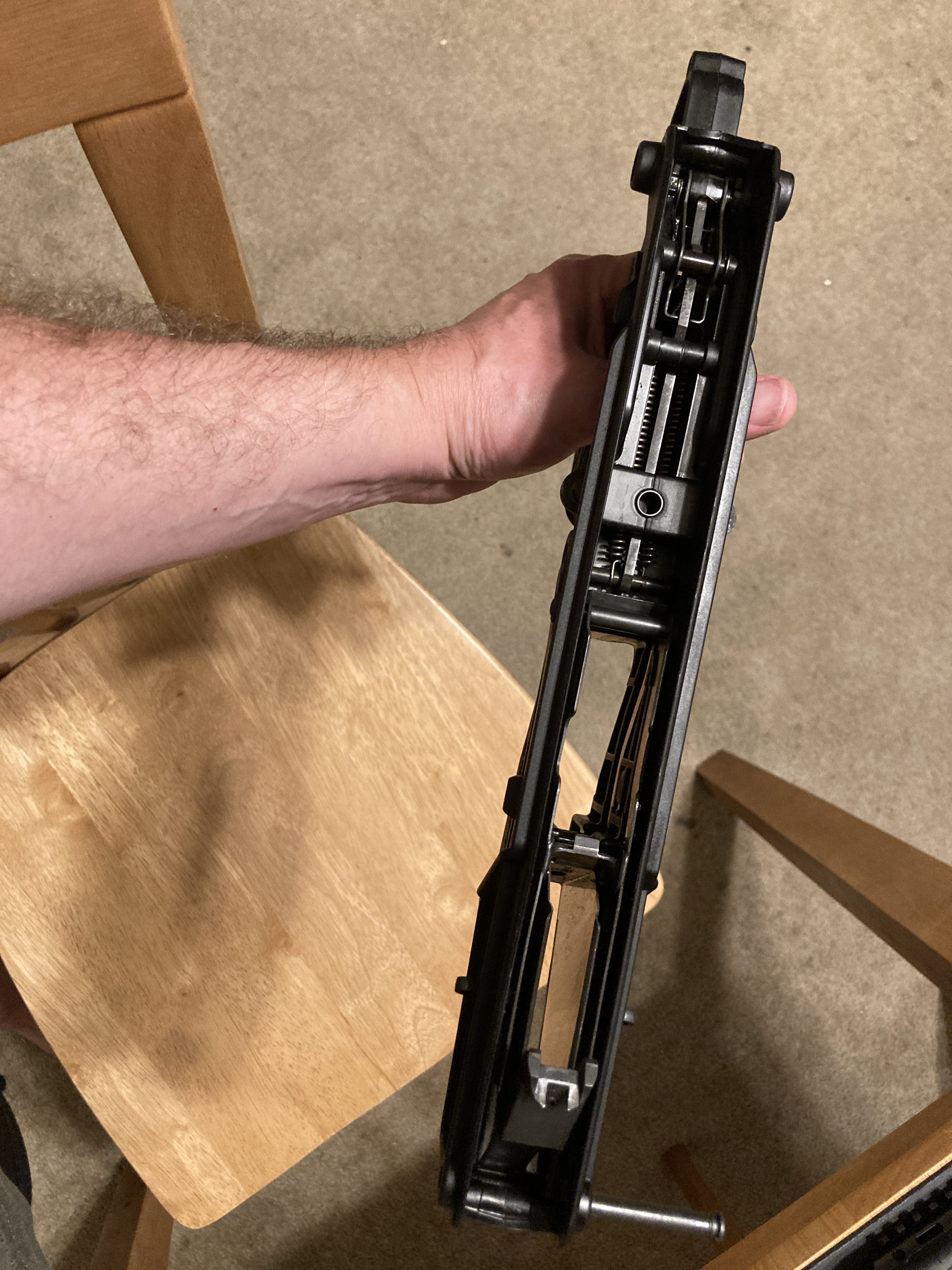
The weapon is dead simple inside — a bolt assembly that sits around the piston rod. When it fires, the bolt travels to the back on the weapon and drops the spent round through an ejection port behind the magazine before traveling forward to pick up the next round.. It expected this to be a point of failure; I was wrong. The trigger on bullpups is usualy awful. The RDB has a smooth pull with a bit of take up and a 5ish pound release. It’s as good as most out of the box ARs. The gas system is easy to access and adjust. There’s a couple of sling points on the front of the handgrip, on the top of the buttstock, and two points on the sides of the receiver/grip assembly. There’s a Pic-rail on the top for optics and flip up sights. I added a pair of UTG cheap pop-ups that worked without adjustment, and the Strikefire off of my AR pistol that needed a lot of drop on the point of aim to get sighted in.

So how does it run? I had no issues with 55 grain ammunition, but Hornady Black 75gr jammed up pretty spectacularly, with two rounds getting caught in the breech. Pulling the magazine and running the charging handle cleared it without issue, and a quick adjustment of the gas block has allowed it to run everything from 55gr to 79gr without malfunction for 1200 rounds. Most of the rifle stays clean but the area around the gas block and the rod are pretty dirty.

Accuracy is solid, with similar groups made between the RDB and a H-Bar AR for comparison. A recent trip out (in the pouring rain, no less) saw the RDB plant shot after show on a frying pan hung from a tree at 50 yards using the Strikefire red dot. Reliability was flawless since the gas was adjusted. Recoil is negligible, and certainly less than the H-Bar. The weapon’s balance allows for great controllability: it moves from target to target naturally, and sights in very quickly.

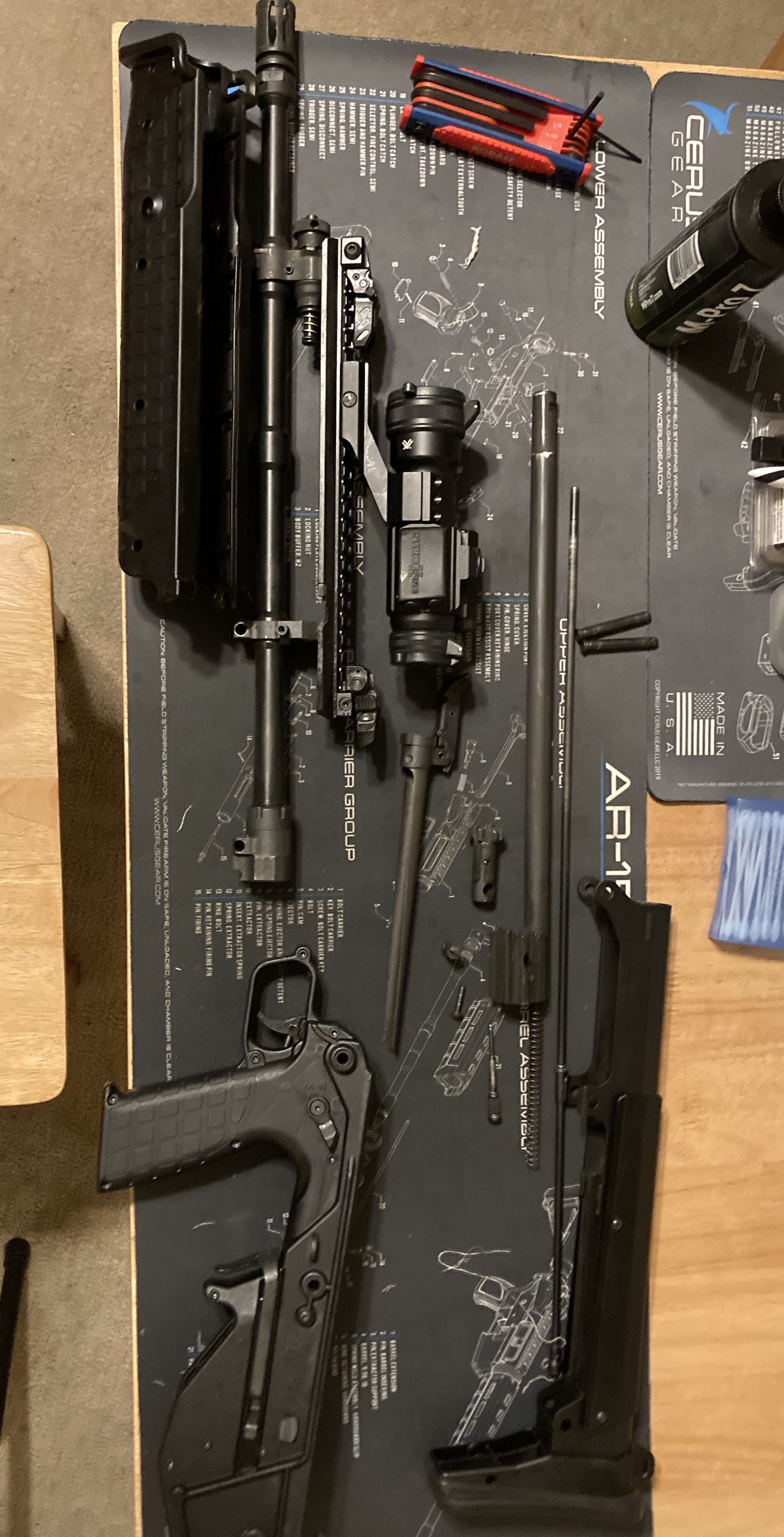
That’s it. Fully taken down, save for trigger internals.

Takedown is simple. Two pins release the grip/receiver, from the barrel assembly. Pull the barrel assembly up a bit, or rotate the grip down and the barrel and bolt assemblies come right out. Putting it back together is just as easy, although sometimes getting the bolt face to lock requires a bit of wiggling. Wear over the thousand plus rounds has been minimal on the finish of the bolt and other friction points. Kel-Tec did a good job on this thing.

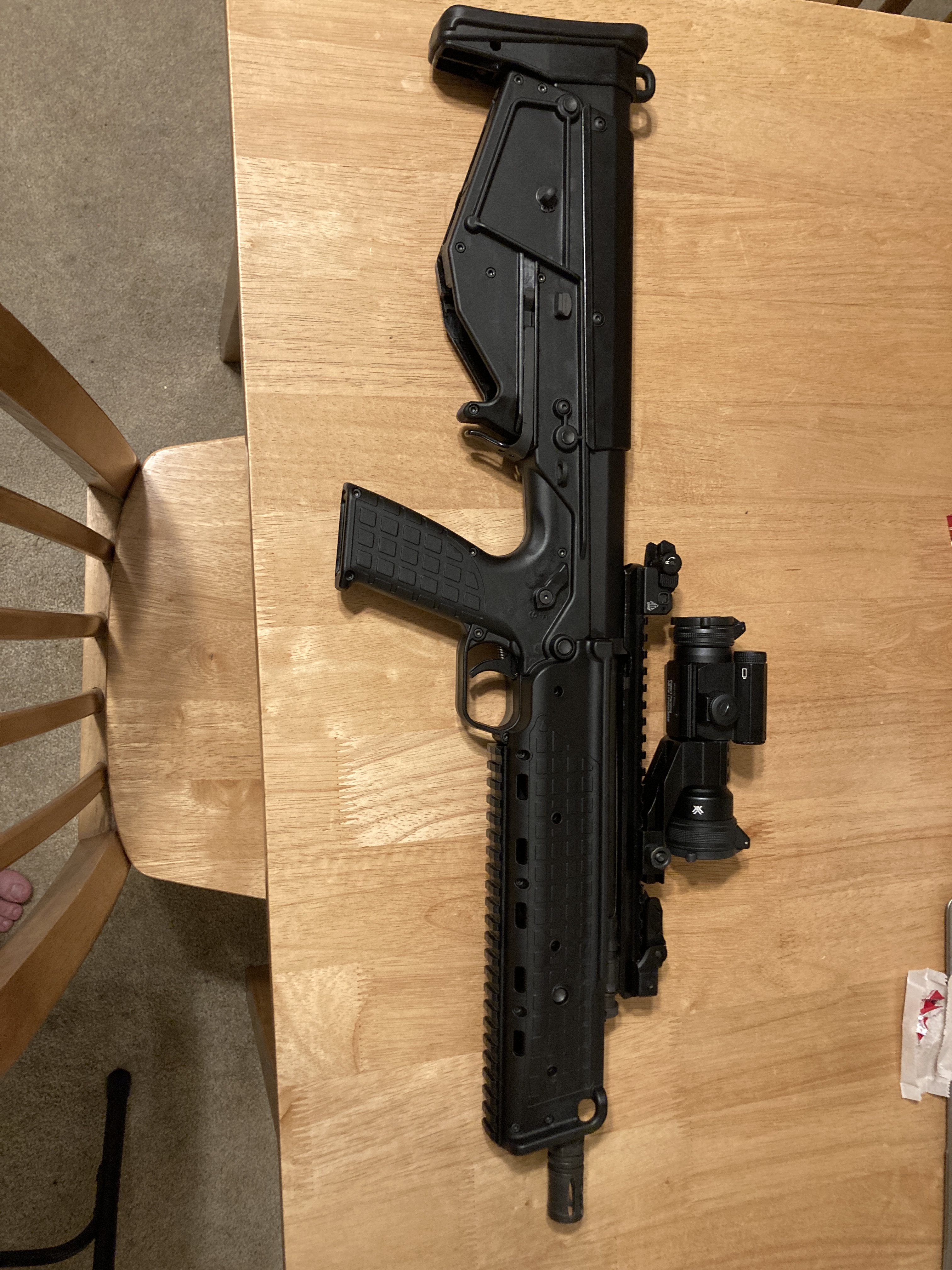
Reassembled.

So…is it worth it. A loud and unqualified yes. The MSRP is about $900 and yes, it’s worth it. Is it better than an AR? I think so, but your mileage may vary. The trigger is good, the balance is superb, it’s light and the size makes for an easy to use weapon.

I’ve got a few .22 long rifle firearms, but overall, I’m not a big rimfire fan. The ammunition quality is spotty, to be kind. I’ve had the bullet fall out of the casing from time to time on some brands (and not that long ago.) Also, the weapons are usually finicky as hell when semi-auto: my daughter’s PPK/S .22 is a great little gun with the right ammunition and at least two rounds through it. (The second round on any trip will fail to feed, then it will be flawless…it just needs to let you know it’s not down to play.) The Rock Island bolt action she has — great: but it’s a bolt-action so it runs like a top and is surprisingly accurate for a 16″ .22 with iron sights. The Kadet conversion for my CZ-85 eats every type of .22LR and just keeps running, but every .22 conversion I’ve used on my friends’ 1911? Crap.

So, it surprised the hell out of me when I went into the local range while the kiddo was rockwall climbing and saw the new Walther WMP in .22WMR (.22 mag for the uninitiated.) After playing with my stuff, I borrowed some time on the WMP. After 300 rounds of CCI 30 gr. Maxi-Mag and Remington green box 40 grain, I had an idea of how the thing functions.

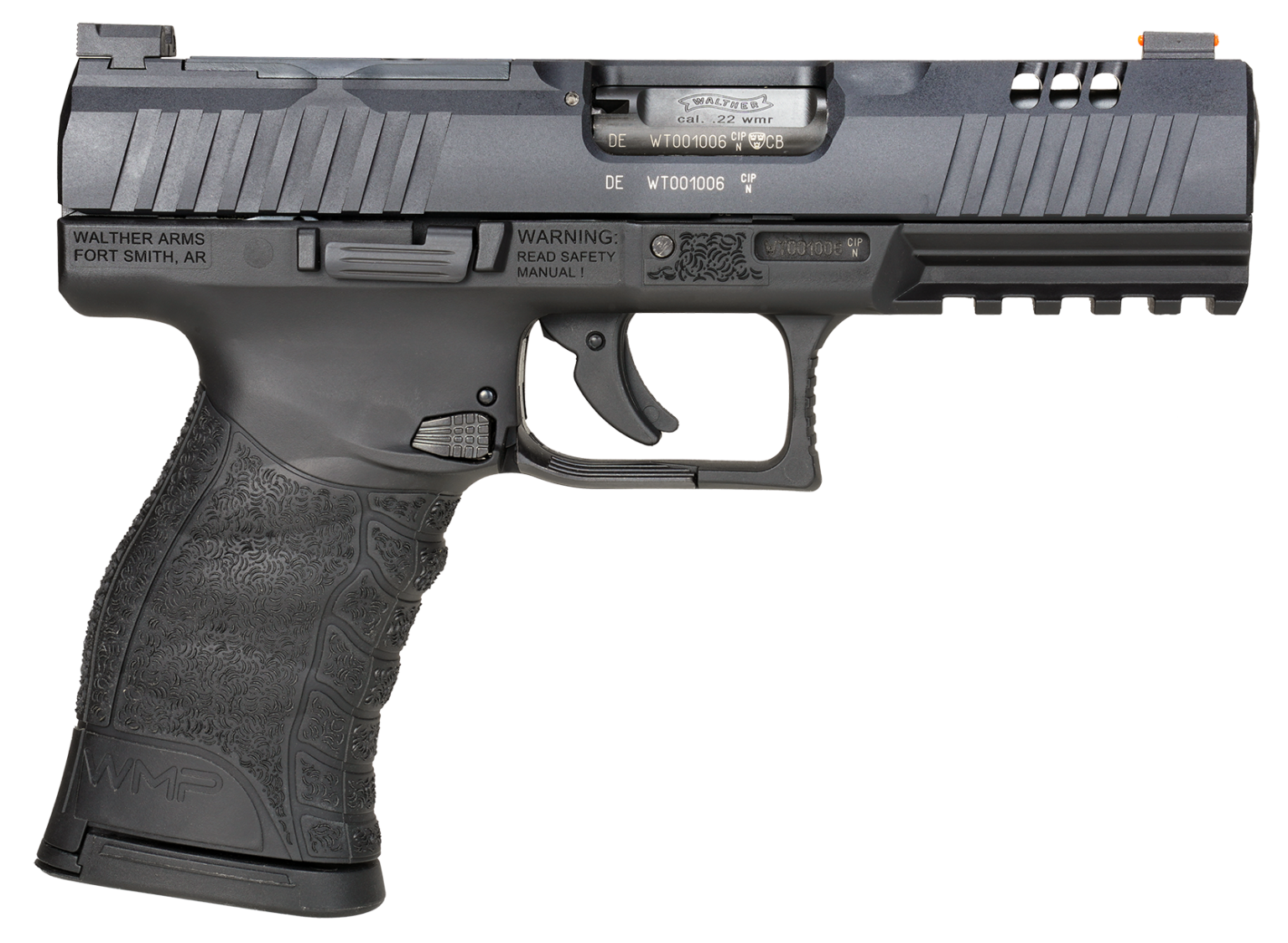
First impressions on the fit and finish: It’s a full size pistol with a 4.5″ barrel and an overall length of just over eight inches. The grip is 5.5″-ish. It’s not the lightest rimfire you’re going to handle and feel slightly heavier than my PPQ unloaded. (It’s 27.8 oz.) The grip is fantastic, as most Walthers since the P99 have been. The grip angle, finger swells and texturing is top-notch. The slide feels like aluminum, and when I looked it up — that’s it. It’s a hammer-fired pistol, which I like, personally. The sights are good — a fiber optic front and windage adjustable in the back. You get multiple sites of different heights to adjust elevation. There’s a plate system for red dot, in case lining up three dots is too hard for you. There’s cocking serrations fore and aft, and what looks like (but isn’t) porting in the slide — it’s just to lighten the slide for function. It’s got the usual blade safety in the trigger.

The weirdness starts for the magazine release, and honestly, I hope this catches on because it’s great. You can’t figure out a new manual of arms? Gotta have the “bullet button” to get the magazine out? It’s an ambi magazine release…but wait, there’s more. You also have paddle releases on either side of the trigger guard for the older Walther and H&K fans. They al can actuate the mag catch on the front of the 15 round magazine. Yes, 15. There’s a nice window to see the rounds and a little thumb button to help load the ammunition. The ammo is ever so slightly staggered, so I was expecting misfeeds. Didn’t happen.

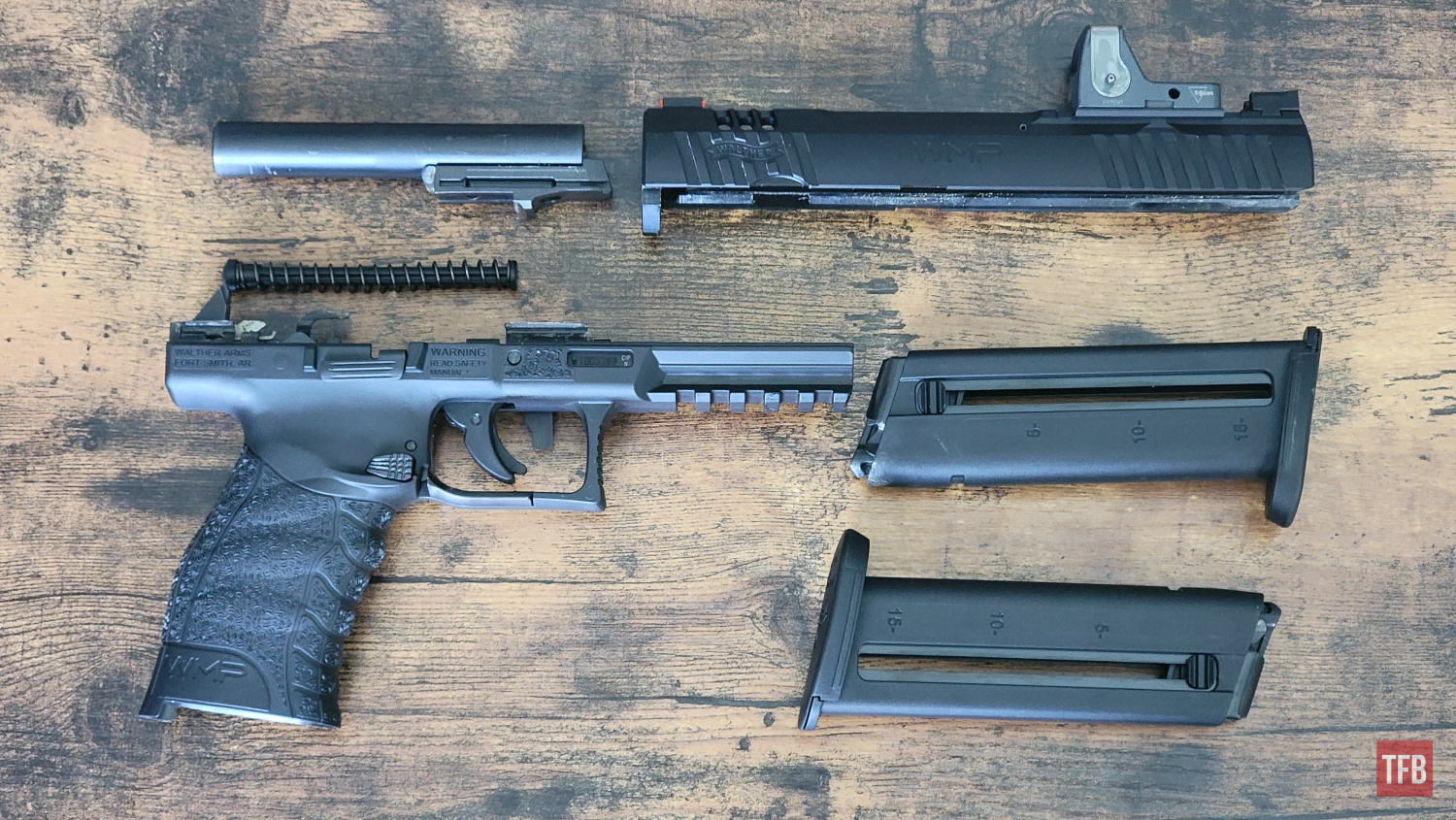
Takedown is simple. Clear the pistol. Lock the slide to the rear, flip the slide catch down and pull the slide off. Pull the captured spring/guide rod, and the barrel. Done. It look like most polymer-frame pistols inside, but the trigger and magazine catch are more complicated than usual. It was easy to clean and reassemble without having looked at the instructions.

I vikked this from another site.

The barrel is fixed with the recoil spring underneath like most semi-autos, not with the spring around the barrel like the PPK. The barrel is thick, steel, and well made. Judging from the triple crown proof marks, Walther’s Umarex group is making this.

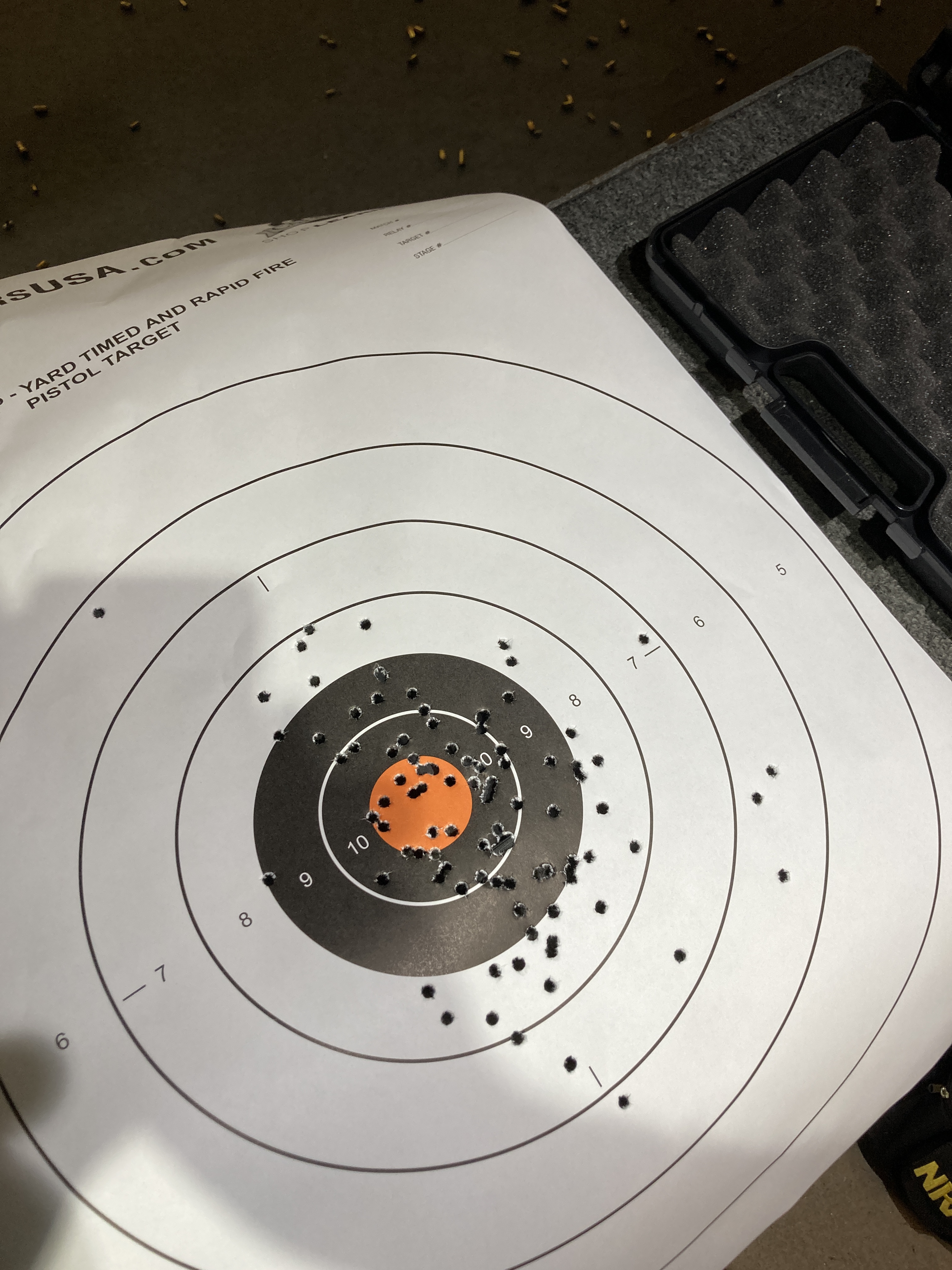
Second, how’s it shoot? One word: spectacularly. For one, much like the .22 TCM 1911s, if you miss your target, you just might set it on fire. The muzzle flash is movie-quality. The report is impressive. The accuracy..?

This is 50 rounds of “not taking my time.” 25 yards unsupported and a bit shaky after 150 rounds of 10mm.

It’s effortless to shoot. There’s almost no recoil, the sights were decent even for low light, and that was with no experience on this platform. The trigger is light — about 4 lbs. using my tip of my finger scale — and resets quickly and with a light audible click. Trigger quality has become Walther’s claim to fame; the WMP lives up to it. A few of the flyers were me double tapping too quickly from the muzzle blast.

The WMP functioned perfectly with the Remington 40 grain and gave two failures to feed (the slide didn’t get back far enough to pick up the next round) on the CCI 30 grain. Walther’s WMP website has ammo recommendations and they suggest 40 grain and speeds of 1875fps+. The 30 grain will “Work OK” according to the website. Both failures occurred at the end of the session, when the pistol was truly filthy and had come straight from the box without any cleaning. While apart, there was white packing grease in the slide rails — this probably was hampering cycling, as we had a couple of “is it going into battery” moments where the slide two stepped back into position with the 40 grain Remingtons. I’m going to blame the grease. After a quick rag cleaning on the line, the next fifty rounds wen’t downrange without issue.

As a light game or varmint pistol, it’s definitely serviceable. As a plinker it’s a tad expensive, ammo-wise; as a target pistol, it’s great. As a self-defense gun..? I wouldn’t want to touch this off inside in the middle of the night with no hearing protection, but at least you and the bad guy would be blind and deaf for a half hour. “Besides,” say the bigger is better bros, “it’s not enough gun…you gotta have a [pick you favorite caliber] to do the job right.” A 40 grain hollow point .22 mag moving at 1200 fps or s from a 4″ barrel gives about 125 ft-pounds of energy that puts you firmly in the .380 ACP range. And if the first shot didn’t kill, set on fire, or blind the target, you’ve got 14 more.

The Walther WMP was selling for $449 at my gun store. So is it worth it? If you are looking for a recoil-light pistol with enough power to dispatch a raccoon stealing your Cool Ranch Doritos™️ or a similarly aggressive wee beastie on a mountain hike, 15 rounds of really accurate .22 mag hollow points just might be the ticket. Or if you have to signal objects is space at night. (Seriously, the muzzle flash is epic.) I want one.

I remember seeing Blade Runner in the theaters in 1982 and being stunned by the visuals, the noir flavor, and the “big questions” that the movie asked. I was 15 or 16, at the time. The movie stuck with me, and with the release of the director’s cut, cemented as my favorite movie. I was adamantly opposed to the sequel movie, almost offended by the very notion — even though I had preferred the director’s, then the “Final Cut” more than the original release version. (I especially like that the Final Cut is just a cleaned up release of Ridley Scott’s workprint — a giant “up yours!” to the producers that mucked with the picture before release. Then I surrendered and watched Blade Runner: 2049 because Denis Villeneuve is a superb director and the original writer was in. I was not disappointed: although it’s long at three hours, the movie is gorgeous, well-acted and written, the movie score by Hans Zimmer blends well with the original Vangelis soundtrack, and the pacing is better than the original. Overall, I found it to be a better movie.

So I was all in when Free League, the Swedish RPG company that’s given us the excellent Tales From the Loop, Forbidden Lands, and Alien, announced their Kickstarter to push Blade Runner: The Roleplaying Game out the door. (You can still do a late pledge!)

The game is up to the usual Free League standards, with atmospheric art that evokes the world of the movies, straightforward writing for the rules and good interstitial pieces to set the tone (a difficult task, as I can attest to, having started in RPGs doing the latter, then graduating to the former.) The layouts are clean, and similar in style to the Alien RPG. The game is set in 2037, after the revocation of the ban of replicants and draws from the two movies, the Black Lotus animated series, and hints from a few of the books and comic books. The players can play a replicant or a human, and the differences show up in their attributes vs. skills — humans are usually around longer and have higher skills; replicants are younger (unless you’re one of those old models…) and have higher physical and mental attributes, but lower skills in general. There are rules for key memories and relationships that can be roleplayed for “promotion points” that allow you to improve the character. There are also “humanity points” that allow a character to become more human or empathic, and lastly there’s a Chiyen point — essentially the “currency” of the world. This is not a game where you sweat money; you either have chiyen to buy something, or you’re reduced to basics until you get some.

The characters, like most FL games based on the Mutant Year Zero ruleset have four attributes: Strength, Agility, Intelligence, and Empathy that tie to certain skills. There are three generalized skills under each (for instance Connections, Insight, and Manipulation under Empathy). The dearth of skills in the MYZ systems worked well for Tales from the Loop, but my players thought them a bit lacking for Alien, so I was interested to see what they thought of the changes made for Blade Runner. The main differences are, similar to their Twilight: 2000 RPG reboot, the characters are graded on their skills and attributes with an A-F scale (although players are never lower than D in Blade Runner.) These equate to a die d12 for an A down to d6 for a D; players roll their skill and the attribute die and want to hit a 6 or higher to have a success. Ten or higher is a critical success.

The simplicity of the d6 die pool from Alien is gone, but the group seemed to prefer this for several reasons. 1) There’s a visual and tactile difference in your abilities with different die (and for those who like different dice, this can be more fun!) 2) It’s more simple that simple the d6 die pool but we found — strangely — your ability to get a success was enhanced with the two dice. We’ve had games were well over a dozen dice were rolled and no successes. 3) With an advantage or disadvantage, you gain another of the lowest die you were rolling, or on a disadvantage, lost that lowest die.

Combat is vicious, and more so than Alien. The damage is set for weapon types plus the number of successes rolled and taken from your health, which represents stamina, pain, etc. Critical success roll a die based on the weapon (or your Strength for HTH and melee) and do some form of damage that lasts, similar to Alien. Additionally, you still take stress like in Alien, but it comes out of your Resolve — your “mental health”. Critical damage to your resolve can break you temporarily. I found I thought this would be an excellent 2nd Edition for Alien, which is already pretty bloody deadly. For this initial release of the game (I have the “early release” beta of the PDF), the characters are all assumed to be members of the LAPD and Blade Runners of some sort, but with a bit of finagling, you could fudge civilian characters without much trouble.

The setting is outlined over 80 or so pages. There’s information on the government, media, Wallace Corporation, etc. There is also a decent bit of material on the structure of the police department, how promotion points play into commendations, promotions, or use for gear or other benefits. There’s a nice section on police procedures and how to work a crime scene that would make a good handout.

Some art from the book.

Our first play session was just a few days ago, and afterward I talked to the group about the experience. We all seemed to prefer the use of different dice. (I was skeptical, but it works better than the d6 pools.) The addition of a DRIVE skill that wasn’t tied to your attribute, but rather the maneuverability of the vehicle was a nice touch. The ability to aid other players by throwing in a skill die into the pool was a good addition — during their sweep of the streets after they caught a triple homicide, the character with the best EMPATHY+CONNECTIONS rolled, while the other two players involved rolled their skill and added successes.

So…is it worth it? The core book is likely to be somewhere in the usual $60 range. It’s got good art, a playable system, and loads of information to be able to hit the ground in this universe. I’d say yes, it’s worth it. Even at the $130 or so my pledge was gives me the starter set, the core book, and all the digital add-ons. I don’t feel I lost out at that price, either.

Actually…more like 16 months on. The Interceptor, or as she is known “Lakshmibai, the Rani of Enfield” has gotten almost 15,000 miles put on her in a combination of trying to kill myself on out twisty mountain roads and commuting to my workplace 23 miles away from home. As the earlier reports have illustrated, Her Majesty has been hopped-up considerably: S&S pipes, high performance cam, high compression pistons, and a airbox eliminator were added, making the bike a nightmare to keep running until we put a Power Commander V on her and got the folks at Speed Associates up in Farmington to dyno and tune the hell out of the fuel map. All bikes are way too lean, these day, for Euro emissions standards, and the Enfields are no different. Fortunately, mine is the last of the Euro4 bikes, so we had little issue enriching the fuel and squeezing almost 20% more power out of her. Here, at a mile up, she turns out 50hp at the wheel — so at sea level, that means she’s pushing 62-63hp and about 50 ft-lbs. of torque. (For comparison, the Honda CBR650R of that year was pulling 86hp and 43 ft-lbs. out of their mill. That’s not bad.) I had (once!) hit 125 mph on the speedometer, flat on the tank, slightly downhill, throttle all the way open, and juuuuuust slipping into the redline. (So figure 115ish with speedo creep.)

Fortunately, there’s a fair number of folks here in the area that love these 650s, so I have a fair amount of anecdotal data to pull from, in addition to my own. The bikes get about 60 mpg at our altitude and on our shitty “winter gas” with ethanol and only 91 octane; in the summer, 70ish without the ethanol. Most folks have had no issues with their bikes, but most also have much few miles than I do on mine. It does seem the need valve adjustments about every major checkup. You’re supposed to do it every 3000, but I’ve been doing the 6000 mile cycle every 5000 miles and the valves are usually just at the edge of spec or slightly out. If you do your own work, it’s pretty easy to do. If you don’t, it’s a bit of a hassle, if you put the mileage on your machine that I do.

Fit and finish on the bikes remains good. No rust or other defects to report, but I did drop my keys on the tank and the paint for the striping on the tank is thin; it had a couple of little paint chips, now. The stock tires (in the US) are the Pirelli Phantom Sportcomps — a tire that was awful on my Street Cup, but works exceedingly well on this bike. I’ve thought about changing out, but they are the cheapest option, so why bother? The frame and geometry on this bike is superlative. It doesn’t feel like 450 pounds. It turns — the favorite road for the motorcyclists here is tricky, with a lot of tight turns and sweepers. She sticks with the “higher end” sportbikes in the turns without issue, and I’ve yet to have her lose her footing. My friend’s GT doesn’t have the torque I do, now, but his bike is not slow; the gearing on these is good, although sixth could be taller. He also recently threw a TEC two-into-one pipe on (they sound fantastic, by the way…)

Issues I’ve had seem to be specific to the modifications done: She definitely has a bit of heat sinking going on in the summer and is more prone to detonation if you give her the gas too quickly in the high gears. This is really specific: it happens between 4200-5000rpm. If you ease through it, she’ll usually have no issues. If you drop to 4th and punch through it, then upshift to where you’re above that engine speed (so about 80mph), no issues. I’ve also had detonation in high wind — and I mean high! We’ve been having a hell of a wind season…I mean spring: both my friend and I had detonation in 35mph plus 50+ gusts while riding. The engines were warm, we were going uphill, and I suddenly started losing power while he was getting engine knock.

So, with a year and a bit behind me, I have to say the Enfield has managed to finally displace my old 2010 Thruxton as my favorite bike. The quality of the build is definitely not what we remember from the old Bullets, and the performance and design is top notch. The newer motorcycles, the Meteor and Classic look to be even high quality; I’m hoping to get a chance to ride the Classic sometime soon.

Update: My buddy and I tried some cooler NGK spark plugs and found these mitigated most of the left-over detonation I was having. I also added a 16 tooth front sprocket, going up one. This didn’t seem to lose me any of my low end torque but it really opened up the mid-range on the Interceptor, with an average drop in engine speed of about 500 rpm. Now, in fifth gear at 55 mph, the mill’s turning about 4000-4200 rpm. I highly recommend the sprocket change.