I’ve finally had an hour to go over Beat to Quarters, the Napoleonic War (at sea) game and companion to Duty & Honor. I came across a review for Beat to Quarters and liked the sound of it –I’m a sucker for Napoleonic sea stories, but strangely, have never done a game campaign in the setting —  and jumped over to DriveThruRPG.com to have a quick look.  Unlike a lot of the big players in the RPG industry, the PDFs didn’t cost an arm and a leg; for $10 for the core book for each system. (Here’sOmnihedron Games‘ page on DriveThruRPG.)

As with Duty & Honor the system is simple and designed to handle the genre’s tropes, without overburdening itself with rules outside the scope of the game. There’s a minimum amount of fluff, but there is enough background to allow the GM and players to jump right in. If you want more historical accuracy, you’ll be doing some of your own research. The art by Peter Frain is adequate and sparsely used.

The basics:  Duty & Honor uses a deck of cards and die poll sensibilities: for a test, the GM pulls a “Card of Fate” (no jokers). If the players are in a contested actions, a fight, wooing, whatever, the FM then pulls a hand of cards. Likewise, the players pull a hand based on their Measures (Guts, Discipline, Influence, Charm), possibly their Reputation, Skills, or a weapon. Match the suit, you get a success; match the card number of the CoF, you get a critical success; match the card (say it was a 3 of Diamond and that’s one of the cards in the players’ hand), it’s a complete success.  You count the number of success for who won.  Complete trumps criticals, criticals trump normal success.

Character creation is simple and fast:  hit on a concept, take a number of experiences (this can be “ten years as an accountant” or “spent a weekend running for my life in the Black Forest”) you’ve agreed on with the GM, pick your position in the ship — officer, warranted office like sailing master or surgeon, or a rating and add their experiences.  Each give you points to put to your measures, skills, reputations, traits, etc. They you collectively work on your ship (or have the GM do it.)

Personal combat mirrors the Duty & Honor rules, and the ship combat is similar to the mass combat. The captain’s tactics matter for the overall success of the action, and his discipline test can aid or hinder the other characters and crew in their efforts to perform their duties, which in turn effect the success of the commander’s tactical test. Damage to the ship or the crew’s morale follows. However, where the mass combat was more interested in the morale of the soldiers in D&H, BtQ has more crunchy rules, which is more genre appropriate.

Wind condition and distance govern what actions can be taken. Discipline tests a above are conducted, then repair to the vessel or crew morale (if necessary), maneuvering into position, then the crew/characters handle their tasks — were you directed to fire guns? Aid in crew morale? Lead your marines in firing from the rigging at the enemy command deck? The broadsides are fired, the damage is figured, and then the next moves are plotted for next round.

The background on BtQ is more detailed than D&H. There is a chart of shipboard offenses and the punishments that were authorized under the Articles of War. This allows me to give Beat to Quarters a higher substance rating: 4.5 out of 5.  The look: 3 out of 5 — it’s clean, neat, and there’s not a lot of razzle-dazzle, but it gets the job done. It’s definitely worth a look if you like age-of-sail naval games.

I suspect I’ve got a pinched nerve in my neck that’s been causing discomfort through the shoulder and arm, and making my index and middle fingers go numb from time to time. I noticed I always feel the latter sensation when heading on my motorcycle. I lasts only for a few minutes, but made me think that the weight of my Scorpion Exo-1000 helmet might be exacerbating the problem.

I like the Scorpion. It’s a solid helmet and I like the internal drop-sunshade. But it’s noisy. And very heavy. So I hit the local motorcycle gear shop (MotoAuthority) to see if there were any lighter lids for me. I had thought about the Akuma Phantom II — a carbon fiber helmet with various doo-dads, but they had me try on a few of the Shoeis and Arais in the shop.

The Shoeis I found to be far to tight back to front. I don’t like having my nose touching the front of the helmet…my first accident I hit the ground straight on the chinbar and busted my nose on the inside of the helmet. I figure the cheek padding should help soak the energy and keep my nose from plowing a divot in the plastic under the windscreen.

The Arais’ fit better, and the latest bowl he had in the shop was the RX-Q, the “street” version of their Corsair racing helmet. It’s very light — according to the various websites, it’s a different of a half pound or so, but it felt about a third to half the weight of the Exo-1000. (I also wear a different size between the Arai and the Scorpion — medium as opposed to large, so that will account for a bit more weight reduction.) After buying the helmet, I hit the road for a few hours of riding to measure the differences between the two.

One: It’s light enough I barely noticed the helmet at all.  Two: the visibility on the RX-Q is like nothing I’ve worn before. I’d swear I could see my ears. Supposedly, the windscreen has an extra 5mm side to side, and it definitely shows. I barely had to turn my head to check the blind spots. Three: it’s relatively quiet…there’s wind noise, but I noticed I could even tell if the wind had shifted around the helmet by the noise. That was good because it meant the slipstream noise over the helmet was low enough to differentiate my wind noise from that blowing off the mountain to my left; it was bad because psychologically, I could tell I was in windy conditions (20mph with 30mph gusts is pretty much de rigeur in New Mexico.)

I got on I-40 heading east through the canyon — always a wind zone — to see how it would handle buffeting. I absolutely did not speed (cough cough)…but if I had been going 90ish, the helmet would still perform as follows: the wind noise is present but better than pretty much any other helmet I’ve had. The RX-Q also does not buffet at all. In fact, there was little change in wind noise when looking from side to side, either. The helmet does not pick up at speed, jostle, nor shift if you are looking into a turn.

What it does do is let a lot of air in under the chin. This helmet will be fantastic in the summer — without the vents open at all, the RX-Q is comfortable with a light breeze across the head. However, in cold wind, it’s going to be a bit too breezy; a balaclava will be necessary. I had mine on and it was in the 40s today while I was riding — it wasn’t cold, but it was a wee bit chilly. There is a retractable chin guard on the RX-Q. It works great up to about 55mph, then seems to aid the air in coming up through the helmet. I put it back up on the highway and got less wind into the helmet, but below about 55mph, it’s the opposite. Don’t ask me…I don’t know.

MSRP is in the low $500s for the frost black that I got, and about $50 higher if you want the swank graphics (the UK flag caught my eye, but extra dough quickly soured me on it.) I got mine for a lot less than that. Before this, I’ve never spent more than $250 on a helmet, but I think the extra money is worth it for the RX-Q — it’s light and stable, and has great visibility.


Very very cool…

Looks like the boys from Hinckley have toyed with the popular Thunderbird cruiser for the new model year. The Storm version is black-only, with much of the chrome anodized black for a more aggressive look. They also swapped the tradition single headlight for the dual headlights of the Rocket III, Street and (old) Speed Triple, and drag bars. Result: a tough-looking machine that even a non-cruiser guy like me finds alluring.

More at motorcycle-usa.com, including some video of the beast moving about.

I got a chance to see this beast in person a few days ago, and it’s definitely better looking than the usual Thunderbird. The gloss gray headlight buckets look fantastic and would look very appropriate on my Street Triple.

More here.

Sustained 500 kv (100 kWt) laser developed by the Office of Naval Research. Unlike solid state lasers, it uses electrons from the atmosphere, so it uses less power and can be frequency tuned.


Well, it all came together well — the Chinese Hollow Earth Expediiton game finished the first “serial” tonight. The characters located the monastery of the mysterious White Lotus group who had captured the body of the mellified man, Prince Yinreng of the Qing Dynasty, in 1799. The final night was a stealthy infiltration of the monastery by the characters, archeologist/grave robber Dr. Hannibal Drake, adventurer Jack McMahon, Chinese gangster Roland Kessik, and street urchin Shanghai Sally, an 11-yer old girl.

They found their mellified men, four of them, but were unable to move the coffin-size confections from the place. They were captured, threatened with mellification, escaped, and were chased by dozens of killer monks.

Some of the better lines of the night: the inimitable (and often idiotic) Jack McMahon, cornered by killer monks with Shanghai Sally, “Hold it right there! I’ve got a pre-teen and I know how to use her…not the way your thinking…”

Shanghai Sally on their new mellification, “They wanted to make you delicious.”

Jack McMahon, following his being beaten unconscious in a single round by a 12 year old monk, “How many were there?” They point to the tied-up monklet. “We never speak of this…”


My Hollow Earth Expedition campaign has been zipping along nicely the last few months. Set in Shanghai in late 1936, the characters have come together to find a legendary mellified man. In preparation, I did a little research on the city, some people of importance — including some of the major players in the Kuomingtang based in nearby Nanking.

Central is the Qing Bang or Green Gang — supported by the Kuomintang, the Nationalist government of China, but is itself rent by internal divisions based on politics — some are outright communists, some lean left, some are firmly in the camp of General (and president of the KMT) Chang Kai Shek. The leader of the Qing Bang is Du Yuesheng, or “Big Eared” Du. He is mainly concerned with smuggling weapons, drugs (especially opium and heroin) into China. Profits are shared with the KMT. Big Eared Du’s point of contact in the KMT leadership is the intelligence chief, Dai Li.

The Green Gang is influential throughout Shanghai, but it’s grip is weakest in Hongkew, the northeast section of the city, where the Japanese intelligence service and the Japanese squad of the Shanghai Municipal Police is strongest. They operate pretty much unopposed in the “old” Chinese City, where the native SMP officers are sympathetic. It is, in 1936, the single most-dangerous city in the world.

The Green Gang has its hooks into many of the cabarets and “singsong” houses on the northern edge of the Old City and seeding the neighborhood between the Avenue Edward VII and Nanking Road to the north, and along the Foochow Road. Off of Ave. Edward VII is the infamous “Blood Alley” a place where bodies were regularly dumped. they also acted as Nationalist intelligence agents and assassins, frequently clashing with communists (mostly along the Avenue Admiral Joffre, and the Japanese.

The most raucous night is Thursday — the day the American troops get paid.

Some of the big cabarets: Ciro’s, Paramount, Majestic (owner, Mr. Wong) and it’s neighbor Little Club (very popular with the USMC.)  Caveau Montmartre is owned by a Corsican admiral who was chief-of-staff for Wu Peifu. The second string were the Palais Cabaret, ‘Frisco, Mumms, Crystal, George’s Bar, Monk’s Brass Rail, New Ritz.

Attempting to keep the peace is the Shanghai Municipal Police — 4756 men, 457 in Foreign Branch, 558 in Sikh Branch, 258 in Japanese. These officers live an existence that is close to ’70s TV cops show violent…shoot-outs, fist fights, riots, spies, and other dangers lurking around every corner.  They are often at odds with the Nationalist-run City of Shanghai government, and corruption in the force, particularly the native contingent, is endemic.  SMP is supposed to concentrate on the International Settlement.

Leading the force is Commissioner Frederick Wernham Gerrard (until 1938).  Already (in)famous is William E Fairbairn, the 55 year-old assistant commissioner of the Reserve Unit — a first-rate squad that is the model for later SWAT teams. He is the creation of defendu, a martial art that is one part karate, one part aikido, and one part dirty tricks. (He would later train British special forces in WWII and invent the Sykes-Fairbarin knife.) By this time, he had been in over 500 reported gun, knife, and fist fights. He’s still here, and most of the city knows you don’t go directly against him. His top sniper is Eric A Sykes (also designed the knife), who is a part-time member of the “Specials”, but his day job is as a manager at SJ David & Co. Last of the big names in the SMP is the huge and dangerous Dermot “Pat” O’Neil, who would later aid in training American OSS officers.

The ranks of the SMP in order of hierarchy from the bootom: Constable, Sergeant, Sub-Inspector, Inspector, Chief Inspector, Superintendent, Ass. Commissioner, Deputy Commissioner, and Commissioner.  The stations:  Central on Foochow Road, Kouza on Nanking Road, Bubbling Well Road Station, Gordon Road, Chungdu Road, Pootoo Road, Hongkew and West Hongkew, Yangtszepoo, Wayside, Arnold Road, Yulin Road, and Dixwell Road.

A few of the major figures in the Nationalist government: Chiang Kai-Shek, the “Generalisimo” is head of the KMT in the 1920s. He only speaks Chinese. Also very influential, especially with the American government, is Soong Mai-Ling, his third wife — a charming and intelligent woman who other members of the Cabinet attempt to exclude when they can. William Henry Donald is an Australian newspaperman who is sometime friend, sometime interpreter, and sometime agent for Chang and his wife. Other members of her family circle the leadership, like Kung Hsiang-Hsi — sometime finance minister and prime minister, who is married to Soong Ailing (Chiang’s sister in law.) Soong Ailing is the oldest Soong girl.  Greedy and corrupt, she used her husband’s position to get rich. Soong Qingling is the middle Soong girl who was married to Sun Yat-Sen, the original head of the Nationalists.

General Chen Cheng is Chang’s chosen successor, although he has compeition for the favors of the generalisimo from the “Christian General” Feng Yuxiang (who has good relations with the European diplomats in Shanghai) and General Fu Zuoyi, who is usually in the north fighting the communists.

Very active and militant is the influential Minister of War He Yingqin, who makes power grabs whenever he can, but usually gets slapped down. He wants to hit the rebels that kidnap Chang Kai Shek for a few months in December 1936, and who Lady Chang jockeys to stop from getting Chang killed in foolish retaliation.

Zhang Xueling (The Young Marshal) — Controlled Manchuria until 1931 when the Japanese took it. Has been working his way back into power & will kidnap Chiang at Xi’an in December 1936.

Hu Hanmin chairs the legislative Yuan in Nanking and is often looking for a way to ingratiate himself to the generalisimo…or whoever looks to be getting the upper hand.

Mao Zedong — Leader of the communists in Jiangxi.

Wang Jingwei — KMT politician and potential heir to Sun Yat-Sen.  Also a Japanese collaborator.

Zhang Jongjiang  (Curio Chang) — Shanghai businessman who buys curios.

A good place to look for more, including maps of the city is the website Tales of Old Shanghai.


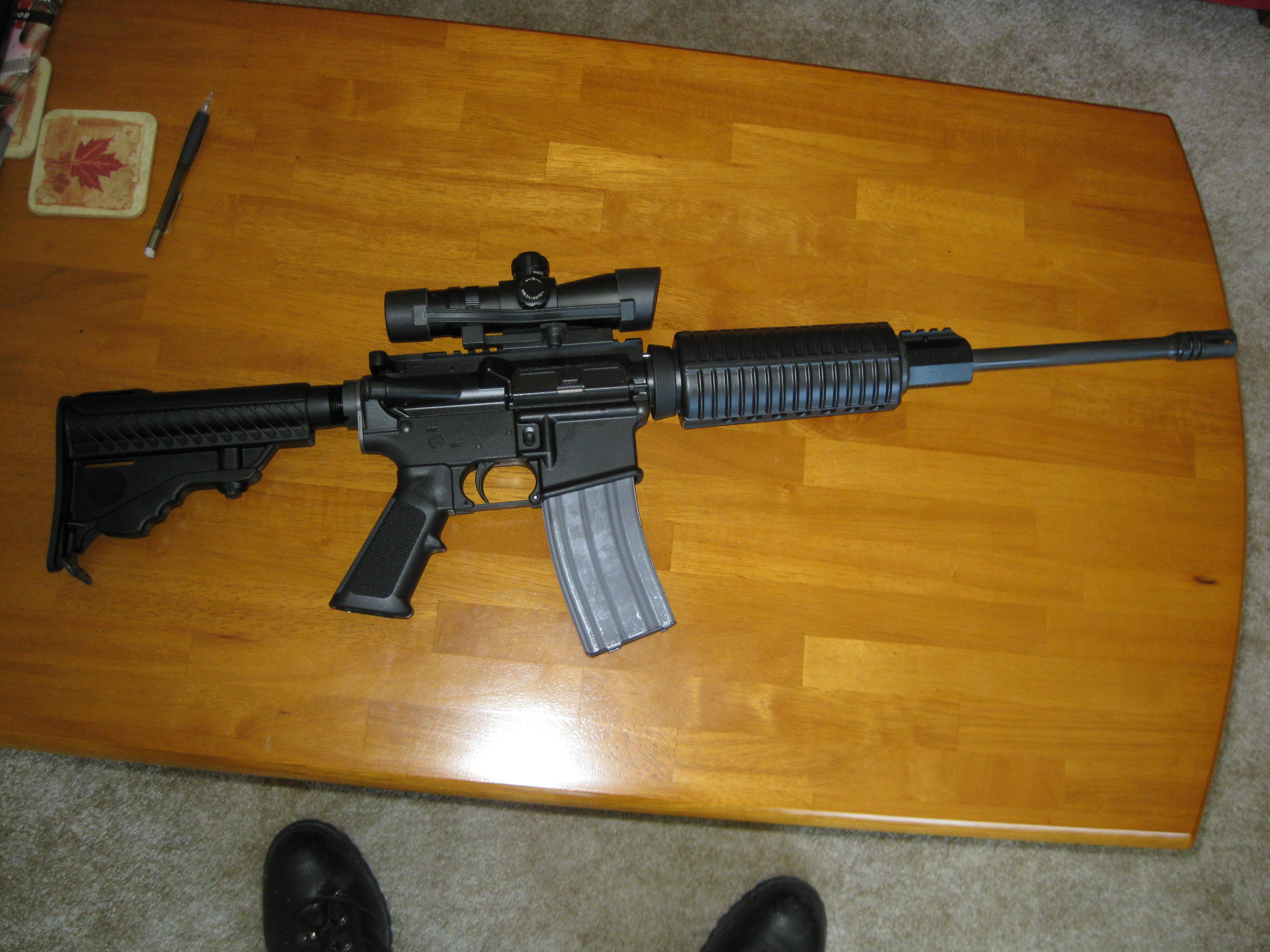
DPMS A-15 (M4A3-style) 5.56mm, 16″ barrel w/ 1-9 twist. Added a 1.5-4x scope with standard and illuminated reticle (red or green…)

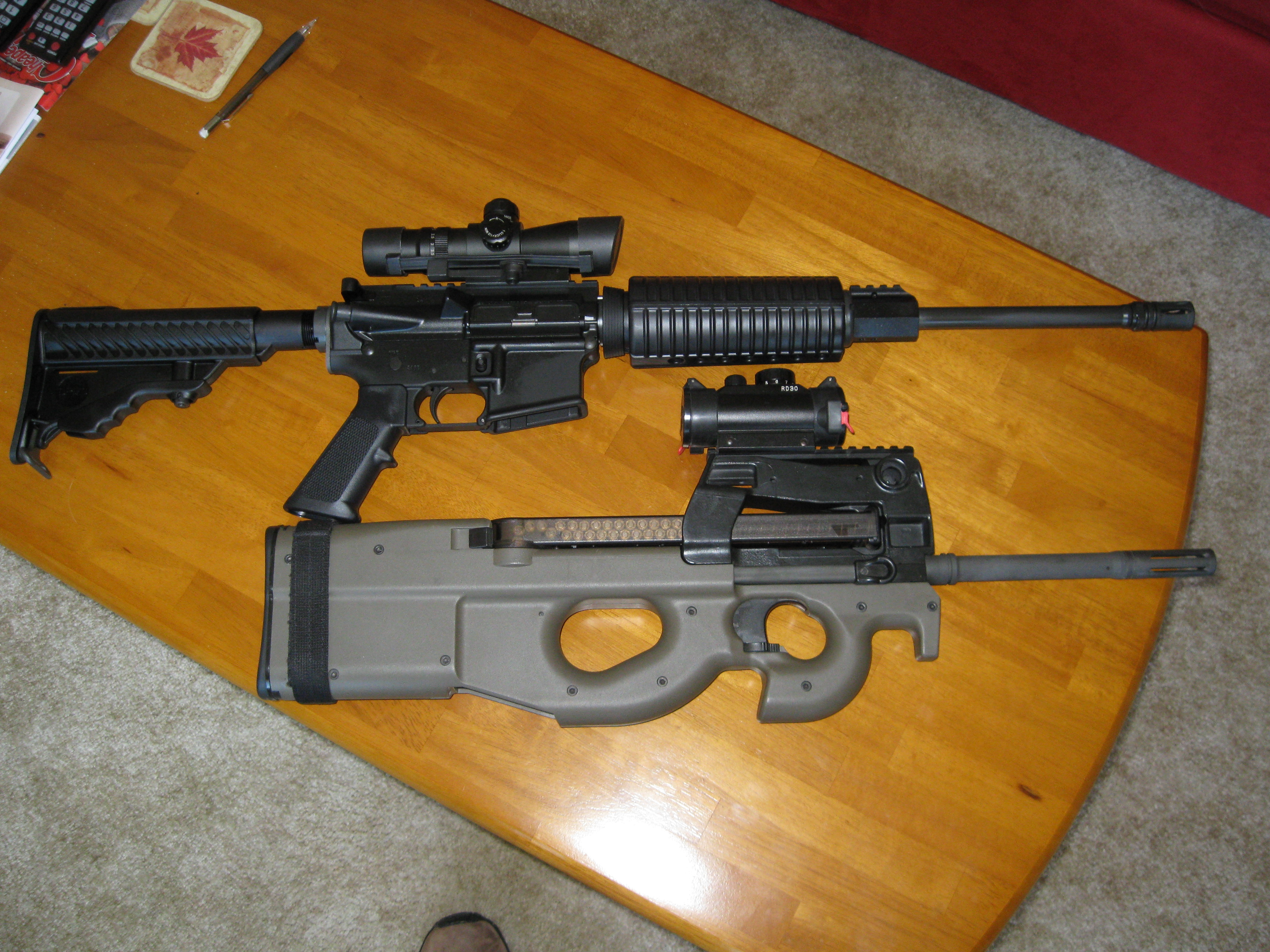
Here’s a size comparison of the PS90 and the A-15:

While the A-15’s got range and muzzle energy on the PS90, the FN’s much better for urban terrain and house-to-house operations for the compact size (the P90’s even better with a 10″ barrel.)

UPDATE: I got a chance to take the DPMS out for a run Saturday, scoping her in for 250 yrds. It only took 9 rounds to get her zeroed, although the old scope seems to have given up the elevation adjustment ghost. Out to 25 yards, I have to give it about a 3″ bump up, but it’s bang on at 100-200 yards. A new scope may be in the offing.

No issues in 100 rounds of shooting, the recoil is the usual M4 quantity — perfectly manageable. (I had a M4 gas piston gun that, while manageable, did hit harder…) And, as expected, only a few magazines and the thing is pretty dirty. Function and accuracy were top-notch. Worth the $25 I paid, would be worth the MSRP of $800-850 I’ve seen.

I think my neighbor is an exotic car dealer. Either that or he buys a high-priced car for a day or two then trades it for something else. Usually, it’s a Porsche 911 or Audi R8 or R10, but there’s been a Bentley Continental  and today’s feast for the eyes…


I think it’s the V-10 Murceliago.

This would be a monumental mistake, if true. They’ve already done it with the Sony reader, and they are having constant fights with other iOS content providers because the Boys of Cupertino want to control the money flow of their customers.

I’ve had multiple readers on my iPad since day one for a reason: iBooks sucks.  Not a little, a lot. We’re talking Jupiter-sized amounts of suck. The availability of books is absolute crap and most of it is very limited in scope, compared to Amazon, and the only place it has a slight lead over Kindle is that it gives you page count, instead of section counts — more useful for using the material in an academic piece.

This sort of locked-down nonsense that makes non-Apple users rail (rightfully) against the Mac platform. I’ve no problem with them restricting certain apps that might be harmful to the stability of the iOS devices (although I’d like the choice, anyway, just warn me the software or content is dangerous), but limiting the functionality of my machine (I bought it; it’s not mine to do with as a please) is a no-go in my book.

UPDATE: Publishers in Europe had, at the launch of the device, pushed Apple to let them do in-app subscriptions, but the Wizards of Cupertino wouldn’t let them…so they redirected the buying of books, magazines, and other downloaded content to their websites. (Case in point: Amazon with their Kindle for iPad/iPhone/Mac app.) Now that the Apple moneymen have realized how much they have to gain, the company is threatening to ban apps that do not do in-app subscriptions that allow them to take a 30% cut.

Simply put, Apple is trying to think like a retailer for the content outside providers are giving the end users. While some agree (often reflexively) with Apple, the “betrayed” publishers in Europe seem to suggest that just having access to their content without Cupertino mafiosi changing a cut aids the sale of the devices, and aids Apple in the end. “By promoting these apps, they promoted the device. Publishers in fact helped to make the iPad successful on the market.” I tend to agree with them on this last point.

More problematic to me than the 30% “road tax” that Apple is trying to slap everyone with, is the issue that iBooks and iTunes often do not have the breadth of product that, for instance, Amazon does. Cupertino also adheres to an outmoded idea of what cost for electronic material should be; the lack of printing costs, shipping costs, and the general “info should be free” attitude of the internet generation means that success of the iOS devices will increasingly require lower prices on content. Amazon, Google and the Android tablet market get this; Apple would be wise to hop on board.

(There may be a way Amazon and others could get around the in-app issue by allowing users to choose to go to their website or to pay Apple’s tax… More here.)