The Guardian notes that Triumph has managed to beat Honda in the UK, becoming the most popular motorcycle line in the United Kingdom.  Not bad for having come out of receivership almost two decades ago.  They are now setting their sights on the American market, hoping to best Harley-Davidson.

As a Triumph owner, I’d love to see it.  Their machines are wonderfully engineered and stylish in a way that H-D isn’t.  They build everything, from sportbikes to cruisers, to monsters like the Rocket III.  The only thing not in their line-up is a starter bike.  (Hey, Triumph — 500cc single or twin!)

My wife has a Buell Blast — the wee 500cc single that H-D made for a decade.  It’s often the butt of jokes and looks a derision from the sportbike community, but it’s bullet-proof:  low maintenance and cost, solid transportation, an excellent commuter machine, and didn’t look half bad.  It’s hard to argue with 60mph+ in the city, dirtbike-like handling (with the right tires), and a 330 lb. weight.  I had one for two years and loved it.  But beyond the Buell line, Harley Davidson never really appealed to me.

The whole leather-clad old guy look is just a bit too cosplay or gay for me.

Raiders of the Lost Ark had one, Sky Captain and the World of Tomorrow had ornithoper verions…the flying wing is one of those retro-cool vehicles that can help instantly set the mood for a Hollow Earth Expedition game.

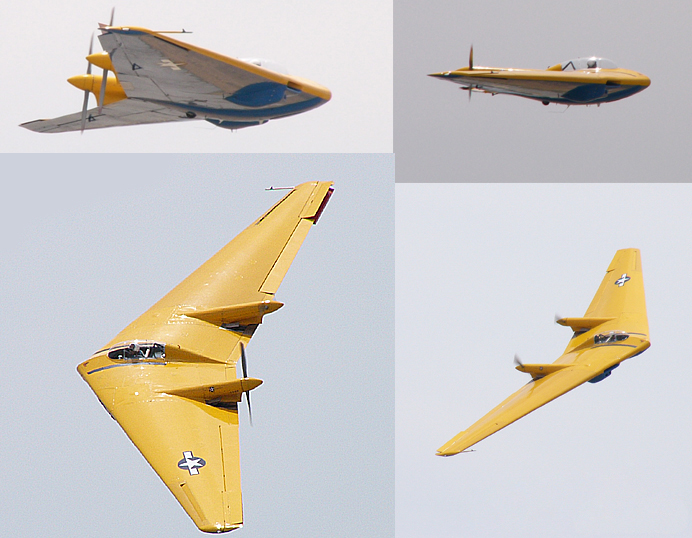
I based this one on the Northrup N-9MB, a single seater flying wing from 1942.

VINCETTI SPECIAL (VS-2)

The Vincetti Special is a radical new design for an airplane — a flying wing.  The vehicle uses a pair of pusher propellers, powered by the Menasco C6 Buccaneer motor and supercharged to a total of 600hp.  The wingspan is a dramatic 60′, the fuselage 18′ long, with a total height of 7′ .  The craft is made out of lightweight aluminum and weights a total of 6600 lbs.  It seats one, although a second observer jump seat can be installed in place of one of the fuel bladders.

SIZE: 4   DEF: 6   STR: 8   SPEED: 300   RNG: 500 mi   CEILING: 21,500′   HAND: +2   CREW: 1   PASS: 1*   COST: $15,000

FLAW:  The craft is finicky and needs a MECHANIC 2 test before all flights.  If the jump seat is installed, the range is only 400 miles.

The speed is a bit high; the actual speed of the N-9MB was 260ish.  We also tricky ours out with a pair of M2 Brownings (for a pair, I make the linked damage 6L, instead of 5L.)

The Statement of Randolph Carter:

Battlestar Galactica and Caprica allow us a few hints for the time reference system over the course of a few episodes.  The units of measurement are about the same as today:  60 seconds to a minute, 60 minutes to an hour, 24 hours to the day.  There’s 7 days in the week and 52 weeks in a year, giving us a 365 day year. (This is pulled from Baltar’s monologue/whine-fest about the number of DNA tests he has to do in the first season.)  There are months mentioned, but never how many.

Days are named as they are in English — Sunday, Monday, and Wednesday are mentioned, so it would be safe, if you want to be a canon-thumper to use the days of the week as is.

Month names are gleaned mostly from set dressing — paperwork, newspapers, etc. Generally, they use the name of months with an “-ius” added to them.  Ianuarius, Februarius, Martius, Aprilus, Maius, Junius, Julius, Sextilis, Septembrius, Octobrius, Novembrius, Decembrius.  (Bolded names are seen in set dressing, others are taken from The Caprican website.)

The years seem to be based on the arrival of Galleon at the Twelve Colonies — 2000 years before the Exodus.  This is based on dating in Caprica which is frequently shown as xx:xx:xx (year, month day.)  There are other systems in the BSG series, but they appear to be, like stardates, a complete and total mess.  I would suggest using the YR01 (Year 1) system from Caprica, rather than trying to make sense of Galactica‘s dating.

To make it a bit more exotic, yet familiar enough to be grasped by the players you could use the Greek weekday names: (Monday to Sunday): Selenes, Areos, Hermiou, Dios, Aphrodytes, Kronou, Heliou.

Your ISP and people on your network won’t see what you’re searching for, but Google can still be subpoenaed by law enforcement.  Here’s the announcement.

Here’s a link:

It’s been about two years since I had the will to sit down and read a book for pleasure.  I’ve had to plow through hundreds of books in that time for my dissertation, and it nearly destroyed the love of reading for me.  I was out at Barnes & Noble looking for a copy of the new Ian McDonald novel Desolation Road, and while gathering that and a replacement copy of The Fortress of Solitudeby Jonathan Lethem (if you’ve never read him, shift your ass out to the bookstore and grab Motherless Brooklyn!)  I noticed a bit of cover art.

Normally, sci-fi cover art is highly formulaic and doesn’t often catch my attention.  Stephen Martiniere’s stuff is about the only look that will stop my eye (and is how I discovered McDonald.)  This was obviously Zeus, king of the Greek Pantheon, giving me the glowing-eyed “you will buy me!” look.  Not being manipulated by cover art at all…I immediately had a look.

Hence my purchase of James Lovegrove’s The Age of Zeus.  I’d never heard of Lovegrove, but I’m a sucker for Greek myth, especially when the back blurb suggests something close to a story idea I’d had.  I bought it yesterday.  I finished it a few minutes ago.  The bloody thing is 678 pages in paperback (well over the 100,000 word suggestion from the publishers I’ve talked to lately.)

Zeus and the Olympians show up out of nowhere ten years ago and with the aid of their panoply of monsters bring peace and justice (of a fashion) to the world.  they’ve decked the world powers in war and have settled down to rule the planet from Mount Olympus in Greece — aiding the Greek economy tremendously.  The UK (it’s a British-centered book, so I suspect the author is in the UK) and US areled by Pantheon sycopants, and only Japan is actively thumbing its nose at the gods.

A wealthy arms merchant has put together a bunch of high-tech combat armor and assembled a collection of people hurt by the Olympian “peace initiatives”, usually due to loss of family or friends.  The twelve heroes wear their TITAN suits and go off killing monsters in preparation for the big throw-down with the Gods.

The book is a fast read, the prose quick and enjoyable.  The characters are fleshed out well, the monsters are nicely brought up to modern sci-fi standards.  So well, that the monster hunts are in some ways better than the combat against the gods in the latter parts of the book.  I particularly like the Medusa — which don’t so much turn you to stone and flash-scorch you into pumice.  The Minotaur features prominently, and gives hints to the final explanation of the gods’ and their creatures’ true nature.  Even knowing where he was going with the story, I was enjoying well enough to slam through the book, but will admit that the final reveal was a bit long in coming and not really a surprise.

The book bothers to do something a lot of sci-fi using the Greek Pantheon does:  flesh out the gods.  Usually, they are glossed over, and only one or two is used to represent them — normally Dionysus or Aphrodite (the ones I find most uninteresting.)  Lovegrove gives us a good view of Zeus and Ares, Dionysus and Aphrodite once again are the main gods that the characters actually interact with, and the two that always fascinate me — Athena and Hephaestus — are given a glossing over, at best.  Lovegrove’s take on Hades — a lecherous necrophile looking to create his next object of affection, his Persephone — is creepy and funny at the same time.

Overall, it’s a good summer read for the beach or the plane.  I got through it in a few hours.
MOntage of ICRA 2010: