1971 Dodge Charger

While other muscle cars were being emasculated, the Charger was being equipped with a V8 ranging from the 312ci and 383ci motors up to the 426 Hemi and 440ci.  This is the 426 Hemi version…

PM: +1   RED: 4   CRUS: 70   MAX: 140   RNG: 230   FCE: 3   STR: 9   COST:  up to $100k at auction

GM Information:  The Charger is a beast in a straight line and gains another +1PM in pursue/flee tests.

Q Evaluation:  There is a former American agent in Miami that drives one of these things.  Beautiful car…  007

Five years ago, I decided to pick up the PS90 carbine from Fabrique Nationale Herstal, along with the FiveSeven handgun.  I had been wanting to get a carbine/handgun combo in the same ammunition in case of political unrest, robot or zombie apocalypse…or just to have.

I had fired the full-auto version of the P90 a few years back and was impressed with the weapon’s reliability and accuracy.  Stopping power was a questionable issue to a lot of the US shooting commnunity, but the record of the P90 in the field was solid, despite the whinging of the “if it don’t start with a 4 and end in a 5, it ain’t good enough” crowd.
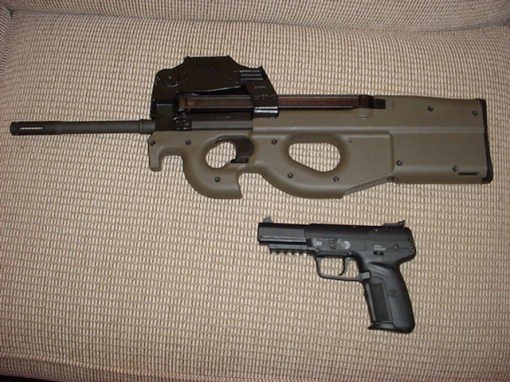
I got my PS90 for $1100 in 2004 and the FiveSeven for $800.  (Can’t do that now!)  Since I’ve had it, I have put 5000-6000 rounds through the carbine with only a few jams (FTF), mostly due to a bad ammo lot.  It likes the 40-grain SS197 blue-tips, especially, whereas the pistol (mine, at least) prefers the 28-grain SS195 rounds.

The weapon is ambidextrous, with charging handles on either side of the weapon and a rotary safety under the trigger.  The magazine sits on the top of the weapon, inside the frame for the optics, and civilian mags hold 30 rounds (10 if you’re unlucky enough to still live in California.)  the guts can be swapped for the standard military 50-round magazine, or you can buy them straight out.  FN mags run about $70, but there are other companies making the magazines, now that there are AR uppers for the 5.7x28mm.  They run about $40.  Spent casings eject out of the bottom.  The weapon is small, even with the 16″ barrel, and the original 10″ makes this the perfect urban house gun.  (you don’t even have to dip the muzzle going through a door; they’re lovely!)

Accuracy is superb in the FN, both in the 10 and 16″ barrel.  Stock PS90s have a black reticle sight that, frankly, sucks.  They also have iron sights on either side of the sight that are solid out to 25 yards.  I was able to group sub-2″ groups out to 25 yards with a bit of deliberation, and could rapid fire a 4″ group at 15 yards without a problem.  Since the stock sight is awful, I installed an equipment rail (simple unscrew the sight, drop in a rail [they can be had from gunbroker or CMMGinc.com] and throw on a sight) and a cheap $40 BSA red dot scope, no magnification, and have managed to hit a wine bottle at 300 yards.  That’s a bit outside of the intended operational range of a personal defense weapon (50-100 yards.)  At the intended self-defense range of 25-100 yards, the weapon will group sub 2″ groups with ease.  Iron sights are good out to about 50 yards, but require the shooter to really hunker over the gun.

Operation is a simple blowback bolt on dual rails with lightweight springs.  The gun, like the FiveSeven, runs incredibly clean and a trip to the range with 200 rounds through it looked like it hadn’t been used at all.  Takedown is accomplished with a push of a button, then pulling off the barrel assembly.  Slide out the bolt and take off the buttplate.  Then remove the trigger pack.  Done.  the gun runs so clean, I rarely clean the trigger pack.  One pass with a boresnake and a few Q-tips, and the weapon is clean in under two minutes.

The 5.7x28mm round is a cut down 5.56mm.  Factory ammo velocities are in the 2300fps range for the PS90.  The round has little recoil and is designed on impact to yaw and cavitate; the effects are disproportionate to the muzzle energy and size of the round (.224 diameter.) SS195s in ballistic gel open a larger temporary wound track than a .45.  Penetration is comparable to a 9mm hollow-point:  about 11-12 inches.  The SS195 yaw and cavitate as designed, where as the SS197s fragment.  Muzzle energy on the SS197s is on par with the 9mm 115 grain round, but I’ve got anecdotal evidence the SS195 are more effective in dropping a two-legged target.  (Thanks to my Little Rock forensics hookup!)

The rounds are easily stopped by hard cover beyond 25 yards, but they do a number on soft tissue out to 100 yards.  They’ll drop a nutria (it’s a souped up groundhog) with a shot, where a 9mm will just piss them off; I’ve heard of guys taking down small deer with the PS90.

Reliability of this weapon is top-notch, as is accuracy.  Recoil is negligible, making it an excellent starter rifle for kids or casual shooters, and an excellent self-defense weapon.  The round is effective on small game and for defense purposes.  Maintenance is incredibly easy.  FN’s customer service is great, as well; I managed to break a magazine and they replaced it, no questions asked.  (The magazines were a problem for a while, but their plastic quality as improved dramatically.)

It’s worth the money up to about $1500.  After that, look for a used one.

Third Born

Type:     Heavy Bulk Freighter   Class:    Hercules HB-921/C   Registry:    TR-61330/H

DIMENSIONS:
Length: 672′   Beam: 88′   Draught: 168′   Scale: Spacecraft   Decks: 11  Crew: 50   Cargo/Passengers: 1.17 million tons (cargo) and 200 passengers; could accommodate up to 1000 with minimal cargo (250,000 tns.)

ATTRIBUTES:
Agility: d4   Strength: d8 (d12)   Vitality: d6   Alertness: d4   Intelligence: d4   Willpower: d6

Initiative: 2d4   Life Points: 14 (18)   Speed: 4 (SL/JC)   ARMOR: 0W, 1S

WEAPONS:
6 30mm Point Defense Autocannons (Planetcraft scale/Skirmish Range): d10W

TRAITS:
Mass-Produced: d4, Variable Cargo Size d4

SKILLS:
Athletics d2, Mech Engineering d4, Perception d4, Pilot d6

NOTES:
Third Born is a heavy bulk freighter designed to carry space-travel standardized cargo containers.  Each container is 60’x 15’x15′ with a grand total of 13,500 cu’ of space.  The class is designed to haul up to 87 containers, for a grand total of 1.17 million cubic feet of cargo space.  (With a full load of containers, the ship uses the Attributes in parentheses.)

The maximum payload for planetfall is 12,000 tons – equivalent to 17 pounds/cubic foot.  Ordinarily, this means the vessel can land with a full cargo load, although it is very sluggish and unresponsive.

Slow and not glamourous, Third Born has been a successful smuggling vessel due to her carrying bulk loads of legitimate cargo, with illicit cargo hidden deep inside the containers.  After the Cylon attack, her master, Gus Costas, used the weapons and ammunition he was carrying to arm the vessel against attack.

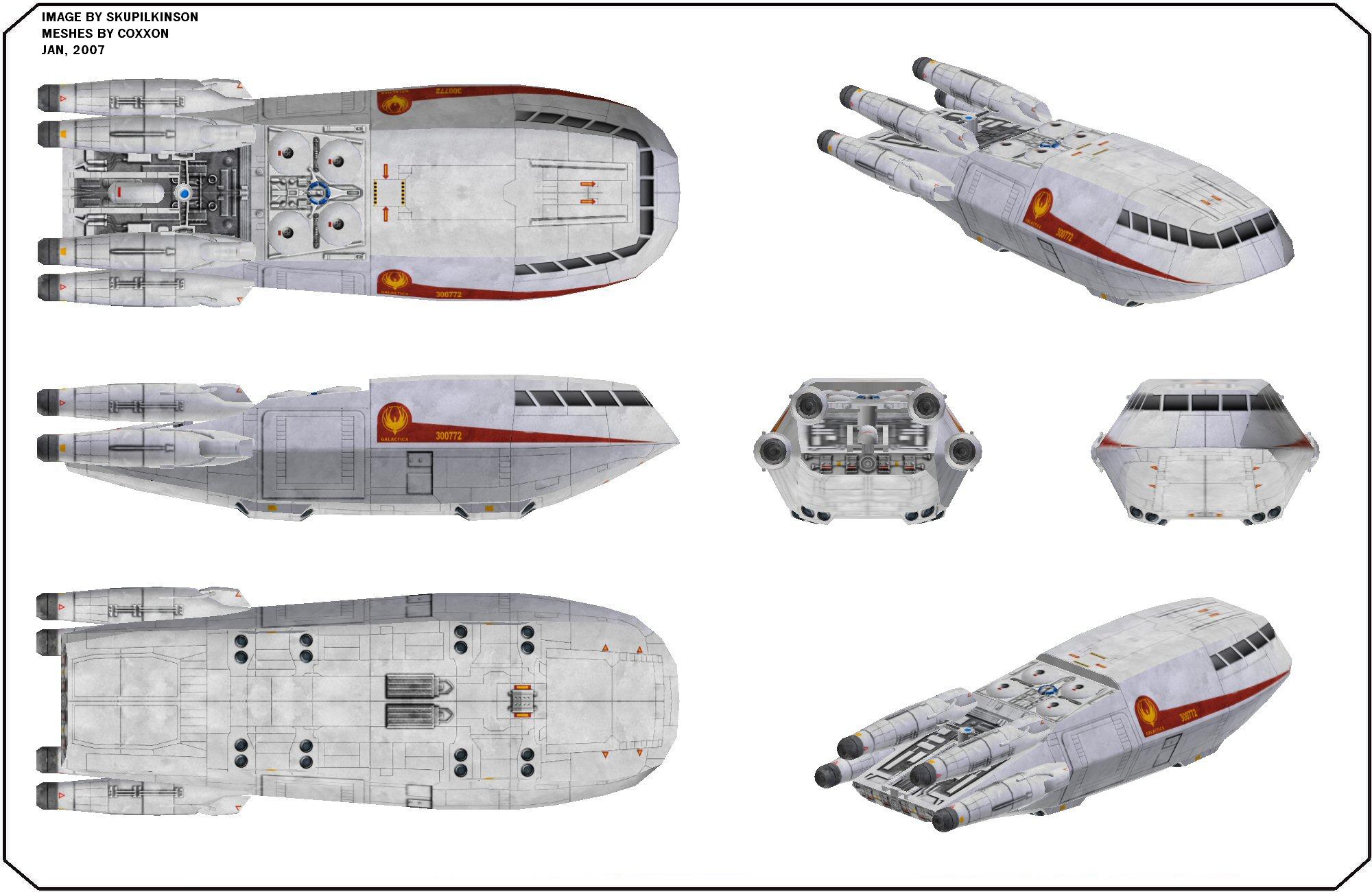
Class: GAL-365 Mk II     Type: Short Range FTL Shuttle

DIMENSIONS:
Length: 74’11”   Beam: 24’8″   Draught: 21’6″
Scale: Vehicular [Barely]   Crew: 2    Passengers: 24 [100 emergency]
Cargo: 70 tons

ATTRIBUTES:
Agility: d4   Strength: d12   Vitality: d8   Alertness: d8   Intelligence: d8   Willpower: d6

Initiative: d4+d8   Life Points: 20   Armor: 1W, 2S    Speed: 5 [SL/JC]

TRAITS:
Mass-Produced [d2], Short-Range [d4], Workhorse [d4]

SKILLS:
Mechanical Engineering [d4], Perception [d4], Pilot [d4]

ARMAMENT:
None

HISTORY:
The GAL-365 Mk II short-range shuttle is a mainstay of ship-to-shore activity, both in the military and the civilian world.  GAL-365C versions are called MLC [marine Landing Craft] and are modified with stronger deck ribbing to carry up to 70 tons – a main battle tank, or up to 4 landrams, depending on configuration.  They can carry the crews of these Vehicles, or can bee used to do emergency evacuations of up to 100 people.  They are equipped with a short-range FTL system good for two jumps (as opposed to 10 with a raptor.)

The Colonial Marine Corps also uses an uparmored version of the GAL-365, commonly referred to as an MLS (Marine Landing Shuttle.)  An MLS is usually piloted by dedicated CMC pilots, but often pilots are crosstrained for MLS and Raptors.

The MLS Armor rating is 2W, 2S, and they carry 24-100 marines, depending on the drop load.  The lower cargo deck is designed to hold a single main battle tank, or up to 4 landrams, depending on their mass and size.  With a tank, only 24 marines can be carried.  For a quick drop, 100 marines and their gear can be loaded.

Since the Colonies were named after the constellations (or vice-versa, I suppose…), here’s the patron god(dess) of each colony:

Aquaria:  Hera,   Arelon: Athena,    Canceron: Hermes,    Caprica: Hestia, Gemenon: Apollo,    Leonis: Zeus,   Libris: Hephaestus,   Picon: Poseidon, Sagittaron: Artemis,   Scorpia: Ares,   Tauron: Aphrodite,   Virgon: Demeter…

This should aid in lending a bit of character to the Colonies and their people in your game.  It also gives you “holidays” should you need them for a plot.

So my question…who is the patron god of Earth and the 13th Colony.  Could “god” — the angry and jealous god mentioned in the Kobol episodes (well, the cut scenes), be Hades?

…under “Role playing Related.”

Back in December, my Nolan N-02 helmet from five years ago finally gave up the ghost; the faceplate snapped in half when I put the fog shield into it.  since it’s been a cold winter, I pretty much needed an immediate replacement.  I had ordered up an HJC Sy-Max II, which is reviewed here, and which had serious issues as a helmet for winter riding.  Hence why I was using the Nolan again.

I stopped at the local Cycle Gear and picked up one of the few helmets that fit me — the Scorpion Exo-1000.  Normally, I like the flip-face helmets.  It’s easier to get them on and off, since I don’t have to remove my glasses, but there were none that fit me.  (Our local Cycle Gear is somewhat lame…but it was the closest place to ride to in bitter cold.)

Appearance:  the EXO-1000 is a full face helmet.  Mine is gloss black with silver S (in appropriate “nasty”-looking font) and silver highlights around the vents.  Scorpion looks to be copying the more expensive Arai and Shoeis in their design.  Overall, it’s a good looking helmet.

Fit:  It has an inflatable air collar to lessen wind noise.  I don’t know it this works, since the medium is tight enough on me that I don’t have to pump it up for a good seal.  Did I say tight, I meant tight.  The interior is comfortable…it’s just getting the bloody thing on and off that’s problematic.  There is an air skirt against the wind, but it’s not particularly effective — I still get air up through the helmet, but it’s not uncomfortable, as it had been with the HJC.

The EXO-1000 has an integral sun shield, as the Sy-Max II had, and is controlled with a little lever on the left-hand side just behind the visor.  The fit is good and it is dark enough to cut the New Mexico sun down to size.  The main shield can be swapped out for other shields with a quick turn of the knobs on either side at the pivot points.  It’s quite easy.

There’s a collection of vents — the usual above and below the visor, two at the top where the aerodynamic-looking elements of the helmet are, and one at the back that allows through flow.  All are simple snap open/ closed types, save the rear, which has a side to side switch.  All work easily.

Road noise is peculiar:  it is more quiet than the Nolan was, and much more quiet than the Sy-Max II (if you are getting the impression the Sy-Max II was a disappointment, you’d be right.  It’ll probably be a great summer commuter helmet, when I want the air to just rush right in loud and cold.)  However, the wind noise across the helmet is there…it’s muted, but the tone is unusual.  i wish I could describe it.  It’s not annoying…just there.  The helmet’s been warm enough this winter, save around the chin.  Chin wind coverage gets a C+ at best.

The helmet is DOT and Snell rated.  Style is on par with more expensive helmets — a 4 out of 5; comfort is good once the thing is on, but the process of getting it on or off is a pain in the ass — 4 out of 5 (and only because of the tightness at the neck); overall it gets a 4 out of 5, and would be improved by either loosening up the padding a bit at the neck (especially with the inflation system to counter it) and a better neck curtain for the winter.

A point of contention for the fans of Battlestar Galactica (show and game) is the size of the Colonial Fleet.  The only real on-screen information is a line in the miniseries in which the crew gets news of the loss of 30 battlestars in the initial engagement and Starbuck says “That a quarter of the fleet…”  Since the word used is fleet — I’m going with the idea that “battlestar”, like ship, is a general term that might cover battlestars we’ve seen down to various escorts, etc.

The fleet appears based on the US Navy, so that is on what I’m basing my take on the Colonial Feet.

Based on Picon, the Colonial Fleet nevertheless has local headquarters on each colony.  (The show seems to suggest Delphi or Caprica City was the regional/colonial base of operations.)  There is a military academy mentioned, and I think we can assume it’s on Picon, where the main HQ for the fleet is located.

The fleet itself is approximately 120-150 ships strong, divided into a collection of operational “battlestar groups” or BSGs.  There are twelve fleets tasked with the protection of a specific colony, with three Colonial Marine Corps Assault Groups (MAG) [these would be the equivalent of marine expeditionary fleets in the US Navy.]  There is also an exploration group, tasked with exploration and mapping of the surrounding star systems, and espionage/early warning activities.  There are also some vessels on detached duty, conducting rescue of civilian vessels, criminal investigations, etc.

The average BSG is comprised of 6-10 vessels.  The main asset is the battlestar, a heavy battleship/aircraft carrier, with four escort vessels (alternately called gunstars or assaultstars in fandom.)  The gunstars are dedicated platforms which provide missile and fighter defense for the battlestar and are positioned far enough away from the primary to give early warning and defensive cover.  Assaultstars are Colonial Marine transport platforms which allow the BSG to project force on the ground, or conduct boarding actions.  Most BSG have one or two in their group.  Lastly, there is often a tender and/or fueler with a battlestar group, providing supplies to the other vessels.

MAGs are smaller, comprised of one or two assaultstars with marine complements and equipment for fast response to crises around the Twelve Colonies.  These assaultstars are accompanied by a pair of gunstars, a tender, and a fueling vessels.  The average marine complement on an assaultstar is anywhere from a company to a battalion of marines, and their ground equipment.  These vessels are more cramped than battlestars, and usually have short “float” durations (a few months, at most.)

The exploration group is broken into small expeditionary groups, usually involving an older battlestar or assaultstar, a civilian science vessel, and a civilian tender/fueler — with the civilians being on military contract and subject to military command and jurisprudence.  Their missions range from a few weeks to six months.  (Here’s a good hook for a “second fleet” campaign.)

With spaceborne assets, ground assets, the CMC I would estimate the total manpower of the Colonial fleet is about a million men and women under arms.

The fleet was created during the First Cylon War, and incorporated military assets from all Twelve Colonies.  It is understandable that there would be vestiges of these older military units — planetary guard (National Guard units, if you will) that are colony-specific and handle most humanitarian aid, peacekeeping, and other non-kinetic operations.  I would assume they could be rolled into Colonial command during a time of war.

Posits that every increase in efficiency in a device ultimately adds to the total energy usage.  Here’s more…

John Robb also has a nice piece on botnet ecosystems, here.

Into protection and transport of drug smuggling.  Reuters is reporting a “rogue aviation network” including Boeing 727s (which can carry about 10 tons of cargo) is operating as an illicit bridge between drug producing countries in the Andies and the West Coast of Africa.  The Africa end of the operation appears to be Al-Qaida in Islamic Maghreb (AQIM).

There’s some obvious game fodder in here that I intend to be using.