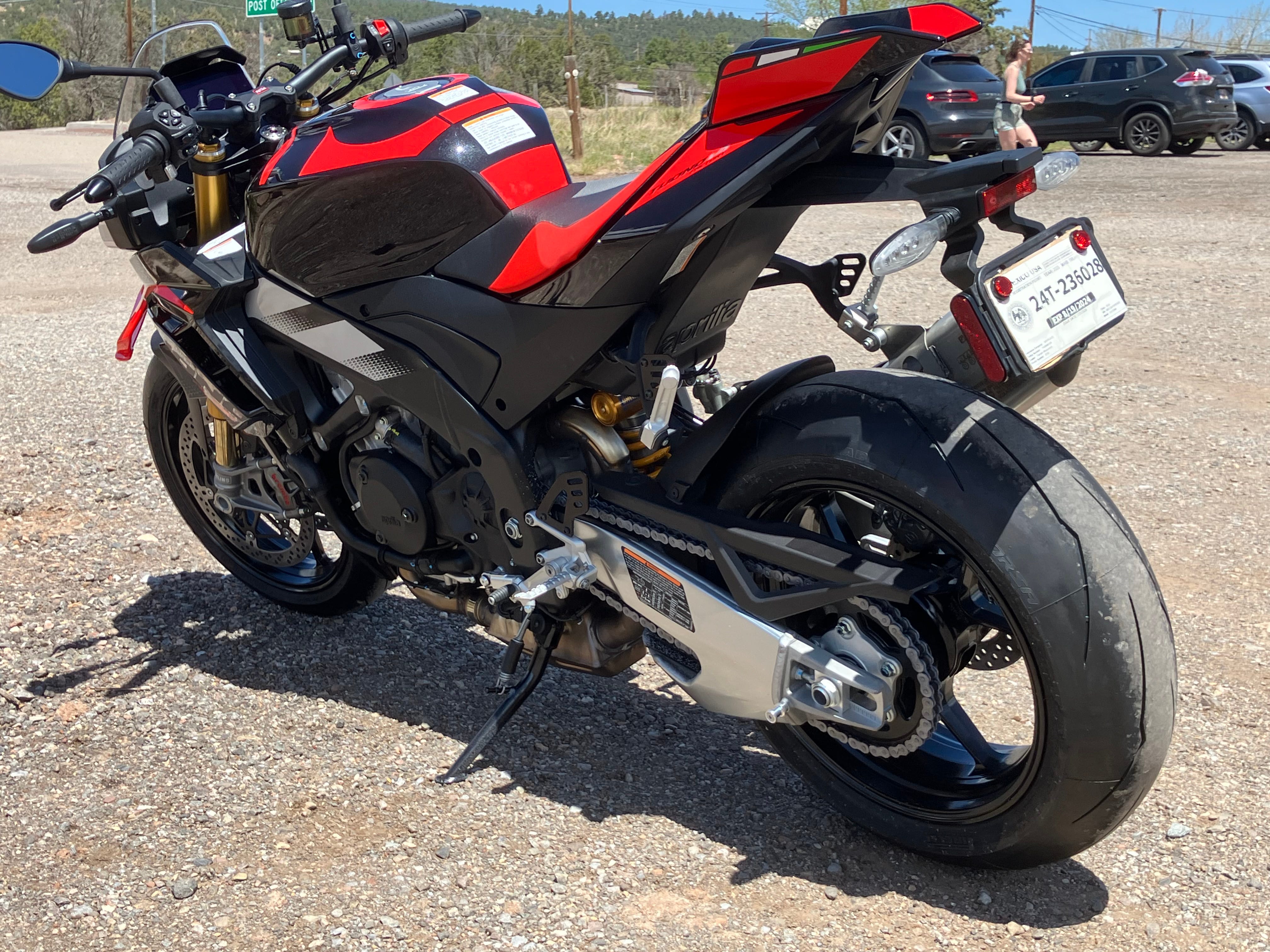
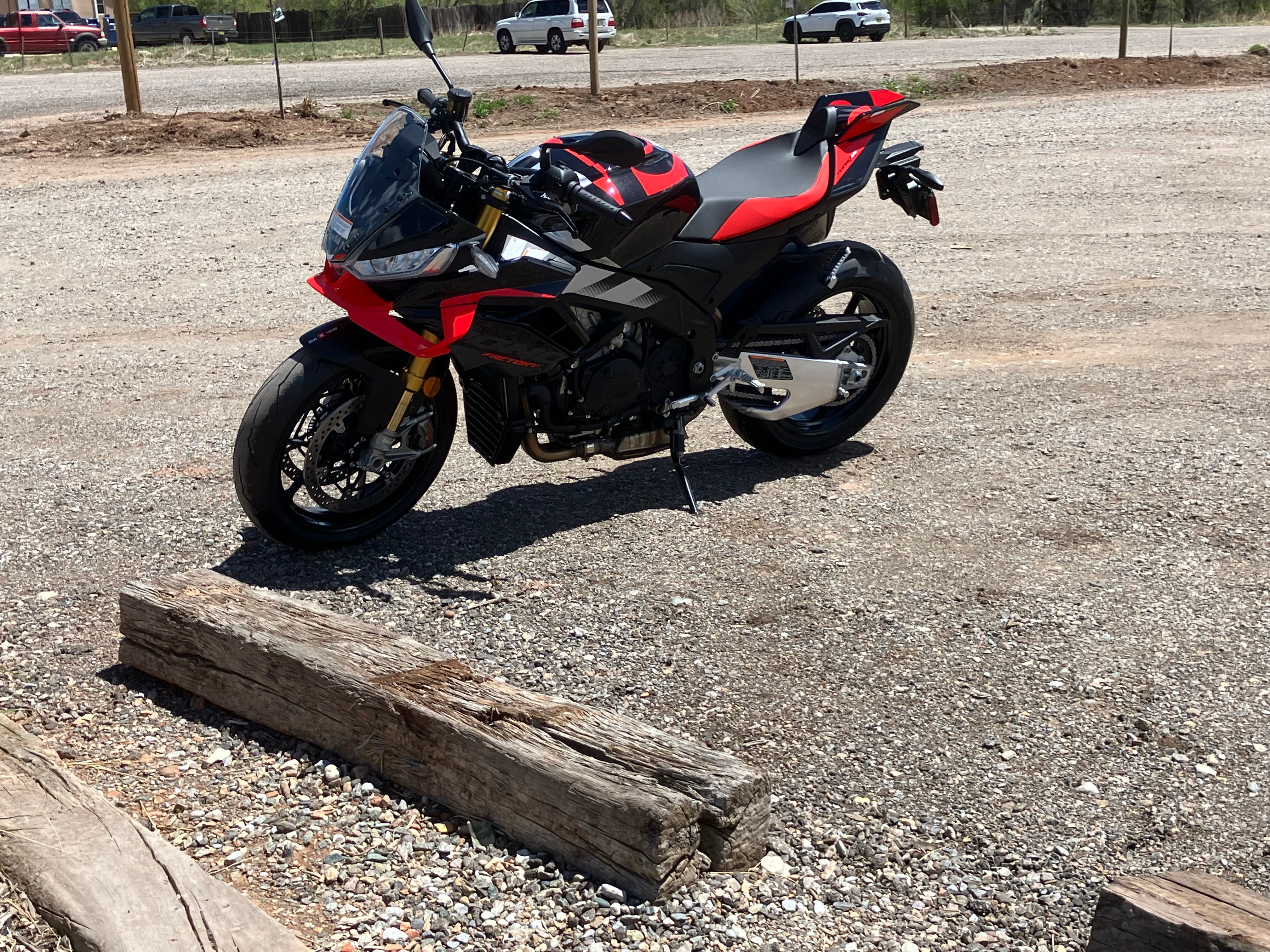
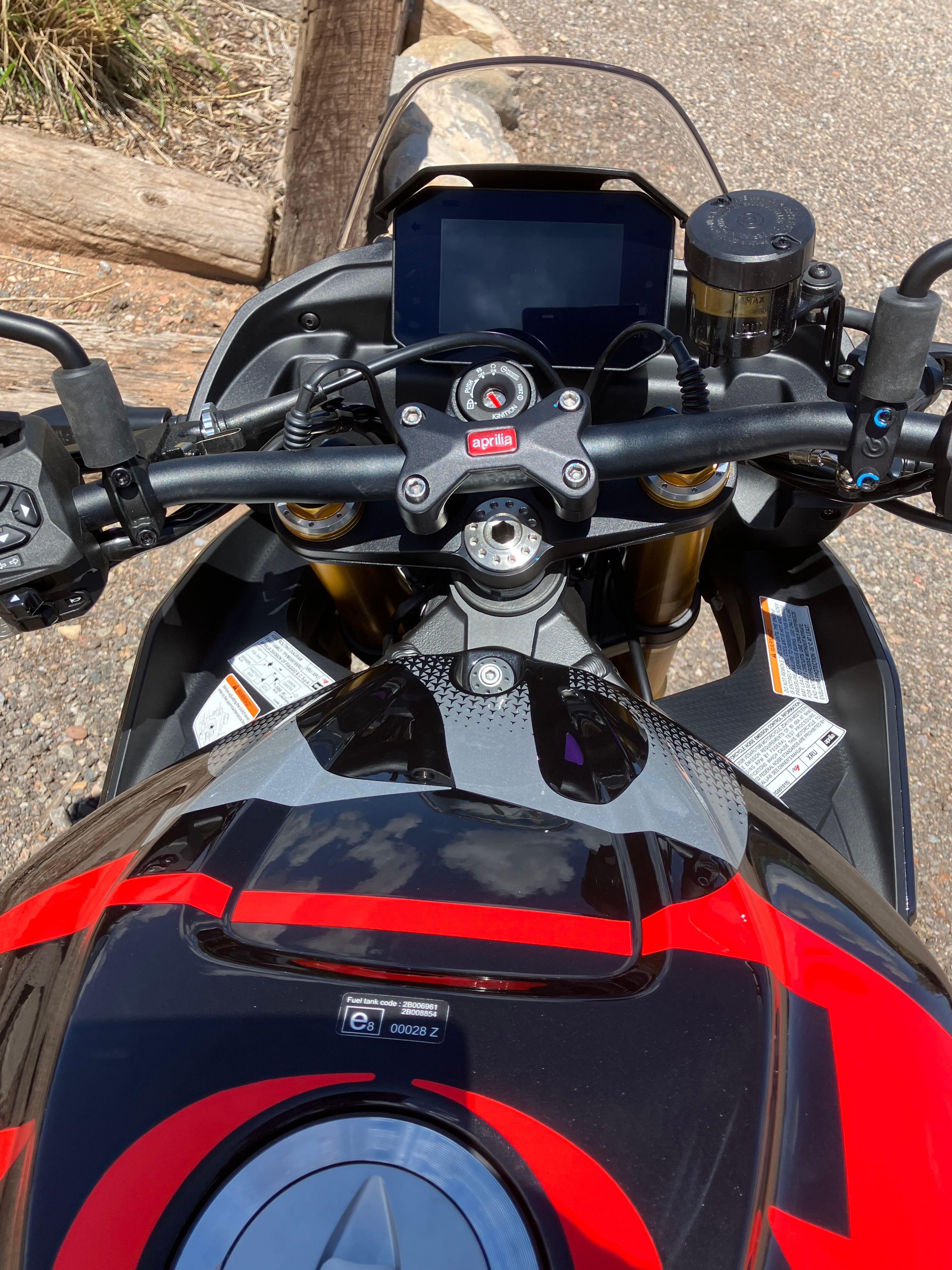
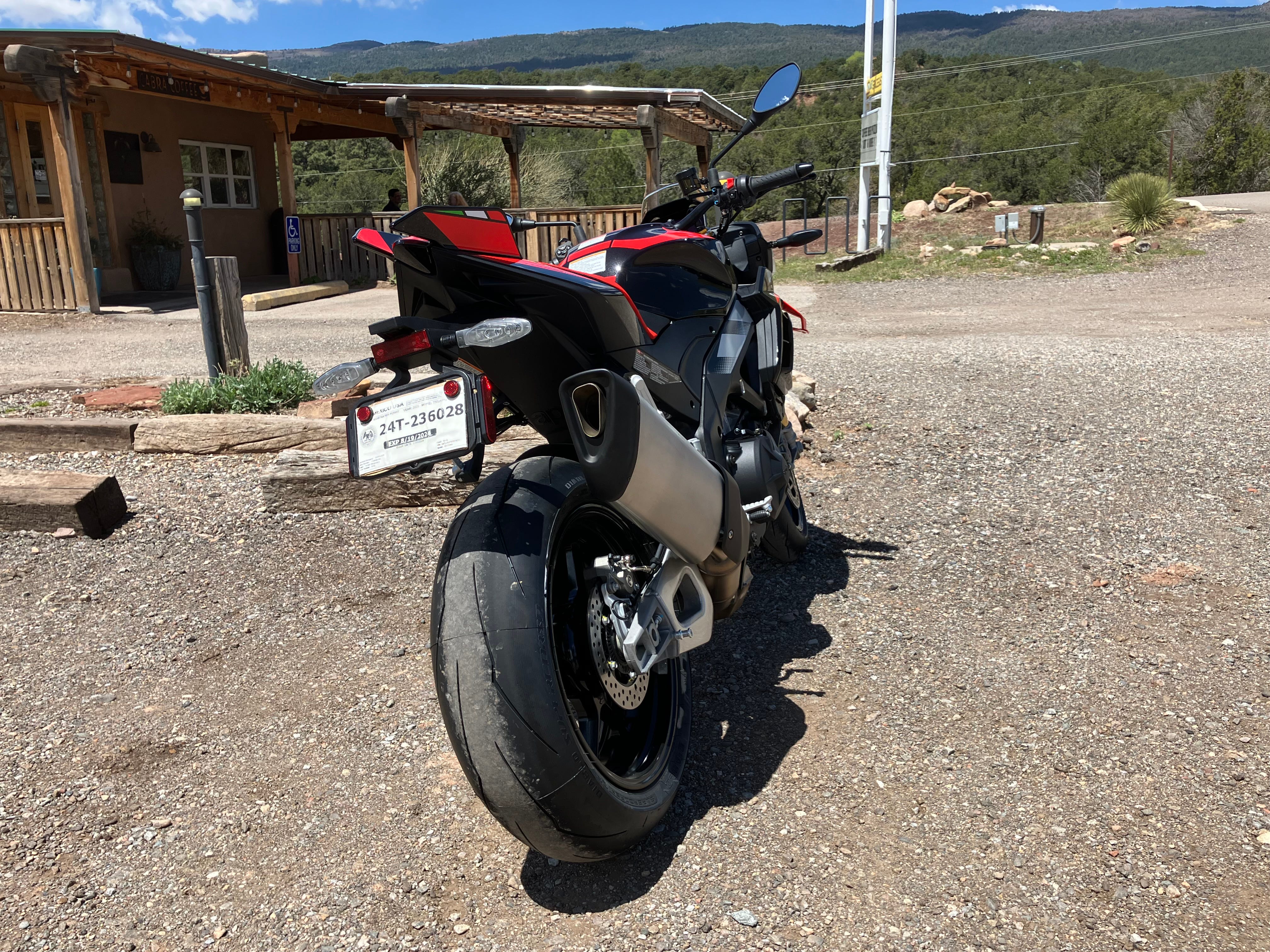
I started riding on a 50cc Aprilia Scarabeo scooter back in 2000. It was a great little machine for popping around town on the cheap. It was my gateway drug into motorcycles. I went through my sportbike phase while still pretty firmly a Triumph guy — I’ve owned the 955 Sprint RS, the 1050cc Speed Triple, the 675cc Street Triple, and I’ve ridden most of the Ducatis that have come out until the last few years. Fast forward — the excellent fellows at Motopia New Mexicorecently picked up the Moto Guzzi and Aprilia lines, as well as MV Augusta. I had to take my V7 in for it’s regular maintenance and was given the new Aprilia Tuono Factory V4 to “go play with it”.

So for the next 24 hours, I got to ride the hell out of it. First off, styling and comfort: it’s Italian, it’s a sportbike. The form mirrors the function: it looks fast and nimble, and boy is it. The wing thingee (the technical term) on the front keeps the nose stable under speed. There’s a single-sided swingarm and single pipe. Chain access is easy. I love the little wings on the back, though I smacked my leg repeatedly when getting on. The mirrors have good visibility and don’t vibrate much when romping on the engine, the windscreen is very effective at pushing the blast off the rider.

I’ve always found the Ducatis, GSX-Rs and most other sport bikes uncomfortable. Your weight is on your wrist and I always feel like I’m perched on top of the things; just waiting to fall off. You sit in the bike with the Tuono, and the bar are comfortably high and wide, and allow for ease of maneuvering. An hour and a half carving up the mountain curves on the Aprilia was comfortable — no fatigue, no hot spots, no pain in the wrists or elbows.

It’s a technological marvel and successfully combines all the things I hate about modern motorcycles in a package that is easy to use. You have wheelie control, traction control, engine break control — the bike practically can ride itself. you can monitor it al on the full color dash, and the togle switch and controls for swapping between the modes and setting up the levels of these electronic aides is easier than I expected.

The suspension is ridiculously smart. It’s got rain, sport and track modes. I didn’t bother with the track mode; it was plenty fast in sport. It’s got an active damping control and wheelie control that I didn’t even notice, except once when getting on the highway. I had to slap the throttle to get past a car and felt the front climbing. Wheelie, for sure…except it just didn’t happen. I found the automatic suspension adjustments of the Öhlins Smart EC 2.0 completely unobtrusive, though a friend who races quite a bit said it messed with his ability to manage the bike in turns. You can, allegedly, turn it off. But for most riders, this would possibly be a life-saver.

The V4 was something Honda created and made well, but Aprilia has perfected it. The 64º 1100cc V4 punches out 180hp and 89 ft-lbs of torque and is managed with a six-speed transmission that wants you to run it long. The motor doesn’t even wake up until 6000rpm. The power delivery is smile-inducingly fast, and the bike never feels like it is straining. On a run out to the backside of the mountain, I got the bike close to the redline in sixth. I though I was doing the ton — I was doing 60mph faster than that. The bike was rock steady. On the mountain twisties at altitudes of 7000 to 10,000 feet, the bike continued to deliver quickly and effortlessly. The quick shift was very useful coming into tight switchbacks — no changing the throttle or hitting the clutch; just shift.

I did notice that bobbling around town the bike got hot and fast, but once you had any speed over about 40mph, the heat washed off quickly. 177F was typical at highway speeds, and it got up to 220F in the hot sun. Pretty standard for a sport bike in traffic. I did also note there’s a flat spot on the fueling about 4000rpm where the motor starts to lag and surge — but my friend at Motopia pointed out I “should be riding it a lot harder than that.”

So is it worth it? It was selling out the door for $26,000 or so. That’s a lotta dough, but this is a top-end race bike…and it is a lot of bike. So, yes — it’s worth every penny (and ticket). I drifted out of my sportbike phase about a decade ago, but this is one of the single best bikes I’ve ever ridden — I’m including the Panigale in this — and it is almost enough to get me back into fast bikes. It’s just simply excellent.

We’ve been gone a while, but the first adventure for our “Prohibition Cycle” — Rum Row — is out on DriveThruRPG.

“Rum Row” is a 2-4 hour scenario for 3-5 players where the characters are roped into a bet — which crew can make the run from Bimini, stop to pick up alcohol at Rum Row and land it in Fort Lauderdale, then return to Bimini first? What could go wrong?

The scenario is written for Ubiquity, but we’ve added some suggestions on how to tweak for other systems like Spirit of the Century‘s FATE and Director’s Cut, the excellent engine for Outgunned Adventure by 2 Little Mice.

After the experience with the MAC2, I thought it would be interesting to see how the Military Armament Corporation’s knock-off of the Benelli M4 (known to the Marines as the M1014) compares. There happened to be a pair of these at the excellent Workhorse Armory here in Albuquerque — one with the walnut furniture, and a more traditional tacticool one. I went with the second.

Unlike the MAC2, which uses the inertia system of the M1/M2 series, the M4 utilizes the “auto-regulating gas-operated” (ARGO) system — it’s a short stroke piston system that supposedly self-cleans (bullshit!), and is supposed to be self-regulating to handle both light and heavy loads. More on that in a moment…

The MAC1014 (in this configuration) came with plastic stock and foregrips, and unlike the MAC2, there was actually a rear sling mount. The shotgun came with a MAC-branded sling, three choke tubes, tools to change said tubes. It uses the “ghost ring” sights — with a nice bright white dot on the front post, and the usual two white dots on the ring for very quick acquisition of the target. It also has a Picatinny rail on the receiver ahead of the read sight for optics. It comes with a 5 round tube — so six shots, total, but like the Benelli, can be modified with aftermarket parts for seven, either from MAC themselves or Benelli-compatible parts. Allegedly, the gun is 99% parts interchangeable.

I did a thorough cleaning, as I had with the other two MAC shotguns and saw none of the finish issues I had with the first MAC2 we tested. The weapon broke down easily and once cleaned and oiled, I took it out to the range the next morning.

This first trip was not the fifty shell shoulder torture of the MAC2; I only shot 30 shells, but could have easily done twice that. One of the supposed benefits of the ARGO system is lighter recoil, and that’s true. Even with older Super-X slugs, the recoil wasn’t worse than my little KS7 firing birdshot.

I kept it simple: all targets were at 20 yards. The ammo used was all Federal Premium and some older Winchester Super-X slugs. About that self-regulating thing with the gas system…nope. Maybe this is a break-in thing, but it really didn’t like the “Personal Defense” loads — 1145fps 00 buckshot. They shot phenomenally well: on point of aim, with a very tight group that had minimal spread (maybe four inches). So, just a good word in for the FliteControl packing for the Federal 00 buckshot; it’s fantastic! But in the MAC 1014, I had a failure to eject with every shell, and I purposefully spread these out with the slugs and heavier buckshot to see if the gun would loosen up a bit as I went on. Nope.

This was not an issue with the Federal Power-Shok buckshot, rated for 1350fps. Recoil was still quite light and I was able to annoy the guy next to me on the range but popping off six in rapid succession. The Power-Shok were nowhere as tight as the FliteControl ammunition, and the spread was about double at 20 yards, including a few over the shoulder of the silhouette. Next was the Federal Trueball slugs rated for 1300fps. These are stout, but I found them surprisingly pleasant to shoot from the 1014, and like the FliteControl — true to point of aim and light enough on the recoil I could drop the whole tube and stay in the nine ring. The older Super-X rifled slugs moving at 1600fps saw me drift a few inches to the right and up, but still in the eight and seven ring, due to recoil, which was noticeable — as was the report; much louder — but not unpleasant.

After the range trip, I broke the shotgun down and cleaned and inspected it. The gas pistons were dirty, but not outrageously so. The barrel was a bit dirty, but one pass had it clean. There was no damage to the finish, as with the original MAC2, and the shotgun went back together without issue. Probably the most annoying parts of the disassembly/reassembly are the bolt handle, which has to be rotated as you pull it out, or it’s not coming; and the two piece forearm, which requires a bit of finesse to get it back in. Nothing serious.

So is it worth it? At $370 before tax, this is an absolutely buy. It’s built like a tank; better than the MAC2, in my opinion, and the ARGO system makes shooting it fun without the shoulder pain. I’ll try some faster birdshot and see if it runs it, but my suggestion for self-defense ammo would be keep it over the 1200fps mark. Federal’s got a FliteControl wad in 00 buck running 1325fps…my suspicion is this would be spot on for home defense by minimizing stray pellets. (Yes, I really impressed with this stuff.)

The walnut stock and forearm version has a nice classic look to it that I really like, as well.

Modiphius had dropped its first supplement for the second edition of Stark Trek Adventures — the Technical Manual is a 129 pages of material on the various gear of the Star Trek universe. From the universal translator to tricorders, alien weapons to phasers, starship systems like the warp drive to replicators, the book gives some insight into the history and working of the toys of Trek. 

There’s new career events choices for character building in the first chapter, as well as some nice talents for characters and service histories for starships that lean into the technical and the weird of the universe. There’s also a new section on space “mines” and the various different types. For those Discovery-philes, there’s material on the spore drive, and the quantum slipstream, transwarp, and protostar systems from the more recent shows also are featured.

Chapter 2 covers the usual equipment that the characters will encounter — from personal gear to replicators and holography. One of the better things that turns up in the chapters, and probably one of the best reasons to buy the book, is the charts for gear compications. Complications are one of the more important, and from what I’ve experienced, one the worst understood, game mechanics in the 2d20 system.

Chapter 3 is an odd choice that hasn’t, to my mind, ever features in a Trek RPG — diplomatic equipment, doctrine, and the like. There’s a large chunk of verbiage on the universal translator, and quite a few charts on complications for diplomatic missions and the use of the universal translator. Chapter 4 goes into scientific equipment, but also has some nice encounter and complication ideas for away teams. Chapter 5, similarly, medical equipment. The material here is influenced heavily by Strange New Worlds and Discovery — and real life: there’s cybernetics, genetic augmentations, and it even has PIke’s chair mentioned. 1966 Trek and the medicine of The Next Generationwas advanced…except for places that should obviously been more so — Worf’s spinal injury, for instance. They could wire LaForge for sight, but not get around a spinal injury with cybernetics?

Chapter 6 deals with the transporter, heavily, and as it is one of the main McGuffins for all the series…good. There’s a section on computer technology from Enterprise to Picard, and a section on the engineering gear of the various eras, plus the complications charts and suggestions. Chapter 7 deals with weapons and armor: from the various hand-to-hand instruments of the various alien races to the various energy weapons, each with a little crypto-history lesson.

Chapter 8 rounds it out with starship systems, and here I think the complications tables for the various different things — from shield or engines, to artificial gravity — will be a big help in starship combat missions.

The layout is clean and in the same design as the 2nd Edition rulebook. This is a good thing, as the LCARS look of the 1st edition, while evocative of the TNG/DS9/VOY era, was a pain to read for most folks. This is clean, neat, easy to read. The artwork is suitably improved, as well. The artwork for the Trek line has always been on the good side, but they’ve been getting it right for the last series of sourcebooks and 2E. While right now, it’s only available on PDF, the pre-order for the physical book is available on the Modiphius website. I suspect they’ll drop it for GenCon, but if it’s the usual hardcover (and seems to be), their track record on physical quality is pretty good.

So is it worth it? At $50 buck on the website for a 129 page book, that’s a bit steep, in my opinion. Hell, the core book isn’t much more expensive for twice the page count and the 2E starter set is selling for $35 on the website. My suspicion is, once we get past GenCon and the release of the book, you’ll be able to find it for a more reasonable $25-30 online. Is it worth buying, yes; at $50…you be the judge.

The copyright for 2d20 system is Modiphius, 2019. STAR TREK and related marks and logos are trademarks of CBS Studios inc. All Rights Reserved and no infringement is intended.

The fantastic fellows at Motopia New Mexico recently picked up MV Augusta as one of their line of machines. They’ve always been pricey high-end, very exclusive sportbikes — or as long as I’ve known about them. They recently got themselves back under the control of the family that created the brand in 1945 and according to the Motopia boys, are very good about sharing profit with the dealers, something not many motorcycle brands do; it’s a very tight margin business that goes dead from about November to April. (Seriously…if you want a bike, don’t wait ‘til “riding season”. Help your local guys out by buying off season and getting in for service work during the winter months.)

I’d seen these Superveloces a few times around town. They are simply stunning. From the torpedo tube/porthole front headlight to the matching singular tail light, there’s nothing on this bike that isn’t beautifully thought out. Every line, every curve cuts through the length of the bike. The triple exhaust with heat shielding (which actually works!) give a nice aggressive flair. The dash is the usual full-color iPad junk that everyone is doing now, but it’s well done and flipping through the menus is easy with a dedicated thumb switch. I didn’t take a pic of it, so here it is off their website…

The version I took out is the inline triple Superveloce. The mill turns out 147hp at the redline of 14,000rpm…which despite being very aggressive on the throttle during my test ride, I never got close to. Ripping it up or flagrantly breaking the local speed limit, I never got about 10k. It’s got a tenor exhaust tone and you can tell that the metals are most likely titanium and other lighter alloys in the engine noise. You can flip it through sport, race, rain, and “custom” modes. I just left it in the stock sport mode. It’s got their EAS 3.0 quick shift transmission. What does that mean? No damned clue, but it shifts fast — enough so the gear indicator lags slightly behind, which is no big deal at speed, but almost caught me stalling while not in neutral at a stop. It’s a six speed. Top end is somewhere around 150mph/240kph. I didn’t get there, but got close. The whole thing weighs in at about 380lbs. It’s light and the weight sits low.

Which is good, because the rider doesn’t sit in the bike — like a normal motorcycle or something like the Ducati Panigale. You perch on it, much like the old Ducati S4R and the lower center of gravity makes the vehicle feel much more planted. I was riding in 20mph winds with 35ish gusts; the bike was stable throughout the ride. The rear seat provides a good bolster that holds you in position. Sitting on it in the showroom, I suspected this would be a “15 minutes and you have to get off”-type sportbike, but I did a full hour on the MV and only the last ten minutes was I feeling any discomfort. Surprisingly, it wasn’t the wrists, which I suspected; it was the hips from the slightly cramped leg position and my elbows (no clue why).

My ride included some in-town traffic, interstate, small road sweepers and mountain twisties with a 2000’ elevation change. Around town, you’re not really getting out of third gear and the bike gets a bit warm, but wasn’t terrible. (It was a warn day, as well.) Getting onto the highway, I had a lot of traffic with a small gap that would allow me to get out into passing lanes, so I romped on the bike and got her from fifty to the ton in about two seconds or so in third gear. Once up to sixth, the bike was calm and quiet at 6000rpm. I got off and onto the small two lane highways that go around the back of the Sandia Mountains (studiously obeying the speed limits, of course) and was in fourth pretty much for the usual 50-60mph speeds. Once on the Crest Road that winds 13 miles and 4000’ in climb with 120 turns, including some sharp switchbacks, I really let the bike play.

While riding, the nose of the bike was just visible below, and provided a nice “artificial horizon” for some of the turns. I wasn’t doing race track style leans, but I did give it a fair amount of tip over at go to jail speeds. You didn’t need to do more than look down with your eyes to see the instrument panel and mirrors — which do vibrate a bit under power. It turns smoothly and well — easily on par with any other big name race bike out there.

On the run back into town, I had I-40 pretty much to myself for about three miles and put the spurs to the bike. Smooth and fast power delivery, minimum buzz on the handlebars (but a lot on the mirrors), and it rolled over the three digit mark with aplomb. For most people, there’s more than enough bike to keep you happy. I love triples for the fast torque (about 65 ft.-lbs. or 88nm) they provide and blipping and laying off the throttle for engine braking allowed very quick passes, speed drops, and coupled with the excellent suspension and dual front Brembo brakes, navigating traffic aggressively is a doddle.

I finished by ride with a simple “Wow!” It really is bloody marvelous.

There is a liter-bike version of the Superveloce with MV’s 4-cylinder they use in one of the Brutale models, but I haven’t had a chance to ride it yet. It seems a titch faster, but the specs on the website seem to be pretty much the same. For looks, the “98” limited version of this machine is stupefyingly beautiful is a deep burgundy with silver accents.

So is it worth it? At $24,500 MSRP plus set-up, this is a pricey machine for a cheap bugger like me, but for the Ducati/BMW/Aprilia crowd, I suspect this is fine. The workmanship is top notch — fit and finish is simply wonderful, the look is unlike the bug-headed monstrosities most sport bikes have become, and performance is more than adequate for the street hooligan or amateur racer. So, yes — it’s well worth it.

My experience with my first “Turkenelli” — the Military Armament Corporation’s MAC 2 shotgun was…lackluster. You can read about it here. A knockoff of the Benelli M2 12 gauge semiautomatic shotgun, it is an exacting enough clone that they are supposedly 90%+ parts compatible. When I took the thing down the first time, I didn’t need the instructions; it was nearly identical to my old M1 Super 90 from the ‘90s. The question was, at $400 after tax, was I getting anywhere near the quality and usability of a gun five times the cost?

Having had a plethora of issues with the weapon, SDS Imports out of Chattanooga had me send it back. The experience with their customer service department was very good. The lady on the phone had responded to my initial email within 24 hours, the tech team had looked at the pictures and concluded “Whiskey Tango Foxtrot” and had me send it back. 48 hours later (plus Sunday), I had a new MAC 2. I decided to do the same 50 round run at the local range to see if my experience would be replicated.

I got the same marine-finish MAC 2 with black plastic furniture and a standard shotgun grip. (I like these more than the “tactical” grips.) The MAC 2 comes with the standard Benelli ghost ring sights, but also an Picatinny optics rail. It has a front slug mount…but not a rear. (Really, guys?) A rotating and heavily knurled cocking lever, standard button to release the bolt, and cross-bolt safety. Exactly like the Italian M1/M2s. It also comes with cylinder, modified, and full chokes. The finish is nice — and appears to have been badly applied in my original unit, judging from the level of wear seen. More in a moment.

For the test, a ran 5 rounds of Winchester #4 buck, 30 rounds of 00 buck — all with a 1150fps velocity according to the boxes; 5 more 00 buck with a 1350fps speed, and lastly 5 shells of older Super-X rifled slug with an 1150fps speed. I figured, like the Benelli, the lower velocity might give me malfunctions to eject or feed like some of the Benellis have in the past. All 50 shells ran without an issue.

The original MAC 2 I had purchased patterned very well an shot true to point of aim with the pre-installed cylinder choke. The #4 buck shot a wide pattern at 15 yards — about 30 inches on the widest axis. The pellets on the 00 were generally within a foot or so and stayed on the silhouette target, aiming center mass at 20 yards and not really taking my time. Interestingly, the shot cups veered pretty wildly — up to two feet from the shot pattern. Slugs shot to point of aim between 5 and 20 yards.

The MAC 2 can pop them out pretty quickly, too. The inertia system of the older Benellis isn’t as quick at the ARGO in the M4, but the gun never lagged behind my ability to get back on target and hit the trigger again. Extraction was enthusiastic, as well; the shells were throwing about three yards and slightly forward. Recoil is not as soft as the ARGO delivers, but it’s not as brutal as a pump action.

With a successful range trip concluded and only the barrel/tube support having worked its way forward during shooting, I took it home to clear the thing. This is were things went wrong with the first MAC 2, and I’m pleased to report that this shotgun did not show the signs of wear on the finish anywhere I looked. Not did it have the damage to the bolt head or receiver that the initial gun did. While a sample of two is hard to make sweeping generalizations — I suspect I got a Monday morning gun the first time. It disassembled and reassembled without issue and the internals were not overly dirty, as you would expect from an inertial semi-auto.

The MAC 2 has the following specs:

  • Chamber: 12-gauge, 3-in.
  • Action: semi-auto, inertia
  • Barrel Length: 18.5 in.
  • Stock/Forearm: Black plastic (although they do a really nice walnut.)
  • Capacity: 5+1 (MAC’s website does have +2 tubes.)
  • Sights: adjustable ghost ring rear/blade front
  • Optic Compatible: yes (Picatinny rail)
  • Finish: bead-blast aluminum
  • Overall Length: 47.8 in.
  • Weight: 6 lb., 8 oz.
  • Chokes: Benelli/Mobil® 1/3/5
  • MSRP: $549.99 (I got mine for $350+tax.)

So…is it worth it? In the original review, hell no. Now? If this shotgun is indicative of the quality of most of the MAC shotguns, then yes. You get a parts-compatible Benelli clone for a third the price that runs well (even the original shotgun I tested ran with only two failures to eject)) and looks the part. I might even pop for their M4 clone.

About five years ago, I bought my buddy’s 2014 Abarth 500. It’s the GQ Edition, so it’s got just about every doo-dad they had for the 500 at the time. Convertable — well, “cabriolet”, it’s got heated seats, satellite radio/CD/and bluetooth for the phone. Leather seats and they’re comfortable. It handles incredibly well, taking twisties like a motorcycle. I did get rid of the low-profile tires for slightly taller ones, taking the bite out of its ride. It is, simply, the most comfortable, best handling car I’ve owned. It’s light and the turbo 1.4 MultiAir gives her, in the Abarth tune, about 160ish horsepower. It’s done very well in dusting everything from a WRX or Alfa Guilla, to a RAM 1500 that was intent on trying to race me for some reason. The main reason is the car is light — 2300ish pounds. Gas milage is about 30mpg around town, but jumps to 33 mpg in sport mode. Turn the stability control “half” off and the clutch response is much, much better than in standard road mode (where it’s pretty awful). Turn it all the way off and it’s a go-kart.

It’s been a reliable, excellent little car for much of that. I had an issue with a blown exhaust valve on cylinder one last year that required a rebuild, but since then she’s been solid, once more. Even with the cylinder down, the damned thing still ran. Once fixed, I ran into a problem that 2014 model Abarths have — the catalytic converter is only listed up to 2013. No one wants to order one for you and install it. So I bought a 200 cell cat from TMC in Northern Ireland. It does make the O2 sensor throw a code intermittently, but it runs without issue.

A family issue came up back in Pennsylvania a few months back, so what better time to give the car a real shakedown during the daughter’s spring break. We added a side trip to Florida to visit more family because what could possibly go wrong with an 11 year old Fiat with 80,000 miles on it during a 5000 mile road trip?

(Here she is in Texas, before the bugs hit.)

We took off from Albuquerque early on a Thursday to miss the massive wind storms that would hit the next day in Texas and Oklahoma, and drove 15 hours to Tennessee without issue. Gas mileage was 37-40 mpg. Once we got below 2000 ft. the check engine code for the rear O2 sensor cleared. 

The next day, we were on the road in the late morning for the last leg to Pennsylvania. We dodged a couple of serious wrecks in Tennessee — where apparently everyone thinks it’s NASCAR on the road — and saw a drop in MPG to bout 30-32 through the Smokey Mountains. We hit Pennsylvania by nine in the evening and threw a code and had the engine shudder a bit. The number four piston was coding. When I started her, it ran a bit rough but still got us 2 hours into our destination. Total distance, 2100ish miles

The spark plugs had cooked, with the number 4 having blown off the electrode hook. I got the plugs changed and had the car sounded. No issues. It drove fine for the next few days, and then we started our leg to Tallahassee — about a 1000 miles. All good until Charlotte — where between it and Columbia, the interstate turned into a parking lot for two hours. Same code. Shit. We still had five hours to drive. The car, despite this, wasn’t running especially rough, loud, but gas mileage dropped to 28ish mpg. Despite all this, it got us to our destination.

Another shop and it was what I suspected, the plugs had mostly killed the number 4 coil. One coil pack later, we were back on the road the next day. The final run home to Albuquerque saw no codes (other than the P0440 because I hadn’t closed the gas cap properly during a fuel stop) and she ran flawlessly with a steady elevation change to 6000 ft. for the pass into town. At about 4000’, the rear O2 sensor alerted again. But with two 12 hour days on the return leg, the car got us in safely.

Coils and plugs — fairly standard wear and tear, especially at her mileage. Despite this failures, the car never stopped running (well, even) and got us where we needed to go. We were averaging 12 hour days in the car when we were traveling between destinations and absolutely not speeding, at all — nuh, uh! — yet until the last day, I didn’t really feel any physical fatigue from sitting in the car. The daughter felt fine with her seat reclined and sleeping. The A/C blew cold the whole trip. No other issues.

Not too bad. So, the lessons I learned: 1) 5000 miles is a long way to drive in 11 days. 2) Other than general wear issues, the Abarth 500 is a pretty damned reliable car. 3) When stuck on little Georgia back roads because Apple Maps decided we needed to go on a scenic tour of nowhere, this car can rip up a winding backwoods road like it thinks it’s a Ferrari. (It’s not….)

You can find these things pretty cheap now. They’re definitely worth it for a cheap, fun ride.

So, I bought a MAC 2 shotgun about a month back and had a… not great experience with it. After sending in the pictures taken upon cleaning it after the first use, I was contacted by Reyes for SDS customer service in Knoxville within a day of sending the email with the complaint. When I called her, I forgot about time zones and such and got in touch with them only 15 minutes before close for the weekend. She informed me that the tech guys had looked over the pics and yes — that was not normal and send the gun back. Before clocking out for the day, she had my waybill emailed to me with the instructions on returning it.

FedEx took a week to get it back to SDS, during which time I was on a roadtrip that would have allowed me to just drop the damned thing off about the same time. But the turnaround was 72 hours. I had a replacement MAC2 by Monday. Same model and finish. Noted remarked that the damage was mostly the bead-blast style coating flaking from wear. Not good, but not actual structural damage, save that seen on the bolt face. Still — good response from SDS: their customer service is solid, the tech guys didn’t cheap me out like I was expecting, and once I get this out to shoot, hopefully, I’ll have a better experience.

I’m not really a shotgun guy. I don’t find twelve gauge all that much fun to shoot, but I always had one. I’ve owned a few semiautomatic shotguns, including the original Benelli M1 Super 90. I noticed a knock-off of the Benelli M2 by Military Armament Corporation at the gun store the other day. The price was hard to resist (sub $400), so I didn’t.

Now, I’ve heard a lot about the quality of Turkish shotguns being as bad as some of their handguns (Tisas) are good. But at $400, I figure if it’s even halfway to the Benelli, it would be worth it.

So how good is it? Wrong question. How bad is it?

First, the good stuff: It actually comes with chokes, something Benellis I’ve bought don’t, plus the tools to adjust the chokes, the sights, the angle and distance of the stock. It’s got adjustable ghost ring sights, a rail for optics, and is very pointable and light. It looks good, and at first pass, the action runs well and smoothly.

I got the M2 home last week, and broke it down, cleaned and lubed it. I noted a few aluminum shavings here and there — probably missed in the cleaning phase of the production. I took it out for a run today (Monday). I put a total of only 50 shells through it (plus another 30 in a Kel Tec KS7). It’s pretty light at six and a half pounds, and you feel the stouter stuff after a few boxes.

The M2 uses the time-tested Benelli inertial recoil system, so it should run some of the lighter stuff that the ARGO system wouldn’t. In this case, I started with some Norma reduced recoil buckshot. Out of 20 rounds, I had a single failure to eject. Not a bas start. I tried a couple of shorty Aguilas, anticipating they wouldn’t cycle. I was correct. Back to Norma Performance buckshot for 20 rounds. The Turkenelli ran them without issue, save for one failure to eject. Again, for the first time out, now awful. Hornady Black buckshot ran like a top save for one failure to fire that looked to be the round. (It was three years old.) Ten rounds of slug with no malfunctions. All 2 3/4rds, no magnums.

Accuracy was decent, though the reduced recoil shot about two inches high at 15 yards. It was spot on with the Black and slug. While the shorties didn’t cycle, they did pattern spot on at point of aim.

So far, so good. As usual, when I got home, I started cleaning the weapons, starting with the MAC 2. First thing I noted was that the magazine tube really didn’t want to unscrew. I also noticed a bunch of aluminum shavings from the threads and there was some damage from the brace that holds the mag tube and barrel. It had worked it’s way forward a bit during firing.

I don’t mean a few shavings like you’d find from having not cleaned the area…

This is just from the magazine tube being unscrewed. But wait, there’s more. I pulled the tube and dismounted the barrel. Here’s the front of the receiver:

Note not just the impact damage where it meets the barrel; look inside the receiver there. But we’re just getting started, Dear Reader. I pulled the bolt and took it down. Here’s the bolt:

Aluminum shavings. I popped the trigger assembly, using the firing pin retaining pin, as they instructed. That was a mistake:

Nice. And before you say anything, yes — you could do this with the Benelli and not break stuff. With the trigger guard off, the real fun started. There were aluminum shavings and damage everywhere. Remember, this is only 50 shells, nothing hot; in fact, half of it was reduced recoil.

No — that’s not dirt. How’d the bolt look? It was scuffed at the front of the face.

After half an hour of cleaning I had a nice collection of metal filings and had to go over the cleaning mat twice just to get rid of the bits. I even vacuumed the floor under my seat. And once I was done and oiled the weapon…? More shavings.

That’s after I cleaned the hell out of the gun. There was still more.

Aluminum, admittedly, seems a bit of a bad choice for a 12 gauge, but I’ve seen it from other manufacturers. None of their stuff spontaneously shed aluminum, like Arianna Grande losing weight. And again — 50 rounds of normal factory ammunition.

So is it worth it? NO. Not just no, hell no. Steer away from this. I can only imagine how they’ve messed up the ARGO system in their 1014s. Yes, it’s sub-$400, but you can get a Maverick, which won’t shred itself with normal operation. Hell, my cheap Kel Tec has hundreds of rounds through it and even eats shorty shells: no failures.

I have a warranty claim into MAC for the firing pin retaining pin and a request to replace the weapon. Will I fire this thing again? Unlikely. If it’s shedding metal, it’s going to fail somewhere.

Update: I reached out to SDS in Tennessee the same day as this occurred, and I will give them this — their customer service folks are on it. They confirmed that this is not a normal event and that the weapon needs to be replaced. The lady on the CS line was very helpful, especially as I got in touch with them right at the end of their work day.

More as events unfold…

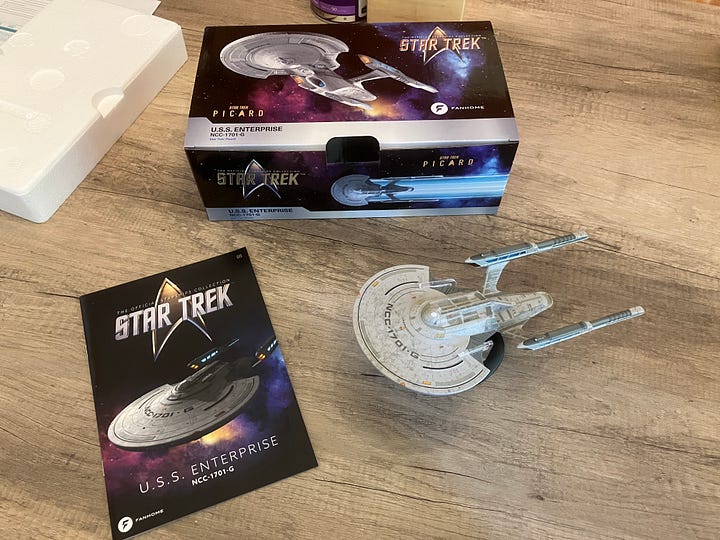
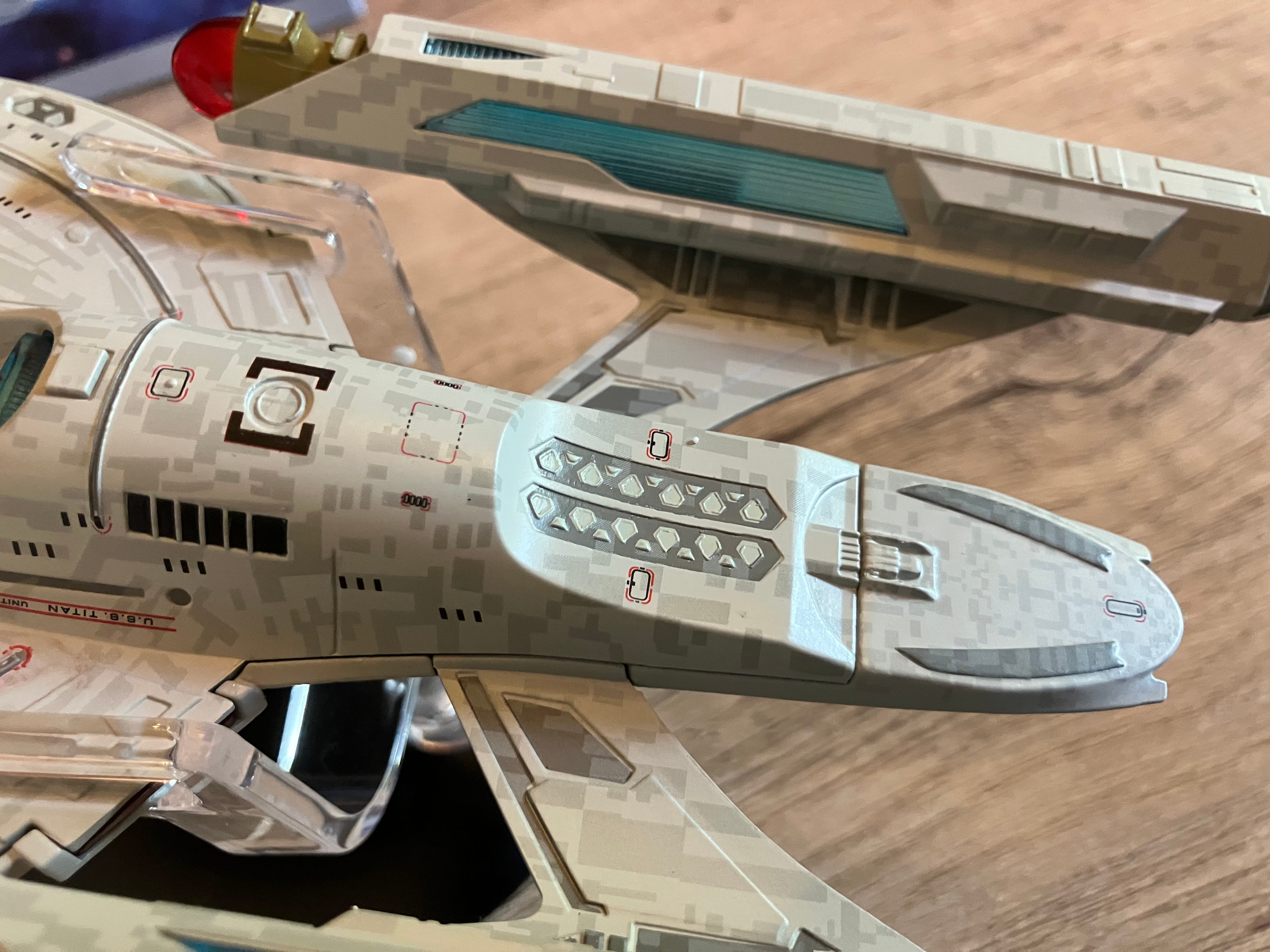
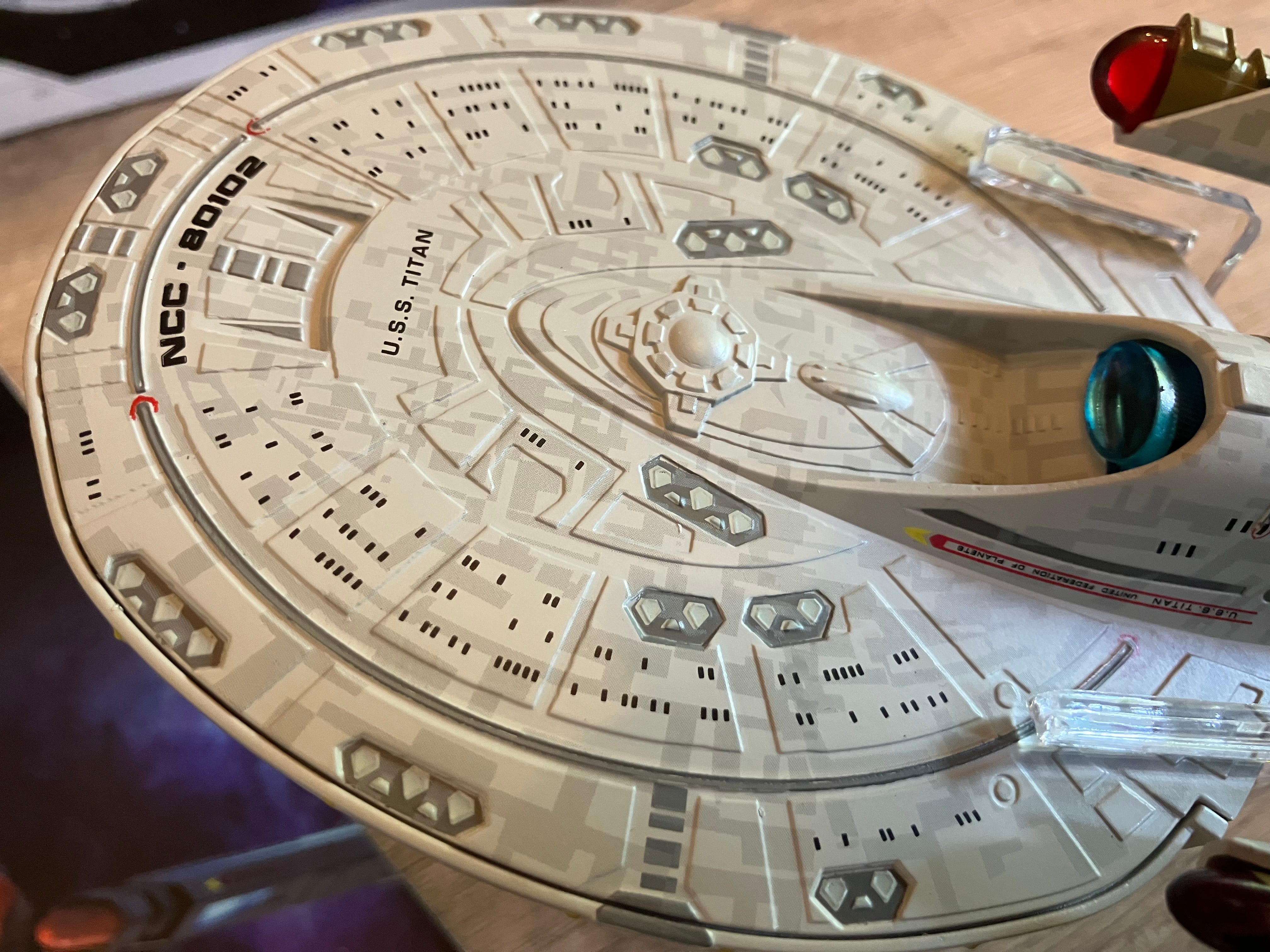
The latest from FanHome’s Starships Collection got delivered yesterday. I’ll admit, I didn’t have much interest in this one. Not being a player of Star Trek Online, I didn’t know anything about this particular ship. Its appearance in the third season of Picardwas my first exposure to the Odyssey-class Enterprise-F.

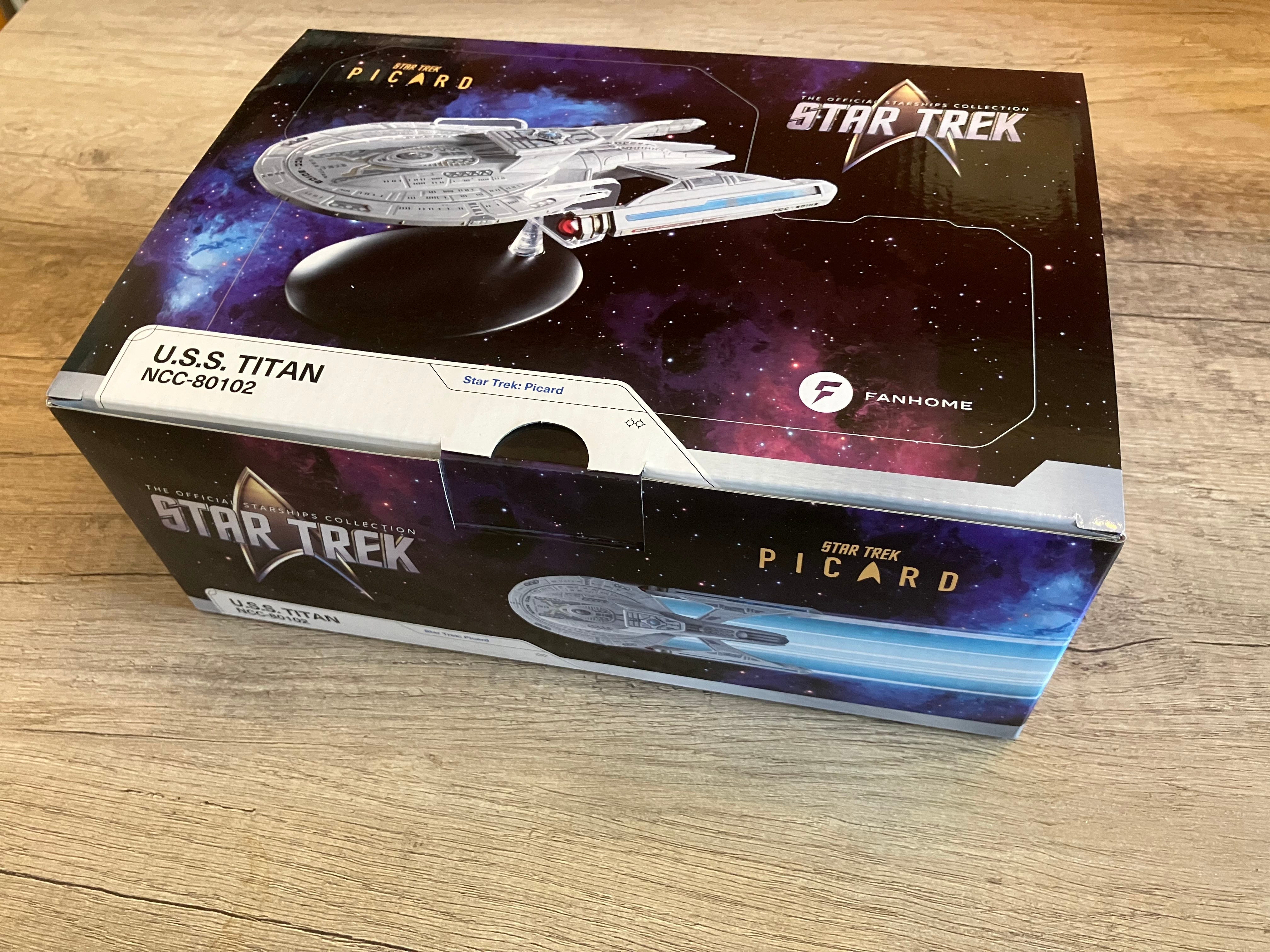
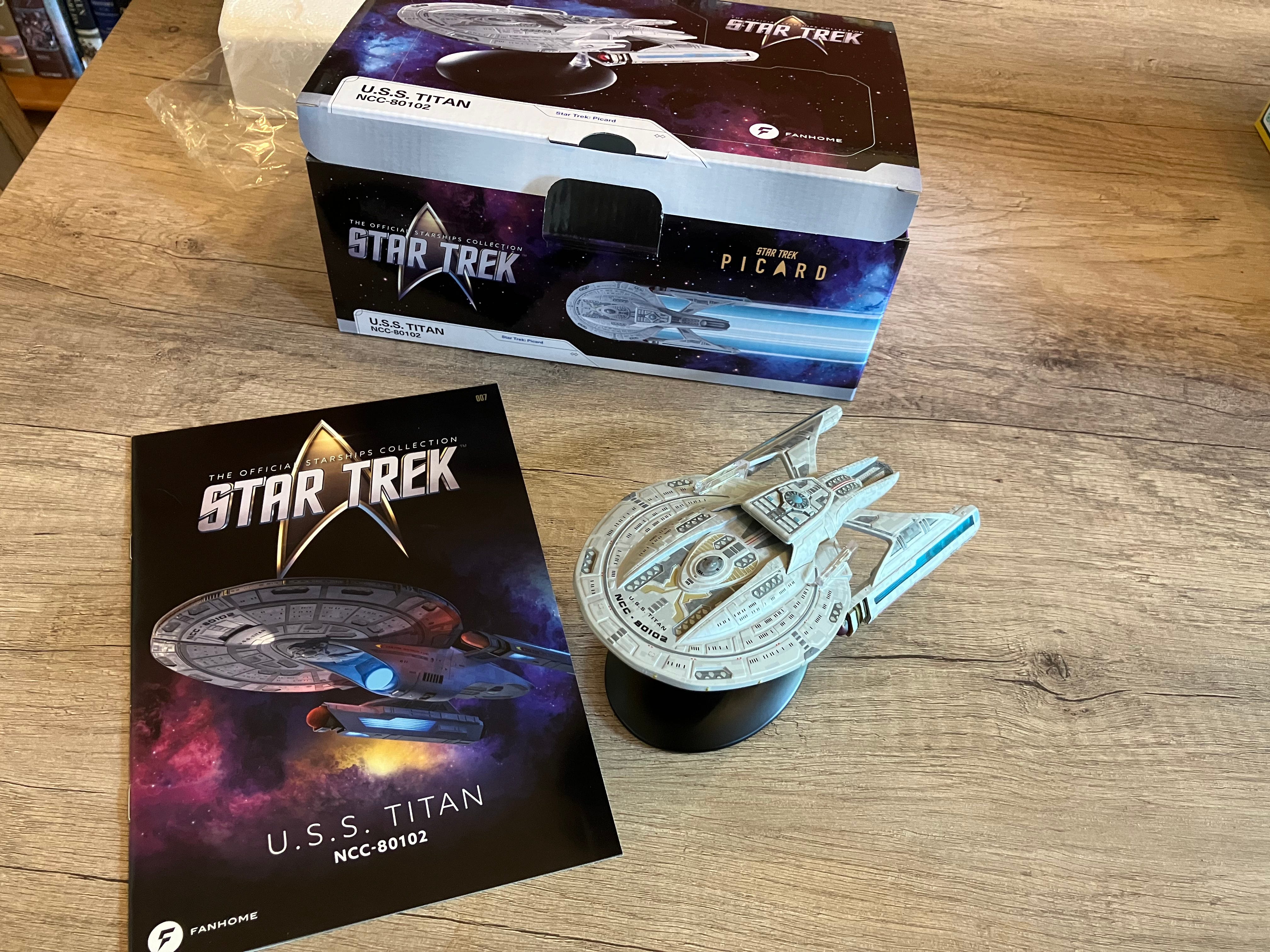
The packaging continues to be much better than the old Eaglemoss stuff: colorful and eye-catching, and this model is their first XL edition. To indicate this, the box has raised embossing for the Star Trek name. The packing is the typical styrofoam set up of the Eaglemoss models. The booklet on the design of the craft and its appearances is tucked in the box, following the lead of what Eaglemoss was doing with the later releases, rather than the large format from the older ships. (I prefer the smaller booklet.)

This shipment included two free extras for the subscribers: a raktejino mug and a master systems display of USS Titan-A. The display is tucked between two thick slabs of plexiglass, and it’s tiny — about the same size as the booklet (it’s in the cardboard box under the booklet in the picture). The mug is small — an 8 oz., I think, and yes — Colombia is misspelled. But since it’s free stuff, I don’t really care.

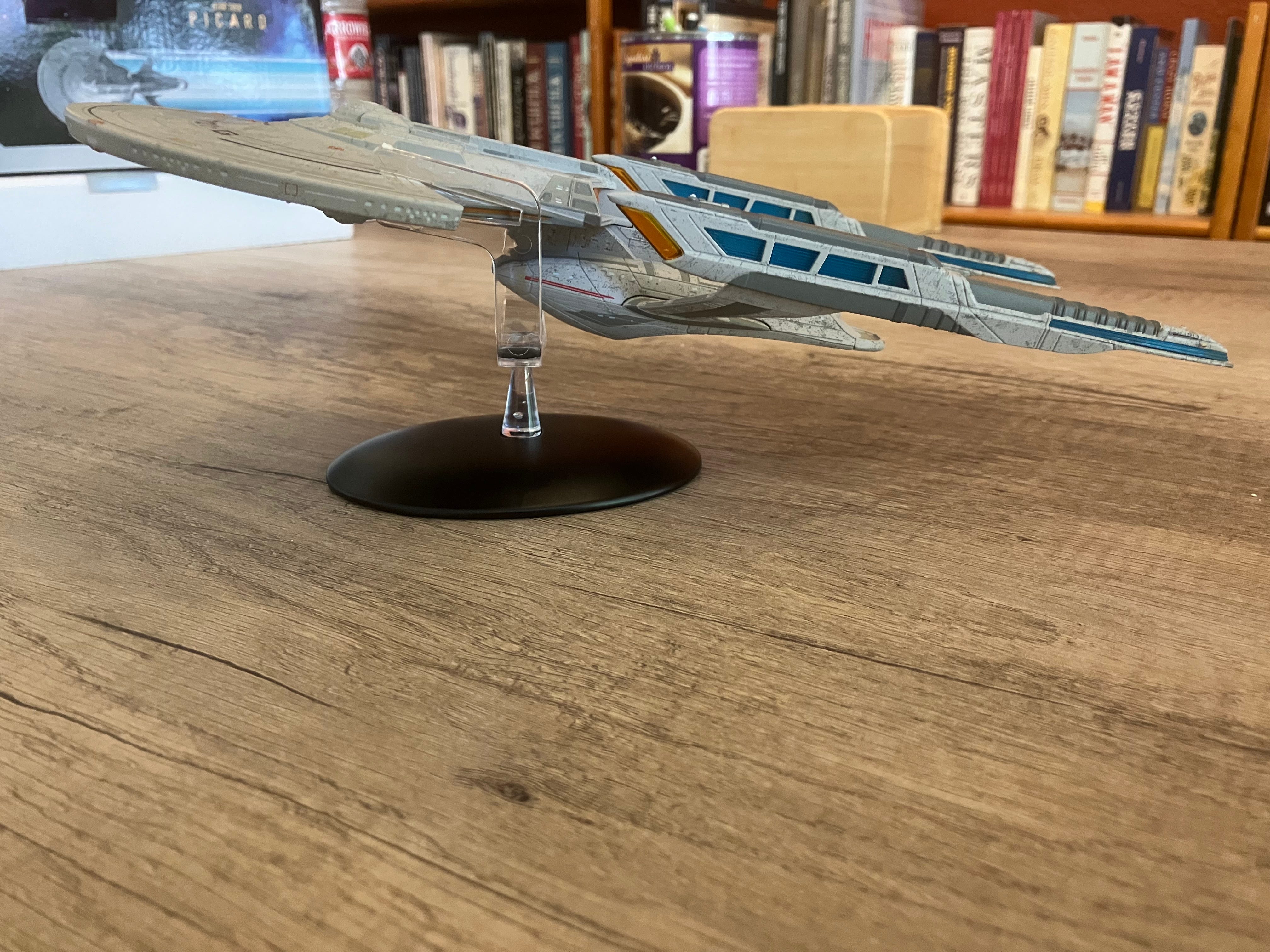
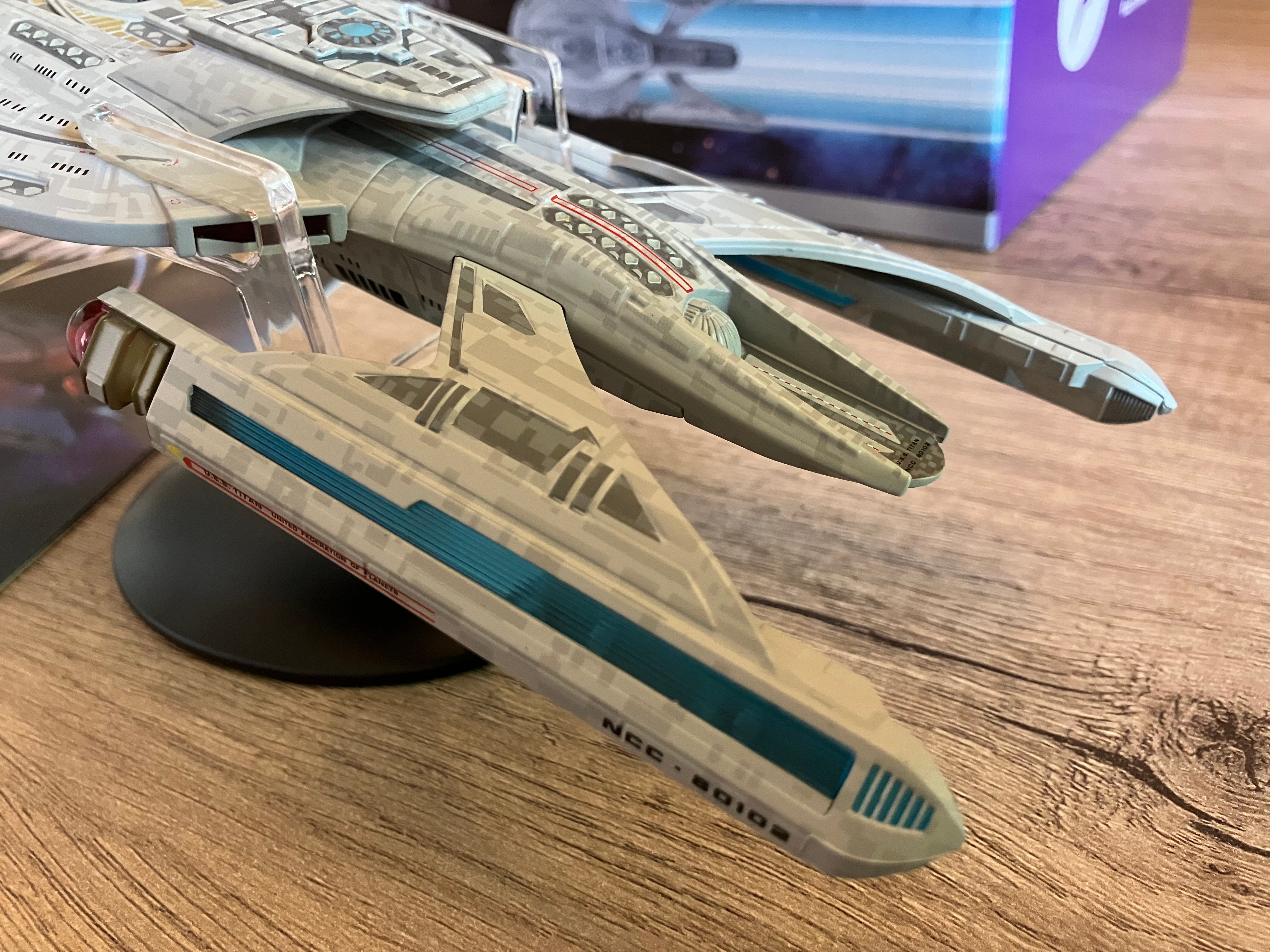
Enterprise herself is gorgeous. I’ll admit — I’m not a fan of this design. It’s squarely in the “negative space” period of design, with ships having open space in places that, frankly, don’t make much sense. In this case, the Enterprise has two thin “necks” holding the saucer section to the secondary hull. The nacelles look better than the Akira-era and the Picard-era nacelles, though; I like ‘em. The ship is supposed to be huge — 1600m stem to stern, with an embarked Aquarius-class runabout tucked where the aft shuttlebay usually is. 

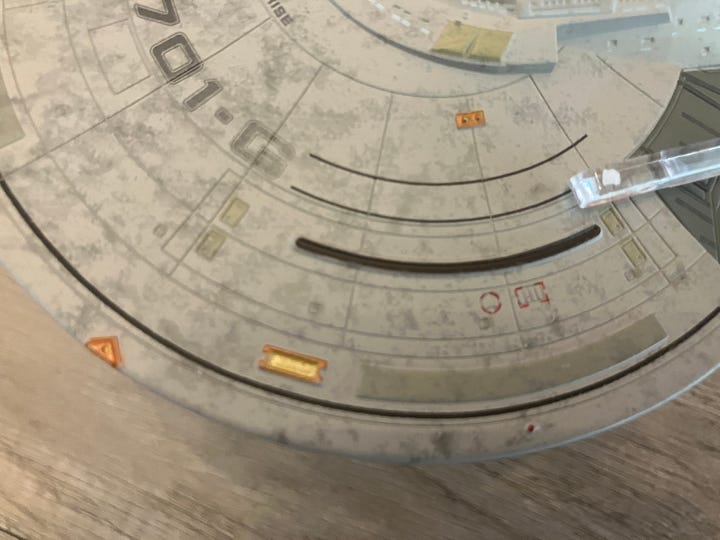
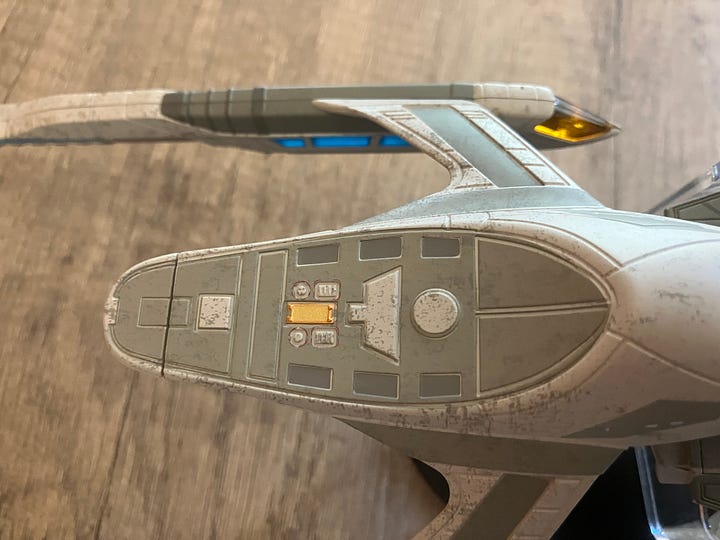
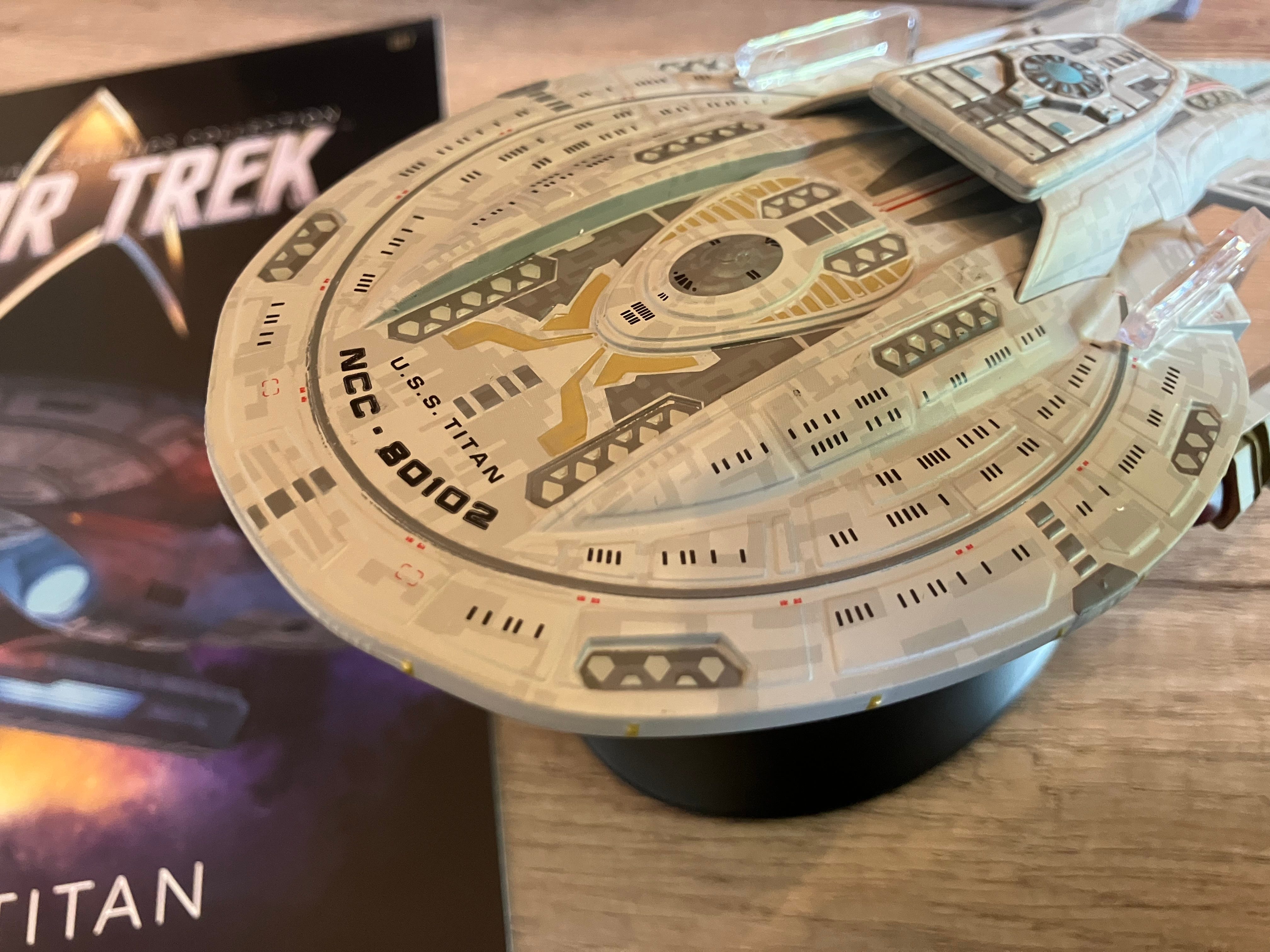
Despite all these niggles, the model is gorgeous, with only a few points that collector have been noting. The impulse drives are not painted red on the nacelles nor the saucer. The Aquarius is painted dark, with minimal detailing. Outside of that, they’ve done a good job with the window placement and decals. I particularly like the UFP seal above the name of the ship. This seems appropriate as in-canon, these are massive diplomatic-focused vessels.

Like Stargazer, seeing the vessel in person is a different experience than on the screen. I wasn’t particularly impressed with Stargazer when it showed in season two of Picard, but the model won me over. I still hate the negative space fascination John Eaves has, but “the F” is much more attractive when you can rotate it and appreciate it from various angles.

FanHome’s off to a great start, in my opinion, with this collection. So is this Enterpriseworth it? It you’re a completist, it you like your starships “looking all Sovereign-y”, as Mariner Beckett put it, if you like the STO ships — yes. If you’re not a fan of the newer Trek, it might not appeal at $90ish. I’ll admit, this is one that will probably get shelved and sold later, unlike Titan and Stargazer. I’m hoping for a focus on Strange New Worlds ships — I’d like to see the new Gorn craft, or maybe a TOS-styled Miranda

With four months of deliveries under the belt, I figure it’s time to address a few things outside the quality of the models. There’s quite a few folks that are grousing about the shipping of the models. (But that’s what the internet is for, yes?) The third shipment, in particular, looked to have been kludged up for a lot of the subscribers — however, I would point out that coincided with the holiday mailing rush and a fairly impressive set of storms through the center of the country.

Here in the States, shipping is being handled by OSM (One Stop Mailing) — a pretty big concern in shipping, it seems. They’re doing the pass off to the post service for the final delivery, but it looks like they handle pickup from FanHome in the US. Normally, a bulk service like this aggregates as many shipments as it can, which is probably why we see a lag time from pickup to when the packages seem to start moving through the system. That said, my shipments have been coming in a consistent four days after the estimated delivery dates (between the 12th and 17th of the month) on the FanHome website. There’s usually a hold up on the package tracking between Kansas City and the next stop, Glendale Heights in Illinois. Partly, this might be OSM aggregating packages, but I suspect that there’s some kind of update issue — USPS is notoriously bad at allowing you to track packages in its system, and KC is one of the more problematic postal hubs in the country — so I think the lag between KC and the next step is more a sorting and tracking issue than the shipments just sitting somewhere. But I could also be full of $h!t.