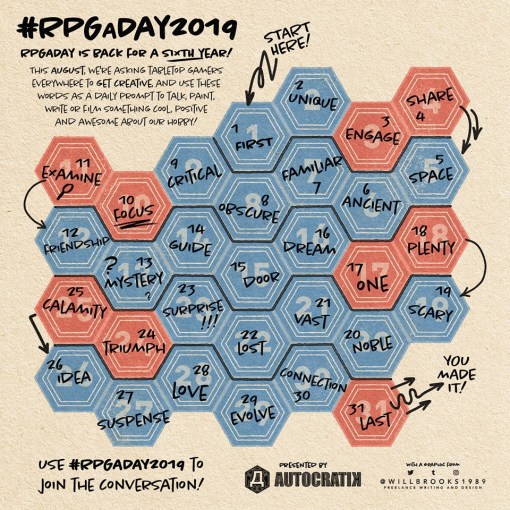
Surprisingly, I had trouble with this prompt. My initial desire was to talk about gaming space — the physical (or virtual) location one plays in, and sort of the dream library (not a man cave — a proper library) I envisioned, but it turns out I’m not hugely interested in pursuing that. So what to talk about..?

Recently, I grew tired of the ’30s pulp game (Hollow Earth Expedition) I’ve been running. It’s a great game with good characters, and the players enjoy it, but it’s been one of two campaigns we’ve been cycling through every few months since this group came together almost three years ago. Prior to that, the pulp game had been the main game for the group for about a year or so prior to that.

All of this had been the rebound game after an epic, five-year long Battlestar Galactica game I’d been running. That campaign was easily the best bit of gaming I’ve been part of,  and I’ve been gaming for four decades, so that’s saying something. It remains the only campaign I miss, and I’ve had plenty of games I’ve been in I’ve really enjoyed, because I hit my stride as a GM. So recently, I’ve really wanted to return to a space opera setting…and hence the tie to the prompt.

I had considered a space-based game for the next rotation, while I get my taste back for the ’30s. The two choices were Battlestar Galactica — but I wasn’t sure we could catch lightning in the bottle again; and Star Trek. Recently, I’ve watched Star Trek: Discovery, and truly enjoyed the second season, despite the interminable “talking about our feelings” scenes and the execrable spore drive McGuffin. I floated the idea of doing a “pilot episode” for both and we started with Star Trek. To my surprise, the group — most of whom only had a passing knowledge of the various series — loved it.

Space is an environment that works well for RPGs because of several elements: First, it’s insanely dangerous. Even soft sci-fi can’t escape things like vacuum, even if you use a lot of hand-waving to ignore weightlessness and the attendant health dangers, radiation, aliens, and the forces that speeds high enough to get around the galaxy entail (inertial dampners, anyone?) are still waiting to kill the shit out of you.

Second, it’s isolating. You’re far from things in space, even in a solar system. One of the issues I had with Discovery‘s spore drive (other than the mushroom idiocy) was that it made space small. It was a similar issue I had with the J.J. Abrams movies. Need to get somewhere? Done! Trek has always traveled at the speed of plot, but this removed the sense of exploration and wonder. Everything was a quick nip down to the corner. I decided to use old show scales of speed — they are often weeks from anywhere, and communications repeaters might allow you to talk to the bosses back home, but once you are outside of the Federation, you are aloneGalactica worked so well because Man was truly alone. There were no “head of the week” aliens just around the corner, or life-sustaining planets. “The universe is a pretty barren place when you get down to it,” as Colonel Tigh tells the president in an early episode. It’s why arctic and antarctic settings work so well for horror — no one is coming to save you.

Third, there’s the unknown. You meet things that are hard to understand or communicate with. There’s physical events and things that can’t be overcome (unless you rewire the deflector dish into a spiraling quantum whatsinator…) One of the issues with the “head of the week” approach of Star Trek is that aliens become just people with strange customs…they’re rarely strange. Even with the watering down of the recent movies, the creature from Alien was strange!

There’s a number of great settings that have RPGs attached to them. There’s the hardish science fiction of The Expanse (although after a quick look at the rules set a few days ago, the game looks to be a hot mess…), there’s the upcoming horror of Alien, done by the guys who gave us Tales from the Loop; there’s various version of Star Trek (I prefer the Decipher CODA system to the new Modipius’ 2d20 system), and there’s the more customizable games like Traveler. You can get your Firefly fix with classic or the Fate-ified Cortex, and there’s even the steampunk of Space: 1889.

Get out there.

Role playing games have been a big part of my life. Since I discovered the basic set Dungeons & Dragons in the late ’70s until today — probably four decades and a bit — gaming has been my main hobby through multiple careers, moves to various different places, sets of friends that came and went, or stayed. It helped me make dozens of friends, meet women, get laid, get married, get jobs (true!) Until I discovered motorcycling in the early 21st Century, it was one of the only outlets I had that wasn’t professional. My first novel was inspired by some game research. Adventures I’ve run have become products for other gamers — shared on DriveThruRPG under the Black Campbell Entertainment brand. (And thus endeth the shameless plug…) There are still stories that I and my gamer buddies will talk about, “Remember that time Antae kicked in the door and the Great Evil was standing right there?” “Remember when that dipshit we used to play with asked the guard [who had missed one of his blasters in a search] if ‘he wanted the other one, too?’ ” or “how ’bout the guy that thought his character was ‘haunting him in his dreams’ because the player did something stupid, got the character killed, and we weren’t a respectful as he thought we should be. I wonder if he’s killed someone yet…”

Stories and characters and moments that still stick with you across a decade or more, and that were a hell of a lot more interesting than your job, or your marriage (or divorce), or your life in general. That’s something to be treasured.

So image my delight when my daughter asked me to run a Dungeons & Dragons game for her. She had watched her whole life as Dad had “nerd night” with his friends, playing games and telling stories. She would occasionally get to roll for the bad guys. Now, I get to share something that has been a delight for me for much of my life I now get to share with my daughter.

She threw together a ranger character because “she wanted to have a bow”, and I built a simple campaign set in Arthurian Scotland, so there was some connection to places and things she knew. She wanted to hunt “undead”, so we’ve had encounters with trolls, hags, and most importantly wights and ghosts. Her mother starting playing, as well, so now we get to have a family game night that is either board games or RPGs.  It’s lovely.

“Engage” — Jean-Luc Picard

One of the primary elements of role playing is interaction. Whether with your character or the other players, the plot, the setting, or the rules, you are engaging with multiple things intellectual, social, emotional, and maybe physical. (LARP? Figures and dice? Dress up?)

A role playing game allows you to delve into a personality you have taken on. Maybe it’s a new character that you came up with yourself that has to be shoehorned into the setting. Maybe it’s a rip off of a character in cinema, TV, or a book, but you want to do it your way. Maybe you were given a pre-generated character at a convention and have exactly NOW to create some personality for this person. Who are they? Where do they come from? Why are they like they are? What are their likes and dislikes, their interests? Are they just you as you wish you could be? All of that is you interacting with this “fake” person.

The character, as well as the player has to engage with the setting. Maybe it is a new one to the player. Maybe it’s an established property that everyone kinda knows the basics. I have a Star Trek game I’m running set in the Discovery period and universe — ’cause I like a lot of the aesthetics of the show (and I get to use the cool as hell Eaglemoss ship models I’ve been collecting) and it allows us to do a lot without “canon” being an issue. They have an idea of the setting, but most aren’t Trekkies (or even Trekkers!) They have to engage with the setting, but it is new to them. Certain things can be assumed; other’s cannot. In a fresh setting no one but the GM knows the world, at first. How does that affect the characters’ through the players’ understanding of the plot and its stakes, or how the characters “fit” in the world? There’s really only one way to find out (short of a massive game bible…and don’t do that to your players.)

How does the story affect them, if it even does? How so? How do the characters react to each other?

When this is done well, and when everything is clicking — when there is engagement — role playing is a magical experience.

This was a tough prompt…unique means the only one of its kind, but it can be used to mean distinctive. Do I go with “distinctive”, a bad synonym of unique?

Is role playing itself “unique”? It’s play, and not unlike that any child does when they are young and pretending to be a Power Ranger, or hunting aliens/zombies/bad guys, or exploring space, or or or… There are no rules, usually, in that unstructured play, but sometimes there are. Role playing has been called interactive story-telling, but people do that while talking over each other about an incident in the pub. “Theater of the mind” — like improvised theater, just at a table. But it’s also LARP. you dress up and pretend to be, well, usually vampires and werewolves, for that. It grew out of board games, wargames, and if you still use minis and grid maps, is it still kind of a board game? Is it unique? If fits in a bunch of Venn diagrams, when you think about it.

Are the game mechanics unique? Roll a die and hit a target number and/or above/below. Add a modifier, or add an attribute and skill together plus the die and hit a target number. Use cards to randomize. Use two d20s and try to figure out what the hell you did. How about some different die that do a different thing if you get a [symbol]. Roll to sixes and get above/below at target. Roll different die according to your ability or skill score to change the probability curve and hit a target. You roll and the other guy rolls: who gets higher? Are these systems, no matter how cool they might be explained, or how the math might work out truly unique?

That bad ass tiefling sorcerer with the androgynous look whose evil but really would like to be good but just can’t because zir a creature of the darkness that likes to wear leather and… Not unique. Look at the most popular race/class combos online. Tiefling sorcerer. Human fighter. Elf ranger. How about that spy you built. Nothing like another character that might have inspired it, but looks a lot like this character. That superhero that’s one part Tony Stark, one part Wolverine, with acrophobia and a bit of geeky wordplay thrown in? Unique? Maybe the way you play it!

Settings…your homebrew is certainly, in how it’s constructed unique, but it might be derivative as hell. But out there, somewhere, is there no one else who threw Pokemon for their little one into their D&D game with a side helping of steampunk because the teenager likes the look of the cosplay? Some of the best “new” settings started as a homebrew of something else — Shadowrun, for instance. Does it have to be unique?

“The thing that hath been, it is that which shall be; and that which is done is that which shall be done: and there is no new thing under the sun.” — Ecclesiastes 1:9, King James Bible. (But I think God was paraphrasing here. ) Is there nothing truly unique? Is everything a bit derivative? And is that such a bad thing? Familiarity with a story doesn’t make it any less impactful or fun; sometimes it’s quite the opposite. That’s why we tell certain stories over and over again, but the permutations are where we make it new, fresh, and…unique.

As you play, the characters, players, setting, and rules combine to make something fun, personalized, and wonderful.

Unique.

This piece ties in nicely with this article…

Today’s prompt, appropriately enough, was “First”, which lead to the inevitable phrase in the title. This year’s prompts are very free-form, a single word for the blogger, artist, etc. to work from in talking about role playing games. So this first piece will be equally open:

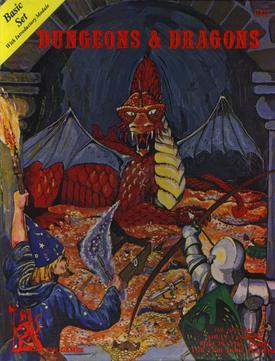
My first introduction to role playing was in 1978(ish). I don’t remember for certain the exact year, but that’s about right. We were in Hess’, a department store chain in Eastern Pennsylvania that may or may not still exist (I could look it up on the interwebz and find out but I’m not gunna.) and in the toy section there was a game called Dungeons & Dragons and had this cover:

D&d_original

So, it was at least 1977. I was into the fantasy scene thanks to the animated The Hobbit on television. The one that was about as long as The Hobbit needed to be, not three movies long.And get off my lawn. I bought the game ith my own pocket money, and read through the thing in an afternoon. What a great idea! thought I.

It took months to find anyone else who played. A “cousin” — I don’t know if they were an actual cousin or distant one, or whatever. We played a bit. There was an older guy running a game at the library that I vaguely remember as a fussy rules lawyer-y type. But it wasn’t until the last year or so of middle school that I found a few people who were also interested in the game. We would play all throughout high school, college — traveling to play together when we could — all the way up to the early nineties. I had other groups in that time, but these were the old crew, and when we got together for a weekend of gaming, it was like slipping on old shoes.

The first game we veered away from D&D was Traveller or Star Frontiers. I like to think it was Traveller, but most likely not. At that time, everything was TSR. To find a new game I had to bicycle a few miles into Bethlehem Township to the good hobby store where I got my models,  art supplies, and model rocketry stuff, as well as role playing games, from. Boot HillGangbustersGamma World — we played it all, at least once. But the one that really grabbed me was Top Secret. By this time I was really into spy novels, movies, but the d20 system just didn’t quite jibe with modern life to me. And in 1983 we got the first game I would truly love: James Bond: 007 by Victory Games.

It was the first game to use quality-based damage and results. The first to let you build your character as you wanted (for points) that we played. It was crafted for telling stories, not just fighting monsters and nicking their treasure. I ran that game for the next quarter century and it’s still on my shelf. It led me into working in intelligence. It taught me how to research because I wanted to create a sense of reality in the game. It taught me to pay attention to international politics and history. Hell, I still put out equipment profiles on this blog for it. There are other systems that i like better now, but this was my “one true love” of the gaming world.

Gaming was the first hobby where I felt I was…myself. Which is weird to say about a game where you pretend to be other people. (Maybe i should have been an actor.) At first, it was a bit like being gay at the time — you never let anyone know you were a gamer until you’d either gotten to know them, or you’d dropped a few hints that only another gamer would get, then you got together to play. Otherwise, you might get ridiculed or beaten up. (It could be a rough neighborhood.) You played with anyone, at first, because there weren’t a lot of others doing it. I could only really start getting a bit choosy about the sorts of folks (like the 300 lb. “ninja” who was “make eye contact and you’ve got a friend for life” sort of co-dependent) hang with us. But it got me my first real girlfriend in college. My first wife — found through gaming (and tangentially, my second, as well.)

And yes, I had to look it up — Hess’ was based out of Allentown and was pretty much just a Lehigh Valley, PA thing. It folded in the mid-90s.

The new Star Trek campaign has necessitated writing up some new ships and some new versions of old ships. It’s a bit difficult, as the new show has done a lot of handwaving about the capabilities of the new vessels. They are generally larger than TOS had vessels being, and they are much technologically advanced (because it’s not 1966 anymore), and I used some online sources as well as the excellent Eaglemoss models to slap these together. First: Federation ships…

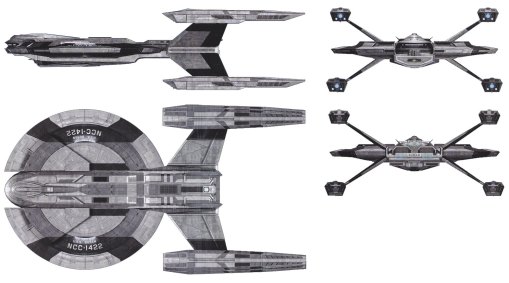
CARDENAS CLASS EXPLORATION CRUISER
dis-cardenas-views2.jpg

I love the stripping some of the new ships have in the show, and our explanation is that the colors denote where the vessel was constructed. Red (as with the Shenzhou) is Utopia Planitia, turquoise (the original stripping color for the same, is Andor), there’s a green in our universe for Tellar, and a rust-color for Vulcan.

SIZE: 7     STRUCTURE: 45     CREW: 350     CARGO: 80     TRANSPORTERS: 3 personnel, 3 cargo     SHUTTLEBAY: 2 (7 shuttlecraft, 4 workbees)

LIFE SUPPORT: Class 2R (CC)     OPERATIONS: Class 2R (CC)     TRACTOR BEAM: 1 aft SENSORS: Class 3 (+3/+2/+1/0/0  D)     IMPULSE DRIVE: SBE (.5c/D)     WARP DRIVE: PB-16 (5/6/7  C)

ARMAMENT: 10 Type II Phaser arrays (4/4/4/0/0/ B); 4 Mk12 IF Photon Torpedo Launchers (4/4/4/4/4 B)

DEFENSE SYSTEMS: PFF-2a  Protection/Threshold: 13/3  Reliability: B

MANEUVERS: CMD +2   HELM +1   TAC: +2

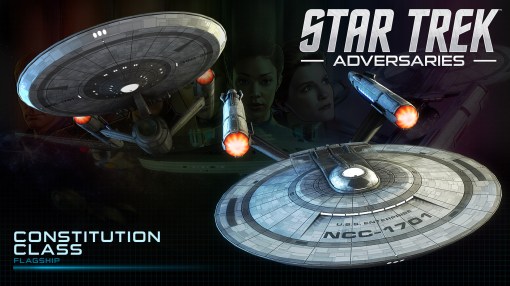
CONSTITUTION CLASS LIGHT CRUISER
ConstitutionClassDSC_Detail.jpg

In DiscoveryEnterprise isn’t the biggest, baddest ship. She’s got “impressive specs” according to one of the characters, but she is now a light cruiser, a bit bigger than the old ship.

SIZE: 6     STRUCTURE: 35     CREW: 210     CARGO: 70     TRANSPORTERS: 3 personnel, 3 cargo     SHUTTLEBAY: 1 (7 shuttlecraft, 4 workbees)

LIFE SUPPORT: Class 3 (D)     OPERATIONS: Class 3 (D)     TRACTOR BEAM: 2 dorsal/aft  SENSORS: Class 3 (+3/+2/+1/0/0  D)     IMPULSE DRIVE: SBE (.5c/D)     WARP DRIVE: PB-32 Mod 3 (6/7/8  C)

ARMAMENT: 6 Type II Phaser arrays (4/3/3/0/0/ B); 4 Mk12 IF Photon Torpedo Launchers (4/4/4/4/4 B)

DEFENSE SYSTEMS: PFF-2a  Protection/Threshold: 13/3  Reliability: B

MANEUVERS: CMD +2   HELM +1   TAC: +1

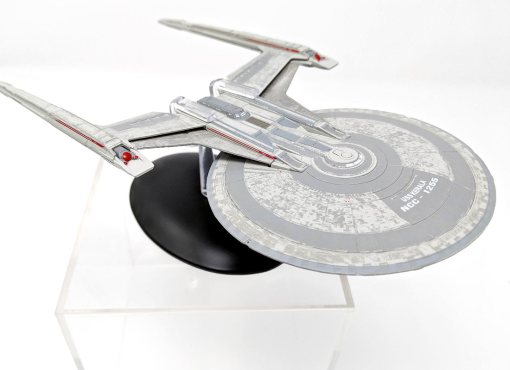
SHEPARD CLASS LIGHT BATTLECRUISER
header-kerala-review.jpg

This sleek ship was originally a design pass for Shenzhou but is larger and more modern. There are a few art pieces floating around out there of this class with the stripping seen on the Walker- and Cardenas-classes. I like to think those are older ships, and the grey paint schemes are ore modern. She’s listed as a “battlecruiser” in a few sources, so I went with that.

SIZE: 7     STRUCTURE: 35     CREW: 250     CARGO: 70     TRANSPORTERS: 3 personnel, 3 cargo     SHUTTLEBAY: 1 (7 shuttlecraft, 4 workbees)

LIFE SUPPORT: Class 2R (CC)     OPERATIONS: Class 2R (CC)     TRACTOR BEAM: 1 aft  SENSORS: Class 3 (+3/+2/+1/0/0  D)     IMPULSE DRIVE: SBE (.5c/D)     WARP DRIVE: PB-16 (5/6/7  C)

ARMAMENT:  8 Type II Phaser arrays & 6 PC-10a PD pulse cannons (4/4/4/4/4  B); 2 Mk12 IF Photon Torpedo Launchers (3/3/3/3/3  B)

DEFENSE SYSTEMS: PFF-2a  Protection/Threshold: 13/3  Reliability: B

MANEUVERS: CMD +0   HELM +2   TAC: +2

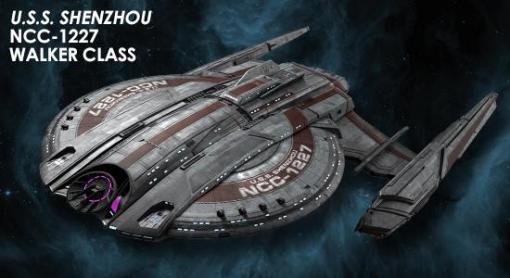
WALKER CLASS LIGHT EXPLORER
95643dcfcb8164892a701cd9bccc66d9.jpg

I love the look of thing — even with Eaves’ fascination for negative space making some of the design seem…anti-functional. I set our Trek game on a sister ship, Fearless.

SIZE: 7     STRUCTURE: 40     CREW: 160     CARGO: 90     TRANSPORTERS: 3 personnel, 3 cargo     SHUTTLEBAY: 1 aft (6 shuttlecraft, 4 workbees)

LIFE SUPPORT: Class 2 (C)     OPERATIONS: Class 2 (C)     TRACTOR BEAM: none SENSORS: Class 3 (+3/+2/+1/0/0  D)     IMPULSE DRIVE: SBE (.5c/D)     WARP DRIVE: PB-8 (4/5/6  C)

ARMAMENT:  8 PC-10a Pulse cannon batteries (4/4/4/0/0/ B); 2 Mk12 IF Photon Torpedo Launchers (3/3/3/3/3 B)

DEFENSE SYSTEMS: PFF-2a  Protection/Threshold: 13/3  Reliability: B

MANEUVERS: CMD +1   HELM -2   TAC: +1
So for Nerd Night™ the guys wanted to try something new. I’ve been wanting to to something more space opera-like and narrowed it down to two games: Battlestar Galactica (using Cortex), or Star Trek. The idea was to do a “pilot episode” and see if either took hold. I pitched Trek first, mostly because I enjoyed Season2 of Discovery so much I’ve actually rediscovered my love for the setting. I decided I wanted to use the new look and sensibilities of the series for the game pilot.

Now which system to use? We had been on the playtest for the John Carter version of 2d20 — the allegedly stripped down version of the game mechanics — and found it nearly unworkable, partly due to terrible writing making an overly complicated base mechanic impossible to grok. I thought of porting it into Cortex, then pulled the old Decipher Trek books off the shelf and had a look through. There’s a few things that are clunky with the game — especially damage in combat, but it was always a workman-like set of rules that I was mostly familiar with, although I’d forgotten quite a bit over the last decade or so since I ran it. Decipher it was.

The setting: It’s just the start of Season 2 of Discovery, and the Klingon War is over. The sudden win for the Federation, after what looked to be an inevitable loss, is still reeling both sides. How did they win? There’s a lot of obfuscation and politics surrounding it, and the command staff of the characters’ vessel is mired in “what really happened.” Their old captain, the famed Captain Robert Garth, hero of the Battle of Izar, has been removed from command for “mental breakdown”, but the crew isn’t buying it. He had been a major critic of the way the war was fought, and his ties to whatever manner they won the war have made him a liability to be pushed aside. His XO, Commander Fiona Kerr, has taken command, but Garth’s rivals in Starfleet Command have held up her promotion to captain citing her youth as a reason.

The characters: Stephen Archer, great-grandson of the admiral, is a hot shot pilot who was itching to get into the fight when the war ended. He’s just graduated the accelerated officer training program at the academy with his roommate and friend, Garav Idrani, a brash Andorian security officer. Right of the bat they find out there’s a lot more going on behind the scenes, as Idrani’s father — the general in charge of the Andorian Guard — invites them to a post-graduation party at the Andorian Embassy in Paris. There they meet their captain and her friend (and another PC) Doctor Sharas P’Trell, son of the Andorian Ambassador to the Federation and a chairman of the Defense Committee. He’s pulled strings to thwart Starfleet Command’s attempts to remove Kerr and any other crew who would not publicly disown Garth. P’Trell and she are tight, having been in direct combat with the Klingons, including the pyrrhic victory relieving Axanar. She’s saved his life and nearly died in the process; the ambassador has her back.

Aboard their ship, Fearless, an aging Walker-class (and one of three to survive the war), they meet the other two PCs, Lieutenant Olaf, a young Saurian operations specialist (Our conceit is that Saurians, like Linus, give themselves human names that other races can pronounce) and another loyalist to Kerr; and Lt. Kohal, the stereotypical hyper-competent Vulcan engineer who has become the ship’s troubleshooter.

The first adventure involved heading to Tau Ceti III to assist the population there with disaster relief, pending the arrival of large, better equipped ships. It’s been six months since the end of the war and 2/3rds of Starfleet is still in port under repairs or refit. They’re the first ship the fleet could afford to send. Along the way they suffer a horrific EPS conduit blowout that nearly kills two crewmen, the result of shoddy, rushed repairs at the Copernicus Yards. They encounter a ship hiding off the spacelanes. The captain is claiming issues with their drive and is evasive about what is going on. Kerr orders the characters to provide a “health and welfare” check of the vessel, and they discover the captain’s transporting Orion slaves to a meeting with a buyer. They promptly get into a fight, take the ship, and arrest the crew. They take the merchant ship with them to Tau Ceti, planning on releasing the women being trafficked and sending the crew to the appropriate officials.

Tau Ceti is a mess. The Klingon attacks here badly disrupted their infrastructure and the crew is hard pressed to address more than a few of the world’s needs. The leadership has felt abandoned and has been trading with the Orions and anyone else that can get them supplies. Starfleet’s arrival, while appreciated, is considered a bit late. The next few nights involved fixing maglev railways, power systems, air processing plants, and uncovering the mystery of a group of farmers who kicked the crap out of the Klingons that invaded a bunch of farming communities. It turns out they are the descendants of the Central Asian Khanate — the Asia-spanning empire of Khan Noonien Singh. There was some worry about what to do with them, but they’ve been staying out of the way of the world until the war. They find out that Section 31 (so far just called ‘the black badges”) cut some kind of deal with them in exchange for ignoring their parentage.

The last session ended with the crew having been replaced by a larger relief mission. They were celebrating in a famed whiskey bar in the world’s capital when their captain is beamed away suddenly — apparently taken by one of the Orion captains that have been supplying the world. It turns out that the high-ranking Klingon she killed was the favored son of House Mogh and there’s a bounty on her head. The crew is recalled hastily but it’s obvious that they are not going to have an easy time catching the much faster Orion freighter…

I didn’t expect the group to get into the game. I figured they’ve been interested enough to play, but it wouldn’t hook them like the Roman D&D campaign had. I was incorrect. Even though most of the players only have a passing knowledge of the shows, they clicked with their characters well, seemed to really respond to the more complicated universe I was throwing out, and bonded with their NPCs quickly. It’s one of the best starts to a game I’ve seen.

So now I’m writing up Decipher Trek versions of the new ships from Discovery. Because dead games are apparently my thing.

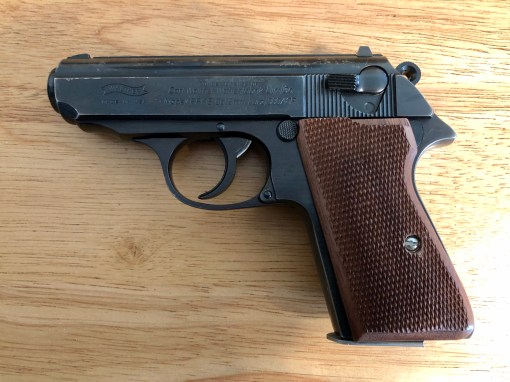
So, I recently picked up a 1995-ish Ranger-made Walther PPK/S in .380 for $300. A decent deal, since you might get that in trade for 5he Interarms period PPKs. It was not the most comfortable gun to shoot, and they have a reputation (outside of the JB fandom) for being finicky Jam-o-matics. The one I bought, so far, has run through various round nose and hollow points without a single failure to feed or extract. As with the FEG knock-offs I’ve owned (great deals!), the accuracy from the fixed barrel is better than most large semi-autos, and the blowback action is…uncomfortable. This thing was designed to be a .32 (7.65mm), and the .380 is a bit robust for it.

I did immediately start having issues with the safety/decocker activating when shot. Not ideal in a stressful situation. “Excuse me, ol’ boy, but my safety keeps going on. Give us a mo’, would you?”. Not gonna happen. It was a common problem sorted by a Walther BBS search and a internet trip to Numrich for an extractor spring and detent kit and new safety lever. The problem disappeared. Then the light hammer strikes started.

A lot of folks don’t like the heavy double action trigger pull, because they haven’t figured out it’s a safety feature: as woth an old revolver, you don’t accidentally blow you bollocks off while pulling it put of a pocket (which is how you were likely to carry in 1929, when it was designed…) Cock it and shoot, or suffer through the first loooong double-action pull. Trust me, the adrenaline will get the trigger pulled. But a lot of users put in a lighter spring.

DON’T. It messes with the firing pin, and it makes the recoil more stout. Also, don’t cut your damned recoil spring (not a problem here.)

So while checking the trigger spring, I found it was very light. A Wolff spring at the factory 20 lb weight and a set of walnut Herrett grip to replace the plastic ones that broke taking them off, and Rolff (my PPQ is called Gunther) was ready to go back out to the range.

Rolff was fatter in the grip, but that and the heavier trigger spring mitigated a bunch of the harsh recoil. He also was pointing better. So my cheap $300 PPK now has another $150 in it, but it…was…flawless! Three different types of hollow point: no jams, superb accuracy, manageable and now non-painful recoil, and it still drops in my shorts pocket without printing.

Beats the pants off the S&W period PPK/S, which would bruise and cut my hand from the tail they put on it. I figure over the next year, I’ll do the rest of the springs and maybe have the local guy I know refinish him.

(Gunther and Rolff…sounds like a Bavarian confectionary shop.) I have to say that working on the pistol myself has been a good learning experience. The gunsmith I originally got to work on it did f*** all to fix it, so I got back in “company armorer” mode and tore it down after watching a few YouTube vids. It is much more complicated than a modern firearm, but it is beautifully designed and engineered. Going to replace a few more of the springs as I go, but right now, it lovely.

…and this time it’s more obscure. Or open. Different. Anyway!

66777285_2338299199824516_24914465333968896_n

The new(ish) game group has settled in nicely over the last two years. We started as a 5th ed D&D group — that was my sales pitch for two of the gamers — but they have tried out Hollow Earth ExpeditionTales from the Loop (which was very popular with the gnag, as most of them are of that particular late ’80s childhood.) I introduced them to a house rules version of cortex to run our end of Roman Britain campaign, swapping for the high fantasy of Dungeons & Dragons. I floated the idea of a new science fiction campaign; I’ve been getting the itch to do sci-fi, and particularly space opera again.

The ideas I threw out were a Star Trek campaign in the reboot (and let’s face it, it’s a reboot) Discovery universe (minus the awful spore drive McGuffin). I like the aesthetic of the ships and gear of the show, and the more gritty tone fits me well. And I would get to use the Eaglemoss starships for battles. (The Discoverse ships are gorgeous! and I’m warming up to the Warhammer 40k aesthetic of the Klingon designs from first season (which I initially didn’t like…) I’m thinking of either busting out the old Decipher Trek rules set, or porting it to classic Cortex, which remains a house fave for rules mechanics.

The second choice was to try and catch lightning in a bottle one more time with Battlestar Galactica. I miss the old campaign, loved the universe we had created, and think I could do a nice variation on the themes without repeating myself. And I would get to use the Eaglemoss models for combat scenes.

Something tells me with the current crop, Trek would fly better.