This question could be taken two ways —  mechanics end of things (I run X system because I get it), and what kind of setting you run well. Let’s start with the second:

Back in the midst of time, when MTV was still doing music and everyone was worried that Ronald Reagan was going to get us all killed, I started playing RPGs in earnest. I’d found a few folks to play with at school — and this was back when furtively letting people know you played D&D was like being a drug user (“Hey, man…you play..?) and the wrong person might lead to embarrassment or a beat down — and i was trying everything out there: Dungeons & Dragons (no “edition”), GangbustersTop SecretGamma World, or the non-TSR stuff like Traveler, and later James Bond: 007, Universe, or Twilight: 2000.

One thing I found quickly was I didn’t like the way the TSR games handled injury — hit points as a combination of physical damage, mental stress, or luck just didn’t feel right. You got “hit” with a sword…you don’t just walk that off. (I still hate that aspect of 5th ed.) I also was a huge Bond and action movie fan. Top Secret and James Bond rapidly became out go-to game in 1983. I researched the hell out of intelligence agencies, terrorist groups, spycraft, guns, cars, whatever I needed to give the game a realistic feeling, while still playing with the action movie tropes. The other big game was Traveler, where the setting was really left up to you. In all these cases, story was the thing, and I wanted rules that worked with me to tell a story, instead of being there to be rules lawyered. This is why GURPS and Hero were to me like silver to a Hollywood monster.

Along the way, that meant that game systems that pushed character creation and storytelling over hack-and-slash became my preferred genres. Dungeons & Dragons and other fantasy games were consigned to memory until very recently. I had a period of running superheroes and prefered DC Heroes to the more abstract Marvel because you build the characters with strengths and weaknesses. Weakness was something a lot of players eschewed in the ’80s, save to get a few more points in their creation. Weaknesses, flaws, problems — these make the characters interesting. Interesting characters make the story interesting.

I might have taken to the White Wolf material, save for the overwrought vampire thing and the attendant LARPing, which a few times playing seemed to me an excuse for people to flirt and hook up. My interest in verisimilitude that started with James Bond, meanwhile, had driven me to embrace the Space:1889 setting — sci-fi, history, cool gadgetry…it led me to study history.

Now, the easiest games for me to run are ones where the setting really entices me. Victorian science fiction, ’30s pulp action, most recently Roman gritty fantasy, and established universes that have loads of material to work with. Central to most of these games is some aspect of intelligence work, bureaucracy and politics. There’s something to be investigated or solved, questions to be answered — sometimes as simple as “where is the missing girl” to “how does morality work in a universe with multiple gods who value different “good?” I need a setting that makes the players and characters engaged with the questions asked.

When it comes the to systems that I run best, they usually have to be simple enough to quickly grasp and not lead to ambiguity in play. They need character’s flaws to actively affect them in some way. Combat had to be crunchy enough to feel real, but slick enough to run cinematically. For that reason, I usually like some kind of hero/fate/plot point mechanic that can be exploited as a “get out of death” card.

The one that works best for my style of GMing is old Cortex. Simple, with loads of support for building good characters. The combat’s got a few quirks, but it’s not awful. Next, I like the old James Bond game. Partly because I know it so well, partly because the mechanics — especially for combat and chase scenes — really captures the flavor of action movies. Fate is also pretty easy to run. The character creation allows a lot of latitude for playing up your flaws and strengths (sometimes at the same time), but the consequences approach to damage, while it covers other kinds of “damage” than physical, feels like it lowers the stakes. (I know, the idea is that there are worse fates that death…) Ubiquity, while I like the basic mechanic, has some really issues with its math and combat is a hot, old school mess that works because I ignore almost all of the special maneuvers, etc.

That’s a really long winded way of saying I’m run rich settings with rule light systems.
I can’t really speak to this except to say it was published before White Wolf became popular. Any of the early RPGs from the mid ’80s can set up rules and a setting with half the pages than an RPG can today. Jeez, Cubicle 7 felt the need to do a book for every damned Doctor in Doctor Who. Each D&D core book — Players Handbook, Dungeon Master’s Guide, etc. is 400ish pages. The AD&D books did it with half that.

Now, get off my lawn!

Ten years ago, I’d have said Coas Book Store in Las Cruces, New Mexico. Now? eBay and Noble Knight online. There’s a really good one out of Canada, I think, that Runeslinger uses that shipped internationally. I’m sure he’ll chime in with a comment as to the place and it’s website.

That’s a tough one. Define “best”…best delivery of information, how to play the game; best writing for setting tone? The problem with RPG writing is that it is part technical manual (the rules) and part creative writing — two sharply different styles of writing with divergent purpose. To balance both is very difficult.

I think the writing team for Firefly did an excellent job with the latter type of writing — getting the tone right, as did the guys over at Evil Hat with their Atomic Robo RPG for Fate. Generally, the Fate games have done a good job with the first type of writing, although they have also been moving toward comic book panel style explanations of things. It works, but it’s probably not qualifying as good writing, but effective design.

Design is an issue I’ve carped on before. There’s a lot of focus on art design and fancy layout on high-gloss paper. These $60 a book tomes are often very pretty, and utter f***ing useless to try and understand the rules. Red typeface on purple backgrounds (dumb!), 8 point type (Have you ever seen a gamer? Most wear glasses.), pages of gorgeous artwork that distract from learning how to play.

Now combine that with the problem of writing clearly the rules so they are understandable and can be played out of the gate without having to flip through a book with a magnifying glass and a Ouija board to figure out what you do in scenario X, with making the verbiage interesting enough you don’t think you’re thumbing though an army field manual. It’s tough! I don’t even think i do it well, and I’ve been at this a while. It’s worse when you can’t stop typing…

One of the my issues with the current state of big production game writing like you find at Cubicle 7, or Wizards of the Coast, etc. is the need to prat on far too long. 300+ page corebooks that could be shaved down to half that with some decent editing and a bit less indulgence. But that is less of function of bad writing than bad editing and the presumption by the producers and consumers that a bigger, prettier book is “better.” (Just look at any of the interminable fantasy series of 1000 page books.  (Hey, the 16th book in the Shadows of Not Tolkein series by Pretentious Cat Lady is out!)

Did I answer the question? Not really…

Easy: Victory Games’ James Bond: 007. I bought a first edition copy in 1983 and have used it until about 2010, since when we haven’t had an espionage game running. Partly, this is a function of having worked in the industry, partly it was a response to the real life asshattery of the Global War on Terror.

Probably next up would be Space: 1889, at least as a setting. We used other game systems to play in that universe, and from 1989 when the game premiered until about 2010, there was usually a campaign going, at least part time.

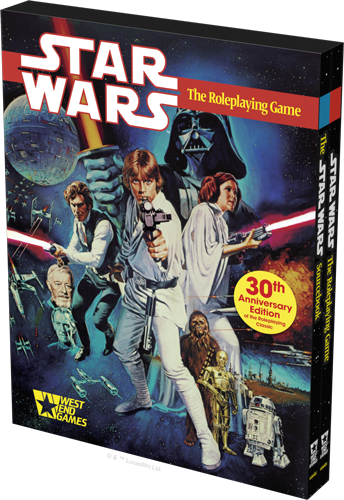
io9 let slip that Fantasy flight, who gave us the multiple core book bullshit for Star Wars that Last Unicorn did with Star Trek, not to mention proprietary dice, is doing pre-orders for a reprint of the original West End Games d6 Star Wars RPG. You know, the real one.

books-in-slipcase2-with-wrap_500px-ht.png

Here’s the link to preorder!


I think this question is supposed to be “…and never played.” At least that’s how I’m taking it.

Hands down, this is Jovian Chronicles by Dream Pod 9. It’s an anime giant-robot setting with a lot of hard science trappings. Think The Expanse meets any Japanimation space show. The setting is wonderfully rich and interesting, but also has the problem of having a built in metaplot that — along with the tons of background material — can be daunting for a GM. Where to start?

Also, in the new millennium the idea of the Singularity, of transhumanism, etc. meant that the anti-AI “Edicts” that was central to the JC setting seemed horribly outdated. Now, I would suggest the worry over AI and joblessness is playing into the conceits of this game universe.

It’s got gorgeous ship designs and rich world-building, and an absolutely shit set of mechanics.

We picked up this week with our 5th edition Dungons & Dragons campaign in the aftermath of the fight between the characters and a pair of Furies. It was looking like a TPK in the making when the monk character, Icio, called on his patron angel, Michael, to bail them out. What they got was a full throwdown between lesser gods that half wrecked the official residence of the Praetor of Aquileia. With two players down — one at a convention in England and one on route to GenCon, I decided to concentrate on the three players’ concerns.

The next morning found Carrus getting his staff of blacksmiths working on the armor and weapons they had taken from the furies. With 20 rolled, he was able to deduce that the weapons and armor aren’t metal, but perhaps some kind of porcelain — light, heat and cold-resistant, and tougher than the best iron. Yet Michael’s arrows went through them like butter, burning a clean hole through the material. The swords the Furies used went through Marcellus’ breastplate similarly cleanly. He hasn’t worked out all the secrets, but he is on the path to learning how to make the stuff.

Marcellus left his tent to find Icio waiting for him. This “Anathema” which had so rattled the Furies and Michael is of great concern to him. Could she really be a relation? What the hell was she? They gathered up Carrus and went to search the city for her. (We assumed Calvinus was busy trying to soothe his father’s concerns about powerful mystical creatures ripping up his town, while Augustinian was researching the information on her.)

They find her in a mariners’ inn by the wharf, sequestered on the third floor away from the other guests. The owner of the inn was terrified of her, but did not want to anger her. After having him clear out the inn (Marcellus is enjoying his imperium), they knocked on the door. The Anathema was waiting, and was open to their questions. Her attitude toward the entire affair was blasé, and she seemed entirely unconcerned to have armed men in the room with her. Marcellus noted she seemed to have a pretty good handle on the entire situation.

What they learned: she claims to be in the service of Hades (she tends to call the gods by their Greek names) and was sent to aid them in their quest. Icio asked her parentage — he calls her brother, but he doesn’t think she means in Christ. She tells him they have the same father. He is not the son of Zaccharius the carpenter; he is the son of Michael. She is the daughter of Michael and Soteria — the mother of angels. Soteria has a much older name: Hecate, the goddess of magic, possibility, and choice. The Anathema is what the various sides call her for she is not supposed to exist — just like the barukhim and nephalhim, the children of angels and demons with humans — she is a child of “good and evil.” Her given name is Chthonia. (No, you don’t actually pronounce the “ch” in a chth blend — it’s “Thonia”.)

If Sataniel manages to raise the Shadow, the various realms would once against be accessible, and the gods of old would be able to interfere in the affairs of Man. Satan could engage in his war against Heaven. When they ask her for her aid, she tells them that is her purpose.

On their way back to the camp, they were waylaid by one of the vigiles, the town guard. There is a problem on the north wall… they arrive to find a small force of satyrs and centaurs! Led by Calacites (King of the Satyrs of Dalmatia) they have been searching the countryside for his daughter: Carona. Instead of being an orphan who fled the destruction of her village, she was drawn out into the world by her curiosity. He has come to save her from the world of Men.

This led to an uncomfortable and amusing exchange where Carrus had to confirm she was here, and in the end — with a choice between having his pregnant girlfriend taken away to live with the satyrs or keeping her with him, he suggested marriage. The satyrs, knowing what a monumentally bad idea this is, managed to contain their mirth and Calacites accepted. We ended the night with his marriage to Carona.


The only rules set that I use with little or no alteration is Cortex. The original Cortex, not the Fate-ified Cortex Plus. The way the game is constructed, there is little that needs tweaking to work well, and the one or two issues I have with it have rarely gotten in the way of play. I did have to cobble together mass combat rules to deal with large space and land battles more quickly, but that didn’t really change the core mechanics.

I ran Marvel Heroic without any house rules, and the same with James Bond. I haven’t done any tweaking with the Ubiquity system of Hollow Earth Expedition, although i can see where the combat system needs streamlined and cleaned up badly.

I have been pretty by-th-book on Dungeons & Dragons, but that’s because I’ve got a rules lawyer in one of the players who has run it much longer than I have.

This is a curious question, as it can be taken a few ways. Do they mean adapting the rules to a different setting, or adapting the setting to fit a rules set?

Let’s start with the first option. I have, over the course of 30 years, used James Bond: 007 RPG from Victory Games for a number of different settings. I’ve run Cyberpunk using the rules, which required the creation of cybernetics rules. I’ve used it for Stargate, which required creating ways to render aliens in the mechanics. It’s a versatile set of rule that can be poked and prodded, but which start to fall apart as scale gets above, say, a coast guard cutter, for spaceships or vehicle combat.

A setting that begs for better mechanics is Space: 1889. The original GDW rules were bolted onto their Sky Galleons of Mars boardgame, more or less. I ran this setting using the GDW game, then using a home-modified version of Castle Falkenstein until about 2006. The new release of the setting by Clockwerk in Germany and Modiphius in the UK, uses the same Ubiquity system as Hollow Earth Expedition, and works well.