One issue that crops up from time to time with Hollow Earth Expedition is the vehicular rules. For small craft like cars, or even smaller boats up to a tramp steamer, they work well, with the size and mass of the vehicle roughly doubling for each size doubling. The issue is once the scales start to outstrip the clean doubling rules at about size eight.

In Secrets of the Surface World, Exile Games, gave us a few very large ships — all size 16. Most of these bigger vehicles had a length of 600-800′ and often in the 15-30,000 ton range, or much more that the doubling that Hollow Earth Expedition was initially settling into. This gives you a couple of issues when it comes to combat vs. massive ships and aircraft: either they are so weak that a good roll with a machine gun might incapacitate them (something as unlikely for the airship Graf Zeppelin as for the mighty Arizona…), or you have to find some fudge factor like adding defense/structure points to model armor or size.

So I see two options to fixing vehicles for Ubiquity:

The First: Keep the scales consistent. A Size 16 would be roughly 101-200′ in length and 100-200 tons or so in size. Size 32 200-400′, Size 64 400-600, and 128 600-1200.

Under this option, USS Arizona would be Size 128, with a Defense of six for metal and and extra, say, 2 for armor giving her an 8. But her structure would be 136. Even with some great bombing runs, it would take dozens of bomb runs to kill the ship.

This is more accurately modeled, when you consider that a similar sized ship, the IJN Yamato, took 11-13 torpedo and 6-8 bomb hits — somewhere around 120 points of damage for just the weapons, if you took the average.

Option 2: Create steps between Size 8 and 16 to keep the scaling from Secrets of the Surface World consistent. Here, you would add a Size 10, 12, and 14 — with a size of 100-200 for Size 10, a 200-400 for Size 12, a 400-600 for Size 14, and-600-800 for size 16. You would add the size to the material to get the Defense and Structure as usual, but ignore the negative modifier given for the lack of Dexterity. In other words, normally, the Size modifier for defense cancels itself out — Body bonuses lost to Dexterity — so that you are trying to beat the material. A wood vehicle of size 8 would have a Defense and Structure of 12. this would, in practice, make it nearly impossible for someone with a .45 Colt  to damage a 50-100′ yacht, say, but a Tommy gun on full auto might make a bit of a mess. That’s mostly accurate. A decent pilot with a medium-sized torpedo could do a few points to Arizona, but it would take a remarkably good hit to sink her with one shot.

Personally, I rather like the first option, but your mileage may vary…
So after having studiously avoided it, I finally watched Batman v Superman: The Dawn of Justice, since it was only $4 on iTunes.

The initial impression: Zach Snyder and Chris Nolan need to be booted from the production of these movies. Second impression: it wasn’t as bad as I expected. Granted, cockroaches and our current presidential frontrunners are about the only things I have lower expectations from, so that wasn’t hard.

Let’s start with the good:

Affleck. Seriously, he’s a good Bruce Wayne, which is essentially to being a good Batman. He’s working his ass off in the role, and it’s probably one of his better acting gigs. Which brings us to Batman — they let him do detective stuff. They show him exercising like crazy to keep in shape. They point out his incredible luck at still being alive. They also give him some solid fight scenes that look like the comics — he uses his environment, his gadgets, and his wits.

This was a great Batman flick. It’s a shitty Superman flick — more in a moment.

Alfred. Jeremy Irons does a great job, and they make Alfred a partner in crime to Batman, not just a sage advisor.

Wonder Woman. She’s the best part of the film. Gal Gadot has her looking like she’s enjoying the hell out of the fight scenes. She feels like a Amazon come to play rough.

The bad: The dream sequences Batman is having. They’re distracting, and for many viewers, I suspect they were confusing. They detracted heavily from the story.

Speaking of — the entire gods among us motif got old about halfway through the first time they brought it up. While the political class of the world would undoubtedly want to find a way to shackle a creature like Superman, I found the incident to question his motives shoddy and forced.

The writers, Snyder, Nolan — they don’t get Superman. They’re looking to do high art, and they’re so busy trying to be deep and subtextual that they miss the chance to shake up the feel of the movie by having Batman’s pessimism and doubts be countered by the optimism and faith in people that Superman embodies in every rendering except the Zach-verse. He’s not dark. He can have a bad day, doubt himself, but in the end he’s that kid from Kansas who thinks you can and should do good.

Which brings us to the worst of the film — Lex Luthor. The kid from Zombieland just doesn’t cut it, but it’s not his fault. The writers were looking for somethig edgy and differennt, and instead we got the same kind of riff that Sherlock gave us with their shitty version of Moriarty. Smart, sure. Nuts, yup. But engaging and cool, or frightening, or funny…nope.

In short,  all the Superman stuff sucks in the movie, from the big man himself to his villain, to this Lois Lane. The Batman stuff was good, and Wonder Woman steals the show.

So is it worth it? On my scale of “I wouldn’t borrow it from the friend” to “See it full price multiple times”, I place it on a rent, maybe a matinee.

I finally finished my Luke Cage binge last night, so let the reviewing begin!

I’ve been bouncing back and forth on whether this is the best of the Marvel shows on Netflix, but by the end of the season, I’d have to go with “yes.” Here’s why:

Harlem. They take a real place and they make it the focus of the show. Daredevil tried this in the first season, as well. Hell’s Kitchen, however, is a weird mix of 1980s crack-period Hell’s Kitchen, and the gentrified version of today. This is necessary for the show to keep the Miller/Mazzuccheli flavor they were going for. Luke Cage‘s Harlem is much closer to the real thing, and the importance of the place to black history, culture, and identity is front and center throughout the show.

Blackness. Connected to that, and a defining subtext of the show is blackness. Cottonmouth Stokes, the crime boss who could have been something else; Mariah Dillard, the all-too-realistic politician; Misty Knight, the honest cop who knows everyone in the neighborhood; and Luke Cage, the stoic, hard-working everyman…who just happens to be damned near indestructible all are aspects of the black community, and their conflict mirrors the conflicts of the black professional, the gangster culture, and the middle-class. The music, the location, and the casting all make this a sharply different view of America than Daredevil and Jessica Jones.

The women. There are a lot of important female characters in the show — Mariah Dillard (Alfrie Woodard), Misty Knight (played superbly by Simone Missick), Inspector Pricilla Ridley (Karen Pittman stuck in a stereotypical annoying commanding officer role), and Claire Temple (Rosario Dawson, stealing scenes again..) — the women in the show are integral parts of the drama and plot. They’re not weak. They’re not victims. And none of the important players are young. They’re mature women. It’s refreshing.

Mike Colter. Sweet Christmas this guy’s got charisma. He was the best part of Jessica Jones (my opinion) and he does good work here. There are a lot of great performances in the show, Mahershala Ali’s Stokes is especially good, but COlter manages to hold the spotlight whenever he’s onscreen.

The surprises. (Yeah, spoilers. Shut up.) The decision to take Cottonmouth off the board halfway through the show was an excellent move, and made the show seem less contrived. That said, exchanging Ali for Erik LaRay Harvey’s Diamondback took away an excellent, and somewhat sympathetic villain for a less interesting creature. Diamondback, despite their best efforts, never feels like anything more than the crazed murdering baddie. That’s not Harvey’s fault; the writing on his is a bit lazy, and that’s probably the worst aspect of the show.

Mariah Dillard’s rise to crime boss is the exact opposite. She’s a compelling and realistic character, not entirely competent or comfortable in her new role, but Woodard’s steady move from pawn to queen is well executed by both writers and actress. Did I mention the women in this show knock it out of the park? They do.

A side mention for one of the better supporting cast has to go to Frank Whaley. Who? you ask. You’ve seen him in just about every damned TV show in the last ten years, and a few movies. He plays Scarfe. (Oh, that guy!) His performance is subtle and nuanced. He feels like a 20 year vet of the NYPD who does his job, and just that; he knows his job barely matters and it makes his corruption seem natural.

Lastly…Method Man. I’m not a hip-hop or rap fan. I barely know who the guy is. He steals all the scenes he’s in. There’s a great moment between he and Cage where the superhero geeks out at meeting the musician. It’s one of the best moments in the entire show and feels right.

The bad — ’cause there always is some bad.

Diamondback. The character is a leering psycho whose character development shows him to be a whinging teen with daddy issues. It’s unoriginal and uninteresting. The Bible-quotes and half-assed philosophizing never rises to the levels that Cottonmouth and Mariah have.

While the final fight between he and Cage is beautifully done, it’s really only good to show Cage to be no martial arts master, no skilled bad-ass, but a dude that simply is very strong and impervious to most damage…why would he need to be a fighter? (Throughout the show, the guy doesn’t fight, so much as sort of push and slap his way through the mooks.)

The first episode. It’s a slow episode, mostly for the work it’s doing setting up Harlem as a character, as much as introducing the leads. Wade through it.

So is it worth it? Hell, yes. Go quit your job and stream this thing, right now.

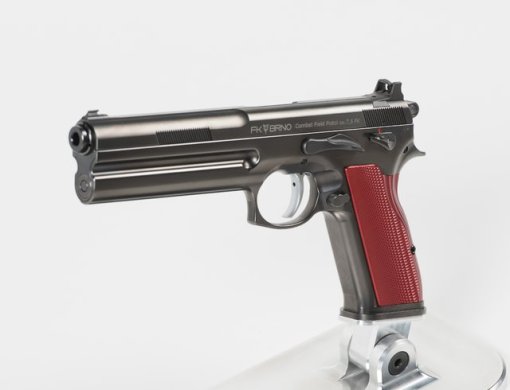
FK BRNO is a firearms R&D company  with ties to CZ. Known for high-quality competition guns, FK developed the Field Pistol in their proprietary 7.5mm FK chambering. The 7.5FK round fires a 100gr hollow-point at a blistering 2000fps, giving the pistol a stunning accuracy of 1.8″ deviation at 100 yards! The pistol was deigned to be comfortable for use by shooters with smaller hands, and the recoil impulse is similar to that of the .40S&W. There are several sight options, from the standard three point to a “butterfly” sight for far target acquisition.

640x520

Made for hunting and competition, these are not small weapons and are heavy, but with a muzzle energy in the range of the .44 magnum and 14 rounds in the magazine, the Field Pistol has limited utility in covert operations.

250x250-1250x250

PM: +2   S/R: 2   AMMO: 14   DC: I   CLOS: 0-10   LONG: 20-40   CON: +1   JAM: 99+   DR: -1   RL: 1   COST: $2500

GM INFORMATION: The 7.5mm FK round reduced armor values by 2WL (Armor that provides -4WL is good only for -2WL vs. the Field Pistol.) The pistol and its ammunition are quite difficult to procure, so requisition requests should be done at a EF3.

Q Evaluation: Holy ***. 007


Our Hollow Earth Expedition game kicked off with a bang — the characters, trapped in their Atlantean flying saucer, sinking under the sea after having been hit by heat rays from war saucers from Atlantis. After a tense escape and rush to the surface, they were rescued from the hovering saucers by merfolk, who took them to a grotto in a cave system under the nearby mountains, and which connects to the merfolk’s home.

The destruction of the large war saucer Durga had produced a blast that stunned or killed dozens of merfolk, leaving the characters in a tight spot with King Triton. Eventually, his son Glaucus intervened on their behalf. They were able to exit the cave complex, finding some of the Sanctuary survivors in the process, before returning to find the old liner badly damaged by fire, their pirate ships sunk, and Zek’s airplane destroyed. The Atlantean saucers had decamped. After searching the ship, they were able to find a few survivors, including Zek and his daughter.

After collecting as much food and other supplies as they could from Sanctuary’s stores, they returned to the caves to try and plot their next move. (One of the players was pretty adamant about attempting to use the whirlpool under the Aerie, assuming it some kind of gate, as it is through there supposedly much of Sanctuary’s found cargo comes from.) They were desperate to rescue Olga and Shria, both captured by Thoth, Emperor Mot’s secret police chief during the attacks.

This led to a hairbrained scheme to find and collect the balloon from Ivora’s crashed airship, Sela, and use it to float their lost saucer with the aid of the mermen. With two dozen people, they trekked two days through the dinosaur-filled jungle to the crash site, build a boma and fires to keep the animals at bay, then spend another three days getting the balloon out of the trees, rolling it, and lugging it and the hot air engine back to Sanctuary.

They were able to repair the engine, patch the balloon, and eventually they attached the balloon to the saucer. Using the engine and a long length of tubing made from jungle vines, Zek, Hunter, and Amon inflated the balloon from a small launch. The plan was working, the balloon was very slowly lifting the saucer when Gus decided the process was too slow and attempted to aid the ascent by trying to restart Agni’s engines…a fumble, followed by a good roll succeeded…but sent the saucer up too quickly, out of control and blinded by the balloon. This capsized the launch, and during their rescue attempt of Gus, the characters (plus Amon) were able to get aboard. Just in time for the saucer to lose power over the whirlpool called the “Hole in the World.”

The balloon acted like a parachute, giving them time to seal the saucer before they were sucked into deep water, tumbled and spun in darkness, only to surface a long time later. They found themselves in the saucer, which was again starting to sink, and escape to the surface to find themselves under a sky at sunset, the stars coming out, in the middle of a endless ocean! (Causing Amon no small amount of terror; he’s never seen the sun “go away.”)

Now they are trapped in the Outer World, with no way to get back to rescue Shria and Olga…

This evening was fun for the endless pulp-fiction moments that kept cropping up. The campaign is proving to be a lesson in go big or go home when it comes to playing pulp. The bigger and more ridiculous, the better.

An old space probe returns to Earth to find a lone survivor…

Here’s a nice sci-fi short. The lead does a great job.

Here’s a nice take on the Seven Dwarves…

The rule book deals with drowning and suffocation, but the cliffhanger of our latest session also has a few other issues the heroes will have to deal with — atmospheric pressure (from water) and decompression…

With their flying saucer sinking under the ocean, they have only a few turns to figure out how to get out of the craft…but in that time, the saucer has sank some distance. so that leaves them with a few issues to address:

The first, air. They should have time to hold their breath, but they will be exerting themselves early on. From the core rules,

“…your character can hold his breath for one minute per point of Body rating. In combat, your character holds his breath for one turn per success on a reflexive body roll. After this time passes, your character will be forced to take a breath and suffer the effects of whatever he breathes in. If he inhales water or thick smoke, for example, he will receive one nonlethal wound per turn until he is able to breathe normally. Your character cannot hold his breath again until he has had a chance to catch his breath.”

It will take several turns before they can exit the craft under the best of conditions. By the time they are out, the saucer will have sank between 100-200′ (between 30-600m-ish), with an increase of 1 bar/33′ or 10m…they could be exiting somewhere in the range of 9 bars of pressure.

So, rules for high atmospheric pressure and decompression:

Characters exposed to high atmospheric pressures will suffer 1 non-lethal in damage for every 3 bars of pressure (every 100′ or 30m of depth.) Also, holding one’s breath becomes more difficult at these pressures, as the lungs are not strong enough to fight the crush of the pressure. Holding your breath requires a Body+Will with the difficulty increasing one success for each 100′ of depth. (You can reflexively hold your breath without a check down to 100′) This damage only lasts as long as the  person is under pressure.

That said, rising or decompressing too quickly will cause the damage to remain and possibly worsen as the body cannot reabsorb nitrogen and other gasses released by the drop in pressure. This can be cured with safety stops and a slower ascent of about 30fpm to allow the body to adapt to the lower pressures, but in an emergency assent (as these characters will have to attempt), the character can ascend at speeds up to 100fpm. That still leaves two minutes for the characters. If the character has to surface at unsafe speeds, they will take 1 non-lethal in damage for every 100′ they have to ascent at faster than 60fpm.After the character has reached the surface, they must make a Body test versus the damage they took. If they fail the test, they take lethal damage equal to the number of failures in addition to the non-lethal they have.

(Example: Steve has to ascend from his crashed and sining seaplane. He was able to catch his breath before exiting the craft, but has to ascend 200′ to the surface before his breath runs out. He has 2NL in damage from the pressure, and has to roll a Body+Will vs. 2, and succeeds. He has a Body of 2 — he has two minutes, if he doesn’t exert himself, to reach the surface. He opts to rise as fast as he can, but it will still take all of his two minutes… The speed of his ascent means the damage will not got away on reaching the surface as he experiences “the bends”. He makes it to the surface, but is suffering from decompression sickness. He rolls his Bodyx2 vs. the 2NL and rolls a 1. He now has 2NL and 1L in damage, which will heal at the normal rates.)

Had Steve has a Body 3, he could have ascended slower, and risked a non-lethal or two for breathing water, but that pressure and drowning damage would have gone away once he could get to the air.


The group finally had everyone back together again for the session this week. We picked up a few days after the raid on the Sanctuary and the removal of the chua te, the pirate king, Trihn from the place. The characters are mostly recovered from their injuries during the fight, they’ve been working to sound the old liner that serves as the trade port, and looking for the other cargo cultists that escaped into the jungle. They’ve been building  docks for the pirate ships, having talked those crews into allying after Trihn was packed off to the merfolk to answer for his crimes against them. And they are preparing for their meeting with the hawkmen of “the Aerie” — a mountain topped by a Greco-Roman-looking city that floats a half mile above the “Hole in the Ocean”, a giant whirlpool that swirls into darkness under the rock.

After some character interaction and catching up the one player who was out for a fortnight, they flew to the Aerie in their Atlantean flying saucer, Agni, only to be met by scores of the creatures, armed and flying in intricate formations. They landed, and Gus Hassenfeldt in a fit of exuberance and naivety rushed out to greet the creatures. Eventually, the characters — with the aid of Prince Glaucus of the mermen and Lord Amon (late of Ultima Thule) — were able to establish enough of a rapport with the incredulous Prince Sycrat of the Hawkmen, to have a sit down and talk about an alliance against the cruel Emperor Mot of Atlantis. With some judicious use of style points and a decent “take the average”, they were able to sell the hawkmen on an alliance, with the hawkmen and merfolk working to extend their lines of communication, and find other ready to rise up and fight.

On their way back to the Sanctuary, however, they spotted several gleaming objects in the sky — Durga and her escorts, returning to investigate the Sanctuary. They decided to submerge the saucer in the ocean and wait it out, but Glaucus — able to communicate with his people nearby — learned that the saucer fleet had gone to Sanctuary and one of the ships had landed on the old liner! Obviously, the chances that Captain Thoth would discover Olga and Princess Shria, both still aboard the craft, were high. With that, they decided to take the bold (and very pulp) action of attacking the fleet!

Bursting from the ocean in their flying saucer, they got an incredibly lucky hit on Durga that disabled the vehicle. The great war saucer fell out of the sky and exploded when it hit the ocean, doing damage to the nearby pirate ships and the shockwave killing some of the nearby merfolk in the water. Disoriented from fireball, Lord Amon almost crashed the saucer, and a bad initiative test led them to be hit by the escort saucers’ heat rays. While the saucer wasn’t destroyed or incapacitated, they landed hard on the ocean…at which point the water rushed through the damage in the hull and started to pull them under.

We ended the night with the cabin filling with water as they struggled to get the exit open. Then the lights went out…

One thing this campaign is teaching me is every time I think it’s time to pull back and be a bit more “realistic”, I find the better choice is to do the opposite: more over the top, more cliché, more action over plot and character. The result has been one hell of a good game, thus far.