This one I’ve remained remarkably consistent on since RPGaDay started eight years ago: Cortex. Not the new Cortex or “Fate-ified” Cortex of Leverage and Marvel RPG or later Margaret Weiss Games productions (may MWG rest in peace…) but the one that powered Serenity and more specifically Battlestar Galactica and Supernatural. The rules were simple and elegant, and the few bits that weren’t could easily be ignored. It’s still my favorite balance between simple rules and storytelling, and something more substantial than newer lite systems like Broken Compass (although that is a very good system, as well.)
A tight second is the rules set for James Bond: 007 RPG from the 1980s, and again — I’ve been really steady on this one, as well. It did a good job of evoking the movies, leaned into the product placement mentality with the different ratings for guns, cars, etc. and was the first game to really get away from random damage — making injury based on the quality of the hit. I often find myself tempted to bust it open and run something using JB:007.
Humor, like horror, is hard to do in a game. Trying to “make it funny”, like trying to “make it scary” often comes off as forced and artificial. It’s only recently I’ve started getting the hang of the horror part of running a game, thanks mostly to having looked at Dungeons & Dragons, when I started running it, and realizing that the fantasy end is often played up to the detriment of the fact your character are going up against “shit that would turn you white!” to quote Winston Zedimore in Ghostbusters. I came at D&D fresh by wanting to make the monsters terrifying, not just a stat bloc to be reckoned with. Alien came later and even still getting the body horror is a bit difficult. (Weirdly, a one-off adventure in our Star Trek game a few years ago was more effective — probably because you don’t expect terrifying monsters in Star Trek.
Humor sort of naturally flows from gaming, especially if you’ve got a good group where everyone’s sense of humor meshes. There’s noting worse that the uptight scold or the truly weird bugger whose funny is dramatically different from everyone else’s.
There are a couple of games that were angled toward humor. There was the West End Games’ Ghostbusters RPG, which sought to make the setting and the humor the point of the game, but you can really develop rules for “being funny”. Similarly, there was Paranoia — another West End Games production. (I forgot how much they put out in the ’80s and ’90s!) Paranoia was supposed to be a tongue in cheek dystopia where your character was a clone who got killed off on a pretty regular basis thanks to their stupidity and the disfunction of the authoritarian, Computer-run city. I played Paranoia a few times, even with a good GM, and it just…didn’t click. It’s aiming for a Brazil quality of humor, and it either winds up being a “Who cares? Let’s see how stupid I can die” humor. (Weirdly, now, I’m thinking you run Paranoia seriously — as a god-awful dystopia and just let the humor evolve naturally.)
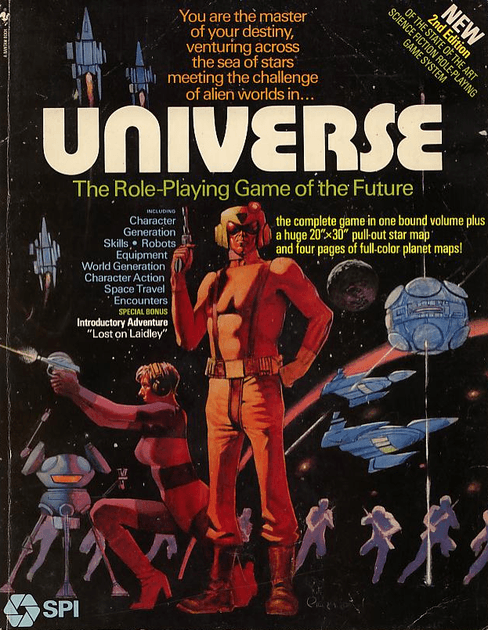
This prompt is amusing. With Amazon and the internet, you can find all those old games — often in good shape! — so if you wish it, you can have it. That said, part of me really wishes I had an old science fiction game called Universe that SPI (I think it was) put out in the early to mid ’80s. It had this spectacular map of the nearest stars that was pretty accurate (for a 2d representation of three dimensions), and I remember the rules being decent, if not as simple as Star Frontiers, but lightyears better than the execrable Space Opera, which we also tried and which has never been bested in my mind for truly awful mechanics until the unfortunate Traveler 5 or whatever that shit was that was published a few years ago.
It’s probably awful by today’s standards, and I realize that there’s a lot of sentimental BS — this was the sci-fi game we settled on in the high school group after Star Frontiers. It was supposed to be SPI’s answer to GDW’s Traveler, if I remember.
Having written this, I of course, hit the interwebz and found the game on eBay and Noble Knight for a ludicrous $175ish (but in excellent shape — so probably as close to new as possible.)
I don’t tend to use modules and campaign guides to run them, but to mine them for ideas. I’ve never run one without tearing it apart and modifying it for the players/characters/campaign we’re playing. However, when we were kicking the tires on Alien a few years ago, I wound up using the Chariot of the Gods adventure to try and lure the group in and kickstart a campaign. The players wrote up their own characters instead of using provided ones. The premise was simple — a missing Weyland-Yutani ship, Cronus, is discovered by a group of salvage operators who find the science module/lifeboat is missing and most of the crew gone, save for a few in hypersleep. The ship is almost dead and they have to get it fired back up. After the crew gets wakened, the requisite horrible stuff starts happening. There’s a third act where a competitor ship shows up, but I ditched that as we got to the end and the characters did some clever things to survive aboard Cronus long enough to go into hypersleep with the ship supposedly on course for the nearest port.
It’s a good adventure and well written, as is the “sequel” a campaign instead of a one-shot “cinematic” adventure — Destroyer of Worlds. The adventure takes place on a colony world on the edge of American space. There’s the the UPP — the setting’s “commies”, if you will, invading because of a secret lab producing the bioweapons. The characters are looking for some deserters from the colonial marines and things, as one might expect, go pear-shaped. The setting of the colony is extensively presented and I wouldn’t mind running a few adventures on the world before the events of DoW. It wound up giving me ideas for creating and running the colony world that some of the players’ characters have landed on after a hit job in Tokyo went bad and they had to run for it.
So while I don’t tend to run published adventures very often, I do find them useful for inspiration or finding material to use. If you’re a new GM, however, they can be a real lifesaver — cutting the prep time down, allowing you to often hit all the rules mechanics for players to learn, and reducing the intimidation factor that running a new game for a group of people can inspire.
This year’s RPGaDay is really exposing my lack of dork. I’ve only been to two conventions in my life. One was back in the ’80s in Philadelphia where I met some cool folks and had to leave early due to food poisoning. The other was a sci-fi and comic convention in Albuquerque about five years ago, and I went to that one to support a friend that was having a time of it and just wanted to go have fun.
I think my favorite purchase was the P90 airsoft gun I found for him to go with his Stargate (Atlantis, if i recall) costume. It wasn’t for me — I wanted him to have a good time and the $100 or so was worth it. I think I bought myself an Eaglemoss Akira-class starship model (one of the wee ones…) The convention was also good for the fee pics he got to take with various actors because i was making a joke of him posing with all these cosplayers — I would take a picture of the person, but only his elbow, arm, small bit would be in frame. (Yes, there was also a proper one with him in the shot.) It was so well received that the actor from Voyager (Garret Wang?), the bad guy/kid from Karate Kid, and a bunch of other guests took pics with him for free to be in on the joke. (They got tipped well — they’re not working for free.)
Sadly, we’re not friends anymore.
I guess someone needs to convince me to go to a convention.
This one’s easy. It’s also a tale of how some folks take gaming way too seriously.
Early ’90s. I had just moved back to my hometown in Pennsylvania and couldn’t find a group. I wound up introducing a regular customer that hung out at the gas station I was working nights at to gaming. I was running Space:1889 using the old GDW rules and the Cloudships and Gunboats minis for the ship combat. A few sessions ensued, a few more folks from the local college joined in.
In an epic battle between the heroes, who had been stranded at a British frontier station on Mars after the cloudship was damaged in a fight, they found themselves pitted against a large force of Martians from a local “empire”. They were fighting to get back to the station after an unsuccessful foray, and running out of ammunition and support, they needed to withdraw. But not this guy. While shouting that he would bring down the might of the British empire (or some such), he charged alone into a horde of baddies.
And died really quickly and ignominiously.
This was done even after the classic GM letting you know you’re idea is truly stupid — “You sure about that?” It was also the way he played the character that made this more comic than tragic or even brave. Afterward, he let me know that he felt the other players weren’t giving Sir Diesalot his appropriate due and that he had a dream where the character had “haunted him” over their lack of respect.
So, he was out of the group quickety-quick. That’s a bit too much lack of reality for me, and honestly, gaming was probably not the healthiest pastime for him, it would appear.
This guy and the “ninja” from my time in Philadelphia are two of the reasons that I vet gamers in a neutral area (you don’t get my address until I know you’re not a kook) and we’re pretty fussy about newcomers.
There’s a few I wouldn’t mind playing, and some that had incredible longevity in our various iterations of the game group. From 1983 until about 2010, I regularly would run James Bond:007, and from 1989 until a few days ago, I ran a Space:1889 game — although I stopped using the GDW mechanics pretty early. We tried FUDGE (the original FATE), settled on Castle Falkenstein (with heavy modifications) to power it through the 1990s and 2000s until it rolled off the game rotation in favor of Hollow Earth Expedition.
So what do we still play? Dungeons & Dragons has recently rejoined the rotation with the latest game group. I hadn’t played it since our big campaign in high school that ended wonderfully. That was Advanced D&D and I didn’t play it again, save for one disastrous game night with a horrorshow of a person running, until 2016 when I coaxed a few old friends back into gaming by doing a Rome-based D&D campaign. Old West End Games’ Star Wars got trotted out for a bit a few years ago, as did the old Decipher Star Trek system.
Setting-wise, however, the big boy is Space:1889 — it was the game that got me into Victorian history (mostly because I wanted verisimilitude in the game world) and eventually led me into history as a field of study. I’ve been running it for my daughter recently, and she loves the setting. However, to drive the game, I’m using the Broken Compass rules. They’re clean, quick, and for a pre-teen that’s the ticket to getting through a “mission” or “adventure” in a night or two.
Define “weird”. I suspect the intent here was to angle toward discussing horror or horror-adjacent RPGs. That’s never really been my thing. I played Call of Chthulu once back in the early ’90s with an absolutely horrible GM. (As an aside, the dude was a goth Christian that wrote really bad goth Christian music.) The experience was so awful, I’ve never played CoC again, and avoided most of the White Wolf lines of the ’90s. (Which, to be honest, having hung around with some of the LARPers that played them, seemed to revolve mostly around dressing up and trying to get laid. Nothing wrong with that, mind; just not my idea of “role playing”.)
I remember buying Kult back in whenever it came out and being unimpressed with the rules. Other than that, the closest I’ve gotten to “weird” — other than being an RPG player in the first place — is probably Tales from the Loop and Things from the Flood. These games are meant to evoke the kids-on-bikes movies of the ’80s, but could be taken in the Stranger Things direction very easily. I ran a few sessions of TftL, but just couldn’t quite get the groove, although the players seemed to like it.
Another than might count more for the material explored in the campaign would be Alien. I love the franchise but we’ve steered away from the alien body horror for the most part and focused on corporate intrigue and the horrors of synths replacing people, genetically-engineered critters for pets — from cute anime synths to gene-spliced sabertooth tiger “pets” and worse. Instead of looking to space for the truly awful, I’ve focused more on people.
Anyway — that’s about all I’ve got for this one. What are some “weird” games I’m missing out on?
Our local dealer, Motopia New Mexico, got in a bunch of test ride bikes from Piaggio Group and needed folks to put some miles on them, so of course, I graciously offered my services to wring out a brand new sport touring bike. Duh!
Enter the new Moto Guzzi V100 Mandello. It’s using a modified version of their usual transverse twin motor and shaft drive system that Guzzis have had for decades. In this case, the motor is a liter in capacity, but they’ve rotated the heads to make it easier to work on and to allow for greater air and exhaust flow. It’s water-cooled, as well. It turns out an advertised 115 horsepower and about 77 ft. lbs. of torque. There’s the usual traction control, ABS brakes, and a host of other electronic doo-dads that I didn’t play with, like an electronic windscreen you can raise and lower, the wee aerodynamic flaps on the sides for the “adaptive aerodynamics”
that they are very proud of, and more. It’s got one of those LED screens for instrumentation. It shows a lot of information and is very useful. I still hate it; I like my old school gauges. And get off my lawn. Here it is in all it’s glory.
With all that aside, how was it? It’s very comfortable. I spent just over an hour and 70 miles in the saddle, riding in heavy street traffic here in Albuquerque, on the interstate, secondary highways, and the challenging mountain twisties of Sandia Crest road. The saddle is superb — I’d easily put it against any other sport touring bike for comfort. It’s a wee bit tall for folks under a 32″ inseam, but I had no problems getting on and reaching the ground at stops; getting off was a bit more challenging. I kept catching on the hand/top box rails.
It’s very quick, and probably fast, as well. What do I mean by that? It gets up to speed fast. The shaft drive really moves the torque and getting on the highway was effortless. Like the V7, these things like run long in the gears or they get finicky until they are warmed up. The bike doesn’t really wake up until 4,000 rpm, and and doesn’t start to shine until 5,000. In a few blimps of the throttle in sixth gear, I was able to climb from 80 to 95mph in about 2 seconds. Not bad. Without hitting the redline, I got the machine up to 118mph indicated a few times and it was still pulling. I never hit the governor on the engine speed, but supposedly there is one. It also will bleed speed very quickly with engine braking.
The motor is smoother than any other Guzzi I’ve ridden. There’s a bit of the side to side that would similarly feel on a BMW boxer, but the quirkiness of the Guzzi motor is gone. At speed, it’s glass. The exhaust note is good — not too loud, but it’s got a nice growl to it.
It handles well. The weight is much higher than I’m used to with the V7 and the Enfields and similar classic styled bikes, but once I got used to it, I was turning with ease up and down the Crest road. Turns at speeds that would have scrapped hard bits on the V7 and even the Enfield Interceptor still had plenty of clearance. It’s nimble and stops well.
(You’ll note that the dealer forgot to put a temp tag on the bike…good thing I didn’t get in front of the one state trooper!)
The V100s I’ve seen at the shop and on the road have superb paint, fit and finish. The one I got was the Marina edition — a tip of the hat to Italy’s marine aviation division. The bike looks good, although I think I’d get tired of this look, as compared to the white and green S version of the machine.
The downsides — and some of this might be because we were breaking these in to first service and they have been demo bikes, so they’ve not been treated the best: The gearbox is clunky — especially into first. When I would drop into gear out of neutral, the bike would lurch just a bit. Not a great feeling. Shifting was stiff, but it was similarly tight on my V7 and a friend’s V85, but after the first service and oil change, loosened up considerably. Most likely, this example hadn’t been the best cared for and would see similar changes in behavior with service. But with how good the motor and handling were, this was a glaring low point.
Another issue — and again, this could have been an issue with the demo bikes — the gear indicator would not show neutral. If you kicked up from first gear, it showed in first; if you kicked down from second, it showed in second. During my trip back into town and shot up through the gear getting onto I-40 and it showed sixth as being in fifth. I dropped a gear for a few seconds and shifted up and it indicated correctly. It might be a glitch in this one machine, but who knows? I have noticed that my V7 takes a whil to indicate correct gear once you release the clutch (while clutched it has a null reading.) Are these deal breakers? No — but if they are something across the line, hopefully the boys at Guzzi are working on a software fix.
Outside of that, it is overall a very, very good motorcycle. If I was looking for a sport touring bike with luggage and so forth, I think I’d probably lean toward the Mandello, even though the Japanese stuff is usually cheaper. Compared to the BMWs and Triumphs, I think this thing is a winner. It’s running about $15,000 — so if you’re a Triumph or BMW or Ducati guy, this thing is in your price range (or cheaper). If you’re a UJM guy, it’s going to be a bit rich.
This prompt again outs my shaky geek credentials. I know there are a lot of games that have tie-in novels, comics, movies, etc. There’s stuff for Dungeons & Dragons and other RPGs, but for the most part, I’m usually focused on my take on that particular property, so I don’t really tend to buy those things. That said — and this particular game keeps coming up — I did rather enjoy the run of DIE the comic, which was developed and published at the same time as the creative team were working on the RPG. The run of the comic is over, so you should be able to get a hold of these at your local comic store or via Comicology or Amazon, or whatever. I suggest the LCS — they probably are still reeling from shutting the planet down.
The comic follows the adventures of a group of friends who got together to play a mysterious new roleplaying game in the ’90s as high school students and subsequently got transported to an alternate world based on RPGs, Tolkein’s experiences in World War I, HG Wells’ fascination with wargaming, the writings of the Bronte kids, and of course, Lovecraft. (As one does…) This world is a 20-sided die, with each facet containing a world (although there’s more to it), and over two years, they existed there before finally escaping — minus the GM who was caught in this other world. They come back to their hometown 15 years later and when their friend’s blood-covered (and magic) d20 is delivered to them, they find themselves trying to decide if they should destroy it. Too late, they are pulled back into DIE, where as their characters, they must figure out what’s going on. The comic deals with the emotional and other issues of the players as they deal with a world that feeds on their emotions and actions — good, bad, or indifferent.
It’s pretty good and worth grabbing the four volumes of graphic novels.
The other obvious one is Dungeons & Dragons; Honor Among Thieves which was a surprisingly good, and just flat out fun! movie. I took my daughter to see it and about half way through realized it was the most fun I’d had at a movie in a long time. And the fat dragon — well done.
Otherwise, without that, I would have to go with one of the properties that a roleplaying game was based on — a sort of inverse tie-in — and then there are so many: Babylon 5, Alien, Star Trek, Star Wars, Firefly, Battlestar Galactica (the good one), and so on… If we’re allowing for that then the hands-down winner for me is Blade Runner. I saw the original in the theater opening night as a teen and was simply blown away by the look and feel, the moral ambiguity, and Rutger Hauer’s amazing performance. I know some purists prefer the original release, but I felt the “director’s cut” improved the movie dramatically by removing the quasi-happy ending, the listless narration, and the addition of the dream sequence that throws an awful lot into question — some of which the newer sequel dodged.
Something a lot of people seem to miss. Gaff makes origami figured to suit the personality of the replicant they are dealing with — the stick figure man for Leon, the unicorn for Deckard (if he is, indeed, a replicant)…and the chicken for Captain Bryant. For me, that one bit begs the question: how many people were actually replicants and didn’t know it? Never went off the reservation and lived out their short lives not knowing?
The Denis Villaneue sequel is excellent, and I think from a standpoint of story and pacing, character and acting, and hitting the emotional and moral elements of the original, it far surpasses the original. (But I could be full of shit.) That said, the world created by Ridley Scott was so unique at the time that it inspired a host of manga, anime, and science fiction films’ look. Ghost in the Shell and Akira owe much to Blade Runner, as do other sci-fi animes (and curiously, to two smaller films — Streets of Fire and the very strange Trouble in Mind (which has one of my all-time favorite villains, Hilly Blue, a gangster played by Divine [out of drag]).
So — tell me what I’m missing out there? Is there a tie-in I absolutely need to see/read?






 The Black Campbell