I happened upon the preview for Mindjammer‘s new edition and was intrigued enough to secure a version of the game. The “thoughtcast” is the pdf version of the soon-to-be-released hardback, and is the second edition of the game setting, which started off as a setting for the Starblazers Adventures game that Cubicle 7 put out a few years ago. The book is almost exclusively written and edited, it looks like, by Sarah Newton, and features some decent (industry standard quality) art in the interior, with a very nice cover. According to Drive Thru RPG, this is a 99% complete version of the print copy, but I’m damned if I could find anywhere that wasn’t fully proofed (and to better standards than the typical RPG core book, I might add) and written.

On the pdf version: The only real fault I could find with the product is the lack of bookmarking. This is a massive core book, running to just under 500 pages, and could really use hyperlinks to the chapters, at the very least. Links to core concepts and rules would be a good idea, too. This isn’t typical of RPG pdf books, to be fair, but I was really spoiled by the high quality linking that Margaret Weis’ bunch did on the Marvel line and I’ve come to expect it. Otherwise, the imaging is very good, the print is pretty easy to real on my iPad, even with my now slightly farsighted eyes (hooray, LASIK!)

The rules: It’s FATE. I know I’ve got a bit of a rep, apparently, as a Fate-hater (FATEr?) but that’s not really true. Like the OGL d20 in the early aughties, I just kind of want to purchase a product that isn’t FATE at some point. (Mostly, I think it’s spoiled grapes of Fate getting into my beloved Cortex.) If you know Fate, you can play this game as soon as the download hits. In the case of this particular setting, Fate is an excellent choice, as it has a narrative flexibility thanks to the relatively rules-light mechanics to handle the wide scales that come with a trans/posthuman setting. If you don’t know Fate, there’s a lot of freebie Fate Lite rules sets floating in the wide electronic sea.

In Mindjammer, you can pretty much play anything you want. Human? Sure. Alien? Sure. Uplifted animal? (Rocket Raccoon, anyone?) Yup. Robots, sentient starships, bioroids, planetary-level computers? Yup, yeah, yes, and sure. FATE allows you a certain level of skills, and descriptive “aspects that can add to your test rolls, which you do with fate or “fudge” dice, but could easily use a d6 to handle. Fate/Fudge dice have two -, two +, and two 0 faces, so when you roll, it’s your skill plus or minus the result on the dice versus a target number from -2 to 9, usually. I suspect my ambivalence for FATE comes from this dice mechanic. (Although the negative die/positive die+skill mechanic of The Babylon Project didn’t bother me as much. I believe the term you want is “hypocrite.”)

Mindjammer uses the same character system to cover everything from a normal being to super-intelligent ships, computers, space habitats, even cultures and organizations. It’s easy, and it allows for a wide range of actions for players in a scenario — want to overthrow a culture? Your skills in manipulating it would be used to attack the Mental Stress of the culture and create complications for them or assets for you.

The setting: Mindjammer doesn’t play with the near future like Transhuman Space and to a lesser extend Eclipse Phase does. It’s placed about 12,000 years in the future, and the Human Commonality (a kind of analogue of Iain Bank’s Culture) is spreading back out into space and finding lost colonies of humans, their machines, and modified creatures that have been left to evolve their own cultures over millennia. There’s a bad guy race, the Venu — human castoffs in the Orion area; there’s sentient machines and uplifted animals that were engaged in a war and now have an uneasy alliance. There’s stranger aliens roaming space. The whole of the Commonality and some of the other powers are joined by the mindscape — a cyberspace/augmented reality that has to be regularly updated by “mindjamers” — sentient starships that ply space syncing the mindscape.

There’s a ton of background setting in this behemoth of a book, and for a newer gamemaster it could be a bit daunting to launch in an run the setting. I would suggest picking a small chunk of the setting and start small, expanding scope as you get more comfortable with the universe. Otherwise, I would consider setting it in your own chunk of the galaxy, create your own worlds and creatures and run from there, joining it to the game’s setting as you feel necessary.

Another area where the book is occasionally almost obsessive about detail is the ability to create cities, cultures, worlds, star systems, sectors, etc. from scratch — and there are tables to help you do it. If anything, Mindjammer might be worth the purchase for someone cobbling together their own sci-fi setting just for these guides alone. For an experienced GM, they’re useful, but could be overlooked if you were in a hurry to run, and/or knew what you wanted to do.

So is it worth it? The sale price for the book is $54US (about $65 after shipping) and is due in March, but you get the pdf version now. I’m assuming that you will get an update through Drive Thru or RPG Now when the main release comes and will get a finished copy, but even if you don’t, this is finish copy, so far as I can tell. It has all the rules you need; you don’t have to buy Fate Core. The setting looks to be as complete as needed, but I expect there will be supplements. Even if you didn’t use the setting, there’s enough here to craft your own sci-fi setting from classic space opera to cyberpunk, to the transhuman settings of Banks or Stross. Yes — it’s worth it.

I’m even willing to run Fate to try it out.

Style: 4.5 out of 5 — the art is average quality, but the writing is good and leads you through the book quickly. Substance: 5 out of 5 — it’s a well crafted, fun, and fully-formed sci-fi universe to play in.

UPDATE: I received the physical copy of Mindjammer about a month or so after this post. It’s a nice hardback, and all the comments about the art, layout, and writing remain the same for the product. It’s a monster, size-wise. Seriously, you could recreate a noir pulp detective torture sequence with this thing. It’s worth the price.
After a few weeks with game cancelled thanks to the swine flu flattening everyone in my house, (kids — little bioweapons! I’ve got a cold, now, thanks to one…) we were finally able to play last week. It was mostly following up little character interaction vignettes, but there were also a few big “push” scenes that advanced the arc:

Our CAG (a PC) has been prone to divine visions throughout the game (he’s the son of an oracle), and has been delving into the Sacred Scrolls, but also the “Aurelian Heresies” — an apocrypha that appears to predate Mankind on Kobol, and possibly even the Lords of Kobol themselves. There are more ties to the Titanomachy (the period of the Titans, only mentioned tangentially in the TV series), and he delves into the Eleusian Mysteries with one of the cults that use the Heresies –which they call the Aurelian Prophecies. One of the introductory rituals is the use of kykeon — a combination of ambrosia, chamalla, and other things that produces a strong hallucinogenic brew. Lucky (the CAGs callsign) takes part and has been having more intense visions of The Blaze — the jealous god that started the war between the Lords and Man. (It’s a toss off line they cut from the Kobol episodes, but became a central theme for the campaign.) The Blaze seems to the “God” of the Cylons, but is also venerated  by the Eleusinians as part of their cycle of death, discovery, and rebirth. During his vision, he is escorted by a minor NPC, his young chaplain’s mate who appears as a winged creature of light. He has the vision of the two and ten vipers, slithering into fire, but only one survives…could that be him? Is he destined to destroy the Blaze?

At this point, the Blaze “sees” him. There is a psychic connection of some sort and he realizes that the Blaze, his gleaming diamond-like spacecraft, are one and the same — some kind of incredibly powerful and intelligent creature or machine, but not God. And this thing has been retelling the story of Kobol, the Colonies, and Earth for thousands of years. To break the cycle, they need to destroy the storyteller…but what is helping him to do this?

The second push moment was a hypnosis session between Lucky and the lawman Chaplain (a PC), and Boomer. They are attempting to help her assimilate her Cylon and “human” personalities and memories. They rolled incredibly well and manage to pull it off — Boomer is Sharon Valerii, now, but her Cylon memories and personality have been integrated. She’s smarter, harder, but the “human” personality is dominant. She offers to help them find the Tomb of Athena, where they can get their roadmap to Earth. The humanoid Cylons (now confirmed to have come from Kobol and are “humans” that followed the Blaze after the War with the Lords) know where the Tomb is, where Hephaestus’ Forge is, have investigated the halls of Olympus, which overlooked the “City of the Gods”, but they cannot access the many of the places the Lords of Kobol left behind. They can only be opened by the faithful; Cylons, the automated systems kill. She can take them there, but she cannot enter.

The end of the session had the crew starting to look for transmissions from Kobol, hoping to develop a better picture of the tactical, political, and societal situation on the planet.

The goal has been to use the show as a jumping off point, to take the elements that caught my imagination and use those to tell another version of the Cycle of Time, linking it to an interesting idea from Zachary Mason’s excellent The Lost Books of the Odyssey — the idea Phaedrans had that every person’s story was a tale told by someone else, and if you could find the storyteller (and kill him) you could be free of your story to live as you pleased. The idea of escaping the predestination built into the Galactica universe was, to me, an interesting one — free will versus divine will. So the game has become focused escaping the Cycle of Time (as, to a lesser extent I would propose, was the bringing Cylons and humans together in the show.)

My hope has been to accentuate the themes of the show, while taking a new and fresh direction, and allowing for moments of “fan service” where the players think they know where the game is going (“Oh, this episode is Bastille Day!”) but then letting them change the outcomes.

Okay…they did Rocket Raccoon well. I’m in.

After 6000 miles or so on the Avon AM26 Roadriders, i decided I needed a new set of feet for the Thruxton. There was probably another 3000 miles left in the tread, but I suspect a combination of underinflation and the tires having been just a bit off balance in their early days was giving rise to an annoying speed wobble in the 50-55mph range — nothing too terrible, but very noticeable — so I figured nip it in the bud.

So what to do? go back to the reliable and predictable Mezlers? Get another set of the Avons with their great turning and grip, but twitchy handling in wind and on grooved concrete? Maybe pop for the fantastic but expensive Dunlop Trailmax dual sport tires? I decided to take the advice of a cafe builder friend out here and try Shinko tires.

The obvious good stuff: they are cheap — the 712s for the Thruxton were about half the cost of a set of Avons. Even with install they’re cheaper than the Avons. They seem to sit just a bit higher on the back tire than the Roadrides did. They have a deep tread, and are nicely sticky, but the lettering style is not attractive. The bad: it’s got the usual center rain groove that doesn’t play well with grooved concrete. Once mounted, I took Trixie for a quick spin on I-40 and South 14’s nice set of twisties just south of Tijeras.

The tires are fairly quiet; I noticed no road noise of note. They have a slight vibration the Avons didn’t, but it’s not finger numbing. They take input very easily and quickly.

On the highway, they do seek on the grooved concrete (and to be fair, it’s an awful stretch of road, as well), but I didn’t get the wobble the Avons liked to give me. On normal pavement, they were sure and solid. I was also catching a hard set of crosswinds coming through the canyon. On the Avons, I would really feel the wind buffeting the bike, but on the Shinkos — as with the OEM Metzlers — there was minimal buffeting.

A quick run down the twisties on S14 (and absolutely not speeding…honest), and I found out the quick response to steering input was not linear (the best way I can put it.) The Avons have a steady fall into turns that is aggressive, but predictable. The Shinkos tip in fast and get progressively move aggressive in turning as you lean. A U-turn at the end of the twisties nearly put me down as the bike hauled over harder than expected, and when I gave it gas she sat up almost as sharply, and I nearly kissed the guard rail. And this is on a bike I know well.

(Hint for you bikers: changing the type tires really can change how your bike feels — be cautious those first few rides until you relearn the new handling.)

Overall, I’m pretty pleased with the Shinko 712s, so far. I figure if I get even half the wear as I got out of the Avons, they were worth it.

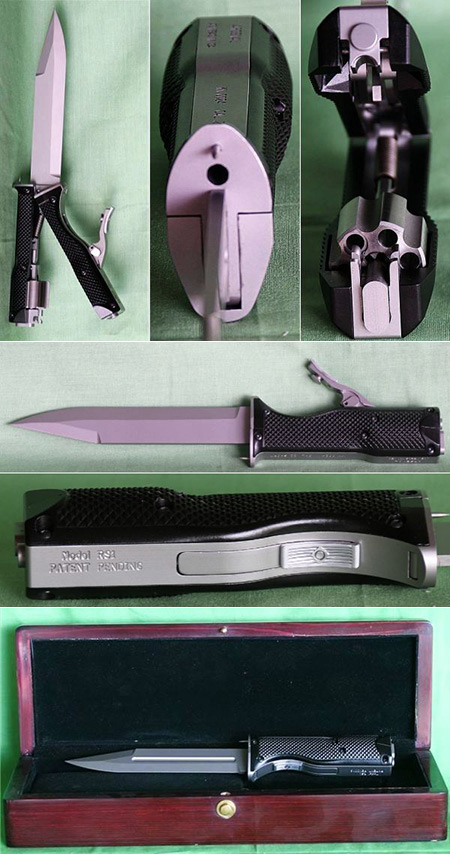
Arsenal Arms created a “ballistic knife” — a combat knife with a six shot .22LR revolver cylinder inside the handle of the knife. The gun is actuated by turning a portion of the trigger, which levers up and for every squeeze, a round is fired. Some of the game stat stuff is conjecture based on videos on the web, as I’ve not actually seen one of these. The trigger looks very heavy and awkward, so accuracy is going to suffer severely. The cylinder looks like it might be off the NAA pocket revolvers, so you can probably carry an extra cylinder (if you can figure out how to keep the rounds in, and hot swap the cylinder. Reloading looks like you’d have to take the cylinder out, knock the rounds that don’t fall free, out, then feed and replace the cylinder before closing.

gun-knife

G.R.A.D. MODEL RS1 BALLISTIC COMBAT KNIFE

PM: o  DC: +2   CON: +1   DRAW: 0

(as gun) PM: -1   S/R: 1   AMMO: 6   DC: D   CLOS: 0-1   LONG: 3-6   CON: +1   JAM: 97+   DRAW: 0   RL: see GM information… COST: ~$2000

GM Information: the RS1 is designed to be a last ditch weapon, so reloading was not a priority. To hot-swap a cylinder, the reload time can be dropped to 3 rounds, to feed the cylinder in the weapon new rounds takes 5 rounds.

(Ed. If anyone has one of these and care to correct me on elements of the function, etc., please do…)

Here’s some vid of the thing in action:

So, after an frightening anxiety attack over my kid having a pretty high fever that led to a near-total breakdown and completely inappropriate behavior from yours truly, I’ve decided to completely detoxify my life. Step 1 is the shut down or refocus of the other website I have away from politics and the awful stuff that’s coming our way. I’ll deal with it when it hits. Step 2 is to revitalize this blog. Hopefully, Step 3 will be something great, but right now it’s a big underpants gnome question mark.

Hilarity ensues…

1545217_10202989107196414_1987803967_n

This past week, the players in my Battlestar Galactica campaign managed to gain some very important intelligence on their quest for Kobol and Earth, but more striking, they got just enough of a hint of the metaplot — that the Cycle of Time, which we’ve referred to time and again as “a story told over and over”, is leading them to re-enact the same basic themes that have befallen other civilizations — most notably the Lord of Kobol/Olympians, and their “parents”, the Titans. I introduced something called the “Aurelian Heresies” — an apocrypha of the Sacred Scrolls that supposedly long predates the Exodus from Kobol, and possibly Kobol itself. This was originally a bit of “fan service” to the players who had been in the last iteration of the BSG campaign, but over time, it has developed to be a central bit of background noise that now has become obviously important.

So why start a post on pacing with this anecdote? One of the hardest elements for a GM is pacing a campaign. Sometimes, you plan on a game running a few sessions and ending, only to have it run six years — like my Star Trek campaign from the early oughties. Other times, you have a plan for three or four “seasons” that will lead to some epic end. Any gamer who has played long enough knows how hard it is to achieve the endpoint of a game campaign. People move away and the game collapses; schedules change and the game collapses; something new and shiny is released and you dabble in it only to wind up playing that game for years, instead; or sometimes, you just don’t want the ride to end and you start throwing filler in to stave off the inevitable.

With the Battlestar Galactica game, the “season 1” pacing started slow — mostly character-driven episodes to realize the world and NPCs for the players, so that when the Cylon attacks occurred, they would feel the loss to some small effect as their character would. It was slow paced with lots of hints about the Cycle of Time and previous “Colonies” that had existed on the 12 Worlds long before the Exodus from Kobol should have happened. A few archeological digs in space found more evidence of similar human settlements long before there should have been any. Cylon infiltration was discovered. I had sold the game on the premise that they might even be able to stop the attacks and save the Colonies; I had no intention of honoring that. The total time was a bit over a year of game time with other games being played in a rotation.

“Season 2” was almost exclusively focused on hunting Cylon infiltrators and conspiracies in the Colonies. The episodes were no longer stand-alone or random, and the pace picked up considerably as they hunted the bad guys. Game time was only a few months, but it played over about six months. Toward the end, I made the decision to put the players’ charactes into some of the lead slots, instead of characters from the show. The Cylon attacks happen pretty much as they do onscreen in the Miniseries.

“Season 3” has been going about six months and is nearing the end. Total game time: two months. The players survive the attacks, fight Cylons, had a few “fleet episodes” to show the crime, bad conditions, and development of the political system. Then we started to find remains from the Kobol Exodus, evidence the Lord of Kobol and the humanoid Cylons share DNA and technology. The Blaze — a toss off line cut from the Kobol’s Last Gleaming episode became the main guide for the direction of the game: the Colonials fled the war between the Lords of Kobol and humans that followed this “god” in its shining diamond-like spacecraft. Then they found the directions to Kobol. Now they are on their way and through a few toss-off lines from an interrogation of Boomer, think the Blaze may have destroyed the Colonies to bring Man back to Kobol for one last chance at submission and redemption.

Now I find myself faced with the classic problem of a campaign sliding into the third act fast — do it string it out, as the show did,  and enjoy some gaming with these characters we love and a universe that is now very much our own? That was my immediate reaction. But sometimes, it’s better to throw it in fifth and punch it. Embrace the direction the game is going and the pacing.

One reason for this is the impending move of one of the players who has only been with us for a year or so, but has really livened up play. He’s been with us through the end of “season 2” and all of the “season 3” stuff playing one of the most important characters, our fighter pilot who is secretly an oracle. I want him to see the end of the game. So, it’s time to floor it.

I had an idea of what i wanted to do with Kobol this time around — in the first game, Kobol was “dead” as in the show, but there were things left from the Gods: Hephaestus’ Forge, the Tomb of Athena. This time, if the humanoid “Cylons” are some kind of apostate version of mankind that has been modified to work with the Colonial built centurions, it would suggest that Kobol is inhabited and at least mostly healthy. So what does that do for the characters trying to get to the Tomb of Athena? How do they pull it off?

One of the characters, the commander, talked about how, if the Blaze is waiting for them, perhaps they might be well served by at least hearing the god/thing/whatever out. This opened a new line of direction that I hadn’t anticipated. Essentially, there are now two main plot directions the game could take — they discover the path to Earth and lead the Cylons a merry chase; or they submit to the will of this “god” and head to Earth, perhaps as his emissaries.

That leaves me with two main lines and a few variations on a theme to be ready to work with, and ultimately, only four real “endgames” for Earth. This “season 4” will be at a faster pace and more tightly plotted than the others. I anticipate the campaign — the first and longest lasting of my “new life” that started in 2010, will come to an end in April.

I aim to make it shine.

The takeaway from the piece is this: for campaigns with an overarching plot — much like a movie or TV show — each of your Acts or Seasons should have it’s own unique flavor and pace, but always moving more swiftly toward the denouement of the season/act, and the overall course of the game. This allows the players to feel like they are making progress in their goals, and revealing any mysteries that might have been set in front of them. Because, in the end, people need a story to have an ending.