Go see it. No spoilers in this

Alfonso Cuarón did a fantastic job with the movie, which must have required a staggering amount of scene blocking to mesh the CGI, lighting, and live action together. (Apparently, they had to design a large lightbox set to get the lighting correct.) The sound design is superb and uses a combination of silence, transmitted sound (you are hearing things as the characters would, transmitted through touch, and the use of musical queues (particularly heartbeat like percussion.)

There’s a few inaccuracies for the people that have to piss on everything they see — yes, the shuttle’s no longer flying; yes, the debris comes from an odd direction and shuttle activity and comms satellites are at different altitudes. If you’re thinking about that stuff, either go home or start watching the movie. You know, the part with the characters in it. I stop noticing any of this about 10 minutes in when the action starts. The pace is well done, with moments of near panic broken by interludes of character development.

The visuals are stunning and the 3D — which I abhor — was used properly, to create depth of field. It’s probably the most effective use of the technology since Avatar. There’s a moment when Bullock’s character, Dr. Stone, opined, “I hate space.” I had the exact opposite response — the beauty of the setting makes me want to go up even more.

Speaking of Bullock: The movie hinges on her performance. She’s the only one on screen for 90% of the movie, and she’s superb in the role. They didn’t pretty her up, and the character’s backstory is tragic without being too saccharine. The sense of hopelessness and loneliness she evokes was grand.

Style: 5 out of 5. Substance: 4 out of 5 — it’s a straight out action survival pic, but there’s a lot of nice touches that boost it from 3 to 4 for me…mostly due to Bullock’s performance.

It’s a must see and even worth the full price for 3D.

I’ve been using an HTC One V for a little over a year now on the Virgin Mobile service. It was a serviceable smart phone, but was increasingly buggy and twitchy. Even cleaning every cache, removing unused apps, etc. would not fix the issues, which included more and more dropped calls and bad reception. I finally broke down and decided to take the hit and buy an iPhone 5 (yes, I know the 5S is coming out at the end of the month, but I doubt it’ll hit VM before the year’s end…and I really don’t need a fingerprint sensor on my home button…)

So, was it worth it? In a word: yes! I’m relatively platform agnostic, but over the last few years i find myself gravitating toward Apple products. It started with the iPad, which I still adore, and then my wife bought me a MacBook Air back in 2010. It’s still going strong with 98% of the original battery capacity, it’s still as fast, and it still works great. I like that the Apple devices talk to each other easily and — outside of the craphill that is iTunes (Seriously, Apple…fix the damned thing!) — I have no complaints. Yes, the interface isn’t as customizable as Android. Yes, it’s a “walled” ecosphere — I still get pretty much all the performance I want. Yes, they’re bloody expensive — the main sticking point for me.

I figured I would like the iPhone — it’s a small iPad with a phone, after all. Except the integration of the apps is astounding. Everything talks to each other. Siri isn’t the greatest search engine, but it makes it easy to use the phone without hunting for the right app — call Mom. Facetime with Paul. Where’s the local Chinese joint? It works. Just don’t ask it if there’s a local distributor for McEwan’s Scotch Ale; it gets confused.

The texting/Message feature is good, and Facetime is quick and stable for video calls (my mother was thrilled to talk to her granddaughter face-to-face.) The voice recognition is about 90% — pretty good for my screwy Pennsylvania-Scottish accent, which throws it on the strangest words.

It looks good, build quality is top-notch — something the HTC also had going for it — and it’s no larger than the One V was. I find iOS6 much more user friendly than the back/home/app button combo of the One V, and i think the stability of the OS build is immediately noticeable.

The big downsides: yes, the interface looks a bit plain compared to Android, which you can customize, but that wasn’t much of a selling point to me; I want to find what I’m looking for fast and be able to hit the icon without worrying about my fingers being too big. This might not be an issue on the billboard-sized Samsungs and Droids coming out, but I want to stick with something phone-sized. Second: No true multitasking. I found with my HTC that multitasking on the Android phone blew through battery life pretty quickly. It’s a good best we’ll see the same issue once iOS7 brings it to the iPhone. Another is battery life. It wasn’t great on the One V, but I only had to charge it every two or three days with average use. The iPhone looks to burn through a charge will average usage (for me a couple of calls, a bit of texting, and some data usage) in about two days. A heavy user would have to charge the thing every day. I assume the same with an Android or Windows phone, as well.

As to the Virgin Mobile service for the iPhone. You can pay $55/month for unlimited everything, but I run the $45/month for the 1200 minutes and everything else unlimited. After taxes and fees, I’m still only paying $50…about half of the big boys, including Sprint, on whose network Virgin functions. Even paying up front for the phone, full price, over the life of a contract period, I pay $932 less. And yes, you can swap the SIM cards and run on other networks. So is it worth a bigger hit at the start for the overall savings? Especially if you can use the PayPal Buy It Now (or whatever they’re calling it) promotion of six months with no payments or interest — yes. Pay it off in a couple of chunks. You’re much better off than with AT&T or Verizon, from a price point.

But what about the quality and coverage? Not as good. I get 3G in Albuquerque and the surrounding New Mexico area with a bunch of dead zones thanks to the massive areas of nothing out here between towns. (911 service, however, has been available in the same places I’d get it on other networks.) You do need to leave LTE on if you want to do anything data-intensive or the performance is glacial; with it on, it’s speedy enough for a Facebook check or to do a quick internet search for whatever. I haven’t bothered to try streaming anything yet, but I suspect it will be a bit jumpy. Call quality is good, for those of you who realized you can use a telephone to speak to people, instead of conducting a 2 minute conversation over the course of an afternoon by text.

Style: 5 out of 5 — you really can’t fault Apple’s aesthetics. Simple, yet pretty; the interface is simple and easy to use. Substance: 5 out of 5 — it’s the largest app store in the world, and you can find just about anything you need. The operating system is almost bulletproof stable, call quality is good, and it’s packed with a host of baked in features.

Additionally, the preview of the iOS7 features and new look is another draw — at least for me — to the phone.

Here’s Danielle, a project by Anthony Cerniello and company showing the effects of aging from child to old age…stick with it, it’s worth the time.

I was reading over a couple of pieces on 11 Things to Help Your Players Be Better Roleplayers over on Gnome Stew, and the referenced 11 Ways to be a Better Roleplayer on LOOK, ROBOT and realized that several of their ideas were on display at this week’s game session.

The last few weeks have been a clusterf#$% regarding player attendance — between GenCon for one, another as a speaker at the Transformers convention over in England, and the third have to be away for work and other issues, we’ve been at least one player low all month. The past two weeks had me adapt to this by throwing together a murder mystery for our Battlestar Galactica game, set on one of the ships in the civilian fleet.

The two characters are members of the new Colonial Marshals Service, tasked with looking into violent crime, hoarding, and other immediate issues to fleet security. “Victimless” crime is ignored. However, in the aftermath of the Fall of the Colonies, there have been an understandable spate of suicides and suspicious deaths…they all have to be investigated. The veteran, Chaplain, is annoyed by this — he wants to focus on the Cylon menace, but I need the guy investigating crimes for this episode…right here, the player was doing what Grant highlighted in the second piece as points 3 and 4 — “Don’t Try to Stop Things” and “Take Control of Your Character”: The player didn’t pull the “my character wouldn’t do that” shtick — he followed the instructions of his boss, who told him he needed these cases closed and to get on it; the second character also had a case on the same ship — a missing 16 year old girl. The two decided to pool resources and investigate. The characters both bitched about their assignments — that was fully in character, and they were given the opportunity to harangue their boss…but they’re doing their jobs. In that, I was engaging in point 2 of Phil’s piece on Gnome Stew, Create Opportunities for the Players to Express Their Characters.

Points 3, 4 and 9 of the Gnome Stew article come into play here: One of the things I’ve always tried to do was act more as a director than a writer in games. The characters were given enough information to take action on their own. The players don’t lolligag — they immediately start looking into their respective cases. The whole time, I try to not just play the NPCs, but give possible queues that they might miss in the action, or might not have occurred to them while playing that tie into their character — getting inside the heads of the characters, as it were. Example: The new guy is a geek, an overweight former programmer than helped stop one of the prongs of the Cylon attack. He’s a coward, but he takes on the responsibility of being a cop seriously. As he realizes the parents of the missing girl are hiding something, and the younger brother is upset, I suggested that — this guy, the guy that no one would notice at college, that spent all his time playing a hero in RPGs and computer games, was suddenly the one guy that actually could make a difference and save this girl — he might find this both terrifying, but also an important moment for his self-esteem and personality. The player ran with it. They didn’t have to.

The veteran realizes that the suicide couldn’t possibly have happened as the report says — the safety protocols, etc. are too complex for a guy who was, in essence, the garbageman of the ship. He was murdered. The character is pissed, because now it’s not a check the box suicide investigation…he has to take it seriously. The two both run into a lot of stonewalling by crew and passengers and start to realize they are in real trouble…there’s something going on aboard the ship. They could, at this point, try to get backup or something, but they investigate further (Point 1: Do Something), checking the ship’s cargo manifests and the coming and goings of cargo ships and shuttles (the vessel is a major logistics hub for the fleet.) They also note the tattoos on the security men and crew of the ship — they realize it’s a Ha’la’tha (Tauron mafia) ship. They get the brother of the missing girl alone and find out she’s was sold to the HLT for extra food and clothing rations.

Point 3 for the GM: Keep things moving. Paraphrasing Raymond Chandler, the pulp mystery writer, when a scene bogs down, have guys with guns burst in. That’s what happened here. We’d been building up the suspense for a while and it was time to get things moving. The newbie’s questioning of the kid brings the gangsters after him. There’s a chase and hiding from the bad guys scene in a crew habitat that I described as being a lot like the living quarters in Outland. (I wanted the catwalks, the multiple tiers with points that would require jumping from level to the next. See the movie — it’s a great action set piece.) The vet has to come rescue him and they proceed to kick serious ass. Having done that, they find out they work for a HLT lieutenat operating out of the “box city” — an area of interconnected pressurized cargo containers (like those on a real cargo ship, but with pressure doors, etc.) The same place where the suicide-now-murder took place.

The encounter the bad guys, whom the vet taunts for their obvious lack of forethought on trying to kill them. “What do you think is going to happen? You’ll just wind up with more cops of the marines in here!” Of course, the gangsters are planning on scattering and changing their identities — easy enough with the terrible record keeping currently in the civilian fleet (it’s less than a month from the Holocaust.) It’s a Mexican (or in this case, Tauron, showdown…)

At this point I realize we’re getting close to quitting time for the night and seek to wrap the night before they get to the part where they rescue the girls. The question — do I go for the anticlimactic “Oh, you’re right, here’s the girls” ending, or step it up. I go Chandler — the area is suddenly sealed by other bad guys and the “big bad” (now just a minor functionary) tells them they’re all dead. The gangsters included. The trail will dead end here.

The area is getting vented and the characters had a series of misadventures trying to get to safety including attempting the classic air duct crawl…only to get stuck. Really stuck. Two botches in a roll stuck. At this point I invoke point 10 in Phil’s piece: Make Failure Interesting. The vet is stuck and goes seriously claustrophobic/ upset that after all the shit he’s been through with Cylons and other dangers, he’s going to die stuck in an air vent…and he doesn’t even know why! The players embraced failure, as grant suggested and ran with it. Eventually, they managed to get clear, but it gave a great half hour of entertainment.

One point grant had: Don’t try to stop things came into play here: the newbie is a coward, had been nearly killed, had to shoot a man, and he’s a wreck…his beloved top-end datapad was shot (saving his life) in the hab fight. He wants to get on the first ship off the craft, but the vet knows the HLT isn’t going to let them do that. They settle for hacking the comms system and firing off a report/call for backup from the CMS before they go after the big bad (see above.) The characters argue, they alter each other’s pans, but they don’t try to undo what the other player is doing. They built on it.

We ended for the night with the characters stuck on a gangster controlled ship, who were nearly killed by nameless baddies, but they know where the brothel/club that the HLT is running is on the ship and the newbie — cowardice pushed aside by pride and the chance to be a hero — is determined to save them.

The thing for players and GM to remember is that RPGs are a collaborative form of storytelling and play. The GM (at least in more traditional sorts of games) creates the outlines of the world and the players flesh it out with their actions. Sometimes it’s just offhand comments like the newbie stating the bad guys were trying to make their deaths look like accidents. Well, no, I was trying to come up with a quick ending that didn’t involve the characters getting killed by the ready to shoot villains…but it sounded good, so I ran with it. Take what the players are doing and mold it to work with what you intended — or it their idea’s better, purloin it [without telling them] and run with it. Ultimately, as long as everyone is having fun, you’re doing it right.

A short dealing with privatized policing. Of course, it only goes for the dystopian view, while missing some of the benefits — like state-sponsored coercion and violence.

There’s some real sci-fi/cyberpunk RPG gold in this

Having really cut my teeth as a GM with the James Bond: 007 RPG in the 1980s, one of the techniques I used to introduce characters and/or stories was inspired by the Bond movies (and many other television series and action movies) is the teaser.

The teaser allows you to give a player(s) the chance to intro his or their characters in a simple action sequence. You begin in media res — the action is already underway. The teaser can have a connection to the rest of the story or not; you can make this the tail end of another unrelated mission, or you can connect it to the upcoming plotline through either a recurring villain or NPC, or some aspect of the teaser that eventually ties to the rest of the adventure upcoming.

The teaser should place the character firmly in their element of expertise, and play to the characters’ strengths and weaknesses. Let’s use Skyfall as an example. In this, we’ll stick with three “new” characters — Bond, Eve, and Tanner. (Why Tanner? We’re using him as the “eye in the sky” or hacker/backup for purposes of example.) You’re looking for a missing hard drive. We think we know who the guy is that has it. (Bad guy NPC Patrice.) One of our agents has tracked him down and is now not responding. Bond is our brick/fighting guy — the experienced, jaded one; Eve is our wheelman with some combat skills — she’s new and a bit unsure of herself; Tanner is their “hacker” — he’s the guy with the satellite feeds, the maps for them to use to try and get ahead of people, the guy that can get medical to you. He can coordinate the action between the characters when they are separated, effectively keeping everyone together, even if the characters are in different locations. He is, in essence, the glue between what could be completely separate scenes, and hence keep all the players involved.

Bond should have a moment to play to his jaded nature (he finds the injured agent — stabilize him or get after the bad guy?), he should have a combat sequence — fistfight or gun fight (or both) to show his combat prowess. Eve should have a chance to use her driving skills in a chase. (He’s in the black Audi!) She should have the chance to get into combat, but try to keep Bond in the spotlight for this. Tanner should be the guy directing them in the case (He’s turned left! If you go through the market you should be able to get ahead of them! [Give the Eve or Bond character some kind of bonus if Tanner gets a good roll on an appropriate skill to help manage the operation.])

Teasers should be short — around 30 minutes or so for a three hour session, but sometimes, they can be intensely fun on their own. I’ve had teasers run most of a game session (2 hours) for particularly complex action sequences. Example (let’s use Bond movies again, this time Goldeneye): The beginning of Goldeneye has a fairly complex action sequence involving Bond sneaking into a secret Soviet weapons plant and linking up with 003. The new characters might be just Bond, or Bond and Alec (003). They have to slip into the main portion of the factor to blow it up. They get cornered and have to escape while still destroying the place. A teaser like this, I can tell you from experience, is probably a one to 1.5 hour affair, minimum. There’s a lot of moving parts, but they do the same thing — Bond does action stuff like base jumping, shooting, and some stealth. Alec, if played by a player, would have to either be doing the same, or come in from a different direction. They would have some moment to play up their friendship or animosity, depending on the weaknesses with which they were designed. (Imagine the base jump’s the only way in  and one of the characters is acrophobic — golden!)

The teaser is a great method for introducing the characters: get them into their element, give them a few challenges that play to their strengths and weaknesses, then move onto the main story or campaign. But it’s also good for reintroducing the characters after a break, or introducing the next plotline.

The Living Daylights begins, as many Bond movies do, with a short mission that seems unrelated to the main story. Bond is training in Gibraltar with other 00s when one is killed by SMERSH. But SMERSH was deactivated! He chases down the assassin but the man is killed in typical spectacular fashion. It seems completely disconnected from the “main mission” — evacuate a Soviet general from Czechoslovakia who is under sniper protection…until the general is spirited out of the Blaydon safe house by SMERSH. Eventually, the plot would reveal the recaptured general is actually behind the SMERSH attack at Gibraltar in an attempt to get rid of a rival in the Soviet intelligence community who is closing in on his dirty opium for diamonds for guns operation.

You might have a character who encountered serious issues in a previous adventure. You might introduce the character in a teaser where an old bad guy turns up to have them murdered, and this drags them back into a life of action. Or that thief who was retired but has burned through his money, or is presented with a challenge just too juicy to ignore — reintroduce them living happily, then hit them with some minor action piece that plays to their diminishing money or requires them to use their mad thieving skills…boy, don’t you miss the rush…?

Hopefully, these few suggestions can give you a new tool in your GM kit to help the players connect with their characters and with the world/adventures you are presenting. While I’ve used primarily modern day examples, you can easily adapt the teaser to any genre you might be playing.

Here’s how to do it, Hollywood…

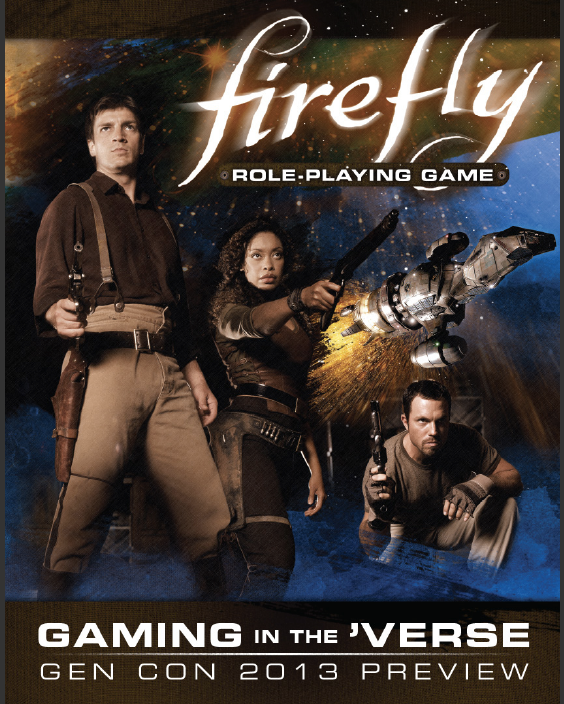
When they first announced the “preview” for the Firefly RPG was being released for $29.99 on Drive Thru RPG, the fandom seemed a bit unimpressed. I happened across the product on the previously mentioned website for $9.99 and judging from the description, I figured it was most of the game with a few adventures thrown in. I was right — this is a “beta”, if anything — the game is nearly finished, but they punched out an edited version with a pair of adventures to allow GenCon goers something to buy and try.

firefly

There are a few things obviously still to be completed — the episode guide isn’t complete, and each show seems to have either sidebars with rules variants or important NPCs for the episode. Once completed, it should be useful for the GM. The experience/advancement rules have yet to be finished, but character and ship generation is mostly there.

So what do you get? The basic rules are complete, and take Cortex Plus closer to FATE than the game mechanics for the other Cortex Plus lines. For some this will be great news, for some…not as much. Characters have three attributes: social, mental, and physical and you have between d6 and d10 , your skills are between d6 and d12 (no knowledge get you a d4), and you get three assets that use the same d8 or d4 and you get a plot point mechanic of Marvel Heroic RPG.  You set up a dice pool from the appropriate attributes, skills, and assets and try to beat a number rolled by the GM based on difficulty and various assets or complications of the scene setting. Sound familiar? Yeah, it’s FATE.

Spacecraft aren’t created like vehicles, which are a single die asset; they have their own attributes and assets. There are a few examples of the vessels seen in the first episodes, and i suspect you’ll have more as the game is completed.

In combat, or doing any other deed, the player or acting character chooses the outcome they want — if you succeed, that happens. In combat, you are “taken out” (this doesn’t necessarily mean dead) if the opposition is trying to harm you, or otherwise gain a complication. Complications are bought off with opportunities due to the GM rolling a 1. Sound familiar? /Yeah, it’s FATE with d4-d12 polyhedral dice (or Cortex Plus.)

There’s a small Chinese glossary (and specific lines from the show are covered in the episode guide), a basic layout of Serenity, and an atlas of the worlds around White Sun. If you’re a big fan of the show, you may already have the beautiful Map of the ‘Verse, the Serenity Blueprint Reference Pack, or the Atlas of the ‘Verse book by Quantum Mechanix. Use these instead. If you don’t have them, pick them the hell up…they’re worth every penny for even passing Browncoats.

How are the adventures? To be fair…I didn’t look at them, yet, and this “quick” review is already over 800 words long.

So how is it? For $10, it’s great! I’m not a huge fan of Cortex Plus (as you could tell from this review or other one on the Cortex Plus line — the main exception being the excellent MHR) but the game design is tight, simple, and easy to learn — perfect for the RPG newbie, which is the stated market of the line producer in an afterword in the book. I suspect it will be fun, easy to play, and worth the full price once the release version comes out. So next question: can you buy this and play it? Yes. And if you know Cortex+ or FATE well enough, you’ll be able to “fudge” (oh, shut up) the missing bits of the rules. For those who just want a quick pick up game in the universe, this beta might be a better choice for you, if you can grab it while it’s still $10.

One the style side: Production values are very high, editing is complete enough that I didn’t have any typos or errors jump right out at me. There are some glaring omissions in the rules set, as mentioned above, and incomplete chapters (although they tweaked those bits enough to not be readily obvious. It’s typical corebook quality from Margaret Weis Production…top notch. The only weak part is the art in the pre-generated character archetype section. The rest of the book uses screen caps and looks pretty and shiny. The art here is, in a work, execrable. A word to Monica Valentinelli — when you guys hit the splatbook phase of the game, do not hire this artist. No, really, just find appropriate screen caps and pop a bit more cash for the next tier of artist, because this guy truly stinks.

So — Substance: 3.5 out of 5 (it’s most of the way done, and if they keep going with what they were doing in the episode guide, I suspect it’ll be a 5 out of 5 for the core book.) Style: 4 .5 out of 5 — it’s pretty, the pdf has some bookmarks and hotlinks in the text but they are not fully built out yet. The use of screencaps is nice, but the original at is crap. As it stands, this particular beta is definitely worth $10, but would have pissed me off royally if I’d paid the original $29.99 they were asking. Another plus — if you buy this, you get 20% off the real book, which should give you the price point; they’re going to spot you the cost of this product — of the main core book is fully bookmarked, hotlinked, and the episode guide and rules are complete, this will be a definite buy as a pdf or hardcover for $30 it looks like they are shooting for.

One of the things most players do when creating a character is develop some sort of hook, or “shtick” for their alter ego — it could be a defining trait, skill, weapon or look, something that makes the character easier to connect with for the player, and the others at the gaming table. Having a shtick is nearly essential for a pulp-style game: the fearless, slightly (or very) unsavory archeologist who ultimately does the right thing; the earnest, down-on-his-luck pilot that finds a rocket pack and turns into a hero; the two-gun toting “shadow” that uses his powers to cloud men’s minds fights crime in a manner that is itself highly questionable; the whip wielding Mexican (well, Californian) hero out to right wrongs…. all have something quickly definable about them.

Shtick is good. It gives a character personality almost immediately, and while it might change or develop over time, it gives you a nice shorthand for describing the character to others and yourself.

Shtick, however when taken too far, or when too well designed can actually hijack a character and make them hard to relate to, or makes them unsuited for the game world they exist in. Here’s two examples of very similar characters…one worked, one did not:

In our Hollow Earth Expedition game, we had the action sidekick in the form of Jack MacMahon. He was a Columbia-trained lawyer who couldn’t pass the bar due to being a bit thick and lazy. He was the son of a politician, rich and well-connected, a bit spoiled, and generally somewhat untalented…except when it came to having guts and fighting. Put his totemic (and at the time, very rare, Registered Magnum) in his hand and he was nigh unstoppable. He was a two-fisted, gun-slinging combat monster — but he also was careful not to go so far over the line he would be arrested for his actions. He was always in the right (well, mostly…) He was a sucker for women to the point he couldn’t hit the female ninja kicking the crap out of him. He was loyal to a fault, almost puppy-dogish.

Jack kicked ass, threw off memorable quips, and always did the stupidly brave thing. And he got his ass kicked, even when he won fights. He was human.

The character was retired when the player could no longer make it to the game. I retooled the campaign, helped one of the new players who obviously liked being the action dude build a “Jack replacement” — “Daredevil” Dan McCoy, a movie stuntman and sometime wing-walker for flying circuses with a sideline in two-story thievery. He was enthusiastic, brave to the point of lunacy, and so damned good at just about anything physical as to be unstoppable. He was a showman and the player obviously enjoyed taking him right to the limit…and over.

The shtick became unmanageable. He would get into scuffles with important NPCs they needed and screw over the other players. He notably chased down bad guys by (unnecessarily) ramming a car through the lobby of a fine hotel in Lisbon, drawing the attention of the military police (Portugal being fascistic at the time), and otherwise was a rabid dog off the chain.

The problem was the combination of the character and player made for shtick run wild, and it ruined the verisimilitude of the world, even though the other characters were also over-the-top…but in a way that was believable for the world. Think Indiana Jones. In real life, he would have had local authorities up his ass on any number of times in the real world. (But then, there also wouldn’t have been Nazis running around British-allied Egypt, either…) He was just enough, but not too much, to make the movie setting fly.

There are ways to manage shtick run wild, and you can see some of the techniques in “the best there is” characters who are suitably restrained by plot and their world. One that springs to mind is Starbuck from the reimagined Battlestar Galactica. We see her in action in the cockpit  the first few episodes of the show – she’s lunatic, better than the best, and unstoppable. So what do the writers do to make it not “Starbuck saves the day” every episode? They break her leg after a crash caused by, frankly, being too damned good in the cockpit and taking on too many Cylon raiders. She has to do other things that are outside the character’s purview.

An example of a similar combat monster/same player in out Battlestar Galactica game: SGT Cadmus is a marine that aids in trying to uncover the Cylon menace. In combat sequences against people or skin jobs, he’s the ruler of the roost. So I stuck him on a number of investigatory adventures that required him to be subtle, use his brain. He’s outside his element, but the player loved it because, eventually, he got to shine in a fight. But the character was restrained so that the shtick was important…something that, when used, made the character stand out, but didn’t stomp on the other characters’ moments in the spotlight. (Eventually, he got to meet the centurions, did very well, but was nearly killed. It gave the players a sense of how damned dangerous the toasters are close up and personal.)

Another example would be Cliff Secord from The Rocketeer. We are led to believe he’s an incredible pilot, and we see some evidence of that in the movie…but what does he he wind up doing most of the movie? Investigating crime, trying to stay out of the clutches of the FBI, and throwing punches — not his strong point. When he gets to fly, he’s a bit out of his element because of the nature of the rocket pack, until he gets the hang of it.

Another way to control shtick gone wild, other than make it a less important element of the game adventure, is to have consequences for folks that, say, blast bad guys when it might not be strictly legal. The cops could be an ever-present issue, requiring them to disguise themselves, a la  The Shadow or Batman, or Zorro. Your war on crime in the 1930s, your raid of that “evil” creature village in your fantasy setting, that murder of an important figures still-beloved zombie wife or child leads to hordes of not-shambling dead coming for your head. The forces arrayed against you are large, well-funded, have the monopoly on the legitimacy of violence, and will eventually get the character, if they don’t step it down a bit. It’s not railroading…it’s a bigger challenge.