This past week, I introduced a bunch of new plot elements to the players. The “B story” about the CAG (a PC) who is also an oracle and has been found out for his abilities while engaging in initiation rituals with an Eleusinian-like mystery cult culminated with the revelation that their priest, Iblis (a tip of the hat to the old show), is in fact a Cylon. Iblis realizes that the CAG is the man destined to destroy the Blaze and seeks to get him alone and kill him. The intent was for a good fight that might lead to the chaacter getting roughed up and a chase to find Iblis by the fleet’s marshals. Instead, Iblis fairly easily incapacitates the character, but they are interrupted by a third party — a young girl from the cult that has been a sort of spiritual guide for the character (he’s even seen her as an angel-like creature in his hallucinations.) She’s no match for Iblis, and even though she distracted the Cylon long enough for the PC to get in a few blows, he’s knocked cold.

Oops. Now what? The obvious end to this is Iblis kills the unconscious character. We cliffhangered on that for the night, but now the question is, “What do I do?” I’ve been too successful with my baddies, and now it threatens the overall plot. I dropped a few emails to the character to ask him what he though: Do we kill him and roll on? Do we kill him off but find some what for him to aid the others in what he was supposed to do? Do we come up with a contrived last-minute deus ex machina savior?

The key, I think, in something like this, where you’ve set up the character as “the One” or some kind of plot-important element is to remember to provide some kind of escape hatch…I didn’t do that. It you get into a situation like the one above, and don’t wish to use GM fiat to ‘cheat” for the character, then I think it’s important to touch base with the player and see what they think should happen. They’ve invested a lot in their characters, and if the dice roll the “wrong way” for the story, you have to improvise. In this case, the player is more interested in aiding the story than saving his character, so we’re trying to figure out what, exactly, would work here.

We were able to finally get the whole crew together Thursday for play, and saw a lot of movement in the various plots. There was a set of romantic subplots that look to cause trouble at some point in the future when the CAG (a PC) may have to put one of the other PCs in harm’s way. The players attempted to prove that Boomer — her personalities collapsed together by hypnosis — is a reliable source of intelligence. She confirmed their target star as the location of Kobol and has been generally cooperative, although they’ve noticed she has fugues where she doesn’t track the conversation if they try to get certain kinds of information out of her, such as the identity of other Cylon agents.

The big discovery was signals from 300 years ago emanating from Kobol, and showing what appears to be a divergent human culture that worships the Blaze, has technology slightly ahead of the Colonies at that point, and early space travel and exploration. they appear to be a unified world government led by a theocracy, but there’s no indications of the twelve or thirteen “humanoid Cylon” models that they believe exist. As the ship gets closer, they should get more up-to-date information.

The second discovery was of a strange cathedral-like ship, guarded by four basestars and their fighter groups. A raptor crew managed to get PHOTINT and ELINT on the vessel that shows it to be some kind of command & control, comunications, or some other high-value asset vessel. Boomer confirns it to be a resurrection ship – one of 13 that ply space providing support for the Cylon’s “immortality.” While she doesn’t know the exact nature of their uploading, she knows that a loss of the vessel would result in any Cylons whose mind-states are connected to the ship would be mortal, and that tens to hundreds of thousands of copies would be killed. It’s a tempting target and the characters are slavering to have a go at the ship.

The other comment Boomer makes is that the Cylons attacked the Colonies to “bring the Tribes” home to submit to the Blaze, and that they are rebuilding the Colonies. Also, she tells them the resurrection ships  are a “gift from the Blaze” and that the loss of one of these ships would get the attention of this “god.” So the choice: hit the ship and get some paycack, possibly strike fear into the Cylons and force them to adjust their style of fighting due to sudden mortality, and possibly piss off a supranatural being; or let the target go in the hopes of negotiating with the Blaze, should the time come?

The session ended with recovered drone footage showing another raptor that appeared to be trailing the resurrection ship battle group. It’s not their ship…so who is out there?

After a few weeks with game cancelled thanks to the swine flu flattening everyone in my house, (kids — little bioweapons! I’ve got a cold, now, thanks to one…) we were finally able to play last week. It was mostly following up little character interaction vignettes, but there were also a few big “push” scenes that advanced the arc:

Our CAG (a PC) has been prone to divine visions throughout the game (he’s the son of an oracle), and has been delving into the Sacred Scrolls, but also the “Aurelian Heresies” — an apocrypha that appears to predate Mankind on Kobol, and possibly even the Lords of Kobol themselves. There are more ties to the Titanomachy (the period of the Titans, only mentioned tangentially in the TV series), and he delves into the Eleusian Mysteries with one of the cults that use the Heresies –which they call the Aurelian Prophecies. One of the introductory rituals is the use of kykeon — a combination of ambrosia, chamalla, and other things that produces a strong hallucinogenic brew. Lucky (the CAGs callsign) takes part and has been having more intense visions of The Blaze — the jealous god that started the war between the Lords and Man. (It’s a toss off line they cut from the Kobol episodes, but became a central theme for the campaign.) The Blaze seems to the “God” of the Cylons, but is also venerated  by the Eleusinians as part of their cycle of death, discovery, and rebirth. During his vision, he is escorted by a minor NPC, his young chaplain’s mate who appears as a winged creature of light. He has the vision of the two and ten vipers, slithering into fire, but only one survives…could that be him? Is he destined to destroy the Blaze?

At this point, the Blaze “sees” him. There is a psychic connection of some sort and he realizes that the Blaze, his gleaming diamond-like spacecraft, are one and the same — some kind of incredibly powerful and intelligent creature or machine, but not God. And this thing has been retelling the story of Kobol, the Colonies, and Earth for thousands of years. To break the cycle, they need to destroy the storyteller…but what is helping him to do this?

The second push moment was a hypnosis session between Lucky and the lawman Chaplain (a PC), and Boomer. They are attempting to help her assimilate her Cylon and “human” personalities and memories. They rolled incredibly well and manage to pull it off — Boomer is Sharon Valerii, now, but her Cylon memories and personality have been integrated. She’s smarter, harder, but the “human” personality is dominant. She offers to help them find the Tomb of Athena, where they can get their roadmap to Earth. The humanoid Cylons (now confirmed to have come from Kobol and are “humans” that followed the Blaze after the War with the Lords) know where the Tomb is, where Hephaestus’ Forge is, have investigated the halls of Olympus, which overlooked the “City of the Gods”, but they cannot access the many of the places the Lords of Kobol left behind. They can only be opened by the faithful; Cylons, the automated systems kill. She can take them there, but she cannot enter.

The end of the session had the crew starting to look for transmissions from Kobol, hoping to develop a better picture of the tactical, political, and societal situation on the planet.

The goal has been to use the show as a jumping off point, to take the elements that caught my imagination and use those to tell another version of the Cycle of Time, linking it to an interesting idea from Zachary Mason’s excellent The Lost Books of the Odyssey — the idea Phaedrans had that every person’s story was a tale told by someone else, and if you could find the storyteller (and kill him) you could be free of your story to live as you pleased. The idea of escaping the predestination built into the Galactica universe was, to me, an interesting one — free will versus divine will. So the game has become focused escaping the Cycle of Time (as, to a lesser extent I would propose, was the bringing Cylons and humans together in the show.)

My hope has been to accentuate the themes of the show, while taking a new and fresh direction, and allowing for moments of “fan service” where the players think they know where the game is going (“Oh, this episode is Bastille Day!”) but then letting them change the outcomes.

I’m getting in just under the wire here in the US for this month’s blog carnival, which is being hosted over at RPGBlogCarnivalLogocopyCasting Shadows.

This month’s theme was “Taking Charge”, and I found the various pieces regarding this a bit odd — almost none of them seemed to address what those two words — for me — implied. How and who takes charge in a role playing game campaign or session.

I’m, I suppose, pretty old-school in some ways, when it comes to the role of game mastering an RPG. I started playing around 1979ish (give or take a year; I honestly don’t remember) with the old box set of Dungeons & Dragons. The role of the DM, in those days, was antagonistic toward the players. You crafted a dungeon or other environment in which the players attempted to find treasure, kill monsters, or do some event that was central to the setting. You populated the play space with traps and opponents to challenge the players in what often seemed like a blatant attempt to do their characters in. The players were more the DM’s opponents; the character sheets might have stats, but ultimately, you as a player tried to outthink the DM. However, ultimately, the “DM was God” in those days.

I never really cottoned to the idea of gamemaster (note the shift of term) as antagonist. I wanted to craft situations and plot lines that the characters could respond to  and alter. Our little game group moved quickly out of D&D to TravellerGamma WorldTop Secret and James Bond — settling in mostly on JB:007. Despite the move to a more narrative style, as some might call it, the GM was still the guy that built the world, presented the adventuring opportunities, and ran the opposition. The GM was still in charge, and the players were still trying to overcome the obstacles he or she set.

The idea of balance of power between the player and the GM started to take a hold in the 1990s, and I found it tied to the White Wolf games of the time, where the gamemaster was more a arbiter, and the bulk of the “action” was interpersonal interaction. This idea of GM as simply a judge or just another player is particularly popular in the indie games of recent years. The players have the power to not just react to the story, but often to use mechanical aspects of the game to change the outcome of events or even the storyline itself. The GM is not in charge. Sometimes, they don’t even exist.

You can imagine what my preference is: I like a strong GM presence or involvement, but ultimately, the players have to do something…and that drives how the story unfolds. So how does a GM take charge without creating, as a recent commenter stated, “hack novelists [sic] shitty drama”?  You can present an interesting setting (in a lot of the bigger games or licensed settings, a lot of that legwork’s been down for you) or atmosphere — something particularly good for sandbox games — and incentivize the players to go after the adventure bread crumbs you drop by tying those adventures to their character’s motivations. If you are playing in a game where the characters are part of a hierarchical organization, this is relatively easy — a character in a military unit, a government organization, etc. has to follow the instructions of their leadership, or they get canned/court martialed/ or similarly penalized. They can riff on how they do something, but they are still running through the scenario.

Depending on what kind of game you are playing, taking charge could mean extensive planning and NPC creation — particularly useful in more crunchy espionage or mystery games. It could be wrangling the players to show up for game. I will usually toss out a “who’s in?” email once a week. We all know we’re playing weekly at a certain time and place, but sometimes schedules change, venues must be shifted. Knowing who is showing up is essential to knowing what you are doing as a GM.

But what about the other players..? How do they take charge? 1) Know your character and play them. Don’t sit on the sidelines (unless it’s someone else’s turn to shine at that moment. 2) Grab onto the clues or opportunities presented to the character and do something. Don’t sit there drinking Mountain Dew and eating pizza…play, Have fun. 3) Sometimes you’ll know where the GM is trying to get you to go. If the players don’t want to go there, try to give the GM some kind of opportunities to help you go elsewhere. If you want to figure out the plot, or get to the big fight scene the GM is trying to get you into…go for it. Embrace the story and the fun that creates will help everyone move the story alone. You won’t have to take charge — it’ll just happen.


Last week’s game session of Battlestar Galactica continued to see us pull from the RDM show, then twist it to fit our campaign. Events have led the fleet to look for more resources, as they don’t know how far their journey will take them. They’ve found tyllium on a moon in the upper levels of an attenuated gas giant in a highly hostile star system with a planetary nebula around a white dwarf. The radiation and ejecta are enough to be dangerous to the smaller ships, but also has the same Cylon-tech jamming signature of Ragnar. The upper atmosphere of the gas giant and it’s magnetic field cut much of the harmful radiation of the nebula, but has its own dangers.

They had found, in the previous night, a derelict galleon (they think) from Kobol that had the markings of the Libran tribe. They immediately add a mission to the hulk in addition to the mining operations they are going to have to run. The mining will be highly dangerous and the fleet population has been reticent to volunteer for hours of hard labor in a space suit exposed to high levels of radiation from the nebula and the planet’s electromagnetic field. As in the show, the vice president (a PC), decides to try and get some of the prisoners to volunteer for the work in exchange for points to release or expedited release for some of them.

As in Bastille Day, this leads to a hostage situation, with the Vice President, the Tauron delegate to the quorum (a former actress), and a PC police officer guarding them being taken by Tom Zarek and another leader of the mutiny — a new character named Janus Seii. Seii is a former colonel in the special forces that worked specifically for the Office of the President running high-level security checks, doing counterterroism, etc. He had been railroaded by the admiralty four years ago, allegedly for embezzlement of black bag funds, but there were always rumors that there was some political issue or that Seii had pissed off the wrong flag rank officers. He doesn’t even have a personnel file — he was being transferred under a simple convict number. Seii is convinced he was to be killed by some elements in the government and specifically the president, who was Minister of Defense at the time, and was not hot to save the colonel.

The prisoners move Astral Queen close to a few liners to prevent being shot down and issue an ultimatum — elections and release of the prisoners. The commander of Galactica (and son of the president) is a PC: he negotiates a meet with Seii in space, raptor to raptor and explains how the conditions in the fleet aren’t much better than prison, that they are willing to run elections — which were supposed to be in the offing in six months anyway, and agrees to release the 500 or so prisoners that haven’t taken part in the mutiny aboard Astral Queen. He has one condition for this — assassinate Tom Zarek. He’s a malcontent, arrested for terrorism and his first action is to take hostages and a ship. He’s a danger and will be divisive and dangerous force in the fleet. Seii agrees and offers to make sure the most dangerous of the prisoners are defending the ship when Galactica moves to board the vessel.

The sticking point is the president. The commander defends his father, but hears how Seii had been onto some kind of subversive or treasonous element in the contractors to the Fleet’s expeditionary fleet. He suspects he was onto the Cylon infiltrators that helped destroy their defenses, but he was shut down by large political forces — perhaps even President Adar — who were indebted to their contractors. Whether they knew it was Cylons, he doesn’t know. Whether the president is a Cylon “puppet”, he doesn’t know. They agree that the political and military leaders have to be tested for Cylon hardware, or bloodtests for being Cylons.

The evening ended there, but it’s opening the campaign to a new direction. Until this point, the characters were trying to follow the laws and norms of their society…now the commander is cutting corners. If it works, will he be horrified by his actions (or suffer consequences for acting without authorization by the civilian government), or if he’ll be tempted to take the easy route and start a slide toward military rule.

There was also a comedic/frightening bit with the Tauron delegate and the cop trying to escape that led him him getting beaten pretty badly, as well as discovering that the delegate is a drug addict. (They had arranged for first aid, took out the guard and prisoner/nurse, and “escaped” into the ship…where she helped him recover from his injuries with a judicious shot of morpha. She also partook. So, high as kites, outnumbered, and not overly competent, they were preparing to go Die Hard on the terrorists. Or hide. Or something…

The night’s play showed how you can take elements of a licensed property and play with them, keeping enough bits of an episode — in this case — to tease the players into thinking things might go one way, only to let their actions led you away from the path the original material took.

This gaming problem child can be a subset of the Mope or the Spotlight Hog: the Lone Wolf. The Lone Wolf is a gamer for whom the experience isn’t communal or cooperative; it’s their time to shine. This is the gamer that doesn’t play well with others, splits the party whenever he can, stabs his party-mates in the back, starts fights with other players, or is otherwise disruptive because it draws attention to them.

How do you handle the Lone Wolf? Depends on the nature of the creature. Is he actively disrupting the game with out-of-play comments, or taking actions in (or out) of game to annoy other players? Pull them aside at a break and explain to them that their behavior is unacceptable.

Do they keep splitting the party, then trying to keep the spotlight on them? You could go for the traditional hit them with more opposition than they can handle, but I like to keep the other players involved by having those players roll for the opposition. This can be a lot of fun for those not involved in the plot line to feel they are still involved in the social aspect of the game. (There’s also a lot of schadenfreude that can be enjoyed when that player rolls really well for the bad guys.)

Usually, the Lone Wolf isn’t going to hang in the game for too long, especially if they start noticing they are pissing off the rest of the group, or get called on their actions. But in the event they do, you may have to explain the concept of courtesy to them. In more extreme cases, it’s perfectly appropriate to show them the door.

Ah, the mope…this is the player that just pulls the life out of the game. He might be the guy that sits in the corner, quietly waiting for the moment when they get to roll some dice, or they might be the guy that is actively involved in the game, but their attitude sucks — “My dice are fucking me!!!” “Man, this sucks! Why can’t we do X?”

I’ve had a couple of these over the years. One of the worst was the guy who min-maxed his character to alway be combat-inventors…they had zero social skills and would either not put in anything to the game or would make useless asides until it was their turn to roll some dice in combat. Every character was some version of this archetype.

Another was the guy with anxiety disorder who would get involved, but his personal discomfort was so palpable it made the other players uncomfortable. Few people enjoy being around someone obviously unhappy about being there. Similarly, another player was having some serious personal issues that provided him a palpable dark cloud of suck that followed him around. You could feel him moping, perfectly quiet, in another room.

The “my dice are fucking me!” guy was so scattered he couldn’t remember the basic mechanics of a game he’d been playing for two years. Worse, the above-mentioned moment was accompanied by him dropping to his knees in exasperation. It’s still one of the most memorable gaming moments for me in 30 years of playing. He was uncomfortable with the group, mostly due to some interpersonal dynamics going on.

The last example was a goth kid that spent the whole session in a light-hearted B-movie RPG playing the — you guessed it, gothy vampire kid with his killer ferret! Every action wasn’t just an attempt to hog attention, but to piss off the rest of the players. (We’ll probably see in him the next installment, as well…)

All these players have one thing in common — they are mopes. They tend to lurk in the room, obviously uninterested, uncomfortable, or otherwise miserable. There’s no real attempt to hide it, and their attitude can be infectious. Even when it is not, the fact people around them are having fun while they are not does not raise them up; they are more miserable than ever. So what do you do about the mope?

1) Find out what is bothering them, if it is something associated with the game, group, or another factor that the group and GM can address.

2) If it’s conflict with another member, perhaps it can be sorted out with a simple airing of differences on the side. The worst ones here, and guaranteed to eventually lead to the player dropping out, is if the conflict is between spouses or lovers. When a romantic relationship collapses between members, usually you lose both players. If there’s another player in the mix as well..? Oof!

3) If it has to do with the game, the setting, their character — these are easiest. Find out what will engage the player and try that. But there’s always the possibility that the player doesn’t want to play Mouse Guard. They joined to play Pathfinder, but everyone else after trying the former thought it would be fun to do that. Compromise. Rotate the games. Maybe split the group and have a second night (if feasible) and play one or the other.

4) Maybe it’s something that can’t really be addressed. The anxiety attack player had real issues that he was on meds for. He couldn’t eat around other people, so he never joined in the food. He wasn’t being rude — that he was there at all showed an interested. The personality just wasn’t especially convivial. Worse, he girlfriend was there…and was a spotlight hog, specifically, the wannabe actress type. They didn’t last too long. In this case, do what you can to accommodate the player. If there are special food needs, address them. If there’s a seating issue, try to cover that, as well. But you can only bend so far before you are inconveniencing the others in the group.

Ultimately, the goal should be to make people feel comfortable, and you should try to make that happen — but ultimately, this is a “needs of the many” situation, and if you cannot keep the mope from draining the life from the group, it might be necessary to ask them to leave. It’s never fun, and in a hobby that has a rarified population few want to lose a player of any kind, but sometimes it is necessary.

Can you think of ways that these respective examples (or others you could provide) might be addressed? Please share them in the comments.
This week’s Battlestar Galactica continued to move away from the TV show canon, while trying to actually one-up the style and flavor of the same. Looking for resources to mine, a recon raptor discovers a moon orbiting in the upper limits of a gas giant’s atmosphere — the word have been severely attenuated by the white dwarf it orbits when the star went nova millennia ago. The whole system is engulfed in the planetary nebula of the nova, awash with radiation — including the signature that affects Cylons — and debris. It’s far too dangerous to hide the fleet in, but the moon is somewhat protected from the nebular radiation by the strong, also dangerous, magnetic field of the gas giant.

They jump in to do a survey of the moon, battling strong atmospheric currents, the magnetic field of the gas giant and the powerful flux tube along the field line connecting the moon to its primary. They discover remnants of a settlement, badly eroded by micrometeorite, gas friction, and other elements…perhaps a mine? they estimate, based on the damage the place has been there for over 2000 years.

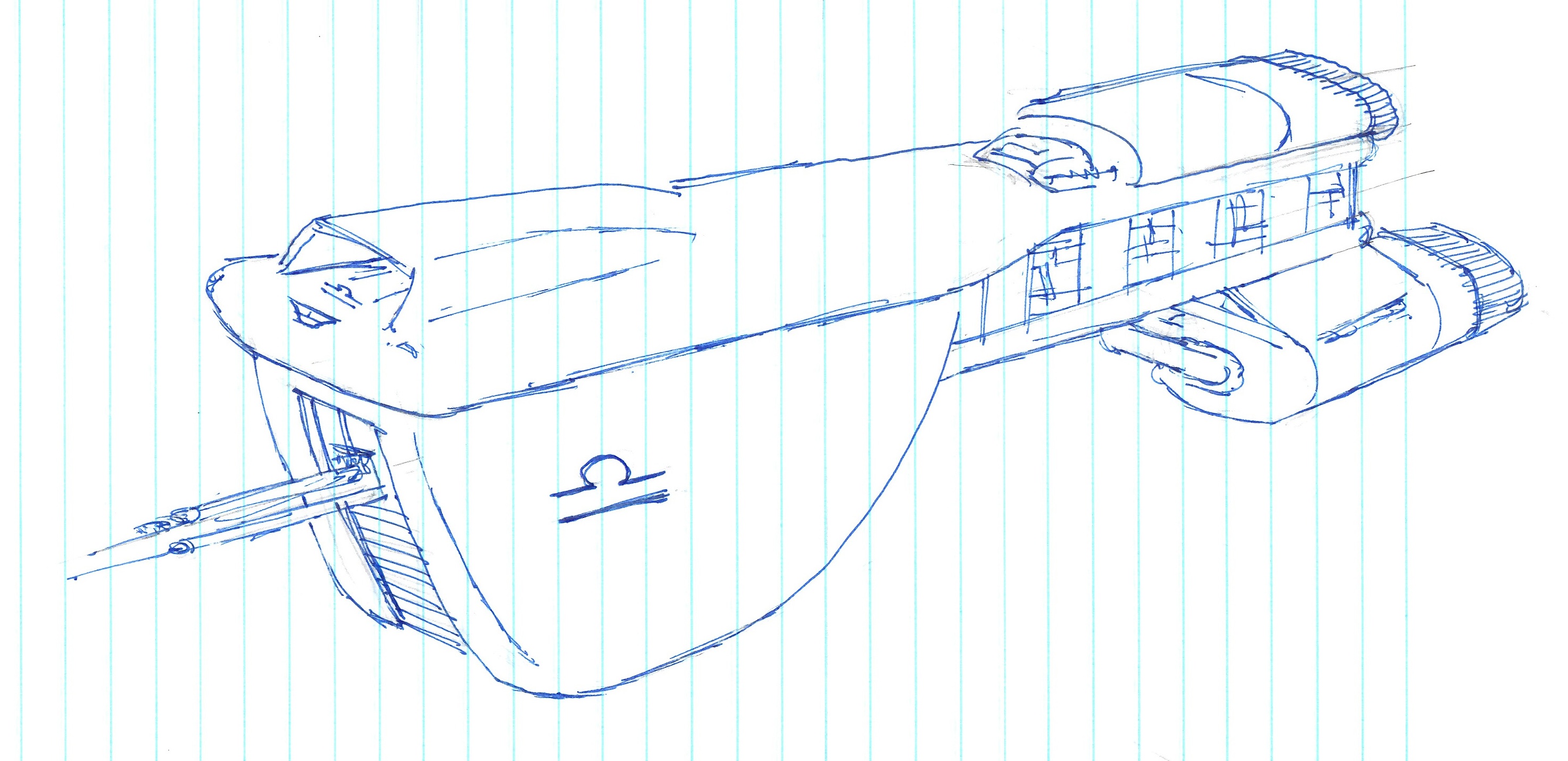
Despite the heavy DRADIS interference, they pick up on a massive object that seems to be trapped, circling the flux tube…it turns out to be an ancient, massive vessel that the pilot (the CAG, a PC) recognizes from a recurring dream I’ve been describing, as one of the galleons that brought humanity to the 12 Colonies!

A quick sketch i whipped up for the session...

A quick sketch I whipped up for the session…

The markings are those of Kobol-era Libra — the ancestors of the Librans, whose population we’d remarked on several times, has been historically much lower than the other Colonies. There was damage to the craft, indications of weapons impacts among the millennia of damage done floating in the atmosphere of the gas giant. They were making plans on how to board an investigate — having to take into account the heavy energy fields, the charges the recon raptor or shuttle’s hull would pick up, how to communicate through heavy communications interference, etc…

We ended there, but the hope is that the hulk will provide a key to the location of Kobol, and Colonial prehistory. The episode also shows how you can veer from the direct plot of an RPG setting based on an established property, and still keep — or enhance — the feel of the original material. In this case, the visions characters are having started as very ephemeral or confusing, but as events happen, they are making more and more sense.

One of the central tenets of Battlestar Galactica –both the 1978 and 2004 shows — was that the characters were trapped in events that were bigger than just their exodus. In the original show, the “ship of light” and its angelic beings were somehow interested in the plight of the Colonials; similarly, the Final Five were shown as being of light, draped similarly in white, and the “ship of lights” is riffed on in one of Starbuck’s paintings.

What I’ve been working toward is establishing that there may be some kind of cosmic force that is continually playing out this cycle of collapse, discovery, and rebirth over and over again, with differing protagonists and antagonists…but always toward some end that is unknowable. Kobol may be the home of godlike creatures that were overthrown by an angry, jealous “Blaze” (as per the cut scene in Kobol’s Last Gleaming), or maybe they themselves were just one set of oppressor-turned-oppressed in the Great Cycle.

I’ve kept the Scrolls of Pythia as a major plot point, but added the Aurelian Heresies — an apocrypha that might predate Kobol, itself — and which has strong influences from the Eleusian Mysteries of Greek myth — a cycle of decent into the underworld or some deadly event, self-discovery or rehabilitation, and the resurrection or rebirth of the character/civilization/etc. It ties tightly to Hades and his capture of Perephone, and I’ve dropped hints that “the Blaze” may have been Hades revolting against the Lords’ rule…but maybe not. Every point here has been to enhance the mystery and mysticism of the setting, but to temper it with some of the characters positing more sensible reasons — the Kobolians were some kind of alien race than made humans; the Kobolians were just exceptional humans; they were the Cylons of the Titans…

Don’t be shy when running a licensed setting to shred what you don’t like, pump up what you do, and go your own way. Your game is best thought as a reimagining, not a canon-inclusive sideshow. This gives the characters the chance to be the heroes, having real influence on their universe, instead of heroes playing in the shadow of the people in the property.

This post was originally published as How to Manage No Shows, but fits quite nicely into the RPG Problem Child series:

I’ve been gaming for 30+ years and one thing you can be sure of:  people will not show up.  Sometimes it’s because they’re just not that interested, sometimes it’s a group dynamics thing…and sometimes (or often) life just gets in the way.  People graduate from high school or college and get jobs.  Jobs that have weird hours are the worst — if the player’s on a night shift, or works in the filnm industry…  They get or have a boy/girlfriend, or get married and now the significant other/spouse is dictating their time.  They have a kid — the ultimate time sink.

It’s rough for gamemasters to deal with people not showing.  Sometimes it’s just a nuisance, sometimes it feels like rejection.  The more work you put into the game, the more likely you are to be peeved with people dropping out for a week here, two weeks there, a couple of months at a time.  Remember, most of the time, it’s nothing personal.  If it is, dump the player.  It’s better to lose a player than to have personality conflicts at the table.  It’s fine for players to be at each other’s throats…not for the players to be.

There’s a few options you have to deal with no-shows, depending on why they’re happening.  If it’s because a friend or gamer is uninterested or busy with other things they’d rather do, simply back burner their character and press on with the understanding the invitation is always open, but they shouldn’t feel pressure to show up.

This can be difficult in campaigns that are more than a dungeon crawl.  Especially if you’ve worked them into the plot line and have to extricate them from the  main storylines.  It’s annoying when you’ve crafted an action or other scene that plays to their strengths — especially if it’s an important scene and no one else has the skills needed.

Now, say you’ve got that player off the main roster — you can give them the henchman, aide, native guide, character that is often in the background, but not necessary to plotlines to take over when they are present.  Another thing we like to do, if it’s just for a session every once in a while is let another player run the character.  It’s fun for the player, often, to give his/her spin on the character.  Or the GM simply bumps him/her into an NPC position and plays the character (often, I have other players roll for the various checks, but I run the character…)

Never just off a character because the player’s not showing up.  They will not appreciate it.  And you might lose a player permanently.

Some examples:  I had a player that worked in the film industry — he was either working all the time for three to ten weeks, or he’s dead broke.  Either way, about four months out of the year, he can’t afford to make it to the game, since he commutes an hour to get here.  No problem:  his characters were very important, but not in a position that they couldn’t be the force off stage (like ship commander, say), or the guy that goes missing in the jungle, only to reappear at a crucial moment in Hollow Earth Expedition.

Another was having trouble at home and needed to get out of the group for a few months.  No problem: we switched to another game until he came back, then picked up where we left off.  (I tend to rotate campaigns to keep things fresh, anyway.)

One player went to Scotland for a year:  her character was badly injured and has been in rehab therapy, only just getting better in the last played adventure.  She’ll be ready to go in a few weeks, when her player returns.

The best advice I can give:  never burn your bridges.  You never know if someone will hove back into your life a couple of decades later (as has happened with a few people), whether your girlfriend or boyfriend will dump them and they’ll be back, or if they get a schedule change.

Foremost, don’t just chose gamers…chose gamers that are friends.  Do things outside of gaming together when you can.  Friends last…and they usually show up. People there to “just game” are there for as long as the game is meeting their entertainment needs.

This player was a lot more common in the bad ol’ days of role playing, when the games were still mostly wargames with character rules bolted on. (It’s also one of the reasons why combat rules are usually a chapter long in modern games, but other skill rules fit in a page or two.) Knowing the rules gave you an edge over the dungeon master, with whom you had an adversarial relationship, rather than a cooperative one for telling a story — the DM spent his time coming up with ways to screw with you and your party; you tried to outsmart him. Knowing you got a +1 on a such-and-such test because of certain factors might make the difference between success and a TPK (total party kill, for those not playing D&D.)

The rules lawyer is still alive and well in gaming. Most of the ones I’ve run into are involved in the vampire LARPing scene, where the antagonistic relationship between characters and between the characters and the storyteller remain a central aspect of play. In modern tabletop games, the relationship between the game master/storyteller/dude who’s not a storyteller, but a facilitator for your gaming enjoyment (barf!) is more cooperative, and the rules usually reflect this by being much more minimalist or fluid. This isn’t the environment for a rules lawyering gamer to thrive…but there they are.

Often the rules lawyer now uses the rules to maximize his benefits at character creation, much like the min-maxer, but the rules lawyer focuses on mechanics that allow them to tweak the flow of play to their advantage. So they might take assets (or whatever they’re called in your favored system) like luck, where they can reroll a test, or something like Intuition in Cortex, where they can ask a question of the GM (usually a yes or no question) to skirt the plot.

In modern games where combat is more prevalent, the rules lawyer is much more effective. They know that a certain maneuver allows this benefit, they hang on the wording of a rule regarding social interaction, or how hacking “works”, and use that knowledge to browbeat the GM (or the group, if it’s a GM-less system) into ruling in their favor.

The rules lawyer was, in the past, much more of a nuisance than they tend to be now — but I admit I also don’t play stuff like D&D or Pathfinder where the benefit of lawyering might be more fruitful. In the early days of RPGs, the dungeon master was “god” in his world — and it was almost always a “he” — creating the setting, the adventure, managing the opposition to challenge the players. Rulebooks showed their wargaming past and were packed with minutiae on various tasks. It was hard to know it all well. Rules lawyers could leverage their knowledge of the rules to question the campaign’s architect. Now, it’s expected that the players will have some say in how the plot unfolds outside of succeeding or failing at a test. Plot/hero/story point mechanics allow them to “bribe” the GM to give them a certain result (and vice-versa), rules are less structured and important to the outcome of a scene (FATE can go so far as to go single test for combat with the player stating the preferred outcome), and gamemasters are more likely to working to help the players succeed than to kill their characters off. That makes rules lawyering much less necessary, or effective, than in early generation RPG mechanics.

So how to handle the rules lawyer? You can go with the time-honored “DM as campaign god” with your decisions as inviolate. Or you can set yourself up as a judge or referee, interpreting the rules to the situation — “I know it says the monster gets a -2 for the slippery surface it’s on, but the sheer size means that it doesn’t have to move around as much, so I’m not applying it…” Or you can give the rules lawyer a statute of limitations to argue their point and change the ruling and edit the story. You want to argue a rule that gives you that +1 you need to succeed in stopping the trap from springing? You’ve got a minute to find me the rule, or we move on with events. This gives the rules lawyer — who gets their enjoyment from that argumentation — time to have their fun, maybe have more of an effect on the play, but limits their ability to halt play over some point of procedure.