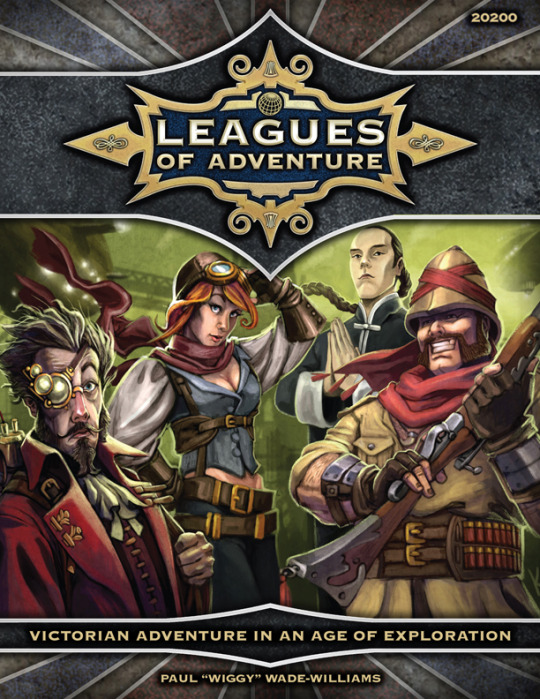
amyfrpppyhs56kirr6tw-734364I was just spitballing a version of the Hawkgirl character that DC has been floating around in their Bombshell series. We have the classic redheaded tomboy in a flight suit, lace-up boots, and a winged rocketpack, with a hawkman helmet. It’s a great 30s/40s image and I thought I’d do a basic write up of a pulp-period aerobat.

First, in Atomic Robo‘s Fate-powered system:

HAWKGIRL

Concept Aspect: Rocket-Powered Aerobat; Omega Concept: Yearning for Adventure!

Stress:  Mental – 3, Physical – 4

Pilot Mode +3: Contacts +4, Notice, +4, Vehicles +4; Aspect: Fly It Like I Stole It

Action Mode +2: Provoke +3; Aspect: Wingwalker

Banter Mode +1: Rapport +2, Will +2; Aspect: Sugar & Spice

Stunts: Barnstormer, Breakneck Ace, 2 more to be decided in play

…and then in Hollow Earth Expedition

HAWKGIRL

Archetype: Adventuress     Motivation: Escape

ATTRIBUTES:   Body: 2, Dexterity: 3, Strength: 2, Charisma: 4, Intelligence: 2, Willpower: 3

SECONDARY ATTRIBUTES:   Size: 0, Move: 5, Perception: 5, Initiative: 5, Defense: 5, Stun: 2, Health: 5, Style: 3

RESOURCES & TALENTS:   Artifact 2 — Jetpack, Attractive, Evasive Action, Lucky, Mobile Attack

FLAWS:   Impulsive, Overconfident

SKILLS:   Acrobatics 4/7, Athletics 3/5, Brawl 2/4, Con 2/6, Diplomacy 1/5, Drive 2/5, Pilot, Air 3/6 (Jetpack 7), Ride 1/4, Stealth 2/5, Streetwise 1/5

Jetpack — Size: -1, Def: 4, Str: 5, Spd: 100, Han: -2, Crew: 1


I remember the first time I saw the original GDW Space: 1889 in The Compleat Strategist near Rittenhouse Square– I was living in Philadelphia and the main games our group was playing were either superheroes (DC Heroes by Mayfair), or espionage games (using James Bond: 007) and cyberpunk Cyberpunk (by R. Talsorian.) The look of the game was intriguing enough, with the great David Dietrick art — one of the big boys in game cover art at the time — and a quick look through the interior was enough to get me hooked. There was a board game, Sky Galleon of Mars, that tied in and allowed you to make the jump from the RPG to a wargame and back, and there were about a dozen supplements and adventure books published before GDW died. I have the book I bought a quarter century ago sitting in front of me as I write this.

After a bit of stumbling to put together a game, I wound up running some form of Victorian science-fiction — usually in the Space: 1889 universe — from 1990 until 2004, when I started to drift toward ’30s pulp and Exile’s Hollow Earth Expedition. The game was one of the reasons I went into history, my specialty was Early Modern and Modern Europe until my doctorate (mostly due to the shoddy condition of the European section of the college) when I drifted into Modern US (which strangely coincided with my move to Hollow Earth Expedition.)

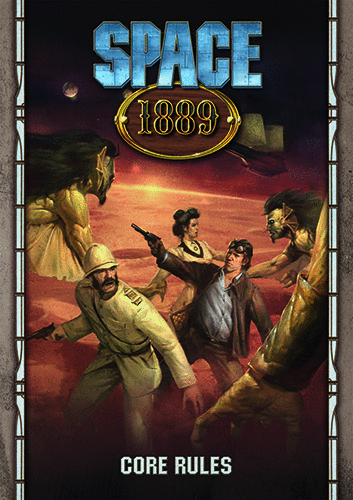
A few years ago, there was a Savage Worlds version of this, the original “steampunk” (gahd, how I hate that word!) game, and I have a PDF of that, as well, but never found SW made much sense, mechanically. Close to that time, it was announced that Clockwork in Germany was doing a version using Ubiquity — the rules set from Hollow Earth Expedition. In 2013, the Kickstarter for an English-language version was posted by Angus Abramson — who I worked for in the early days of Cubicle 7 on the Victoriana line — and his new Chronicle City house. I missed the Kickstart for this, having already blown dough on the Revelations of Mars book by Exile a month earlier (still not @#$%ing close to done…) Well, the PDF just dropped for sale yesterday with the print book not far behind, and I had a chance to do a quick read-through this afternoon.
space1889

The new book is very true to the original. There’s some difference in the verbiage and the arrangement of the book, but most of the setting is unchanged, with additional material for Germans on Venus that was most likely part of someone at Clockwork’s campaign prior to resurrecting the game. There is new artwork, some of which is an update of pieces in the original book, some of which is original. The quality is true to the original book, as well — mostly black and white pieces and the occasional color plate. The maps of Mars and Venus are updated and look better than the original, but when I looked at them side-by-side, they are “the same.” There is the alternate history from the original book — Edison’s flight in an airship with ether propeller to Mars, and the other alternate history moments. There’s a gazette for Earth, Mars, Venus, and Mercury. Here and there, you can see where the new publishers added bits and bobs to flesh out the worlds — new gadgets and gear, a few locations and “worlds in the ether”, etc.

Character generation is nearly the same as you would find in Hollow Earth Expedition, but there is a specific set of rules for older, more experienced characters that looks a lot like the character creation house rules we’ve been using for our HEX games. There are a few traits and flaws that are setting specific, the Status Resource is very slightly more fleshed out, but otherwise it’s the character generation from HEX. One of the things that I noticed was there were no real traits that differentiated the Martians from the human characters in the game. (Here’s my take on the setting species.) I would have expected something to take into account the acclimation to lower gravity and pressure, but Space: 1889 also has a much more friendly Mars than reality — heavier gravity and atmosphere than most alternate Mars settings. (Over a few campaigns, I started using a Mars with .5G, rather than the .9G of this game, and lower pressures, making mountain travel dangerous for Earthlings.)

Rules-wise, it’s Ubiquity: roll the number of dice (any even sided will do — even a coin) equal to your skill plus the connected attribute and beat the number of successes. It has the “take the average” than makes Hollow Earth Expedition work so well when fighting mooks and the like — the GM doesn’t have to do a lot of rolling and the action moves quickly; characters that just need a pass/fail result can take the average when they know it’s higher than the needed successes for the same reason — getting roll playing out of the way of role playing. If you know HEX, you can pick up and play this.

Style: The original game was pretty sharp for it’s time, with good color art and crappy line art for the rest; the new version is average RPG quality art for the black and white art, decent color. I’d go 3-3 1/2 out of 5. Substance: Unless you plan on really digging into political intrigue and the like, the book is good enough to launch into a campaign that night, and the rules are complete enough to handle mot situations. 4 out of 5. Is it worth the $56US for the print and pdf combo? If you are into this genre, yes; if you are an old Space:1889 fan that wants a better set of mechanics than the execrable ones from 1989, absolutely; if you’re just curious..? No.

Extra Review Goodness!
loa

So, let me stack this up against the closest thing to its peer — Leagues of Adventure, also a Ubiquity-powered game set in a Victorian science-fiction alternate universe. This one is published by Triple Ace Games. Again — the mechanics, character creation, etc. is no different from Space: 1889 or Hollow Earth Expedition, but there are a few places where Leagues of Adventure excels: in the character creation section, there is a great bit on the Rank Resource, and how it ties to the various real and invented clubs of the period. Being a member of a club was almost essential for the well-heeled gentleman, and certainly for the aristocrat. Like Space: 1889, the Status Resources is pretty sketchily defined, but at least Space:1889 makes room for people below the rank of peer or wealthy middle class (bravo!) Also, Leagues provides rules for Inventions — something Space: 1889 (like the original) glosses over. Characters as inventors seem to be an afterthought in Space: 1889, but there’s a nice set of rules for it in Leagues and a goodly selection of weird steam- and clockwork-powered science!

Style: 4 out of 5 — the Art is superior RPG quality, full color, and the layout is nicely done. Substance: There’s a lot on the society and the basics of the Victorian period, and the rules are more comprehensive than Hollow Earth Expedition was… 4 out of 5. Is it worth the price of $30 US for the book? Absolutely. Is it worth the $18 for the PDF — no. Buy the book.

Now, here’s my suggestion: I would be surprised if Clockwork and Chronicle City didn’t do some kind of reprint or series of splatbooks for Space:1889, and TAG already has one book out and another with weird inventions on the way…if you’re a Space; 1889 or Victorian speculative fiction RPG fan — buy them both and mix and match the bits and bobs you need to build up your setting. (It’s what I’m doing.)

So, we finally had a chance to play another session of our pulp campaign I’ve titled Thrilling Action Stories! after a two week hiatus to visit family in various parts of the country.* We had started off the campaign with the McGuffin — a death jade that apparently belonged to the first sovereign emperor of China — which was used in a summoning to better effect than was expected. The host of the summoning was temporarily taken over by the spirit of the emperor, but this was interrupted by the arrival of a bunch of black-clad martial arts types that killed the possessed man and stole the jade.

Fights and car chases ensued, and the characters eventually did a bit of sleuthing that led them to a warehouse in Limehouse (the Chinese district at the time of the game, 1936.) With the aid of a rival gang, they were able last night to raid the warehouse. There was a quick bit of wushu vs. gun play action and the heroes discovered the major henchman of the piece — a captain of the Si-Fan Triad named “Terrible Blade.” After a bit of chop-socky, they pursued the villain into the damp, dank catacombs below the warehouse, where the villain released a trio of black-skinned, pale eyed “Creature from the Black Lagoon”-style monsters.

The heroes destroyed the monsters by using a convenient barrel of gasoline used for the hoopcycles from the aforementioned car chase and a few well-placed shots from a Mauser .30 to blow the critters (and, very nearly, themselves) to kingdom come. Another chase sequence led to the capture of the jade.

After a night in jail and the intervention of MI5 and the Colonial Office, the characters have been hired to return the jade to the Nationalist government in Nanking — more to get them out of London and put to bed any talk of amphibian monsters, possessed academics, and Chinese gang activity.

I finally getting around to responding to a reader’s question…

“Hey, Scott, why do you hate Fate so much?”

I don’t hate FATE, so much as I find some of the fast and loose aspects (See what I did there..?) can create a much higher level of complexity that is needed. I had the same issue with Marvel Heroic Roleplaying and Firefly from Margaret Weiss — which are essentially Fate with Cortex die schemes. The plehtora of assets, complications, etc. adding to dice pools can get a bit hard to manage. (Although it doesn’t reach the wheelbarrowful dumping of dice majesty of d6 Star Wars when a Stardestroyer opens up on you.) I also dislike the “damage” system of the rules. (I’m not a hit point guy, either.)

Speaking of dice: I hate the idea of the Fate dice, which is why the MWP stuff is a big more palatable for me. Similarly, I was okay with the positive/negative die mechanic of Chameleon Eclectic’s The Babylon Project, although I’ll admit it was also a crappy way of resolving chance. I’ve bought the Ubiquity Dice for Hollow Earth Expedition, but they aren’t needed; they simply make rolling dice pools (and Ubiquity does have a Shadowrun-esque love of dice pools) easier. You can play HEX with a bunch of coins, if you need to.

“But, Scott, you can do Fate die with a normal d6 — just assign positive, negative, and nought to the sides.” Well, there you go making sense. Away wi’ you!

The real issue isn’t Fate — they’re great pick-up game rules that can be tweaked any ol’ way you wish — it’s that I can’t seem to get a game that doesn’t have Fate trying to claw its way into the game mechanics. It’s like trying to escape OGL d20 junk in the early aughties.

“You like [enter game name]? you know you can get those rules in d20, right!?!” Scott: “Screw you, and get off my lawn!”

I’ve looked over a bunch of the new Fate and Fate-infected products that have been hitting the shelves over the next few months. There’s some really good stuff. I’ve been very complementary of Mindjammer — a game that really plays to the strengths of Fate — and Firefly — a Fate-ified Cortex product that makes good use of some of the Fate ideas, while retaining some of the flavor of old Cortex, but which, like the previous book, really shines for the writing, production values, and background material. I’m looking forward to Atomic Robo, but anticipate that’s going to get played using the MHR rules.

Addendum: This is also, apparently, the 1000th post for The Black Campbell!

Another great Kickstarter on the loose! We just saw Exile Games kick ass for Revelations of Mars, now Angus Abramson’s Chronical City is bringing the English version of Space: 1889 using Ubiquity (Exile’s rules set for Hollow Earth Expedition ) to life.

20130717-194004.jpg

The game has already been released in Germany and is doing well.

UPDATE: It’s been a day and looks like they’ll likely be funded by tonight. Excellent!

1053279_169185066596741_134993686_o

I’ve been waiting for this book for, what, five years? Well, it looks like the boys at Exile Games are about to finally show us their version of Mars. I, for one, can’t wait.


After about a year, I’ve finally got the gaming group back to playing Hollow Earth Expedition. This time, the intrepid adventurers are returning home to New York CIty after their China adventures to sell the artifacts they’ve collected. We also introduced Tom Steele, private dick — a surprisingly fun character. He’s a former NYPD detective who is dying from emphysema (and doesn’t know, yet.)

The game started out with Steele doing a job for Ciro Terranova, the disgraced “Artichoke King” who is looking for juice to get back in charge of the 116th Street Crew that is now run by “Trigger Mike” Coppola for Luciano. He’s been hired to take pics of a city councilman engaging in the usual nasty sex-for-hire thing Steele deals with. Except the councilman is Trigger Mike’s guy. He is confronted by a couple of goons from the Mason Tenders 47 union, here to teach him a lesson, and it led to one of my dream fights — and didn’t disappoint!

Steele decides to crash through the one-way mirror above the councilman’s bed to avoid the 10lb. sledges that bad guys are wielding and manages to get a hold of one. That’s right, the scene I’ve wanted in an RPG since seeing Street of Fire all those years ago finally happened: sledgehammer fight! Steele has a bit of trouble due to his emphysema, but he managed to fight these guys down a set of stairs and into an alley before winning. It was fast, dangerous, and fun!

Then we cut to the arrival of Dr. Hannibal Drake and Jack MacMahon in NYC. There was some character stuff with Drake’s grad advisor/mentor, they drop off the mellified men they found, and stop by Jack’s apartment on Upper Park West…to find it being tossed by goons. There’s another great fight using the environment (something I liked seeing in Haywire [see today’s quick review]) with heavy glass ashtrays being used as bludgeoning weapons, Tiffany floot lamps, art deco metal naked lady table sculptures…it was funny and magnificent. We were off to a great start.

Steele gets hired by a limey, a Special Branch guy and fellow Mason. He needs help finding a journal of research from a murdered Scottihs lord, that Jack’s uncle Mike (also murdered for it) sent to the States. The British flatfoot knows it went to Jack. They link up with the other two characters right after the fight. The journal would have been mailed to his PO box nearby. They arrange to meet and retrieve it the next morning.

The English cop doesn’t know the full story, just that it has something to do with a missing Illuminati treasure from 1776 that was hidden in the United States. Drake is hooked! Jack is too; his uncle was murdered! Steele is a Mason and this involves the Brotherhood, so he’s in…

We ended there. Let the ride begin!

Our latest game is set in 1930s Shanghai, and the flavor has been a cross between Indiana Jones, noir gangster, and chop socky action…while I’ve been working hard to make China fairly realistic to the period, this is — to my mind — a pulp comic being played out. It’s how I frame scenes, in panels and splash pages and sound bubbles (SMACK!) So looking at the combat rules, I’ve started tweaking to make it a bit more pulpy/Hong Kong action movie in style.

One of those tropes is the hero fighting scads of black-clad bad guys. The Ubiquity system rules give you a -2 dice step for each attacker past the first to your Defense, but that doesn’t capture the flavor of fighting hordes of warrior monks bent on turning you into a pin cushion.

To this end, I’ve created a house rule to 1) speed combat, and 2) capture the hero ducking/blocking multiple opponents while fighting. For each attacker wailing on the character at the same time, they gain a +2 dice step, but they roll as one attack; the character gets his regular Defense, or Brawl/Martial Arts test (to block), or Melee (to parry) the attack. Mechanically, it’s a bit easier on the character, but not by much, and each wave of baddies means a -2 to those defense rolls. There is a logical spatial limit to how many people can gang up on you effectively, about 4 time — anymore would blocked by the bodies of the other attackers.

Example: Jack MacMahon has slaughtered a bunch of Silk Mountain Triad guys with his trusty Smith & Wesson Registered Magnum (#RM11!) and has had to resort to the sweet sport of boxing to defend himself. He describes his defense as classic boxing style (hands up, guarding as much as he can and dancing about, his Boxing skill is higher than his Defense, so he is blocking shots, rather than trying to dodge combat: he has a Boxing dice pool of 6. Being in a tight space on a balcony over the rest of the action, the GM decides only two guys can get to him at once. They are typical mook, but with a bit more skill — Kung Fu of 5+2 for the second attacker. Jack rolls 4, the mooks get 2. He’s dancing and blocking shots fairly handily…but they’ve moved onto a wider area of balcony where the next wave of mooks come at him from behind.

The GM decides the max number that can get to him are four mooks. Jack’s Boxing is now a 4 for this set of blocks, but these mooks are fresh — Kung Fu 5+8 for the number of mooks: they roll 13 dice and get five successes, while Jack only rolls a 2. He takes 3 non-lethal hits for that wave of attacks and is getting bounced around pretty badly, reaching his stun rating.

The place where more numbers would be applicable would be grapple attacks, where the weight of attackers behind the immediate attackers could be added on, even this shouldn’t add more than +16 dice (eight attackers.)

Example: Jack has escaped the Silk Mountain, staggering out of the temple and straight into the arms of a crowd of the bad guys. They go for a grapple attack, seeking to dogpile him. There are dozens of bad guys, and they roll a base 4+16 — 20 dice, while Jack rolls his Defense (Boxing really doesn’t apply for grappling attacks…Wrestling, yes) of 5: He gets incredibly lucky: five successes! The mooks don’t even get their average of 10, but do get a seven: Bad guy throw themselves on Jack, driving him to the ground and securing him to be taken before their nefarious leader…


Here are some more formalized rules for mass combatusing Hollow Earth Expedition.

hex mass combat


During our game on Thursday, an interesting problem surfaced: The characters were attempting to raid an alleyway housing complex in 1936 Shanghai that was full of Indochinese gangsters of Hanoi Shan’s Silk Mountain Triad. There were roughly twenty “houses” with 3-4 floors, in a complex that had two entrances from the main thoroughfares on either side of the block. The road was tight, allowing only three men abreast, with no room for vehicles. they estimated the population at about 300-400 people, max.

The characters, led by one who is an Inspector in the Reserves (the SWAT of its day), has 100 officers and 20 Reserves. It was at this point I realized that Hollow Earth Expedition had no rules for mass combat that I could find quickly. (Now, I could be wrong, and if so would appreciate a comment to direct me to the pages in question…) So I had to wing it. But that led me to slap together some mass combat rules based on a few other systems out there.

First — how I did it. I assumed that no more than 20 or so could be engaging at a time as a means to keep the die rolling to a manageable level. Each side rolled 20 die, and each success was a man down/killed. It worked fine and allowed for a general idea of how the respective sides were doing, but completely ignored the influence of the commanding police officer (a PC), or the fact that the cops were all armed with Enfield #2 .303 rifles and a few had Thompsons. the bad guys were mostly rocking melee weapons, with a few having “box cannons” — the C96 Broomhandle in 7.63mm — and a couple of Mauser 98Ks. they should have been able to outmatch the numbers, save fo the tight spaces and defensive positioning of the bad guys, so I ignored any kind of mods for simplicity sake.

But I thought it removed the PC in the command position from really having an impact (the others were involved in a side operation that allowed me to simply run combat normally — 2 guys against a few dozen gangsters.

So…here’s my battle rules for HEX:

Figure out how many troops each side has and divide by 10. Use 10 of whatever you use for style point/chips/whatever to keep track; each is 10% of the respective force. Now compare the numbers. In the above scenario, only about a third of the people in the place were active triad members — it was about 200 guys vs. 125 cops. Round down that 2 to 1 odds, so the bad guys had a +1 advantage.

The two sides start with the Diplomacy/Leadership or Warfare skill of the commander. The side with the superior force adds that number to that dice pool (so the bad guys would have a +1 added to the “leader” of the gang (a senior mook, in this case) of 3. The lead cop had a Diplomacy of 4 and  Warfare of 3 — I figure the Warfare can give him a synergy die to his DIplomacy…so a total of 5 to the bad guys’ 4.)

Now we add in some basic modifiers for the situation: superior weaponry +1, artillery or light cav support +2, air cover or tanks +4. Terrain: slight advantage (high ground) +1, entrenched or in defensible location +2, fortifications +4.

So the initial combat engagement would have given the cops a 6 (for the guns over melee weapons), but the triad 6 for the tight, easily defendible environment. Roll the dice. For each success, the force is reduced that number of markers (or that number x 10% of the force [in this case 10 cops or 20 gang members].) Works mostly the same, but gives the PCs, if they are in charge of troops, a chance to shine. You could break the forces up, as well — say each PC had had a section of 40 or so guys (4 guys/marker) and would get to roll for their men.

This makes it quickly scalable, and you can add in mods for senior commanders. Say they’re working for a general or other senior officer in a war time event. Each player is a company commander. The general or whoever rolls their Warfare or Leadership first (with mods if the GM wants to) and his successes add to the initial die pool — this represents the strategic position of the commanders and how it effects the tactical picture on the ground.

As the forces are diminished, you add the difference in survivors to the superior force. So if the initial police raid hammers the Triad with 3 successes (30% or 60 guys) and the cops only suffered 10 men or 10% losses, the next test, the police commander would have another +2 to his roll.

You could add in a morale test at the end of each move to see how the respective forces are holding up — a Leadership test vs. a target number equal to the number of markers lost. Example: the Triad got hammered on the initial assualt and the mook in charge needs to roll a Leadership test and get three successes to prevent a rout (and the police inspector one success.) The mook leader would roll three dice, the cop 6 (his Leadership of 4 plus the two markers more he has than the Triad boss.)

You could scale the combat for the number of troops, as well: for a “small” engagement like the one above, each combat round might be 1-5 minutes, but for a battalion level action, it could be 15 minutes, for a whole army an hour each round. Player characters could be doing their part or having specific combat scenes during these rounds.

It’s pretty easy and should allow the game not to get bogged down while allowing the players to influence the outcome of big battles, without having to resort to pre-determines outcomes.