I’ve shot a few of the old Hi-Powers over the years, but never owned one until the Springfield Armory SA-35 came out. Overall, I always found them accurate and pleasant to shoot, though a few were finicky. My experience with the SA-35 was very much a love-hate thing: it was accurate and easy to point, but I was one of the many in the early run that had incessant issues with failures to extract that seemed tied to an issue with the the breech spacing, rather than the extractor. It went back to Springfield (good customer service, to be fair!) and came back with an extractor…and new barrel. After that, it’s been reliable.
I really liked the look of the new Inglis P-35 with the case hardened finish that dropped a year or two ago, and when Palmetto State Armory had a 50% off deal a few weeks ago, I jumped on it. $480 later, I got the pistol and hit the range today to get an idea of what $800 MSRP would buy you, and how it compares to the SA-35.
Fit & Finish: There’s no contest. The Inglis is beautiful. Even the standard blue model has real bluing (or looks it) — making it a much more faithful copy than the chintzy Parkerized finish of the Springfield. The case hardened finish is perfect, and runs through the interior of the slide (though it is not polished in the mag well. Smooth Turkish Walnut grips look good, but the Springfield’s were checkered — a win for the Springfield. I might slap some nice checkered wood on the Inglis, though I like the function of the ugly Mark III grips on the SA-35, right now.
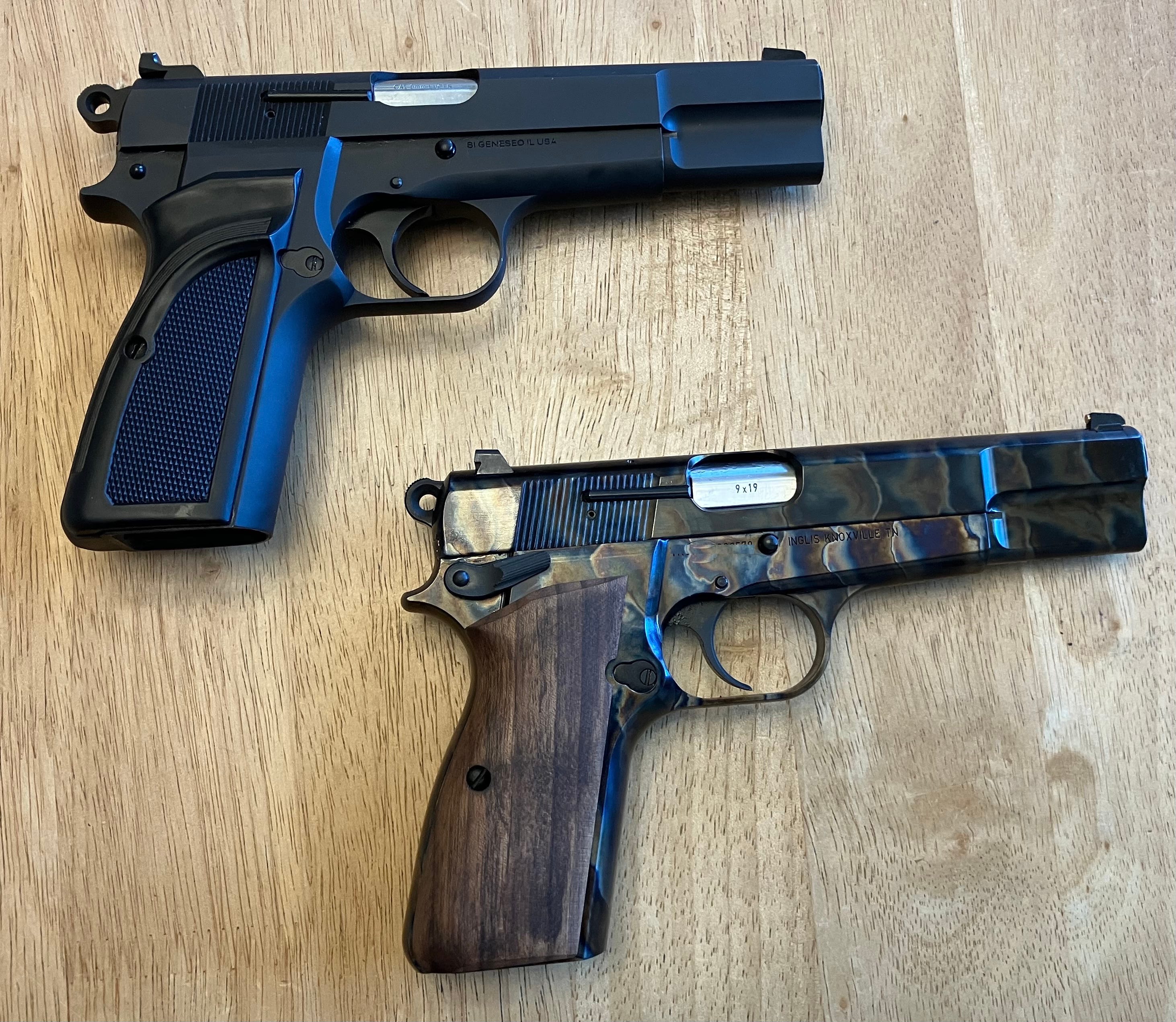
The markings, as with the Springfield are minimal and add to the aesthetic. Finish definitely goes to the Inglis, Fit is slightly tighter than the SA-35 — though in fairness the Springfield has had a few thousand rounds through it — let’s say it’s even.
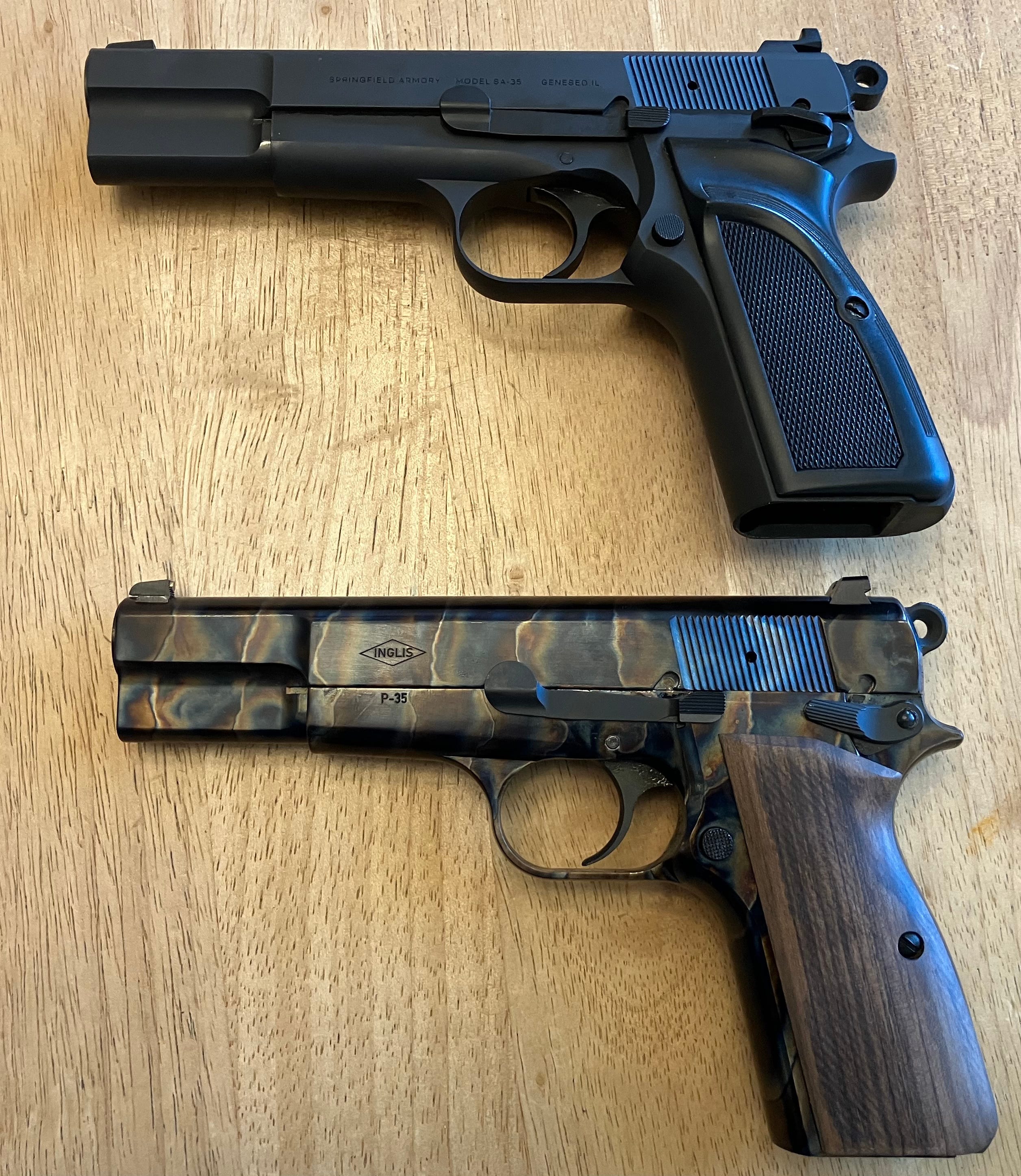
Ergonomics: It’s a Hi-Power. It points exactly where you are aiming. Groups can be serviceable to excellent, depending on how fast you are shooting. The walnut grips are a bit fatter than I like, but I had no issues with the pistol squirreling around under faster strings of fire. Where it wins, hands down over the SA-35: ambidextrous safety, which was standardon a Hi-Power! (Get with it Springfield!) The safety sniks on with a little resistance and is barely audible. The magazines fall easily and the magazine release works smoothly. (No magazine safety!) The SA-35 has slight beveling at the mag well; the Inglis does not. I didn’t find either was especially easier to load.
This pistol is sprung tight! The hammer spring feels like it’s an old stock Browning weight. The recoil spring is shorter than the SA-35, but feels a bit heavier. Shells were falling about 6-7 feet; so that’s inside proper tolerances for the Hi-Power. Weaker hands might have trouble with it. Drawing and cocking the thing with the stock hammer set-up is not happening; run it cocked and locked.
The trigger was a bit rough until I cleaned it prior to the range. a bit on the trigger internals and where the sear meets the trigger and it smoothed out. After the first range run, it was breaking the Lyman gauge the guy next to me had at 5.5 lbs. It’s not a competition trigger but is still pretty good. Reset is sharp and audible, unlike the mush of the SA-35. There’s more take-up, however, before hitting the wall. The reset is also long, compared to a 1911 or 2011, or something like the Daniel H9 or Walther PPQ. I found this slowed my strings quite a bit. You could run it moderately fast and very rhythmically, but amag dump occasionally led to me missing the reset. While I think the reset is better on the Inglis, the SA-35 wins for trigger pull.
Accuracy: It’s a Hi-Power — if you learn the pistol, you might not be competition accurate, but you will be able to get that first shot off in an engagement very quickly and spot on. It just points naturally. On the P-35, the front sight has a brass inlayed dot, the rear is a U-notch — same set-up as the SA-35, minus the brass. I had no issues picking up the brass in the dimmer light of an indoor range. Here, both pistols were fairly evenly matched. I only measured out the first 15 from each pistol, but got better groups on the Inglis the longer I shot it, with my tightest being 2” on the longest axis of a group. For the first magazine, my largest axis on a group was 5” on the SA-35, and 4” on the Inglis at 10 yards and a moderate shooting speed.
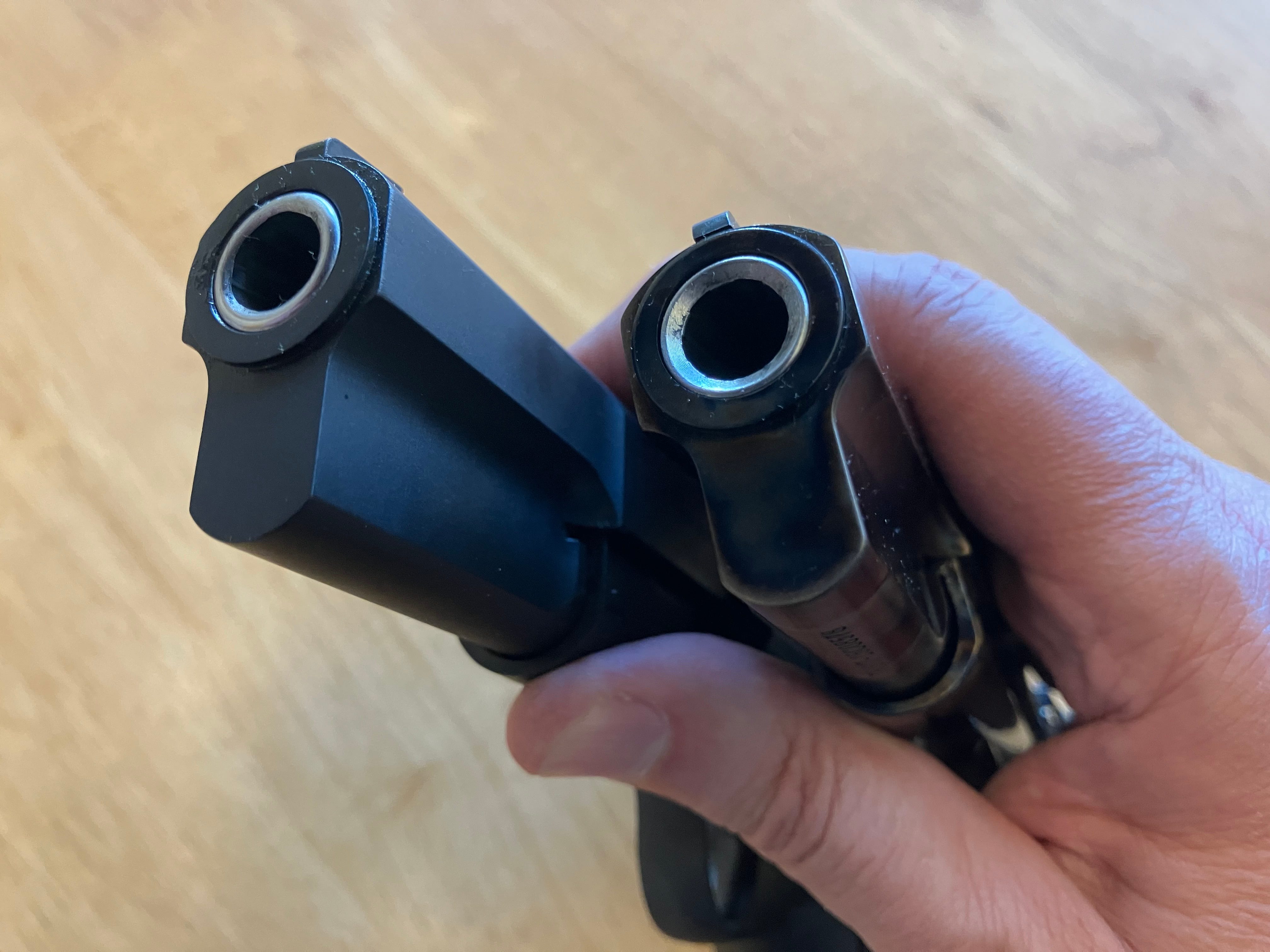
It didn’t have any effect on the accuracy that I saw, but should aid with wear on the barrel: the Inglis is slightly crowned, compared to the stock barrel of the Springfield.
Reliability: As mentioned above, the Springfield was initially a Jam-o-matic, but after a trip back to the factory has been fairly reliable, with a stoppage once every few trips — usually if it hasn’t been oiled prior to shooting. The Inglis went through 250 rounds, without a hiccup. I used SVT Scorpio 124 grain FMJs, which I’ve had good luck with save for this last lot. We’ve had a lot of hard primers — about a 10-12% rate for the last eight boxes — that have been an issue for everything from the ultra-reliable CZ-85 and Springfield Prodigy, to the Daniel H9 and Kimber CDS. The Inglis ate ‘em up with no malfunctions. Remington Green & White 115 grain: no issues. Underwood 124 grain XTPs: no problem. This one’s a tie (so far.)
One thing I’d seen with a few online videos was trouble with the slide locking back mid-magazine. The shooters (and I would have suggested this) is modern shooting techniques. This pistol was designed when most folks shot one-handed, with the thumb down to lock the pistol into your hand. The recoil means occasionally, you might bump the slide stop. Shooting with you thumbs locked one over the other (revolver style), might mitigate that, if you run into this. I’m a lefty, no issues…with either hand.
The big surprise for me was that my accuracy improved, though speed of fire dropped, firing one-handed. Take from that what you will.
Who makes Inglis? No, it’s not Canadian, anymore, but Turkish made — but the company is US-owned, a subsidiary of SDS Imports in Tennessee. (Probably one of the best customer service experiences I had was with these guys.) The barrel has the manufacturer stamp on it: Ozerbas. Ozerbas Machining does military weaponry for the Turks, as well as machining for other gun makers, and based off of what I saw, they give Tisas — for me the gold standard in Turkish made pistols — a run for their money.
So…is it worth it? Do you want an old-school, gorgeous dress-up gun for your next Texas barbecue? At $800, it’s worth it. Get it for what I did and that’s an absolute yes. Concealed carry? It’s lighter than most 1911s, the muzzle of the gun is thin, light, and it holsters well in the pants. It is fully parts compatible with the Mark III Hi-Power, so that gives you customization options, should you want to do work on the trigger, but for a self-defense situation — this thing is more than capable. If you like the Hi-Power platform and don’t want to beat up your old classic, then yes (and you can get it in nickel or bluing) — this would be an excellent practice pistol.
Is it better than the similarly priced SA-35? Yes — at least from this example. Fit is as good, finish is much better, the ambi safety and better trigger reset, and the crowned barrel make me think it’s a better polished version of the Hi-Power. From a performance standpoint, they’re pretty neck and neck, with a 15 round capacity (but can use old Browning or FN 13 round mags), and similar shooting characteristics.

