The default for a character motivated by discipline is usually a military or similarly employed person. Discipline is central to military training, but it need not be due to how most folks view this word. When you’re young, discipline is often extrinsic — there are rules, parents, teachers, coaches — and the most commonly associated thing with discipline is punishment. As an adult, discipline might still be extrinsic: I don’t want to go to jail. I don’t want to lose my job…but the most successful people tend to be ones where discipline comes from within. Discipline, the Swanson Pyramid of Greatness tells us jokingly is “The ability to do a boring thing over and over again” but it’s more than that.

Discipline is the ability to restrain your emotions. It is the ability to push yourself past your limits, fears, or to do that boring thing over and over again. Ask anyone who exercises regularly — it’s getting past that first (and most recent) “I don’t want to” to do what you have to. The lack of discipline is the main point of failure for most new college students. It’s the point of failure that causes corruption, and by extension the collapse of trust not just interpersonally, but at a societal level.

So, here’s two versions of a character driven by discipline. The first was crafted quickly in the excellent Outgunned!system by Two Little Mice. I based this on someone I know well — Robert Moray is an interrogator, former army, well educated, and worked as a contractor through the global war on terror. He sought out for his ability to create rapport above all else. He’s the guy you send to schmooze drug dealers and other criminals; or send in with a team to collect a high value target to interrogate. He’s not a brute, but can rise to the occasion. His main ability is his ability to be what he needs to be, to full invest in that persona, then use it to be who his target needs him to be. The downside to something like this is that deep down, the good person doing this job for “the greater good” has had to do awful things and his conscience attacks whenever he’s not in the thick of it. The scary thing is how easily it is for him to put that all away and be who he needs to be at that moment.
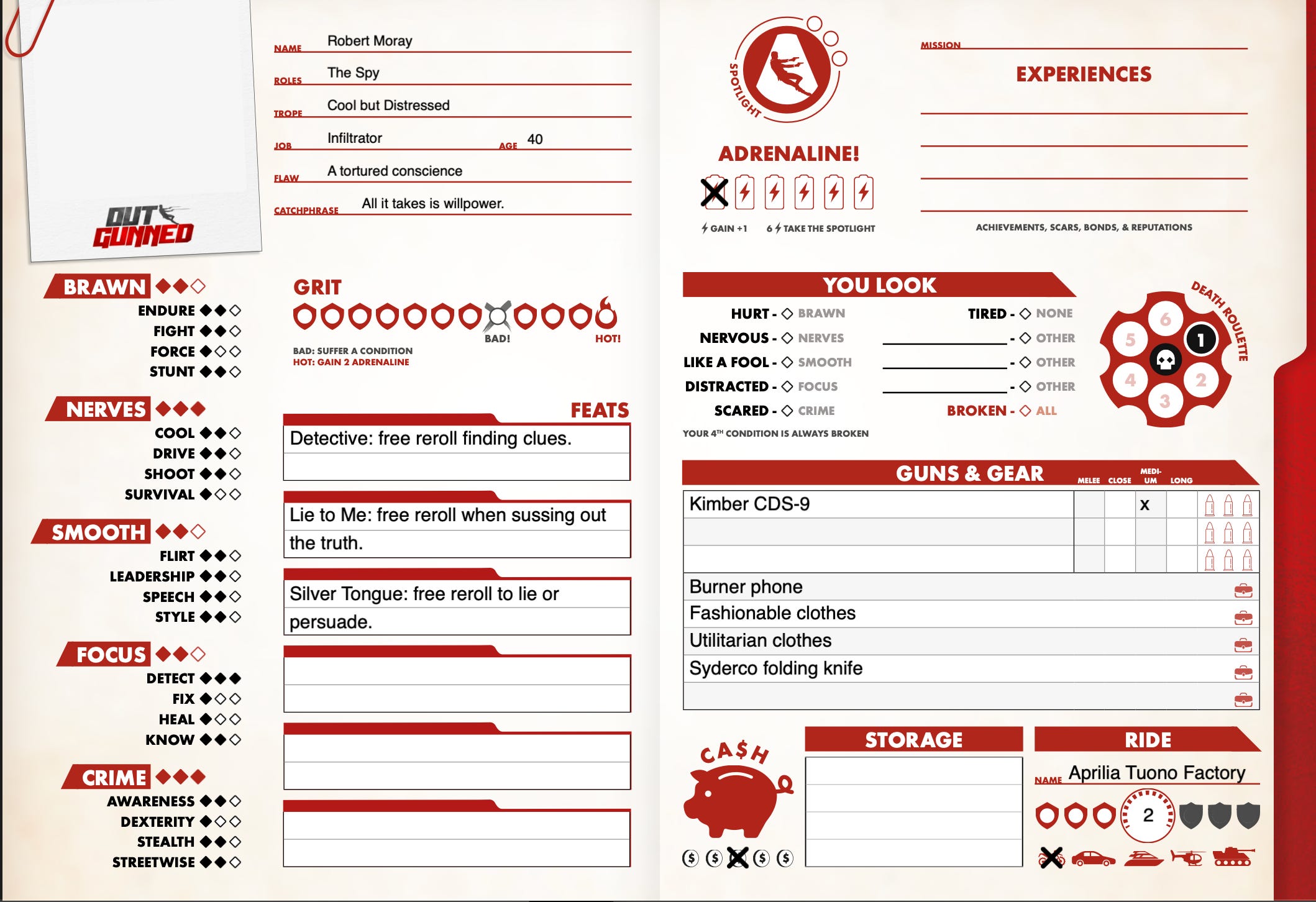
What is it that keeps the demons at bay? What is it that helps him keep his cool when he needs? What allows him to smile at a bad guy and treat him like his best friend when he wants to put a bullet in him? Discipline — the ability to control himself.

The second choice for this is a character that will probably pop up a couple of times this month. A major NPC, she was written up as a player character — a habit I have for central NPCs that will show up on a regular basis in a campaign, and will even likely be aiding the player’s characters. This one was originally crafted in the old Decipher Star Trek system, but is presented here in Modiphius’ Star Trek Adventures format at what would have been the start of the campaign.
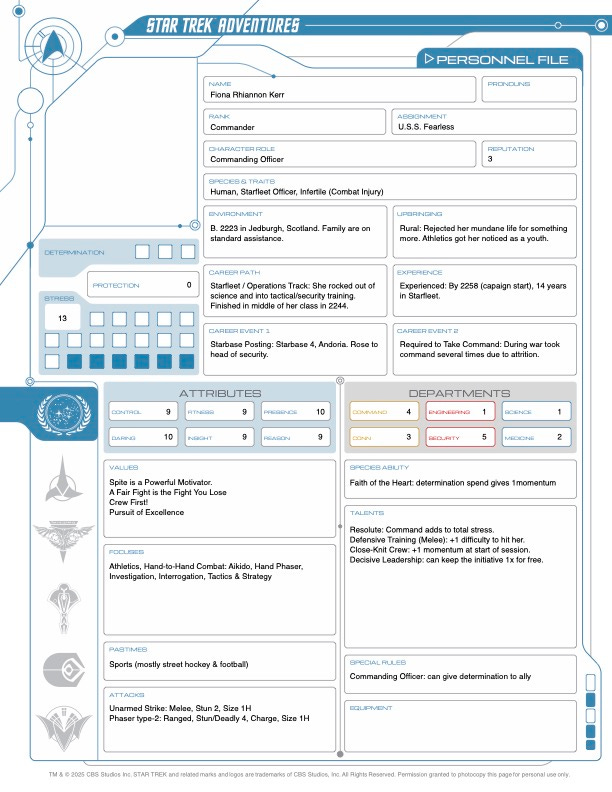
Kerr’s driving force has always to be better than she is. A council housing kid, Fiona was driven to escape mediocrity. She wasn’t a great student, but an excellent athlete. She barely made it into the academy, rocked out of science but landed in security operations when her physicality and personal skills allowed her to graduate in the middle of her class. Despite excellent fitness reports while a security officer and later head of security on the starbase at Andoria, she was overlooked for promotions, due to the lack of prestige of assignment, but also the influence of an admiral and a former instructor with a grudge.

However, her tenacity and fearlessness during a crisis on the starbase brought her to the attention of Captain Garth of Izar, who snatched her up for his chief tactical officer and pushed through promotions to get her up to where she should have been. With the outbreak of the Federation-Klingon War, she was able to show what she could do with inspiring leadership, a good head for tactics, and an absolute refusal to surrender or show fear. At the Battle of Deneva Prime, she rescued her medical personnel and killed the commander of a Klingon force in hand-to-hand combat, and was gutted in the process. She barely survived, but is infertile and badly scarred in the abdomen. At the war’s end, she was Garth’s hand-picked successor, and while she was given the office of captain, she was denied the rank and remained a commander. (Her former instructor, again…)

Kerr is a fierce opponent and a loyal friend, she awards merit and scorns sloth. She has a vicious temper and sharp tongue, but she can be very diplomatic when it suits her. Or in Captain Garth’s words, “If her people or her personal reputation is on the line, Fi won’t stop and she won’t allow you to win out of sheer spite.”

The copyright for 2d20 system is Modiphius, 2019. STAR TREK and related marks and logos are trademarks of CBS Studios inc. All Rights Reserved and no infringement is intended.
In preparation for RPGaDay this year, I’ve been thinking about characters that fit one or more of the prompts. This naturally led to how we create characters in roleplaying games. 

There are, broadly, two ways to do this: the stats/race/class come first, or the idea comes first. For a lot of the early RPGs, that first path was often more common. Example: in the bad ol’ days of Dungeons & Dragons and the d20 stuff that followed (Gamma WorldTop Secret, etc…), a lot of players would maybe have a preferred class and race in D&D, or know they wanted to play a G-Man in Gangbusters, but often the stats came first — strength, constitution, what have you. My elven wizard has X in wisdom. From there, after minutes agonizing over a name, (I’ve always found this amusing…) you might start to throw together a basic picture of who the character was, or just let it form in play.

Nothing wrong with this. It’s fast and gets you into the game with a minimum of preparation, and way back when roleplaying was more of an extension of wargaming, players were much more interested in combat as the thing. Character was often secondary. There are fewer of these RPG systems, these days — Lex Arcana is a good example of this, but mostly you have to look back to older stuff still being played to see this focus on “roll playing”. It’s kept D&D in the public eye for decades, and it’s one of the reasons it’s still the most popular game system on the planet.

The second is to have an idea for a character up front. You have, at least, the bare bones of a persona you want to inhabit for a few hours at the gaming table. For instance: I want to play a private eye that is not hard-boiled, but surprisingly kind and empathetic — and this naiveté is he main weakness in a noir setting, where societal corruption is usually a theme in the background. I don’t have much else built in, yet, but it’s a great idea with good hooks — a character less likely to resort to violence, a guy that genuinely cares about the people he’s helping, and a glaring weakness that, for once, isn’t simply he’s a sucker for a dame. Why is he like this? Maybe he’s a war veteran and violence repulses him…but he’s good at it, and hates that part of him. 

A change came in RPGs around the ‘90s. You started to see games more focus on this second style of play — “role playing” — immersing yourself in a character and a world. There were hints of it showing in the ‘80s. James Bond: 007 had the idea of “weaknesses”, something any English major will tell you is what makes a hero interesting. It was a central part of comic book RPGs like DC Heroes and Marvel Superheroes, if only because limitations to a character’s powers were part of the tropes of the genre. 

When building your character, a few simple questions help get this started: who is this person — what is their defining trait? Why do they do what they do? What or who matters to them? What or who do they hate? Where are they from and how does that affect how they act? Right now, there are a few systems on store shelves that are really good at helping a player create a character, not just a set of numbers. The standouts for this approach to gaming, where the system helps you flesh out a character and the stats encourage playing the strengths and weaknesses are Legend in the Mist and the Avatar games, both based on and a refinement of, the Apocalypse World engine; and specifically two of the 2d20 systems from Modiphius: Star Trek Adventures and Dune: Adventures in the Imperium; and the very rules-lite Die: the Roleplaying Game, based on and developed in tandem with, a comic book of the same name.

Each of these systems revolve around the development of the character less from the level-up standpoint of roll-playing, and more from a how do they change as people. The best of the bunch for the theater kids out there is Die. You develop, together, not just your character in the world of Die, but the player playing that character; the other players also have input on who this person is. Then the players’ own desires and failings inform not just the character — an expression of their wish fulfillment — but the enemies, stories, even the settings that adventure in. It’s very meta. It’s also very cool.

As good in Legend in the Mist (and their City of Mist), where characters are not about their stats, at all. You have four themes — devotion, skill or trade, some physical characteristic, for example — and “tags” short descriptors that may or may not help you in an action, like Charming or Strong as an Ox. These each add a +1 to a simple 2d6 test. There are weakness tags per theme, as well, and these are essential to the improvement of the character. Your weaknesses and failures help you learn; not your successes…much like real life. You goal milestones level you up, in so much as allow you to change themes and tags as you grow. 

Similarly, Star Trek Adventures and Dune have your goals, values, and weaknesses built into the character at creation and they have mechanical impacts in play. In Dune, your Values (Power, Duty, etc…) and your Skill (in broad terms like Understand or Battle) add together to give you your target number for a test. If a test does not impact your Duty, say, but your Faith in leaders or a system, that alternate Value is used for your test. STA has Value statements that give you game currency that can help supercharge an action — for instance, resisting intimidation, or taking an action that might seem futile might play into a Value or Spite is a Powerful Ally. These help drive a player to have their character act in ways that might not always be in their interest. Addicted to Love is one character’s Value in our STA game. He falls in love easily — and gains game currency for taking the hit due to the value, like being a sucker for seduction or persuasion by women.

The matrix above shows character beats that are useful both for individual character, but also for a group’s character, or even overarching themes for a campaign. This is something starting groups sometimes miss: why they are working together. There are a few easy ways around this: you all got hired for a job and meet in the stereotypical tavern; if you’re in a military, police, or other service setting — you all got assigned there recently; or happenstance — our plane went down and now we’re all we’ve got. Building out why they are there and how they interact at the start is an extra step that slows getting right into the action…but it does help create interesting games.

Of the systems noted above, Son of Oak’s Mist games do this well. in Legend in the Mist, you build your “fellowship” along with your characters. You not only have tags for your players, but ones for the group as a whole. you decide what the relationship is to the other players and that can be used as a tag when interacting with each other. Die has the players build their player/characters together, define how they view themselves and their friends, as well as what kind of world they would be interested in playing.

So as we roll into RPGaDay, I’m hoping to use these prompts not just to showcase character ideas, but how these can be used for group dynamics and story ideas.

I’ve been remiss in doing the RPGaDay for several years, now. The day job required a lot of attention in August, and the last few years saw the school year start in July, so I rarely had time to do more than a few posts. This is the first year without a schedule in the way, so let’s see if we can do a post a day this month.

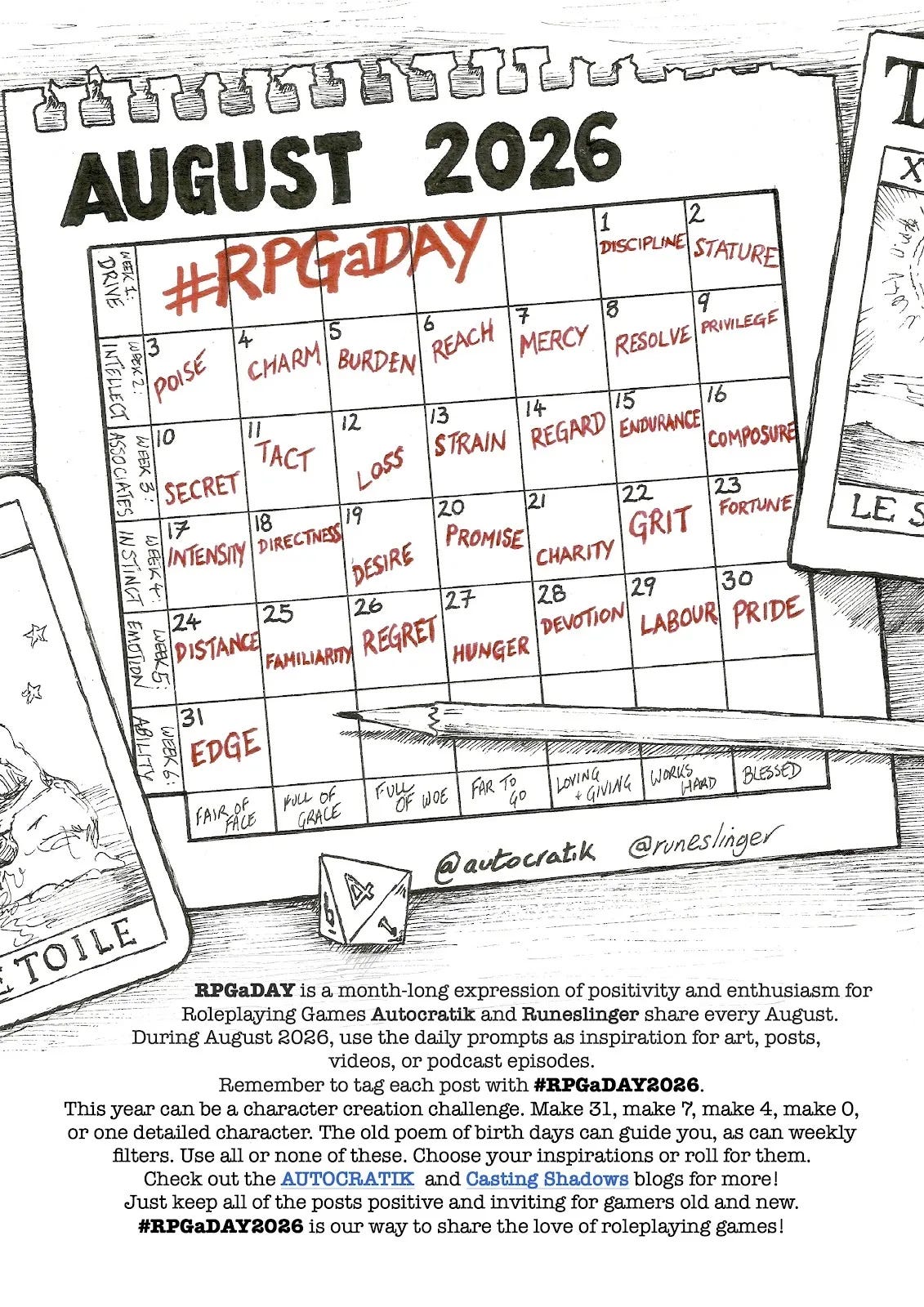
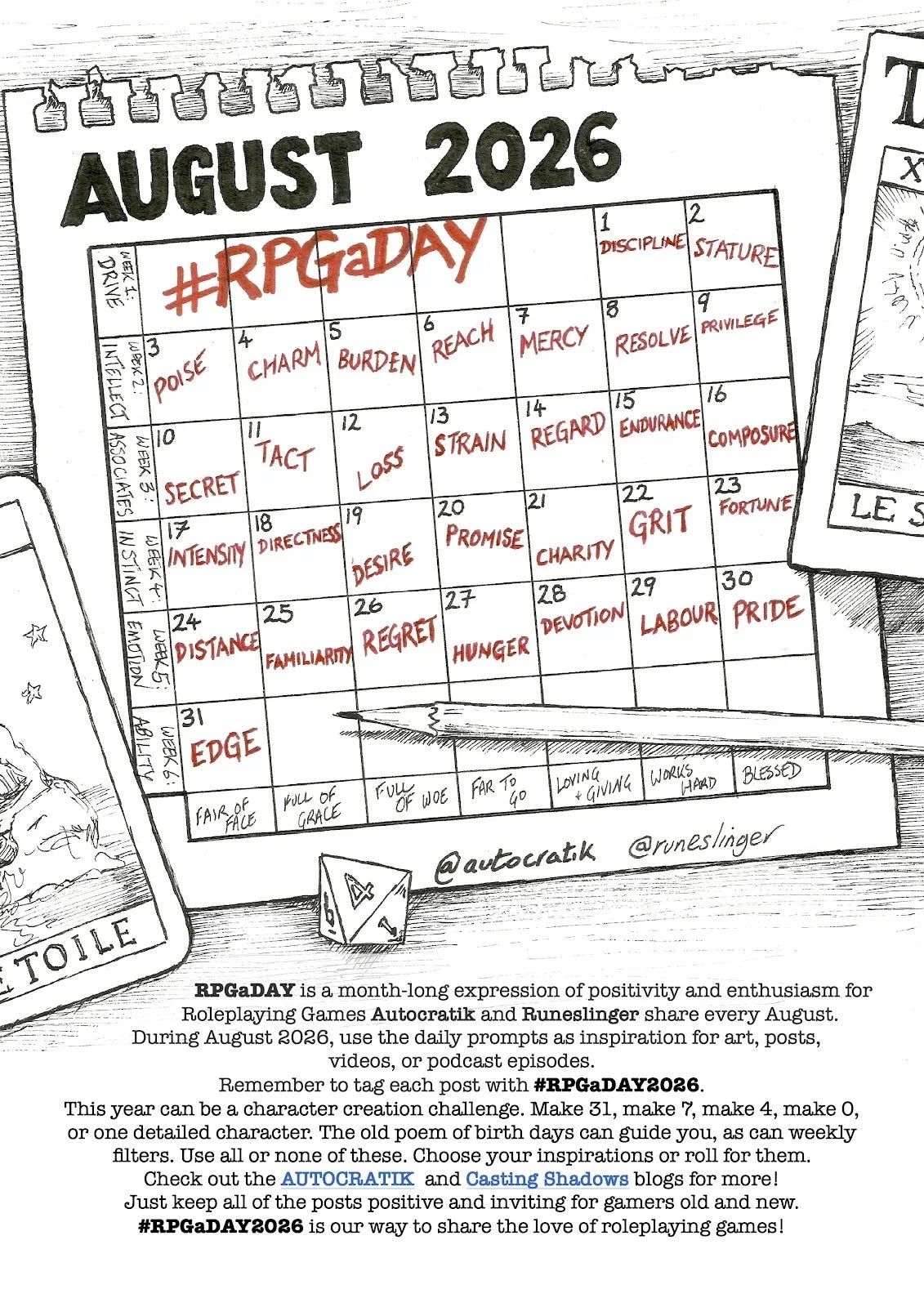
Here’s the prompt for this year:

The prompt calls for character creation, and I doubt I’m going to do 31 characters — but posts on how to integrate some of these themes in character creation, creating motivations, and challenges feels like the right way to go.

As always during RPGaDay, readers are encouraged to comment with their own ideas and approaches to gaming. This is about enjoying our hobby. So, August 1, RPGaDay starts