February 2010
Monthly Archive
16 February, 2010
My first gun was a Webley Mk III .38S&W (or .380/200 in British parlance) made in 1897. I bought it because it was a piece of history, more than as a self-defense piece, although I did carry it for several years. This particular weapon has an relatively rare grip, and the Webley folks confirmed it was originally a Singaporean constabulatory weapon. More on this later…
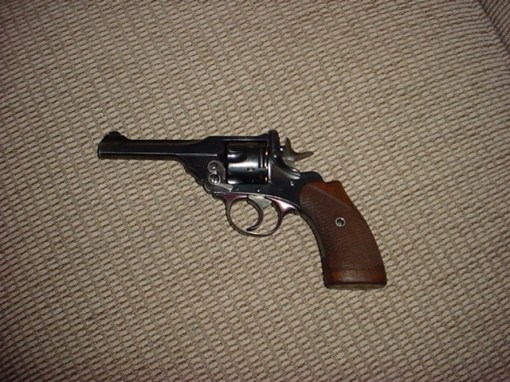
Shortly afterward, I bought a Mk VI in .455 Webley. This is the weapon that was the British military issue gun from 1889 until about 1963, when the Browning High-Power officially replaced it. Heavy and large, this is not a concealed carry weapon. It is, however, a superb field gun: very robust, reliable, accurate, and a fairly good manstopper.

This weapon was made in 1918 and has the “wartime” finish. Apparently, Webley couldn’t take the time to make the bluing mate well on the guns, and they suffer from wear on the barrels. Despite this, the pitting is minimal and there is no rust on the pistol. The design is pure Victorian — heavy (almost 3.5 lbs loaded), with handsome lines along the octagonal barrel, and a lovely curved underbarrel, where the hinge for the weapon is. The weapons have a heavy breech lock above the backface of the receiver that locks the weapon closed for operation. It is stout! and opening it can take a bit of thumb strength. It can easily handle the pressures of .45ACP +P.
Webley double pressure proofed they guns and they can take a hell of a pounding. I regularly hot-loaded the .455 cartridge and one of my Mark VIs is converted to .45ACP. It coughs out +P rounds like they were nothing. These are some of the most robust, well-made handguns in history. In my opinion, the Webley is one of the best overall designs for a revolver, period.
Function of the Webley is no-nonsense and very reliable. I have, in several thousand rounds in three different Webleys, never had a malfunction or any kind of damage to the gun through use. The double action trigger pull is long and stiff, running 10-12 pounds, with the double action a crisp 5ish pounds (and my Mark III has a dangerously light 2 lb. trigger.) Cocking the hammer with the off hand I have been able to achieve a rate of fire comparable to that of a 1911 .45, with a high order of accuracy.
Speaking of accuracy, the Webley is on par with any full-size 1911 frame handgun, and I have reliably hit targets at 50 yards. An officer was expected to fire with his troops during volley fire during the 1880s, and the Webley was capable of hits out to 100 yards. At usual handgun engagement ranges of 25 yards or less, the Webley will print 3″ groups in single action with little effort. At 10 yards, double action will at least score you hits in the center mass area. Rapid fire, thumbing the hammer to single action, I have managed to do 6 round groups of 2″ at 10 yards on a regular basis.
Stopping power is one of the few places were “experts” will question the .455 cartridge. It is a short-box cartridge that speeds a 265 grain soft conical bullet (this is the Fiocchi load — pretty much all you’ll find commercially, although Hornady is doing a Webley round, now, as well) to 650-660fps. The muzzle energy is lower than a .45ACP by a bit and is on par with a 9mm round; recoil is mild, aiding in follow-up shots. Despite the lower energies, this is a big, heavy bullet and was plenty effective in combat. For a while, the British military was obsessed with “knockdown”, and the .455 was considered highly reliable in stopping a target. It did well in the 1904 trials for the US military, leading up to the adoption of the .45 ACP. I would have no trouble counting on it for self-defense…other than the $40/box cost. If you are a handloader, however, the Webley is a nice challenge. You can get .455 dies, and it will accept most .451 caliber slugs. I have also fired .450 Corto and Short Colt through the weapon without incident. .476 Enfield should also work, but I’ve not tested that.
As mentioned, I also have a Mark VI that has been modified for .45ACP. The cylinder is shaved down to allow moon clips, and once again, has never provided any trouble in its operation. It has fired everything from soft lead to hollow points to +P ammunition with nary a hiccup. These “cut” cylinders also allow the use of .45 Auto Rim, a bit more expensive, but some of the loads range up to 255 gr. with an 800fps velocity. Not whimpy.
A quick note on the .380/200 Webley Mark III from the beginning of the piece. This weapon is also a sturdy and reliable sidearm, and small enough for concealed carry. The .38 S&W round is anemic by most standards, but is on par with .380 for stopping power. Recoil is non-existent out of the 4″ barrel Webley, and a friend used to reload the used cartridges to 9mm Luger specs without incident (I split a few cases, though…) Accuracy was steady to 25 yards.
The Webley is not exactly a common gun, but out west in the US, you will find them with some regularity. The .455s are usually cheap in the local gun store — $300 is the highest I’ve seen, while the .45 conversions will run you up to $500, depending on condition. Most of the .380/200s I’ve seen have been Enfield Mark IIs (same gun, essentially) and they usually run the gambit from $250-400 depending on the condition of the gun. (You’ll pay higher on Gunbroker for all of these.)
For the cost, they are worth every penny.
16 February, 2010
Previously, I had posted some ideas for Battlestar Galactica campaigns preceding the Cylon attacks. Now here are a few for things post-attack…
For a Ground Survivor Campaign:
One of the things I found effective in my campaign was to have the attacks happen in the middle of an ongoing adventure/mission. In our case, the Critical Investigations Unit of the Colonial Marshals’ Service was in the process of hunting a bunch of escaped convicts whose bus overturned on slick roads and went down a mountain ravine, not too far from Oasis. While in the midst of this, they lose comms and hear a strange rumbling. That was Caprica city getting nuked, only 50 miles away (but they were shielded by mountains from the initial gamma burst.)
They then had 30 minutes to race to usable vehicles and get to Oasis — a small mountain town (think First Blood) — where the nearest fallout shelter was.
Other ideas include 1) survival in the shelter for the 8 days it will take before radiation levels should drop enough for them to move. Plumbing problems, tight and darkspaces for claustrophobes, and general fear make this a good environment for the first adventure. The radio isn’t working for whatever reason, or they can’t get their transmissions out so they get a fragmented and frightening picture of what is happening topside.
2. After coming out of the shelter, they must forage for supplies — canned foods, bottled water, first aid supplies –anything they didn’t have in the fallout shelter. Maybe they grab vehicles. Remember, metal holds radiation — the car hulls will be hot, but not necessarily more dangerous that causing contact injuries. It’s raining a lot on Caprica after the attacks (we can assume the same on many worlds), so puddle will be dangerously radioactive. Spice it up with a Cylon attack to get them moving if they dally too much. (Our campaign lost 20 of their initial 42 survivors this way.)
3. Hide and seek: using vehicles in the mountains to avoid the Cylons, the characters try to find survivors and bolster their numbers. Radiation sickness in the animals can make for an interesting encounter. Our players ran into bears foraging in garbage dumpsters that were loosing their hair and were on the…upset…side.
4. Trying to fortify an area. The players might try to find a defensible spot for raids or to hide. Another good variation on this is finding the survivalist camp where they can get aid, but perhaps the people are a little too eager to have women here to help repopulate the colony; the military camp where everyone’s gone a bit ’round the bend (ala 28 Days Later); or the religious end-of-the-world cult (possibly even the monotheist Soldiers of the One from Caprica.)
5. A good ol’ The Road Warrior-style adventure where the characters have to either run the gauntlet through a Cylon platoon or other road gangs. I added a motocenturion similar to the motorcycle Terminators from the execrable movie. Also, I figured the Cylons — if they didn’t have their own vehicles — would use what they could or retrofit vehicles with their Cylon brains to fight Colonials using vehicles to do hit & runs. (Yes, it’s not canon, but it’s more fun.)
6. A raid on CMC reservist caches. They’ll will, of course, have to get past the Cylons sitting on the reserve bases. This should probably be a later adventure, with serious danger, but the rewards being military medical and food supplies, tanks or APCs, guns and ammo.
7. One group had no pilots, so their goal was to get to the sea and get a small boat out onto the water, hoping to avoid Cylon attention. Pilots might have the goal of getting a hold of an FTL-capable ship and getting off of the planet.
8. Something you can string in is the danger of radiation sickness, but also of exposure to other disease caused by the death of animals and plants around them.
9. The farms. Have them discover the Cylon Farms. I made this much more horrifying than the show did, playing up the machine rape element of it with a spicing of Japanimation tentacle/machine porn. Make it truly disturbing. We also had healthy men being “milked.” Yes, disgusting…that’s the point.
10. The Offensive — the characters have enough followers to stage guerrilla attacks on locations: farms, bases of operations, etc. You can do variations on theme until the end of time…or Day 282. (More about that later.) Perhaps they find a bunch of planetary guard, or Colonial Marines that have been successfully playing hit and run. We had a tank battle between the Cylons and CMCR in our campaign. Eventually, the Cylons just nuked the site from orbit, but it was a glorious battle…
One thing to remember, the Cylons stage a cease fire and leave Caprica on Day 282. The characters don’t need to know this, but if they can hold out until then they have a chance to possibly rebuild one of the colonies… Yes, it’s not canon, but we can’t assume that only Sam Anders’ bunch were the only survivors in the Twelve Colonies.
Next time, ideas for a “second fleet” campaign…
12 February, 2010
With the Oscars in the offing and Avatar undeservedly in the list, Asylum gives us the top 5 science fiction movies screwed at the Oscars.
For those blown away by Avatar’s special effects and incredibly effective use of 3-D, granted it should win scads of technical awards. But best picture? Not even close. Funnily enough, the best movie of last year is a sci-fi flick that the studio couldn’t even be bothered to put up for consideration: Moon — a phenomenal movie that is about character, and is carried by spectacular performance by Sam Rockwell. (If you’ve seen it, you know why I say performances, plural.)
Rockwell and the lead actor from District 9, Sharlto Copley, easily gave us the best work for an actor of the year…where are they? Copley alone manages to give us a man who is utterly bereft of likability — an insensitive bureaucrat — at the beginning of the movie, and make us not just care about him, but like him by the end.
Avatar was pretty…and not much more than that.
11 February, 2010
Here’s a quick take on the Cylon vessels of the first war…
Cylon Basestar Mk I
The Cylon basestar was a combination aircraft carrier and battleship used by rebel Cylons during the First Cylon War.

Dimensions: 1200x1200x600′ Crew: 5,000 Cylons
AGL: d6 STR: d12+d2 VIT: d10 ALE: d8 INT: d8 WIL: d8
Initiative: d6+d8 Life Points: 24 Armor: 3W, 4S Speed: 4 (SL/JC)
Traits: Memorable d4
Skills: Mechanical Engineering d6, Pilot d6, Technical Engineering [Electronic Warfare] d6 [d10]
Armaments: Medium & heavy vehicle/scale, capital-range missiles (can be used as point defense) d12W; heavy spacecraft scale, capital range missiles: d12+d2W; nuclear missiles (spacecraft-scale, short DRADIS range): d12+d6W
Auxiliary Craft: 200 Cylon raiders, 50 shuttlecraft (similar to raptors)
Cylon Raider Mk I
The Cylon Raider of the First Cylon War was a bulky thing, compared to the latter biomechnical versions. They carried a crew of three centurions, and acted as a landing craft, as well as an attack fighter.
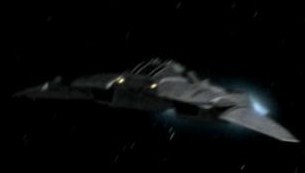
Dimensions: 23’x40’x13′ Crew: 3
AGL: d6 STR: d8 VIT: d10 ALE: d8 INT: d6 WIL: d8
Initiative: d6+d8 Life Points: 18 Armor: 2W, 2S Speed: 7 [5 in atmo] [SL]
Traits: none
Skills: [Cylon crew] Mechanical Engineering d6, Pilot [Raider] d6 [d10], Perception d6,Technical Engineering d6
Armament: 2 30mm cannons [vehicle-scale, skirmish range]: d8W, 2 vehicle-scale, skirmish-range missiles: d12W or 2 anti-ship missiles [spacecraft-scale, capital-range]: d8W
10 February, 2010
Posted by blackcampbell under
Technology | Tags:
gynoid,
robot,
sexbot |
Leave a Comment
Inventor Doug Hines relates who Roxxy was developed…and it’s not for the prurient interests one would think. John Stossel weighs in on how consumer protection laws blocked the original purpose of the robot, to act as a companion for the elderly.
10 February, 2010
Pacing, pacing, pacing!
This is one of the tougher things to get right as a gamemaster. Depending on the type of adventure being run, you might want to have the characters go through a series of hoops to get things done, other times, you want to keep the speed of events high.
It’s a problem moviemakers have, as well. And cinema gives us a few ideas of how to do pacing for certain genres. For the mystery, for instance, you will want the characters to wander through a series of clues and red herrings until they get to the bad guy. However, even mystery movies often leave out or gloss over things like the foot work required. And how do they do that?
MONTAGE! The characters roll a test or two to sweep the streets, leading to the sequence where they actually find a clue. They’ll know there’s something worthy of paying attention to in a sequence, because you aren’t glossing over the process. It allows you to control the pace of their investigation — say the flat foot took 3 hours to get to the sequence where Eddie the Nose finally drops a hint for where they need to look. It allows you to make sure things unfold as your want them to, without looking like you’re railroading or stifling the pace of the players. And you don’t spend an evening wasting the players’ time. The story unfolds at a pace that keeps people’s attention.
The montage also allows players who aren’t in the center of the action, but whose skills are necessary to the plot, to get in important tests. For instance, the spies/detectives/whathaveyou need to find out about the actions of a dead real estate mogul. One player is walking the streets, talking to the gangs, etc. that might know of a hitman that could have killed the guy. Meanwhile, another player goes through the escrow records to see what he might have been into, while another scours financial records. Describe the montage quickly, while they do their rolls. Did each get the piece of the puzzle necessary? If not, how can you get them to the place they need to be..?
The montage gets things done that are overall boring to most players. No one wants to sit on the sidelines while Jane Doe asks scads of questions about the intricacies of investment portfolios. If they got the roll, explain what they need to know. Give them their clue and press on.
Most stories work better if the pacing is faster. One, the players will sometimes (but not always) miss the plot holes that you didn’t account for. Two, they are more involved in the action, and action sequences take up more time due to their tactical nature, than the main storyline. If you need to stretch an episode over a few nights — a damn good firefight/fistfight/car chase will do that.
That brings us to another important thing you’ll see in movies. When things start to lag, throw a problem in their way. Usually, this is an action sequence, but it doesn’t have to be. Take Burn Notice, for instance. Are the players getting ahead of your plot? Have one of the character have a family emergency (it’s especially good if it’s not a real emergency.) Maybe the party is hunkered down from the Cylons or the orcs int he area, or what have you…they’re making their move tomorrow. Maybe a sentry finds them. Or — as a friend of mine related to me — your fire team is camping in Honduras waiting for the big operation tomorrow. Rebels are in the area. Then your warning flare goes off because a big friggin’ pig comes through the camp! Rebels! Oh, wait! Sorry I almost shot you, dude…
The axiom in Hollywood: when there’s a lull, hit them with a car chase or an explosion. It works.
Occasionally, you want to slow things down to allow for character interaction, or to allow the plot to unfold. If you keep pushing the pace too hard, you get Quantum of Solace — where the plotline is lost in far too many chases and fights. You lose the narrative. If the players start to lose track of what they’re doing, where they are, or what their objective is, back off a bit and give them a breather.
9 February, 2010
Gleaned from the twitter account of “Serge”, the Graystones’ butler bot:
The planet in the Caprican sky is not a moon, but a “twin” planet…Gemenon. They orbit a common center of gravity. Gemenon, in addition to being a hotbed of religious and fundamental pantheism (which adhere to a literal interpretation of the Sacred Scrolls), it is also the cynosure for monotheism.
Sere informs us that Canceron is a beautiful, but very poor world with first class beaches. Scorpia also has some of the loveliest beaches, as well, according to The Caprican (see the Caprica website on syfy.com) a rather dangerous and low-brow quality to it. the description seems to be suggesting a sort of Central/South American quality to the places.
Arelon and Aquaria are relatively close to each other. Arelon is the breadbasket of the colonies, we know from BSG, and low class. Aquaria is mostly cold, “brackish” ocean, with a lone continent.
Leonis is a “declining empire” with extensive vineyards, and is known for illegal drugs and energy drinks.
Picon is know, according to Serge, as “little Caprica” and was colonized by Virgon. From the new show, we can surmise that Virgon is a much more libertine world than Caprica (Sam’s comment about Virgons being able to fornicate in public, while Taurons are arrested for anything.)
Serge also relates that much of Libran is a game preserve…
9 February, 2010
Over the last 30 years (sheesh!) of gaming, I have found that story telling often requires characters to work separately of each other, rather than operating as a single unit to achieve a goal. For instance, in most dungeon crawls, the characters operate as a “fire team”, if you will, each bring some tactical advantage to the exploration, a fight, etc. However, in an espionage game, it is not always advantageous to have 4-6 people attended an opera to make contact with an agent, or to sneak into a building to crack a safe… You have a character or two doing one thing, while others are either waiting, or doing something else.
This can be tricky for a GM. Some groups are adult enough to realize they aren’t going to get to monopolize time in a game session, or that their character might be a major player in that particular adventure. As with movies or TV, the trick here is to cut back and forth between the characters, to heighten the drama, and give people play time.
In the case of the above: the team needs to break into a building to steal something. The team has one person with safecracking skills (’cause there’s always a thief character, I find), but the rest are mostly special forces types. The thief, for stealh’s sake, as well as deniability, is operating alone in the high rise in question. One of the team might be the wheelman, ready to make a getaway. One might be doing countersurveillance, watching for security or police response so that they can warn the primary. One might be handling the infil/exfiltration or the building — say with rappelling gear. they are in charge of the ropes, making sure to belay the primary when they come out of the high rise window to scale down the building. A common bit here would be the hacker taking over security systems to disguise the thief’s actions.
You cut back and forth between the people. The thief goes in from the roof, say, rappelling down to the target floor window and cutting through to an unoccupied office. The belaying man is handling the ropes, making sure the thief doesn’t overshoot, etc. Maybe he has a close call with a bird; this effects the thief. Once the thief is in, however, the belaying man is not really necessary. One trick here is have them on radios to talk to each other, another — if they can’t communicate — is bump up the stress level. Have the other characters get antsy as time goes on (it’ll play into the players’ desire to do something…) Maybe someone decides to crash the party and check on the thief, alerting security in the process.
For the guys in the car or doing surveillance, throw them a few red herrings. A stray guard or police car looks way too interested in the car parked in the alley. How do they get out of it? If the thief trips an alarm or is otherwise found out, how do they support the thief?
As with a movie, you cut back and forth between the primary (the thief) and the others. One of the best ways to do this is bring up a problem. The thief finds the safe isn’t the right one; they’re going to need more time. Or a security feature is different than they expected. If they’re using a hacker, they trip up and alert a sysadmin, so he’s busy disguising himself or fighting for control of the system, rather than protecting the thief.
There is a beat to these scenes in a movie. The thief finds out there’s a problem or the hacker screws up. Once they know there’s a problem, go to someone else on the team. It gives the thief or hacker a moment to think through their problem, while giving the other people time. Say a cop car stops to harass the wheelman — what does he do? Cut to the over watch — does he aid the guy in the car, or hold his position? Cut to: the hacker does what he needs to solve his particular problem. Cut to: the thief can do their bit. The safe is open…where’s the McGuffin their after? The car guy talks his way out/kills the cop/gets pulled out of the car for an interview…does he make the cop suspicious, or pull some smooth talking? Or does the over watch get his attention?
The trick is at each cut to leave the character in question with a heightened sense of danger. Each problem adds to the others’ problems. If the thief succeeds but the hacker screws up, they might be identified. If the getaway driver is arrested or forced to move on, does that mean the guy doing over watch is involved in a holding action when they are bugging out? What if the belaying guy screws up and the thief, or he, is injured? Each person’s problem is the team’s problem, but only one or two of them can do anything about it. This heightens tension and makes everyone an important party of the action.
Another thing when having to split the attention, don’t overengineer the problems for the team. You need to keep the pace up, so that everyone is interested in the action.
6 February, 2010
The site seems to be pulling some decent traffic this last month, so thank you to all who are reading the blog and making it worth my time. I’ve almost out of adventures for the various games I run, so tomorrow is a game writing day. (Today was bang around on the Triumph too fast day.)
But while I’m plotting and scheming the demise of my players (not their character…just the players), I throw it out to those who care: what would you like to see here?
Comment away…
5 February, 2010
Here in The Washington Post.
The main problem with NASA is the incredible amount of administrative waste and abuse, coupled with an institutional mindset that is highly risk-adversive…not the right attitude when shooting your ass into space. NASA has been a relic of the Cold War and Jet Age for some time, and has needed to be trimmed and focused on the future of space travel. that means not building yet another space truck like the Space Shuttle.
There needs to be closer ties with commercial space exploration, and more support for the private sector to jump in on the space race. This means less regulation of the space industry by the FAA. This means a concentration on the real explorers of the next half century: robots.
It’s time to stop pussy-footing around in low orbit and shoot for Mars with robotic explorers that are capable of setting up the habitats necessary for an eventual manned mission.
Most of the complaints about cutting NASA’s budget come from people who still view space as a means to national pride. The benefits in glory do not outweigh the cost with government in charge. There is the argument about the Chinese and Russians holding the “high ground”, but most of the military space applications are handled by the US Air Force; I don’t see their budget getting chopped badly.
It’s time to start working toward a viable exploitation of space. That can only happen when the bureaucrats are out of the way and there’s a profit to be made.
« Previous Page — Next Page »


 The Black Campbell