Roleplaying Games


[While these tips and thoughts are oriented toward Dungeons & Dragons, at present, they are just as useful for other settings. SCR]

So, you’re building a new campaign for your group. There are a couple of things to think about, right off the bat. There are several canned settings for Dungeons & Dragons — Forgotten Realms is the Wizards of the Coast “official” setting, but there’s Eberron, Dark Suns, Al-Qadim (an “Arabized” version of Forgotten Realms, if I remember correctly…), Blackmoor, Dragonlance, etc. etc… Or you could build your own high fantasy setting, building off of various influences. (And let’s face it…the big one is Tolkein.)

The first thing you have to realize is how much time do you have to put into this. For the high school kid, the college kid studying alternative Feminist Dance Theory, or the dude sitting doing security at a remote site, this could be “a whole lot.” For the rest of the world, there’s work, kids (bah! kids! little time sinks!), college, errands, etc. It can be at a premium, especially if you lack good time management skills.

Published settings like Forgotten Realms can be very handy for the newbie dungeon master, or one that is pressed for preparation time. Having a “world in a can” allows you to get right to plotting a story in a ready-made framework, or to use published adventures to kickstart your game, or even run it without doing much work outside of reading the modules. There’s nothing wrong with this approach, particularly if the players haven’t run through any of the materials you are going to use.

One problem I’ve seen to these prepared settings, especially in some of the science fiction RPGs is the use of metaplots: there are large scale events going on, described in the books, and the idea is that your characters can or will be somehow involved in these world/solar system/galaxy shaping moments, but often these metaplots feel like they are being played out in the background, affecting your characters, but rarely vice-versa. Two games I’ve always wanted to run, but just couldn’t quite find a hook are Jovian Chronicles and Eclipse Phase — and both have this metaplot thing going on. Every supplement moves the publishers’ stories along, but where do you fit in? do you shove your characters into the interstices of these big plots? Do they simply exist, keeping their heads down, while empires rise and fall, or do you want them in the thick of it…where they will inevitably take you off script. (And a good thing, I’d say…)

Another option is the Chinese Buffet Method® where you pick the stuff you want, and leave the rest that doesn’t work behind. For the game I’m working up, I’m keeping the pantheon of gods from Forgotten Realms, but I’m ditching most of the rest of the setting — creating my own map and political structures on the fly. (There’s a reason for this not connected to time management…well, partly connected to time management…) I wanted something that felt familiar to any of the players who had played D&D, but I wanted my particular stamp on it.

Connected to this — don’t feel you have to use every creature in the Monster Manual. In fact, it’s a good idea to chuck quite a bit of it. There are all sorts of variants of critters presented, and a lot of them are really cool…but not everything needs to be jammed into your dungeon or castle or whatever (unless you have a reason for it.) Read the descriptions, figure out what works best for the story, maybe look for some consistency in which critters would live where.

The most work is to create your own home brew setting. Even if you offload some of this on the players — “Hey, why don’t you tell me what Zaybo the Barbarian’s culture looks like?” — you’ll be carrying a heavy load in preparation. This also can be the most rewarding, if the campaign catches everyone’s imagination.

My suggestions, even for the experienced DM are: 1) Start small. Do a short adventure that introduces elements of the world, but leaves it open for you to expand. Even with an established world, you could fit a small town or ruin in without wrecking things. 2) Steal from all over. You want the Norse gods in your setting? Go for it! You want Isengard and Saruman? Cool! 3) Let the players help you out. As they build their characters’ backstories, you might consider letting them tell you about where they are from — the place, the people, the beliefs. Give them a chunk of the worldbuilding, to lighten your load.

I did some of this with my Battlestar Galactica game, where one of the more motivated players would throw out quips about former presidents, places, or things that I would then weave into the background of the Colonies. Wondering aloud about certain things lead me to either use their thoughts as red herrings, or actual plot elements. I would advise against the “too many cooks in the kitchen” approach of modern indie games, especially if you have a very specific story arc to work with, but I’m also a crotchety old guy who’s been running games for three plus decades…so I’m biased.
Ordinarily, my group tends to do a lot of backstory for their characters, and we interweave them with things that make them more than a bunch of guys that meet at a tavern, then start adventuring. This is not necessarily the way to go about things, but most of our games tend to be either modern(ish) pulp fiction games, or space opera.

How much backstory is enough or too much? Depends on what you need for the story. Some characters can have a pages long backstory with all sorts of things the dungeon master can hook into for plots. Or it could be something simple, like Indiana Jones, for instance: he’s an archeologist with a reputation. He’s a bit shady, was in love with a character he will encounter, and isn’t afraid of much save snakes. Go!

So how to give characters interconnections that make them not just want to travel together, but give them common purpose?

The first way is to have them be in the employ of a particular NPC or organization. This works very well in military, police, or spy -oriented games very well, but might not fly in a D&D game, depending on the classes you’ve chosen. It also works to give the characters purpose for their adventure. Simply put, you got orders.

An example of this might be the town garrison of a city. Warriors have an obvious role here, but so do rangers and rogues — who could both be used as scouts or spies. Clerics as medics; wizards as artillery or leadership. For whatever reason, they’ve joined up — be it honor, money, love, adventure, religion.

Or maybe they’re all from the same town. This can be a bit difficult if they are all different species/races in D&D. Why are elves, dwarves, and humans all residents of the town? The explanation can be pieced together by the DM, or it can be a join effort. Maybe it is an trading post on the edge of various territories — a medieval Casablanca or Babylon 5. Maybe it’s a major city, like Venice was in the 14th Century, bringing people together.

Maybe some are related. Obvious linkage.

Or they could have different reasons to go after the Big Bad™. Maybe he has one of he character’s loved ones hostage, or has some McGuffin you need for one of the characters (like, say, a scroll for the wizard) — they could come together because they (or at least some of them) have a common enemy.


I just read an interesting piece on d20art about modules and art. The author suggested that art in adventure scenarios — even the good stuff — was pretty much useless. I found the idea thought-provoking. The products we’ve been putting out have gotten more art since that first module. White Ape of the Congo went very minimalist with the interior art — with two pieces in the adventure guide, and small portraits for the sample characters, a thing we stopped doing with The Death Jade and Murder on the Hindenburg. However, the number of pieces in those two grew to provide visuals to aid the GM with what Shanghai and the airship looked like at the time. The trick, I think, is to balance between utility and making the product visually interesting enough for the reader.

But he’s right — a lot of that art, while it can help the gamemaster find a feel for a scene, isn’t necessarily useful to the players. They could show a picture of the cabins in Hindenburg to give them an idea of the setting, but in the pdf they would either have to resize to avoid showing the verbiage, or cut and paste into another file. It’s not easily useful.

Pointing to a specific example of an old D&D module, the author had suggested breaking art pieces into a separate section that the GM could show the players. It’s a compelling idea. Do you separate the words and the images to give the adventure guide more utility? Do you simply copy the images into a series of pages at the end of the product? This could be especially useful on a tablet like the iPad, where you could show a full-page image quite easily (but which has the unfortunate effect of blowing up the file size, if you’re not careful — another issue of utility.)

Something to keep in mind, I think. We might have to try it out on a future adventure scenario.

After two weeks of holiday nonsense, the group got together to continue our Hollow Earth Expedition campaign. The characters, now bolstered with Amazons, hawkmen, panthermen, Waffen-SS, and Atlantean turncoats, turn their fleet of airships toward Ultima Thule, with an eye to restoring Amon to the throne, and staging their next action against Atlantis…

Lady Zara, once thought dead, but actually rescued by the “green women” and given to the Amazons to heal, quickly drops herself back into the thick of things. She is surprised to find Hunter in charge, and tries a new tactic to help them prepare for their assault on Ultima Thule — winning General Inanna to their side by offering to try and rescue her daughters, Princess Shria (whom they had traveled with until she was captured with Olga) and Mara. The general knew that would be near impossible. The Amazon general, Aella, offered something sweeter — a return to command of troops. Be a general again, but on their side. She will not be welcomed back by the emperor; she lost her ship to a small force! But with them, she might have the chance to become important again. With a damned good roll, they won her over and shot apart most of the big fight I had planned for the night.

Inanna countered by demanding to be freed, immediately, and given her fancy cabin back. They acquiesced. She then aided them with a developing a plan to hit Ultima Thule, and introducing to Hunter some of the ideas of modern combined air-ground operations that wouldn’t be developed for decades. The big win, however, was went she talked them past the the air traffic control for Captain Memnon, the man running the city since Amon was deposed. She claimed Deutshland was an Outlander prize they took in battle.

This got Shiva to the ground while LZ-128 held the air. As soon as they hit the grounds of the palace, General Aelaa of the Amazons, and Gus Hassenfeldt and SS-Obersturmfuhrer Werner led the combined troops into a short fight, using surprise to overwhelm the honor guard and troops on display for General Inanna’s arrival. Shiva and Deutschland traded shots with the antiaircraft heat ray batteries in the towers around the city, disabling them, while the ground forces pushed forward to the strategy room of the palace and killed Memnon. Amon then reclaimed his throne and ordered his people to stand down.

Ultima Thule was taken!

Over the next week, the characters started working on their next steps. Dr. Gould, predictably, wanted to try diplomacy and they sent a courier to Atlantis; Hunter and General Inanna focused on putting together a coherent defense of the city, while Gus — who was offered an officer’s position with Amon’s forces — was in charge of teaching their rag-tag forces how to shoot. Werner offered to take a representative of the hawkmen, panthermen, and Amazon back to their respective homes in Deutschland to solidify their alliance, and after a week, headed out from the city.

We knocked off there for the night with the ball in Emperor Mot’s corner.

Okay…so the universe has been signaling I should run a D&D campaign for a few months now. First, I get a set of the 5th edition books for free; their original owner didn’t want them. Next, there’s a crap ton of people on the local Meetup looking to play, to the point there’s two full groups on Thursday. The guy heading up the Meetup group (who also gave me the books) asks me if i want to step in and run a game for the Meetup. I mention this in passing on Facef#$k and to a few friends. Suddenly, I’ve got about 5-6 people who are interested, and a few of my long term gamers telling me they’re interested in how I would do fantasy… Other incidents conspire to say, “Hey, why don’t you run a D&D game?”

Me: I haven’t run it since 1984 for a reason…I did the epic game back then, it was awesome, but I don’t much care for d20 or fantasy…go away, universe.

Then I read the books. Oh, says I, it’s AD&D, but with some nice fixes. Sure, it’s still got classes and alignments (really!?!) and AC and HP, but now I’m nostalgic for those time when we (no, fooling) played D&D in my friend’s basement (they had a bar setup; it was cool…) or Car Wars, or James Bond: 007, or  or or…

So, a few days ago, having started to suffer from no gaming due to the holidays, and having a bit of free time, since I can’t really get much work done when everyone is on vacation, I start tinkering with ideas for my first Dungeons & Dragons campaign in 32 years. (Christ, I’m old…)

So after 279 words of prologue (Christ, I’m verbose!):

I have a metaplot that will wrap the entire game, no matter if we have to dump it early, or it goes on forever. Dropping hints will be part of it, but it will explain the why of the game universe, including all the shitty inconsistencies that come along with a D&D game. It is also a fine reason for why you have characters with as much or little backstory as we might have. I’m planning on a lot less backstory that we usually have for our characters in this group.

So the world —  First, no lost technology or sci-fantasy we’re the remnants of some lost space colony where the tech is what makes magic, that’s been done. A lot.

I have a few choices but I’m narrowing on two main ideas. 1) a modified Forgotten Realms game keeping their pantheon of gods and some of the planar stuff, and 2) a modified Earth where the old gods never left and their horrific progeny — the monsters — are still wandering the world during the medieval period. I’m leaning toward the first, though I miss playing with the Olympians, as we did with Battlestar Galactica.

On either of these I’ve decided to throw out a goodly chunk of the Monster Manual. With the modifed FR game, I’m thinking of doing a bit of tinkering — pulling some of the races together to use elements of the classic bad guy races while cutting chaff. Orcs, for instance, are a Tolkein thing, but he uses them interchangeably with goblins and ogres, so I’m thinking ogres and orcs are the same thing, just named differently, depending on where you are. “It’s an orc!” “Oh…we call these ogres where I’m from.” “Let’s kill them!” “We call that murder where I come from.” “Shut up, Sir Thesaurus! Chaaaaaarge!”

Similarly, I’m thinking the “angels” of the game will be the avatars or manifestations of the various gods; you can’t kill ’em, but you can take their proxies off the board. Demons and devils — same thing — but they’re the manifestations of “evil” gods. I can raid the MM for stats on the fly, but keep some level of consistency in the world’s cosmology. I want to use the tiefling. For some reason they really speak to me, so I want the aasimar as their “cousin” race. They’re the half-breeds of these good or evil avatars. Maybe. Still thinking on it.

The world itself will start off badly defined — a small county/country that will be part of a world that will be designed on the fly or in very broad swathes. I’m usually pretty good at extemporaneous world-building, but it’s also part of the metaplot.

For the type of adventures, I’m leaning toward wilderness crawls and mercenary work over big maps and dungeon crawls, politics and morality plays over murder and treasure gathering. With my group, it’ll fly.


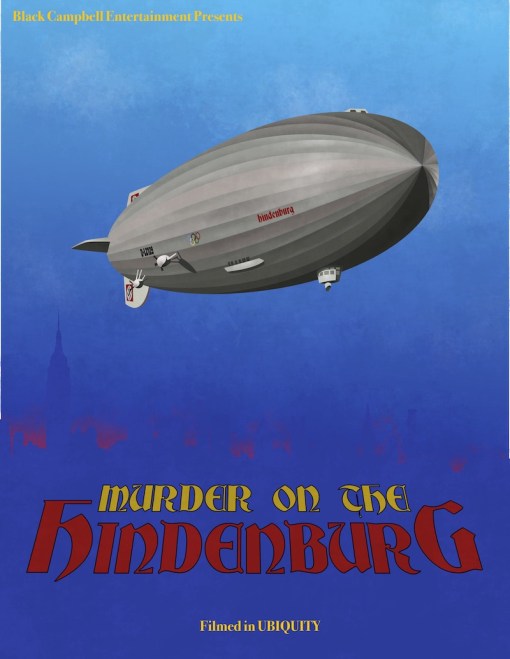
 Murder on the Hindenburg is now up for sale on DriveThruRPG for Ubiquity and Fate role playing games. 

moth-ubiquity

This 22-page adventure scenario is in the style of the ’30s closed-room murder mysteries. You’ve taken a flight on the most prestigious and modern means of transatlantic travel there is. Two days to Europe surrounded by the rich and famous of the world. But when steel magnate Stefan von Eckhardt dies under mysterious circumstances, it’s up to you to find out who the killer is before Hindenburg reaches Frankfurt!

The adventure has four pre-generated characters that would well fit the scenario, but players could easily make or substitute their own. It was designed to be played in a single session of two to three hours.

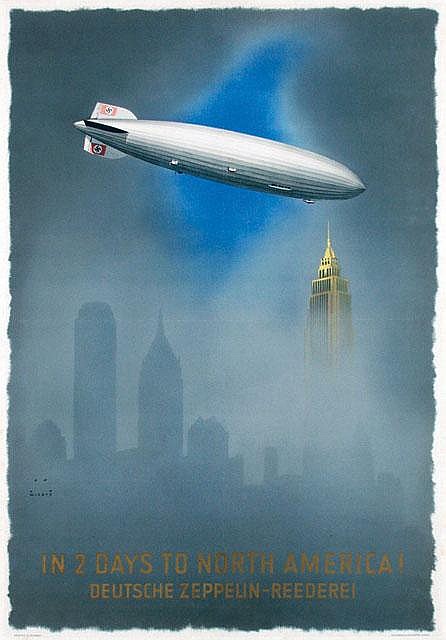
Matthew Bohnhoff, again, did duty for the cover, trying to get a mix of the ’30s movie one sheet and the actual DZR and DELAG posters by Jupp Wiertz (the following was the inspiration for the cover…)

h3297-l16975458


We had a player out for the night, so we focused on Gustav Hassenfeldt and David Gould, and had Hunter off-screen for the night. Now the Sky Marshal of the alliance, he was busy politicking with Amon’s aid, pulling together the various factions, getting their crew put together, and seeing to the preparation of Shiva for their raid on Ultima Thule.

Gus and Gould, meanwhile, went with the scientific teams from the two surface world airships aboard Los Angeles. For the Americans, it’s a flag waving tour and trying to collect more data to take back with them; for the characters, it was to invite people to join the alliance. They brought with tem a representative from the hawkmen, the merfolk, the cargo cultists from Sanctuary, and members of the German science team.

First, they made contact with the panthermen that live in the mountains to the south of where Sanctuary had been. Here their way was eased by one of the cat people that had been a prisoner of the hawkmen, now released on Gould’s request. The pride, at least the females with young cubs, and the elderly, live in a massive matrix of treehouses, connected by walkways and the classic rope bridges. This is to protect them from the predatory dinosaurs of the island. The are high on the mountain slopes because the massive herbivores live in the valleys and plains. Most of their people are solitary, except when mating or when older; a great number of their people live out in the jungle, hunting, and only return here to trade or when injured or sick. The pride leader of the panthermen was unwilling to support them, but gave some of his braves permission to join the fight. A dozen did so.

They were also introduced to Haika — a greenman or “dryad” according to Lord Trevor, their philologist. Haika’s people will not involve themselve in the conflict, but will provide medical aid to those they find, and are willing to provide communications. She, like the merfolk can through the sea, can communicate across vast distances through the flora. She points them toward the So Nai Valley, where one of her sisters took an Outlander they once discovered. They are a warlike race and may help…but be cautious.

This led them to a valley with several towns and a small city centered on an old “Saracenic” rock-carverd temple or palace…the people below stream out on horseback and riding dinosaurs, armed to the teeth and wearing armor. And not one of them is male.

They make contact with the ground through Lord Ansom in ancient Greek, only to be answered in English by one of the women — none other than Lady Maragaret “Zara” Ansom-Bose, their companion they’d thought dead for several months. For her, however, it has been over a year, being nursed back to health by the Amazons of Thermadon.

They are eventually led to the presence of Queen Penthesilea V and her advisor, Hero the Centaur, and there they pitched the alliance and the chance at glory toppling the emperor. The queen throws her support behind them, and allows those warriors that wish to seek fame and glory to join them. They immediately have more volunteers than they can take.

Byrd, however, has received word from their German counterparts on Deutschland that a storm is headed their way — short-lived by violent. Los Angeles has to pick up and circle around the storm, leaving the scientists and the characters for the next two days.

After a feast and bit of debauchery that evening, the characters catch up with Zara. She was rescued by the dryads, who — she thinks — brought her back from the dead and gave her to the Amazons for safe keeping. She has obviously settled in well, and even her uncle’s entreaties to return home with him are met with skepticism — the surface world, she’s always going to have to fight for respect and freedom; here, they take her as is. She is someone, part of something.

But she’s damned sure not missing the party at Ultima Thule and is joining the Amazons going.

Later, there was a bit of hunting a pair of spinosaurus that wandered into the city. The Amazons were having trouble with the giants, until the party brought their guns to bear. Even still, they had to chase out into the jungle to kill one of the creatures.

Finally, Los Angeles arrived with Deutschland and Shiva in tow. With a battalion’s worth of hawkmen and Amazons, dozens of panthermen and legged merfolk, and 50 cargo cultists, Waffen-SS soldiers, and an assortment of Atlantean vril who changed sides, they headed for Ultima Thule to restore Amon to his throne.

On the way there, Los Angeles turned north for Valhalla to give Woden the report on how things are going and to refuel. If the assault on Ultima Thule goes badly, they can fall back and meet up; if it goes well, they can take messages back to the surface, but unless Byrd gets instructions from FDR, he cannot commit his people.

We ended with Shiva and the German airship closing on Ultima Thule.

So, once we get the first line of adventure scenarios out the door, we’re going to be turning our attention to Victorian sci-fi modules (I’m not calling it “steampunk!”) and location sourcebooks.

Right now, I’m thinking Shanghai and Istanbul — they’re unusual settings with loads of stuff going on in the 1930s. However, one of my players was enjoying the setting of Hindenburg so much during our play test, and the use of Los Angeles in our Hollow Earth Expedition campaign, he suggested an airship supplement.

Being a massive dirigible aficionado, I really want to do one. Realizing that the reality of airships is less thrilling than fiction, I’m not so sure.

moth

Coming really soon…

Cover is by Matthew Bohnhoff, who did The Zugspitze Maneuver for us. We’ll be going for that same movie poster look.

One of the readers wanted a recap on the characters of the current Hollow Earth Expedition. My games tend to wind up with loads of long-running NPCs that flesh out the players’ worlds, so here’s the primer:

PLAYER CHARACTERS (aka “The Guys in the Credits”)

LADY MARGARET “ZARA” ANSOM-BOSE (player: Ysharros; deceased..?) — She was the impetus for the campaign, then the player had to back out over work and personal scheduling. The character was the classic pulp “modern woman” who smoked, drank, caroused, and flew planes. She had money, being the ex-wife of an oil tycoon, and was lost a while back in one of their fights.

GUSTAV HASSENFELDT (player: Jim S): Son of a German doctor and missionary, he was raised in German East Africa until the Great War. He’s a big game hunter with a reputation for scrupulous honesty, bravery, loyalty, and recently for leaping before he looks. He is the moral center of the group, and their ranged “brick.”

DAVID GOULD, MD (player Matt M): A Spanish Jew, he was run out of Spain for getting too friendly with a powerful(and Catholic) politician’s daughter. He’s a bit of a scoundrel who is starting to develop into a “hero.” He has Atlantean blood, causing Atlantean technology to operate for him. He is fixated on Atlantis and “saving” the Inner World.

JOHN HUNTER (player Ponz): A late comer to the game, Hunter is an Italian-American, a former US Marine during the Great War, and an “overseer” with the Terra Arcanum, a secret group trying to protect the world from the technology of the Atlanteans (or so they say…) He’s become their brick — a fierce close in fighter. Recently, he was made Sky Marshal of the races allied against Atlantis…for some reason, people trust this guy.

IMPORTANT NPCs (Supporting Cast)

OLGA MUHIDNOVA/LADY MORANA: A Russian Jew and some kind of “psychic battery” the Soviets created or trained, she is a deadly killer. She and Gould became lovers, and she seemed to be mellowing into just friggin’ dangerous. She was captured before the group was ejected from the Hollow Earth in their last big battle with the Atlanteans, and has spent over a year in the emperor’s clutches. According to new intelligence, she is being trained as some kind of psychic or magician, and has taken the name Lady Morana (Slavic goddess of death and magic). She supposedly gave the emperor his first son.

PRINCE AMON: The former ruler of Ultima Thule, he was overthrown by the emperor’s forces for trying to snap up Gould before the emperor could. He’s been their companion and a decent friend, but now that his return to power is close, they don’t quite trust him, anymore.

“UNCLE” ZEK (Zebulon Edward Koenig): A former agent of the Terra Arcanum, he was a protege of Nikola Tesla, and was lost in an operation to stop Rasputin from using an Atlantean warship to take over Russia in 1908. (See Tunguska…) He is a master tinker and inventor, and his daughter Erha is a top notch pilot of the half-assed planes and other things he’s created.

GENERAL INANNA: One of the “white Vril” — the almost albino-like, tall rulers of Atlantis and Valhalla, she is the emperor’s tursted consort and top general until a lucky counteroffensive by the group took her flagship. She is a prisoner, now, and they are hoping to use her for leverage.

OBERSTURMBANNFUHRER GEORGE WERNER: This SS officer is the head of the Nazi expedition into the Hollow Earth, he has been a thorn in the group’s side and occasional ally. He is actively playing Amon, hoping to gain advantage for the Reich. His base of operations is the airship LZ-128 Deutschland, which was built in secret.

REAR ADMIRAL RICHARD BYRD: Famed arctic explorer, expert airplane pilot, and the head of the American expedition to the Hollow Earth. He is also a member of the Terra Arcanum, a master. His base of operations is the airship ZR-3 or USS Los Angeles. Byrd is trying to match Werner’s moves, without exceeding his legal mandate.

OSHA: A mermaid princess, she is King Triton’s daughter and Gus Hassenfeldt’s lover. She holds a strange charm over him that even he thinks is unnatural. While they were out of the Hollow Earth, she had his child — a “walker” or legged merman.

LORD TREVOR ANSOM: Zara’s uncle (and the guy they rescued in the first adventure.) He was a captain in the British Army in the Great War, and suffers from shell shock, absent-mindedness, but is a brilliant philologist and historian. He came along on the Los Angeles mission to find Zara.

BIT PLAYERS (Speaking parts)

Emperor Mot of Atlantis: Our Ming the Merciless.

Princess Shria: A former ally captured with Olga, she is the daughter of Mot and General Inanna.

King Woden: King of the Vril of Valhalla.

Lady Sigrun: A Valkyrie that is Woden’s emissary to Los Angeles.

King Triton: Leader of the merfolk. Osha’s father.

Prince Glaucus: A walker and Triton’s son and ambassador. Osha’s brother.

Princess Aditra: Ruler of the hawkmen since her husband was killed by the Inanna’s last attack.

General Akator: The hawkman general.

Captain Thoth: Head of the Emperor’s secret police.

« Previous PageNext Page »