Roleplaying Games


RPGBlogCarnivalLogocopyRACES is the subject for the RPG Blog Carnival this year — hosted by Roleplaying Tips — and having perused a few of the entries, all of the entrants seem to have kept to the the safe zone of “species”, really — how to treat having dwarves, and elves, etc. in you game, along with a few excellent posts on building culture of these other races/species. But no one really has touched on race…because it’s like to cause a shitstorm if you stray outside the comfortably politically correct lines set up by critical race theory halfwits of the endless [your group here] Studies in academia.

I’ve already covered this in another post, and I’m going to borrow from it for this one. Please forgive my self-plagiarism. How do you approach different species or races in a game can be varied — from the “we don’t see color” notions of Star Trek to more accurate portrayals of race in historical RPGs. The key here is simple — if the players want to play color-blind, 21st century-style characters in medieval Europe, they can. If they want to embrace a period-specific game, that is appropriate as long as the table agrees to keep any racism and sexism in game.

But Scott! Racism and sexism are never appropriate! I agree. Neither is slaughtering people with swords, halberds, guns, and lasers. Queue the Schwarzenegger line from True Lies, “But they were all bad!” So is killing everyone in your way in a game an indication of psychopathy in your players? The first rule of thumb, when dealing with touchy issue in a game is to realize everyone has different comfort levels. Establish the ground rules before you start the game, and adjust if someone can’t cope with how things are going around the table. The first rule of gaming applies here: Don’t be a jerk.

For future-based games, most “racism” will fall under the category of allegory for modern issues. The players are likely to be the Star Trek-like heroes that find the notion distasteful and will gladly treat every new species, no matter how awful or culturally bereft as something to be taught how to love their neighbor in 48 minutes plus commercials. Hell, Peter Quill slept with an Oscararian (But it was just that one time…) Species and race, here, are conflated and makes it easier to approach the idea of hating someone or thing because they are different. There’s socially-acceptable padding to addressing the issue, and this second-hand racism helps to create verisimilitude — a feeling of reality.

Let’s look at a popular game setting for this blog: Battlestar Galactica, where the Cylons are “toasters” and “skin jobs”, and are viewed as a hated and feared “other”, despite their very obvious human characteristics and desires. Equally, the Cylons view man as obsolete — or “backwards” in racial or Social Darwinist terms — but we overlook the blatant racism as just part and parcel of the “fun.” Even when the show got heavy handed with the moral equivalence, you could fall back on “these guys killed 30 billion people…we have a few zeros to go before the score is evened up.” Can you address this aspect of the setting without being racism yourself? Yes.

What about modern games, however? Is there still racism rampant in the world today? Um…yeah, and addressing it from time to time can create a sense of realism, but don’t beat your players over the head with it (or let them do the same to the others.) It should be appropriate to the genre and flavor of the game. Are you playing a Tarantino-esque crime gang? Then the constant flood of racial, gender, and sexual preference epithets might help to create a faux 1970s flavor that particular director goes for. No my thing, but to each his own.

What about spy-fi or some other modernish setting? Is it always the imperialistic, peckish white male seeking to subjugate and ritual rape their lesser man? (I’m not kidding…I listened to this shit for six years.) No. Having traveled pretty extensively and having a fair bit of understand of several non-western cultures — racism is pretty rampant around the world. Trying being anything other than a pure Japanese male in Japan. That white privilege doesn’t even enter into the equation. How about being black or Muslim in China? Oh, you like to pick the “difficult” setting in the game of life! You can use this particular element of the setting’s culture to create a sense of reality. But here’s the thing: We play role playing games because we want to be something, if only for a few hours in the safety of fantasy, extraordinary. The brave fighters, the canny wizard or hacker, the fighter pilot, the plucky thief, the social diva — whatever…we want something larger than life. If addressing race or sex, or gender is uncomfortable, leave it out. Outside of your group, no one is going to know your incredibly artful approach to the issue of [insert pet issue here.]

Keep that in mind for games set in periods before modern day. Maybe your fantasy setting is the usual milquetoast Tolkein retread with the numbers filed off — you can ignore race/color, or gender issues, if you like. You can add a female lesbian elf warrior (and many a teenage boy does…) and no one looks askance. However, if the need for verisimilitude in a setting is important for the audience (your players) buy-in, you might want to approach the issue of race or sex more directly.

Race relations were not exactly stellar prior to …well, ever. And being a woman before the first sexual revolution of the 1920s was not conducive to a life of high adventure or being treated as an equal. And what if you were poor? Not a lot of crofters had the option to race off and explore the world unless they were wearing army red. The societies of pre-industrial nations aren’t known for their open-minded stance on gender, race, or sexuality. Combine that with class issues and the thought of living pre-1920 should put most people off. So how do you handle this? Set the reality dial too high and you will exclude certain character types, and by extension, certain demographics of players.

First off, no matter how real it is for the NPCs, the players are special. There are always exceptions to the rule in history. Boudica was a warrior woman who wasn’t about to take crap from anyone, but lived in a world where women were second-class citizens in the Britain of the Roman Empire. Joan d’Arc was a peasant girl and maybe a lunatic, but she was an excellent general. Mary Read was a successful pirate you didn’t mess with. Jane Digby and Lola Montez were different stripes of female adventurer when is was not acceptable, they knew it, and played to their eccentricities — to the delight of those that knew them (and the hatred of those who did not.) Tom Molineaux was a successful boxer, despite being black, in the 1830s and was the toast of town, getting away with things that no other black man could. The Lafayette Escadrille had a black pilot who was treated the equal of the others he flew with. (Plenty of women and minorities found escape in early aviation and motorsports. they might be on the harder setting of the game of life, as John Scalzi would put it, but they still got away with things most colored folks and women couldn’t because cars, and motorcycles, and planes, and jazz music, and movies were new — and this novelty insulated them to some extent from traditional values.)

The players’ characters are the exceptions, the special ones…and you can use this to also address racism or sexism because their vaunted position in the game allows them more latitude. Giving your players realistic impediments can (and should) be frustrating, but they should be able to outsmart, outfight, or out-politic their foes. They should have detractors who decry their stepping out of place or take steps to ruin the character socially, but there should always be those folks that back them. It’s actually pretty realistic, historically.

When dealing with different cultures and races (or species) it’s important remember this one uncomfortable fact — stereotypes exist for a reason. They are society’s “macro” for dealing with the other, but they are not always accurate, and there are plenty to folks who break the type. You should build up the expectations the characters might have for a foreign culture — be it the wogs in Sardinia, or those penny-pinching dwarves under Frosty Mountain, or the sneaky Romulans…then smash the prejudice with examples that defy the stereotype, or portray it in a different light. Those Sardinians have a very similar outlook and culture to your Scottish highlanders, just with a prettier language and better looking women; those penny-pinching dwarves actually believe that your have an obligation not to impose on other people — the cheapness is fiscal frugality designed to make you less a burden on your family in your dotage; Romulans aren’t “sneaky”, but adapted to life in a police state — they’re home life is loving, tight-knit, and suspicious of outsiders for good reason. Kind of like those thieving pikies. By using the racial stereotypes, you can break them by diving into why those traits exist, and why they were viewed incorrectly.

Here are a few examples of how race or sex was using in some of my campaigns, over the years:

Example 1: I often ran Victorian sci-fi games until my recent spate of ’30s pulp and space opera games. One of the players chose to play aristocrats almost exclusively. Why? Because of the freedom that money and connection gave her characters to flaunt convention and get away with it. She played almost exclusively characters that were socially adept and attractive — the sort that thrived in the nooks and crannies of the Victorian period.

Example 2: A young Chinese street urchin, female, who was able — because she was young, a girl, and Chinese — hence invisible, right or wrong — was the perfect spy and go-between for the Western male characters in 1936 Shanghai. She was always in danger of physical or official abuse, was often hungry and dirty…but her utility allowed her to tag along on adventures and gained her respect by from the characters. But that didn’t stop one from calling her “My little monkey” — racist and awful? Yes. Fully appropriate for the period? Yes…and that was all it was, part of the character, not the player (who was in a biracial marriage at the time.)

Example 3: A black woman who had gone into prostitution in our Victorian game, but who managed to seduce the right men, gain some level of financial stability and notoriety, then launched on a series of adventures with the other characters who — being the exceptions to the rule — were at least tolerant of the character.

Example 4: A female Martian in a Space:1889 game got involved with an American cowboy wandering the Red Planet. Despite their string of high-profile adventures and relative acceptance by Martians, human religious types viewed their union as “bestiality.” This caused them troubles, and was very realistic for the period, but these issues were not insurmountable ones because they are the heroes.
After about a month, I’m finally getting around to doing a new AAR for our Battlestar Galactica game. Originally, that’s because we had a couple of “let’s talk about our feelings” episodes that are great for the players, but don’t really work well for these posts (or a season of The Walking Dead, either…) But tucked in all that character development, there have been big doings that are driving the plot in a direction that both mirrors the show (RDM, not TOS) and breaks away from it.

When last we checked in, the Kobol mission had succeeded, the roadmap to Earth was recovered, and the team had brought back the Lord of Kobol, ATHENA, inhabiting the body of their CAG. The government and military are skeptical about revealing this to the fleet, but the word gets out and soon the priests are clamoring to have access to her. The crew is split between those who really need her to be their Goddess of War and Wisdom, right now, and those who either view her with suspicion — some kind of Cylon, maybe? — or view her as some kind of advanced being, maybe not a “god”, but certainly something greater than humans. Some of her acquaintances are trying to reach out, see if there’s any of their old comrade, others reject her outright. They don’t know how she fits — she’s not in the chain of command and is being careful not to interfere with the operation of the ship or the government; she’s not an officer (they declared her KIA), but has offered to fly with the air group, and they don’t know how to even refer to her — is “sir” really acceptable for this creature? The commander pushes this option, but quickly is dismayed that the crew are referring to Athena as “your holiness”, or “your divinity”, or “your grace.” They’re leaving offerings at her door. It’s annoying the shit out of her.

They discover that much of Evripidi (the character that was possessed by Athena) is still there, and the memories and personalities and memories of the two are often in conflict. Evripidi has made Athena understand humans like she never bothered to — she was always a creature of reason and kept herself apart from romantic interludes and real connections; now she has the memories of love, lust, sex to contend with. Evripidi sees a fellow spirit who has lost her whole race, and is now on a divine mission to aid not just humans, but “life.” In one cryptic conversation, she tells Pindarus, the commander, that she still instinctively is an atheist, but knows how terribly wrong she is.

The government is trying to use her to bolster the spirits of a people who lost everything, then were crammed into metal cans in space, with limited food, space, and no way to blow off steam or escape their reality. There’s elections coming up and the president was not running again. He was quickly succumbing to his cancer, but an experimental treatment using Cylon blood has put him into remission in a matter of a week. The doctor and veterinarian that came up with the idea are still claiming it was Colonial science, and not Cylon blood, that did the trick. They are trying to find ways to artificially create the “leukobots” in Cylon blood to start treating those they know will eventually be stricken with cancer after a protracted interstellar flight in ships designed for short-term radiation exposure. (We’ve already established that most Fleet servicepeople get cancer later in life; it’s part of “the life.”)

With the Cylons locked into a civil war between the centurions and other machines vs. the biologial or biomimetic Cylons, the fleet splits to try and increase their chances of success. Kobol is destroyed, and with it most of the Cylon industrial base. There know where the other Cylon outposts are, and have a good number on the remaining basestar groups. With hit and run attacks, Admiral Cain thinks it is possible to break the Cylon supply lines, confounded them, and distract them while the fleet slips away to Earth. In a best case scenario, Pegasus could carry the flight back to the Colonies, then follow the fleet with survivors they found.

There were some gang machinations that toppled one of the PCs from running the black market, and cost him his position as security minister after it was discovered his aide was a Cylon. This group — the Salamir Cartel — is one of the oldest, savviest criminal enterprises, and they are getting involved in politics, looking to set up an alternative party to the Pindarus “regime.” They get some traction when the fleet stumbles across a Cylon battle group running from the centurions. After some tough moments, they finally manage to cut a deal for prisoner exchanges, and a truce — at least with this group. The president manages to catch enough support in the fleet (it was a HEROIC leadership test) that it’s mostly stable. But the Cartel is working to undermine him, already, and they are getting traction when in a show of trust after her near death defending the Kobol mission, Boomer is put back in uniform.

The crew is, again, split. Most are distrustful and furious, they think the commander is losing it. Others, including ATHENA think this is a necessary step. The cycle of hatred that has played out across time hasn’t worked, maybe it’s time to try the hard road of redemption and forgiveness. Pindarus risks his credibility by putting the one other Cylon that chose not to be exchanged — a Three that had been a sleeper in the Colonies, and still has trouble separating her “human” cover identity of LT Ishtar Biroi from her Cylon side. The commander is gaining insight into this sort of struggle from Athena, and decides to give her a chance. But the sides are hardening toward a possible mutiny, and it’s even splitting families in the fleet.

This is a subject that comes up frequently in RPG circles: Realism — how “real” should your games be? Ultimately, the issue is that you are not modeling reality, but are engaged in some form of storytelling. Dependent on the demands of genre, or the style of story told, your “reality” is likely to be different. Realism, however is the wrong word. A more appropriate one would be verisimilitude:

ver·i·si·mil·i·tude ˌverəsəˈmiliˌt(y)o͞od noun: the appearance of being true or real. “the detail gives the novel some verisimilitude.” Synonyms: realism, believability, plausibility, authenticity, credibility, lifelikeness “the verisimilitude of her performance is gripping”

Not only is it more accurate a description of what you are trying to explain, but it’s a damned cool-smart word.

Almost no movie, book, or game is going to be based in “reality.” There is some aspect of the fantastical — either you are in a world with elves, dwarves, and the like; or you are in a spy-fi world where you go out and hunt down bad guys (or are bad guys engaged in amazing acts of cool criminality) instead of sitting at a desk reading and translating a five foot high pile of SIGINT captures and hoping the TS-cleared coffee guys at the Starbucks in the lobby showed up today, while negotiating the hazards of the CIA Style Guide; or you are fighting killer robots in space, in airplane like fighters that have no business being plane-like in space; or you are fighting zombies/robots/ancient horrors….

See my point? Not reality. But you can use elements of reality to make it feel real. Steven King, for all his faults, is a great horror writer because most of his books start out normal. They really dig into the mundanity of every day life so that when things tip into the supernatural, or simply the dangerous (like getting stuck in a car with a rabid dog outside), the stakes feel heightened.

Why did the reimagined Battlestar Galactica work so well? Because it felt real. Clunky intercom phones, realistic military jargon, battered metal ships that broke down, guns not lasers. In the end, even the ability to do FTL jumps could be waved away, as there were issues with the time to “spin up” or distance limitations. The outlandish technology felt real because it seemed to have limits and they were consistent.

In multiple action movies, guys can shoot a propane tank –which, by the way, is probably built tougher than an actual battle “tank” — with a 9mm and BOOM! We don’t question it. You can shoot a car gas tank (again, kinda engineered to resist punctures) and BOOM! Pistols are magic. The heroes can fall ridiculous distances and with a pained grunt, limp away. We buy it. Grenades apparently explode in a neighborhood-sized ball of fire (they don’t; I know) and that fireball will travel linearly (just turn the corner!) and only as fast as you run/drive/fly. Is that real? Or even remotely realistic? No — but it is part of the tropes of that genre. It is the reality of that universe.

Is Tolkein “realistic”? Hell, no; but between the rich history, the different languages, the maps, the great characters, the feeling of real injury and danger, and the general consistency of how magic works, it feels real.

The key to verisimilitude is to, from the start, have a set of rules for the universe, or at the very least, an understanding of how it works. If technology works a certain way, don’t rewire the spiraling quantum whatsinator in your deflector dish this week to solve and issue, then forget all about it the next. If time travel requires living material, then your morphing death machine should still have to be inside a living creature to travel (and then it can be much more frighteningly revealed…) If your Cylons can’t breed, why? Is it “God” stopping them, or something to do with their bio-tech hybrid nature?

Example: Often when I run “spy-fi”, the game universe is based pretty tightly on how the nations, agencies, groups operate in reality. There’s politics to take into account, there’s technological limits to satellite imagery, cell phone captures, etc. You can’t get from Washington to Dubai in less than a day (but it’s still a nice smash cut for the sake of getting on with it.) You spend time doing some investigations, but often the analyst team has done the heavy lifting for you…otherwise, you are gaming sitting in an office going over reports and transcripts of phone calls. Guns aren’t magic, nor are explosives; you can only pack some many gadgets in a high-end car and if you keep breaking them, eventually they’re going to give you the Nissan subcompact rental with you have to pay for the insurance. This helps it feel real.

But you can still do things that are outside the norm of human ability — after all, you’re the heroes. And the villains are sometimes going to be larger than life — because that’s spy-fi. you can’t be hunting the same group of Islamic terrorists week to week; sometime you have to go for that evil environmental philanthropist looking to collapse the world economy to make another tens of billions on shorting currencies. (Not that governments would send you after these guys…they’re the politicians’ bread and butter.) This is what keeps it fun.

Depending on the genre and tone of the game, there will be a natural balance between the fantastic and verisimilitude. A ’30s pulp game could run the gambit from a Raiders of the Lost Ark setting where high action, very tough characters, and really high stakes (and the occasional supernatural) are going on but few generally know, to something a bit more outlandish like the plethora of masked crime-fighters from The Phantom and The Shadow to their more successful derivative, Batman. Pirates are loose in the world doing evil things, villains dress up like clowns, or guys have the power to “cloud men’s minds.” There is a natural step away from realism in these settings. You can embrace it, or you can try to amp up the “realism” but that only works if you show how unusual the hero and villain really are. (The Dark Knight does this to good effect in the first 2/3rds of the movie — Batman is established, but still odd, still an outsider; and the Joker…?)

Another great example of how verisimilitude can work is The Incredibles, a movie I borrowed a lot from for my short-lived Marvel Heroic RPG campaign. The heroes are pushed out of adventuring and crimefighting under the weight of a litigious society and ordinary folks’ envy and fear of them. I combined this with the desire of the state to box, catalogue, and control pretty much anything they can (read Seeing Like a State by James Scott) to make a game setting where heroes and villains exist, super-powered creatures have been around since the beginning of time, but with the population boom of the 20th Century, what was once a rare thing is still statistically rare, but common enough to be an ever-present threat. To use your powers, you needed licenses and insurance against damages. Many of our villains were folks that couldn’t get these permits and started operating outside the confines of the law. There was “the Crane” – a super-strong guy that worked construction illegally, but because it’s a federal crime, it’s a felony; there was the Hollywood heartthrob hero who liked little girls and lost it all. There were special teams of supers and well-trained normals with incredible gear to stop the bad guys. But it had certain rules to ground it in a reality where the normals were desperately trying to control creatures that were beyond that.

So how “real” do your game settings have to be? The answer is “it depends” — look at the conventions of the setting you are working with through the lens of the tone you want. There should be a natural balance that you will arrive at. Then be consistent with your rules.

Glen A Larson died at UCLA Medical Center of esophageal cancer this weekend. Without this producer, we wouldn’t have had the Star Wars knockoff that would be the inspiration for one of the best science fiction shows in TV history.

Since that reimagined show, and the RPG tied to it, is a (if not, the) major draw of visitors to this site, I thought it would be appropriate to mention him.

I remember the first time I saw the original GDW Space: 1889 in The Compleat Strategist near Rittenhouse Square– I was living in Philadelphia and the main games our group was playing were either superheroes (DC Heroes by Mayfair), or espionage games (using James Bond: 007) and cyberpunk Cyberpunk (by R. Talsorian.) The look of the game was intriguing enough, with the great David Dietrick art — one of the big boys in game cover art at the time — and a quick look through the interior was enough to get me hooked. There was a board game, Sky Galleon of Mars, that tied in and allowed you to make the jump from the RPG to a wargame and back, and there were about a dozen supplements and adventure books published before GDW died. I have the book I bought a quarter century ago sitting in front of me as I write this.

After a bit of stumbling to put together a game, I wound up running some form of Victorian science-fiction — usually in the Space: 1889 universe — from 1990 until 2004, when I started to drift toward ’30s pulp and Exile’s Hollow Earth Expedition. The game was one of the reasons I went into history, my specialty was Early Modern and Modern Europe until my doctorate (mostly due to the shoddy condition of the European section of the college) when I drifted into Modern US (which strangely coincided with my move to Hollow Earth Expedition.)

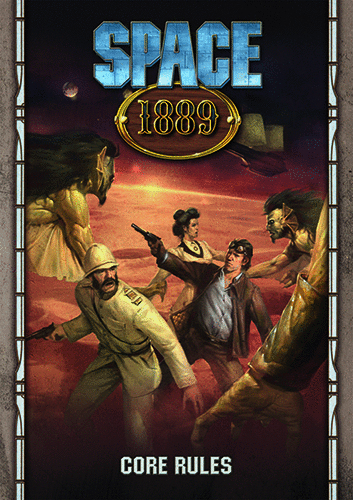
A few years ago, there was a Savage Worlds version of this, the original “steampunk” (gahd, how I hate that word!) game, and I have a PDF of that, as well, but never found SW made much sense, mechanically. Close to that time, it was announced that Clockwork in Germany was doing a version using Ubiquity — the rules set from Hollow Earth Expedition. In 2013, the Kickstarter for an English-language version was posted by Angus Abramson — who I worked for in the early days of Cubicle 7 on the Victoriana line — and his new Chronicle City house. I missed the Kickstart for this, having already blown dough on the Revelations of Mars book by Exile a month earlier (still not @#$%ing close to done…) Well, the PDF just dropped for sale yesterday with the print book not far behind, and I had a chance to do a quick read-through this afternoon.

space1889

The new book is very true to the original. There’s some difference in the verbiage and the arrangement of the book, but most of the setting is unchanged, with additional material for Germans on Venus that was most likely part of someone at Clockwork’s campaign prior to resurrecting the game. There is new artwork, some of which is an update of pieces in the original book, some of which is original. The quality is true to the original book, as well — mostly black and white pieces and the occasional color plate. The maps of Mars and Venus are updated and look better than the original, but when I looked at them side-by-side, they are “the same.” There is the alternate history from the original book — Edison’s flight in an airship with ether propeller to Mars, and the other alternate history moments. There’s a gazette for Earth, Mars, Venus, and Mercury. Here and there, you can see where the new publishers added bits and bobs to flesh out the worlds — new gadgets and gear, a few locations and “worlds in the ether”, etc.

Character generation is nearly the same as you would find in Hollow Earth Expedition, but there is a specific set of rules for older, more experienced characters that looks a lot like the character creation house rules we’ve been using for our HEX games. There are a few traits and flaws that are setting specific, the Status Resource is very slightly more fleshed out, but otherwise it’s the character generation from HEX. One of the things that I noticed was there were no real traits that differentiated the Martians from the human characters in the game. (Here’s my take on the setting species.) I would have expected something to take into account the acclimation to lower gravity and pressure, but Space: 1889 also has a much more friendly Mars than reality — heavier gravity and atmosphere than most alternate Mars settings. (Over a few campaigns, I started using a Mars with .5G, rather than the .9G of this game, and lower pressures, making mountain travel dangerous for Earthlings.)

Rules-wise, it’s Ubiquity: roll the number of dice (any even sided will do — even a coin) equal to your skill plus the connected attribute and beat the number of successes. It has the “take the average” than makes Hollow Earth Expedition work so well when fighting mooks and the like — the GM doesn’t have to do a lot of rolling and the action moves quickly; characters that just need a pass/fail result can take the average when they know it’s higher than the needed successes for the same reason — getting roll playing out of the way of role playing. If you know HEX, you can pick up and play this.

Style: The original game was pretty sharp for it’s time, with good color art and crappy line art for the rest; the new version is average RPG quality art for the black and white art, decent color. I’d go 3-3 1/2 out of 5. Substance: Unless you plan on really digging into political intrigue and the like, the book is good enough to launch into a campaign that night, and the rules are complete enough to handle mot situations. 4 out of 5. Is it worth the $56US for the print and pdf combo? If you are into this genre, yes; if you are an old Space:1889 fan that wants a better set of mechanics than the execrable ones from 1989, absolutely; if you’re just curious..? No.

Extra Review Goodness!

loa

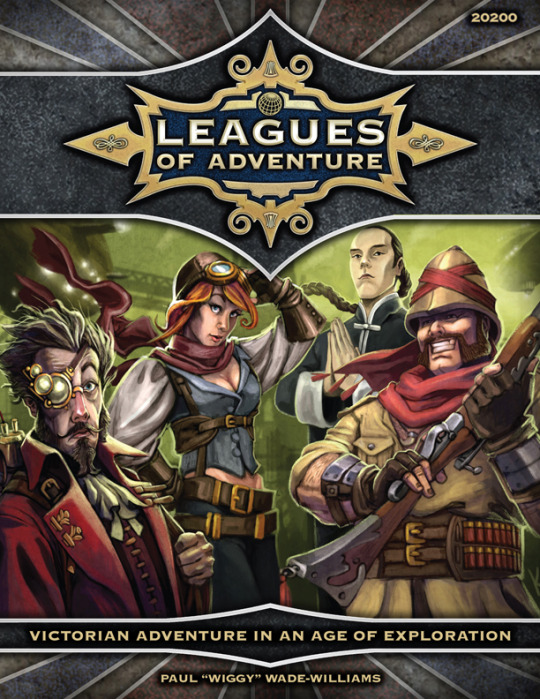
So, let me stack this up against the closest thing to its peer — Leagues of Adventure, also a Ubiquity-powered game set in a Victorian science-fiction alternate universe. This one is published by Triple Ace Games. Again — the mechanics, character creation, etc. is no different from Space: 1889 or Hollow Earth Expedition, but there are a few places where Leagues of Adventure excels: in the character creation section, there is a great bit on the Rank Resource, and how it ties to the various real and invented clubs of the period. Being a member of a club was almost essential for the well-heeled gentleman, and certainly for the aristocrat. Like Space: 1889, the Status Resources is pretty sketchily defined, but at least Space:1889 makes room for people below the rank of peer or wealthy middle class (bravo!) Also, Leagues provides rules for Inventions — something Space: 1889 (like the original) glosses over. Characters as inventors seem to be an afterthought in Space: 1889, but there’s a nice set of rules for it in Leagues and a goodly selection of weird steam- and clockwork-powered science!

Style: 4 out of 5 — the Art is superior RPG quality, full color, and the layout is nicely done. Substance: There’s a lot on the society and the basics of the Victorian period, and the rules are more comprehensive than Hollow Earth Expedition was… 4 out of 5. Is it worth the price of $30 US for the book? Absolutely. Is it worth the $18 for the PDF — no. Buy the book.

Now, here’s my suggestion: I would be surprised if Clockwork and Chronicle City didn’t do some kind of reprint or series of splatbooks for Space:1889, and TAG already has one book out and another with weird inventions on the way…if you’re a Space; 1889 or Victorian speculative fiction RPG fan — buy them both and mix and match the bits and bobs you need to build up your setting. (It’s what I’m doing.)

That’s it! you’ve finished that epic (or not so) campaign. Months or years in the running, the players have enjoyed themselves so much that when it comes time for the next game to be played…they want more. Perhaps you felt like the game universe was moving in a direction that lent itself to something new and fresh and you all want more. Time for Game II: The Revenge of Game!

Like movies and spin-off TV show, there’s a lot to recommend about the sequel. There’s a built in interest for people who liked the last one. It’s a familiar universe or premise, and maybe a familiar character or two to help ease the audience into the next cast. They also have several problems that come along with them. So first:

WHY DO A SEQUEL?

Maybe there were things in the game universe that were left unanswered, or tantalizing bits on the side that people wanted to explore but there was no time? “What about that alien race we discovered? What were they up to?” “Remember that legend about the fall of Zarus? We should have adventured our way to that side of the map!” “What the hell was that cult up to — the one we were investigating before we all went made and were institutionalized?”

Maybe the players just aren’t ready to let that character go. “You know, Jack escaped the Wing Kong exchange, but was that it..? What if he ran into some other occult group in, say, New Orleans?” “The rebellion might be over, but i don’t think Wedge would just hang up his wings just yet.” “After fighting terrorists, I think my guy would go into business doing international security.”

WHY NOT DO A SEQUEL?

“How can the same thing happen to the same guy twice?” was one of the best lines from Die Hard 2 because it directly addressed the unlikely nature of someone called to be a hero then returning to regular life finding themselves playing the hero again. Bilbo Baggins had an adventure. Then he went home. Had he been fighting another dragon the next week, folks might have been a bit less intrigued by The Hobbit 2: Another F’ing Dragon. The main danger of the sequel is doing the same thing over again. It’s like the first one, but with bigger CGI ‘splosions!

HOW TO DO A SEQUEL

There are a few routes you can take in a sequel or spin-off game. Doing a new campaign requires a new focus. Maybe your sci-fi campaign was doing head-of-the-week exploration like a certain franchise we know; the next should be focused on something else — maybe long-term politics between the good guy organization and the prosthetic-headed alien we really liked the last time; or a static location where people come to you like Babylon 5, or some colony world that provides the opportunity for adventuring, while being connected to the rest of the parent universe.

Jump the action a couple of decades and include one or two of the old players as more mature, playing the mentor to the new characters. You could conceivably come back in a generation or two and see what the children of the players are doing. Did Bolbar the Barbarian’s kingdom really stand for 100 years as was prophesied, or did he spend himself into the poorhouse and wind up with his kingdom gobbled up by the larger Empire of Whatever?” Did your daughter wind up being a Jedi in the New Order? Did your grandkid follow the ol’ WWII hero (you) into the military or CIA to fight terrorists?

Another way to change the flavor of the game is to try a new set of mechanics in the same universe. Say you were playing 1930s pulp using Hollow Earth Expedition or Savage Worlds. The players love their characters, but they’ve been sold on your early Cold War game. You could rewrite the characters in their post-war form in James Bond: 007 or Spycraft and have them working for the new CIA with a Bondesque spy-fi vibe (itself just really a post war pulp style.) Hell, Atomic Robo has specific rules for playing a game with flashbacks, allowing you to tie new adventures to historical ones.

Aside — If you wanted to do flashbacks to adventures in the old campaign, you could do something old like use one system for the modern stuff, then return to the old game system for the flashbacks.

An example of a sequel campaign would be the Star Trek campaign I started in 2000. It was set just post-Dominion War and I carved up the Trek canon to make a more believable, consistent universe. the first game was mostly interested in post-war politics. We dealt with the Federation more — how a post-scarcity society with access to androids and sentient spacecraft (the big metaplot of the first campaign) might look. It got increasing transhuman as we battled Borg incursions and an ancient race of self-relicating machines. The sequel campaign was about a decade after that — sentient starships and androids were commonplace, as was storage of transporter patterns — essentially ridding the biological races of death. This campaign was deep space exploration focused, but the real adventure was dealing with how the new technology introduced in the first game was changing the lives of the characters. there were carry-over characters in secondary roles, minor characters that were now leads.

The campaign was good but hit one of the issues of a sequel campaign…it was just different enough that it no longer felt like Star Trek. There were the trappings, but as the characters got more used to the transhuman future-meets-Trek setting, it lost some of its luster.

YOU THINK SEQUELS ARE HARD? TRY A PREQUEL (PLEASE, DON’T!)

“Wow! I wonder what a show about the Federation before there was a Federation might be like!” “I wonder what the Galaxy was like before the Emperor took over.” “Hey, maybe Indiana Jones should do something with mystic stones before he “doesn’t believe in hocus-pocus”…”

Do I need to continue?


Recently, in our Battlestar Galactica campaign, the characters made the trip to Kobol (the notes on the episode here) in which they “find” the Lady of Kobol, Athena, in addition to the map to Earth. Using her “coffin” — actually a highly sophisticated 3D printer for biotechnology — an injured and dying character was transformed into the Olympian goddess of war.

Genetically-engineered by the TITANs thousands of years ago, the Lords of Kobol had been modeled on the Greek myths of Old Earth. The idea was to capitalize on the archetypes as leaders for the human race that the Titans recreated on Kobol long after destroying the Earth (and those that inhabited it) they were created on.

ATHENA possesses all the “memories” of the stories and myths surrounding her namesake, as well as her various incarnations since she was created by the Titans. These were stored in the genetic code of robust virii that were stored in the Arrow of Apollo after the last living version committed suicide in shame over the Olympians’ inability to protect Mankind from the Blaze, and their own creeping dementia.

She was reactivated when the crew of Galactica found her tomb, and a security program identified them as friendly. She used the body mass of the critically injured Colonel Aeria Evripidi to remake herself. Pressed for time and under attack by Cylon forces, Athena chose not to remake herself, but rather “improve” on Evripidi so that she could be in action as quickly as possible. Once resurrected, she claims her purpose is to aid the Colonials in locating the Earth and the 13th Tribe, but also to get them past the “Guardians of Earth”, as they will know her.

Athena suffered intense pain as the virus used to rewrite Evripidi’s genetic code did its work. She still resembles the woman, although her appearance is expected to change slowly over time, but genetically she is a Lord of Kobol. Athena is preternaturally intelligent, a master of recursive thinking and strategic planning; and physically is strong, fast, and athletic. She possesses many of the memories and skills of Colonel Evripidi, but is a very different creature.

ATTRIBUTES: Agility d8, Strength d8, Vitality d8, Alertness d10, Intelligence d12+d4, Willpower d12; Initiative d8+d10, Life Points **22

ASSETS: **Goddess of War & Wisdom d6 (Adds to Perception-based tests), Immunity to Disease d8, **Physical Exemplar d10 (Adds to all physical tests, Quick Healer d8, So Say We All d6

COMPLICATIONS: Divine Purpose d12, Insatiable Curiosity d6, Multiple Personalities d6, Overconfident d4, Uncanny d4

SKILLS: Artistry d4, Athletics d6, Covert d4, Craft d6, Discipline d6 [Leadership d10], Guns d6, Influence d6, Knowledge d6, Mechanical Engineering d6, Melee Combat d6 [Spear d8], Perception d6 [Tactics d12], Perfrom d4, Pilot d6, Survival d4, Technical Engineering d6, Unarmed Combat d6 [Brawling d8]

AEGIS ARMOR: Move 4W to stun, ignore all stun. Design is lightweight with HUD in helmet.

SPEAR: Damage d6W, Range [thrown] 15 yards [18 for Athena]; Energy Weapon Damage: d10W, Range 200 yards, Ammo unknown

**These Assets are much wider in scope than traditional Cortex Assets to cover the supranatural nature of these creatures. Rather than using the scaling rules from the Cortex Core rulebook, I decided cribbing a page from Cortex Plus might work better here. I was on the fence about adding the Physical Exemplar to the Life Points, but decided to give her the same benefit as Tough d8.

Recall this is a “watered down” version of the original. Pressed for time, instead of remaking herself, Athena used what she could as a framework. We’ve already seen corpses of the Lords or at least their spawn through the campaign. they were often between 6’6″ and 7’2″ tall with muscle and bone mass half again that of a normal person. An actual Lord of Kobol would be (and should be) awe-inspiring to say the least.

A quick look at TV and movies and you might notice something, 1) “It’s amazing how England looks nothing like Southern California”, and 2) it’s always sunny…unless something dramatic is about to happen. It always rains at a funeral. It’s never foggy unless there’s a killer stalking in the mist. Weather can be a very good means to not just create a challenge for your players, or for establishing atmosphere in a scene, but it can also help define the space the players’ characters inhabit.

Example 1: Most folks know Scotland is a rainy place…but as we said in the Army, “It’s one thing to know it’ll suck, and another to feel the suck.” Scotland doesn’t just have rain — it’s got a plethora of ways it can rain. It’s often foggy in the mornings around the resepective firths (bays.) There’s “smir” — that mist that is statically charged so it stick to f@#$%ing everything. Wearing glasses? Good luck seeing. Wanted to check the map on your phone? Say that screen got wet faster than immediately, didn’t it? There’s drizzle. There’s a soft rain. There’s downpours of such astounding frigidity as to take your breath away. Snow. Sleet. And it can go on for longer than Noah was floating about.

As one of my cousins once wrote on Facebook, “I’d go for a walk, but I don’t have a boat.” People don’t do well with things when they’re uncomfotable. Sure, they can ride to the occasion — but cold, wet feet are simply the worst!

How could this affect the characters? When there’s a deluge of freezing cold water, people tend to look down. They tense up. They naturally look for someplace where the air isn’t trying to drown them. That’s a bit of a bitch in a footchase down the shops in Sauchiehall Street, ennit? “Whaddya mean ye lost him?” “Well, sir, it was pissin’ doon and…”

Example 2: What’s a car chase like in the snow?

Example 3: You live in Victorian London — or modern day Shanghai — it doesn’t have to be a dark, smoky night for the “London Fog” of industrial filth to have some kind of an effect. Shame you got all dolled up to meet that important person, but your white shirt is now a sort of grey-yellow when you arrive hoping to make the best impression. Maybe you’ll got allergies. Or asthma. Shame about losing that guy in that footchase on the Bund because you were hacking up a lung from your 400 pack a day habit of just breathing the air. What’s it like to try and finish a fistfight when you’re hacking up a lung from the soot?

Example 4: What about it being sunny and warm all the time? It’s lovely in the Southwestern American desert. Except you get thirsty. And sunstroked in a matter of minutes or an hour. Maybe you were fine when you were out there, but not that you’re indoors and mostly hydrated again, you want to sleep. For a week. It’s a bit hard to concentrate on sorting through those clues when you want to collapse on your desk and sleep. Or you’re getting ready for the Nasty Brothers, of whose kin you just shot saving that Wells Fargo stage, but man! this chair is comfortable!

Example 5: You’re in Houston. Or anywhere along the Alabama to Texas coastline. It’s 100F, somewhere between 100 and 600% humidity, and you’d be drier in the shower. Your clothes stick to you. You feel like you’re breathing sweat and decaying fish soup. You’re not certain if you’ve gone incontinent or that sweat in your underwear. You’re only goal is to get into an air conditioned building that makes the climate something approaching a sauna instead of a credible facsimile of Venus.

Example 6: Speaking of space…what’s it like in a spaceship? They outgas a lot of humidity. The air is nosebleed dry and static electricity is a constant danger. What about the spots where there might be heavy water use? Mold and mildew! Better get cleaning.

Example 7: Low or high gravity. Sci-fi games are good about putting this in there rules sets, but I’ve yet to see anyone do more than lip service to different gravity. Even habituated, it’s a beast to have that chase or fight in half gravity on Mars. Or in a centrifugal gravity torus. You thought that ball was going to fly straight, but look at that! Physics! What about heavy gravity? Suddenly, you’re not a svelte 170 pounds, but 210…your knees and feet hurt all the time. It feels like you’re walking or running uphill, all the time. You’re out of breath, headachy, and a bit tired because your blood isn’t getting to the brain that well.

Creating character for your location doesn’t just make for verisimilitude, but creates the space as an ancillary character. The place becomes important not just to the plot, but something interesting in an of itself. How did Miami become a sort of character in Miami Vice, or Burn Notice? How did Louisiana define True Detective? Making the setting ‘real” can create of love of the place — think about Babylon 5: after five seasons, the space station felt like a real place that you wanted to visit; watching her scuttled is nearly painful.

How would the character of the place play into where players go willingly, or dragged there complaining endlessly? You couldn’t get me to go to Houston with a cattle prod and the promise of a million a year salary…no, wait, that last bit would work. But I’d hate every second of it. I love the desert, but I’m from environs where it’s cold, wet, and dark a third of the year. Move back? Screw that! (But it’s better than Houston.)

Weather or climate — it fells create your setting as much as the look of a place.


The series of tubes is afire with responses to John Wick’s Chess is Not an RPG: The Illusion of Game Balance in which the game designer gives us a rambling examination of issues with role playing games, gamers, game masters, and why we should get off his lawn… In between his grumpy old man professing, Wick gives us a bunch of good ideas, a few mediocre ones, and a fistful of attitude that was most likely designed to “get the conversation going.”

The main point, however, is “Do these rules help you tell stories?” It’s a good question, and Wick is known for his being part of the artsy indie game community where “role play should win out over roll play.” One of Wick’s tricks is to tailor a game for the setting and the types of stories it is supposed to engender. Strip the junk out and play. It’s a good philosophy for a game master, and one I subscribe to, despite my tendency to create wee rules mechanics for stuff that might not need it.

Because if the most important part of your game is balancing the damage, rate-of-fire, range modifiers, damage dice, ablative armor, dodge modifiers and speed factors, you aren’t playing a roleplaying game. You’re playing a board game.

And you need to stop it. Because all that crap is getting in the way of telling a good story.

He’s right, it can, but it needn’t, but knowing that the effective range of an M4 is pretty accurate inside 250 yards,  has an effective range of 550 yards, but is still capable of doing some damage at twice that…you’re just really unlikely to hit someone out there. It is useful to telling the story in a way that aids verisimilitude — if the setting calls for it — but reducing the game to that, that’s bad.

As a GM, your job is to help the players tell the stories of their characters. “Game balance” has nothing at all to do with telling good stories. It’s an archaic hold over from a time when RPGs were little more than just really sophisticated board games. Or, as someone once told me, “An RPG is a strategy game in which you play one hero rather than a unit of heroes.”

Wick doesn’t hold to this idea. Neither do I, which was why I wandered away from the Dungeons & Dragons crowd very early into gaming. It’s why i don’t mix miniature games and RPGs, like i used to back when we played Space: 1889 regularly. I realized that swapping from role playing to busting out the boards and pieces broke the narrative flow. It was cool it it’s own right, yes…but it didn’t move the story along. For our Battlestar Galactica game, where military maneuvers are occasionally very important, I like to set out some of the Titanium series BSG toys and use the little plastic raiders and vipers from the Battlestar Galactica board game to aid in visualizing what is happening, even though the show itself often didn’t really show you the tactics of a battle…it wasn’t important to the story.

What matters is spotlight. Making sure each player feels their character had a significant role in the story. They had their moment in the spotlight. Or, they helped someone else have their significant moment in the spotlight.

Absolutely…and let’s use the Galactica campaign as an example: if you have a bunch of guys playing fighter pilots, the tactics and the one on one combat is important and should be played out. Or if you are in a spy game where a character has to make a tough, 2710 yard shot at a Taliban commander with your Accuracy International .338 Lapua (thus also gaining the longest shot record)  then that weapons table Wick hates so much actually is useful. For the “mundane” 800 yard shot, though, the specs of the rifle are relatively unneeded.

Having blasted game masters for being too rule-bound and board gamey, Wick then turns his attention to both GM and player with this tidbit:

The reason roleplaying games are a unique art form is because they are the only literary genre where wewalk in the hero’s shoes. We are not following the hero, we are not watching her from afar, we are not being told the story. As Robin Laws now famously said, “A roleplaying game is the only genre where the audience and the author are the same person.”

I highlighted that particular tidbit — a unique art form — for a reason. It’s this attitude that takes the fun out of the indie games for a lot of players and GMs. Is role playing an art? Sure — everything can be an art. Changing the oil of your car can be made into art. My last encounter with this “you just aren’t trying hard enough to play correctly,” was playing in a game with Mark Diaz Truman — who intimated that people don’t like certain games (or more specifically his game system) because you haven’t played it enough, or aren’t role playing enough… wick again:

I don’t want you to think I just get rid of combat mechanics. On the contrary, for Vampire, I usually get rid of that whole Social trait thing entirely. Why? Because this is a roleplaying game, and that means you roleplay. You don’t get to say, “I have a high charisma because I’m not very good at roleplaying.”

My response to that is, “Then, you should get better at it. And you won’t get any better by just rolling dice. You’ll only get better by roleplaying.”

If you want to get good at playing chess, you play chess.

If you want to get good at first-person-shooters, you play first-person-shooters.

If you want to get good at roleplaying, guess what?, you roleplay.

He’s right — if you just role the dice and let the GM describe what you do, you aren’t getting better at role playing. But thats’ not enough for Wick, or Truman, or the collection of post-deconstruction RPG designers:

…[y]ou are not playing a board game. You’re playing a roleplaying game.

Start acting like it.

This attitude is arrogant, elitist bullshit, pure and simple. Here’s why: for those of us who have to, say, work a 10 hour day, or run all over the f’ing world with our kids, games are a chance to relax and have fun — and sometimes you just ain’t feeling it. Rolling how you do in an encounter is perfectly acceptable because maybe you just aren’t super charismatic, even if your character is; just like you might not be an expert in hacking, though your character is. My response to this artsy crap is, “Well, Mr. Fancy Pants GM — why didn’t you set up a computer system for me to actually hack? Let’s go take our computer science classes together so we can really dig down and make this art.”

The argument that you have to play a certain way is that dumb. Are you having fun? Then you’re doing it right.

For some time now, we’ve been stomping all over the canon of the reimagined show with our campaign. I figure if you’re going to roleplay in an established setting you’ve got two real choices — adhere to the established material and slavishly model it, or work in the interstices between the events of the movie/show/book…or that what you like, throw caution to the wind, and do it your way.

I’ve used all of these techniques — from playing on the edges of the Babylon 5 universe in a campaign back in the late ’90s, to throwing a large part of the franchise out the window for a Star Trek campaign a few years back. With my first Battlestar Galactica campaign, I did the second fleet thing — a smaller group looking to find a new home, working from the flashes of insight of an oracle in the fleet and an alternative book from the Sacred Scrolls. It worked well, but with the collapse of that gaming group, I tried something new — throwing out the stuff I didn’t want and building anew.

Adama: gone; replaced with a player character, Commander Pindarus. The Final Five nonsense: gone. The humanoid Cylons are actually from Kobol, and are agents of the blaze known as Seraph. I borrowed the Ship of Lights for the Blaze and the Seraphs from the old ’70s show. Added: more science fiction elements, archeological hints that the Cycle of Time has repeated for at least three or four times. And our people finally set down on Kobol this time in the midst of a civil war between the Seraph and the centurions they had created and those from the Colonies they coopted into working with them. The goal was the same: find the Temple of Athena and the roadmap to Earth.

We had established that the war and the Fall of Man was to bring them “home” under the loving embrace of “the Blaze” — the one true god…except it’s not. We had a ton of exposition under fire this last session, and some of it involved what the Blaze is/was.

After a great cliffhanger (literally) in the week before, we launched off into characters on the ground mission rappelling out of an old Olympian temple or palace while the ruins were being blasted apart around them. They’d already lost one (former) PC, scads of NPCs, and lost a major NPC — the love interest of the commander — when she broke her back falling from the building. Still alive, but paralyzed and barely able to breathe, the characters carted her to the Temple, where they used the Arrow of Apollo to open the tomb — to do this, the arrow had to be shot at a “lock”, which opened the tomb.

The tomb, however, was more of a command center for the Goddess of War. Athena presented as a hologram, demanded from them their intentions, and learning they were from the 12 Tribes, demanded a “sacrifice” — the injured and dying member insisted she be used, as she was the obvious choice and the Athena specter agreed. She was loaded into the sarcophagus of the goddess (empty), and a vial of something inside the Arrow of Apollo was loaded at the hologram’s direction into a panel of sorts. The sarcophagus went to work doing something horrific — laser light and milky liquid a la the resurrection ships — while the hologram gave them the night time sky from Earth stuff from the show, but followed it up with a zoom out to show that they are about 1100LY from the world, on the other side of the Orion Nebula. They can be there (safely) in about 300 days.

The sarcophagus was done, by this time, having repaired the injured colonel and “infected” her with the DNA of the original Athena. While her appearance won’t change — the body is mature and while it might change over time — she still looks like the colonel, has many of her memories, but has also had Athena’s memories programmed in somehow. The newly restored Athena gives them the low-down:

The Blaze is Hades, a jealous “god” who should have been the King of the Lords of Kobol, as he was the eldest, but was usurped by Zeus. At least, that is the memories, the legend, they had been created with. In truth, they are the creations of the TITANs, some kind of advanced machine intelligence that destroyed their makers…humans, then in a bout of regret, recreated life from Earth on Kobol and gave them the Lords to rule over them and help them develop. The Lords started to take the PR too seriously, especially Hades, who after the rebellion and exodus of the Ophiuchan or 13th Tribe (of whom he was the patron god), he followed them and discovered the TITANs. Intrigued by their investigations into the nature of the universe, he “saw the face of God” and went mad, fashioned himself as a god, and returned to Kobol to instill order and gain the adulation of his peers and their human charges.

Except it didn’t work out that way…and for ten thousand years or more, they’ve played out this story — over and over — with Hades hoping for the “right” outcome: he as the one God, worshipped and loved by his followers. However, just as humans created their machines that destroyed them, and the TITANs created the Lords that fashioned themselves as gods and viewed Man as their creation, and just as Man created machines in their image, the Blaze created Seraph as a replacement for his departed brothers and sisters, the Lords of Kobol.

The history is fractal — from the massive superintelligent TITANs, to the Lords, to the Blaze, the humanoid Cylons/Seraph and the humans…the same hubris to create a perfect slave destroys the maker. Athena, having remembers other iterations of the story, threw herself from Olympus not in despair over the colonies leaving, but to set her mind-state free to be transmitted to “follow the course of the Blaze” and find a way to stop him. She has been waiting for a millennia for someone to find her, having been beamed home 1000 years ago.

While this was happening, Galactica found out the mission on the ground was rapidly going FUBAR, and they jump in to nuke the Blaze’s citadel on the ruins of the “City of the Gods” on Kobol — the Tower of Dis, a massive diamondoid structure that is mostly computational substrate, but also an active energy weapon system. It’s dug into the planet to feed on geothermal energy and according to Athena, has the records of every Seraph, human puppet, Lord of Kobol, and who knows what else stored in it. If Hades escapes, the cycle will just start all over.

While Galactica  is locked in a tense fight with the Cylon fleet over the planet, and the missiles are on route, Athena and Hades have a snark off that ends with her revealing the one thing she has left: her father’s thunder. She lets the ship and the ground crews know it’s a trick she can do only once…and they have three minutes to be outside of the magnetic field of the planet. With a strike of her spear on the floor, she sets the weapon in motion.

A few more NPCs and almost two PCs, were lost trying to evac to the SAR raptor had had just gotten to them (One of the characters was physically hurled by the increasingly strong Athena into the raptor.) and they manage to barely clear the planet as the magnetic field starts to amp up sharply and the planet starts showing signs of volcanic activity all over the globe. The magnetic field collapses down to the surface and increases to a sci-fi ridiculous level and destroys the Blaze…and Kobol.

The Cycle is broken. With the roadmap to Earth they head back for the fleet.

There was a great moment when the mission returns when the commander realizes that Athena is no longer his lover, and has his nervous breakdown in private. They also learn from her that while they have the map, they will need her to get past the “Guardians of Earth”, who will need to see someone they “know.” Hence the need to take biomass and retool it with her DNA. There were some intimations that the TITANs may be “near” Earth, and that the Blaze may or may not be destroyed. If not, they will need to attract the attention and aid of the TITANs to stop him.

If the characters follow their own plans, the fleet will split with Galactica leading the ragtag fleet of civilians to Earth, while Pegasus takes the other military assets and fights the much weakened Cylons with hit and run attacks designed to distract the enemy from the fleet’s escape.

So that’s an example of how you can take the material from an established property or universe, keep a lot of the elements (and even enhanced them), and still go your own way.

« Previous PageNext Page »