Roleplaying Games


Somehow, I’d missed that Margaret Weis Productions were kicking out Firefly supplements at an amazing rate this year. I picked up the corebook about a year ago, and our gaming group did an A/B tet between Firefly and the older Cortex Serenity game to see how they compared. Later, I played in a pickup game with one of the designers of the game, just to see how it ran with someone who really knew the system. Follow the links to see the original review of the game and other observations.

Knowing there was an opportunity to spend money I didn’t have to, I ordered up Things Don’t Go Smooth and Smugglers’ Guide to the Rim for the game. I should be receiving hardcopies soon, but USPS is apparently in full-blown FUBAR mode this holiday season, so they got bounced back. However, MWP provides buyers of the book with a free .pdf of the game, and while the Smugglers’ Guide is not out, TDGS was. This review is going to concern itself with the e-book version of the supplement.

First off, the book is essentially a sourcebook for GMs — the first three chapters are a catalogue of new bad guy NPCs and their organizations, henchmen, and hideouts or ships. There’s a chapter on new ships and distinctions for the same, and a chapter specifically on running the game, and fleshing out towns and cities. There are two adventures that I haven’t read through (I don’t tend to run canned adventures), and an appendix of the new rules and distinctions. The book weighs in at 238 pages, and two pages of character/ship sheets.

The writing is solid, and the editing — which used to be a weak spot in early MWP productions — has caught most, if not all, errors.  The art design and layout is similar to that of the corebook: it’s full-color, pretty, and uses almost no “game art” — that middling quality stuff gamers expect — in favor of screen caps from the show, CGI art, and photos of characters in setting-appropriate garb. The pdf is well-designed, with heavy linking from the table of contents, and hyperlinks on key terms throughout the book. This is one of the big strengths of MWP e-books; they are excellent for use on a tablet or laptop, if that’s how you access your books in play.

The collection of NPCs are good. They are well-designed and fleshed out, as are their support networks. There’s a nice choice, from corporate spies, to crime bosses, to privateers and pirates. There’s a section on using Reavers effectively. The new ships are good, but the artwork does not alway match the description of the vessel — if you’re going to do ship art, make it match the vessel on the page.

The Scheming and Narrating chapter is particularly good for helping new and inexperienced GMs, especially in dealing with the use of assets or complications. In play, one of the issues I’ve seen with Firefly is that the complications can become a bit overwhelming for newcomers. You are encouraged to make them…a lot of them, and tracking and using them was one of the consistent complaints I saw in various play sessions. Unlike Fate, where you often have to spend a Fate Point (plot points in Cortex and Cortex +), Firefly lets you use any one that makes sense in play. This can give you Shadowrun-esque dice pools, but more to the point often “systematizes” elements of play that might be better handled in narration.

Case in point: There’s some great stuff on using the setting to create appropriate complications — like “The Building is on Fire d6” which could definitely be used to help or hurt you, or “Dark and Spooky d6”, which could be used to help a stealth roll or create mental stress from fear or unease. But there was an example that immediately highlighted the issue with just making complications or assets for everything — “Calling for Help d8”. The characters a trapped and calling for help…wouldn’t this be assumed to be the case? Do you need to systematize “Walking in a Straight Line d6”? Without having to use plot points to invoke these complications, as you might in Fate, requires the GM to really sit on the players when they get out of hand. However, that is against the stated goal of Fate like systems, which seek to have the players have more narrative control.

For all these observations, Things Don’t Go Smooth is an excellent, and well-made sourcebook to help GMs bootstrap their campaigns, or fill them out without having to do all the heavy lifting. I suspect, if I run a campaign, i will be using several of the bad guys and their organizations. The GM guidance is good for those who aren’t accustomed to running a game, but will be mostly weak tea for the experienced one. The adventures looked lie they would be good for pickup or convention games, and probably could be mined for material for a self-created campaign.

The physical book is a softcover, but judging from the pdf will be a handsome thing. It’s retailing for $35 (with free pdf download if you buy on the MWP site or from a “preferred retailer.”), and Drive Thru has the ebook for $13. So is it worth it? If you are playing the game, absolutely to either format. If you’re playing occasionally or just need to snag a few things from the book, electronic version might be better

Style: 5 out of 5 — it’s a gorgeous sourcebook, much better production values than necessary for a splatbook. Substance: 5 out of 5 — I was surprised I gave it this, but there’s a whole acre of bad guys and groups to choose from, new distinctions for players and ships, and some good GM advice. It’s a buy.


This week saw our last game of the year, most likely. (Damn you, holidays!) However, we did get the chance to start a new arc for the fleet, post mutiny and coup.

The first half of the night was concerned with picking up the pieces after the whole of the elected government was killed off. Rather than reconstitute the tradition set up of a quorum, there will be a council of ship captains, who will report their concerns to the small bureaucracy that is still mostly in place. Logistics Minister to handle food and other supplies; a morale and welfare minster for the necessary “bread and circuses” to keep people stuck in 74 tin cans occupied and out of as much mischief as possible; a justice minister (also our head and only judge) to handle criminal cases (and who is overloaded with the coup conspirators); a health minister; and a security minister controlling the civilian police force. The commander of Galactica, a PC, is doubling as defense minister — he is the last word on military matters. There is an “interim president”, which sounds better than “president placed there by the very angry military commander that just had his president dad murdered.”

The big move was the Quorum of Priests who demanded Lady Athena of Kobol rule them. She declined, but took the position of prime minister. She is not legally empowered to make policy or law…but everyone knows that she is guiding the whole show, now. This has actually created more stability in the fleet, despite her having to spend several weeks selling the people on the new government and more importantly, the announcement of the alliance with the Seraph (humanoid Cylons) of Basestar 19.

There was a lot of politicking and changing of the guards — including the PC pilot who was cousin of the mutiny leader finding herself as CAG — but this was overshadowed by two new plotlines:

1) The inclusions of Basestar 19‘s ships, including Resurrection 3. We introduced a new PC — a Leoben-like “messenger” model. This one, named Devet Cavil as a tip of the hat to the new show, is trying to find stability and answers in the wake of The Blaze turning out to be a false god (Hades, armed with Titan’s technology, to be specific) and his continuing revelations from God. He is convinced Athena is the key to figuring it out…what does she know? He has a second problem — the Seraph that have recently been “decanted” are showing odd personality traits — they are very docile, and overly amenable to the policies of the Ones and Twos…are they being programmed? Is this a move by a few of the models to be more equal than the others?

This is leading toward some espionage and politicking in the Cylon fleet.

2) They have gotten close enough to have their first distant survey of Earth’s star. This has raised morale (if only the mutineers had held their fire a few days!), but more important is that as they have moved past the stellar nurseries of the Orion Nebular group, they are picking up what look to be super high frequency and bandwidth communications from dozens of systems in the Orion Spur. These are between 500 and 1000 years in the past…but this section of the galaxy looks to be alive with settled worlds! What might be waiting for them out there, even the Seraph/Cylons — who had sent “Seeks” into the area to find humans to bring under the embrace of the Blaze — can’t know…

So we are about to wander further away from the show, and more toward the post/transhuman elements that have been hinted at throughout the campaign. We know the TITANS created the Lords of Kobol to rule/supervise the humans that they recreated on Kobol after destroying Earth. We know Hades left with the Ophiuchan Tribe (the 13th Tribe) and apparently contacted the Titans, and in his effort to find “God” or understand the universe, went mad and came back as “the Blaze” to overthrow the Olympians on Kobol and rule over the people there. He eventually created the Seraph (our humanoid Cylons) in the image of his brothers and sisters he destroyed, and had them reign in his stead, and also send them to find the rest of humanity and bring them under his gaze.

What we’re finding out: the Seraph lost any of their Seeks to unknown elements at Earth and other worlds near it. We now suspect that the Titans or humans from Earth or the 13th Tribe have settled this region of space…but the transmissions seen suggest they are far more advanced technologically than the Colonials or Seraph; what might they be encountering soon?

We’re in the home stretch of the campaign, and the flavor of the game is moving more toward a combination of the spiritual, but also more transhuman sci-fi. I’ve pretty much got the main elements of the next few episodes mapped out, but only can really plan an episode or two ahead of where I am, as player input is driving us in directions I hadn’t anticipated. (I know my players well enough to usually know where they’ll take us…this hasn’t been the case of late.)

Majestic 12 a bit too fast on the trigger and under the radar for you? Here’s a faction for our upcoming “pilot” game to see if the group is interested in running the Atomic Robo game:

Office of Scientific Intelligence:

Formed out of the United States Army Corps of Engineers’ Strategic Science Division (SSD) in 1946, Office of Scientific Intelligence was the more legitimate face of superscience research and was immediately tied to the new Atomic Energy Commission with the passage of the McMahon Act. The “theft” of their science division led the intelligence and military community to push Majestic 12 on the president in 1948.

The SSD had been formed by the Department of War in 1930 in an attempt to recreate some of the developments of Telsa Heavy Industries — specifically Atomic Robo — but also other “superscience” organizations around the world. The focus on research and legitimate scientific inquiry continued throughout the early years of OSI, which would later become conflated with the Air Force organization of the same name. By the late 1960s, however, OSI increasingly shifted from R&D toward intelligence gathering and analysis. Plowing the same ground as MJ12 and Daedalus, OSI was frequently at odds with these groups, particularly as they were not competing for budgeting.

OSI was renamed and the mandate shifted toward more science-related counterintelligence with the Energy Reorganization Act of 1974 to become the Division of Energy Research. DER survived the 1977 creation of the Department of Energy, only to be re-renamed in 1992 to the Office of Scientific Intelligence.

US Corps of Engineers’ Strategic Science Division (SSD) — 1930-1946

Mission Statement: Scientia est Victoria (Knowledge is Victory)

Mode: Average (+1); Resources (R&D +3) — after 1942-1946: Mode: Fair (+2); Resources (Transport +4, Armory +3)

Office of Scientific Investigations — 1946-1974

Mission Statement: Protecting the Nation Through Science!

Mode: Fair (+2); Resources (R&D +4, Transport +3) — after 1960 (R&D +4, Intel +3)

Division of Energy Research — 1975-1992

Mission Statement: The Secret Sword of Science!

Mode: Fair (+2); Resources (Intel +4, R&D +3)

Office of Scientific Intelligence — since 1992

Mission Statement: On the forefront of science!

Mode: Fair (+2); Resources (Intel +4, R&D+3)

The final acts of our mutiny arc were played out this week. Previously, one of the player characters connected to the black market, and who had been the Security Minister until it was discovered his aide was a Cylon, led a coup d’etat against the government. He and one two of his conspirators did for the entire Quorum of Twelve, as well as the president (the father of the commander — played, funnily enough, by the same guy with the coup leader.) Once they had secured the quorum chambers and president’s office (on Cloud 9 in our game because no politician is going to “rule” from a bitty liner…), they set about finding out what was going on with the mutiny on Galactica.

This play session was mostly on the battlestar. Of the two players there that night, one had his viper pilot and a veterinarian-turned-medic (and budding mad scientist researching Cylon infertility); the other had his coup leader and commander of Galactica as their characters. The viper pilot is the cousin of the mutiny leader — a very popular engineer who is also a master organizer, and whom managed to pull of the mutiny in a matter of minutes. They engineered a malfunction of the communications while most of the pilots (the majority of the officers) were out on an exercise, raided CIC, and placed the command staff in the brig until the mutiny was complete.

Things start to go wrong when some of the mutinous pilots with marines in tow try to capture the Three — who had been a sleeper in the Colonial Feet and is wracked with doubt and guilt over her actions — the commander had put back in uniform (along with our version of Boomer.) She was in the infirmary giving eggs for the vet’s experiments, along with Lady Athena — the Lord of Kobol they picked up in the Tomb of Athena. The mutineers attempt to take them into custody, only to get mangled badly by the two of them. (With some help from the vet.)

Athena sends the Three (call sign Trey) to round up the loyal officers currently being held in the pilot’s briefing room by one of the mutineers and the pilot PC, who was having a crisis of conscience. The PC decided she needed to find out what was going on and was being held at gunpoint when Trey arrives to aid her. The loyal pilots break out — some headed for the brig to rescue the command staff, some headed to the CIC to aid Athena, who had disappeared to go “get dressed for the party” — getting into her high-tech (yet Greco-retro looking) armor, with shield and energy-weapon firing spear.

A lot of the violence happened off-camera, but the vet (as their field medic) aided Trey, Helo, and a few others in rescuing the commander and his staff — who then headed for the CIC. The pilot PC, with Starbuck, and a few worshippers of Athena headed for the CIC and managed to link up with Athena before she raided the place on her own. In the ensuing fight, a bunch of the mutineers got dropped, but the pilot managed to talk down her cousin, who wound up in the brig. The Lady of Kobol chewed through the opposition scarily easy; the first time they’ve really seen her in action.

By the time the coup leaders called into Galactica to check on the situation, the ship had been retaken (or at least the CIC), and they were surprised to find themselves not talking to their woman on the inside, but Athena — who told them she was coming for them next. This lead to a chase to capture the coup leader, who was ultimately shot down.

In the end, both players each lost one of the troupe of characters, some of the former PCs were killed, and a host of main supporting NPCs went under the bus.

The players were left with a badly fractured fleet, a sudden loss of a lot of their officer corps, about half the marines of the fleet dead, and no political leadership. they instituted an interim president and decided to run with a periodic meeting of ship captains to manage the big issues, but they need to get the bureaucracy back online to keep supplies and services going. There was some talk of martial law, and the pilot PC is looking to fill their badly depleted ranks with pilots from the humanoid Cylon fleet they are weakly allied with; another idea is not to intermingle the pilots, but have the Cylons — now that everyone knows they’re out there — join the fleet to bolster their air assets.

The next episode, however, will show us that things aren’t exactly stable on the Cylon side of things, and that their “leadership” hasn’t bee playing on the up and up…

After a week off for the holidays, a couple of simmering plot thread finally came together tonight. Between the president having been sick and uninvolved, the interfleet gang war that left the Salamir Cartel in charge of the black market, the loss of important characters on Kobol (and the finding of Lord of Kobol — Athena — inhabiting the daughter of the heretofore unknown head of the cartel), the putting Boomer and another turncoat Cylon back in uniform, and the discovery that the fleet has been working with a faction of the humanoid Cylons running from the centurions…one of the player’s black marketeers staged a violent coup d’etat, while a simultaneous mutiny is going on aboard Galactica.

The set up involved the shooting of a well-liked madam and matchmaker on Cloud 9 (where our government resided…seriously, politicians wouldn’t live on the nicest ship in the fleet?) The investigation starts chasing the murder suspect, who is the main fixer for the Salamir, and was eliminating a person that knew their plans. The cops are sidetracked by a corrupt officer and are not there when the action goes down in the quorum chambers.

Meanwhile, Galactica‘s mutineers — led by the popular, hyper-competent, and thoroughly destroyed by the apocalypse chief engineer — get most of the pilots off the ship in a big combat exercise, sequester the ones they are unsure of, and stage a big fire by the main antenna that requires, in the engineer’s plans, the shutting down of the main power trunks to the antenna. Galactica is suddenly deaf and dumb, and the internal comms go down, as well. The warning about losing comms caused the president to call the quorum — three of whom are coup leaders — together.

While the cops are chasing down the bad guy, he is leading thugs against the quorum security, and the gangster PC, and the two other NPCs, gun down the quorum, but not before there was some serious action hero moments by the 76 year old president, who managed to stab one of the gunmen in the eye and turn his weapon of several of the others. In the end, one coup leader was dead, several of their mooks, and another leader injured, but the other nine quorum delegates were killed.

Next week, we resolve the situation on Galactica


Here’s a website with a nice set of utilities for the Firefly RPG. There’s a probability generator for the dice pools, starship complications charts, travel time calculator, an interactive map that’s a bit twitchy, and a name generator.

Have at!

I’ve been toying with an idea for a late ’40s/early ’50s spy game of late, and have been trying to decide if i want to do the heavy lifting to write up cars, etc. for the James Bond: 007 RPG, or try something with a different flavor, like Ubiquity (Hollow Earth Expedition). I opened up the Leverage RPG — Cortex Plus — and had a shufty around the rules.

At their heart, con/thief settings are very comparable to the espionage genre. There are certain archetypes that are used that cross the two genres — the thief, the “face” or grifter, the assassin or thug. The hacker is present in the new spy-fi, but prior to the 1980s, it’s more likely they would be some sort of tech.

The main thing to do to turn Leverage into a spy-fi game is sort the “roles.” In the game, these are Grifter, Hacker, Hitter, Mastermind, and Thief. But these don’t quite match a classical espionage setting, so here are the ones I propose:

ANALYST: This is sort of the hacker of the pre-computer age. They know how to look up and find information, analyze it, and aid the team with the information.

HITTER: Pretty much the same as Leverage, this is the two-fisted man of action or the cold shooter.

RECRUITER: This is the “face” — part grifter, part diplomat, part “mastermind” from the game. They known how to manage assets, bureaucracies, and how to get people to do what they want.

TECH: This is the gadgeteer or the “McGuiver” trope — the guy that knows how to build/destroy things with Science!

THIEF: the classic second-story man (or woman).

WHEELMAN: This is another classic trope from spy-fi — the guy that can drive like the devil (The Transporter), the race car driver turned operative, the “guy who can drive/fly anything.”

To reflect the wider skill set usually given superspies in this genre, you might want to account for the extra role by having characters take the usual primary role at a d10, secondary at d8, but increase the tertiary from one to two d6s, with the rest being d4. A more realistic campaign might stick to the d10/d8/d6’everything else d4 of Leverage. 

One of the reasons I’ve been considering Leverage is to increase the speed of play — combat is resolved like any other action, instead of a series of action rounds. The other is laziness — I can run a game in the system without having to stat out the Ferarri barchetta the character happens across, or figure out the specs on a particular airplane. The issue I could see is you lose that “brand name” quality that the Bond movies brought with them and James Bond: 007 captured so well — the specific gin, the Aston Martin, the Walther, the Beechcraft airplane, the Brioni suits and Omega watches, etc.

I’m supposed to be trading my .45 1911 for one of these this weekend, so the specs might change once I’ve had a chance to shoot it.

ROCK ISLAND .22TCM 1911 Fullsize

left

There are currently a few versions of the 1911 Fullsize for .22TCM, and a commander-sized “Midsize”, but they are exclusively manufactured by Armscor (as is the ammunition.) The idea is similar to that of the 5.7x28mm cartridge — a light, fast bullet that minimizes recoil, increases accuracy and armor penetration, and give a large magazine capacity. The .22TCM uses a 40 grain bullet moving at between 1900-2100fps with a muzzle energy between 312-375 ft lbs. (I chrono’ed the stuff I shot at 2050 average.)

The platform is a double stack (although there is a single stack available) 1911-style pistol. The quality of manufacture is very high, although the standard grips are awful (at least the ones with the finger groove, but some folks like those), and has an excellent trigger, which aids in the accuracy of the gun. The .22TCM and 9mm barrels can be swapped quickly, and gives the shooter the ability to use different ammo; the magazine used is the same 18-round double stack. There are reported issues with the last round of the magazine “jamming” because the slide stop engages early, but I had none of that in my original magazine. The new one I bought, however, did, and the culprit is the follower is not shaved appropriately. Ammunition availability for .22TCM can be problematic, but it’s plentiful online.

The handgun does not fit standard fitted 1911 holsters like the SERPA, etc.

PM: +1   S/R: 3   AMMO: 18 (17 in 9mm)   DC: F (G in 9mm)   CLOS: 0-7   LONG: 12-20   CON: +1   JAM: 99   DRAW: 0   RL: 1   COST: $700

GM Information: The .22TCM ammunition will reduce personal armor ratings by a DC step, but the DC against inanimate objects (cars, etc.) is reduced one. The barrels can be swapped in about a minute. The 9mm barrel does not give the armor bonus, nor does it lose DC against inanimate objects.

amyfrpppyhs56kirr6tw-734364I was just spitballing a version of the Hawkgirl character that DC has been floating around in their Bombshell series. We have the classic redheaded tomboy in a flight suit, lace-up boots, and a winged rocketpack, with a hawkman helmet. It’s a great 30s/40s image and I thought I’d do a basic write up of a pulp-period aerobat.

First, in Atomic Robo‘s Fate-powered system:

HAWKGIRL

Concept Aspect: Rocket-Powered Aerobat; Omega Concept: Yearning for Adventure!

Stress:  Mental – 3, Physical – 4

Pilot Mode +3: Contacts +4, Notice, +4, Vehicles +4; Aspect: Fly It Like I Stole It

Action Mode +2: Provoke +3; Aspect: Wingwalker

Banter Mode +1: Rapport +2, Will +2; Aspect: Sugar & Spice

Stunts: Barnstormer, Breakneck Ace, 2 more to be decided in play

…and then in Hollow Earth Expedition

HAWKGIRL

Archetype: Adventuress     Motivation: Escape

ATTRIBUTES:   Body: 2, Dexterity: 3, Strength: 2, Charisma: 4, Intelligence: 2, Willpower: 3

SECONDARY ATTRIBUTES:   Size: 0, Move: 5, Perception: 5, Initiative: 5, Defense: 5, Stun: 2, Health: 5, Style: 3

RESOURCES & TALENTS:   Artifact 2 — Jetpack, Attractive, Evasive Action, Lucky, Mobile Attack

FLAWS:   Impulsive, Overconfident

SKILLS:   Acrobatics 4/7, Athletics 3/5, Brawl 2/4, Con 2/6, Diplomacy 1/5, Drive 2/5, Pilot, Air 3/6 (Jetpack 7), Ride 1/4, Stealth 2/5, Streetwise 1/5

Jetpack — Size: -1, Def: 4, Str: 5, Spd: 100, Han: -2, Crew: 1


One of the few things that disappointed me about the Space: 1889 rules that came out recently was the lack of addressing Martian physiology in the rulebook. So here’s something more in line with what I expected for the new Ubiquity-powered game:

MARTIANS

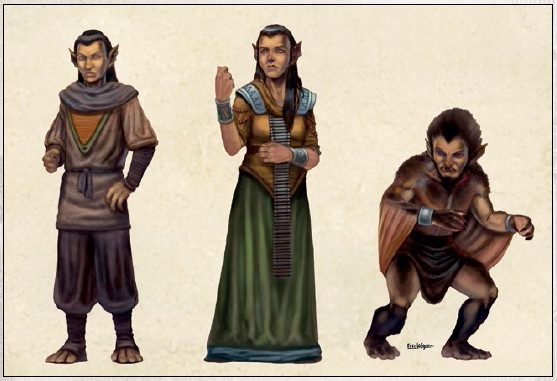
Hill, Canal, and High Martians -- as portrayed in Chronicle City's version

Hill, Canal, and High Martians — as portrayed in Chronicle City’s version

The denizens of Mars have three major racial types — the Hill Marian, found in the desolate wastes of the Red Planet; the Canal Martians, found almost exclusively in the urban and canal-fed areas of the world; and the High Martians — thought to either be the “Ur” Martian, or possibly a Hill Martians evolved to the particular environment of mountainous Mars.

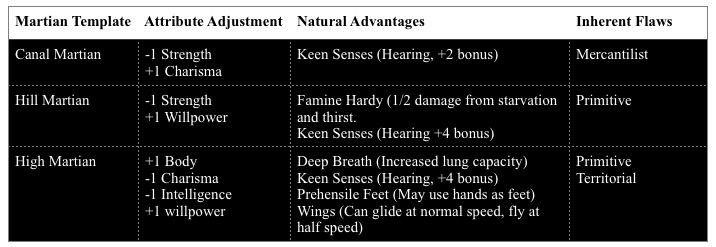
Using some of the Beastmen advantages from Mysteries of the Hollow Earth (pg. 14-25), I slapped together Martian character templates that were more in keeping with the original flavor of the game:

template

Venusians

Venusians aren’t set up as a player character in either any of the editions of Space: 1889, but I’m sure there are folks out there that might want to give them more to do in their campaign than be a poor man’s Sleestak. So here is a Template, vikked from Hollow Earth Expedition‘s Mysteries of the Hollow Earth to use to create a player character Venusian:

venusian

Update: Looks like the boys at Clockwork, over in Germany — the originators of the Ubiquity Space: 1889 noted this piece and are interested in incorporating it into future productions. Might lead to some more work, which would be nice.

« Previous PageNext Page »